Best Online MPP Programs for Alabama Students (2026)
Compare costs, accreditation, concentrations, and career outcomes for top online MPP degrees available to Alabama residents.
By Max SheltonReviewed by PAP Editoral TeamUpdated August 14, 202625+ min read
What you’ll learn in this article…
No Alabama institution currently offers an online MPP, so residents rely on nationally accessible programs from other states.
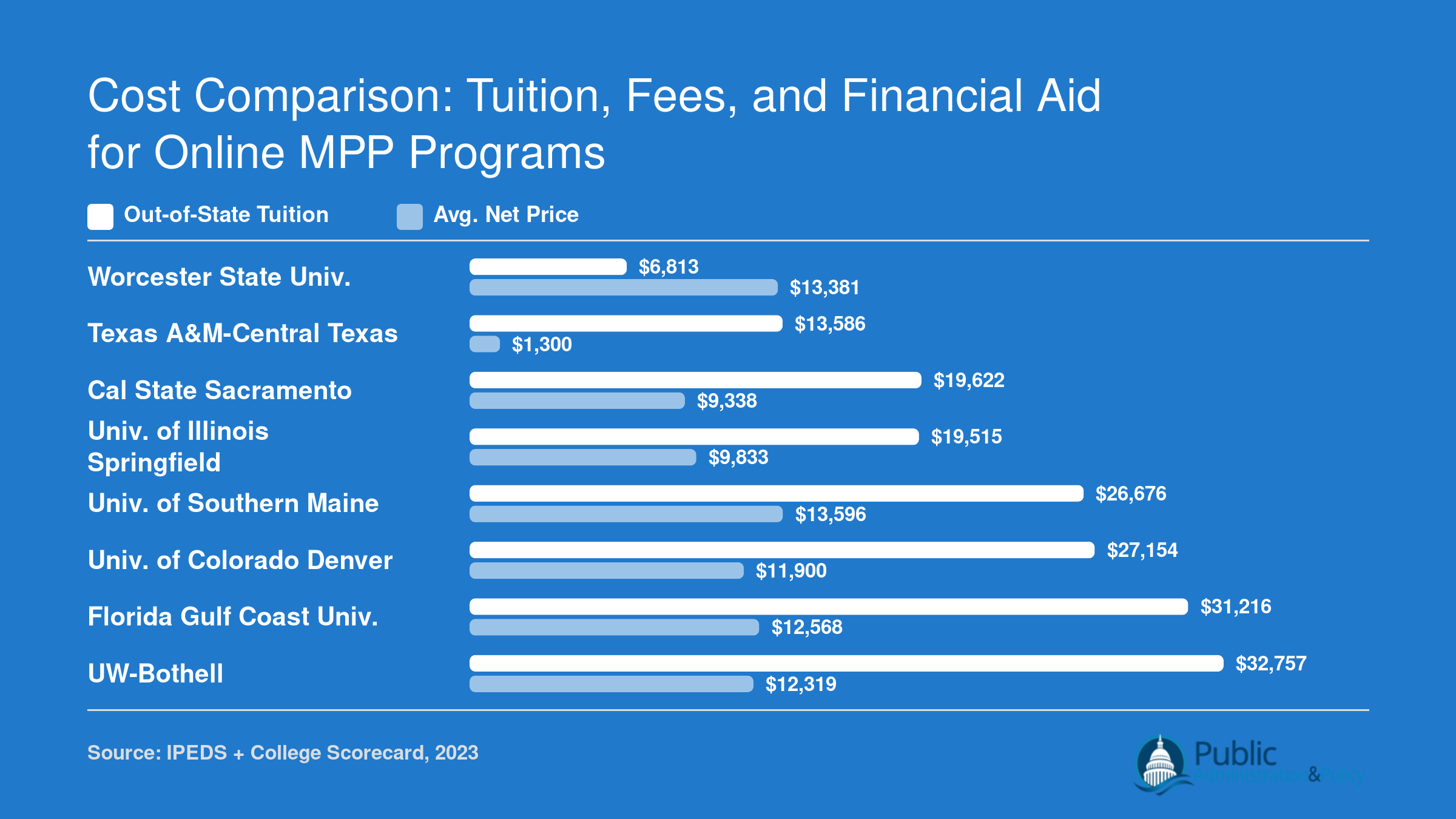
Worcester State University charges a flat tuition of $6,813 regardless of residency, making it the most affordable option for Alabama students.
Most top online MPP programs no longer require the GRE, reducing admissions barriers for working professionals.
NASPAA accredited 209 programs as of the 2023 to 2024 academic year, and a growing share are fully online.
Alabama's state government and nonprofit sectors employ thousands of policy analysts, program evaluators, and legislative staff, yet no in-state institution currently offers an online Master of Public Policy degree. That gap means Alabama residents must look to nationally ranked programs delivered fully online, where out-of-state tuition can range from roughly $6,800 to more than $60,000 depending on the school.
The practical challenge is sorting programs by what actually matters: NASPAA accreditation, total cost for non-resident students, GRE requirements, concentration options aligned with Southern policy priorities, and realistic completion timelines for working professionals. Students weighing an MPP against a complementary alabama mpa credential should compare both pathways, since the two degrees often work together in careers in public administration. Demand for MPP-trained analysts continues to grow as state agencies and advocacy organizations face increasingly data-driven policy environments, making the credential more relevant in Alabama than it has been in the past decade.
Top-Ranked Online MPP Programs for Alabama Students
Every program below accepts Alabama residents and can be completed remotely, so you can earn a respected Master of Public Policy without relocating from the state. Rankings reflect a composite of institutional quality, program design, graduation outcomes, and return-on-investment signals rather than cost or earnings alone. Where program-level earnings data is available, we note it as an additional indicator of long-term value.
NCES-IPEDS federal institutional data — nces.ed.gov
Internal program database
Independent program research
#1
The University of Tennessee-Knoxville
Knoxville, TN · ~$19,000/yr (est.)
Best for: Alabama professionals seeking regional accessibility
The University of Tennessee, Knoxville offers a fully online MPP through the Baker School that is purpose-built for distance learners. Alabama residents benefit from NC-SARA authorization, and the program may qualify for Southern Regional Education Board tuition reciprocity in some years, making it worth confirming current Academic Common Market eligibility. With seven concentration tracks spanning energy, health, national security, and more, the 36-credit curriculum lets students complete internships and capstone work from their home state while building Alabama-based professional networks.
View program
Master of Public Policy — Online
36 credit hours with no thesis required
Seven concentration options including Health and Energy Policy
Fully online delivery with NC-SARA authorization
Internship and capstone master class included
GRE required only for non-U.S. degree holders
Institution-wide graduation rate of 73.9%
Out-of-state tuition approximately $34,760 per year
Best for: Mid-career government employees saving on tuition
The University of Pittsburgh's online Master of Public Policy and Management stands out for one key reason: all online students pay in-state tuition regardless of where they live, effectively eliminating the out-of-state premium for Alabama residents. Designed for mid-career professionals with at least five years of experience, the 30-credit program can be finished in about 20 months. Full-time government employees receive an additional 20% tuition discount, a meaningful perk for those already working in Alabama's public sector.
View program
Master of Public Policy and Management — Online
30 credit hours across 10 courses (4 required, 6 electives)
Online students pay in-state tuition from any state
Completable in approximately 20 months at two courses per term
20% tuition discount for full-time government employees
Requires five or more years of professional experience
Best for: Fast-track learners wanting asynchronous flexibility
Binghamton University delivers a fully asynchronous online MPP that can be completed in as little as one year of full-time study, making it one of the fastest paths to a policy credential on this list. The curriculum emphasizes data analysis, policy modeling, and global perspectives, and students gain hands-on experience through an applied policy laboratory. In-state tuition starts at approximately $13,950, with out-of-state rates around $27,140, and the institution's median ten-year earnings of $80,596 signal strong long-term value.
View program
Master of Public Policy — Online
Fully online and asynchronous, no campus visits required
Can be completed in one year full-time
In-state tuition around $13,950; out-of-state around $27,140
Applied policy laboratory for real-world project experience
Duke University's Sanford School of Public Policy offers a hybrid MPP with concentrations including Development Policy and Energy and Environment Policy. The 24-month, 51-credit-hour program blends online coursework with on-campus components and includes a required summer internship and capstone project. Although the sticker price is among the highest on this list at roughly $66,523 per year, the institution reports a median net price of $29,612 and median ten-year alumni earnings of $97,800, suggesting a strong return for graduates willing to invest.
View 2 programs
Master of Public Policy — Hybrid
24-month hybrid program with 51 credit hours
Concentrations in Development Policy, Energy and Environment, and more
Ohio State University's Glenn College offers a Master of Arts in Public Policy and Management tailored to working professionals with at least three years of experience. The 38-credit hybrid program features evening classes that can accommodate Alabama-based students who travel occasionally, and most students finish within five semesters. No GRE is required, and core coursework spans economics, management, and decision support systems.
View program
Master of Arts in Public Policy and Management — Hybrid
38 credit hours in a hybrid evening format
Designed for professionals with 3+ years of experience
No GRE required for admission
Most students complete in five semesters
Core courses in economics, management, and decision support
Institution-wide graduation rate of 87.7%
In-state tuition approximately $13,901; out-of-state $42,740
Rutgers University's Bloustein School delivers a 48-credit MPP with 14 concentration options, from health policy to budget and finance, plus the ability to design a custom track. The hybrid model blends in-person and synchronous remote coursework, and a distinctive cross-registration agreement with Princeton's School of Public and International Affairs broadens course access. Every student completes a 300-hour internship and a group policy research practicum.
View program
Master of Public Policy (MPP) — Hybrid
48 credits over two years with hybrid delivery
14 concentrations or design your own track
300-hour internship and group research practicum
Cross-registration with Princeton available
No thesis required; no entrance exam needed
In-state tuition approximately $23,241; out-of-state $37,689
George Mason University's Schar School of Policy and Government offers a hybrid MPP that leverages its location near Washington, D.C. to connect students with federal agencies, consulting firms, and international organizations. Evening classes and growing online course options make the program accessible to out-of-state students, including those in Alabama. Merit scholarships and military tuition assistance are available, and over 80 faculty members bring practitioner experience to the classroom.
View program
Master of Public Policy — Hybrid
Hybrid format with evening classes near Washington, D.C.
Access to employers like the World Bank, USAID, and CIA
Merit scholarships and military tuition assistance offered
80+ faculty members with practitioner backgrounds
In-state tuition approximately $17,964; out-of-state $40,308
The University of Houston's Hobby School of Public Affairs offers a NASPAA-accredited, 39-credit-hour MPP in a hybrid format that combines on-campus and online learning. The curriculum integrates economics, politics, ethics, and quantitative analysis, capped by an internship and capstone project. With in-state tuition at roughly $10,051 and out-of-state at about $19,231, it is one of the most affordable options on this list.
View program
Master of Public Policy — Hybrid
39 credit hours with NASPAA accreditation
Hybrid delivery blending online and on-campus learning
Internship and capstone project built into the curriculum
In-state tuition approximately $10,051; out-of-state $19,231
Interdisciplinary coursework in economics, politics, and ethics
Oregon State University's NASPAA-accredited MPP requires 54 quarter credits and offers seven established concentrations, including Energy Policy, Environmental Policy, International Policy, and Rural Policy, plus a self-designed option. The hybrid program is available through OSU's well-established Ecampus, and an 11-week online capstone pairs student teams with real policy clients. NC-SARA participation means Alabama students can enroll without complications.
View program
Master of Public Policy, energy policy — Hybrid
54 quarter credits (34 core, 20 concentration)
Seven concentrations plus a self-designed option
NASPAA-accredited and military-friendly
11-week online capstone with real client partnerships
Hybrid delivery through OSU Ecampus
In-state tuition approximately $16,206; out-of-state $33,351
The University of Washington, Bothell offers a Master of Arts in Policy Studies built around an interdisciplinary, cohort-based model. Evening classes meet two to three times per week after 5 p.m., and the curriculum emphasizes evidence-based policy analysis, social theory, and community partner projects. While the program is primarily campus-centered, hybrid elements and SARA participation make it accessible to motivated Alabama students willing to engage with some synchronous evening sessions.
View program
Master of Arts in Policy Studies — Hybrid
Interdisciplinary cohort model with community partner projects
Evening classes held after 5 p.m., two to three times weekly
Focus on evidence-based analysis and social change
In-state tuition approximately $18,738; out-of-state $32,757
Institution-wide graduation rate of 65.3%
Designed for working professionals and non-traditional students
Alabama does not currently have an in-state institution offering an online Master of Public Policy degree. That gap makes nationally accessible online and hybrid MPP programs the primary pathway for Alabama residents who want to build policy analysis, quantitative research, and leadership skills without leaving the state. The good news: a growing number of respected universities deliver their MPP curricula entirely or mostly online, and many of them actively enroll students from every U.S. state. Students interested in the closely related online MPA programs Alabama track should also compare those options, as the two degrees often complement each other in public administration careers.
The Tuition Advantage of Online Enrollment
One of the biggest concerns for Alabama students considering an out-of-state program is cost. In a traditional on-campus setting, non-resident tuition can be dramatically higher than in-state rates. Online programs frequently eliminate that disparity. The University of Pittsburgh, for example, charges all online students in-state tuition regardless of where they live, and full-time government employees receive an additional 20% tuition discount. At Binghamton University, the gap between the in-state graduate tuition of roughly $13,950 and the out-of-state rate of about $27,140 may narrow or disappear for online students depending on current pricing policies. Private institutions like Duke University list a single tuition rate (around $66,523) for all students, so residency is irrelevant. Before ruling out a program based on sticker price, Alabama residents should confirm whether the online track carries a flat-rate or reduced-rate tuition structure.
Flexibility for Working Professionals
Many Alabama residents pursuing an MPP are already embedded in state government agencies, county offices, nonprofits, or advocacy organizations. Relocating to attend a campus program in Ohio, New York, or North Carolina is often impractical. Online and hybrid formats solve that problem by allowing students to complete coursework asynchronously or through evening synchronous sessions. Programs such as the University of Tennessee-Knoxville's fully online MPP and Binghamton University's asynchronous MPP are designed specifically for professionals who need to study around a full-time work schedule. Even hybrid options, like those offered by Ohio State University with evening classes, can accommodate students who are willing to travel occasionally for short residencies.
Quality Assurance Across State Lines
Alabama students understandably want assurance that an online degree from another state carries the same weight as a traditional campus credential. NASPAA accreditation, which is covered in detail in the next section, provides that assurance. Whether you earn your MPP online from Oregon State University or on campus at George Mason University, the same rigorous accreditation standards apply to curriculum design, faculty qualifications, and student outcomes. Employers in Alabama's public and nonprofit sectors recognize NASPAA-accredited degrees as the professional benchmark for policy careers, regardless of where or how the coursework was delivered.
The combination of no in-state MPP option, competitive online tuition structures, schedule-friendly formats, and accreditation-backed quality makes out-of-state online programs a practical and appealing choice for Alabama students ready to advance in public policy.
NASPAA Accreditation and Program Quality
When evaluating online Master of Public Policy programs, accreditation status deserves careful attention. The Network of Schools of Public Policy, Affairs, and Administration (NASPAA) serves as the recognized accrediting body for graduate programs in public policy, public affairs, and public administration. Think of NASPAA accreditation as the equivalent of AACSB accreditation for business schools: it signals that a program meets rigorous standards for curriculum design, faculty qualifications, student learning outcomes, and mission-driven governance.
For Alabama students weighing their options across multiple institutions, understanding which programs hold this credential, and which do not, can shape both your educational experience and your long-term career trajectory.
What NASPAA Accreditation Signals
NASPAA-accredited programs undergo a thorough peer-review process that evaluates everything from the quality of instruction to how well graduates are prepared for public service careers. Programs must demonstrate continuous improvement and meet competency benchmarks aligned with real-world demands in policy analysis, management, and leadership.
Accreditation also matters beyond the classroom. Many federal agencies and state governments give hiring preference to candidates who hold degrees from NASPAA-accredited programs. In Alabama, where state government and federally funded agencies are major employers, that preference can translate directly into a competitive edge during the application process. Accreditation also eases credit transferability and can be a factor in qualifying for certain fellowships or tuition assistance programs. If you are weighing a policy degree against an mpa Alabama option, understanding accreditation distinctions across both degree types is essential.
Accreditation Status for Top Online MPP Programs
One important nuance: NASPAA accreditation often applies to a specific degree within a school, not necessarily to every graduate program the school offers. A university may hold NASPAA accreditation for its MPA but not its MPP, or vice versa. The table below, based on the 2025-2026 NASPAA roster of accredited programs, clarifies where each program stands.
School
NASPAA-Accredited MPP?
Notes
American University
Yes
Both the MPA and MPP are accredited, including online formats
University of Southern California
No
Only the MPA holds NASPAA accreditation; the MPP does not
George Washington University
No
Only the MPA is NASPAA accredited; the MPP is not covered
University of Chicago
No
No NASPAA-accredited master's programs
University of Michigan
No
The Ford School does not hold NASPAA accreditation for its policy degree
Northwestern University
No
The MPPA is not NASPAA accredited
Indiana University
MPA only
The MPA is accredited, including online delivery; no accredited MPP
Penn State (World Campus)
MPA only
The online MPA is accredited; no standalone MPP offered
University of Kentucky
MPA only
The online MPA holds accreditation
Northern Illinois University
MPA only
The online MPA is accredited
University of Nebraska at Omaha
MPA only
The online MPA is accredited
What This Means in Practice
As the table illustrates, very few online MPP degrees specifically carry NASPAA accreditation. American University is a notable exception. Several other well-regarded programs, including those at the University of Chicago and the University of Michigan, deliver strong policy education but do not hold NASPAA accreditation for their policy degrees.
Does that mean a non-accredited program is a poor choice? Not necessarily. Program reputation, faculty expertise, alumni networks, and concentration offerings all matter. However, if you plan to pursue a career in government, especially at the federal level or within Alabama's state agencies, an accredited credential can remove friction from the hiring process. Some employers explicitly list NASPAA accreditation as a preferred or required qualification in job postings.
Before committing to any program, verify the current accreditation status directly with the school and on the NASPAA roster. Accreditation cycles update periodically, and a program that is currently pursuing accreditation may achieve it during your enrollment. Asking admissions teams about accreditation timelines is a reasonable and worthwhile step in your decision-making process.
Questions to Ask Yourself
Do you need NASPAA accreditation for the specific public-sector roles you're targeting in Alabama?
Some state and federal agencies in Alabama prefer or require degrees from NASPAA-accredited programs, especially for senior analyst and management positions. If your target role lists accreditation as a preference, choosing a non-accredited program could limit your competitiveness.
Would a concentration aligned with Alabama's policy landscape, such as health policy or education policy, advance your career more than a generalist MPP?
Alabama faces distinct challenges in rural healthcare access and K-12 funding equity. A program offering a relevant concentration lets you build specialized expertise that translates directly into state and local policy work.
Can you commit to a full-time accelerated schedule, or do you need a part-time track that accommodates your current job?
Full-time cohorts often finish in 12 to 18 months but demand 20-plus hours per week. Part-time formats stretch to two or three years yet let you keep earning a salary, which can offset tuition costs and preserve professional momentum.
How important is synchronous interaction with faculty and classmates to your learning style?
Some online MPP programs rely on live virtual sessions at set times, while others are fully asynchronous. If you work irregular hours or are in a different time zone from the university, asynchronous coursework offers more scheduling freedom.
Cost Comparison: Tuition, Fees, and Financial Aid for Online MPP Programs
Because Alabama students will pay out-of-state rates at most of these programs, the tuition figure that matters most is the out-of-state rate. One notable exception is Worcester State University, which charges a flat tuition of $6,813 regardless of residency, making it the most affordable option on this list. Across these programs, median graduate debt ranges from roughly $14,600 to $20,500, and average net prices after aid range from $1,300 to $13,596. Many programs offer merit scholarships and graduate assistantships to online students, but availability varies; contact each school's financial aid office for details.
Program Length, Format, and Flexibility
One of the biggest advantages of pursuing an online MPP is the ability to tailor your pace and schedule around professional and personal commitments. For Alabama students balancing state government careers, nonprofit work, or family obligations, understanding how each program structures its timeline and delivery is essential before you apply.
Typical Completion Timelines
Most online MPP and related policy programs require between 36 and 48 semester credit hours, though programs on the quarter system may list requirements in quarter credits. Full-time students can generally finish in 18 to 24 months, while part-time students should plan for two to three years.
Here are some concrete examples:
American University (MPAP): 36 credits delivered in eight-week course terms, with a typical completion timeline of 24 months. The program uses a quasi-cohort model, meaning students progress through courses together in a structured sequence.1
Indiana University (MPA): 45 credits with a flexible 24- to 36-month timeline, accommodating both full-time and part-time enrollment.1
USC (MPA): 40 to 48 credits completed over 24 to 36 months, with some accelerated term options for students who want to move faster.1
Oregon State University (MPP): 45 quarter credits, fully online through the university's E-campus platform, typically completed in 24 to 36 months.1
DePaul University (MPP): 13 courses (52 quarter hours) completed in roughly 25 months for students following the standard progression.1
Asynchronous, Synchronous, and Cohort-Based Formats
The daily experience of an online MPP varies significantly depending on whether a program is asynchronous, synchronous, or cohort-based. Understanding these distinctions helps you choose a format that fits your schedule.
Asynchronous coursework lets you watch lectures, complete readings, and participate in discussion boards on your own time. This is the dominant format across most online policy programs, including those at Indiana University and Oregon State. For an Alabama student working full-time in Montgomery or Birmingham, asynchronous delivery means you can study in the evenings or on weekends without logging in at a fixed hour.
Synchronous components add live, scheduled sessions, typically via video conferencing. Programs at American University, DePaul, and George Washington University blend asynchronous material with periodic live meetings. DePaul, for example, requires a mandatory live online session at the start of each course.1 These sessions foster real-time discussion and networking but do require you to block out specific times, so check whether scheduled sessions align with Central Time.
Cohort-based models, like the one at American University, move a defined group of students through the curriculum together. This structure builds strong peer relationships and keeps students on pace, though it offers less flexibility to rearrange your course sequence. If you are also considering an mpa degree alongside your MPP research, many of these same format considerations apply.
Residency Requirements: What Alabama Students Should Know
Many students choose online programs specifically to avoid travel, so residency requirements deserve careful attention. The good news is that most leading online MPP and MPA programs do not require on-campus visits. American University, Indiana University, George Washington University, Northwestern, Oregon State, and DePaul all offer fully online completion paths with no mandatory campus residency.1
USC is the exception to watch: depending on the cohort and program track, a short on-campus residency may be required. If traveling to Los Angeles is not feasible, confirm current residency expectations with USC's admissions office before applying.
It is also worth noting that some programs not listed here, particularly those housed within traditional campus-based schools, may require a capstone residency or intensive weekend seminar. Always verify residency policies directly, as they can change between admission cycles.
For Alabama students seeking maximum flexibility, prioritize programs that confirm fully online delivery with no travel obligations. If a brief residency sounds appealing as a networking opportunity, treat it as a bonus rather than a barrier.
Admissions Requirements and GRE Policies
One of the most encouraging trends for Alabama applicants is that top online MPP programs have broadly relaxed their admissions barriers over the past several years. If you have been away from standardized testing for a while, or if you simply prefer that your professional track record speak for itself, you will find plenty of highly regarded programs that no longer hinge admission on a GRE score.
GRE Policies Across Leading Programs
The shift toward GRE-optional and GRE-free admissions is now the norm rather than the exception. Here is how several widely recognized online MPP programs handle exam requirements:
American University: Does not require any standardized exam. No minimum work experience is needed, making this a strong fit for early-career applicants.1
USC Price School: GRE is optional, though applicants are generally expected to have two to three years of professional experience.2
Indiana University O'Neill: Does not require the GRE. One to three years of relevant work experience is recommended.2
George Washington University: GRE is optional. Two to three years of professional experience is typical for admitted students.2
University of Chicago Harris: GRE is optional, and no minimum work experience is required.2
All five programs listed above expect a minimum undergraduate GPA of approximately 3.0 on a 4.0 scale.2 If your GPA falls slightly below that threshold, strong professional experience or a compelling personal statement can often offset the gap, particularly at programs that take a holistic review approach.
What the GRE-Optional Trend Means for Alabama Applicants
For professionals working in state agencies, nonprofits, or local government offices across Alabama, the decline of GRE requirements removes a significant hurdle. Preparing for and sitting the exam costs both time and money, and a test score taken years ago may not reflect your current analytical abilities. GRE-optional policies let you channel that energy into crafting a stronger application, whether that means refining your statement of purpose or securing a well-targeted recommendation letter. Alabama residents weighing an MPP alongside a complementary mpa alabama credential will find similar GRE flexibility across both degree types.
That said, if you do have a recent, competitive GRE score, submitting it can still strengthen your candidacy, especially at programs like USC or George Washington where the score is considered but not mandated.
Application Deadlines and Financial Aid Timing
Deadline structures vary in ways that directly affect your financial aid prospects:
Rolling or multiple-start programs: American University offers several entry points throughout the year, giving you flexibility to apply when your materials are strongest.1
Semester-based intakes: Indiana University O'Neill admits students on a semester cycle, so planning around fall or spring entry dates is important.2
Fixed rounds with priority deadlines: USC, George Washington, and the University of Chicago Harris each use set application rounds. Applying by the priority deadline is highly advisable because merit-based scholarships and assistantship funding are often distributed on a first-reviewed basis. Missing a priority window does not disqualify you, but it can reduce the financial aid pool available.2
Alabama students should also check whether individual programs require prerequisite coursework in statistics, economics, or quantitative methods. Some programs, such as the University of Chicago Harris MPP, integrate quantitative foundations into the curriculum itself, while others may ask you to complete a statistics course before enrollment. Confirming these requirements early prevents last-minute scrambles and keeps your timeline on track.
As a practical step, build a spreadsheet with each program's deadline, GRE policy, GPA floor, experience expectation, and any prerequisite courses. Having everything in one place makes it far easier to submit polished applications on time and maximize your shot at financial support.
Concentrations and Specializations by Program
Choosing the right concentration can shape your entire policy career, so Alabama students should weigh each program's specialization options carefully. Some online MPP programs offer a wide menu of defined concentrations, while others let you build a customizable track through electives, certificates, or graduate minors. The table below maps available concentrations across programs featured on publicadministrationpolicy.org, with tags highlighting areas especially relevant to Alabama's policy priorities: education, health, economic development, and environmental or energy policy.
School
Available Concentrations or Specializations
Alabama-Relevant Policy Areas
Customizable Track Option
University of Tennessee, Knoxville
Agricultural and Environmental Policy, Economic and Community Development, Energy Policy, Health Policy, National Security, Nuclear Security, Public Management
14 concentrations including Budget and Finance, Health, Environment, Urban Policy, and more
Health, Environmental
Yes (students may design a custom concentration)
Oregon State University
Energy Policy, Economic Policy, Environmental Policy, International Policy, Law and Crime Policy, Rural Policy, Social Policy
Energy, Environmental, Economic Development
Yes (self-designed concentration or graduate certificate integration)
Pepperdine University
American Policy and Politics, Applied Economic Policy, International Relations and National Security, Public Policy and Dispute Resolution, State and Local Policy
Economic Development
No (select from five defined specializations)
University of Colorado Denver
Education Policy, Environmental Policy, Policy Analysis and Methods, Policy Entrepreneurship and Advocacy
Education, Environmental
Yes (concentrations are optional; electives allow customization)
Colorado State University, Fort Collins
Public Management, Public Policy, International Policy and Management
N/A
No (select from three defined areas of study)
Duke University
Development Policy, Energy and Environment Policy, and additional policy area concentrations
Energy, Environmental
Yes (customizable education with dual degree options)
University of the Pacific
Environmental and Water Policy, Public Policy Advocacy, Nonprofit and Social Capacity Management, Local Government
Environmental
No (select from four defined concentrations)
York College of Pennsylvania
Urban Planning, Nonprofit Leadership, Local Government
Economic Development (Local Government track)
No (select from three defined concentrations)
Drexel University
Customizable through certificate programs and graduate minors
Varies by certificate selection
Yes (build specialization via certificates or graduate minors)
University of Southern Maine
Community Planning and Sustainable Development, Public Policy and Public/Nonprofit Management
Economic Development (Community Planning track)
Yes (graduate certificates in Applied Research, Policy Analysis, and more)
The New School
Data Visualization, Global Urban Futures
N/A
Yes (elective courses allow further customization)
University of Pittsburgh
General (customizable through six elective courses)
Varies by elective selection
Yes (no fixed concentrations; tailor through electives)
Binghamton University
General (no defined concentration)
N/A
Yes (generalist curriculum with applied policy projects)
Ohio State University
General (public policy and management focus)
N/A
Yes (electives allow some customization)
University of Northern Iowa
General (no defined concentration)
N/A
No (cohort-based generalist curriculum)
Southern Methodist University
General (no defined concentration)
N/A
No (generalist curriculum with capstone project)
As of the 2023 to 2024 academic year, NASPAA accredited 209 programs nationwide, and a growing share now offer fully online options. You can explore NASPAA's annual data reports, BLS.gov salary projections, and APPAM research publications to compare online and on campus MPP outcomes before choosing a program.
Career Outcomes and Earnings for MPP Graduates in Alabama
An online MPP degree opens doors to a range of policy-focused careers, and Alabama offers a surprisingly diverse job market for graduates. Because most of the top online programs enroll students from across the country, the earnings data reported by individual schools reflects national outcomes rather than Alabama-specific salaries. Program-level earnings figures are not yet available for the MPP programs featured in this guide, but institutional data and regional labor market research still paint a useful picture of what graduates can expect.
What MPP Graduates Earn Nationally
At the institutional level, graduates from the universities highlighted on publicadministrationpolicy.org report strong mid-career earnings. Duke University alumni, for example, report median earnings of roughly $97,800 ten years after enrollment, while graduates of Drexel University, Pepperdine University, and Binghamton University report figures ranging from approximately $78,000 to $85,000 over a similar timeframe. These numbers span all degree programs at each institution, so individual MPP outcomes will vary depending on sector and role. Specific post-graduation earnings for the MPP programs themselves have not yet been published, but the overall institutional track record signals that these schools prepare graduates for competitive salaries. For a broader look at compensation benchmarks, consult our public administration salary guide.
Alabama's Policy Job Market
Alabama's capital, Montgomery, is the hub for state government employment and houses dozens of agencies that regularly hire policy professionals, from the Alabama Department of Finance to the Alabama Medicaid Agency. Beyond state government, the city supports advocacy and research organizations such as the Public Affairs Research Council of Alabama (PARCA), which conducts nonpartisan policy analysis on issues like education funding and tax reform. The Southern Poverty Law Center, headquartered in Montgomery, employs policy researchers focused on civil rights and social justice.
Birmingham anchors the state's health policy sector. UAB (the University of Alabama at Birmingham) and its affiliated health system drive demand for professionals who can evaluate health programs, manage grants, and shape hospital policy. Huntsville, meanwhile, is home to Redstone Arsenal and NASA's Marshall Space Flight Center, creating a niche for graduates interested in defense and aerospace policy, federal contracting oversight, and technology regulation.
According to the Bureau of Labor Statistics, management analysts in Alabama earn a median annual wage in the range of $75,000 to $82,000, while political scientists, a smaller occupation concentrated in government, earn median salaries that tend to track somewhat higher nationally but can vary by metro area. Alabama's lower cost of living means that these salaries stretch further than equivalent pay in Washington, D.C. or coastal cities.
Return on Investment
When comparing total program debt against post-graduation earning potential, several featured programs stand out. Duke University and Binghamton University both show particularly favorable ratios of earnings to debt, suggesting graduates recoup their educational investment relatively quickly. Programs at public institutions like Binghamton and the University of Washington-Bothell carry lower tuition for out-of-state online students, which further strengthens their long-term financial value.
Typical MPP Career Paths
Graduates of online MPP programs pursue a variety of careers in public policy that align well with Alabama's employment landscape:
Policy analyst: Researching legislation and evaluating program effectiveness for state agencies or think tanks like PARCA.
Legislative aide: Supporting elected officials in Montgomery or at the federal level.
Program evaluator: Assessing outcomes for social services, health initiatives, or education programs funded by state or federal grants.
Government affairs director: Representing corporations, hospitals, or universities before Alabama's legislature.
Nonprofit director: Leading organizations focused on poverty reduction, civil rights, or community development across the state.
Alabama may not be the first state that comes to mind for policy careers, but its combination of a growing government workforce, active nonprofit sector, and specialized federal installations in Huntsville creates genuine opportunity for MPP holders willing to put their analytical skills to work.
Frequently Asked Questions About Online MPP Programs for Alabama Students
Choosing the right online Master of Public Policy program involves weighing accreditation, cost, timeline, and career fit. Below are answers to the questions Alabama students ask most often when exploring online MPP options.
Which online MPP programs are available to Alabama students?
Alabama students can enroll in online MPP programs offered by universities across the country, including schools such as the University of Southern California, the University of Michigan, American University, and others that accept out-of-state online learners. Some programs charge the same tuition rate regardless of residency, while others offer discounted rates through regional compacts or reciprocity agreements. Always verify state authorization before enrolling.
Are there NASPAA-accredited online MPP programs for Alabama residents?
Yes. Several nationally recognized universities offer NASPAA-accredited online MPP degrees that Alabama residents may pursue. NASPAA (the Network of Schools of Public Policy, Affairs, and Administration) accreditation signals that a program meets rigorous standards for curriculum, faculty qualifications, and student outcomes. Checking the NASPAA directory is the most reliable way to confirm a program's current accreditation status.
How long does it take to complete an online MPP degree?
Most online MPP programs require 36 to 48 credit hours and can be completed in about two years of full-time study. Part-time students typically finish in three to four years. Some programs offer accelerated tracks or allow transfer credits, which may shorten the timeline. Program length also depends on whether a capstone project or internship is required.
Do online MPP programs require GRE scores?
Policies vary by institution. A growing number of online MPP programs have adopted GRE-optional or GRE-waiver policies, especially for applicants with professional experience or strong undergraduate GPAs. Some programs have dropped the GRE requirement entirely. Check each school's current admissions page, because testing policies can change from one application cycle to the next.
What can you do with a Master of Public Policy degree in Alabama?
MPP graduates in Alabama work in state and local government, nonprofit organizations, healthcare systems, and consulting firms. Common roles include policy analyst, program evaluator, legislative aide, budget analyst, and government affairs specialist. Major employers in the state include the Alabama Legislature, city and county agencies, the University of Alabama system, and advocacy organizations across sectors such as education, health, and economic development.
How much does an online MPP program cost?
Total tuition for an online MPP ranges widely, from roughly $20,000 at more affordable public universities to $80,000 or more at selective private institutions. Costs depend on residency status, credit-hour rates, and fees. Many programs offer merit scholarships, graduate assistantships, or employer tuition reimbursement options. Alabama students should also explore whether a program participates in the SARA agreement, which can affect pricing.
Can I work full-time while completing an online MPP?
Yes. Online MPP programs are specifically designed for working professionals. Most feature asynchronous coursework, meaning you can complete lectures and assignments on your own schedule. Some programs include synchronous sessions on evenings or weekends. Part-time enrollment options and flexible pacing make it realistic to balance a full-time job with graduate study, though students should expect to dedicate 15 to 20 hours per week to coursework.
More Online MPP Programs Available to Alabama Students
In addition to our top-ranked picks, these online and hybrid MPP programs are available to students in Alabama. Each offers a unique curriculum and flexible delivery, expanding your options for pursuing a public policy master's degree remotely.
University of Northern Iowa
This 36-credit online MPP program uses synchronous Zoom sessions on Tuesday evenings, following a cohort model with two-year completion for full-time students. Tuition is $586 per graduate credit for 2025-26.
SMU's online part-time MPP focuses on technical skills in policy analysis, research, and data-driven evaluation. The program includes virtual live lectures, project-based assignments, and two on-campus immersions.
CSU's online Master of Public Policy and Administration offers concentrations in Public Management, Public Policy, and International Policy and Management. The interdisciplinary curriculum blends theory with practical experience.
This hybrid MPP at McGeorge School of Law combines online coursework with in-person Saturday sessions in Sacramento. The 39-unit program offers concentrations in Environmental and Water Policy, Public Policy Advocacy, and more.
The 36-credit hybrid Master of Public Administration and Policy blends face-to-face and online courses. It includes a capstone fieldwork component and prepares students for careers in policy analysis and municipal planning.
UIS offers a hybrid MPP with online and on-campus options. No entrance exam is required, and the program can be completed in under two years. Graduate Public Service Internships provide paid government work and tuition waivers.
Drexel's hybrid Master of Public Policy offers a case study-driven curriculum with full-time or part-time study, completing in 18-24 months. Courses blend online and on-campus learning, and no entrance exam is required.
NDSU's hybrid MPP allows in-person or remote real-time attendance. The 36-credit curriculum focuses on policy design and evaluation, and an accelerated option lets undergraduates earn both a bachelor's and MPP in five years.
This hybrid Master of Public Administration is military-friendly and combines online coursework with in-person sessions. The 36-credit program emphasizes policy analysis, organizational theory, budgeting, and ethical decision-making.
Pepperdine's hybrid MPP offers a 48-unit, 20-month curriculum with five specializations and a Washington, DC track. Over 95% of students receive scholarships covering an average of 70% of tuition. No GRE is required.
University of Colorado Denver/Anschutz Medical Campus
This hybrid MPP requires 36 credits with core courses in research methods, economics, and policy design. Optional concentrations include Education Policy and Environmental Policy. No entrance exam is required.
York's fully online Master of Public Policy and Administration offers concentrations in Urban Planning, Nonprofit Leadership, and Local Government. The 36-credit program can be completed in two years and includes a thesis project.
The hybrid Master of Public Policy and Management offers concentrations in Community Planning and Sustainable Development or Public Policy and Public/Nonprofit Management. No entrance exam is required, and out-of-state tuition is reduced.
Redlands' hybrid Master of Public Policy & Administration requires 56 credits and features 8-week courses with cohort-based learning. Classes meet evenings and Saturdays. No standardized tests or strict GPA minimums are needed.
The hybrid Master of Science in Public and Urban Policy focuses on urban challenges through a lens of social inclusion and equity. The Urban Policy Lab provides team-based client projects. No GRE or GMAT is required.