Best Online Bachelor of Public Administration (BPA) Degree Programs

Compare top-ranked BPA programs by cost, outcomes, and career ROI to find the right fit for your public service goals.

By Carrie HirschReviewed by PAP Editoral TeamUpdated May 19, 202610+ min read

Key Points

  • Top-ranked online BPA programs can be completed fully online and are scored on graduation rate, net price, earnings, and ROI.
  • BPA graduates enter government, nonprofit, and consulting roles, with a retirement wave expected to open thousands of public sector positions by 2033.
  • Core BPA coursework is consistent across schools, covering public budgeting, organizational management, policy analysis, and ethics.
  • A BPA serves as a launchpad to MPA programs, public service fellowships, and senior leadership career ladders in government agencies.

Public administration graduates manage roughly $4.6 trillion in annual state and local government spending, yet fewer than 30 accredited institutions offer a bachelor of public administration that can be completed entirely online. That scarcity makes choosing the right program consequential, especially when net prices range from under $1,500 a year at the most affordable schools to over $23,000 at others, and institution-level median earnings ten years after enrollment span from about $42,500 to more than $76,000.

The real tension for most prospective students is balancing cost, flexibility, and career return. A BPA degree prepares you for budget analysis, city management, nonprofit leadership, and public policy making, but outcomes vary sharply by program structure, regional labor market, and whether the curriculum includes fieldwork such as internships or service-learning placements. With a wave of retirements projected across state and local agencies through the early 2030s, demand for trained administrators is rising even as overall government employment growth stays modest.

What Is a Bachelor of Public Administration (BPA) Degree?

A Bachelor of Public Administration is an undergraduate degree designed to prepare students for management and leadership roles within public organizations. That includes government agencies at every level, nonprofit organizations, and quasi-governmental bodies such as public utilities and regional planning authorities. The curriculum is intentionally applied: you study budgeting and financial management, policy analysis, organizational behavior, public law, and ethics so that you can step into operational roles soon after graduation.

Unlike a purely theoretical program, the BPA treats public service as a discipline that requires its own management toolkit, one shaped by democratic accountability, legislative mandates, and the public interest rather than shareholder returns.

How a BPA Differs from Related Degrees

The landscape of undergraduate programs in government and public affairs can be confusing. Here is how the BPA stacks up against the degrees most often compared to it:

  • BA or BS in Public Administration: Some universities offer a Bachelor of Arts or Bachelor of Science in public administration rather than a BPA. The distinction usually comes down to general education requirements. A BA version leans on liberal-arts electives (humanities, foreign languages), while a BS version emphasizes quantitative coursework (statistics, economics, data analysis). The core public administration content is largely the same.
  • Political Science: Political science programs focus on governmental theory, comparative politics, and electoral systems. They are valuable for understanding how power operates but typically include less applied management training in areas like budgeting or human-resource administration.
  • Public Policy: A online bachelor of public policy degree zeroes in on policy analysis, program evaluation, and research methods. It overlaps with the BPA in some coursework but tends to prioritize analytical frameworks over day-to-day organizational management.
  • Business Administration: Business degrees orient students toward private-sector markets, corporate finance, and shareholder-driven strategy. A BPA replaces those lenses with public-sector finance, administrative law, and stakeholder engagement.

Accreditation: What to Look For

Prospective students sometimes ask whether BPA programs carry the same accreditation as graduate-level MPA or MPP degrees. The short answer is no. NASPAA, the primary accrediting body for public affairs education, accredits only master's-level programs as of the 2025-2026 academic year.1 There is no equivalent specialized accreditor for undergraduate public administration degrees.2

That does not mean quality signals are absent. When evaluating an online BPA program, focus on:

  • Regional accreditation: The university itself should hold accreditation from one of the recognized regional accrediting agencies. This is the baseline requirement for financial aid eligibility and credit transferability.2
  • Practicum and capstone components: Strong programs embed internships, service-learning projects, or capstone courses that connect classroom concepts to real public-sector work.
  • Faculty with applied experience: Look for instructors who have held roles in government agencies, nonprofit leadership, or policy organizations, not only academic appointments.
  • Graduate pathway alignment: Programs that build competencies in writing, economics, statistics, budgeting, and policy analysis set you up well for an MPA or MPP later on.

What Can You Do with a BPA Degree?

Graduates enter a wide range of roles. At the local level, a BPA can lead to positions in city manager roles, zoning administration, or community development. At the state and federal level, budget analyst positions, program coordination, and civil service careers are common entry points. Nonprofit administration is another natural fit, particularly for graduates interested in grant management, community outreach, or advocacy.

Internship pipelines built into many BPA programs connect students directly with local, state, and federal agencies as well as nonprofit organizations, giving you professional experience before you finish your degree. For a closer look at what these roles pay and how earnings grow over time, see the salary and career outcomes section later in this article.

Best Online BPA Programs Ranked

The following ranking spotlights accredited online and hybrid bachelor of public administration programs scored on a composite of institutional graduation rate, net price after financial aid, institution-wide graduate earnings, and return-on-investment ratio. Every program listed can be completed fully online or in a hybrid format, making each a practical option for working adults and traditional students alike. Program-level earnings data (such as median salary one year or four years after completion) is not yet available for these programs, so institution-wide figures are referenced where relevant.

Factors considered
  • Institutional graduation rate
  • Net price after financial aid
  • Graduate earnings over time
  • Return on investment ratio
  • Program delivery flexibility
Data sources
  1. #1

    Florida International University

    Miami, FL · ~$9,000/yr (est.)

    Best for: Affordability-focused students in public policy

    Florida International University pairs a strong 74% institution-wide graduation rate with one of the lowest net prices on this list at $9,288 after aid. Housed in the Steven J. Green School of International and Public Affairs, the Bachelor of Public Policy and Administration blends policy development, public management, budgeting, and urban resilience across 120 credit hours. The program is available both in-person and fully online, and an integrative capstone seminar in the final semester ties the coursework together.

    View program
    • 120 credit hours with 36 upper-division credits
    • Ten core courses plus two concentration electives
    • Available fully online or in-person in Miami
    • Covers budgeting, urban resilience, and public management
    • Internship recommended for students without experience
    • Foreign language competency required for graduation
    • Integrative capstone seminar in final semester
  2. #2

    University of Central Florida

    Orlando, FL · $10,000/yr

    Best for: Online learners wanting concentration choices

    The University of Central Florida delivers a fully online BA or BS in Public Administration with two distinct concentrations, giving students the flexibility to specialize. With a 78% graduation rate and a net price of $10,411, UCF balances academic rigor with accessibility. An internship is integrated into both tracks, and the program sits within the College of Community Innovation and Education.

    View program
    • 120 credit hours, choose BA or BS pathway
    • Concentration in Nonprofit Management available
    • Concentration in Urban and Regional Planning available
    • Fully online delivery with no campus visits required
    • Internship requirement builds hands-on experience
    • In-state tuition of $179.19 per credit hour
    • Three annual start terms: fall, spring, and summer
  3. #3

    George Mason University

    Fairfax, VA · $15,000 – $20,000/yr

    Best for: Government employees advancing mid-career

    George Mason University's BS in Public Administration is built around a cohort model designed specifically for Northern Virginia local government employees who already hold an associate's degree. The hybrid format pairs one in-person and one online class per week, letting working professionals progress through two courses per term over three years. Graduates benefit from the Schar School's proximity to federal agencies and the D.C. policy ecosystem, and the institution reports median earnings of $76,343 ten years after enrollment.

    View program
    • Cohort-based structure over three years
    • Hybrid: one in-person and one online class weekly
    • Designed for associate's degree holders in local government
    • Curriculum blends policy analysis and economics
    • One-time $1,000 scholarship for cohort members
    • Two courses per term for manageable pacing
    • Supportive peer community throughout the program
  4. #4

    California State University-Chico

    Chico, CA · ~$14,000/yr (est.)

    California State University, Chico offers a BA in Public Administration through a hybrid format that explores how government serves communities across public safety, healthcare, environmental stewardship, and urban planning. The program emphasizes close student-faculty contact within the Political Science and Criminal Justice Department. At a net price of $14,480 and institution-wide median earnings of $64,172 a decade after enrollment, Chico State presents solid value for California residents and beyond.

    View program
    • Hybrid format blending online and on-campus learning
    • Curriculum covers public safety, healthcare, and urban planning
    • Part of the Political Science and Criminal Justice Department
    • Public Administration minor also available
    • Close student-faculty interaction emphasized
    • Prepares graduates for governance and advocacy careers
  5. #5

    Rutgers University-Newark

    Newark, NJ · $20,000/yr (net price)

    Rutgers University, Newark's BA in Public Administration is anchored in experiential learning. The 35-credit major weaves together service-learning internships, off-campus class sessions, and practitioner panel discussions. Students also complete a required second concentration within their 120-degree credits, broadening their expertise. The program is available online, and the Newark campus's location provides natural connections to New Jersey's public and nonprofit sectors.

    View program
    • 35-credit major within a 120-credit degree
    • Service-learning internships totaling 5 credits
    • 15 credits of core courses and 15 elective credits
    • Off-campus sessions and practitioner panel discussions
    • Second concentration required for breadth
    • Available online with experiential learning focus
    • Career explorations course and mock interview training
  6. #6

    University of Hawaii-West Oahu

    Kapolei, HI · ~$10,000/yr (est.)

    The University of Hawai'i, West Oahu stands out for offering the broadest array of concentrations on this list, including Community Health, Disaster Preparedness and Emergency Management, Health Care Administration, Justice Administration, and Long-Term Care. The hybrid BA in Public Administration prepares students for supervisory roles and culminates in either a senior project or an administrative practicum. With a net price of $10,327, it is among the most affordable options for students interested in specialized public-sector tracks.

    View program
    • Six concentrations, from Community Health to Justice Administration
    • Hybrid delivery with online and campus components
    • Capstone: choose senior project or administrative practicum
    • Stackable certificates in emergency management and health care
    • Net price of $10,327 after aid for eligible students
    • Only upper-division public administration program in Hawai'i
  7. #7

    University of Colorado Denver/Anschutz Medical Campus

    Denver, CO · $10,000 – $15,000/yr

    CU Denver's BA in Public Administration is an applied, 48-credit major covering management, policy analysis, and communications. The program accepts up to 30 career and technical education transfer credits and offers an optional Nonprofit Management concentration. An internship is typically required unless waived, and the university participates in the Western Undergraduate Exchange, which can lower tuition for out-of-state students from participating states.

    View program
    • 48 major credits with 30 core and 15 elective credits
    • Optional Nonprofit Management concentration
    • Hybrid: primarily online with some in-person options
    • Accepts up to 30 CTE transfer credits
    • Internship required unless waived
    • WUE tuition discount available for eligible states
    • Four-year completion timeline for full-time students
  8. #8

    St Petersburg College

    St. Petersburg, FL · $1,000/yr

    St. Petersburg College offers the lowest net price on this list at $1,471 after aid, making its BS in Public Policy and Administration a standout for budget-conscious students. The hybrid curriculum covers policy analysis, government processes, economics of public administration, and evaluation methods. Students must earn a C or higher in all courses, and both foreign language and civic literacy requirements apply for graduation.

    View program
    • Bachelor of Science degree with policy and leadership focus
    • Lowest net price on this list at $1,471 after aid
    • Covers policy analysis, economics, and evaluation methods
    • Hybrid delivery combining online and campus sessions
    • Grade of C or higher required in all courses
    • Foreign language and civic literacy graduation requirements
  9. #9

    University of Houston-Clear Lake

    Houston, TX · $15,000 – $20,000/yr

    The University of Houston, Clear Lake's Public Service Leadership BS offers two distinct tracks: Political Science and Public Service Leadership. Upper-division coursework is available fully online for students who have completed their first 60 credit hours, making UHCL a natural fit for community college transfer students. The curriculum spans budgeting, policy analysis, and conflict resolution, and the 15:1 student-to-faculty ratio supports close mentoring.

    View program
    • Two tracks: Political Science and Public Service Leadership
    • Fully online for students with 60+ completed credits
    • Covers budgeting, policy analysis, and conflict resolution
    • 15:1 student-to-faculty ratio for close mentoring
    • Transfer guides available for community college students
    • Part of the College of Human Sciences and Humanities
  10. #10

    University of New Hampshire

    Durham, NH · $24,000/yr (net price)

    The University of New Hampshire offers a fully online BS in Public Administration built for working professionals. The 120-credit curriculum progresses through foundation, intermediate, and advanced tiers, culminating in an integrative capstone project or internship. Coursework spans grant writing, public sector budgeting, data analytics, and change management. UNH's 76% graduation rate is among the highest in this ranking, though its net price of $23,805 is also the steepest.

    View program
    • 120 credits with tiered foundation-to-advanced structure
    • Fully online, designed for working professionals
    • Capstone options: integrative project or internship
    • Courses in grant writing, data analytics, and budgeting
    • 30 credits must be completed at UNH
    • Four writing-intensive courses embedded in curriculum
    • Minimum 2.0 GPA required for degree conferral

Questions to Ask Yourself

A BPA degree focuses on leading government agencies and nonprofits. If your interests lean toward quantitative policy research, a political science or public policy major may be stronger. If your goal is corporate leadership, a business administration degree is likely a better match.

Online BPA programs built around asynchronous schedules let you complete assignments on your own timeline, which is critical if you juggle shift work, deployments, or family obligations. If you thrive on peer interaction and structured routines, an on campus cohort model may keep you more engaged.

Some online BPA programs offer accelerated pathways or credit sharing agreements with affiliated MPA or JD programs, which can save you a semester or more of graduate tuition. Confirm whether your prospective school has a formal pipeline before you enroll.

BPA Degree Salary and Career Outcomes

A bachelor of public administration opens doors to a range of careers in government, nonprofit management, and consulting. Understanding what graduates actually earn, and how those earnings compare to typical student debt, can help you decide whether this degree delivers a strong return on investment.

What BPA Graduates Earn

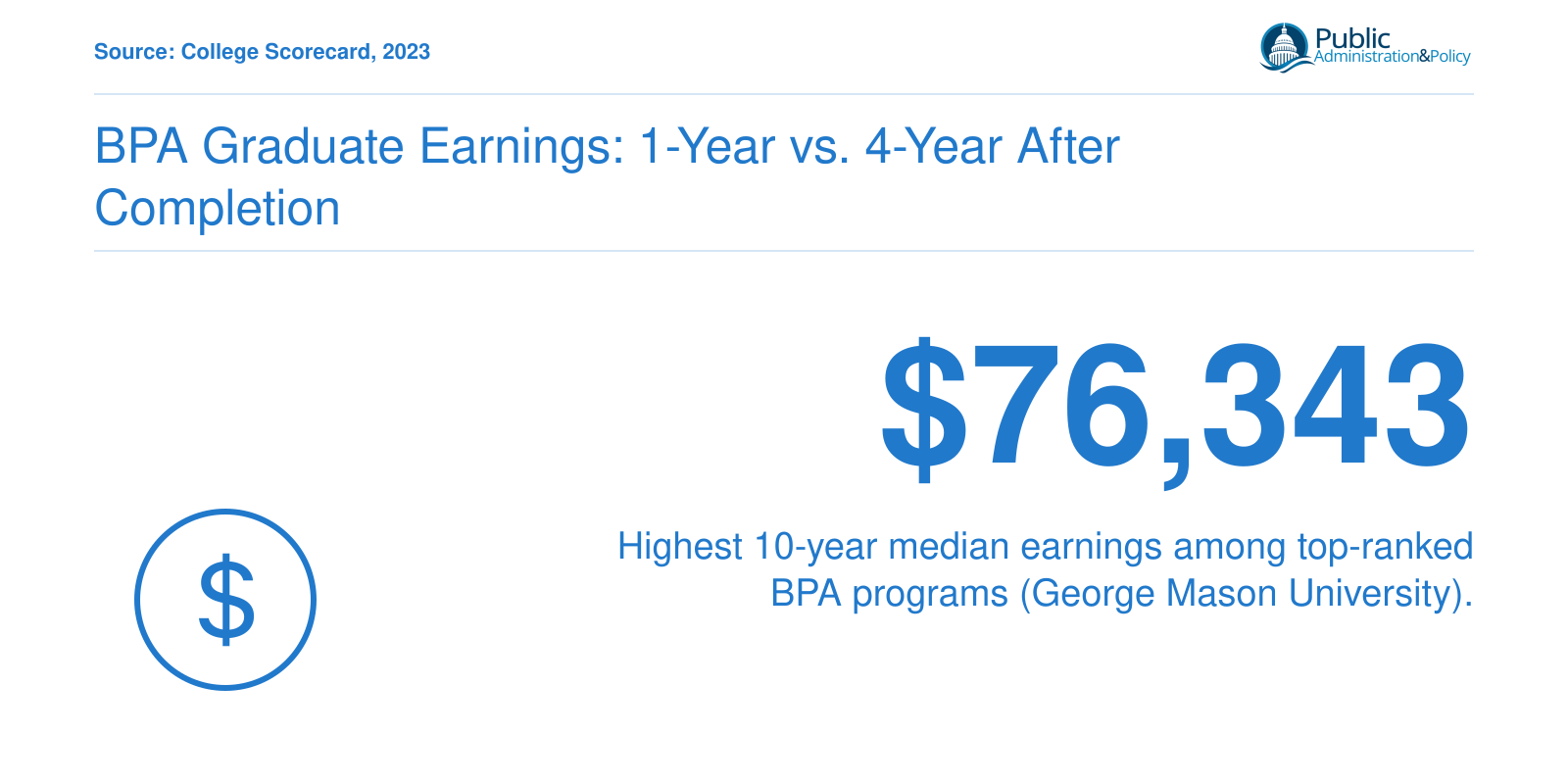
Program-level earnings data (such as median wages one year or four years after completion) are not yet published for the online BPA programs in our rankings. However, institution-wide data offers a useful proxy. Across the ten highest-scoring schools on our list, median earnings ten years after enrollment range from roughly $61,500 to $76,300. Schools like George Mason University sit at the top of that range, while California Baptist University anchors the lower end. Keep in mind that these figures reflect all graduates of the institution, not only public administration majors, so your individual trajectory will depend on your career path, location, and whether you pursue graduate study.

Occupation-Specific Salary Benchmarks

Federal labor data paints a clearer picture of where BPA graduates land professionally. Four career paths stand out:

  • Budget analysts: Median annual wage of $84,940, with entry-level roles starting around $56,760 and experienced professionals earning up to $131,630.1 Job growth is projected at about 1% from 2024 to 2034, reflecting steady but limited demand.2
  • Administrative services managers: Oversee facilities, records, and operational functions across agencies and organizations, with median pay well above the national average for all occupations.
  • Management analysts (policy analysts): Help organizations improve efficiency and implement new policies, a role that draws heavily on the analytical skills a BPA curriculum develops.
  • Urban and regional planners: Work at the intersection of land use, community development, and public policy, a growing field as cities adapt to population shifts and climate challenges.

Budget analysis and administrative services management tend to offer the highest starting salaries among these four tracks, while planning roles often appeal to graduates who want a direct hand in shaping communities. If you are considering the management analyst path, our guide on how to become a policy analyst breaks down the skills and credentials employers expect. Those drawn to planning work can also explore our urban policy planner career overview.

Evaluating Return on Investment

Median student debt at completion across our ranked programs ranges from approximately $16,550 (California State University, Chico) to roughly $26,800 (University of New Hampshire). A useful rule of thumb: if your total debt at graduation is less than your expected first-year salary, the degree is generally considered a sound financial investment.

You can build a quick debt-to-earnings ratio by dividing your anticipated loan balance by projected annual earnings. A ratio below 1.0 signals manageable debt. For example, a graduate of CSU Chico carrying about $16,550 in debt and entering a budget analyst role near the national median would see a ratio well under 0.25, an exceptionally strong position.

Institution-wide graduation rates included in our scorecard data are not program-specific, so they should be treated as directional rather than definitive. Still, pairing debt figures with occupation-level salary benchmarks gives you a realistic framework for comparing programs and making a confident enrollment decision.

BPA Graduate Earnings: 1-Year vs. 4-Year After Completion

One of the most common questions prospective BPA students ask is how quickly salaries grow after graduation. While institution-level median earnings at 10 years post-enrollment are available for these top programs, program-level earnings at the 1-year and 4-year marks after completion are not yet published for the public administration programs listed here. The 10-year institutional figure below reflects the highest earner among the programs we ranked and gives a useful benchmark for long-term earning potential.

George Mason University leads ranked BPA programs with $76,343 median earnings 10 years after enrollment, per 2023 College Scorecard data

BPA vs. Related Degrees: Public Policy, Political Science, and Business

Choosing between a Bachelor of Public Administration and its closest relatives depends on where you want to work and how you prefer to solve problems. The table below breaks down four popular degree paths across the dimensions that matter most, so you can match your goals to the right program. If you see yourself managing budgets, leading teams, and delivering services in government or nonprofits, the BPA is purpose built for that role.

DimensionBachelor of Public Administration (BPA)BA/BS Political ScienceBachelor in Public PolicyBachelor of Business Administration (BBA)
Core Curriculum FocusPublic budgeting, organizational leadership, administrative law, program managementPolitical theory, comparative government, constitutional law, research methodsPolicy analysis, economics, statistics, program evaluationAccounting, marketing, finance, operations management
Applied vs. Theoretical OrientationHighly applied and management oriented, with capstone projects tied to real agenciesTheory and research oriented, emphasizing analytical writing and debateBlends theory with applied evaluation; heavier quantitative modeling than political scienceApplied and management oriented, but centered on private sector profit models
Quantitative RigorModerate: budgeting, basic statistics, performance measurementLow to moderate: survey design and introductory statisticsHigh: econometrics, cost benefit analysis, data visualizationModerate to high: financial analysis, managerial accounting, business analytics
Typical Entry Level CareersCity manager trainee, budget analyst, grants coordinator, nonprofit program directorLegislative aide, policy research assistant, campaign analyst, paralegalPolicy analyst, government research associate, program evaluatorManagement trainee, financial analyst, marketing coordinator, operations associate
Common Graduate School PathwaysMaster of Public Administration (MPA), Master of Public Policy (MPP)Law school (JD), PhD in political science, MPPMPP, PhD in public policy or economics, MPAMaster of Business Administration (MBA), MS in Finance or Analytics
Best Fit ForStudents who want to manage public sector or nonprofit operations from day oneStudents drawn to research, legal careers, or academic scholarship in governmentStudents who enjoy data driven problem solving and want to design or evaluate programsStudents aiming for corporate management, entrepreneurship, or private sector leadership

Admissions Requirements and Transfer Credit Policies

Getting into an online bachelor of public administration program is more straightforward than many prospective students expect. Most online BPA programs cater to working adults and transfer students, so admissions criteria tend to be accessible rather than exclusionary. Here is what to anticipate as you prepare your application.

GPA and Testing Requirements

Minimum GPA thresholds for online BPA programs typically fall between 2.0 and 2.5. Open-access institutions such as Northwest Missouri State University require a 2.0 cumulative GPA2, while more selective programs like Texas State University set the bar at 2.5.1 Standardized test scores (SAT or ACT) are optional at most schools offering online public administration degrees in 2026, and many have dropped the requirement entirely.1 International applicants should plan for an English proficiency exam, with most programs expecting a TOEFL score in the 78 to 80 range.1

Institution-wide acceptance rates can give you a rough sense of selectivity. For example, the University of Central Florida admits about 40 percent of applicants, while George Mason University and the University of New Hampshire accept closer to 88 percent. Keep in mind that these figures reflect the full university, not the public administration department specifically, so your actual chances may differ.

Transfer Credit Pathways

Many accredited online BPA programs are structured as 2+2 completion degrees, meaning they are designed for students who already hold an associate degree in general studies, government, or a related field. Community college graduates can typically transfer 60 to 75 credits, and some programs accept up to 90 transfer credits toward the 120 credits required for graduation.1 Texas State University, for instance, allows 60 to 75 credits from a two-year institution while requiring at least 30 credits be completed in residence.1 Florida International University recommends entering with an Associate of Arts degree, which maps cleanly onto its upper-division public administration coursework.

Before you apply, request a preliminary credit evaluation. Transfer guides published by programs like those at the University of Houston-Clear Lake and the University of Colorado Denver can help you identify which courses will count and which gaps remain. If you are considering graduate study later, the trend toward test-optional admissions continues at that level as well, with many No-GRE MPA programs available nationwide.

Credit for Prior Learning

Online BPA programs serving adult learners frequently offer credit for prior learning, a pathway that can shave a semester or more off your timeline.3 Common options include:

  • CLEP and DSST exams: Standardized tests covering subjects like American Government and Introductory Sociology that many programs accept for lower-division credit.3
  • AP and IB scores: High school exam credits that still apply if you never used them toward a previous degree.
  • ACE military credit: Service members and veterans can receive credit recommendations through the American Council on Education for military training and occupational experience.
  • Portfolio-based assessment: Some institutions evaluate professional work samples, certifications, or documented on-the-job training and award credit accordingly.

Programs generally cap prior learning credit at 30 to 60 credits, ensuring that a meaningful portion of your coursework is completed within the degree program itself.3 Application fees are modest, typically ranging from $50 to $75 at schools like Texas State University, so the financial barrier to starting is low.1

If you are a transfer student or a working professional with years of relevant experience, these flexible admissions and credit policies can significantly reduce both the time and cost of earning your bachelor of public administration. You can also compare related online public administration degree options to find the program structure that best fits your background.

Online BPA Curriculum and Specializations

Whether you enroll at a large research university or a smaller regional school, online bachelor of public administration programs share a remarkably consistent core curriculum. That consistency exists for a reason: BPA coursework is designed to prepare graduates for the practical realities of managing public resources, navigating regulatory environments, and leading diverse teams in government and nonprofit settings.

Core Courses You Can Expect

Across the programs featured on publicadministrationpolicy.org, core requirements typically cluster around six to ten courses covering the foundational skills every public administrator needs:

  • Public Budgeting and Finance: Revenue structures, expenditure analysis, and the budget cycle at local, state, and federal levels.
  • Organizational Behavior in Government: How public agencies are structured, how teams function under bureaucratic constraints, and how to lead change.
  • Public Policy Analysis: Frameworks for evaluating policy proposals, cost-benefit reasoning, and stakeholder engagement.
  • Administrative Law: Legal authority of public agencies, rulemaking procedures, and due process obligations.
  • Ethics in Public Service: Accountability, transparency, conflicts of interest, and codes of conduct that distinguish government work from the private sector.
  • Research Methods and Statistics: Quantitative and qualitative techniques for program evaluation, survey design, and data-driven decision making.
  • Capstone or Internship: Nearly every ranked program concludes with an integrative experience. Some schools, like the University of New Hampshire, let students choose between a capstone project and a supervised internship. Others, such as Rutgers University-Newark, embed service-learning placements directly into the curriculum.

BA vs. BS: Choosing Your Track

Several schools, including the University of Central Florida and Eastern Oregon University, let applicants choose between a Bachelor of Arts and a Bachelor of Science in public administration. The distinction matters more than the title suggests. BA tracks typically require broader liberal arts coursework and may include a foreign language component, as seen at Florida International University and California State University, Chico. BS tracks lean into data analysis, economics, and quantitative methods, making them a stronger fit for students interested in budget analysis, program evaluation, or policy research. George Mason University's BS program, for example, emphasizes policy analysis and economics within a cohort-based structure designed for working professionals.

Available Specializations

One of the advantages of pursuing a BPA online is the range of concentrations that let you tailor the degree to a specific career path. Among the programs we reviewed, the most frequently available specializations include:

  • Nonprofit Management: Offered as a concentration at the University of Central Florida and the University of Colorado Denver, this track covers grant writing, volunteer coordination, and fundraising strategy.
  • Healthcare Administration: The University of Hawaii-West Oahu lists both healthcare administration and community health as distinct concentration options.
  • Emergency Management and Disaster Preparedness: Also available at the University of Hawaii-West Oahu, this track prepares graduates for roles in FEMA, state emergency offices, and local first-responder coordination.
  • Criminal Justice and Justice Administration: Several programs, including the University of Hawaii-West Oahu's justice administration track, bridge public administration with law enforcement leadership and correctional management.
  • Urban and Regional Planning: The University of Central Florida offers this as a dedicated concentration, pairing land-use policy with transportation and environmental planning coursework.

Nonprofit management appears most frequently across the ranked programs, reflecting strong labor market demand. Healthcare administration and emergency management round out the top three. Students drawn to public policy making will find that most specializations integrate policy coursework alongside management training.

Online vs. On-Campus: The Same Accredited Curriculum

If you are weighing an online BPA against an on-campus option, know that accredited online programs deliver the same coursework, learning outcomes, and degree designation. Eastern Oregon University, for instance, notes that online students learn from the same faculty who teach on campus. The primary difference is logistical: internship and practicum requirements can almost always be fulfilled at a government agency, nonprofit, or community organization near your home. Schools like the University of Colorado Denver require an internship unless it is formally waived, but the placement itself happens locally, not on campus. That flexibility makes the online format especially practical for working adults already employed in public service who want to formalize their skills with a recognized credential. Graduates who later pursue a master of public administration often find that their undergraduate core courses provide a strong foundation for advanced study.

The Bureau of Labor Statistics projects just 1.5 percent employment growth in government occupations from 2023 to 2033, yet a wave of retirements across state and local agencies is expected to open thousands of positions. For BPA graduates, this combination of steady demand and workforce turnover signals strong opportunity in the public sector over the coming decade.

Pathways After a BPA: MPA Programs, Fellowships, and Career Ladders

A bachelor of public administration is not a terminal credential. It is a launchpad, and the trajectory it enables depends on how deliberately you plan the next steps. Whether you pursue graduate education immediately or build experience first, the BPA opens doors across government, nonprofit, and civic sectors.

The Public Administration Career Ladder

Most BPA graduates enter the workforce as analysts, coordinators, or program assistants, earning roughly $40,000 to $52,000 in their first positions. With three to five years of experience, many advance into mid-level roles such as budget analyst, government program manager, or grants administrator, where salaries typically range from $55,000 to $75,000. Senior positions like department head, assistant city manager, or chief administrative officer generally require eight to fifteen years of progressive responsibility and often a graduate degree, with compensation ranging from $85,000 to well over $130,000 depending on jurisdiction size and geographic location.

The MPA Pipeline

A BPA is the natural feeder into a best online Master of Public Administration (MPA) degree programs, and NASPAA-accredited MPA programs actively recruit from this undergraduate pool. If you are evaluating online BPA programs, look for schools that offer 4+1 accelerated BPA-to-MPA tracks. These pathways allow you to begin graduate coursework during your senior year and finish the MPA in as little as one additional year, saving both time and tuition. Not every program offers this option, so it can be a meaningful differentiator when comparing schools.

Alternative Graduate Pathways

The MPA is not the only option. BPA graduates pursue a range of advanced degrees depending on their career interests:

  • JD: Ideal for those drawn to administrative law, regulatory compliance, or public interest litigation.
  • MPP (Master of Public Policy): Emphasizes quantitative policy analysis and is well suited to research and evaluation roles.
  • MBA with nonprofit concentration: Blends management fundamentals with mission-driven organizational strategy.
  • PhD in Public Administration: Prepares graduates for academic careers, university teaching, and advanced policy research.

Each of these paths complements the foundation a BPA provides, and choosing the right one depends on whether you gravitate toward practice, law, analysis, or scholarship. For those leaning toward the MPP route, an affordable online master's in public policy can offer a cost-effective entry into quantitative policy work.

Fellowships and Leadership Development

Competitive fellowship programs can accelerate your career dramatically. The Presidential Management Fellows (PMF) program is the federal government's flagship leadership pipeline, though it requires a graduate degree completed within the past two years. At the state and local level, many governments run their own management fellowship programs that place early-career professionals into rotational assignments across departments.

For those drawn to civic and nonprofit leadership, the Coro Fellows Program offers an intensive experiential curriculum in cities like New York, Pittsburgh, and Los Angeles. Other options include Public Allies, which places fellows in nonprofit organizations for a year of community-focused leadership development. These programs value the skills a BPA cultivates, including organizational management, stakeholder engagement, and public budgeting, and they can serve as powerful springboards into senior roles far earlier than the traditional career timeline would suggest.
How We Ranked These Online BPA Programs

Transparency matters when you are comparing degree programs that will shape your career in public service. Here is a clear look at how we built this ranking, what data informed it, and where the limitations lie.

Filtering and Scoring

We began by identifying accredited bachelor of public administration programs offered in a fully online or hybrid format. Programs that required a majority of coursework on campus were excluded. From that filtered set, each program received a composite score drawn from four weighted factors:

  • Institutional graduation rate: The share of first-time, full-time students who complete their degree within 150 percent of normal time.
  • Net price after financial aid: The average annual cost a student actually pays once grants and scholarships are applied.
  • Program-level median earnings: Post-completion earnings reported for graduates of each specific program.
  • Completion volume: The number of students finishing the program in a recent reporting cycle, which serves as a proxy for program stability and peer community size.

No single factor dominates the composite. Programs that perform well across all four dimensions rise to the top, while a weakness in one area does not automatically disqualify a school. For a deeper explanation of each weight and its rationale, see our full Rankings Methodology.

Where the Data Comes From

Earnings, debt, and graduation figures are drawn from the College Scorecard, maintained by the U.S. Department of Education. Tuition details and institutional characteristics come from the Integrated Postsecondary Education Data System (IPEDS). Both are federal datasets updated on a regular release cycle, and we refresh our rankings annually to reflect the most recent available numbers.

Important Caveats to Keep in Mind

No ranking is perfect, and a few nuances deserve your attention as you interpret the results:

  • Graduation rates reflect the institution as a whole, not the public administration program specifically. A university with a strong overall completion culture may still have variation across departments.
  • Net price is an average across all aided students. Your actual cost will depend on your financial profile, residency status, and the aid package you receive.
  • Median earnings data captures all completers of a given program, including those who went on to graduate school. An alumnus who earned an MPA and then entered the workforce at a higher salary is counted alongside someone who entered the job market immediately after finishing the bachelor's degree. This can skew earnings figures upward for programs that serve as strong pipelines to advanced degrees.

Editorial Independence and Annual Updates

This ranking is editorially independent. No school can pay for placement or influence its score. Our team reviews and republishes the list each year when the Department of Education releases updated Scorecard data, ensuring you are always working with the latest available information. If a program's outcomes improve or decline meaningfully, its position in the ranking will shift accordingly.

Used together with your own priorities, such as schedule flexibility, specialization options, or state residency benefits, this methodology gives you a data-grounded starting point for one of the most consequential decisions in your public service career.

Common Questions About Online BPA Degrees

Prospective students often have similar questions when researching online bachelor of public administration programs. Below, we address the most frequently asked questions using current labor market data and admissions trends to help you make an informed decision.

A bachelor of public administration (BPA) degree prepares students to manage and lead within government agencies, nonprofits, and public sector organizations. Coursework typically covers public budgeting, organizational management, policy analysis, ethics, and administrative law. Some programs offer a Bachelor of Arts (BA) track while others award a Bachelor of Science (BS) in public administration, but both equip graduates with the analytical and leadership skills needed for public service careers.

Earnings vary by role and experience, but the Bureau of Labor Statistics reports that social and community service managers earned a median annual salary of roughly $74,000 as of the most recent data, while administrative services managers earned approximately $104,000. Entry-level positions in local government or nonprofit management generally start lower, but salaries tend to rise steadily with experience, certifications, and advanced education.

A BPA focuses on the practical skills of managing public organizations: budgeting, human resources, program evaluation, and operations. A political science degree emphasizes theory, political systems, governance structures, and policy debate. If you want to run a city department or manage a nonprofit, a BPA is typically more applied. If you are drawn to research, law school, or legislative analysis, political science may be the stronger fit.

Yes, provided you choose a regionally accredited program. Online BPA degrees offer the same curriculum as on-campus counterparts and are widely accepted by public sector employers. Many programs also include capstone projects or internship components that build real-world experience. For working professionals already in government or nonprofit roles, an online format makes it possible to earn a degree without stepping away from a career.

Most online BPA programs require a high school diploma or GED, a minimum GPA (often 2.0 to 2.5), and official transcripts. Some universities ask for a personal statement or letters of recommendation. Many programs accept transfer credits from community colleges, and several have generous transfer policies that allow up to 90 credits. Standardized test scores like the SAT or ACT are increasingly optional.

BPA graduates pursue careers in city and county management, public budgeting, emergency management, human services coordination, nonprofit leadership, and healthcare administration. Common job titles include city manager, program analyst, budget analyst, grant coordinator, and community development specialist. Federal, state, and local governments are among the largest employers, though many graduates also find roles in NGOs and private consulting firms.

Not always, but a Master of Public Administration (MPA) can accelerate career growth significantly. Many senior leadership positions, such as city manager or agency director, list an MPA as preferred or required. Some employers offer tuition assistance for graduate study. If you plan to stay in mid-level roles or specialize early through certifications (such as the Certified Public Manager credential), a bachelor's degree combined with experience can still take you far.

More Online BPA Programs to Consider

Beyond our top ten, these additional programs offer flexible online BPA options across the country. Each school has unique strengths, whether you're a working professional seeking a degree completion track or a transfer student looking for an affordable path into public service.

Lipscomb University
Offers an online BPA through a Business Management & Leadership program with a Public Administration concentration. Asynchronous 8-week courses allow completion in 18–36 months, and up to 94 transfer credits are accepted.
Tarleton State University
A Bachelor of Applied Arts and Sciences in Public Administration designed for working professionals with prior public sector experience. Awards 12–33 credits for documented training in fire service, law enforcement, or military.
Fairleigh Dickinson University-Metropolitan Campus
BA degree completion program with a specialization in public administration. Hybrid format combines online and off-campus New Jersey locations, with accelerated 8–10 week courses and rolling admissions.
Fairleigh Dickinson University
Another BA degree completion program specializing in public administration, also hybrid with online and off-campus options. Features reduced tuition and generous transfer policies for prior college and experiential learning.
Eastern Oregon University
Online Bachelor's in Politics, Policy and Public Administration with a rural-informed global perspective. Accepts up to 135 transfer credits and offers both B.S. and B.A. options.
California Baptist University
Online BA in Public Administration with 100% asynchronous coursework. Classes start every 8 weeks, and the 48-unit program can be completed in as little as 16 months full-time.
National University
Bachelor of Public Administration offered online, in-person, or hybrid. No application fee or entrance exams; year-round enrollment and transfer-friendly policies make it accessible for adult learners.
University of Maine at Augusta
BS in Public Administration prepares students for administrative careers in government and nonprofits. The 121-credit curriculum covers public budgeting, human resources, and program evaluation.
Flagler College
Bachelor of Public Administration degree completion program for professionals with an A.A. or 60 transferable credits. Courses available online or on-campus in St. Augustine, Florida.
Rutgers University
BA in Public and Nonprofit Administration from the School of Public Affairs and Administration. Fully online with a curriculum emphasizing policy analysis, evidence-based decision-making, and community engagement.
University of New Hampshire College of Professional Studies Online
Online BS in Public Administration covering public sector finance, HR, grant writing, data analytics, and ethics. Includes a capstone internship or project for real-world experience.
Marshall University
Online BA in Public Administration & Policy with core courses in public management, budgeting, and governance. Designed for careers in government, nonprofits, and policy analysis.
Dalton State College
Online BS in Organizational Leadership with a concentration in Public Service Administration. Covers public administration, human resource management, and finance.
University of Houston-Downtown
BAAS in Applied Administration with a concentration in Applied Public Administration and Leadership. Targets experienced public sector professionals with reduced tuition and 8-week terms.
Franklin University
100% online Bachelor of Public Administration for working adults. Focuses on practical public sector management, policy analysis, and leadership skills with flexible scheduling.

Recent Articles