Best Online Ph.D. in Public Policy Degree Programs for 2026

Compare top-ranked programs by cost, career outcomes, and flexibility for working professionals.

By Carrie HirschReviewed by PAP Editoral TeamUpdated June 7, 202625+ min read

What you’ll learn in this article…

  • Only 157 public policy doctorates were awarded nationally in 2024, giving graduates a rare competitive edge in the job market.
  • Most online Ph.D. in public policy programs take four to seven years for the part-time working professionals who typically enroll.
  • Several ranked programs now offer no-GRE admission paths, broadening access for experienced policy professionals.
  • Annual in-state tuition across the 2026 list ranges widely, making funding strategy and employer sponsorship critical planning steps.

The National Science Foundation counted just 157 doctorates awarded in public administration and public policy across all U.S. institutions in its most recent survey, making this one of the smallest doctoral cohorts in the social sciences. Demand for that credential, however, keeps growing: federal agencies, state policy offices, university departments, and large nonprofits increasingly expect research-fluent leaders who can design and evaluate programs at scale. Fully online and hybrid Ph.D. programs now let working professionals pursue that expertise without relocating or leaving mid-career roles.

The tension is real. Tuition can range from roughly $11,000 to over $50,000 per year, timelines stretch from three to seven years depending on enrollment pace, and admissions hurdles vary from full GRE requirements to No-GRE MPP pathways. Choosing the wrong program means years of misallocated effort in a field where credential fit matters as much as credential prestige.

Ranked: Best Online Ph.D. in Public Policy Programs

The following online and hybrid doctoral programs in public policy and administration are ordered by a mixed quality composite that weighs institutional outcomes, program design, and return on investment rather than cost or speed alone. Because fully online Ph.D. programs in public policy remain relatively rare, several entries use a hybrid model that pairs synchronous virtual coursework with limited on-campus requirements. Program-level earnings data are not yet available for these doctoral programs, so we report institution-wide figures where they exist to give you a broader financial picture.

Factors considered
  • Institution-wide graduation and retention rates
  • Graduate earnings and debt levels
  • Online delivery flexibility
  • Program breadth and concentrations
  • Return on investment ratio
Data sources
  1. #1

    Saint Louis University

    Saint Louis, MO · $24,000/yr (net price)

    Best for: Scholars wanting multiple policy concentrations

    Saint Louis University houses one of the most concentration-rich public policy doctorates available with online coursework, offering six distinct specializations under a single Ph.D. in Public and Social Policy. Rooted in the university's Catholic Jesuit mission, the interdisciplinary curriculum develops advanced methodological skills across areas ranging from geospatial analysis to international development. Schools offering this program have graduation rates of approximately 80%, and the institution reports a 9:1 student-to-faculty ratio, signaling strong mentorship potential at the doctoral level.

    View program
    Public and Social Policy, Ph.D., Public Administration — Hybrid
    • Six concentrations: Public Admin, Health, International Development, and more
    • Hybrid delivery with select online and in-person coursework
    • Interdisciplinary curriculum spanning multiple colleges
    • Advanced geospatial and data-science methods courses available
    • Students may combine two or more concentration areas
    • Tuition of $25,590 applies to both in-state and out-of-state students
    • Prepares graduates for government, research, and nonprofit leadership
  2. #2

    Augusta University

    Augusta, GA · $8,000 – $25,000/yr

    Best for: Defense and cybersecurity policy professionals

    Augusta University launched a first-of-its-kind Ph.D. in Intelligence, Defense, and Cybersecurity Policy in fall 2025, delivered through synchronous online sessions designed for national security professionals. The 84-credit curriculum taps into the university's proximity to Fort Eisenhower and the U.S. Army Cyber Center of Excellence, giving students direct exposure to defense policy practitioners. In-state tuition starts at $6,992, making it one of the most affordable doctoral options on this list for Georgia residents.

    View program
    Public Policy — Hybrid
    • Synchronous online classes built for working defense professionals
    • 84 total credit hours with flexible elective options
    • In-state tuition of $6,992; out-of-state tuition of $21,060
    • Strong ties to military and intelligence community employers
    • First globally unique intelligence and cybersecurity policy doctorate
    • Expert faculty with national security and policy backgrounds
    • Virtual lab environments for cyber-range coursework
  3. #3

    Tennessee State University

    Nashville, TN · $9,000 – $22,000/yr

    Best for: Working professionals seeking a fully online cohort

    Tennessee State University offers a fully online Ph.D. in Public Policy and Administration built around a cohort model with synchronous evening seminars. As the only public university in Tennessee delivering this doctorate entirely online, TSU is particularly well suited for working professionals who need a predictable schedule and structured research pipeline. The HBCU provides GRE waiver options and an eRate tuition discount for out-of-state online students, keeping costs manageable.

    View program
    PhD in Public Policy and Administration — Online
    • 100% online delivery with synchronous evening core classes
    • 12 required courses plus dissertation research credits
    • GRE waiver options available for qualifying applicants
    • Out-of-state eRate discount for fully online students
    • In-state tuition of $11,188; out-of-state tuition of $23,808
    • Cohort-based model with limited annual admissions
    • Prepares graduates for academic, research, or senior management roles
  4. #4

    Walden University

    Minneapolis, MN · $34,000/yr (net price)

    Walden University's fully online Ph.D. in Public Policy and Administration follows a scholar-practitioner model that lets students apply coursework directly to their home communities and workplaces. With 73 quarter credits, a completion window of three to eight years, and virtual residency options, the program offers maximum scheduling flexibility. Walden does not require the GRE, and a $5,000 grant is available for eligible students, which can offset tuition of $700 per quarter credit.

    View program
    PhD in Public Policy and Administration — Online
    • Fully online format with virtual or in-person residency choices
    • 73 quarter credits; typical completion in 3 to 8 years
    • No GRE required for admission
    • $5,000 grant available for eligible students
    • Tuition of $700 per quarter credit
    • Dissertation required alongside leadership and ethics coursework
    • Doctoral Degree Coach assigned to support milestone progress
  5. #5

    Lipscomb University

    Nashville, TN · $25,000/yr

    Lipscomb University's Ph.D. in Leadership and Policy with a public service leadership and policy concentration is a compact, 63-credit-hour hybrid program designed to be completed in about three years. The Nashville-based university blends online distance learning with periodic on-campus intensives, and students can earn a Master of Science in Leadership and Policy en route to the doctorate. Schools offering this program have graduation rates of roughly 72%, and a 13:1 student-to-faculty ratio supports personalized mentoring.

    View program
    Doctor of Philosophy in Leadership and Policy, public service leadership and policy — Hybrid
    • 63 credit hours with a targeted three-year completion timeline
    • Hybrid format: online coursework plus weekend or intensive sessions
    • Concentration in public service leadership and policy
    • Master of Science in Leadership and Policy earned en route
    • Tuition of $17,334 for both in-state and out-of-state students
    • Problem-of-practice dissertations embedded in students' agencies
    • Interdisciplinary curriculum spanning education, health, and government
  6. #6

    Old Dominion University

    Norfolk, VA · $13,000 – $34,000/yr

    Old Dominion University's Ph.D. in Public Administration and Policy, housed in the School of Public Service, combines a rigorous 49-credit-hour curriculum with strong online infrastructure through ODUOnline. Faculty regularly involve doctoral students in applied policy research contracts for Virginia state agencies, and many core courses are offered in synchronous online format during evening hours. The program is especially noted for strengths in coastal resilience, environmental policy, and emergency management.

    View program
    Public Administration and Policy (PhD) — Hybrid
    • 49 credit hours including core, research, electives, and dissertation
    • Hybrid delivery with many courses available synchronously online
    • In-state tuition of $15,390; out-of-state tuition of $36,174
    • Emphasis on quantitative and qualitative research methods
    • Strong applied research ties to Virginia government agencies
    • Minimum 3.0 GPA required throughout the program
    • Remote comprehensive exams and defenses available
  7. #7

    California Baptist University

    Riverside, CA · $25,000 – $30,000/yr

    California Baptist University delivers a fully online Doctor of Public Administration designed for working professionals who want to finish in approximately three years. The program integrates evidence-based practice with ethical leadership training, drawing on CBU's Christian worldview while maintaining a global perspective on public administration challenges. Schools offering this program have graduation rates of about 62%, and CBU's designation as a Hispanic-Serving Institution reflects a diverse student body.

    View program
    Doctor of Public Administration — Online
    • 100% online format with flexible coursework for professionals
    • Three-year expected completion timeline
    • Tuition of $15,562 for both in-state and out-of-state students
    • Focus on ethical leadership and policy innovation
    • Interdisciplinary collaboration across public administration sectors
    • Christian worldview integrated into curriculum
  8. #8

    Claremont Graduate University

    Claremont, CA

    Claremont Graduate University's Doctor of Public Policy is a practice-oriented hybrid doctorate that replaces the traditional dissertation with a capstone project and eliminates qualifying exams entirely. The 64-unit program requires a master's degree and at least three years of professional experience for admission, attracting a cohort of seasoned policy practitioners. With spring, summer, and fall start dates, students can enter the program on a schedule that aligns with their career demands.

    View program
    Doctor of Public Policy — Hybrid
    • 64 units at $2,070 per unit; 3 to 4 years full time
    • Hybrid modality with online flexibility and on-campus sessions
    • No dissertation or qualifying exams required
    • Capstone and practicum replace traditional dissertation
    • Requires a master's degree and three years of work experience
    • Spring, summer, and fall start dates available
    • Core areas include policy analysis, research methods, and transdisciplinary study

How We Ranked These Online Public Policy Doctoral Programs

Transparency matters when you are deciding where to invest years of doctoral study and tens of thousands of dollars. Here is exactly how we built the rankings you see on this page, what data drives each score, and what we deliberately left out. For a deeper look at our approach, see our full Rankings Methodology.

Programs We Included

We started by filtering for doctoral programs in public policy and closely related fields that offer fully online or hybrid delivery, meaning you can complete most or all coursework remotely. Programs requiring full-time, on-campus residency throughout were excluded. From there, each qualifying program was scored on a composite index built from three institution-level and program-level data points.

What the Composite Measures

Our scoring composite weighs three dimensions:

  • Affordability: We used a sector-conditional average net price drawn from federal data. This figure is an approximate benchmark, not a personalized quote. Your actual cost will vary based on residency status, financial aid, and enrollment intensity.
  • Completion track record: Graduation rates come from IPEDS and reflect the institution as a whole, not a single doctoral program. While imperfect, this metric signals whether a university supports students through to degree completion at a broad level.
  • Post-completion earnings: We anchored the return-on-investment dimension to program-level earnings data from the College Scorecard, drawing on outcomes measured at one, two, four, and five years after completion where available. These figures give a concrete, federal-data-backed picture of what graduates actually earn.

Together, these three pillars balance what you pay, whether students finish, and what earning power the credential delivers.

What the Ranking Does Not Cover

We intentionally excluded several factors that matter but are better addressed in their own sections. Admission selectivity, GRE requirements, and curriculum content do not influence a program's rank here. You will find detailed GRE and GPA thresholds in the admissions table later in this article, and curriculum breakdowns in the section on typical coursework. This separation keeps the ranking focused on measurable outcomes rather than blending in subjective or highly variable admissions criteria.

No ranking replaces your own due diligence. Use these scores as a starting framework, then dig into the factors that matter most to your career goals, schedule, and budget.

What Can You Do with a Ph.D. in Public Policy?

A doctorate in public policy opens doors to some of the most influential positions in government, academia, and the nonprofit sector. While program-level earnings data for these specific online doctoral programs are not yet published in federal reporting, the broader labor market signals are strong. Institutional-level median earnings ten years after enrollment at the schools featured in our ranking range from roughly $42,700 to $70,800, and those figures reflect all graduates across every program at each university, not just doctoral completers. For a clearer picture, it helps to look at occupation-level wage and employment data from the Bureau of Labor Statistics.

University Faculty and Researcher

For graduates drawn to the life of the mind, a tenure-track or research faculty position is a natural fit. Postsecondary political science teachers earned a median annual wage of $83,640 as of 2023.1 With projected job growth of about 4 percent over the 2023 to 2033 decade, openings remain steady as institutions replace retiring faculty and expand interdisciplinary policy programs. Online Ph.D. holders who build a strong publication record during their studies are competitive candidates for these roles at research universities, teaching colleges, and policy institutes alike.

Senior Government Policy Analyst

Political scientists, many of whom hold doctoral degrees, earned a median salary of $139,380 in 2024.2 Total employment in this category is relatively small (about 6,500 jobs nationally), and the BLS projects a slight contraction of roughly 3 percent through 2033. That said, demand within federal agencies, state legislatures, and international bodies remains concentrated among candidates with advanced quantitative and analytical training. Graduates who bring both the research rigor of a Ph.D. and hands-on experience from an online program designed for working professionals are well positioned to compete for these high-paying roles. Those interested in this career track can learn more about how to become a policy analyst.

Think-Tank Fellow and Policy Advisor

Major policy research organizations, from Brookings and RAND to smaller regional think tanks, rely on doctoral-trained analysts to produce the white papers, cost-benefit analyses, and program evaluations that shape legislation. Compensation varies widely by organization size and geography, but senior fellows at well-funded institutions often earn salaries comparable to those of political scientists. The analytical and methodological skills developed in a public policy and administration salary-competitive Ph.D., particularly in econometrics, program evaluation, and qualitative case study design, are exactly what these employers seek. For a deeper look at this career path, see our guide on How to Become a Think Tank Analyst.

Nonprofit and NGO Executive Leadership

Nonprofit and nongovernmental organizations increasingly look for executive directors and chief strategy officers who can translate evidence into action. A doctorate signals the ability to design rigorous evaluations, secure grant funding, and communicate findings to policymakers and donors. While salaries for nonprofit executives range broadly depending on the organization's budget, senior leaders at mid-size to large NGOs frequently earn six-figure compensation, and the strategic credibility a Ph.D. confers can accelerate advancement.

Do Graduates Actually Find Work?

One common concern about doctoral programs is whether they lead to employment or simply extend time in academia. Program-level employment outcomes for these specific online doctorates have not yet been released by the federal College Scorecard, but the career trajectories described above, and the fact that most of these programs are explicitly designed for working professionals who continue employment throughout their studies, suggest strong workforce attachment. Programs like Walden University's Ph.D. in Public Policy and Administration and Tennessee State University's synchronous online doctorate both emphasize a scholar-practitioner model, meaning students typically remain employed in policy-relevant roles while completing their degrees.

Whether your goal is to shape national legislation from a federal agency, publish research that reframes how we think about inequality, or lead a nonprofit tackling community health, an online Ph.D. in public policy equips you with the credentials and skills to operate at the highest levels of influence.

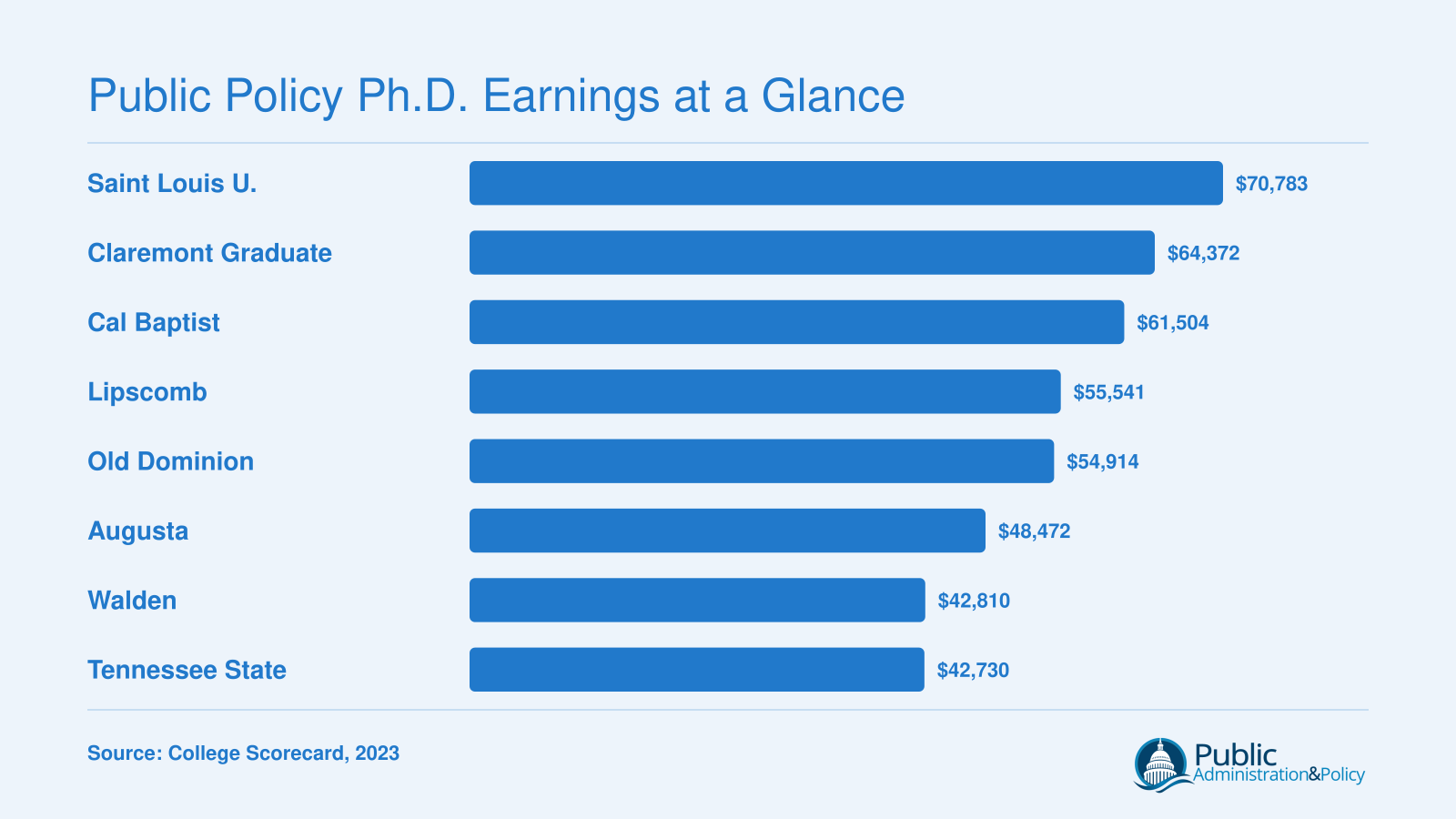
Public Policy Ph.D. Earnings at a Glance

How do median earnings compare across the top online public policy doctoral programs? The chart below shows institution-level median earnings ten years after enrollment for each school. Program-level earnings at one year and four years post-completion are not yet available for these doctoral programs, so we present the broader institutional figures as a useful benchmark for prospective students.

Median earnings ten years after enrollment at eight public policy doctoral programs, ranging from $42,730 to $70,783

Questions to Ask Yourself

Your goal shapes which program fits best. Practitioners often benefit from applied policy dissertations and flexible cohort models, while aspiring faculty need programs with strong research mentorship and publishing support.

Many federal, state, and nonprofit employers offer education benefits that can offset doctoral costs significantly. Confirming these options before you enroll can reduce out of pocket debt by tens of thousands of dollars.

Even part-time online formats require sustained weekly effort, and the dissertation phase demands self-directed research over multiple semesters. Underestimating this timeline is one of the most common reasons doctoral students stall or withdraw.

How Long Does an Online Ph.D. in Public Policy Take?

The honest answer is: it depends on your enrollment status, your life circumstances, and how quickly you can move through your dissertation. Most programs advertise a 3-to-5-year timeline for full-time students, but online doctoral students are overwhelmingly part-time working professionals. For that population, five to seven years is a more realistic window, and some programs allow up to eight years to finish.2

To set expectations, consider the national benchmarks. The median time to degree across all doctoral fields was 7.2 years as of 2022, while public affairs doctorates (across all modalities) averaged roughly five to six years.3 Online-heavy institutions reported an average completion time of about 7.3 years in 2021.2 These figures include students who started full-time and those who juggled careers alongside coursework, so they capture the full spectrum of experiences you might encounter.

Three Phases of the Degree

Virtually every online Ph.D. in public policy follows a three-phase structure, and understanding each phase helps you plan realistically.

  • Coursework (roughly 2 to 3 years): You will complete seminars in policy making, research methods, quantitative and qualitative analysis, and your chosen specialization area. Part-time students typically take one or two courses per term, stretching this phase toward the longer end.
  • Comprehensive exams or qualifying milestones (1 to 2 semesters): After coursework, most programs require written or oral qualifying examinations, a portfolio review, or a dissertation proposal defense before you advance to candidacy.
  • Dissertation research and defense (1 to 3 years): This is the longest variable in the equation. The dissertation phase has no fixed course schedule, so progress depends almost entirely on your discipline, your committee's responsiveness, and your access to data. Programs with structured dissertation seminars and milestone deadlines tend to keep candidates on track.

Why ABD Attrition Matters

Nationally, only about 57 percent of doctoral students complete their degree within ten years.2 Many of those who leave do so after finishing coursework but before defending their dissertation, a status commonly known as ABD (all but dissertation). The dissertation phase is where isolation, competing work demands, and unclear timelines converge. When evaluating programs, pay close attention to the dissertation support structures each school offers. Cohort-based models, dedicated dissertation advisors, and regular milestone check-ins all correlate with higher completion rates.

Can You Shorten the Timeline?

If you already hold a master's degree in public policy, public administration, or a closely related field, some programs will accept transfer credits that shave a semester or two off your coursework phase. The savings are modest, typically 9 to 15 credit hours, but they can meaningfully accelerate your path to candidacy. Ask admissions offices specifically which credits transfer before assuming any will.

The bottom line: plan for at least five years if you are working while enrolled, budget your time and energy for the dissertation as carefully as you budget tuition, and choose a program whose structure is designed to push you across the finish line rather than leave you stranded in candidacy.

Online Ph.D. in Public Policy Admissions: GRE, GPA, and No-GRE Options

Admissions requirements for doctoral programs in public policy vary significantly from school to school. Some programs still require the GRE, others accept alternative credentials, and a handful have dropped the requirement entirely. The table below summarizes known policies at several prominent programs, but always verify details directly with each university's admissions office, as policies can change between application cycles. For accreditation standards and broader admissions benchmarks, consult NASPAA (the Network of Schools of Public Policy, Affairs, and Administration). The Bureau of Labor Statistics (BLS.gov) is also useful for understanding the typical qualifications expected in public policy careers, though it does not track individual program requirements. Note that programs advertising "no GRE" may still require scores for conditional or full admission in certain circumstances, so contact the department to confirm.

University / ProgramGRE PolicyMinimum GPAMaster's Degree Required?Key Admissions Notes
American University, PhD in Public Administration and PolicyRequired3.20N/AFall admission only; full-time only
UT Austin LBJ School, PhD in Public PolicyRequiredN/ANoTOEFL required for international applicants; IELTS not accepted
Duke University, PhD in Public PolicyRequiredN/ANoGMAT not accepted; GRE Subject test is optional
Harvard Kennedy School, PhD in Public PolicyRequiredN/AN/ATOEFL or IELTS required if applicable
Georgetown University, PhD in GovernmentNot requiredN/AN/AApplications without GRE scores are acceptable and not penalized; residential program (not online)
Ohio State University Glenn College, PhDRequired3.00N/ADomestic deadline Dec. 1; international deadline Nov. 1
University of Washington Evans School, PhD in Public Policy and GovernanceNot requiredN/AN/AGMAT may substitute for GRE; applicants must submit either GRE scores or a quantitative/analytic resume

Cost and Funding for Online Public Policy Doctoral Programs

Understanding the full cost picture before committing to an online Ph.D. in public policy is essential, especially when you are likely balancing tuition bills against a mortgage, family obligations, or existing student debt. The programs on our 2026 list span a wide range, and several strategies can bring the net price well below the published sticker figure.

Tuition Ranges Across Ranked Programs

Annual tuition for the online and hybrid doctoral programs we reviewed ranges from roughly $6,992 (Augusta University, in-state) to $36,174 (Old Dominion University, out-of-state). Private institutions such as Saint Louis University ($25,590) and Lipscomb University ($17,334) charge the same rate regardless of where you live. An important detail for out-of-state applicants: many public universities now extend in-state or discounted e-rates to online students. Tennessee State University, for example, offers an eRate tuition discount for out-of-state online learners, which can cut costs significantly compared to its published out-of-state rate of $23,808. Always confirm residency pricing directly with the program, because policies vary and can change from year to year.

What Students Actually Pay

Sticker tuition rarely tells the whole story. Institution-level net price averages (which factor in grants and scholarships) range from about $13,787 at Augusta University to $33,817 at Walden University. Keep in mind that these net price figures reflect a campus-wide average across all degree levels and student populations, so your individual cost at the doctoral level may differ. Median borrowing at graduation across these schools falls between roughly $19,500 and $27,000, though program-level debt and monthly repayment figures are not yet reported for these specific doctoral programs.

Funding Strategies Worth Exploring

Because most online public policy doctoral students are working professionals, employer tuition reimbursement is often the single most impactful funding lever. Federal agencies, state governments, and many nonprofits offer annual reimbursement benefits that can cover a substantial share of per-credit costs. If you are earlier in your academic journey and weighing whether a doctorate is the right next step, comparing costs against an affordable online master's in public policy can help clarify the investment. Beyond employer support, consider the following:

  • Federal graduate loans: Direct Unsubsidized and Grad PLUS loans remain available to doctoral students enrolled at least half-time, regardless of delivery format.
  • Institutional grants: Some programs build in their own incentives. Walden University, for instance, advertises a $5,000 grant for eligible doctoral students.
  • Graduate assistantships and fellowships: Availability for fully online students is limited at most institutions. Hybrid programs with on-campus residency components occasionally offer research or teaching assistantships, but competition is stiff. If assistantship funding is a priority, ask the program coordinator directly before you apply.
  • State employee fee waivers: Tennessee State University and several other public universities offer tuition waivers for state government employees, a benefit that stacks well with federal financial aid.

The Monthly Debt Reality

Before signing a promissory note, run the numbers on what repayment actually looks like. On a standard 10-year repayment plan, a median graduate debt load in the $20,000 to $27,000 range translates to roughly $200 to $310 per month, depending on the interest rate at the time of disbursement. That is manageable for many mid-career professionals, but it adds up alongside any existing undergraduate debt. Income-driven repayment plans and Public Service Loan Forgiveness can further reduce the long-term burden for graduates who work in government or qualifying nonprofit roles, a common career path for public policy Ph.D. holders. Students who are also considering a closely related online Ph.D. in Public Administration should run the same comparison, since credit requirements and timelines can differ.

The bottom line: compare total program cost (tuition multiplied by the number of years to completion), not just the annual rate. A program with lower per-credit tuition but a longer timeline can end up costing more than a higher-priced program designed for three-year completion.

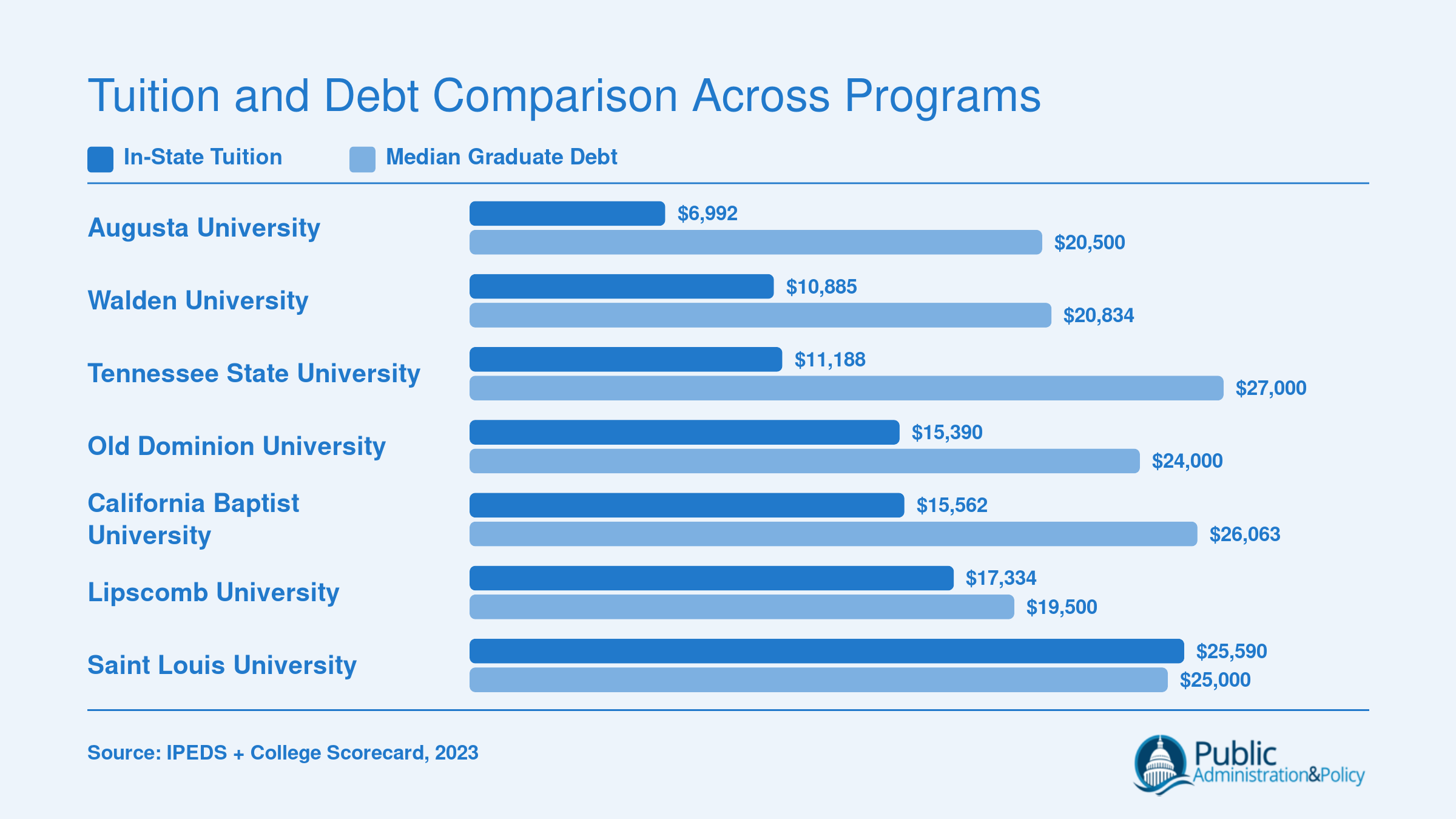
Tuition and Debt Comparison Across Programs

How do graduate tuition rates and institution-level median debt stack up across top online public policy doctoral programs? The chart below places annual in-state tuition alongside each school's median graduate debt so you can compare sticker-price costs at a glance. Keep in mind that these are degree-aware graduate tuition figures reported to federal databases; your actual net price after institutional aid, fellowships, and assistantships may be significantly lower.

Grouped bar chart comparing annual in-state tuition and median graduate debt for seven online public policy doctoral programs, ranging from $6,992 to $25,590 in tuition

Typical Curriculum in an Online Ph.D. in Public Policy

An online Ph.D. in public policy is not simply a collection of graduate seminars. The coursework is structured to build a layered skill set that prepares you to produce original research, lead policy initiatives, and advise decision-makers at every level of government and the nonprofit sector. Rather than listing individual course titles, it helps to understand the curriculum through the four pillars most programs share.

Four Core Pillars of Coursework

The first pillar, quantitative methods and research design, anchors the degree. Expect coursework in advanced statistics, econometrics, causal inference, and mixed-methods research. These courses equip you to design rigorous studies and analyze data sets that inform real public policy making decisions.

The second pillar is policy analysis and evaluation. Here you learn to assess the costs, benefits, and unintended consequences of existing and proposed policies. Program evaluation techniques, benefit-cost analysis, and evidence-based policymaking frameworks sit at the center of this track.

Governance and institutions form the third pillar. Courses in this area explore how political systems, bureaucratic structures, regulatory agencies, and intergovernmental relationships shape the policy process. Understanding institutional dynamics is essential whether you plan to work inside government or influence it from the outside.

Finally, a specialization or elective track lets you tailor the degree to your career goals. Common concentrations include health policy, education policy, urban policy, environmental policy, and nonprofit management. Choosing a specialization early can accelerate your dissertation timeline and position you for targeted roles in think tanks, federal agencies, or advocacy organizations.

The Dissertation as Capstone

The dissertation is the defining element of any doctoral program, and in public policy it must represent an original contribution to the field. Most programs require you to pass qualifying or comprehensive exams before advancing to candidacy, a milestone that signals you are ready to shift from coursework to independent research. Dissertations in public policy often tackle pressing societal questions, from the effectiveness of housing voucher programs to the equity impacts of state-level education funding formulas.

Dissertation Support for Remote Learners

One legitimate concern for online doctoral students is whether they will receive adequate mentoring at a distance. Programs have responded with several support structures designed specifically for remote learners:

  • Virtual cohort models: You progress through coursework and milestones alongside a fixed group of peers, building a network that sustains you through the dissertation phase.
  • Assigned dissertation chairs: Faculty advisors are matched with you based on research interests, and regular video meetings replace traditional office hours.
  • Online writing workshops: Structured writing groups meet on a recurring schedule to review drafts, troubleshoot methodology questions, and maintain accountability.
  • Milestone-based check-ins: Programs set formal deadlines for prospectus approval, IRB submissions, data collection, and chapter drafts to keep candidates on track and reduce time-to-completion.

Connecting Specializations to Career Paths

Your choice of elective track should align with the career outcomes discussed earlier in this article. A health policy masters concentration, for example, maps naturally to leadership roles in public health agencies, hospital systems, or health-focused research organizations. An education policy focus pairs well with positions in state departments of education, university-based research centers, or philanthropic foundations. Urban policy specialists often move into city planning departments or metropolitan governance bodies, while nonprofit management concentrations prepare graduates to lead large-scale service organizations or consult on capacity building.

When evaluating programs, look beyond the course catalog. Ask how the curriculum integrates applied projects, whether faculty have active research agendas that match your interests, and how the program structures the journey from first seminar to dissertation defense. The strongest online Ph.D. in public policy programs treat curriculum design as a deliberate pathway to professional impact, not just a checklist of credit hours.
Advantages of Earning Your Public Policy Doctorate Online

Online doctoral programs in public policy have matured considerably, but the format still involves real trade-offs. Most programs now blend asynchronous coursework on platforms like Canvas or Blackboard with synchronous sessions via Zoom, giving students time-zone flexibility while preserving faculty interaction. Brief on-campus residencies, typically one to three per year, help bridge the gap between virtual learning and traditional scholarly community. Before committing, weigh the following benefits and drawbacks carefully.

Pros
  • You can maintain full-time employment and your current salary, offsetting tuition costs while gaining practical experience that enriches your research.
  • Geography is no longer a barrier, so you can enroll in a top-ranked program without relocating your family or leaving a policy role.
  • Asynchronous coursework lets you study around irregular professional schedules, which is especially valuable for public servants with unpredictable hours.
  • Total program costs are often lower because you avoid relocation expenses, campus fees, and the opportunity cost of leaving the workforce.
  • Recorded lectures and digital discussion boards allow you to revisit complex material at your own pace, reinforcing deeper understanding of policy analysis methods.
Cons
  • Graduate assistantships, teaching fellowships, and on-campus networking events are rarely available to fully online students, limiting funding and relationship-building opportunities.
  • Self-discipline and time management demands are significantly higher when no fixed class schedule structures your week.
  • Some academic hiring committees and certain government agencies still favor candidates from traditional, residency-based doctoral programs.
  • Dissertation isolation is a genuine risk; without proactive outreach to advisors and cohort peers, the writing phase can stall or feel directionless.
  • Reliable high-speed internet and a quiet workspace are essential, and technology hiccups during synchronous residency sessions can disrupt the learning experience.

According to the National Science Foundation's 2024 Survey of Earned Doctorates, only 157 doctoral degrees were awarded in public administration and public policy across all U.S. universities that year. That small cohort means graduates enter a job market where advanced expertise in policy research and analysis remains genuinely rare.

Frequently Asked Questions About Online Ph.D. in Public Policy Programs

Prospective doctoral students often share the same core questions about online public policy programs. Below, we address the most common concerns using data and insights referenced throughout this article to help you make a well-informed decision.

Yes, several accredited universities now offer fully online Ph.D. programs in public policy and public administration. Most deliver coursework entirely through asynchronous or synchronous virtual platforms, though some require brief on-campus residencies for dissertation defenses or intensive seminars. As outlined in our 2026 rankings above, a growing number of programs are designed specifically for students who cannot relocate.

Most online doctoral programs in public policy take between four and seven years to complete. Part-time students, who make up the majority in online programs, typically finish closer to the five-to-seven-year range. Full-time students may complete requirements in about four years. As discussed in our program duration section, dissertation progress is often the biggest variable affecting total time to degree.

Yes, a number of programs have dropped or made the GRE optional, particularly since 2020. Our admissions comparison table above identifies specific no-GRE options. These programs often weigh professional experience, writing samples, and prior academic performance more heavily. If standardized testing is a concern, look for programs that explicitly list GRE-optional or GRE-waiver policies on their admissions pages.

Total tuition varies widely, ranging from roughly $40,000 at some public universities to over $150,000 at private institutions. As detailed in our cost and funding section, many programs offer graduate assistantships, tuition waivers, or employer tuition reimbursement partnerships. Comparing net cost after funding is essential, because sticker price alone can be misleading.

A Ph.D. in public policy opens doors to careers in academia, government leadership, think tank research, nonprofit executive management, and consulting. As highlighted in our career outcomes section, graduates often move into roles such as policy analyst, program director, legislative advisor, or university professor. Median earnings for doctoral holders in this field tend to exceed those with a master's degree alone.

For professionals seeking senior leadership roles, research positions, or tenure-track faculty appointments, a doctorate can be a strong investment. Online formats allow you to continue working while earning the credential. As our earnings infographic illustrates, the salary premium for doctoral holders is significant over time. The key is aligning the degree with a clear career goal that requires or rewards doctoral-level expertise.

A Ph.D. in public policy emphasizes policy analysis, design, and evaluation, focusing on the research behind what governments should do. A Ph.D. in public administration centers on organizational management, implementation, and the operational side of public institutions. In practice, there is considerable overlap, and many programs blend both disciplines. Your choice should depend on whether your interests lean toward research-driven policy design or organizational leadership.

Recent Articles