Your Guide to Earning a Graduate Certificate in Public Administration
Compare costs, curricula, and career outcomes for online public administration certificate programs nationwide.
By Holly AbramsonReviewed by PAP Editoral TeamUpdated August 7, 202625+ min read
What you’ll learn in this article…
Most online public administration certificate programs require 12 to 18 credits and can be completed in under one year.
Total tuition ranges from roughly $4,000 at public universities to over $15,000 at private institutions.
Certificate credits typically stack directly toward an MPA or MPP, reducing future degree time and cost.
NASPAA programmatic accreditation applies to master's degrees, so checking institutional accreditation and MPA alignment matters most.
A graduate certificate in public administration is a focused, post-baccalaureate credential that typically spans 12 to 18 credit hours, or about four to six graduate courses. It is not the same thing as a public administration certification such as the ICMA Credentialed Manager designation, nor does it carry the breadth of a full Master of Public Administration, which usually requires 36 to 42 credits.
The practical tension is straightforward: many mid-career professionals in government and nonprofit roles need graduate-level training in budgeting, policy analysis, or organizational management but cannot commit two or three years to a master's program. Certificate programs compress that training into roughly two to four semesters. Because most accredited programs draw from the same course catalog as their parent MPA, the credits earned often stack directly toward the full degree, making the certificate both a standalone credential and a lower-risk entry point into graduate study.
Graduate Certificate Vs. MPA: Key Differences
A 15-credit certificate completed in under a year stands apart from a 42-credit master's degree spanning two years, yet both credentials open doors in public service. Understanding how these pathways differ across several dimensions helps you choose the option that aligns with your career stage, budget, and long-term goals.
Credit Hours and Time Investment
Graduate certificates in public administration typically require 9 to 18 credits, which most students complete in 6 to 12 months of part-time study.1 The Master of Public Administration, by contrast, demands 30 to 60 credits and generally takes about 24 months to finish.1 For working professionals balancing job responsibilities and family obligations, the certificate's compressed timeline offers a faster route to new skills without the multi-year commitment a full master's degree requires.
Program Cost and Financial Aid Access
Total tuition for a public administration certificate usually falls between $8,000 and $15,000, while MPA programs commonly range from $20,000 to $60,000.1 That difference matters beyond sticker price: certificates are often not eligible for federal student loans, whereas MPA students typically qualify for graduate-level federal aid.2 If you plan to pay out of pocket or rely on employer tuition reimbursement, the certificate's lower cost may fit your budget more comfortably.
Depth of Study and Capstone Requirements
An MPA curriculum covers budgeting, policy analysis, organizational leadership, and research methods in considerable depth, culminating in a capstone project, thesis, or comprehensive exam. Certificate programs focus on a narrower skill set, such as nonprofit management or local government finance, without requiring a capstone. That streamlined approach suits professionals seeking targeted upskilling rather than comprehensive academic preparation. If you are weighing whether the fields themselves differ, a closer look at the difference between public administration and public policy can clarify which skill set matches your goals.
Career Impact and Employer Perception
MPA graduates often see earnings premiums around 20 percent compared to peers without graduate credentials, according to broad labor-market analyses.3 The degree remains the standard entry route to senior management, policy analysis, and executive leadership positions in government and nonprofits.1 Certificates, meanwhile, signal specialized competence and can strengthen a mid-career resume, but they cannot substitute for a graduate degree when a master's is explicitly required for promotion or hiring.4
Barriers to Entry
Both credentials are widely available online, yet the certificate has notably lower barriers. Many programs admit students with a bachelor's degree and relevant work experience, sometimes waiving standardized test scores entirely.2 MPA admissions committees may weigh GRE results, letters of recommendation, and statements of purpose more heavily, making the application process more demanding.
Which Path Fits You?
The certificate works best for career changers exploring public administration before committing to a full degree, or for experienced professionals who need a specific skill upgrade rather than broad academic training. If your goal is executive leadership, policy design, or positions that explicitly require a master's, the MPA remains the stronger credential. Many students start with a certificate, confirm their interest, and then apply those credits toward an MPA, a pathway discussed later in this guide.
Typical Admission Requirements for a Public Administration Certificate
Graduate certificate programs in public administration are designed to be accessible, and the admission bar is generally lower than what you would encounter applying to a full master's degree. That said, programs still screen for academic readiness and, in some cases, professional maturity. Knowing what to expect before you start gathering documents can save weeks of back-and-forth with admissions offices.
Educational Prerequisites
Nearly every online public administration certificate program requires a bachelor's degree from a regionally accredited institution. Most programs do not restrict applicants by undergraduate major, which makes the certificate a strong fit for career changers coming from fields like education, criminal justice, social work, or business. GPA thresholds typically fall in the 2.75 to 3.0 range, though some schools will consider applicants below that cutoff if they can demonstrate substantial professional experience or complete a conditional admission process.
One welcome trend across certificate programs: the vast majority waive the GRE and GMAT entirely. Because these certificates are shorter credentials aimed at working professionals, standardized test scores are rarely part of the equation. This mirrors a broader shift seen in No-GRE MPA Programs, where accessibility is increasingly the norm. If you left graduate entrance exams off your to-do list, you can breathe easier here.
Application Materials
While specifics vary by institution, most admissions offices ask for a similar set of documents:
Official transcripts: From every post-secondary institution you have attended.
Statement of purpose: A brief essay explaining your career goals and how the certificate fits into them.
Current resume or CV: Highlighting relevant work, volunteer, or military experience.
Professional references: One to three letters, often from supervisors or academic mentors.
Some programs streamline the process further by dropping the essay or reference requirement altogether, particularly if you already hold a graduate degree.
Work Experience Expectations
This is where programs diverge most. A number of certificates, especially those housed within NASPAA-recognized departments, prefer applicants with one to two years of professional experience in government, nonprofit, or related sectors. The rationale is straightforward: coursework in public budgeting or organizational leadership lands differently when students can connect concepts to real workplace situations.
Other programs have no work experience requirement at all, welcoming recent graduates who want to test the waters of public administration before committing to a full MPA. If you are early in your career, look for programs that explicitly market themselves to emerging professionals or recent bachelor's degree holders.
A Note for Career Changers
Because public administration certificate programs accept applicants from virtually any academic background, you do not need prerequisite coursework in political science or public policy. The curriculum is built to bring students up to speed on foundational concepts, making the certificate one of the most approachable entry points into the field. If your undergraduate transcript looks nothing like a government or policy curriculum, that is perfectly fine. Professionals interested in a closely related credential may also want to explore an online public policy certificate as a complementary option.
Questions to Ask Yourself
Am I trying to pivot into public service, or do I need to formalize skills I already use on the job?
Your answer shapes which courses matter most. Career changers typically benefit from foundational policy and budgeting classes, while current government employees often gain more from electives in leadership or program evaluation that sharpen existing competencies.
Would I eventually want to pursue a full MPA, and if so, should I choose a stackable certificate program now?
Some online public administration certificate programs let you transfer all 12 to 18 credits directly into a master's degree. Choosing a stackable option up front can save thousands of dollars and a full semester of coursework if you decide to continue.
Does my employer offer tuition reimbursement that could cover most or all of the certificate?
Many federal, state, and local agencies reimburse up to $5,250 or more per year for job-related education. A 12 to 18 credit certificate often falls within that cap, potentially eliminating out-of-pocket tuition costs entirely.
Can I realistically commit to coursework alongside my current professional and personal responsibilities?
Most online certificates require about 10 to 15 hours per week and can be completed in two to four semesters. Mapping those hours against your schedule now helps you avoid surprises and choose between accelerated or part-time pacing.
Curriculum and Core Coursework in Public Administration Certificates
Graduate certificate programs in public administration are designed to be compact yet rigorous, typically spanning four to six courses for a total of 12 to 18 credit hours. That focused structure means every course in the sequence carries real weight, and programs tend to prioritize foundational competencies that translate directly into day-to-day government and nonprofit work.
Core Courses You Can Expect
Although course titles vary across institutions, the same pillars appear in nearly every public administration certificate program:
Public Management: Covers the principles of managing public organizations, including accountability structures, performance measurement, and intergovernmental relations.
Public Budgeting and Finance: Explores revenue systems, budget cycles, fund accounting, and the fiscal tools that drive policy implementation.
Policy Analysis: Teaches systematic methods for evaluating proposed and existing policies, from cost-benefit analysis to stakeholder impact assessment.
Organizational Leadership: Focuses on leading diverse teams in public-sector settings, with attention to ethics, change management, and strategic communication.
Some programs add an introductory research methods course, while others weave quantitative reasoning into the finance or policy analysis offerings. Students with a strong interest in fiscal topics may eventually want to explore a full MPA in Finance & Budgeting.
Specialization Tracks and Elective Options
A growing number of certificate programs let students tailor one or two elective slots toward a concentration area. Common options include:
Nonprofit management and philanthropy
Digital government and e-government innovation
Urban planning and community development
Emergency and crisis management
These electives can be especially valuable if you already work in a specific sector and want credentials that speak directly to your role. Not every program offers elective flexibility, so review course catalogs carefully before enrolling.
Course Delivery and Pacing
Most online public administration certificate programs deliver coursework asynchronously, meaning there are no set class meeting times. Lectures, discussion boards, and assignments are available on your schedule. Many institutions use accelerated seven- or eight-week terms rather than traditional 15-week semesters, allowing students to complete one course at a time while maintaining full-time employment. This pacing structure is one of the certificate format's strongest appeals for working professionals in government agencies and nonprofits who cannot step away from their responsibilities.
What Certificates Do Not Require
Unlike a full Master of Public Administration, certificate programs rarely include a capstone project, thesis, or supervised practicum. The absence of these culminating requirements keeps the timeline shorter and the workload more predictable, though it also means you will not graduate with a portfolio-style deliverable. If building a research portfolio matters to your career goals, that distinction is worth weighing as you compare the certificate path against a full degree.
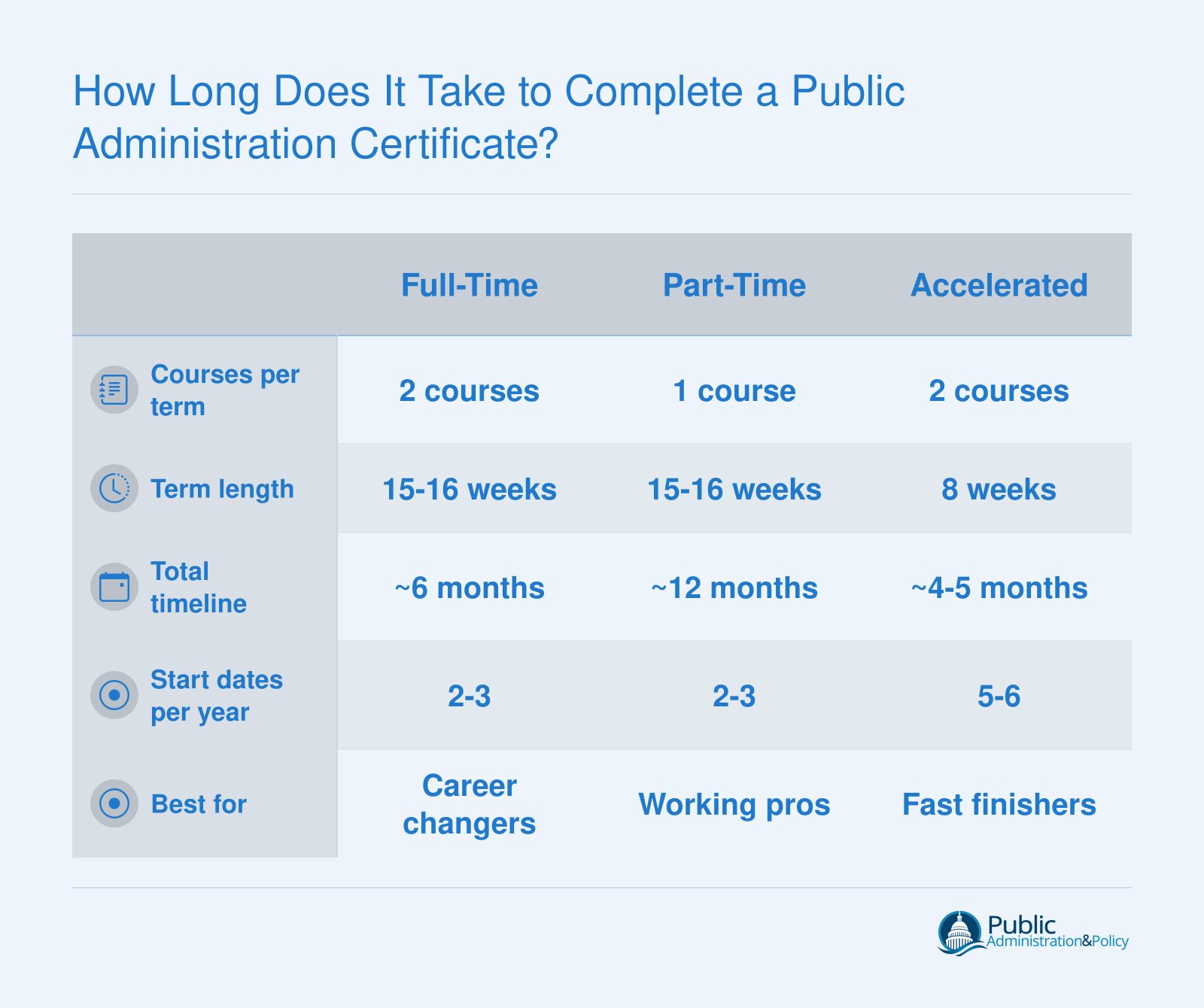
How Long Does It Take to Complete a Public Administration Certificate?
Most online public administration certificate programs require four to six courses, but how quickly you finish depends on your enrollment pace and the academic calendar. Programs with rolling or multiple start dates throughout the year can shave weeks off your timeline compared to traditional semester-locked schedules.
Cost, Financial Aid, and Employer Tuition Benefits
One of the strongest selling points of a graduate certificate in public administration is the price tag. Because these programs typically require only 9 to 18 credits, total costs often land well below what you would pay for even a single year of a full master's degree. That said, tuition varies considerably depending on the institution, its public or private status, and whether it distinguishes between in-state and out-of-state online learners. For comparison, you can review affordable MPA programs to see how certificate pricing stacks up against a full degree.
What You Can Expect to Pay
Per-credit rates at representative online programs in the 2025-26 academic year range from roughly $580 to over $900, yielding total program costs between approximately $5,000 and $16,000. Here is a snapshot of five institutions to illustrate the spread:
Liberty University (9 credits): $580 to $645 per credit, with a total cost of roughly $5,220 to $5,805. A military rate of $290 per credit is also available.1
UNC Chapel Hill (12 credits): $682.25 per credit for in-state students and $1,718.75 for out-of-state students, bringing the total to about $8,187 for North Carolina residents and significantly more for non-residents.2
UCCS (12 credits): $710 per credit for Colorado residents and $811 for out-of-state students, totaling roughly $8,520. A $60 application fee also applies.3
University of Virginia, School of Continuing and Professional Studies (15 credits): $629 per credit, for a total near $9,435.4
Northwestern University, School of Professional Studies (4 courses): Approximately $16,092 in total tuition plus a $520 technology fee. Tuition is reviewed annually and has historically adjusted by about 3.5 percent per year.5
Note that several public universities still differentiate between in-state and out-of-state tuition even for fully online students. UNC Chapel Hill and UCCS both charge non-resident premiums, so confirming your rate before you apply is essential. Some public institutions, however, have adopted flat online tuition regardless of residency, so check each program's tuition page carefully.
Federal Financial Aid Options
Graduate certificate programs at regionally accredited institutions generally qualify for federal financial aid through the FAFSA. The primary vehicle is the Direct Unsubsidized Loan, which allows graduate students to borrow up to $20,500 per academic year. Interest accrues from the date of disbursement, so borrowing only what you need is wise.
One important caveat: Pell Grants do not extend to graduate-level students. If you are returning to school after completing a bachelor's degree, grants from the federal government will not be part of your aid package. Institutional scholarships and graduate assistantships may still be available at some universities, so ask the financial aid office directly.
It is also worth noting that not every certificate program participates in federal aid. The University of Virginia's continuing education certificate, for instance, is not eligible for federal financial aid, though an optional payment plan is offered.4 Always verify aid eligibility before enrollment.
Employer Tuition Reimbursement: A Major Funding Lever
If you are already working in government, a nonprofit, or a large private-sector organization, employer tuition reimbursement may cover most or all of your certificate. Under IRS Section 127, employers can reimburse up to $5,250 per year in educational expenses tax-free. Because many online public administration certificates cost between $5,000 and $10,000 in total and can be spread across two calendar years, a reimbursement benefit alone can fund a substantial share of the program.
Federal agencies, state governments, and many county and municipal employers actively encourage credentialing through tuition assistance programs. Large nonprofits increasingly offer similar benefits to retain mid-career professionals. Before you pay out of pocket, check your employee handbook or speak with your HR department. Some employers require you to maintain a minimum GPA or commit to staying with the organization for a set period after completing the program, so understand the terms up front.
Putting It All Together
When you combine a lower credit requirement, potential employer reimbursement, and access to federal student loans, the net cost of a graduate certificate in public administration can be remarkably manageable. A practical approach is to map out a simple budget: total tuition, minus any employer benefit, minus any institutional scholarship, equals your gap. For many working professionals, that gap is small enough to cover through modest savings or a single semester of federal borrowing.
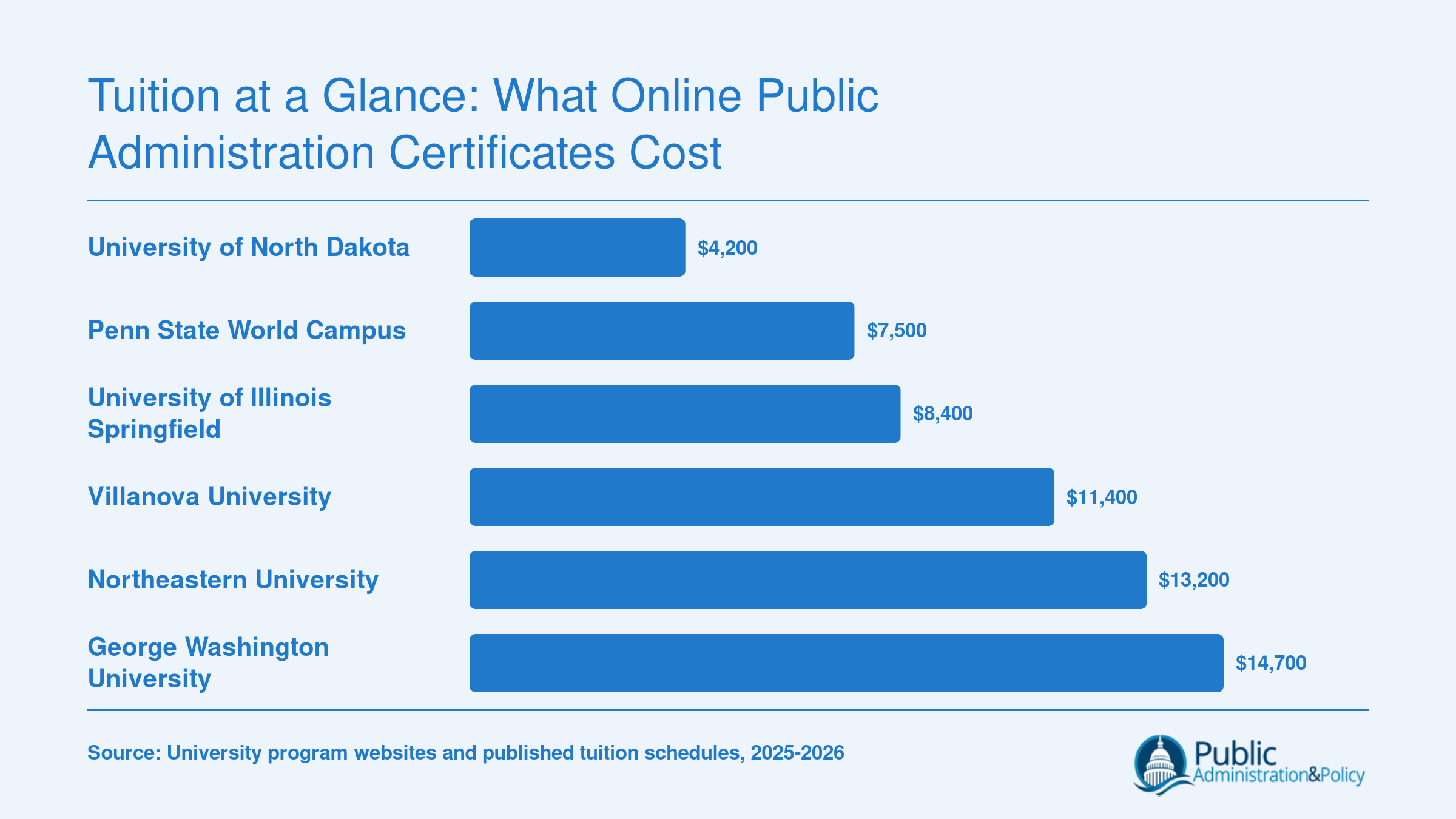
Tuition at a Glance: What Online Public Administration Certificates Cost
Online graduate certificate programs in public administration vary widely in total cost depending on whether you choose a public or private institution. The range below highlights estimated total program tuition at six universities, giving you a quick sense of budget-friendly and premium options.
Accreditation: What NASPAA Recognition Means for Your Certificate
Accreditation is one of the most important quality signals you can check before enrolling in any graduate certificate in public administration. However, the way accreditation works at this level is often misunderstood. Understanding the distinction between institutional accreditation and programmatic accreditation will help you avoid costly mistakes and choose a credential that employers actually respect.
NASPAA Accredits Degrees, Not Certificates
The Network of Schools of Public Policy, Affairs, and Administration (NASPAA) is the recognized accrediting body for graduate programs in public policy, public affairs, and public administration. Its peer-review standards apply specifically to master's degree programs such as the MPA and MPP.1 Graduate certificates are not separately accredited by NASPAA, so you will never find a certificate that carries its own NASPAA accreditation stamp.1
That said, a certificate housed within a department or school that also offers a NASPAA-accredited master's program benefits from the same faculty, curriculum design standards, and institutional oversight. When you complete coursework in that environment, the credential carries the reputational weight of the accredited program even though the certificate itself falls outside NASPAA's formal scope.
Regional Accreditation Is the Non-Negotiable Baseline
Before you evaluate any programmatic affiliation, confirm that the university itself holds regional accreditation (now referred to as institutional accreditation by agencies recognized by the U.S. Department of Education). This baseline accreditation determines whether:
You are eligible for federal financial aid, including student loans and employer tuition reimbursement plans that require an accredited institution.
Your credits can transfer to an MPA, MPP, or other graduate degree at a different university.
Your credential will be recognized by state and federal human resources offices for hiring or promotion purposes.
A certificate from a non-accredited or nationally accredited (rather than regionally accredited) school may leave you with credits that cannot stack toward a future degree and a credential that some employers will not accept.
Why Employers Care About NASPAA Affiliation
Some government agencies and nonprofit organizations specifically look for credentials from NASPAA-affiliated schools when screening applicants. Federal HR offices, in particular, may reference NASPAA membership or accreditation as a quality benchmark when evaluating educational qualifications for competitive service positions. While holding a certificate from a NASPAA-affiliated school is not a formal requirement for most roles, it can give your application an edge in environments where hiring managers know the public administration landscape well.
How to Verify Before You Enroll
Take these steps to confirm accreditation status before committing tuition dollars:
Regional accreditation: Search the university on the U.S. Department of Education's Database of Accredited Postsecondary Institutions and Programs.
NASPAA affiliation: Visit NASPAA's accreditation page and search for the school's master's program. If the MPA or MPP in the same department holds NASPAA accreditation, the certificate program shares that academic infrastructure.
Credit transferability: Contact the admissions office directly and ask whether certificate courses are drawn from the NASPAA-accredited curriculum and whether they are eligible for transfer into the school's own MPA or MPP.
Choosing a program that meets both regional accreditation standards and NASPAA affiliation positions your certificate as a credible, career-relevant credential, whether you use it as a standalone qualification or as a stepping stone toward a full master's degree. For professionals interested in related credentials, an online public policy certificate can complement your public administration training with a sharper analytical focus.
Career Outcomes and Salary Potential for Certificate Holders
A graduate certificate in public administration positions you for a range of roles across government, nonprofit, and private-sector organizations. Understanding where certificate holders land, and what those roles pay, helps you gauge return on investment before you enroll.
Federal, State, and Local Government Roles
Public administration certificate holders frequently pursue positions such as administrative services manager, budget analyst, policy analyst, and urban policy planner. According to the Bureau of Labor Statistics, administrative services managers earned a median annual wage of roughly $106,470 as of 2023, with projected job growth of about 4 percent from 2024 to 2034 and approximately 36,400 openings anticipated each year.1 Budget analysts, political scientists, and urban and regional planners each occupy distinct niches in the public sector. For the most current median salaries and ten-year growth projections for these occupations, visit the Occupational Outlook Handbook for Administrative Services Managers and search by the relevant Standard Occupational Classification codes (11-3012 for administrative services managers, 13-2031 for budget analysts, 19-3094 for political scientists, and 19-3051 for urban and regional planners).
If you are targeting federal employment, pay special attention to the General Schedule qualification standards published by the Office of Personnel Management. Positions in the 0300 (general administrative) and 0340 (program management) job series sometimes accept graduate-level coursework or certificates as meeting part of the education or experience requirement. Review OPM's classification and qualifications guidance at opm.gov to confirm whether your certificate alone, or combined with professional experience, qualifies you for the GS level you are seeking. Requirements vary by grade, so checking the specific vacancy announcement is always a smart final step.
Verifying Outcomes Through Program Data
Salary benchmarks from the BLS provide a national picture, but program-specific outcomes matter just as much. Before committing to a certificate, take these steps:
Check the program website: Many universities publish placement rates, average starting salaries, or alumni testimonials for their certificate completers.
Request alumni data directly: If outcomes are not posted online, contact the admissions or career services office and ask for certificate-specific placement statistics.
Look for capstone or practicum partnerships: Programs that embed fieldwork with government agencies or nonprofits often produce stronger post-completion employment numbers.
Leveraging Professional Associations
Industry organizations offer salary surveys, networking events, and career boards that complement what you learn from federal data sources. ICMA (the International City/County Management Association) is particularly valuable for aspiring local government managers and urban planners. The American Political Science Association (APSA) publishes compensation data and career guides relevant to policy analysts and political scientists. NASPAA, best known for accrediting MPA programs, also maintains career resources that certificate holders can access. Membership in one or more of these organizations connects you with mentors, job postings, and continuing education opportunities that extend the value of your credential well beyond graduation.
Realistic Expectations
A graduate certificate alone may not vault you into a senior leadership role, but it can meaningfully accelerate your trajectory. For mid-career professionals, the credential often serves as the differentiator that qualifies them for a promotion or a lateral move into a policy-focused position. For career changers, it demonstrates subject-matter competency without the two-year commitment of a full master's degree. Either way, pairing the certificate with relevant work experience tends to produce the strongest salary outcomes. When evaluating any program's claims, cross-reference them with BLS data and professional association surveys so you have a grounded, realistic picture of what the investment can return.
A graduate certificate in public administration can qualify you for higher GS pay grades in federal roles and position you for management track promotions in state and local government. Most programs take under a year to complete and cost less than $15,000 total, making this one of the fastest, most affordable ways to advance a public service career.
How Certificate Credits Stack Toward an MPA or MPP
One of the most compelling reasons to pursue a graduate certificate in public administration is stackability: the ability to apply every credit you earn toward a full master's degree if you decide to continue your education. Many universities intentionally design their certificate programs so that all 12 to 18 credits transfer directly into an MPA or MPP curriculum at the same institution. In practical terms, completing a certificate can function as your first semester (or more) of a master's degree, saving you both time and tuition if you later enroll. For students weighing a public policy certificate online, the same stacking logic often applies to MPP tracks as well.
Universities With Confirmed Stackable Pathways
Several institutions have published policies that allow certificate credits to count toward a master's degree. While program details can shift from year to year, the following examples illustrate how stackability works in practice.
Kansas State University: The online Public Administration Certificate requires 15 credits, and those credits may be applied toward the university's MPA program. Students must hold a bachelor's degree, and a minimum 3.0 GPA in certificate coursework is generally expected for smooth transfer into the master's track.1
University of Kansas: Graduate certificates offered through the School of Public Affairs and Administration, including concentrations in city and county management, public and nonprofit management, and public policy making, can count toward the MPA or Master of Urban Planning even if a student applies to the master's program after completing the certificate.2
University of Missouri-Kansas City: Certificate options in public policy, nonprofit management, urban policy, and health leadership are embedded directly within the MPA structure, making the transition from certificate to degree especially seamless.3
University of Colorado Denver: The MPA/MPP program requires 48 to 51 credits in total, and students who complete certificate-level coursework with at least a B-minus in each required course may be positioned to carry those credits forward into the full degree.4
These examples reflect information available as of spring 2026, but policies do change. Always verify current stacking rules with the specific program you are considering.
The Fine Print You Need to Read
Stackability is not automatic, even within the same university. Before you enroll in any certificate program with the intention of eventually pursuing an MPA or MPP, be aware of several common restrictions.
Same-institution requirement: Credits earned at one school rarely transfer into a master's program at a different institution. Stackability is almost always limited to continuing at the university where you completed the certificate.
Expiration windows: Many programs require that credits be applied within five to seven years of completion. If you wait too long to enroll in the master's program, you may need to retake coursework.
GPA thresholds: A minimum GPA of 3.0 in certificate courses is a typical requirement for credits to count toward the degree. Falling below that threshold could mean repeating courses or losing transferability.
Program-specific rules: Not every certificate offered by a university's public affairs school automatically stacks into every degree the school offers. A certificate in nonprofit management, for instance, may stack toward an MPA but not toward an MPP, depending on how the curriculum is structured.
Get It in Writing
The single most important step you can take is to confirm stackability in writing before you pay your first tuition bill. Contact the graduate admissions office or the program director and ask specifically how many certificate credits will apply to the master's degree, under what conditions, and whether there is a time limit. Save that correspondence. Verbal assurances from an admissions counselor, while helpful, are not a substitute for documented policy.
If stackability is a deciding factor in your enrollment decision, look for language on the program's official webpage that explicitly states how certificate credits integrate into the degree. Students exploring affordable online master's in public policy options will find that many of those programs also accept stacked certificate credits, so confirming transferability early can unlock significant savings. Programs listed on this site are profiled with this kind of detail whenever institutions make it publicly available, so use those listings as a starting point for your research, then follow up directly with the school.
Frequently Asked Questions About Public Administration Certificates
Below are answers to the most common questions prospective students ask about online graduate certificate programs in public administration. Each answer draws on the admissions, curriculum, cost, and career details covered throughout this guide.
What is a graduate certificate in public administration?
A graduate certificate in public administration is a focused, post-baccalaureate credential typically comprising four to six courses (12 to 18 credit hours). It covers foundational topics such as public budgeting, policy analysis, organizational management, and ethics in governance. The certificate is designed for working professionals who want to build or sharpen public sector skills without committing to a full master's degree.
How long does it take to get a public administration certificate?
Most students complete an online public administration certificate in roughly six to twelve months of part-time study. Programs that offer accelerated terms or allow full-time enrollment can be finished in as few as four months, while those who take one course per semester may need up to 18 months. Flexible online formats make it easier to maintain a work schedule throughout the program.
What is the difference between a public administration certificate and an MPA?
A graduate certificate typically requires 12 to 18 credits and focuses on a targeted set of competencies, whereas a Master of Public Administration (MPA) usually spans 36 to 42 credits and includes electives, a capstone or practicum, and broader specialization options. The certificate can often be completed in under a year, while the MPA generally takes two years. Certificates suit professionals seeking a credential boost; an MPA is better for those pursuing senior leadership roles.
Can you transfer graduate certificate credits toward an MPA or MPP degree?
Yes, many universities design their certificate programs so that completed coursework can stack directly into an MPA or Master of Public Policy (MPP) program. Typically, 12 to 18 credits transfer, which can shorten the master's timeline by one to two semesters. Confirm stacking policies with each institution before enrolling, because transfer allowances vary and some schools require a minimum GPA in certificate courses.
Is a graduate certificate in public administration worth it for career advancement?
For many professionals, the answer is yes. Certificate holders often qualify for supervisory or analyst roles that require graduate-level training, and the credential can strengthen promotion applications in federal, state, and local agencies. Because the time and cost commitment is significantly lower than a full MPA, the return on investment can be favorable, especially when combined with employer tuition assistance programs.
Do you need work experience to enroll in a public administration certificate program?
Most programs do not require prior professional experience, though some prefer applicants with at least one to two years of work in government, nonprofit, or related fields. Standard admission requirements include a completed bachelor's degree, a minimum GPA (often 2.75 to 3.0), and a statement of purpose. Select programs may also request a resume or professional references, but standardized test scores like the GRE are increasingly waived.