Public Administration Certifications: Best Options for 2026
Compare academic certificates, professional credentials, and exam-based certifications to find the right fit for your government or nonprofit career.
By Max SheltonReviewed by PAP Editoral TeamUpdated August 14, 202625+ min read
What you’ll learn in this article…
Professional certifications prove job skills and portability, while academic certificates provide credit-bearing subject depth from accredited universities.
Only about 1,400 local government professionals nationwide held the ICMA Credentialed Manager designation as of 2023, highlighting its competitive distinction.
Credential costs range from a few hundred dollars for a certification exam to several thousand for a graduate certificate program.
Credentialed public service professionals consistently earn higher median salaries and advance faster than peers without certifications.
The federal government alone lists more than 200 distinct occupational series, many of which recognize or require specialized credentials for advancement. Add state agencies, municipal departments, and the nonprofit sector, and the credentialing ecosystem expands further: professional certifications from bodies like ICMA and GFOA, graduate certificates housed in NASPAA-accredited programs, and a growing catalog of micro-credentials from online platforms all compete for a practitioner's limited time and budget.
Much of the confusion starts with terminology. A "public administration certificate" can mean a credit-bearing university program or a pass/fail exam credential, and the cost difference between the two can exceed $10,000. Choosing the wrong type wastes money; choosing the right one at the right career stage can shorten the path to a senior analyst, budget director, or how to become a city manager role by years. Employers increasingly expect both proof of applied skill and formal academic grounding, which is why the strongest candidates tend to stack credentials rather than pick one.
Professional Certifications Vs. Academic Certificates: What's the Difference?
If you have searched for "public administration certifications" or "accredited public administration certificates," you have probably noticed that results blend two very different credential types. Understanding the distinction before you invest time and money is one of the most important steps in career planning for public service.
What Is a Professional Certification?
A professional certification is an exam-based credential issued by a recognized professional body. To earn one, you typically must meet eligibility requirements (such as a combination of education and work experience), pass a standardized examination, and commit to ongoing continuing education to keep the credential active. Examples include:
ICMA Credentialed Manager (ICMA-CM): Issued by the International City/County Management Association for local government managers.
Certified Government Financial Manager (CGFM): Issued by the Association of Government Accountants (AGA), requiring passage of three exams and renewal every two years through continuing professional education.
Certified Public Finance Officer (CPFO): Issued by the Government Finance Officers Association, covering areas like budgeting, accounting, and debt management.
The defining features are standardization, portability, and renewal. Because every holder passes the same exam, the credential signals a verified level of competency to any employer in the public sector. The ICMA-CM, for instance, is a widely recognized benchmark for professionals pursuing a city manager career path.
What Is an Academic Certificate?
An academic certificate is a university-issued credential earned by completing a structured set of courses, often ranging from 12 to 18 graduate credit hours. There is no standardized national exam. Once you finish the coursework, the credential is recorded on your transcript and you are done. Think of it as a focused mini-degree: it builds foundational or specialized knowledge in areas like public management, nonprofit leadership, or policy analysis. The credits can frequently ladder into a full master's program such as an MPA. If you are weighing this route, our guide to graduate certificate in public administration programs outlines what to expect from the coursework and admissions process.
A Side-by-Side Example
Consider the CGFM alongside a graduate certificate in public management from a university. The CGFM requires you to pass three separate exams administered by AGA, maintain at least 80 hours of continuing professional education every two years, and meet specific experience thresholds. A graduate certificate in public management requires you to enroll in a university, complete four to six courses (earning grades, writing papers, participating in discussions), and receive a notation on your transcript upon completion. One is renewable and exam-driven; the other is a one-time academic achievement.
Why the Distinction Matters for Your Career
Certifications and certificates serve complementary but different purposes:
Certifications signal to hiring managers and promotion boards that you possess a tested, current skill set. They are especially valuable mid-career when you need to demonstrate specialization without returning to school full time.
Academic certificates build deeper conceptual knowledge, strengthen your transcript, and can serve as a stepping stone toward an MPA or MPP degree.
Some professionals ultimately combine both credentials with a graduate degree such as an online MPP programs track to maximize their competitiveness. One important note about accreditation: NASPAA (the Network of Schools of Public Policy, Affairs, and Administration) accredits academic degree programs, not professional certifications. When you see "accredited" applied to a certificate program, that typically refers to the university or the degree track the certificate feeds into, not the certificate itself in the way a professional body accredits an exam-based credential. Keeping this distinction clear will help you evaluate options more accurately as you compare programs and certifications throughout this guide.
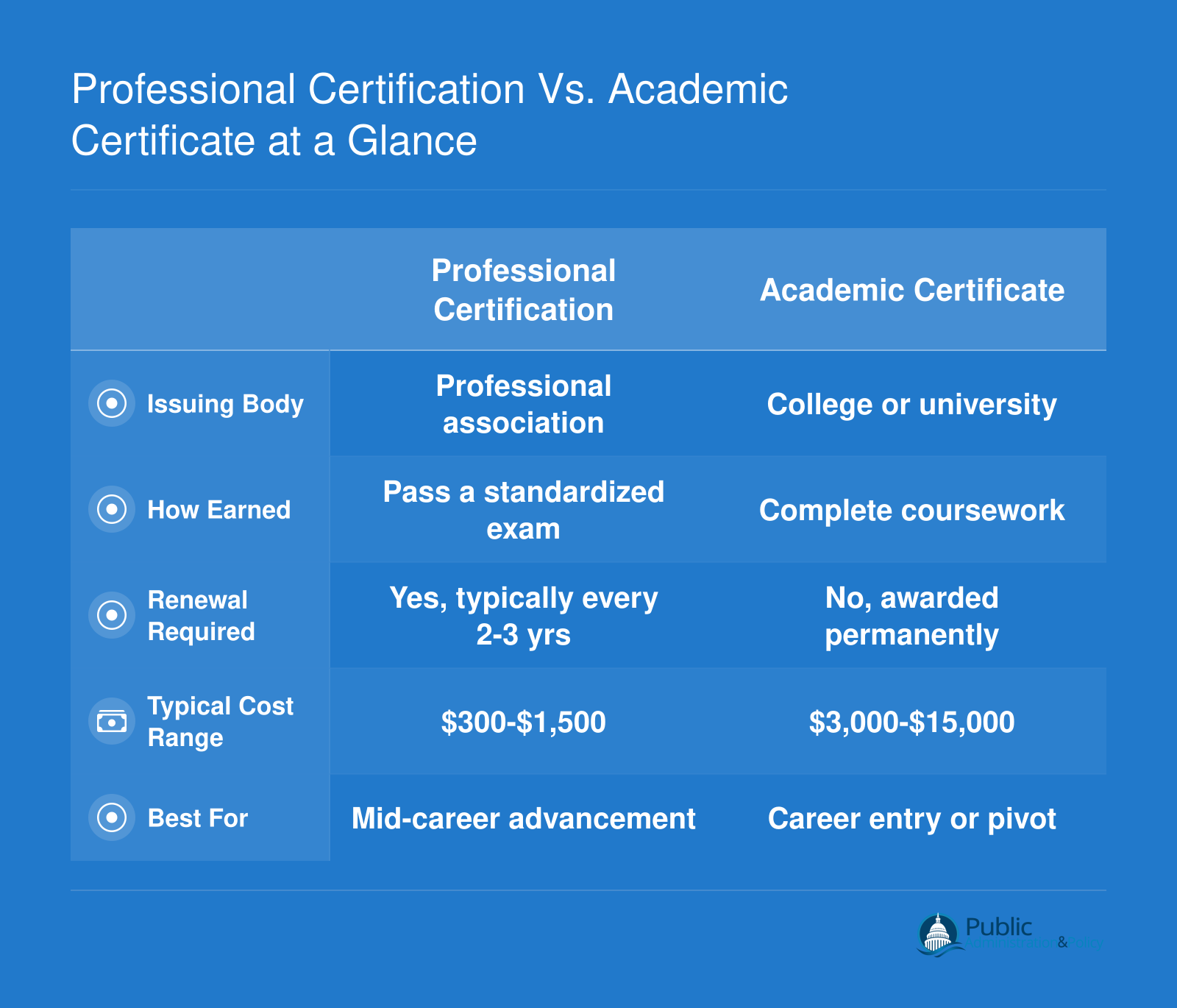
Professional Certification Vs. Academic Certificate at a Glance
Professional certifications and academic certificates both strengthen a public service career, but they differ in structure, cost, and purpose. This side-by-side comparison highlights the key distinctions so you can decide which credential fits your goals.
Top Professional Certifications for Government and Public Service Careers
The public service landscape rewards professionals who can demonstrate specialized expertise through recognized credentials. The certifications below span city management, government finance, nonprofit leadership, urban planning, project management, and human resources. Some are built specifically for the public sector, while others carry cross-sector recognition that government employers and federal contractors value highly.
ICMA Credentialed Manager (ICMA-CM)
Issued by the International City/County Management Association, the ICMA-CM is the premier credential for local government executives, including those pursuing how to become a city/county manager. Candidates must serve as a chief administrative officer or assistant CAO, hold ICMA membership, and adhere to the association's Code of Ethics.1 Education and experience requirements scale together: applicants with an MPA or MPP need at least seven years of qualifying experience, while those without a bachelor's degree need fifteen years.1 The credentialing process includes the ICMA Management Assessment, a reflective self-assessment, and a professional development plan.2 The application fee is $50 and the assessment fee is $75.2 Renewal is annual, requiring 40 hours of professional development and continued adherence to the Code of Ethics, plus a multi-rater assessment within every five-year cycle. There is no separate renewal fee, though ICMA membership dues apply.2
Certified Government Financial Manager (CGFM)
Administered by the Association of Government Accountants (AGA), the CGFM targets professionals working in government financial management at the federal, state, or local level, making it especially relevant for anyone exploring a career as a public budget analyst. Candidates need a bachelor's degree (with at least 24 credit hours in financial disciplines) and two years of professional government financial management experience. The certification involves three exams covering governmental environment, governmental accounting, and governmental financial management and control. Exam fees run approximately $115 per section for AGA members and higher for non-members. The credential renews every two years through 80 hours of continuing professional education.
Certified Public Finance Officer (CPFO)
The Government Finance Officers Association (GFOA) awards the CPFO to professionals who pass five rigorous examinations spanning governmental accounting, auditing, financial reporting, cash management, debt management, and retirement administration. Eligibility requires a combination of education and public finance experience. Individual exam fees typically fall in the range of $150 to $200 each, with GFOA members receiving a discounted rate. The credential renews every three years through continuing education.
Project Management Professional (PMP)
The PMP, issued by the Project Management Institute (PMI), is not specific to government, yet it appears routinely in federal job postings, state agency hiring guidelines, and contractor position requirements. Candidates need either a four-year degree plus three years of project management experience or a secondary diploma plus five years. The exam fee is $405 for PMI members and $555 for non-members. The 180-question computer-based exam covers people, process, and business environment domains. Renewal occurs every three years and requires 60 professional development units. Professionals interested in applying these skills in the federal space may also want to explore how to become a government program manager.
SHRM-CP for Government HR Professionals
The Society for Human Resource Management's SHRM Certified Professional (SHRM-CP) designation is another cross-sector credential that carries significant weight in public sector hiring. Government HR offices, including those at the federal level, frequently list it as preferred or required. Eligibility combines education with HR experience, and the computer-based exam includes knowledge and situational judgment items. Exam fees are approximately $300 for SHRM members and $400 for non-members. Recertification requires 60 professional development credits every three years.
Certified Nonprofit Professional (CNP)
Offered by the Nonprofit Leadership Alliance, the CNP is designed for professionals working at the intersection of government and the nonprofit sector. Candidates complete a competency-based program through an affiliated university, accumulate at least 300 hours of nonprofit experience, and attend a national training event. Costs vary by university partner but generally reflect tuition and a modest certification processing fee. Renewal involves ongoing professional development and engagement with the Alliance network.
AICP Certification for Planners
The American Institute of Certified Planners (AICP), a branch of the American Planning Association, certifies urban and regional planners who meet education and experience thresholds and pass a comprehensive exam. Candidates with an accredited planning master's degree need one year of planning experience; those with an unrelated degree need two years. The exam fee is approximately $435 for APA members. Certification renews every two years through 32 continuing education credits, including ethics and equity topics.
While credentials such as the ICMA-CM, CGFM, CPFO, CNP, and AICP are tailored to public and nonprofit service, the PMP and SHRM-CP deserve particular attention from public service professionals because of their broad recognition across government hiring frameworks. Federal agencies and state governments frequently reference both in position descriptions, and contractors bidding on government work often require project managers and HR staff to hold these designations. Pursuing any of these seven credentials signals a commitment to professional standards that hiring managers across all levels of government understand and respect.
Questions to Ask Yourself
Are you looking to deepen expertise in a current government role, or are you pivoting into the public sector from another field?
Your answer shapes whether a professional certification or an academic certificate is the better fit. Deepening existing skills often favors a targeted exam-based credential, while career changers typically benefit from structured coursework that builds foundational knowledge.
Do you learn best through structured coursework or through self-directed exam preparation?
Professional certifications usually require independent study and a high-stakes exam, whereas academic certificates follow a semester-based format with faculty guidance. Matching the format to your learning style improves completion rates and long-term retention.
Is your employer willing to cover tuition or exam fees, and does that influence which credential type makes sense?
Many federal, state, and local agencies offer tuition assistance or professional development funds, but reimbursement policies often favor one credential type over the other. Confirming coverage before you commit can save thousands of dollars and steer you toward the most cost-effective option.
How quickly do you need the credential to affect your career trajectory?
Professional certifications can sometimes be earned in a few months of focused preparation, while academic certificates may take six months to a year. If a promotion window or job application deadline is approaching, timeline matters as much as content.
Best Academic Certificate Programs in Public Administration
Academic certificate programs in public administration offer a structured, credit-bearing pathway into the field, whether you are exploring public service for the first time or sharpening your expertise as a mid-career professional. Because these programs are housed within accredited universities, the coursework often mirrors what you would encounter in a full Master of Public Administration curriculum. Choosing the right program, however, requires evaluating a few critical factors.
What to Look for in an Academic Certificate Program
Before enrolling, consider these benchmarks:
NASPAA accreditation or affiliation: The Network of Schools of Public Policy, Affairs, and Administration sets the gold standard for public administration education. A certificate offered through a NASPAA-accredited school signals that the curriculum meets rigorous quality expectations, even if certificates themselves are not individually accredited.
Credit count: Most graduate certificates require 12 to 18 credits, roughly four to six courses. This range is substantial enough to build real competency yet manageable enough to complete in two to three semesters.
Stackability: Many certificate programs allow you to apply your earned credits toward a full MPA if you decide to continue. This stackability makes a certificate an effective trial run, letting you test graduate-level coursework before committing to the full degree.
Delivery format: Programs range from fully online to hybrid to traditional on-campus models. Your professional obligations, geographic location, and learning preferences should guide this choice.
Notable Programs Worth Exploring
Several well-regarded universities offer academic certificates that illustrate the variety available across the field:
Indiana University's O'Neill School of Public and Environmental Affairs provides graduate certificates in areas like public management and nonprofit management, with many courses available online.
The University of North Carolina at Chapel Hill offers a certificate in public administration through its School of Government, designed for working professionals in state and local government.
Arizona State University's Watts College of Public Service provides fully online graduate certificate options that stack directly into its MPA program.
George Washington University offers graduate certificates in several public policy and administration concentrations through its Trachtenberg School, with a hybrid format suited to professionals in the Washington, D.C., area.
Rutgers University's School of Public Affairs and Administration houses certificates that align with its NASPAA-accredited MPA, giving students a clear pathway to the full degree.
These examples represent a range of formats, specializations, and price points. Prospective students should visit each program's website for current admissions requirements, tuition, and course schedules.
Undergraduate vs. Graduate Certificates
The distinction between these two levels matters more than many applicants realize. Undergraduate certificates serve as entry-level primers, typically requiring no prior degree and covering foundational topics like introduction to public policy, government budgeting, and civic leadership. They are well suited for career changers or community college students exploring the field.
Graduate certificates, by contrast, assume you hold at least a bachelor's degree and often expect some professional experience. The coursework is more advanced, frequently covering program evaluation, public financial management, or administrative law. Employers generally view graduate certificates as evidence of specialized expertise, which can translate into stronger candidacy for supervisory or analyst-level roles.
Certificates as a Gateway to the Full MPA
One of the most practical advantages of an academic certificate is its role as a low-risk entry point into graduate education. Many NASPAA-accredited MPA programs explicitly design their public administration certificate programs so that every credit earned counts toward the master's degree. If you are uncertain about committing two or three years to a full program, completing a certificate first lets you gauge the rigor of graduate coursework, build relationships with faculty, and confirm that public administration aligns with your long-term goals. Should you choose not to continue, you still walk away with a credential that holds real value on a resume.
How Much Do Public Administration Certificates and Certifications Cost?
Cost is one of the most practical factors in choosing a credential, and pricing in this space varies dramatically. Whether you are eyeing a professional certification exam, a university graduate certificate, or a shorter online course, understanding the full financial picture helps you budget wisely and take advantage of employer reimbursement programs.
Professional Certification Exam Fees
Exam-based professional certifications tend to have the lowest upfront price tag, though the total investment depends on preparation materials and ongoing maintenance. Application and exam fees for credentials such as the ICMA Credentialed Manager (ICMA-CM), Certified Government Financial Manager (CGFM), Certified Public Finance Officer (CPFO), and Certified Nonprofit Professional (CNP) generally fall in the $150 to $500 range per exam or application cycle. Some credentials require multiple exam sections, which can push the total closer to $500 or above.
Recurring costs are easy to overlook. Most professional certifications require:
Annual or biennial dues: Membership fees to the sponsoring organization, often $50 to $300 per year.
Continuing education: A set number of CPE or CE credits each renewal period, which may be free through webinars or cost several hundred dollars through conferences and formal courses.
Recertification fees: Some bodies charge a separate renewal or recertification processing fee on top of dues.
Over a five-year span, plan for a few hundred to over a thousand dollars in maintenance costs beyond the initial exam.
University Graduate Certificate Programs
Graduate certificates from accredited universities represent a more substantial investment, typically ranging from roughly $4,000 to $15,000 or more depending on the institution, credit-hour count, and residency status. For a deeper look at program structures and admissions, see our guide to public administration certificate programs. Published tuition figures from several programs illustrate this range:
Columbia Southern University's Graduate Certificate in Public Administration: approximately $4,200 to $5,400.1
Liberty University's Online Graduate Certificate in Public Administration: approximately $5,220.2
SUNY Empire State College's Online Graduate Certificate in Public Administration: approximately $7,065.3
The University of Colorado Colorado Springs Public Administration Leadership and Management Graduate Certificate: approximately $8,520 to $9,732.4
Arizona State University's Public Administration Graduate Certificate: approximately $11,000 to $13,500.5
These figures reflect tuition as of 2024, and costs may shift slightly by the 2025-2026 academic year. Most graduate certificates do not carry renewal or ongoing fees once you complete the coursework.
MOOC and Non-Credit Certificates
Platforms such as Coursera and edX offer shorter, non-credit certificate programs in public administration and related fields for as little as $50 to $1,500. These are best suited for skill-building or resume enhancement rather than formal credentialing, but they can be a cost-effective entry point for professionals testing the waters before committing to a larger program.
Employer Reimbursement and Federal Training Support
Many federal, state, and local government agencies reimburse employees for professional development, including certification exam fees, graduate certificate tuition, and continuing education. At the federal level, the Office of Personnel Management (OPM) publishes training and development guidance that outlines how agencies can fund employee credentialing. State and municipal governments often have parallel programs, though policies and dollar caps vary by agency. Before paying out of pocket, check with your human resources office or training coordinator. Even partial reimbursement can substantially reduce your net cost and make higher-tier credentials far more accessible.
Career Impact: Salary, Promotions, and Employer Recognition
Earning a credential in public administration is an investment, and the return on that investment shows up in three tangible ways: higher compensation, faster advancement, and stronger standing with hiring managers. The evidence comes from federal data, professional association surveys, and university alumni networks, all of which point in the same direction.
What Federal Salary Data Tells Us
The Bureau of Labor Statistics (BLS) publishes median annual wages for occupations where certifications are common requirements or strong differentiators. As of the most recent BLS data, Administrative Services Managers (SOC 11-3012) earn a median annual wage north of $104,000, while urban policy planners and related Urban and Regional Planners (SOC 19-3051) earn a median near $81,000. Both figures climb in metro areas with large government footprints such as Washington, D.C., and state capitals. While BLS does not isolate wages by credential status alone, job postings in these fields increasingly list professional certifications as preferred or required qualifications, suggesting that credentialed candidates land the higher-paying tiers of these roles more consistently.
You can explore these figures yourself by visiting BLS.gov and filtering the Occupational Employment and Wage Statistics (OEWS) data by state or metropolitan area. Comparing roles that commonly require certifications against those that do not can give you a practical sense of the salary premium at stake.
Insights from Professional Association Surveys
Organizations like the International City/County Management Association (ICMA), the Association of Government Accountants (AGA), and the Network of Schools of Public Policy, Affairs, and Administration (NASPAA) periodically survey their members on compensation and career progression. These surveys consistently reveal that credential holders report:
Higher median salaries: Members who hold a professional certification often report earning several thousand dollars more per year than peers without one, even when years of experience are similar.
Faster promotion timelines: Credentialed professionals frequently move into supervisory or director-level roles one to three years sooner than non-credentialed colleagues.
Greater job mobility: Certified public servants report an easier time transferring between agencies or levels of government, partly because a recognized credential signals a standardized competency baseline.
Many of these reports are available as free downloads on each association's website. Searching for terms like "salary survey" or "compensation report" on the ICMA or AGA sites will surface the most current editions.
Federal Workforce Development and ROI Studies
The U.S. Office of Personnel Management (OPM) and the Government Accountability Office (GAO) both publish research on training outcomes for federal employees. OPM reports on professional development spending frequently highlight that agencies investing in credentialing programs see measurable improvements in employee retention and performance ratings. GAO studies, searchable on GAO.gov using keywords like "certification impact" or "training ROI," have documented scenarios where structured credentialing reduced costly turnover and improved service delivery metrics.
For federal employees specifically, holding an accredited certification can qualify you for higher General Schedule (GS) grade levels at the point of hire or make you eligible for quality step increases that would otherwise require exceptional performance reviews alone. Our broader public administration jobs guide covers how credentialing intersects with GS classifications across agencies.
Tapping University Career Services and Alumni Data
If you are currently enrolled in or have graduated from a public administration or public policy program, your institution's career services office is an underused resource. Many programs, including public administration certificate programs, track post-graduation salary data segmented by whether alumni completed certificate coursework or earned a professional certification alongside their degree. These internal reports often reveal that certificate holders command starting salaries five to fifteen percent higher than classmates who graduated without an additional credential.
Alumni networks can also provide anecdotal but valuable intelligence. Reaching out to graduates who hold credentials like the Certified Public Manager (CPM) or the Certified Government Financial Manager (CGFM) can give you a realistic picture of how the credential factored into specific promotion decisions or salary negotiations.
Employer Recognition Across Sectors
Beyond salary and promotions, certifications signal dedication and specialized competence to hiring committees. State and local governments in particular have begun embedding certification requirements into formal job classification systems, meaning that certain positions simply cannot be filled by applicants who lack the relevant credential. Nonprofit and consulting employers serving the public sector follow a similar logic, often listing certifications as "preferred" qualifications that move a resume to the top of the pile.
The bottom line: credentialing in public administration does not guarantee a raise or a new title overnight, but the cumulative data from BLS, professional associations, federal workforce studies, and university alumni outcomes consistently shows that the right credential sharpens your competitive edge and accelerates career growth.
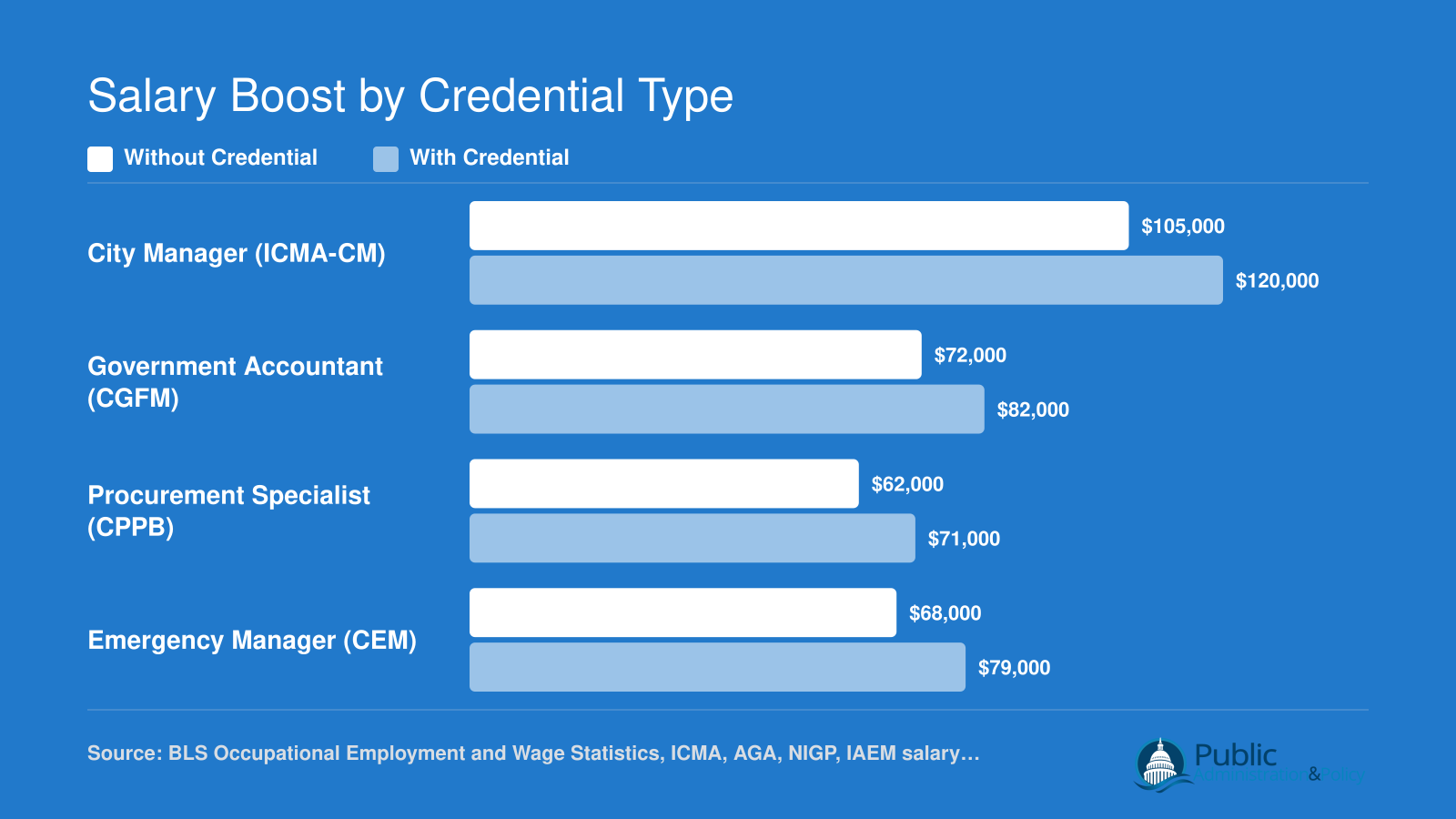
Salary Boost by Credential Type
Earning a professional certification or academic certificate in public administration can translate into meaningful salary gains. The grouped comparison below highlights estimated median salaries for selected public service roles, comparing credentialed professionals to their non-credentialed peers.
How to Choose the Right Certification for Your Career Goals
With so many public administration certifications and certificate programs available, the most important step is matching the credential to where you are in your career, which sector you plan to work in, and how much time and money you can invest. A credential that accelerates one professional's trajectory may be redundant or premature for another. The framework below can help you make a confident decision.
Match the Credential to Your Career Stage
Not every certification delivers the same return at every point in your career. Think of credentials along a timeline:
Early-career professionals: Academic certificates and entry-level certifications build foundational knowledge and signal commitment to public service. The Certified Nonprofit Professional (CNP) designation or the SHRM-CP for human resources are strong starting points that do not require years of management experience.
Mid-career professionals: Credentials like the ICMA Credentialed Manager (ICMA-CM), Certified Government Financial Manager (CGFM), and Certified Public Finance Officer (CPFO) reward hands-on experience and position you for senior roles, budget authority, or city/county management.
Career changers entering from the private sector: A graduate certificate in public administration is often the smartest first move. It fills knowledge gaps in public budgeting, governance, and policy analysis before you pursue a specialized professional certification.
Match the Credential to Your Target Sector
Different corners of public service weigh credentials differently.
Federal government: The Project Management Professional (PMP) and SHRM-CP are among the most frequently cited preferred qualifications in federal job postings.
State and local government: The ICMA-CM and CPFO carry significant weight with city councils, county boards, and hiring committees for management and finance roles.
Nonprofit organizations: The CNP directly addresses the governance, fundraising, and program management skills nonprofits need.
Urban planning: The American Institute of Certified Planners (AICP) credential is virtually a prerequisite for advancement in planning departments and consulting firms.
Certificate vs. MPA: Complement, Not Replacement
One question surfaces repeatedly: can a certificate replace a Master of Public Administration? The short answer is no, at least not for senior leadership positions where an MPA or equivalent graduate degree is a formal requirement. A certificate is faster to complete and significantly less expensive, making it an excellent way to test your interest in the field, build specific skills, or strengthen a graduate school application. Many professionals earn a certificate first and later apply those credits toward a full MPA, getting the best of both paths.
A Simple Decision Heuristic
When you are weighing your options, two questions can clarify the choice quickly:
If your employer offers tuition reimbursement and you can commit two or more years, an accredited academic certificate (or a full MPA) is likely the higher-value investment. The financial support offsets cost, and the structured curriculum provides deeper preparation.
If you need a portable, nationally recognized credential in a matter of months, a professional certification is the faster route. Exam-based certifications like the PMP, CGFM, or SHRM-CP travel with you across employers and jurisdictions, making them especially useful if relocation or a sector switch is on the horizon.
The right credential is the one that closes a specific gap between where you are today and the role you want next. Exploring careers in public administration can help you identify exactly which competencies hiring managers expect, so start there and the decision becomes far more straightforward.
Certifications That Complement a Public Policy or MPA Degree
A best online MPA programs track or a Master of Public Policy provides the broad analytical foundation that public service employers expect. Yet breadth alone does not always distinguish you in a competitive applicant pool. Adding a targeted certification signals that you can apply classroom knowledge to a specific functional area, giving hiring committees and promotion boards concrete evidence of both academic rigor and practical competency.
Strategic Pairings Worth Considering
Not every certification pairs equally well with every degree concentration. The strongest combinations align your graduate coursework with the knowledge domains tested on a credential exam.
MPA + CGFM: If your MPA concentration is in public financial management or budgeting, the Certified Government Financial Manager credential reinforces that specialization. Many of the exam topics, including governmental accounting, financial reporting, and budget execution, mirror core MPA finance courses.
MPA + ICMA-CM: Students drawn to city or county management careers should pair their MPA with the ICMA Credentialed Manager designation. This combination is widely recognized by local government employers as a mark of executive readiness.
MPP + PMP: Policy analysis is valuable, but organizations also need people who can manage the implementation side. The Project Management Professional certification adds structured project delivery skills that translate policy recommendations into measurable outcomes.
MPP + AICP: For those focused on land use, transportation, or community development policy, the American Institute of Certified Planners credential bridges the gap between policy design and planning practice.
Timing Your Credential Timeline
Some certifications require documented professional experience before you can sit for the exam. The ICMA Credentialed Manager designation, for instance, requires a qualifying period of local government management experience, which means most candidates earn it several years after completing their degree. Others, like the PMP, require a defined number of hours leading projects. Plan accordingly: map out when you will meet eligibility requirements so you can begin exam preparation without a gap after graduation.
Students still in their degree program can use the time strategically by completing prerequisite professional hours through internships, fellowships, or practicum placements that count toward certification eligibility. Those interested in planning careers can explore the urban policy planner path to understand exactly which experience hours qualify.
Look for Programs That Build in Certification Prep
A growing number of accredited MPA programs embed certification preparation directly into their curriculum. Some align specific courses with CGFM or CPFO exam content areas, allowing students to study for a credential while earning graduate credit. When evaluating programs, check whether the curriculum maps to a recognized certification body's knowledge domains. Candidates who also want a shorter credential before committing to a full graduate degree may benefit from a public administration certificate programs option that covers foundational exam content. This kind of alignment can save you months of independent study and reduce the total cost of earning both a degree and a professional credential.
How to Prepare for Certification Exams and Program Admissions
Preparation looks very different depending on whether you are sitting for a professional certification exam or applying to an academic certificate program. Understanding those differences early saves time, money, and unnecessary stress.
Preparing for Professional Certification Exams
Most professional certifications in the public sector, such as the Certified Government Financial Manager (CGFM) and the Certified Public Finance Officer (CPFO), rely on multiple-choice examinations. Each issuing body publishes its own study guides, content outlines, and practice questions. A structured self-study plan of two to four months is realistic for most candidates who are already working in a related role.
The ICMA Credentialed Manager (ICMA-CM) designation is a notable exception. Rather than a traditional exam, it requires a portfolio that documents your professional management experience, adherence to an ethics code, and ongoing professional development. Preparation here is less about memorizing content and more about compiling evidence of competency over time. If you are targeting the ICMA-CM, start building your portfolio well before you submit your application. Aspiring city managers and local government leaders will find this credential especially relevant.
Some free or low-cost resources worth bookmarking:
AGA's CGFM study guides: Available through the Association of Government Accountants, these guides align directly with each exam section and include practice questions.
ICMA's self-assessment tool: Helps prospective credentialed managers evaluate whether their experience meets eligibility thresholds before they invest time in the portfolio process.
PMI's free PMP exam content outline: The Project Management Institute publishes a detailed breakdown of domains, tasks, and knowledge areas tested on the PMP exam, which is valuable for public sector project managers.
University-hosted info sessions: Many schools that offer graduate certificates in public administration hold free virtual information sessions covering admissions requirements, curriculum structure, and financial aid options.
Navigating Academic Certificate Admissions
Graduate-level public administration certificate programs typically require a completed bachelor's degree and a minimum GPA, usually in the range of 2.5 to 3.0 depending on the institution. A personal statement or statement of purpose is common, and some programs ask for a resume or professional references. The good news for working professionals is that standardized tests like the GRE are rarely required for certificate-level admissions in 2026, removing one of the more time-consuming barriers to entry.
If your GPA falls slightly below a program's stated minimum, a strong personal statement that highlights relevant work experience in the public or nonprofit sector can often strengthen your application.
Realistic Time Commitments
Budgeting your time accurately is essential, especially if you are balancing coursework or exam prep with a full-time government role.
Professional certification exams: Plan for roughly two to four months of dedicated self-study, averaging five to eight hours per week. Candidates with less direct experience in the subject area may need to extend that timeline.
Academic certificate programs: These generally span six to eighteen months depending on whether you enroll full-time or part-time. Many accredited programs are designed with working professionals in mind, offering evening, weekend, or fully online course schedules.
Whichever path you choose, start by downloading the official content outline or admissions checklist from the credentialing body or university. Having a clear picture of what is expected on day one makes the entire preparation process more manageable.
As of 2023, approximately 1,400 local government professionals nationwide held the ICMA Credentialed Manager designation, a voluntary credential awarded by the International City/County Management Association. This relatively small number underscores the distinction the credential carries and the competitive edge it can provide for public service leaders seeking senior management roles.
Frequently Asked Questions About Public Administration Certifications
Choosing the right credential can feel overwhelming, especially when terminology overlaps and options vary widely. Below are straightforward answers to the questions students and professionals ask most often about public administration certifications and certificates in 2026.
Do you need a certification to work in public administration?
No, a certification is not typically required to enter public administration. Most government positions list a relevant degree and applicable experience as primary qualifications. However, earning a professional certification or academic certificate can make you a stronger candidate, help you qualify for promotions, and signal specialized expertise to hiring managers. Some senior or specialized roles do list specific credentials as preferred qualifications.
What is the difference between a public administration certificate and a certification?
An academic certificate is a credit-bearing program offered by a college or university, often consisting of several graduate-level courses in public administration or a related subfield. A professional certification is awarded by an industry or professional organization after you pass an exam or meet defined competency standards. Certificates build foundational knowledge, while certifications validate demonstrated proficiency in a specific skill set or professional domain.
Is a public administration certificate worth it?
For many professionals, yes. An academic certificate can strengthen a resume without the time and cost commitment of a full degree. It is especially valuable for career changers entering the public sector or current government employees seeking advancement into management or policy roles. The return on investment improves when the certificate is earned from an accredited, well-recognized program and aligns directly with your career goals.
What certifications should I get with a public policy degree?
Credentials that complement a public policy degree include the Certified Public Manager (CPM), Project Management Professional (PMP), Certified Government Financial Manager (CGFM), and Certified Fraud Examiner (CFE). The best choice depends on your career focus. If you plan to lead programs, the CPM or PMP fits well. If you are drawn to budgeting or fiscal oversight, the CGFM is a strong option.
Are online public administration certificates respected by government employers?
Yes, as long as the program is offered by a regionally accredited institution. Many federal, state, and local agencies accept online credentials on equal footing with in-person alternatives. Programs accredited by NASPAA (the Network of Schools of Public Policy, Affairs, and Administration) carry additional weight. When evaluating any online certificate, confirm its accreditation status and check whether the curriculum aligns with job requirements in your target agency.
How long does it take to earn a public administration certificate or certification?
Timelines vary by credential type. Most academic certificate programs require four to six courses and can be completed in one to two semesters if you study full time, or within a year at a part-time pace. Professional certifications such as the CPM may take one to two years because they include coursework, a capstone project, and supervised experience. Exam-based certifications like the PMP can be achieved in a few months once eligibility requirements are met.
What Is a Certified Public Administrator (CPA)?
The title "Certified Public Administrator" is one of the most searched terms among professionals exploring public administration certifications, yet its meaning is often misunderstood. Below, we clarify what the designation actually involves, how it is used in practice, and how to select the credential that best aligns with your career goals.
Is there a single, universally recognized "Certified Public Administrator" designation?
No. Unlike the CPA credential in accounting, there is no single, universally recognized "Certified Public Administrator" designation conferred by one governing body.1 Some organizations and training centers offer programs that use the title, but these are program-specific credentials rather than a standardized national or international license. In practice, several well-established certifications fill the role that many people expect a "Certified Public Administrator" designation to serve, including the ICMA Credentialed Manager (ICMA-CM), the Certified Government Financial Manager (CGFM), and the Certified Public Finance Officer (CPFO).
How is the term "Certified Public Administrator" typically used?
The term is most often used generically to describe any professional who holds a recognized certification in public administration or a closely related discipline.2 You may also encounter it as the formal name of a specific certificate or training program offered by individual institutions or credentialing organizations. Because usage varies, it is important to look beyond the title and evaluate the issuing body, eligibility requirements, and industry recognition before enrolling.
Which certifications are considered the strongest alternatives?
Three credentials are widely respected across the public sector. The ICMA-CM is best suited for professionals pursuing city or county management and executive-level public administration roles. The CGFM focuses on government accounting, auditing, and financial oversight, making it ideal for finance-oriented careers. The CPFO targets public finance, budgeting, treasury, and fiscal management responsibilities, akin to a city finance commissioner's responsibilities. Each credential carries its own education, work experience, and membership requirements.
How do I choose the right certification based on my career goals?
Start by identifying the functional area you want to work in. If your goal is executive leadership in local government, the ICMA-CM is a natural fit. If you are drawn to financial compliance and auditing, the CGFM aligns well. For roles centered on budgeting and treasury operations, consider the CPFO. Review each credential's eligibility criteria carefully, because education, professional experience, and organizational membership requirements vary. Also consider whether you plan to pair a certification with an academic degree such as an MPA or a public policy master's, since some credentials complement graduate coursework more directly than others.
Government Agency Administration Certificates
Not all public administration certificates are created equal. Some programs zero in on the specific challenges of running a government agency, covering topics such as agency management, public sector regulations, and intergovernmental relations. These specialized certificates are designed for professionals who want practical, operations-level skills rather than a broad survey of public administration theory. Below are answers to common questions about this focused credential path.
What makes a government agency administration certificate different from a general public administration certificate?
General public administration certificates tend to cover a wide range of topics, from policy analysis to nonprofit management. A government agency administration certificate, by contrast, concentrates on the day-to-day realities of managing within a government structure. Coursework typically addresses agency management frameworks, compliance with public sector regulations, budgeting within legislative constraints, and intergovernmental relations. The result is a credential tailored to professionals who work in, or aspire to work in, a specific government agency rather than the broader public sector.
Who are these certificates designed for, and what are the typical admission requirements?
Most programs target working public sector professionals, including mid-career civil servants, agency supervisors, and local government managers seeking to deepen their local government management education. Many are offered at the graduate certificate level, so applicants generally need a bachelor's degree. Some programs may also require relevant professional experience or current government employment. Because the audience is largely composed of working adults, a growing number of programs are available fully online.
How many credits do these programs require, and how long do they take to complete?
A typical government agency administration certificate runs 12 to 18 credit hours, which translates to roughly four to six courses. Full-time students can often finish in two to three semesters, while part-time students working in government may spread the coursework over a year or more. Institutions such as University of Southern Indiana's public administration certificates and SUNY Empire State University's advanced certificate are among those offering graduate-level public administration certificates, and several provide flexible online formats to accommodate professional schedules.
Are there federal credentials that complement these certificates?
Yes. The U.S. Office of Personnel Management offers credentials in federal program and project management, including the FAC-P/PM certification3, and the Federal Acquisition Institute provides certification and career development programs focused on procurement and contracting4. Pairing an academic certificate in agency administration with one of these federal credentials can strengthen your qualifications for leadership roles within federal agencies.
Can I complete a government agency administration certificate entirely online?
Many programs now offer a fully online delivery mode, making them accessible to professionals stationed anywhere in the country. Schools such as the American Public University System1 and the University of Virginia School of Continuing and Professional Studies2 provide public administration certificate options through distance learning. Before enrolling, confirm that the program covers agency-specific coursework, not just general public administration topics, to ensure the credential aligns with your career goals.