How Urban Planning Improves Quality of Life | 2026 Guide
Evidence-based planning strategies that shape healthier, more equitable, and livable communities
By Max SheltonReviewed by PAP Editoral TeamUpdated August 14, 202625+ min read
What you’ll learn in this article…
Barcelona's Superblocks, Medellín's Metrocable, and Portland's transit investments each produced measurable gains in health and mobility.
Zoning codes, comprehensive plans, and transit investments are policy decisions that residents can directly influence through civic participation.
Urban planning has historically entrenched racial segregation, making equity analysis essential to every contemporary planning process.
Graduate degrees in public administration, urban planning, or public policy offer distinct career pathways into this field.
Picture two neighborhoods five miles apart in the same metro area. In one, the average resident spends 52 minutes commuting each way, the nearest park is a 20-minute drive, and particulate matter readings regularly exceed EPA thresholds. In the other, a protected bike lane connects homes to a transit hub in under 15 minutes, a tree-lined greenway filters stormwater and lowers summer temperatures by several degrees, and mixed-use zoning keeps groceries within walking distance. The difference is not geography or luck. It is planning.
Urban planning remains the single most scalable lever local governments control for shaping daily quality of life, touching everything from respiratory health to household transportation costs. Yet the same regulatory tools that create livable streets can also entrench segregation when deployed without equity analysis. That tension between planning's promise and its track record makes both civic participation and professional expertise equally urgent, and it is precisely the kind of challenge that draws people toward careers in public policy.
What Is Urban Planning and Why Does It Matter for Quality of Life?
Urban planning is the deliberate process of designing and managing how land, transportation, housing, and public spaces are organized to serve a community's needs over time. While it overlaps with related disciplines, the distinction matters: architecture focuses on the design of individual buildings, and civil engineering concentrates on the structural systems that make those buildings and roads function. Urban planning sits above both, coordinating the broader patterns of how a city or region grows, where people live and work, and how they move between the two.
The Scope of Urban Planning in Daily Life
The reach of urban planning is easy to underestimate because it touches so many dimensions of everyday experience. Consider the major domains planners work across:
Zoning: Determines which areas are residential, commercial, industrial, or mixed-use, shaping neighborhood character and commute distances.
Transportation networks: Decisions about roads, transit lines, bike lanes, and pedestrian infrastructure dictate how easily residents can reach jobs, schools, and healthcare.
Green space: Parks, urban forests, and waterfronts provide recreation, reduce heat-island effects, and support mental health.
Housing density: Policies governing how many units can be built per acre influence affordability, walkability, and community cohesion.
Infrastructure investment: Water systems, broadband access, stormwater management, and energy grids all flow from planning priorities.
Public services: The placement of schools, libraries, fire stations, and health clinics follows land-use plans that determine who has access and who does not.
Each of these domains shapes a different slice of the lived experience in a city, from commute times to air quality to the price of rent.
Connecting Planning to Quality of Life
The World Health Organization defines quality of life as an individual's perception of their position in life in the context of the culture and value systems in which they live, and in relation to their goals, expectations, standards, and concerns. That definition spans physical health, psychological well-being, social relationships, economic opportunity, and environmental quality. Urban planning affects every single one of those dimensions. A well-designed transit system reduces commute stress and air pollution. Accessible green space lowers rates of anxiety and cardiovascular disease. Mixed-income housing policies broaden economic opportunity. When planning fails or is absent, those same dimensions deteriorate, often unequally.
Planning as a Public Policy Function
It is important to recognize that planning decisions are, at their core, political decisions. Zoning codes are adopted by elected bodies. Transportation budgets are set through legislative processes. Comprehensive plans undergo public hearings and community review. This is where urban planning and public policy making intersect most directly: every choice about where to build a new transit line, which neighborhood receives infrastructure upgrades, or how much affordable housing a development must include is made within governance structures that reflect (or fail to reflect) public priorities. For students and professionals in public administration, this intersection is a critical entry point. Understanding the mechanics of planning means understanding how policy gets translated into the physical environments that millions of people navigate every day. Those drawn to this work may also want to explore careers in public policy to see where planning, governance, and community impact converge.
Key Planning Tools and How They Shape Communities
Urban planners rely on a well-defined toolkit of regulatory and design strategies, each targeting specific dimensions of community well-being. The table below maps eight widely used planning mechanisms to the quality of life outcomes residents experience most directly. Whether you are a student exploring urban planning and public policy or a professional evaluating local initiatives, scanning this table will help you connect each tool to the life quality dimension it is designed to improve: health, affordability, mobility, environmental resilience, or social cohesion.
Planning Tool
What It Does
Primary Quality-of-Life Dimension
What a Resident Would Notice
Example City or Policy
Zoning Reform
Updates or replaces single-use zoning codes to allow a broader mix of housing types and land uses in more neighborhoods
Affordability and Housing Choice
More duplexes, accessory dwelling units, and small apartment buildings appearing in formerly single-family-only areas, expanding housing options at different price points
Minneapolis, MN (2040 Comprehensive Plan eliminating single-family-only zoning citywide)
Form-Based Codes
Regulates the physical form of buildings (height, setback, facade) rather than separating land uses, encouraging walkable streetscapes
Health and Social Cohesion
Streets that feel more pedestrian-friendly, with storefronts closer to sidewalks and consistent building scale that invites walking and social interaction
Miami, FL (Miami 21 form-based code adopted in 2010)
Transit-Oriented Development (TOD)
Concentrates housing, retail, and employment within a short walk of high-capacity transit stations
Mobility
Shorter commutes, reduced car dependence, and the ability to walk from home to a train or bus rapid transit stop in under ten minutes
Arlington, VA (Rosslyn-Ballston corridor along Metro lines)
Mixed-Use Development
Combines residential, commercial, and sometimes civic uses within a single building or block
Social Cohesion and Convenience
Daily errands (grocery shopping, dining, childcare) accomplished on foot within the same neighborhood, reducing the need for car trips
Portland, OR (Pearl District redevelopment)
Complete Streets Policies
Designs roadways to serve all users safely, including pedestrians, cyclists, transit riders, and drivers
Health and Safety
Protected bike lanes, wider sidewalks, accessible crosswalks, and lower traffic fatality rates on redesigned corridors
New York City (DOT Complete Streets program, implemented across multiple boroughs)
Inclusionary Zoning
Requires or incentivizes developers to set aside a percentage of new housing units at below-market rents or prices
Affordability and Equity
Affordable apartments available in new buildings located near jobs, transit, and amenities rather than concentrated in distant, underserved areas
Montgomery County, MD (Moderately Priced Dwelling Unit program, one of the longest-running in the U.S.)
Green Infrastructure Standards
Mandates features such as bioswales, permeable pavement, urban tree canopies, and stormwater gardens in new development
Environment and Public Health
Fewer flooded streets after storms, cooler summer temperatures under expanded tree canopy, and more green spaces integrated into neighborhoods
Philadelphia, PA (Green City, Clean Waters plan targeting stormwater management)
Urban Growth Boundaries
Establishes a legal perimeter beyond which urban development is restricted, directing growth inward and preserving farmland or natural areas
Environment and Livability
Nearby access to farms and open space, reduced sprawl, and more compact neighborhoods with shorter distances between daily destinations
Portland, OR (Metro Urban Growth Boundary, maintained since 1979)
Health, Safety, and Well-Being Outcomes of Good Urban Design
When neighborhoods are designed with intention, the health benefits ripple across nearly every dimension of well-being. Good urban design is not just an aesthetic preference or a planning buzzword; it functions as a public health intervention, one that often costs far less per capita than treating the chronic diseases that poorly designed environments produce.
Physical Health: Walking as Medicine
The connection between walkable neighborhoods and better physical health is now supported by robust data. A 2023 cross-sectional study drawing on the National Health Interview Survey found that adults living in highly walkable areas, defined by the presence of sidewalks, nearby shops, transit stops, and places to relax, were significantly more likely to meet recommended physical activity levels (odds ratio of 1.26, with a confidence interval of 1.10 to 1.44).1 Those same residents showed a lower prevalence of obesity (odds ratio of 0.84, confidence interval of 0.74 to 0.95) and had body mass index measurements roughly 0.4 kg/m² lower than their counterparts in less walkable settings. About 32 percent of the relationship between walkability and obesity was explained by increased physical activity alone.1
These numbers may look modest in isolation, but at the population level they translate into meaningful reductions in cardiovascular disease, type 2 diabetes, and related healthcare spending. Researchers and the World Health Organization have consistently noted that residents of walkable neighborhoods accumulate 35 to 45 more minutes of physical activity per week compared to residents of car-dependent areas, enough to move a large share of sedentary adults across the threshold into health-protective activity levels.
Mental Health: Why Green Space Is Not a Luxury
Access to parks, tree-lined streets, and community green space has been linked in multiple studies to lower rates of depression and anxiety, reduced cortisol levels (a key biomarker of chronic stress), and improved cognitive function in children. These findings hold even after researchers control for income and education. For students and professionals interested in public policy, the implication is clear: green space planning is mental health infrastructure. Communities that treat it as optional are absorbing costs elsewhere, through emergency services, school behavioral interventions, and lost productivity.
Safety: Designing Crime Out of the Built Environment
Urban design also shapes how safe residents feel and how safe they actually are. The principles of Crime Prevention Through Environmental Design, commonly known as CPTED, emphasize natural surveillance, territorial reinforcement, and access control. Mixed-use streetscapes where shops, residences, and offices share the same block create what the urbanist Jane Jacobs famously called "eyes on the street," a constant, passive form of community monitoring that deters criminal activity.
Complete-streets projects that add pedestrian lighting, wider sidewalks, and active ground-floor uses have demonstrated measurable reductions in both property crime and violent crime. Well-lit intersections and visible storefronts discourage opportunistic offenses without requiring additional policing, making design a cost-effective complement to traditional public safety budgets.
Air Quality and Environmental Health
Compact, transit-oriented development reduces the number of vehicle miles traveled in a metro area, which directly lowers exposure to fine particulate matter and ground-level ozone. These pollutants are linked to asthma, respiratory infections, and cardiovascular events. By investing in public transit, protected bike lanes, and mixed-use zoning that keeps daily destinations within short distances, cities can reduce tailpipe emissions at the source rather than relying exclusively on post-hoc regulation.
The Bottom Line: Design as Prevention
Taken together, these outcomes point to a single, powerful conclusion. Thoughtful urban design functions as upstream prevention. Every dollar invested in walkable streets, accessible green space, safer streetscapes, and cleaner air corridors offsets downstream costs in healthcare, policing, and lost economic productivity. For anyone considering a career in public administration or urban policy, understanding this connection is essential. The choices planners make on paper become the environments that shape millions of lives, and the evidence now leaves little room for doubt that those choices matter enormously.
Questions to Ask Yourself
Can you walk to a grocery store, a park, and a transit stop within 15 minutes of your front door?
If the answer is no, that reflects a planning failure, not a personal one. The 15-minute city concept measures whether neighborhoods provide basic access without a car, and gaps reveal where zoning and infrastructure investments have fallen short.
When your city last rezoned a neighborhood or approved a new development, were you or your neighbors part of the conversation?
Land use decisions shape property values, traffic, noise, and displacement for decades. If residents learn about changes only after approval, the social planning process has excluded the people most affected by its outcomes.
Who in your community has the least access to green space, safe sidewalks, or affordable housing, and what would it take to change that?
Answering this question honestly surfaces equity gaps that data alone can obscure. Identifying which populations bear the greatest burden is the first step toward advocacy, policy change, or a career focused on planning justice.
Equity in Urban Planning: Who Benefits and Who Gets Left Behind?
Urban planning has never been neutral. The same tools that can create vibrant, livable neighborhoods have also been used to entrench racial segregation and economic inequality. If you are studying public administration or considering a career in urban policy, understanding how equity shapes quality of life is not optional. It is the difference between planning that lifts entire communities and planning that displaces the people it claims to serve.
A Legacy of Exclusion Built Into the Built Environment
For much of the twentieth century, planning instruments were explicitly designed to separate communities by race and income. Single-family zoning restricted who could afford to live where. Federal redlining maps denied mortgage access to Black neighborhoods, starving those areas of investment for decades. Highway construction deliberately routed interstate corridors through communities of color, demolishing homes and severing social networks in the process. These were not accidents or oversights. They were importance of public policy choices, and their consequences persist today in measurable health disparities, shortened life expectancies, and enormous wealth gaps between white households and households of color.
Gentrification: When Improvement Becomes Displacement
Even well-intentioned investments can harm the communities they target if equity safeguards are absent. New transit lines, park revitalizations, and mixed-use developments tend to raise property values, and rising costs push out the long-term residents who advocated for those improvements in the first place.
Research from the National Community Reinvestment Coalition estimates that roughly 1,800 downtown census tracts across major metro areas experienced gentrification between 1980 and 2020, displacing an estimated 500,000 Black residents over that period.12 In neighborhoods that were previously majority Black, about half were no longer majority Black by 2020.1 The scale of demographic change has been staggering in specific regions: the Los Angeles metro area saw its count of majority-Black neighborhoods fall from 24 to just 2 over those four decades, while the Washington, D.C., region dropped from 55 to 9.2 Cities like San Francisco-Oakland, Denver, and Boston ranked among the most intensely gentrifying metros between 2013 and 2017.3
Notably, roughly 69 percent of gentrifying neighborhoods during that window overlapped with or sat adjacent to federally designated Opportunity Zones, raising questions about whether tax incentives intended to spur community development may instead accelerate displacement in already vulnerable areas.3
Environmental Justice: Unequal Exposure to Risk
Displacement is only one dimension of the equity problem. Low-income communities and communities of color are disproportionately exposed to pollution sources, flood risk, and extreme heat. Industrial facilities, waste sites, and highways cluster in neighborhoods that lack the political capital to resist them. The result is a pattern in which the people who contributed least to environmental harm bear the greatest burden. EPA analyses and academic research consistently show that race remains one of the strongest predictors of proximity to environmental hazards, even after controlling for income.
Urban heat islands illustrate the connection between planning history and present-day risk. Formerly redlined neighborhoods tend to have less tree canopy and more impervious surface, making them measurably hotter during extreme heat events. In a warming climate, this is not a minor inconvenience. It is a public health emergency with roots in planning decisions made generations ago.
Solutions Planners Are Putting Into Practice
Recognizing these patterns, planners and policymakers are developing tools specifically aimed at preventing displacement and distributing the benefits of investment more equitably. Approaches gaining traction across U.S. cities include:
Community land trusts: Nonprofit entities that hold land in trust for the community, keeping housing permanently affordable even as surrounding property values rise.
Anti-displacement policies: Measures such as inclusionary zoning, tenant protections, and right-of-first-refusal ordinances that give existing residents a foothold when development arrives.
Right-to-return programs: Initiatives that prioritize formerly displaced residents for new affordable housing in neighborhoods they were pushed out of, as Portland, Oregon, has piloted.
Participatory budgeting: A process that gives residents direct decision-making power over a portion of public spending, ensuring investment reflects community priorities rather than developer interests alone.
Equitable development frameworks: Comprehensive plans that require equity impact assessments before major zoning changes or infrastructure projects move forward.
None of these solutions work in isolation, and none eliminate the underlying power imbalances overnight. But they represent a shift in how the social planning process operates, centering the voices of those historically excluded from it.
Why This Matters for Your Career
If you are exploring public administration and policy as a professional path, the equity dimension of urban planning is where some of the most urgent and meaningful work is happening. Professionals such as an urban policy planner are at the forefront of these efforts. Equity is not an add-on to good planning. It determines whether a new park, transit line, or zoning reform genuinely improves quality of life for everyone or simply accelerates advantage for those who already have it. Understanding this dynamic, and building the skills to address it, positions you to make a tangible difference in how cities grow, who they serve, and who gets to stay.
Case Studies: Cities That Improved Quality of Life Through Planning
Theory matters, but evidence matters more. The three cities below demonstrate that deliberate, sustained urban planning interventions can produce measurable improvements in health, mobility, equity, and economic vitality. Each case offers a different lesson for students and practitioners of public administration.
Barcelona Superblocks: Reclaiming Streets for People
Barcelona's superblocks (superilles) are perhaps the most cited contemporary example of how redesigning street space can transform a neighborhood. The concept is straightforward: a grid of roughly nine city blocks is grouped together, and through-traffic is redirected to perimeter roads. Interior streets become shared spaces prioritizing pedestrians, cyclists, and greenery over cars.
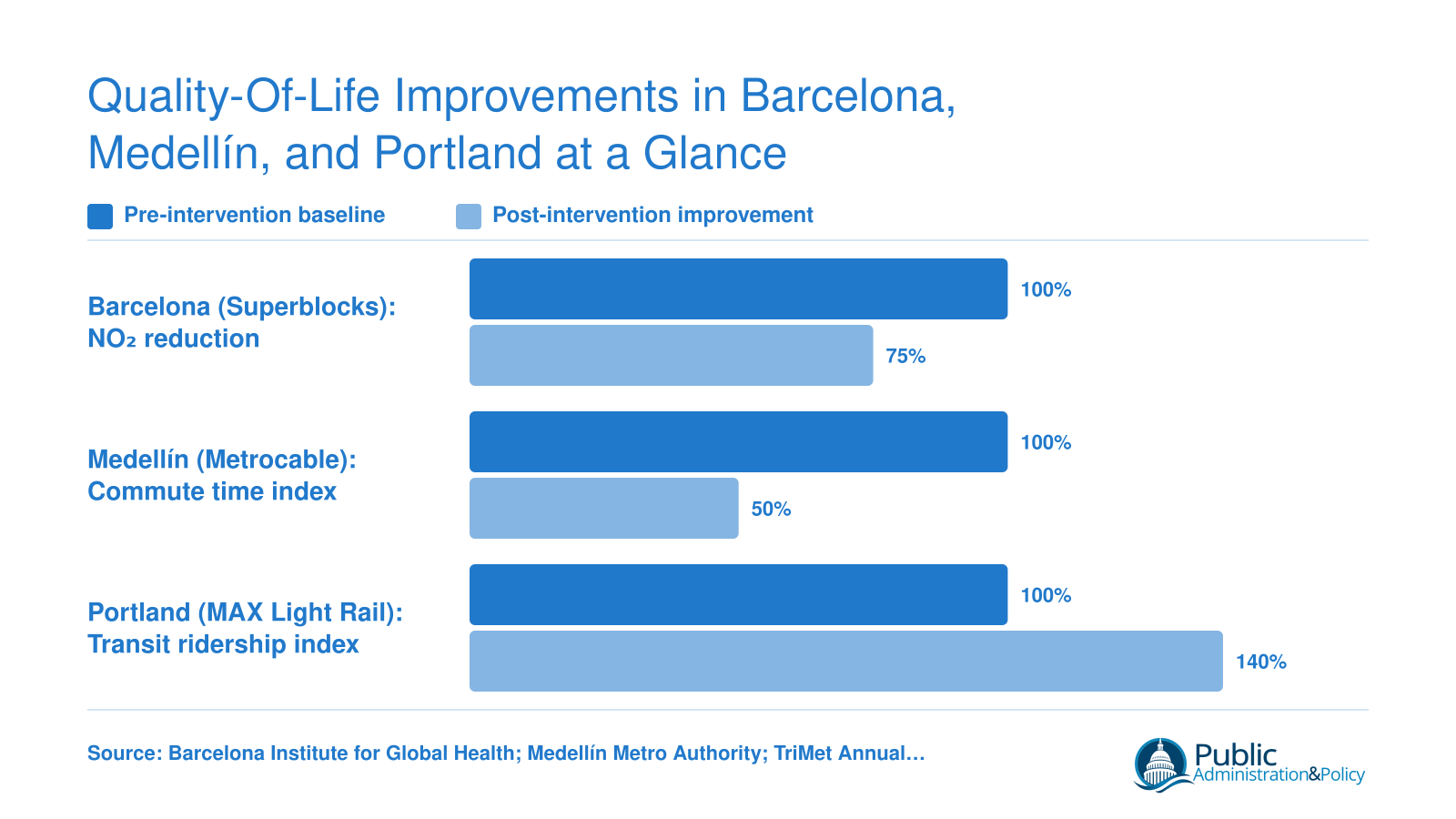
The quantified results are striking. Research published in PubMed Central found that nitrogen dioxide (NO2) concentrations inside superblock areas fell by roughly 25%, an absolute reduction of about 14.6 micrograms per cubic meter.1 Fine particulate matter (PM10) dropped by approximately 17%, or 4.1 micrograms per cubic meter.1 Ambient noise levels decreased from 66.5 dB to 61 dB, a 5.5 dB reduction that represents a meaningful shift in the daily acoustic environment for residents.2 Space allocated to pedestrians expanded from 45% of the street area to 74%, a gain of 29 percentage points.2 Local businesses along redesigned corridors have also reported increased foot traffic, reinforcing the economic case for pedestrian-friendly design.
What makes the superblock model especially relevant for defining public policy professionals is its scalability. Barcelona plans to extend the concept across the Eixample district and beyond, treating urban planning as an iterative, evidence-driven process rather than a one-time intervention.
Medellín, Colombia: Cable Cars as Social Infrastructure
Medellín's Metrocable system, launched in the early 2000s, connected steep hillside comunas, many of them informal settlements, to the city's metro network for the first time. Before these aerial gondola lines were built, residents in neighborhoods like Santo Domingo Savio faced commutes of 90 minutes or more using informal minibuses on winding roads. After the Metrocable opened, commute times for many riders dropped by as much as half.
The system now carries tens of thousands of riders each day, but its significance extends well beyond transit. The cable car stations became anchors for broader public investments: libraries, parks, schools, and health clinics. Research on the social impact of these integrated transit-and-community projects has found improvements in school enrollment rates and labor force participation in surrounding neighborhoods. Homicide rates in some served comunas declined substantially during the same period, though researchers caution that attributing causation solely to transit investment oversimplifies a complex security landscape.
For students of public administration, Medellín illustrates a critical principle: transportation infrastructure is social infrastructure. When planning links marginalized communities to jobs, education, and services, mobility becomes an equity tool. Professionals interested in this intersection may find a path as a community development specialist.
Portland, Oregon: Growth Boundaries and Transit-Oriented Development
Portland's urban growth boundary (UGB), established in the late 1970s, remains one of the longest-running experiments in managed metropolitan growth in the United States. The boundary draws a line around the metro area beyond which urban development is restricted, directing investment inward and preserving surrounding farmland and forest.
Over the decades, the UGB has helped Portland achieve higher housing density within its core than many comparable mid-size U.S. cities. Transit-oriented development along the MAX light rail corridors has concentrated mixed-use neighborhoods around stations, supporting walkability and reducing automobile dependence. Portland's per capita vehicle miles traveled (VMT) has trended below the national average, and TriMet light rail ridership grew substantially over successive decades of line expansion, even as many peer cities saw flat or declining transit use. The region has also maintained significant tracts of productive agricultural land just minutes from the urban core, a tangible benefit that few similarly sized metro areas can claim.
The Portland model is not without criticism. Housing affordability has emerged as a persistent challenge, partly because restricting outward growth increases land values inside the boundary. This tension underscores that planning tools must be paired with complementary policies, such as inclusionary zoning or public housing investment, to avoid displacing the very residents they aim to serve.
What These Cases Tell Us Together
Barcelona, Medellín, and Portland differ in geography, governance, and income level, yet a common thread runs through their successes. Each city committed to a sustained planning vision backed by measurable targets, dedicated funding, and ongoing evaluation. None achieved results overnight, and none claims perfection. What they share is proof that quality of life is not an accident of geography or wealth. It is the product of policy choices, and those choices can be studied, replicated, and improved by the next generation of public administrators and planners.
Quality-Of-Life Improvements in Barcelona, Medellín, and Portland at a Glance
Three cities, three distinct interventions, and measurable gains in livability. Barcelona's Superblocks program reclaimed streets from cars to cut air pollution. Medellín's Metrocable gondola system connected hillside neighborhoods to the urban core. Portland's decades-long transit investment boosted ridership and reshaped commuting patterns. The metrics below highlight one signature outcome from each initiative.
Measuring Success: Quality-Of-Life Indices and Frameworks Cities Actually Use
Urban planners need more than intuition to know whether their work is making life better. That is where quality-of-life indices come in. Several widely used frameworks give cities a structured way to measure livability, compare themselves against peers, and justify the investments that show up in capital budgets and bond measures.
Four Frameworks Worth Knowing
AARP Livability Index: Focused on the United States, this tool scores communities across seven categories: Housing, Neighborhood, Transportation, Environment, Health, Engagement, and Opportunity.1 It draws on more than 50 data sources and incorporates 40 metrics plus 21 policy indicators, scoring each category from 0 to 100 with a national average of 50.1 Updated annually, it is one of the few indices that operates at the neighborhood and census-tract level, making it especially useful for planners targeting age-friendliness and hyperlocal disparities.2
Mercer Quality of Living Survey: Used primarily by multinational corporations and diplomatic agencies, the Mercer survey evaluates over 450 cities worldwide on factors such as political stability, healthcare, education, recreation, and infrastructure. It is designed to help organizations set hardship allowances and relocation packages, but city governments also reference it when marketing themselves to attract talent and investment.
WHO Healthy Cities Indicators: The World Health Organization developed this framework for its Healthy Cities Network, assessing urban health through metrics that span environmental quality, access to primary care, housing conditions, and health equity. It is distinctive because it embeds social determinants of health into the scoring rather than treating health outcomes in isolation.
Economist Intelligence Unit Global Liveability Index: This index ranks 173 cities on stability, healthcare, culture and environment, education, and infrastructure. Published annually, it receives widespread media attention and often shapes public perception of which cities are "the best" to live in.
How Cities Put These Tools to Work
Planners do not treat these indices as vanity scores. They serve concrete operational purposes. A city updating its comprehensive plan might benchmark its AARP Livability scores against similarly sized communities to identify where it lags. Transit agencies might point to low transportation scores when seeking voter approval for a bond measure. Sustainability offices track year-over-year movement on specific indicators to demonstrate that public investments are producing measurable returns.
Limitations Planners Acknowledge
No single index tells the full story. City-wide averages can mask stark neighborhood-level disparities, meaning a high composite score may obscure the reality that some residents face poor air quality, long commutes, or a lack of affordable housing just blocks from thriving districts. Many indices rely on lagging data, sometimes one to three years old by the time results are published. Weighting methodologies can also favor wealthier cities that already have robust infrastructure, making it harder for lower-resource communities to score well regardless of recent improvements.
For these reasons, planners increasingly supplement standardized indices with community-defined indicators. These might include resident satisfaction surveys, measures of displacement risk, or locally relevant metrics such as the number of culturally specific businesses in a corridor. The combination of top-down data and ground-level input produces a more honest picture of who is actually experiencing improved quality of life.
Why This Matters for You
If your city or county publishes a livability scorecard, sustainability dashboard, or annual performance report, you are looking at a planning document. It translates abstract policy goals into numbers that officials are, at least in theory, accountable for meeting. Learning to read these reports, questioning which neighborhoods are and are not reflected in the data, and showing up at public comment periods armed with that information is one of the most direct ways residents and emerging professionals can influence urban planning outcomes. For students exploring careers in public administration, understanding these measurement frameworks is not optional. Whether you aspire to work as a policy analyst or lead a municipal planning office, fluency with livability data is foundational to the work.
The Role of Public Policy and Civic Participation in Urban Planning
Urban planning does not happen in a vacuum. Every zoning change, transit expansion, and park investment is the product of a governance structure that distributes decision-making power across multiple levels of government. Understanding that structure, and the points where residents can influence it, is essential for anyone interested in how planning translates into real quality-of-life gains.
Who Makes Planning Decisions?
At the local level, city councils and planning commissions hold the most direct authority over land use, zoning codes, and comprehensive plans. Regional authorities coordinate transportation networks and environmental protections that cross municipal boundaries. State legislatures set enabling statutes that determine what local governments can and cannot regulate.
Federal policy shapes local options in less visible but equally powerful ways. Funding from the Department of Housing and Urban Development (HUD), the Environmental Protection Agency (EPA), and the Department of Transportation (DOT) often comes with conditions: environmental review requirements, equity analyses, or community engagement mandates. A city's decision to build affordable housing near transit, for example, may hinge on whether it can secure federal grants that require inclusive planning processes. Understanding the importance of public policy at each level helps clarify why these requirements exist.
The Social Planning Process and Where Residents Plug In
Most planning decisions follow a structured sequence that creates multiple entry points for public input:
Needs assessments: Planners gather demographic, economic, and environmental data to identify community priorities. Residents can participate through surveys and community workshops.
Public hearings: Formal sessions where proposed plans, rezonings, or projects are presented for comment. These are typically required by law before a vote.
Environmental impact reviews: Federal and state regulations often mandate review periods during which community members can submit written concerns.
Comprehensive plan updates: Cities revisit their long-range plans on regular cycles (often every five to ten years), opening sustained windows for civic engagement.
Each stage offers an opportunity to shape outcomes, but only if residents know the process exists and can realistically participate.
Barriers to Participation and Emerging Solutions
Traditional engagement methods have well-documented limitations. Public hearings are frequently scheduled during work hours, discouraging participation from hourly workers. Technical jargon in planning documents can alienate residents without specialized knowledge. Communities with large immigrant populations may lack access to translation services, and rural or lower-income neighborhoods often face digital divides that limit online engagement.
Innovations are lowering these barriers. Participatory budgeting programs give residents direct decision-making power over portions of public spending. Online engagement platforms allow asynchronous input that accommodates varied schedules. Community benefit agreements create legally binding commitments between developers and neighborhoods, ensuring that growth delivers tangible local returns such as jobs, affordable units, or public space.
Where Public Administration Professionals Fit
Effective planning requires more than technical design skill. It demands professionals who understand democratic governance, stakeholder negotiation, budgeting, and regulatory compliance. This is precisely the intersection where graduates of Master of Public Administration and Master of Public Policy programs make an impact. They bring the analytical training to evaluate data-driven plans and the governance expertise to ensure those plans reflect community voice rather than override it.
For students considering this path, the careers in public administration section offers resources that connect degree options with the practical realities of planning and public service. The takeaway is straightforward: planning is a policy arena, and the professionals who staff it shape the daily lives of millions of people.
Career Pathways: Pursuing Urban Planning Through Public Administration
If the connection between urban planning and quality of life resonates with you, there are several graduate-level pathways that can translate that interest into a professional career. Each degree equips graduates with a different lens, so understanding the distinctions matters when choosing your program.
Degree Pathways Worth Knowing
The three most common graduate routes into urban planning work are:
Master of Urban Planning (MUP): This is the most direct path. MUP programs emphasize design, land use, transportation systems, environmental planning, and community engagement methods. Graduates tend to work as planners in municipal or regional agencies.
Master of Public Administration (MPA) with an urban planning concentration: An MPA grounds you in organizational management, budgeting, and leadership within public agencies. Adding an urban planning focus lets you manage planning departments or lead cross-functional initiatives that shape how cities grow.
Master of Public Policy (MPP): MPP programs train graduates in policy analysis, program evaluation, and quantitative methods. An MPP is ideal if you want to work on housing policy, transportation equity, or sustainability from an analytical and legislative perspective rather than a design one.
The degree you choose shapes the roles available to you. Common career titles include city planner, transportation planner, community development director, housing policy analyst, and sustainability officer. The Bureau of Labor Statistics projects 4 percent growth for urban and regional planners through 2032, and the 2024 median annual salary for the occupation was approximately $81,000, making it a stable and competitive field within public service.
Why AICP Certification Matters
Once you have gained some professional experience, earning certification from the American Institute of Certified Planners (AICP) is a meaningful next step. AICP certification signals that you have met national standards for education, experience, and ethical practice. Many senior-level and director positions list it as preferred or required, and it can meaningfully expand your earning potential and credibility across jurisdictions. For a broader look at credentials that strengthen a public service career, our guide to public administration certifications covers the most valuable options.
Turning Interest Into Action
Whether you lean toward managing agencies, analyzing policy, or designing neighborhoods, the overlap between public administration and urban planning is where some of the most impactful public service careers exist. If you are exploring how to enter this space, our how to become an urban policy planner guide walks through the steps in detail. For those ready to compare programs, our directory of best online public administration degree programs includes options with urban planning concentrations. Reviewing program profiles is a practical first step toward turning your interest in livable communities into a career that shapes them.
Frequently Asked Questions About Urban Planning and Quality of Life
Urban planning shapes nearly every dimension of daily life, from the air you breathe to the commute you endure. Below are concise answers to the questions students and professionals ask most often about how planning decisions translate into measurable quality-of-life outcomes.
What is the role of urban planning in quality of life?
Urban planning determines how land, transportation, housing, and public spaces are organized within a community. When planners use tools such as zoning codes, comprehensive plans, and design standards effectively, they create environments that support physical health, social connection, economic opportunity, and environmental sustainability. In short, planning is the connective tissue between public policy goals and the lived experience of residents.
How does urban planning affect public health and well-being?
Well-designed communities reduce exposure to air pollution, encourage walking and cycling through complete-street networks, and expand access to parks and green space. Research consistently links these features to lower rates of chronic disease, improved mental health, and fewer traffic fatalities. Planning decisions around housing quality, noise mitigation, and proximity to healthcare facilities also play a direct role in population health outcomes.
How do planners balance equity, sustainability, and economic growth?
Planners rely on inclusive engagement processes, equity-focused impact assessments, and data-driven frameworks to weigh competing priorities. Strategies like inclusionary zoning, transit-oriented development, and community benefit agreements help ensure that sustainability investments and economic development do not displace vulnerable populations. The social planning process is central here: it requires planners to surface who benefits, who bears the costs, and how trade-offs are distributed.
How can residents participate in urban planning decisions that affect their community?
Residents can attend public hearings, join neighborhood advisory boards, submit comments during comprehensive plan updates, and participate in participatory budgeting programs. Many cities now offer digital engagement platforms that make it easier to contribute outside of traditional meeting hours. Active civic participation ensures that planning outcomes reflect diverse community needs rather than only the preferences of well-resourced stakeholders.
What tools and frameworks do cities use to measure quality of life?
Cities draw on composite indices such as Mercer's Quality of Living Survey, the OECD Better Life Index, and locally developed dashboards that track indicators across domains like housing affordability, air quality, commute times, green space per capita, and public safety. Barcelona, Medellin, and Portland, for example, have each used tailored metrics to evaluate the impact of superblocks, cable transit systems, and urban growth boundaries on resident well-being.
What degree do you need to become an urban planner?
Most entry-level positions require a master's degree in urban planning, urban studies, or a closely related field such as public administration or public policy. A Master of Public Administration (MPA) with a concentration in urban affairs is a common pathway. The American Institute of Certified Planners (AICP) credential further strengthens career prospects. You can explore accredited programs and career guidance on publicadministrationpolicy.org.