How to Become a Community Development Specialist: Your Complete Career Guide

Explore education paths, salary expectations, certifications, and career progression for this impactful public service role.

By Max SheltonReviewed by PAP Editoral TeamUpdated May 19, 202625+ min read

What you’ll learn in this article…

  • A bachelor's degree in public administration, urban planning, or social work is the standard entry requirement for this career.
  • Bureau of Labor Statistics data place median pay for community and social service specialists in the mid-range, with senior roles exceeding that by 40 percent or more.
  • Certifications such as the Community Development Professional credential can move your resume ahead of candidates who hold only a degree.
  • AmeriCorps VISTA and Peace Corps placements count as professional experience at many government agencies, offering the fastest path into the field.

Community development specialists work on projects as varied as rural broadband expansion in Appalachia and mixed-income housing programs in Los Angeles, yet the career path into the field remains surprisingly consistent. A bachelor's degree in public administration, urban planning, or a related social science is the baseline requirement for most positions, and demand continues to grow as federal grant programs channel billions into underserved areas each fiscal cycle.

The central challenge for professionals entering community development is positioning themselves at the intersection of government agencies, nonprofit organizations, and the residents they serve. Salaries reflect that complexity, ranging from roughly $42,000 at the entry level to over $80,000 for senior specialists, with significant variation by sector and geography. Employers increasingly favor candidates who pair formal education with field-tested credentials such as public administration certifications and the Community Development Professional (CDP) designation, making early career planning more consequential than it was a decade ago.

What Is a Community Development Specialist?

A community development specialist is a professional who designs, implements, and evaluates programs aimed at improving the social, economic, and physical conditions within a community. The role sits at the intersection of public policy, social services, and project management, requiring practitioners to translate broad community needs into actionable initiatives, then measure whether those initiatives deliver real results. You will find community development specialists embedded in city and county government agencies, nonprofit organizations, consulting firms, and programs funded through the U.S. Department of Housing and Urban Development (HUD). The scope of the job shifts with the employer: a specialist in a municipal planning department may focus on neighborhood revitalization grants, while one at a nonprofit might coordinate workforce training for underserved populations.

How This Role Differs from Similar Titles

Several related job titles overlap with community development work, and the distinctions matter when you are mapping out a career path.

  • Community organizer: Primarily focused on grassroots advocacy, coalition building, and mobilizing residents around specific causes. Organizers drive campaigns; specialists manage sustained programs.
  • Urban planner: Concentrated on zoning, land use, transportation networks, and the physical design of cities and regions. Planners shape the built environment; community development specialists address broader social and economic well-being.
  • Economic development specialist: Centered on business attraction, retention, and workforce expansion to grow a local economy. The mandate is narrower than the holistic community lens a community development specialist brings.
  • Community development representative: Often a banking or financial services title tied to Community Reinvestment Act (CRA) compliance and lending activities. Despite the similar name, this role operates in a regulatory and financial context rather than a direct service or program management context.

Understanding these differences helps you target the right job postings, degree programs, and professional networks as you build your career. For a broader look at where this role fits within the field, explore careers in public administration.

Three Core Work Modes

Regardless of the employer, a community development specialist's day-to-day work tends to cluster around three interconnected functions.

  • Program management: Planning project timelines, coordinating staff and partner organizations, tracking deliverables, and reporting outcomes to funders or elected officials. This is the operational backbone of the role.
  • Stakeholder engagement: Facilitating public meetings, conducting needs assessments, building relationships with residents, local businesses, faith-based organizations, and government leaders. Effective engagement ensures that programs reflect actual community priorities rather than top-down assumptions.
  • Resource and grant development: Identifying federal, state, and private funding sources; writing competitive grant applications; managing budgets; and ensuring compliance with funder requirements. Many positions, especially those in nonprofits and HUD-funded programs, treat grant writing as a core competency rather than an occasional task.

These three modes rarely operate in isolation. A single affordable-housing initiative, for example, might require you to secure Community Development Block Grant funding, coordinate construction timelines with contractors and city inspectors, and host resident input sessions, all within the same quarter. That blend of strategic thinking, relationship building, and fiscal discipline is what defines the community development specialist role and distinguishes it from adjacent public administration jobs.

Key Responsibilities and Day-to-Day Work

Community development specialists rarely spend an entire day behind a desk. A typical morning might begin with a stakeholder meeting involving city planners, housing authority staff, and local business owners, followed by a site visit to a neighborhood slated for infrastructure improvements. By afternoon, the focus shifts to updating grant expenditure reports or reviewing program data. In the evening, you may facilitate a community forum where residents voice priorities for how federal block grant dollars should be spent. That rhythm, moving between desk work, fieldwork, and public engagement, defines the profession.

Core Duties

While specific tasks vary by employer, most community development specialist positions share a common set of responsibilities:

  • Needs assessments: Surveying neighborhoods, analyzing census data, and mapping service gaps to determine where resources should flow.
  • Grant writing and administration: Drafting competitive proposals, managing award budgets, and ensuring compliance with funder requirements throughout the grant lifecycle.
  • Program design: Developing initiatives such as affordable housing programs, small business assistance funds, or workforce training partnerships.
  • Community outreach: Organizing public hearings, leading focus groups, and maintaining ongoing dialogue with underserved populations.1
  • Data collection and reporting: Tracking outputs and outcomes for funded programs, then compiling reports for federal, state, or philanthropic stakeholders.
  • Inter-agency coordination: Serving as a liaison among municipal departments, nonprofits, healthcare providers, and educational institutions to align services.
  • HUD compliance monitoring: Ensuring that projects funded through programs like CDBG, HOME, HOPWA, and ESG meet federal regulatory standards for spending, eligibility, and environmental review.2

How the Daily Mix Varies by Setting

The balance among these duties shifts depending on where you work. In a local government role, much of your time centers on compliance, budgets, and federal reporting cycles. You are the person making sure every dollar is documented and every regulation is followed. In a nonprofit setting, the weight tips toward direct engagement and programming: running workshops, coordinating volunteers, and building trust with community members face to face. If you move into consulting, the emphasis lands on assessment and strategy, conducting analyses for multiple client communities and delivering actionable recommendations without necessarily managing long-term implementation. Those drawn to the consulting path may find overlap with the work of a public policy consultant.

Understanding these differences matters when choosing your career path, because the skills you lean on day to day will shape your professional development over time.

Tools and Platforms You Will Use

Modern community development work depends on a growing technology stack that many career guides overlook. Familiarity with these platforms will set you apart in the job market:

  • HUD systems: IDIS (Integrated Disbursement and Information System) is required for reporting on CDBG, HOME, HOPWA, and ESG grants. DRGR handles disaster recovery and mitigation funds. HEROS manages HUD environmental reviews.2
  • GIS mapping: ArcGIS is the de facto standard for visualizing low-to-moderate income areas, housing conditions, and infrastructure needs. QGIS offers a free open-source alternative. CPD Maps, a HUD tool, lets specialists map CDBG and HOME investment areas directly.2
  • Grant management software: Platforms like eCivis and AmpliFund streamline the full grant lifecycle for government agencies, while Fluxx is widely used in the philanthropic and foundation sector.3
  • Civic engagement platforms: Tools such as PublicInput, Go Vocal, MetroQuest, and Polco help structure community input through digital surveys, participatory budgeting exercises, and interactive mapping.1
  • Data reporting and visualization: Excel remains foundational, but Power BI and Tableau are increasingly expected for dashboards that communicate program impact to elected officials and funders.
  • CRM platforms: Salesforce, Microsoft Dynamics, and similar systems track stakeholder relationships, service delivery records, and outreach history.3
  • Emerging AI tools: As of 2026, many agencies and organizations are beginning to pilot generative AI assistants for drafting reports, summarizing public comments, and analyzing survey data, though human oversight remains essential.4

Building competency across these tools early, whether through coursework, certifications, or on-the-job training, gives you a practical edge that complements the interpersonal and analytical skills the role demands. Professionals who pair technical fluency with strong urban policy planner skills or a solid grounding in public administration are especially well positioned for advancement.

Questions to Ask Yourself

Community development specialists spend much of their time bridging gaps between groups with competing priorities. If navigating these dynamics drains you rather than motivates you, the daily reality of the role may not be a good fit.

You will need to interpret census data, grant metrics, and housing statistics, then translate those numbers into narratives that persuade decision makers. Comfort with both spreadsheets and stakeholder presentations is essential.

Neighborhood revitalization, affordable housing initiatives, and economic development plans often unfold over three to seven year timelines. Patience and the ability to celebrate incremental progress are critical to long term satisfaction in this career.

Education Requirements: Degrees and Majors That Qualify You

A bachelor's degree is the standard entry point for community development specialist roles across government agencies, nonprofits, and private organizations. Several majors can set you on the right path, though the one you choose will shape the type of community development work you pursue.

Bachelor's Degrees That Open the Door

The most common undergraduate majors for aspiring community development specialists include:

  • Public Administration: Builds a foundation in government operations, budgeting, and policy implementation, making graduates strong candidates for municipal and county planning departments.
  • Urban Planning: Focuses on land use, zoning, housing policy, and infrastructure, which translates directly into community revitalization and neighborhood development roles.
  • Social Work: Prepares graduates for direct-service positions where the emphasis is on connecting residents to resources, facilitating community organizing, and addressing social determinants like housing instability or food insecurity.
  • Sociology or Public Policy: Provides analytical frameworks for understanding inequality, demographic change, and program evaluation, skills that underpin grant writing and needs assessments.
  • Community Development: A dedicated bachelor's degree in community development is the most tailored option, though relatively few institutions offer it. The University of New Hampshire and the University of Missouri are among the schools with established programs in this area.

Matching Your Degree to a Career Trajectory

Think of your major as a lens that focuses your career in a particular direction. A social work degree tends to channel graduates toward direct-service and community organizing roles at nonprofits or social service agencies. An urban planning or public administration degree, on the other hand, positions you for government roles such as community development planner, grants coordinator, or housing program analyst. If you are interested in related government careers, you may also want to explore what it takes to become a policy analyst. If you can find a dedicated community development program, it combines elements of both tracks and often includes fieldwork with local organizations.

When a Master's Degree Matters

While a bachelor's degree is sufficient for entry-level and many mid-level positions, a master's degree significantly accelerates advancement. An MPA (Master of Public Administration), MSW (Master of Social Work), or master's in urban planning is frequently required for senior government positions, department director roles, and leadership posts at large nonprofits. If your goal is to eventually oversee programs, manage budgets in the millions, or shape policy at the regional or state level, plan for graduate education. Many professionals work for a few years before returning to school, which also makes them stronger applicants for competitive programs.

Experience That Can Substitute for Formal Education

Not every path into community development runs through a four-year degree, at least not immediately. Service programs like AmeriCorps, Peace Corps, and VISTA provide structured, hands-on experience in community organizing, program delivery, and stakeholder engagement. Many nonprofit employers and some local government agencies will accept two or more years of this kind of service in lieu of a completed degree for entry-level positions. Sustained volunteer work or employment at a local community development corporation, housing authority, or neighborhood association can also build a competitive resume. If you take this route, pairing field experience with a certificate or associate degree in a related area strengthens your candidacy and keeps doors open for advancement.

Certifications That Strengthen Your Career

While a relevant degree opens the door, professional certifications signal specialized competence to hiring committees and can move your resume to the top of the pile. Several credentials align directly with community development work, each with its own focus, eligibility criteria, and issuing body. Because fees and requirements are updated on a rolling basis, always verify the details on the issuing organization's website before you apply.

American Institute of Certified Planners (AICP)

The AICP credential, administered by the American Planning Association, is one of the most widely recognized designations in urban and community planning. Candidates typically need a combination of education and professional planning experience, and they must pass a comprehensive exam covering plan making, land use, ethics, and public engagement. The AICP website publishes its current fee schedule and eligibility matrix each year, so check there for the latest requirements. Holding the AICP can be especially valuable if your community development role intersects with zoning, comprehensive planning, or municipal land use policy, areas that also overlap with the work of an urban policy planner.

Certified Community and Economic Developer (CCE)

Offered by the National Council for Community and Economic Development (NCED), the CCE is tailored specifically for professionals who manage neighborhood revitalization, economic development strategy, or housing programs. Eligibility generally involves a combination of education, field experience, and continuing education credits. The NCED site lists current exam windows, costs, and study resources. Because the CCE is niche, it carries strong signaling value with employers in local government, community development financial institutions, and regional planning agencies.

Grant Professionals Certification (GPC)

Community development specialists frequently write or manage federal and state grants, making the GPC credential from the Grant Professionals Certification Institute a practical addition. The certification handbook, available on the Institute's website, outlines eligibility thresholds and exam content areas such as grant research, proposal writing, and post-award compliance. If your role involves securing funding from agencies like HUD, USDA Rural Development, or the Economic Development Administration, this credential demonstrates a validated skill set that funders and employers both respect.

HUD-Specific Training Programs

The U.S. Department of Housing and Urban Development offers targeted training through HUD Exchange, covering topics like Community Development Block Grant administration, fair housing compliance, and environmental review. These programs are not formal certifications in the traditional sense, but completing them shows fluency in federal community development frameworks. Many local government job postings reference HUD training as preferred or required. Browse the HUD Exchange site for current offerings and cross-check job postings on BLS.gov or USAJOBS to see how often these qualifications appear in vacancy announcements. Professionals interested in how federal program management certification requirements work may also find the FAC-P/PM framework instructive.

Other Credentials Worth Considering

  • Project Management Professional (PMP): Issued by the Project Management Institute, the PMP is sector-agnostic but highly relevant when you oversee multiyear community projects with complex timelines and stakeholder groups.
  • Certified Economic Developer (CEcD): Administered by the International Economic Development Council, this credential suits professionals whose community development work leans heavily toward business attraction, workforce development, or economic resilience planning.

Investing in one or two well-chosen certifications can differentiate you in a competitive hiring landscape and, over time, contribute to higher earning potential. Prioritize the credential that most closely matches the sector and project types you want to pursue, then build from there as your career advances.
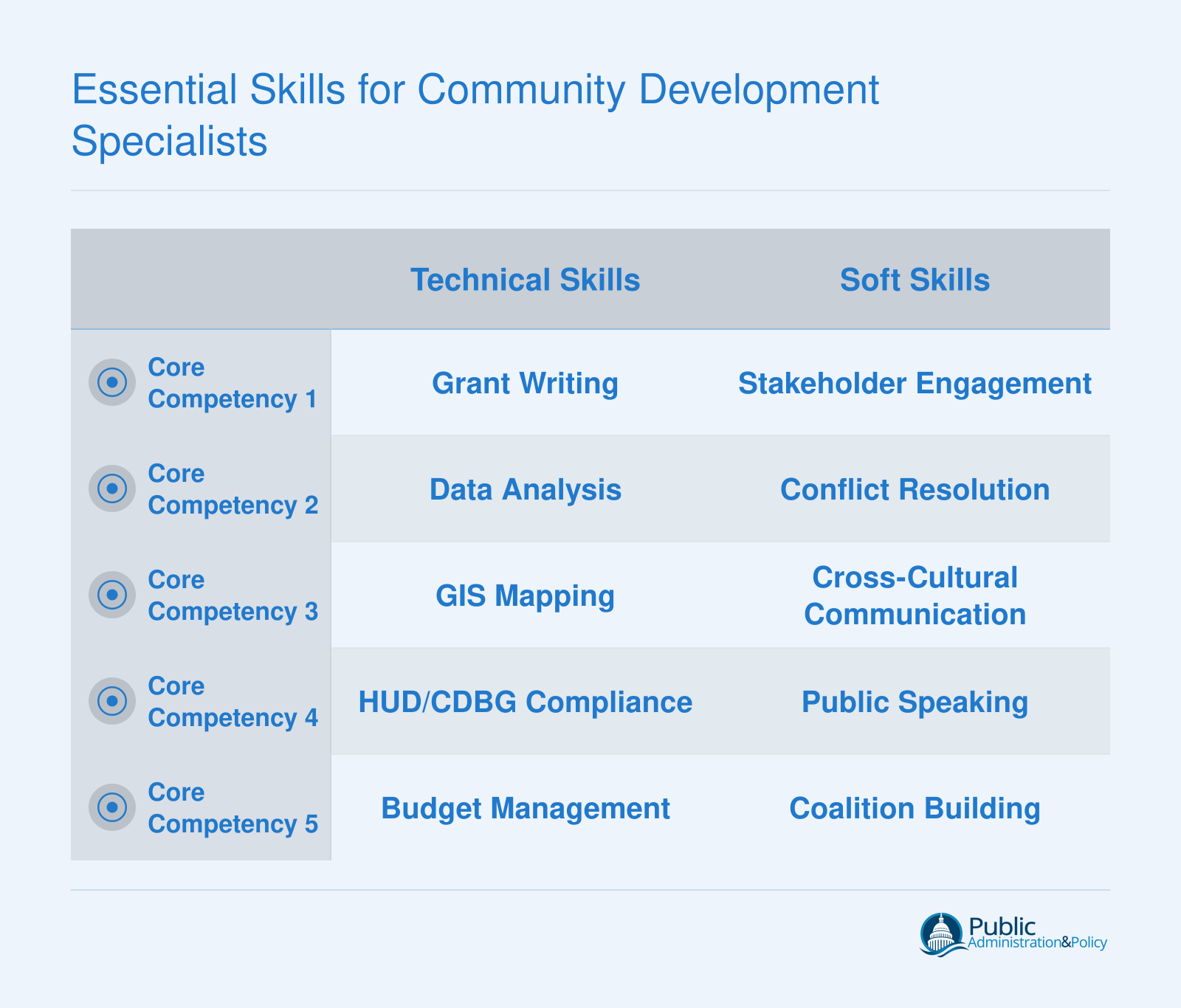
Essential Skills for Community Development Specialists

Successful community development specialists draw on a blend of technical expertise and interpersonal abilities. Use the checklist below to self-assess your readiness. If you spot gaps on either side, targeted coursework, certifications, or volunteer work can help you close them before your next application.

Side-by-side checklist comparing five technical skills and five soft skills essential for community development specialists

Community Development Specialist Salary by Experience, Sector, and Region

Compensation for community development specialists varies significantly depending on how long you have been in the field, which sector employs you, and where you live. According to Bureau of Labor Statistics data for Community and Social Service Specialists (SOC 21-1099), the median annual wage stood at $49,690 as of May 2023, with a mean annual wage of $54,020 and a mean hourly rate of $25.97.1 Roughly 95,310 professionals held positions in this occupational category nationwide.1 Understanding the factors that push pay above or below that median can help you plan a career trajectory that meets both your financial goals and your mission-driven aspirations.

Salary Ranges by Experience Level

Earnings climb noticeably as you accumulate expertise and take on more complex projects.

  • Entry level (0 to 2 years): Depending on the sector, expect a range of roughly $38,000 to $65,000. Government positions typically start between $48,000 and $60,000, nonprofit roles between $38,000 and $50,000, and consulting engagements between $50,000 and $65,000.1
  • Mid-career (3 to 7 years): Government salaries generally rise to $60,000 to $75,000, nonprofit pay reaches $50,000 to $65,000, and consulting compensation jumps to $65,000 to $85,000.1
  • Senior level (8 or more years): Professionals who move into program director, planning manager, or principal consultant roles can exceed six figures, particularly in consulting and federal agencies. Exact senior ranges vary widely by organization size and geography.

How Sector Shapes Total Compensation

The raw salary number tells only part of the story. Government roles at the federal, state, and municipal levels typically bundle robust benefits packages, including defined-benefit pensions, generous leave accrual, and subsidized health insurance, which can add 30 percent or more to your effective compensation. Professionals interested in federal program management should note that senior federal positions often carry some of the most generous total compensation packages in the field. Consulting roles tend to offer the highest cash pay, especially at firms specializing in housing, economic development, or federal grant management, but benefits are often less comprehensive. Nonprofit positions generally trail in base salary, yet many practitioners choose this path because it provides direct mission alignment and community-level impact that can be harder to find inside large agencies or private firms.

Regional Differences and Top-Paying Areas

Geography plays a meaningful role in pay. Metropolitan areas with a high cost of living and heavy demand for community planning talent, such as Washington, D.C., New York, San Francisco, and Boston, typically pay above the national median. States with large federal footprints or active community development block grant programs also tend to support higher salaries for specialists who manage those funds. Conversely, rural regions may offer lower base wages but often come with lower living costs and, in some cases, loan repayment incentives designed to attract public service professionals.

Job Growth Outlook

The Bureau of Labor Statistics projects 9 to 10 percent employment growth for this occupational group over the 2022 to 2032 decade, a pace faster than the average across all occupations.2 Increasing federal and state investment in affordable housing, environmental policy consulting, and rural broadband expansion is expected to sustain demand for skilled community development specialists through at least the late 2020s. For career planners, this growth rate signals strong long-term job security regardless of the sector you choose.

When evaluating offers, look beyond the paycheck. Compare retirement contributions, tuition reimbursement, remote work flexibility, and professional development budgets. These factors often close the gap between a higher-paying consulting position and a seemingly lower government or nonprofit salary, and they can make a substantial difference over the course of a decades-long career in community development work.

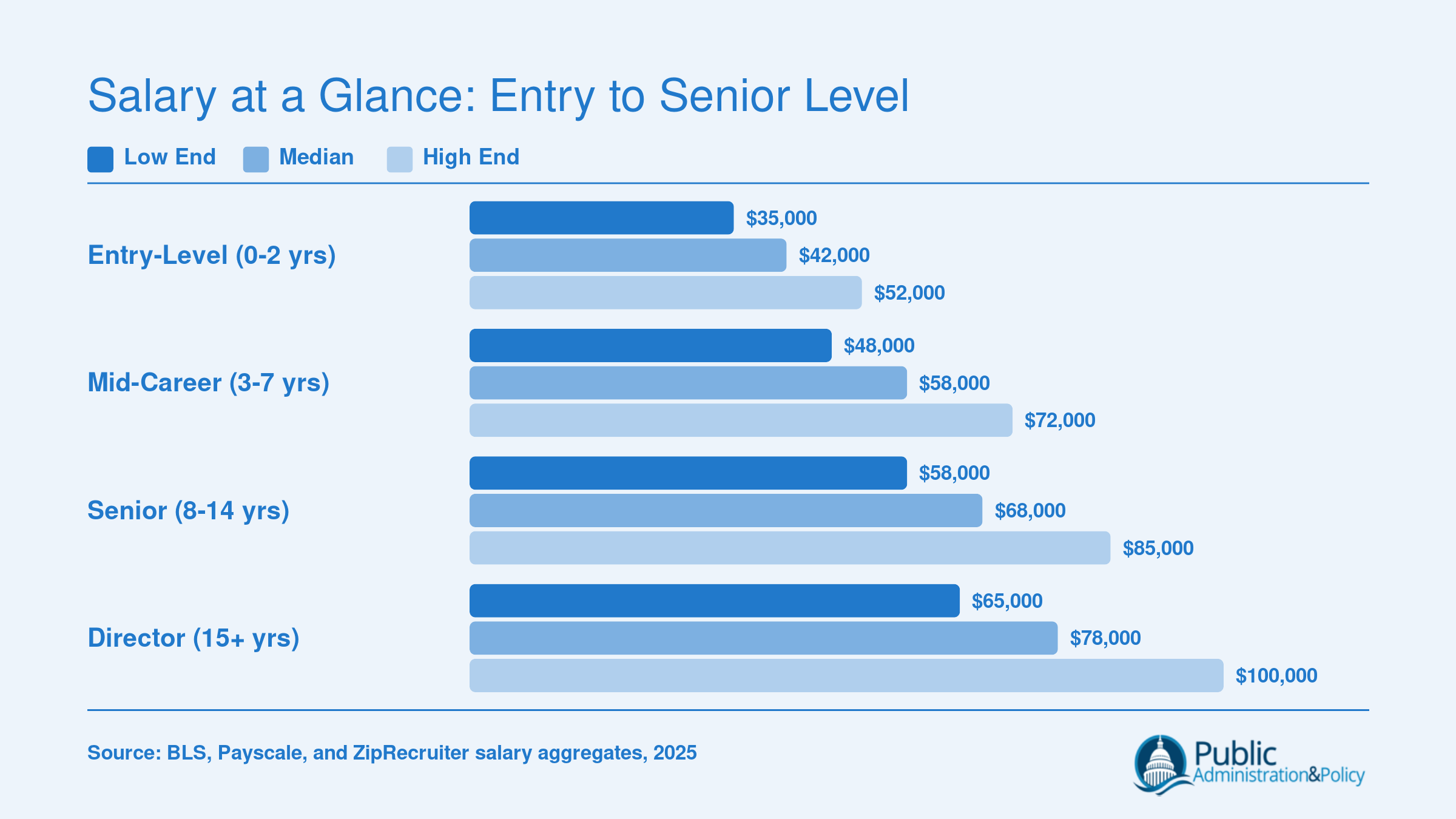
Salary at a Glance: Entry to Senior Level

Community development specialist salaries vary widely depending on experience and responsibility level. The figures below show median earnings alongside typical ranges, illustrating how compensation grows as professionals move from entry-level roles into senior and director positions.

Median community development specialist salaries ranging from $42,000 at entry level to $78,000 at the director level, based on 2025 labor market data

Career Path and Advancement Opportunities

Community development is a field where momentum builds over time. Each role you hold expands your network, deepens your subject-matter expertise, and opens doors to positions with greater scope and compensation. While timelines vary by sector and geography, a general trajectory is well established across government agencies, nonprofits, and private consulting firms.

Typical Promotion Timeline

Most professionals move through four broad stages over the first decade or more of their careers:

  • Entry-level specialist (0 to 2 years): You handle neighborhood assessments, stakeholder outreach, data collection, and grant compliance tasks under a senior colleague's supervision. Building a track record of completed projects and reliable reporting is the primary objective.
  • Senior specialist or project lead (3 to 5 years): After demonstrating competence with individual assignments, you take ownership of multi-stakeholder projects. At this stage, earning a professional certification or completing a master's degree often accelerates promotion.
  • Program manager or coordinator (5 to 8 years): You oversee a portfolio of programs, manage budgets, supervise junior staff, and represent your organization in interagency collaborations. A growing grant portfolio, measured by the dollar value of funding you have secured or administered, is one of the clearest markers of readiness for this level.
  • Director of community development or equivalent (8 to 12+ years): Directors set strategic priorities, negotiate public-private partnerships, report to elected officials or executive boards, and shape policy at the municipal or regional level. Leadership experience and a demonstrated record of measurable community outcomes are essential to reach this tier.

What Triggers Advancement at Each Stage

Promotion decisions hinge on a mix of credentials and demonstrable impact. Completing a relevant certification, such as the Community Development Professional credential, signals specialized competence. A master's degree in public administration, urban planning, or a related discipline is increasingly expected for management roles. Beyond formal credentials, decision-makers look at the size and complexity of grants you have managed, the breadth of partnerships you have cultivated, and your ability to lead teams through multi-year initiatives.

Lateral Moves and Career Pivots

Community development specialists are well positioned for lateral transitions because their skill set, spanning stakeholder engagement, policy analysis, and program evaluation, transfers readily. Common pivots include urban policy planner roles, housing policy, economic development, and nonprofit executive leadership. These moves can be strategic: a stint in housing policy, for example, may deepen the expertise you need to return to community development in a director-level role. Professionals who enjoy fiscal oversight sometimes pivot to become a public budget analyst, while others explore how to become a city manager in smaller jurisdictions.

Government Versus Nonprofit and Consulting Tracks

The structure of your career ladder depends heavily on where you work. Federal and state agencies typically follow defined pay scales with step increases tied to time in grade and performance evaluations. Promotions are transparent but can feel slow. Local government positions often mirror this structure, though smaller municipalities may offer faster advancement simply because teams are leaner.

Nonprofit and consulting careers are more fluid. Advancement is portfolio-driven: the grants you land, the programs you launch, and the outcomes you can quantify matter more than years of service. This flexibility means talented professionals can rise quickly, but it also means that career progression is less predictable. Building a visible body of work and cultivating a strong professional network are especially important in these settings.

Regardless of sector, the common thread is clear: each stage rewards professionals who combine formal credentials with real-world results. Investing in both education and hands-on leadership experience is the surest way to keep your career moving forward.

Where Community Development Specialists Work: Sectors, Settings, and Employers

Community development specialists find employment across a wide spectrum of organizations, each offering distinct missions, work environments, and compensation structures. City and county governments remain the largest single employer category, but federal agencies such as HUD and USDA Rural Development, national nonprofits like NeighborWorks America and Enterprise Community Partners, and private consulting firms all compete for qualified talent. Local community development financial institutions (CDFIs) also hire specialists in growing numbers, particularly for neighborhood revitalization and small business lending initiatives. The comparison below breaks down the four main sectors so you can evaluate which environment best fits your goals.

City or County GovernmentState and Federal AgenciesNonprofit OrganizationsConsulting Firms
$48,000 to $72,000$55,000 to $95,000 (GS 9 to GS 13 scale for federal roles)$42,000 to $68,000$58,000 to $100,000+
Roughly 50/50 desk and field work, including site visits, public hearings, and neighborhood walkthroughsPrimarily desk and policy analysis, with periodic field audits or regional travelHeavily field oriented, with direct community engagement, workshops, and partner meetingsProject based, blending data analysis at the office with client site visits and stakeholder facilitation
Administering block grants, zoning incentives, housing programs, and local economic development plansSetting policy frameworks, distributing federal funding (e.g., CDBG, HOME), and monitoring complianceGrassroots advocacy, affordable housing development, financial literacy, and capacity buildingTechnical assistance, program evaluation, strategic planning, and grant writing for public and nonprofit clients
Community Development Coordinator, Neighborhood Planner, Housing Program SpecialistCommunity Development Representative, Program Analyst, Rural Development SpecialistCommunity Developer, Program Manager, Community Engagement DirectorCommunity Development Consultant, Senior Analyst, Project Manager
Skews urban and suburban, though rural counties also hire for grant administrationBroad geographic reach; USDA Rural Development focuses specifically on rural and tribal areasPresent in both settings; national groups like NeighborWorks America operate through a network of over 240 local affiliatesConcentrated in metro areas, but project assignments may involve travel to rural or underserved regions
Strong job security, public pension plans, and structured pay increasesHigh stability, federal benefits package including FERS retirement and generous leaveModerate stability; benefits vary widely by organization size and funding cyclesVariable; performance bonuses and profit sharing are common, but contracts can be cyclical
Municipal planning departments, county housing authorities, regional councils of governmentU.S. Department of Housing and Urban Development (HUD), USDA Rural Development, state housing finance agenciesEnterprise Community Partners, NeighborWorks America, local CDFIs, Habitat for Humanity affiliatesICF, Abt Associates, HR&A Advisors, smaller regional planning consultancies

Frequently Asked Questions About Community Development Specialists

Below are answers to the questions prospective community development specialists ask most often. Each response draws on the salary benchmarks, education pathways, and career details discussed throughout this guide.

A community development specialist typically spends each day meeting with residents, local organizations, and government officials to assess neighborhood needs and coordinate improvement projects. Daily tasks include writing grant proposals, analyzing demographic and economic data, facilitating public meetings, and tracking program outcomes. The work blends planning, outreach, and project management to drive measurable community change.

Salaries vary by experience, sector, and location. Entry-level community development specialists often earn in the low-to-mid $40,000s, while mid-career professionals typically fall in the $55,000 to $70,000 range. Senior specialists and those in high-cost metropolitan areas or federal agencies can earn $80,000 or more. Nonprofit roles generally pay less than government positions at equivalent experience levels.

Most employers require at least a bachelor's degree. Common majors include public administration, urban planning, social work, public policy, and sociology. A master's degree in public administration (MPA) or a related field strengthens competitiveness for senior roles and can accelerate advancement. Some entry-level positions accept an associate degree paired with relevant field experience.

Community organizers focus primarily on grassroots mobilization, building coalitions, and empowering residents to advocate for themselves. Community development specialists take a broader, more institutional approach that includes program design, grant management, data analysis, and cross-sector coordination. While both roles serve communities, specialists tend to work within government agencies or nonprofits in a planning and implementation capacity rather than a purely advocacy-driven one.

Several credentials can boost your career. The Community Development Professional (CDP) certification from the Community Development Society is widely recognized. The Housing Development Finance Professional (HDFP) credential from the National Development Council is valued in housing-focused roles. Project Management Professional (PMP) and Certified Nonprofit Professional (CNP) designations also demonstrate specialized competencies that employers look for when promoting to leadership positions.

Success in community development requires a blend of hard and soft skills. Key technical abilities include grant writing, budget management, data analysis, and familiarity with geographic information systems (GIS). Equally important are interpersonal skills such as stakeholder facilitation, cultural competency, public speaking, and conflict resolution. Strong written communication is essential for producing reports, funding applications, and policy briefs.

Yes. Federal investment in infrastructure, affordable housing, and climate resilience continues to create demand for professionals who can manage community-level projects. The Bureau of Labor Statistics projects steady growth for related occupations through the late 2020s. Increasing emphasis on equity-driven planning and place-based economic strategies is further expanding opportunities in both the public and nonprofit sectors.

The path to becoming a community development specialist is straightforward once you break it into deliberate steps: earn a relevant degree in public administration, urban planning, social work, or a related field; build field experience through AmeriCorps VISTA, Peace Corps placements, or local internships; pursue a certification aligned with your target sector; and document the community impact you create along the way. As the salary and career path sections of this guide illustrate, each layer of education and experience compounds, opening doors to roles with greater responsibility and compensation.

Start today. Search for open AmeriCorps VISTA positions or visit your state's community development job board to see what employers in your area are hiring for right now. One concrete step this week puts you closer than another month of research ever will.

Recent Articles