How to Become a Nonprofit Executive Director: A Complete Career Roadmap

Step-by-step guidance on the education, experience, and skills needed to lead a nonprofit organization

By Carrie HirschReviewed by PAP Editoral TeamUpdated May 16, 202610+ min read

Key Points

  • Most nonprofit executive directors hold a master's degree and build 12 to 18 years of progressively strategic experience before reaching the role.
  • A proven fundraising track record is the single most career-accelerating skill at every stage of the nonprofit leadership ladder.
  • Historic executive director departures and weak succession planning have created a strong supply-demand gap favoring aspiring leaders in 2026.
  • Starting at a smaller organization with a budget under two million dollars is a deliberate strategy that builds the broadest leadership foundation.

Roughly 70 percent of current nonprofit executive directors plan to leave their roles within the next five years, according to recurring sector surveys, yet fewer than a third of organizations have a succession plan in place. That gap represents one of the largest leadership pipeline shortfalls in any sector of the U.S. economy.

The executive director role sits at the intersection of mission-driven purpose and CEO-level operational demands: fundraising targets, board governance, financial oversight, and public accountability all land on one desk. These responsibilities overlap significantly with careers in public administration, where stewardship of public resources and organizational leadership are equally central. Candidates who understand how to stack the right education, build a credible fundraising record, and time their move into a first leadership seat hold a measurable advantage in a market where demand already outpaces supply.

What Does a Nonprofit Executive Director Do?

The executive director is the top operational leader of a nonprofit organization, responsible for translating the board of directors' vision into day-to-day reality. If you have ever wondered what an executive director of a nonprofit actually does, the simplest answer is this: the ED runs the organization. Some larger nonprofits (typically those with budgets above $10 million) use the title "CEO" instead, but the function is essentially the same. The ED title remains far more common across the sector, especially among small and mid-size organizations that make up the vast majority of the nonprofit landscape.

It is critical to distinguish this role from the board chair. The board chair leads the governing body that sets policy, approves budgets, and hires (or fires) the executive director. The ED, in turn, manages everything beneath that governance layer: programs, staff, finances, and fundraising.

Five Core Responsibility Buckets

Regardless of organization size, the executive director role clusters around five areas:

  • Strategic planning: Setting organizational direction in partnership with the board, defining measurable goals, and ensuring programs align with the mission.
  • Fundraising and revenue: Leading grant applications, donor cultivation, major gift solicitation, and earned-revenue strategies that keep the organization financially viable.
  • Financial oversight: Managing budgets, monitoring cash flow, ensuring compliance with tax and reporting requirements, and presenting accurate financial pictures to the board.
  • Staff management: Hiring, mentoring, and evaluating the leadership team (and often all staff at smaller organizations), while shaping workplace culture.
  • External representation and advocacy: Serving as the public face of the organization with funders, media, partner agencies, elected officials, and the communities the nonprofit serves.

How the Role Shifts by Organization Size

At a nonprofit with a $500,000 annual budget, the executive director is often a hands-on generalist. Writing grant proposals, coordinating events, posting on social media, and even locking up the office at night are all part of the job. There may be only two or three staff members, and the ED fills every gap.

At a $20 million organization, the picture looks dramatically different. The ED delegates program operations to department directors, focuses on cultivating relationships with major donors and board members, and spends significant time on strategic partnerships and public policy. The skill set shifts from doing the work to leading the people who do the work.

The Board-ED Dynamic: The Relationship You Must Master

If there is one thing every aspiring executive director needs to internalize, it is this: the board governs, the ED manages. This division sounds clean on paper but creates real tension in practice. Boards sometimes micromanage operations; executive directors sometimes make policy decisions unilaterally. Navigating that boundary with clarity, professionalism, and mutual respect is the single most important interpersonal competency the role demands.

A healthy board-ED relationship rests on transparent communication, clearly defined roles (often codified in a board governance manual), and regular performance evaluations that run in both directions. Aspiring EDs who learn to manage "up" toward a board just as effectively as they manage "down" toward staff will be far better positioned for long-term success in the role. Those interested in the financial dimensions of nonprofit leadership may also benefit from understanding public budget analyst competencies, since budget stewardship is central to the ED's credibility with the board.

Education Requirements: What Degree Do You Need to Become a Nonprofit Executive Director?

There is no single required degree for the executive director role, and you will not find a universal licensure the way you would in law or medicine. That said, a master's degree has become the de facto expectation for most mid-to-large nonprofit organizations. Scan job postings for executive director positions at organizations with budgets above one million dollars and you will see a clear pattern: the overwhelming majority list a graduate degree as preferred or required. Understanding which degree aligns with your target subsector can save you years of misaligned preparation.

The Three Graduate Degrees That Matter Most

Three master's programs dominate the nonprofit leadership pipeline, and each one opens doors to slightly different corners of the sector.

  • MPA or MPP (Master of Public Administration or Public Policy): The most versatile choice for nonprofit leadership. These programs train you in organizational management, budgeting, program evaluation, and stakeholder engagement. Arts, education, civic engagement, and policy advocacy organizations tend to favor MPA or MPP holders because the curriculum maps directly onto the governance and public accountability demands of these subsectors.
  • MBA with a nonprofit or social enterprise concentration: Large-budget organizations, federated nonprofits, and health systems increasingly seek candidates with MBA training. If your target organization has a budget north of ten million dollars, revenue diversification challenges, or complex financial structures, an MBA signals fluency in the strategic and fiscal language boards want to hear.
  • MSW (Master of Social Work): Health and human services nonprofits, community development organizations, and direct-service agencies often prefer or require an MSW. The clinical and community-practice foundations of social work align with program delivery models, and an MSW can also satisfy licensing requirements that some funders expect of leadership.

If you are leaning toward the MPA route, comparing accredited programs early is worthwhile. Our guide to the best online MPA programs can help you evaluate curriculum, cost, and format side by side.

When a Bachelor's Degree Is Enough

At small grassroots organizations, particularly those with budgets under five hundred thousand dollars, a bachelor of public administration or another relevant bachelor's degree paired with ten or more years of progressive nonprofit experience can be sufficient. In these settings, boards prioritize demonstrated fundraising results, community relationships, and operational track records over graduate credentials. Many successful executive directors at grassroots organizations earned their roles by growing with the organization from program coordinator through director-level management.

Alternative Pathways for Career Switchers

If a full master's program is not realistic given your timeline or finances, executive certificate programs in nonprofit management offer a credible middle path. Universities such as Harvard Extension School, Georgetown, and Indiana University's Lilly Family School of Philanthropy offer certificate programs that cover governance, fundraising, financial management, and strategic planning in a compressed format. A graduate certificate in public administration can serve a similar purpose for professionals who want grounding in public-sector management principles. These programs are especially useful for professionals transitioning from corporate or government careers who already hold a graduate degree in another field and need sector-specific knowledge rather than a second master's. A certificate alone will not substitute for deep nonprofit experience, but it can fill a visible credential gap on your resume and connect you with a cohort of peers navigating the same transition.

Regardless of the educational path you choose, remember that the degree gets your application past the initial screen. What earns you the role is the combination of leadership experience, fundraising capability, and a clear vision for the organization's mission, topics explored in the sections ahead.

The Nonprofit Executive Director Career Ladder: Feeder Roles and Timeline

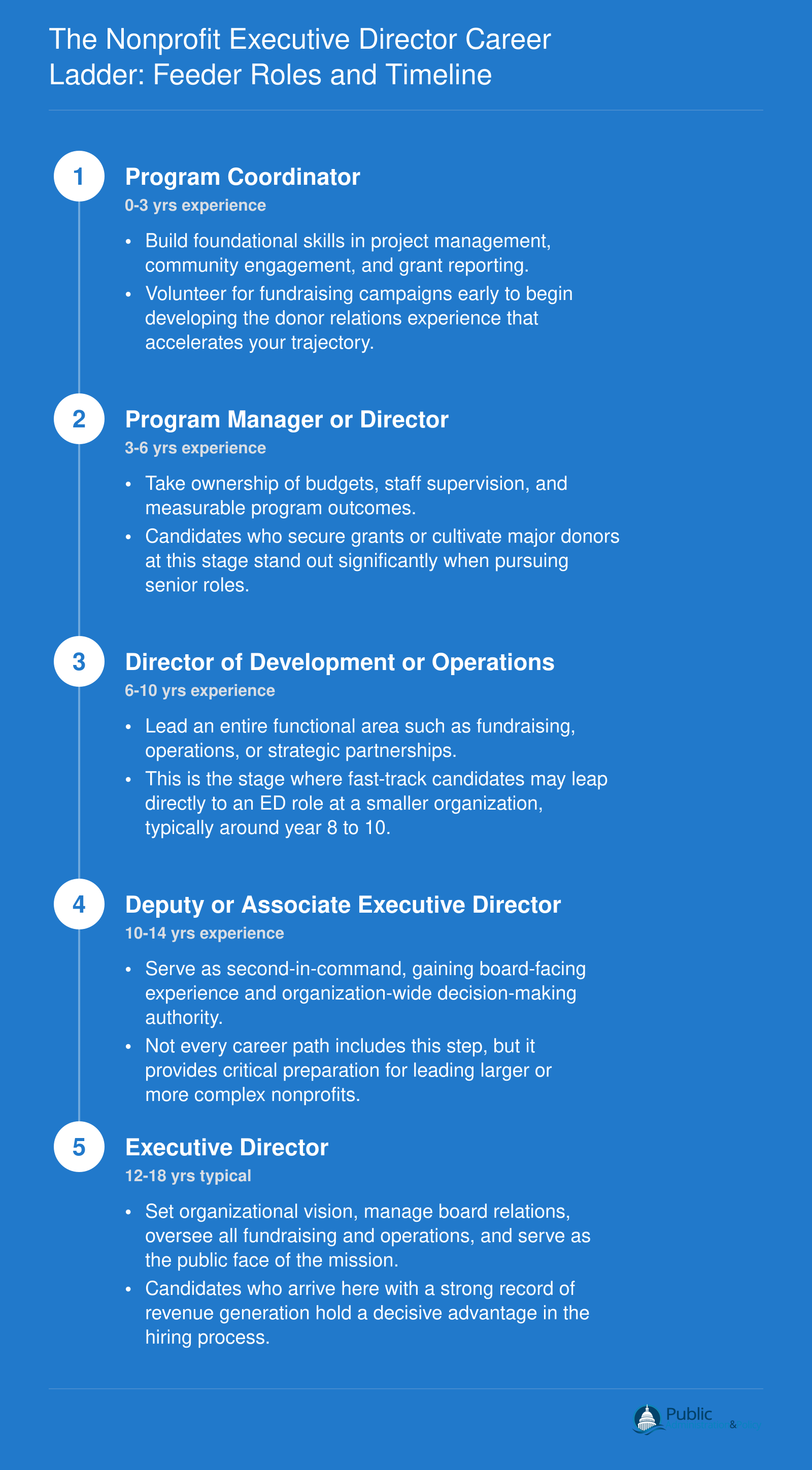
Most nonprofit executive directors follow a progression that spans 12 to 18 years, moving through increasingly strategic roles before reaching the top seat. A proven fundraising track record is the single most career-accelerating skill at every stage, allowing candidates who can demonstrate success with major gifts or grants to leapfrog peers. Note that a well-documented "fast track" exists: candidates who skip the deputy layer and jump from a director-level role directly to an ED position at a smaller organization, often around year 8 to 10.

Five-step career ladder from program coordinator to nonprofit executive director, spanning approximately 12 to 18 years

Questions to Ask Yourself

Executive directors manage staff, contractors, and volunteers simultaneously. If your leadership experience is limited to peer collaboration, consider stepping into a director or department head role first to build supervisory confidence.

Budget stewardship, from grant writing to financial reporting to the board, is a core duty. If you have not yet owned a six-figure budget cycle, seek a development or finance role that gives you hands-on fiscal responsibility before pursuing the top seat.

The executive director represents the organization to donors, media, legislators, and community partners. If public speaking or media engagement feels daunting, invest in communications training now so visibility becomes a strength rather than a stressor.

Board relations are often the most politically complex part of the role. If you tend to avoid conflict or struggle to influence without formal authority, practice those skills in committee work or advisory settings before stepping into this dynamic.

Essential Skills and Competencies for Nonprofit Executive Directors

The executive director role demands a broad skill set, but not every competency carries the same weight. Thinking about skills in two tiers, must-haves and differentiators, helps you prioritize your professional development and present yourself strategically to hiring boards.

Must-Have Skills: The Non-Negotiables

These are the competencies that search committees and boards treat as baseline requirements. Without them, you are unlikely to advance past the first round of interviews.

  • Fundraising and donor cultivation: This is the single most scrutinized skill on any ED candidate's resume. Even if you inherit a capable development team, boards expect the executive director to personally cultivate major donors, participate in asks, and serve as the public face of revenue generation. If fundraising makes you uncomfortable, start building that muscle now: volunteer for capital campaigns, lead annual fund efforts, or shadow a seasoned development director.
  • Financial management: You do not need to be a CPA, but you must be able to read and interpret a Form 990, manage a multi-line budget, and explain financial statements to board members with confidence. Budget oversight is where mission meets reality, and boards rely on the ED to flag variances early.
  • Board governance: An effective executive director partners with the board rather than simply reporting to it. That means understanding fiduciary responsibilities, managing meeting structures, onboarding new trustees, and occasionally navigating difficult governance dynamics with diplomacy.
  • People management: Nonprofits run on talent, and retaining that talent in a sector known for lean salaries requires an ED who can coach, motivate, and build a culture that keeps people engaged.

Differentiators: What Sets Top Candidates Apart

Once the must-haves are established, these competencies signal that you can lead an organization through complexity and change.

  • DEI strategy: Boards increasingly expect executive directors to embed diversity, equity, and inclusion into programming, hiring, and community engagement, not as a side initiative but as a strategic pillar.
  • Earned-revenue models: Grant dependency is a vulnerability. Candidates who can design fee-for-service programs, social enterprises, or other earned-income streams bring a level of financial creativity that resonates with forward-thinking boards.
  • Data and impact measurement: Funders and stakeholders want evidence that programs work. Familiarity with logic models, outcome frameworks, and evaluation design gives you credibility when making the case for continued investment.

Compliance and Legal Literacy

A layer of knowledge that cuts across everything above is legal and regulatory awareness. As the chief executive of a 501(c)(3), you bear personal responsibility for compliance in several areas. You need a working understanding of federal tax-exempt obligations, state charity registration requirements (which vary significantly across jurisdictions), employment law basics such as wage-and-hour rules and volunteer classification, and the fiduciary duties you share with your board. You do not need a law degree, but you do need to know when to call an attorney. Many of these competencies overlap with careers in public administration, where financial stewardship and regulatory compliance are equally central.

Digital Fluency: The Post-Pandemic Baseline

The shift to virtual operations during the pandemic permanently raised expectations for digital competence. Executive directors are now expected to be comfortable with CRM platforms that track donor relationships and giving patterns, virtual fundraising events and peer-to-peer campaigns, and social media advocacy that positions the organization in public conversations. Boards no longer view digital savvy as a bonus; they view it as evidence that you can lead an organization in a landscape where online engagement drives both revenue and visibility. Candidates who also bring strong financial analyst skills to the table can combine budget fluency with digital fundraising analytics for a particularly compelling profile. If your tech skills are limited, invest time in learning at least one major CRM system and familiarize yourself with digital fundraising analytics before pursuing an ED role.

Certifications and Professional Development That Actually Matter

Not all credentials carry equal weight in the nonprofit hiring world. Some certifications genuinely move the needle with boards and search firms, while others serve more as professional enrichment than hiring differentiators. Here is an honest breakdown of the credentials worth your time and money, depending on where you want to land.

CFRE: The Fundraising Gold Standard

The Certified Fund Raising Executive credential is the one that hiring committees and search firms most consistently recognize. If the executive director role you are targeting sits at a fundraising-heavy organization, the CFRE sends a clear signal. According to CFRE International, 94 percent of credential holders in 2023 reported that the CFRE enhanced their professional credibility, and 82 percent linked it to a salary increase.1 The designation is most closely associated with roles like development director and chief development officer.2 It carries over meaningfully into ED searches at organizations where revenue generation is a primary leadership responsibility.

  • Best for: candidates whose career path runs through development and major gifts.
  • Hiring impact: high, especially at small to mid-size organizations where the ED is also the chief fundraiser.
  • Requirement: five years of paid fundraising experience plus a standardized exam.

CNP: A Solid Generalist Foundation

The Certified Nonprofit Professional credential, administered by the Nonprofit Leadership Alliance, targets early- to mid-career professionals who are building or pivoting into nonprofit management.3 Its curriculum covers nonprofit fundamentals and integrates real-world experience, making it a practical stepping stone rather than a capstone credential. The CNP will not typically be the factor that wins you an ED position on its own, but it demonstrates a serious commitment to the sector and rounds out a resume that might otherwise lean too heavily on for-profit or government experience.

  • Best for: career-switchers and rising professionals who need a structured grounding in nonprofit operations.
  • Hiring impact: moderate. Boards rarely require it, but it signals intentionality.

CAE: The Association Management Credential

The Certified Association Executive designation matters if your target is leading a professional association, trade group, or membership organization. These entities operate differently from direct-service nonprofits, and the CAE reflects that specialized knowledge. Outside association management, boards and search committees seldom seek or weight this credential.

  • Best for: professionals aiming specifically at association leadership.
  • Hiring impact: high within the association subsector, limited elsewhere.

University Executive Certificate Programs

For career-switchers coming from the corporate or government sector, university-based nonprofit management certificate programs can be more strategically valuable than any standalone credential. Programs offered by schools with strong public administration certificate programs or public policy programs deliver concentrated coursework in nonprofit finance, governance, and strategy. These programs, typically lasting a few months to a year, also provide networking access to nonprofit leaders and board members in ways that exam-based certifications do not.

  • Best for: mid-career professionals transitioning into the nonprofit sector who need both knowledge and connections.
  • Hiring impact: varies by institution, but a certificate from a well-regarded program can open doors that credentials alone will not.

The Bottom Line for Aspiring Executive Directors

Boards conducting ED searches tend to prioritize demonstrated leadership results, fundraising track records, and sector-specific experience over any single credential. That said, the CFRE remains the most broadly respected certification in nonprofit hiring. The CNP and CAE serve more targeted purposes, and university certificate programs fill an important gap for those pivoting into the sector. Choose the credential that aligns with your actual career trajectory rather than collecting letters after your name. One well-chosen professional development investment, paired with hands-on leadership experience, will outperform a stack of resume lines every time.

Nonprofit Executive Director Salary by Organization Size, Sector, and Region

Compensation for nonprofit executive directors varies more dramatically than many candidates expect. Unlike corporate roles where industry benchmarks cluster tightly around a median, executive director pay is shaped by three intersecting variables: the organization's budget size, the subsector it operates in, and its geographic location. Understanding these dynamics helps you set realistic expectations and negotiate from an informed position.

Salary Ranges by Organization Budget Size

Organization budget is the single strongest predictor of executive director compensation. Based on 2025 and 2026 compensation data from sector surveys, here is what the landscape looks like:1

  • Under $250K budget: Median salary falls between $50,000 and $60,000, with an overall range of roughly $45,000 to $65,000. Many organizations at this level employ part-time or even unpaid executive directors.
  • $250K to $1M budget: Median pay rises to approximately $58,000 to $70,000, with a broader range of $45,000 to $75,000. At this tier, the ED is often a player-coach, handling both strategy and day-to-day operations.
  • $1M to $5M budget: Median compensation jumps to around $90,000 to $115,000, ranging from $85,000 to $130,000. Executive directors at this level typically manage a small leadership team and navigate multi-funder budgets.
  • $5M to $10M budget: Median salary ranges from approximately $120,000 to $150,000, with some positions paying between $110,000 and $175,000. Organizations of this size often employ a COO or CFO, allowing the ED to focus more on external leadership.
  • $10M to $25M budget: Total compensation (including bonuses and benefits) typically falls between $160,000 and $210,000 at the median, with the full range spanning $140,000 to $230,000. Complex finance and program management define this tier.
  • $25M or more: Median total compensation reaches $200,000 to $300,000 or higher. The broadest range extends from $180,000 to over $400,000, particularly at large institutions in health, higher education, and major human services organizations.

The takeaway is clear: moving from a sub-million-dollar organization to one with a $5M budget can more than double your compensation.

How Subsector Shapes Pay

Not all nonprofits compensate equally, even at the same budget size. Health and hospital nonprofits consistently sit at the top of the pay scale, followed closely by higher education institutions and large research organizations. These subsectors generate substantial revenue, manage complex regulatory environments, and compete with for-profit employers for leadership talent, all of which push salaries upward.

By contrast, arts and culture organizations, community-based social service agencies, and grassroots advocacy groups tend to pay meaningfully less. An executive director overseeing a $5M community arts organization may earn $100,000 to $120,000, while a counterpart at a $5M health-focused nonprofit could earn $140,000 or more.1 If maximizing compensation is a priority, the subsector you choose matters as much as the budget tier you target. Professionals weighing options across related fields, such as a public administration career, will find similar variation depending on the specific agency or organization.

Geographic Variation: Metro vs. Rural Markets

Location introduces yet another layer. The highest-paying metro areas for nonprofit executive directors include New York City, San Francisco, Washington D.C., Boston, and Los Angeles. These markets feature higher costs of living, larger and more numerous nonprofit organizations, and deeper donor pools. Executive directors in these cities can expect salaries 15 to 30 percent above national medians for comparable budget sizes.

Conversely, rural areas and smaller metro markets in the South, Midwest, and Mountain West regions often pay below national medians. However, when adjusted for cost of living, some of these positions offer comparable or even superior purchasing power. A $90,000 salary in a low-cost Midwestern city can stretch further than $130,000 in San Francisco.

Putting It All Together

When evaluating a nonprofit executive director opportunity, consider the full picture: budget size sets the baseline, subsector adjusts the range, and geography fine-tunes the number. Total compensation packages at larger organizations frequently include retirement contributions, performance bonuses, and professional development stipends, so look beyond the base salary figure. For more detailed benchmarking, consult resources like the Nonprofit Executive Director Salary Guide 2026, which segments data across all three of these dimensions.

Job Market Outlook: Why Now Is a Strong Time to Pursue Nonprofit Leadership

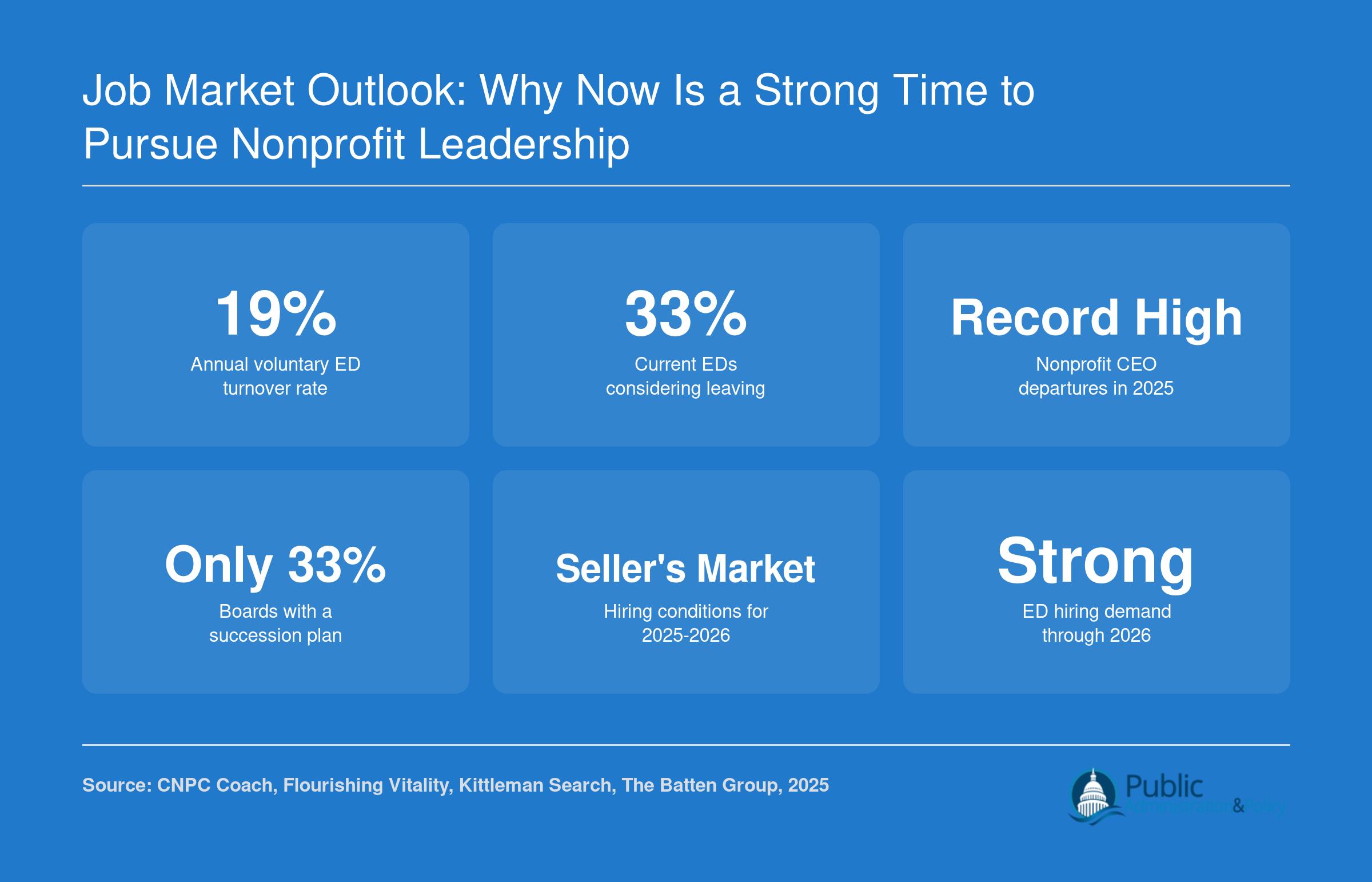
A generational leadership transition is reshaping the nonprofit sector, and the numbers tell a compelling story. Executive director departures have reached historic levels, yet most organizations lack a plan to replace outgoing leaders. For aspiring nonprofit executives, this supply-demand gap is creating more openings than the pipeline can fill.

Six nonprofit leadership statistics for 2025 and 2026 showing 19% annual turnover, 33% of EDs considering leaving, record departures, and strong hiring demand

How to Land Your First Executive Director Position

Securing your first executive director role requires a deliberate strategy that goes well beyond submitting applications. The hiring process for nonprofit leadership positions is unique, often involving board committees, executive search firms, and a heavy emphasis on cultural alignment. Here is how to navigate each stage effectively.

Where Executive Director Roles Are Posted

The nonprofit job market has its own ecosystem, and knowing where to look gives you a meaningful advantage. Idealist remains one of the most comprehensive boards for mission-driven roles, while LinkedIn has become increasingly important as nonprofit boards and search committees use it to vet candidates. The Chronicle of Philanthropy posts senior leadership openings at mid-size and large organizations, and your state nonprofit association likely maintains a job board that features local ED positions you will not find elsewhere.

For organizations with annual budgets above roughly $5 million, executive search firms frequently manage the hiring process. Firms that specialize in nonprofit placements maintain candidate pools and often reach out to professionals who are not actively job-hunting. Building relationships with these recruiters early, even before you are ready to apply, positions you for opportunities that never hit public boards.

Resume Framing: Lead With Impact, Not Duties

The resume that earned you a director-level role will not land you an ED position. Board members reviewing your application want evidence that you can lead an organization, not a list of tasks you performed. Lead every bullet point with impact metrics: dollars raised, programs scaled, policy wins secured, or communities served. Quantify outcomes wherever possible.

Title your summary section something like "Nonprofit Leadership Profile" rather than "Objective." That framing signals that you already think of yourself as a leader, not a job seeker. Emphasize cross-functional experience, board engagement, and revenue generation because those are the competencies that catch a hiring committee's eye. Candidates who have developed strong financial analyst skills will find that fiscal fluency is especially valued at this level.

Preparing for Board-Panel Interviews

ED interviews almost always involve a panel of board members, and the format can feel quite different from a standard hiring conversation. Expect scenario-based questions such as "How would you handle a budget shortfall?" and "Describe your fundraising philosophy." Board members want to see strategic thinking, composure under pressure, and a genuine connection to the organization's mission.

Prepare three to four leadership narratives using the STAR format (Situation, Task, Action, Result). Choose stories that showcase different dimensions of your leadership: one about financial stewardship, one about team development, one about stakeholder management, and one about navigating a crisis or organizational change. Rehearse these until you can deliver them conversationally rather than reciting a script.

In most searches, candidates who advance past the initial panel meet the full board in a final round. At this stage, culture fit with the board often carries more weight than technical qualifications. Board members are asking themselves whether they can imagine partnering with you for the next five years. Be authentic, ask thoughtful questions about board governance, and demonstrate genuine curiosity about how the board operates.

Negotiating Beyond Salary

Once an offer arrives, resist the instinct to focus exclusively on compensation. At the ED level, the total package matters far more than base salary alone. Consider negotiating for:

  • Professional development budget: Funding for conferences, coaching, or executive education keeps your skills sharp and signals that the board invests in its leader.
  • Performance review structure: Clarify how and when the board will evaluate you. A well-defined review process protects you and sets mutual expectations.
  • Sabbatical policy: Burnout is a real risk at the executive level. Even a modest sabbatical provision after three to five years demonstrates organizational maturity.
  • Benefits and flexibility: Health coverage, retirement contributions, remote work arrangements, and paid leave all factor into long-term sustainability in the role.

Approach negotiations collaboratively. You are not haggling with an employer; you are establishing the terms of a partnership with a board that wants you to succeed. Frame every request around organizational health: a well-supported executive director delivers better outcomes for the mission.
Transitioning to Nonprofit Leadership from the Corporate or Government Sector

A growing number of mid-career professionals are pivoting from corporate management or government service into nonprofit executive director roles, and for good reason. The sector needs leaders who can bring financial rigor, operational discipline, and sophisticated stakeholder management to organizations that are scaling in complexity. If you have spent a decade or more running budgets, managing teams, and navigating institutional politics, you already possess competencies that many lifelong nonprofit professionals are still developing. The challenge is not whether your skills are valuable; it is proving that you understand the distinct culture, governance, and revenue model of the nonprofit world.

The Gaps You Need to Close

Three stumbling blocks derail most cross-sector candidates. Addressing them proactively is essential before you apply.

  • Fundraising experience: This is the single most common disqualifier. Boards hiring an executive director want evidence that you can cultivate donors, write grant proposals, and lead a capital campaign. Reading about fundraising is not enough. You need to have asked real people for real money.
  • Board governance dynamics: Corporate boards and nonprofit boards operate under fundamentally different power structures. A nonprofit ED serves at the pleasure of a volunteer board, manages board committees, and must balance fiduciary oversight with mission advocacy. If you have never reported to an unpaid governing body, the learning curve can be steep.
  • Salary adjustment: Depending on your current compensation, moving into nonprofit leadership may mean accepting a pay cut, particularly at small or mid-size organizations. Understanding market rates by budget size (covered earlier in this article) helps you set realistic expectations.

A Staged Transition Strategy

Rather than applying cold for an ED role, consider a phased approach that builds credibility in the nonprofit ecosystem.

  • Join a nonprofit board of directors as a volunteer member, ideally on the finance or development committee, so you gain firsthand exposure to governance and fundraising.
  • Volunteer for or co-chair a capital campaign or annual fund drive. This gives you a concrete fundraising accomplishment to cite in interviews.
  • Pursue an interim role such as deputy executive director, chief operating officer, or director of development at a nonprofit. These positions let you learn the revenue model from the inside without the full weight of the top job on day one.
  • Complete a nonprofit management certificate through a university program or a professional association such as the Nonprofit Leadership Alliance. A credential signals genuine commitment and fills knowledge gaps around fund accounting, program evaluation, and donor stewardship.

Where Government Experience Is a Direct Asset

If you are transitioning from a government role, target policy-adjacent subsectors where your institutional knowledge translates immediately. Housing authorities, community health organizations, workforce development nonprofits, and education advocacy groups all rely heavily on federal and state funding streams. Understanding how grants from agencies like HHS, HUD, or the Department of Education flow through to community-based organizations is a rare and highly valued skill set. Professionals with this background may also find that their expertise in public policy making gives them a strategic edge in shaping organizational direction. In these subsectors, a government background is not something to explain away; it is a competitive advantage that can make you the strongest candidate in the pool.

The common thread across all of these strategies is intentionality. Boards and search committees want to see that you did not simply tire of your previous career. They want evidence that you chose nonprofit leadership deliberately and invested the time to prepare for its unique demands.

Frequently Asked Questions About Becoming a Nonprofit Executive Director

Aspiring nonprofit leaders tend to share a common set of questions about qualifications, compensation, and what the role really demands. Below are direct, practical answers to the questions we hear most often from students and professionals exploring this career path.

In most nonprofits, 'executive director' and 'CEO' describe the same top leadership position, but the titles signal different organizational cultures. Smaller and mid-size nonprofits typically use 'executive director,' while larger organizations with revenues above $10 million increasingly adopt 'CEO' to reflect corporate-style governance. Functionally, both report to a board of directors, oversee strategy, and bear ultimate accountability for the mission, finances, and staff.

Most executive directors step into the role after 7 to 15 years of progressive nonprofit or related experience. At smaller organizations with budgets under $1 million, boards may consider candidates with 5 to 7 years if they demonstrate strong fundraising results and leadership ability. Larger nonprofits often expect 10 or more years, including several years in a senior management position such as deputy director, development director, or program vice president.

Compensation varies widely by organization size, sector, and geography. As of 2026, national median base pay for nonprofit executive directors generally falls between $75,000 and $130,000, according to recent salary surveys. Directors at organizations with budgets above $5 million commonly earn six figures, while those leading small, community-based nonprofits may earn $55,000 to $75,000. Metropolitan areas on the coasts tend to pay significantly more than rural regions.

Yes. A master's degree is preferred but not universally required. Many successful executive directors hold only a bachelor's degree, particularly at smaller organizations where demonstrated results in fundraising, community engagement, and program management outweigh formal credentials. That said, a Master of Public Administration, Master of Nonprofit Management, or MBA can accelerate your timeline and make you more competitive for larger, higher-paying roles.

The most critical competencies include fundraising and donor cultivation, financial management and budgeting, strategic planning, board relations, and people leadership. Strong communication skills (both written and verbal) are essential for grant writing, public speaking, and stakeholder engagement. Increasingly, data literacy and digital fluency also matter, as boards expect executive directors to use metrics to demonstrate impact and guide decisions.

It can be. Executive directors juggle fundraising pressure, board expectations, staff management, and public accountability, often with lean resources. Burnout is a well-documented concern in the sector, and average tenure in the role hovers around four to five years. However, many directors report deep personal fulfillment from mission-driven work. The key to sustainability is setting boundaries, building a capable leadership team, and maintaining a supportive relationship with your board.

Two takeaways matter more than anything else on the nonprofit executive director career path. First, start building fundraising experience now, regardless of your current title. As earlier sections of this guide make clear, a proven fundraising track record is the single most career-accelerating skill at every stage of the leadership ladder. Volunteer for grant writing, join a development committee, or lead a capital campaign in your current role. Second, target a smaller organization for your first executive director position. Leading a nonprofit with a budget under two million dollars gives you full-spectrum leadership exposure that larger organizations simply cannot offer at the entry level.

The nonprofit sector needs prepared leaders, and the generational leadership transition underway means the opportunity is real. Whether you are completing a public administration degree program or pivoting from government or corporate management, the path is long but structured, and every role you hold along the way contributes directly to the mission you care about. Start building today.

Recent Articles