Your Complete Path to Becoming a Government Program Manager
A step-by-step career guide covering education, certifications, GS levels, and federal hiring strategies
By Holly AbramsonReviewed by PAP Editoral TeamUpdated August 2, 202625+ min read
What you’ll learn in this article…
Federal program managers fall under the OPM 0340 series, which employs roughly 15,700 people across the civil service.
A bachelor's degree, one to three years of relevant experience, and a PMP certification can qualify you for GS-11 or GS-12 roles.
FAC-P/PM certification follows three tiers that align with increasing program complexity and senior GS grade responsibilities.
Most career program managers spend 10 to 15 years progressing from entry level to senior federal leadership positions.
Federal program managers oversee portfolios that channel hundreds of billions of taxpayer dollars each year across defense acquisition, public health infrastructure, and civilian technology modernization. The roughly 15,700 professionals in the Office of Personnel Management's 0340 series carry responsibilities that have no clean parallel in the private sector: multi-year congressional funding cycles, Federal Acquisition Regulation compliance, and accountability structures tied to statutory mandates rather than shareholder returns.
Breaking into this career means threading together the right degree (or equivalent experience), targeted certifications like FAC-P/PM and PMP, and a clear understanding of General Schedule grade requirements. The path is structured but not simple. Competition at the GS-13 and GS-14 levels, where most full program management authority begins, remains tight, and agencies increasingly treat FAC-P/PM certification as a baseline expectation rather than a differentiator. For professionals weighing this route alongside other careers in public administration, few federal roles combine fiduciary scope, regulatory complexity, and mission impact quite like the 0340 series.
What Does a Government Program Manager Do?
A government program manager occupies one of the most consequential roles in the federal workforce. Classified under the 0340 occupational series by the Office of Personnel Management, these professionals oversee multi-project portfolios that can span years, involve hundreds of millions of dollars, and directly affect how well an agency fulfills its mission. If you are considering this career path, understanding the day-to-day scope of the role is the first essential step.
Managing Budgets, Timelines, and Mission Alignment
At its core, the government program manager role is about translating legislative intent and agency strategy into concrete results. Program managers set milestones, allocate resources across interdependent projects, and continuously assess whether deliverables remain aligned with the broader mission. Unlike a single-project lead, a program manager must balance competing priorities, reallocate funding when conditions shift, and justify spending decisions against strict federal budget cycles.
Budgetary oversight is especially demanding in the public sector. Program managers must comply with guidelines issued by the Office of Management and Budget (OMB), follow the Federal Acquisition Regulation (FAR), and document every financial decision in a way that withstands audits from inspectors general and the Government Accountability Office.
Coordinating a Complex Stakeholder Landscape
One dimension that sets government program management apart from its private-sector counterpart is the breadth of stakeholders involved. Because the work sits at the intersection of public policy making and operational execution, federal program managers routinely coordinate with:
Contractors and vendors: Managing performance under government contracts, including cost-plus and firm-fixed-price arrangements.
Inter-agency partners: Collaborating with other federal departments, state governments, or tribal organizations that share jurisdiction or funding streams.
Congressional stakeholders: Responding to oversight committees, preparing testimony materials, and ensuring program activities satisfy statutory requirements.
This web of accountability means that communication skills, political awareness, and the ability to navigate bureaucratic processes are just as critical as technical expertise.
Common Domains Where Program Managers Operate
Government program managers work across a wide range of mission areas. Some of the most active domains include:
IT modernization: Leading large-scale technology upgrades such as cloud migration, cybersecurity initiatives, and legacy system replacements.
Defense acquisition: Managing weapons systems, logistics platforms, and research programs within the Department of Defense.
Grants administration: Overseeing the distribution and monitoring of federal grant funds to states, localities, and nonprofits.
Infrastructure: Directing transportation, energy, or water projects that require coordination among multiple agencies and jurisdictions.
Public health programs: Administering vaccination campaigns, disease surveillance networks, or behavioral health initiatives.
Accountability and Reporting Structure
Government program managers typically report to members of the Senior Executive Service (SES) or equivalent senior leaders within their agency. This reporting chain carries real weight: program managers are personally accountable for earned value metrics, risk registers, and milestone reviews that senior executives present to agency heads and, ultimately, to Congress. For professionals who want to explore the broader landscape of careers in public administration, the combination of fiduciary responsibility, regulatory compliance, and mission impact makes the program manager role both challenging and deeply rewarding.
Program Manager Vs. Project Manager in Government: Key Differences
In the federal workplace, the titles "program manager" and "project manager" are sometimes used interchangeably, but the roles differ in meaningful ways. The program manager sits at a strategic layer, overseeing a portfolio of related projects that collectively advance an agency's mission. Individual project managers typically operate within that portfolio, delivering discrete products or outcomes that feed into the broader program. Understanding these distinctions is essential if you are charting your career path, because OPM's 0340 occupational series is designated specifically for program management, and the competencies, grade levels, and certification expectations diverge from those of a project manager.
Dimension
Government Program Manager
Government Project Manager
Scope of Work
Oversees a portfolio of interrelated projects aligned to a strategic agency objective
Manages a single project with a defined deliverable, timeline, and budget
Authority Level
Sets strategic direction, resolves cross-project conflicts, and reports to senior leadership or the agency head
Executes within the boundaries and priorities established by the program manager
Budget Responsibility
Accountable for multi-year, multi-million dollar program budgets that span several cost centers
Controls a project-level budget that is typically a subset of the larger program allocation
Typical GS Grade Range
Generally GS-13 through GS-15, with Senior Executive Service (SES) roles for chief program managers
Often GS-11 through GS-13, depending on project complexity and agency size
OPM Classification
Falls under the 0340 Program Management series, which is specifically defined for this function
May be classified under various series (e.g., 2210 for IT projects) depending on technical domain
Key Certification
FAC-P/PM (Federal Acquisition Certification for Program and Project Managers) at mid or senior tier, plus PgMP for advanced roles
PMP (Project Management Professional) is the most common credential; FAC-P/PM entry tier may also apply
Planning Horizon
Long-range, often spanning three to ten years and aligned with agency strategic plans
Short to medium range, typically six months to three years tied to project milestones
Stakeholder Engagement
Coordinates across multiple offices, Congress, OMB, and external partners to secure sustained support
Engages stakeholders within a single project team and its immediate sponsors
Questions to Ask Yourself
Do you thrive in structured, process-driven environments where timelines are measured in years, not sprints?
Federal programs often span five to fifteen years and follow rigid acquisition and oversight frameworks. If you prefer fast pivots and minimal documentation, the pace and formality of government program management may feel frustrating rather than rewarding.
Are you comfortable navigating bureaucratic approval chains and building consensus across multiple agencies?
A single initiative can require sign-off from contracting officers, congressional liaisons, inspectors general, and partner agencies. Success depends less on unilateral decision-making and more on patient coalition building through layered governance structures.
Does mission-driven work in areas like national security, public health, or infrastructure motivate you more than shareholder returns?
Government program managers trade equity compensation and rapid promotions for the chance to shape outcomes that affect millions of people. If that tradeoff energizes rather than discourages you, the role aligns well with your values.
Are you prepared to earn and maintain specialized federal certifications alongside any degrees you hold?
Roles at mid and senior levels typically require credentials such as the FAC-P/PM, and maintaining them means ongoing training hours. Factor this continuing education commitment into your long-term career plan before pursuing the path.
Education Requirements: Degrees That Prepare You for the Role
One of the first questions aspiring government program managers ask is what degree they need. The short answer: the Office of Personnel Management (OPM) does not mandate a specific degree for the 0340 Program Management series. Relevant professional experience can substitute for formal education under federal qualification standards. That said, a bachelor's degree is the practical baseline for most candidates seeking entry at the GS-9 level, and agencies almost always prefer applicants who hold one.
Degree Fields That Align With Agency Needs
Certain academic backgrounds come up again and again in federal program management job announcements. The most relevant fields include:
Public Administration (MPA): Directly addresses budgeting, policy analysis, organizational leadership, and public accountability, all core to managing government programs.
Business Administration (MBA): Builds fluency in strategic planning, financial management, and stakeholder engagement, skills that translate well into large-scale federal programs.
Engineering: Particularly valued at agencies like NASA, the Army Corps of Engineers, and the Department of Energy, where programs involve complex technical systems.
Information Technology or Computer Science: Essential for program managers overseeing digital modernization, cybersecurity initiatives, or IT acquisition portfolios.
Public Policy: Equips graduates with analytical frameworks for evaluating program outcomes, navigating the legislative process, and designing evidence-based interventions.
The best choice depends partly on which agencies and mission areas interest you. A computer science degree positions you well at agencies investing heavily in technology, while an master of public administration offers broader versatility across civilian agencies.
How a Master's Degree Can Accelerate Your GS Entry
OPM's general qualification standards allow candidates with a master's degree (or equivalent graduate education) to qualify at the GS-11 level directly, bypassing GS-9. Under the superior academic achievement provisions, a strong graduate record can serve as a substitute for one year of specialized experience. For career changers or recent graduates, this is one of the most efficient ways to enter the federal workforce at a higher pay band and with greater responsibility from day one.
Special Considerations for DoD Acquisition Program Management
If your goal is managing acquisition programs within the Department of Defense, your degree field carries extra weight. Under DoDI 5000 series workforce requirements, the DoD prioritizes STEM and business degrees for its acquisition workforce. Program managers in major defense acquisition programs are expected to demonstrate technical depth alongside management competency, and holding a relevant STEM or business degree can satisfy key elements of the credentialing framework. This preference extends to both uniformed and civilian positions, and it influences hiring, promotion, and assignment to critical acquisition programs.
Regardless of which degree you pursue, pairing it with internships or fellowships in federal agencies (such as the Presidential Management Fellows program or agency-specific pathways) will strengthen your candidacy considerably. Those interested in policy analyst education may find that the analytical skill set transfers directly into federal program oversight. Education opens the door, but demonstrated experience in public sector environments is what moves you through it.
Certifications: FAC-P/PM, PMP, and Pgmp Explained
Three certifications dominate the federal program management landscape, and understanding what each one does, who needs it, and how they relate to one another will save you time and steer your professional development in the right direction.
FAC-P/PM: The Federal Government's Own Credential
The Federal Acquisition Certification for Program and Project Managers (FAC-P/PM) is the credential the government requires for civilian acquisition program and project managers across all executive agencies except the Department of Defense, which maintains its own framework. Established under an Office of Federal Procurement Policy memo from December 2013 and administered through the Federal Acquisition Institute (FAI), the certification is structured in three tiers.1
Entry Level: Requires at least one year of project or program management experience within the last five years. Candidates complete a designated training track through FAI, choosing between two course sequences (Track A: FPM 120A, FPM 120B, FPM 121; Track B: FPM 131, FPM 132, FPM 133, FPM 134) depending on their background.2
Mid Level: Requires at least two years of relevant experience within the last five years, plus completion of a four-course training sequence (FPM 231, FPM 232, FPM 233, FPM 234) focused on intermediate competencies.2
Senior Level: Requires at least four years of experience within the last ten years, including a minimum of one year of federal experience. The senior training sequence (FPM 331, FPM 332, FPM 333, FPM 334) adds coursework in strategic leadership and oversight of complex acquisition programs.2
Experience can be stacked across tiers, meaning time counted toward Entry certification can also contribute to your Mid Level application. Whether advanced degrees can substitute for portions of the experience requirement varies by agency.2 After earning any tier, you must accumulate 80 Continuous Learning Points (CLPs) per certification cycle to maintain your status.
FAI also offers a specialized IT Core-Plus designation for professionals managing major IT programs. Eligibility requires holding Mid or Senior level FAC-P/PM certification before enrolling in the additional IT-focused coursework (FPM 511, FPM 512, FPM 513).2
PMP: The Bridge Between Private and Public Sectors
The Project Management Professional (PMP) credential, issued by the Project Management Institute (PMI), is the most widely recognized project management certification in the world. If you are transitioning from the private sector into federal service, PMP is the logical starting point because hiring managers in both sectors understand its value immediately. Professionals who pair this credential with a broader career in public policy often find the combination especially compelling on federal resumes.
One common misconception is that holding a PMP automatically satisfies FAC-P/PM requirements. It does not.2 There is no blanket equivalency between the two credentials. Some individual agencies may accept PMP as meeting certain training or competency requirements on a case-by-case basis, but you should not assume this applies universally. Treat PMP and FAC-P/PM as complementary rather than interchangeable.
PgMP: The Executive-Level Differentiator
PMI's Program Management Professional (PgMP) credential sits above PMP and is designed for professionals who oversee multiple related projects that align with strategic organizational goals. In the federal context, PgMP maps well to senior and executive program management roles, particularly at the GS-14 level and above or within the Senior Executive Service. Earning it signals that you can manage complexity, cross-functional portfolios, and enterprise-level risk, all competencies that federal agencies increasingly value.
Practical Guidance: Which Certification Should You Pursue First?
Your starting point depends on where you are right now.
If you are already a federal employee working in or near acquisition programs, begin with FAC-P/PM through FAI.gov. The training is available at no cost, your agency likely has a certification coordinator, and holding the credential is often mandatory for the positions you want.
If you are moving from the private sector or from a non-acquisition federal role, earn PMP first. It gives you portable credibility, strengthens your USAJOBS applications, and positions you to layer on FAC-P/PM once you land an acquisition role.
If you have several years of program-level leadership under your belt and aspire to chief program manager or SES-track positions, PgMP is the credential that distinguishes you from a crowded field of PMP holders.
Regardless of which credential you pursue first, plan to earn more than one over the course of your career. The most competitive federal program managers hold both FAC-P/PM at the Senior level and at least one PMI certification, giving them standing within the federal acquisition workforce and recognition that travels outside it.
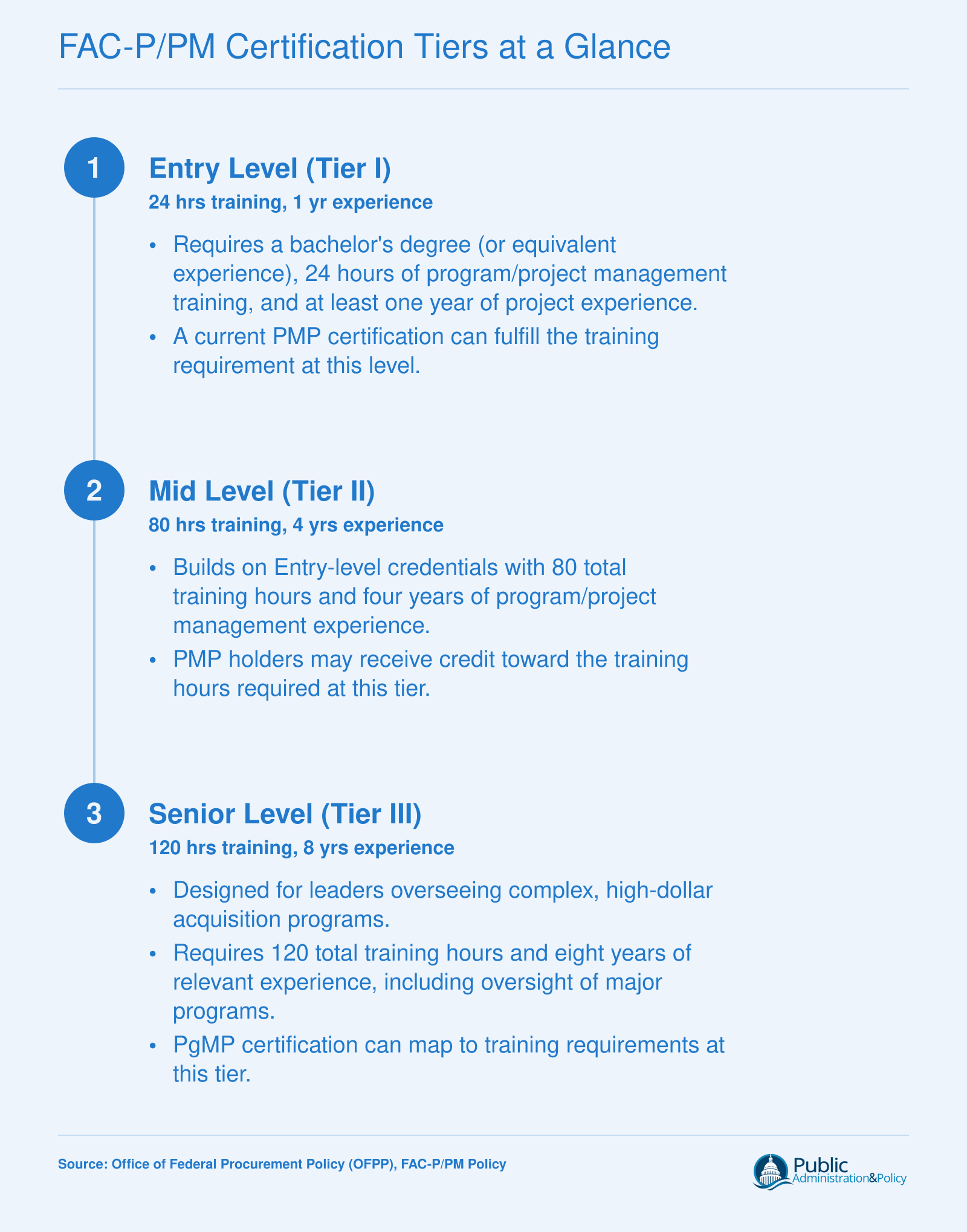
FAC-P/PM Certification Tiers at a Glance
The Federal Acquisition Certification for Program and Project Managers (FAC-P/PM) follows a three-tier structure that aligns with increasing levels of responsibility and complexity. Each tier builds on the previous one, requiring additional training, experience, and demonstrated competency. Notably, holding a PMP credential can satisfy training requirements at the Entry and Mid levels, while PgMP holders may receive credit toward Senior-level requirements.
GS Levels and Career Progression for Program Managers
The federal General Schedule (GS) pay system provides a transparent, structured ladder for government program managers. Understanding where each grade falls in terms of responsibility, compensation, and advancement requirements can help you plan a realistic career timeline, whether you are just entering federal service or positioning yourself for senior leadership.
Entry Level: GS-9 and GS-11
Most program management careers in the federal 0340 occupational series begin at GS-9 or GS-11. At these grades, you typically serve in a developmental or junior role, supporting more experienced managers on acquisitions, scheduling, stakeholder coordination, or performance reporting.
GS-9: Base salary ranges from approximately $51,332 to $66,452 per year (2025 scale).1 Roles at this level often focus on assisting with program documentation, tracking deliverables, and learning agency-specific processes.
GS-11: Base salary ranges from roughly $62,107 to $80,512.1 At this grade you may lead smaller program segments, manage a modest budget, or coordinate across two or three functional teams.
Many agencies hire new program managers at GS-9 with a promotion potential to GS-11 or GS-12, meaning you can advance without recompeting for a new position, provided you meet performance standards.
Mid-Career: GS-12 and GS-13
The jump to GS-12 and GS-13 is where you transition from supporting programs to owning them. At these levels you are expected to manage full program lifecycles, lead cross-functional teams, and report outcomes directly to senior executives.
GS-12: Base pay of $74,842 to $96,217.1 You may oversee a single program valued in the low millions or manage multiple related projects simultaneously.
GS-13: Base pay of $88,520 to $113,324.1 Program managers at this grade frequently supervise other program or project staff, negotiate with contractors, and present performance data to agency leadership.
Time-in-grade rules, codified in federal regulation, generally require you to spend at least 52 weeks (one year) at a given grade before you can be promoted to the next. This means the fastest possible climb from GS-9 to GS-13 takes about four years, assuming you are promoted at every eligible interval and your position's promotion potential allows it. In practice, many professionals spend 18 to 24 months at each grade, especially at GS-12 and GS-13, where competition for advancement intensifies.
Senior Level: GS-14, GS-15, and the Senior Executive Service
Senior program managers occupy GS-14 and GS-15 positions, overseeing large, complex, or high-visibility programs that may span multiple agencies or involve billions of dollars in lifecycle cost.
GS-14: Base salary of $104,604 to $133,125.1 At this grade you are often the lead program manager for a major acquisition or enterprise initiative, accountable for cost, schedule, and performance baselines.
GS-15: Base salary of $122,998 to $156,298.1 GS-15 program managers typically serve as chief program managers, division directors, or equivalent roles. They set strategic direction, brief political appointees, and mentor the next generation of program leaders.
These base figures do not include locality pay, which can significantly increase total compensation. In the Washington-Baltimore-Arlington area, the locality adjustment is 33.94 percent for 2026, pushing effective GS-15 pay up to a statutory cap of $197,200.2 Locality rates vary for other metro areas, so your actual earnings depend on your duty station.
Beyond GS-15, the Senior Executive Service (SES) represents the pinnacle of federal program management. SES members lead entire portfolios or agency-wide program offices, and their compensation is set on a separate pay scale that exceeds GS-15 maximums. Reaching SES typically requires a combination of executive-level certifications, sustained superior performance, and selection through a competitive review board. The civil service framework that governs these promotion pathways has evolved considerably over the decades, but the merit-based principles at its core remain the same.
How Time-in-Grade Shapes Your Timeline
Because federal promotion rules mandate at least one year at each grade before advancement, the minimum path from GS-9 to GS-15 spans roughly six years of grade-to-grade movement. Realistically, most program managers reach GS-15 after 12 to 18 years of combined education, developmental assignments, and progressive responsibility. Lateral moves between agencies or into rotational leadership programs can accelerate your visibility and readiness, but they do not override the one-year minimum at each grade. Those exploring broader career in public policy options will find that the GS system applies across many federal occupational series, making this progression framework relevant well beyond program management alone.
The federal government employs roughly 15,700 people in the 0340 Program Management occupational series, according to data from the Office of Personnel Management. That makes it one of the larger management series across the civil service, reflecting how central program managers are to executing agency missions and overseeing billions in public spending.
Step-By-Step Path: From Entry-Level to Senior Program Manager
Reaching the senior ranks of federal program management is a marathon, not a sprint. Most career civil servants spend 10 to 15 years building the blend of technical expertise, leadership credibility, and institutional knowledge required to oversee large-scale government programs. Below is a realistic roadmap, whether you are starting from inside or outside the federal workforce.
Phase 1: Building a Foundation (GS-7 through GS-9)
Most government program managers begin their careers as management analysts or policy analysts at the GS-7 or GS-9 level. In these roles you learn how federal budgets flow, how performance metrics are tracked, and how agencies translate congressional mandates into operational plans. Expect to spend two to four years at this stage, developing fluency in acquisition regulations, stakeholder coordination, and the mechanics of federal reporting. Pursuing your FAC-P/PM Entry-Level certification during this phase signals early commitment and positions you for faster advancement.
Phase 2: Growing Into Project and Assistant Program Management (GS-11 through GS-12)
With a solid analytical foundation, you can move into project manager or assistant program manager positions at GS-11 or GS-12. Here, you begin managing discrete deliverables, coordinating cross-functional teams, and owning portions of a larger program's scope. This phase typically lasts three to five years and is where you should earn your FAC-P/PM Mid-Level certification and, ideally, a PMP or PgMP credential. Rotational assignments and detail opportunities within your agency (or across agencies) are especially valuable at this stage because they expose you to different mission areas and leadership styles, accelerating your development beyond what time-in-grade minimums alone would allow.
Phase 3: Full Program Manager (GS-13 through GS-14)
At GS-13 and GS-14, you take ownership of entire programs, often with multimillion-dollar budgets and dozens of team members. This is where strategic thinking, risk management, and executive communication become your daily currency. Federal employees who participated in the Presidential Management Fellows (PMF) program or similar leadership development tracks often reach this level a year or two earlier than their peers. Plan on three to five years here before being competitive for senior roles.
Phase 4: Senior and Chief Program Manager (GS-15 and SES)
The most experienced program managers ascend to GS-15 or Senior Executive Service (SES) positions, where they set program strategy, advise political appointees, and manage portfolios that span multiple agencies or offices. FAC-P/PM Senior-Level certification is typically expected or required at this tier. Competition is intense, and selection often hinges on demonstrated results across several major programs.
Transitioning from the Private Sector
You do not have to climb every rung from the inside. Professionals with substantial corporate program or project management experience can target mid-level GS-12 or GS-13 postings on USAJobs. The key is translating private-sector accomplishments into the language agencies understand: cost, schedule, and performance outcomes tied to measurable mission impact. A current PMP certification strengthens your application, and tailoring your resume to mirror federal job announcement language is essential. Many hiring managers look favorably on candidates who can bridge commercial best practices with government oversight requirements.
Accelerated Entry for Military Veterans
Veterans with program management backgrounds, especially those from Department of Defense acquisition corps or similar career fields, can often enter the federal civilian workforce at higher GS levels under veterans' preference authorities. Defense Acquisition Workforce Improvement Act (DAWIA) certifications frequently map to FAC-P/PM tiers, giving veterans a head start on credentialing. If you served in a program office managing weapons systems, logistics programs, or IT modernization efforts, your experience may qualify you directly for GS-12 or GS-13 program management roles.
Tips to Accelerate Your Timeline
Seek rotational assignments: Agency rotation programs and interagency detail opportunities expose you to new mission sets and build a broader professional network.
Join communities of practice: Organizations such as the Federal Acquisition Institute's program management community connect you with mentors and peers who can advocate for your advancement.
Document results relentlessly: Promotion panels and hiring boards evaluate concrete accomplishments, so maintain a running record of programs delivered on time, under budget, or with measurable mission improvements.
Invest in continuous education: A master's degree in public administration, public policy, or a related field strengthens your candidacy at every transition point along this path.
Whether you enter as a fresh graduate, a private-sector professional, or a military veteran, the trajectory rewards those who combine formal credentials with hands-on program delivery and proactive career management.
Which Agencies Hire the Most Government Program Managers?
Federal program management positions exist across nearly every cabinet department and independent agency, but a handful of organizations consistently dominate the hiring landscape. Knowing where to focus your search can save months of effort and help you tailor applications to each agency's mission.
Agencies With the Highest Demand
The Department of Defense (DoD) is far and away the largest employer of program managers in the federal government.1 DoD program managers oversee acquisition, information technology, and research and development portfolios that often run into the billions of dollars. Many of these positions use the NH-4 pay band, with salaries reaching as high as $181,031 in 2025 figures.1
The Department of Homeland Security (DHS) is another major hiring hub, employing more than 1,629 program managers in the 0340 series as of 2025.1 Roles at DHS tend to center on cybersecurity, border security, and emergency management, making it an attractive landing spot for professionals who want mission-critical impact.3
The Department of the Treasury, including the IRS, also maintains a sizable program management workforce, with roughly 1,495 employees in the 0340 series.1 IRS program managers are especially sought after for IT modernization and human capital initiatives.4 Other agencies with consistent demand include the Department of Veterans Affairs, the Department of Health and Human Services, and U.S. Citizenship and Immigration Services (USCIS), where program managers lead work in immigration benefits processing and fraud prevention.5
How to Track Current Openings
The single best resource for real-time hiring data is Program Manager GS-0340 job listings on FederalJobs.net. Search for the occupational series code "0340" or the title "Program Manager" on USAJobs.gov, then filter results by agency to see which departments are actively recruiting. At any given time, you may find hundreds of open postings, and agency-level filters reveal where the greatest concentration of opportunities lies.
Beyond USAJobs, review agency-specific career pages directly. DoD, DHS, VA, and HHS each publish hiring announcements, workforce planning updates, and information about upcoming recruitment events that may not appear in a general search. If you are still weighing credential options, exploring public administration certificate programs can strengthen your application for these competitive roles.
Leverage Professional Networks for Insider Intelligence
Job boards only tell part of the story. Joining professional associations adds a layer of insight that passive searching cannot replicate.
American Society for Public Administration (ASPA): Offers member forums, career resources, and connections to public sector hiring managers across federal, state, and local government.
Project Management Institute (PMI): Publishes hiring trend reports, salary surveys, and industry outlooks that help you benchmark opportunities and identify growth sectors within government.
Agency-specific affinity groups: Many departments maintain internal professional communities (such as the DoD Program Management Community of Practice) that share job leads and mentoring opportunities.
Use BLS Data to See the Bigger Picture
The Bureau of Labor Statistics Occupational Outlook Handbook provides employment projections and industry breakdowns for management analysts and program managers (SOC 11-1021). Reviewing this data gives you a macro view of where public administration is growing and which functional areas are expected to add positions over the next decade.
Combining USAJobs searches, agency career pages, BLS projections, and professional association insights creates a comprehensive picture of where demand is strongest and where your skills are most likely to be rewarded.
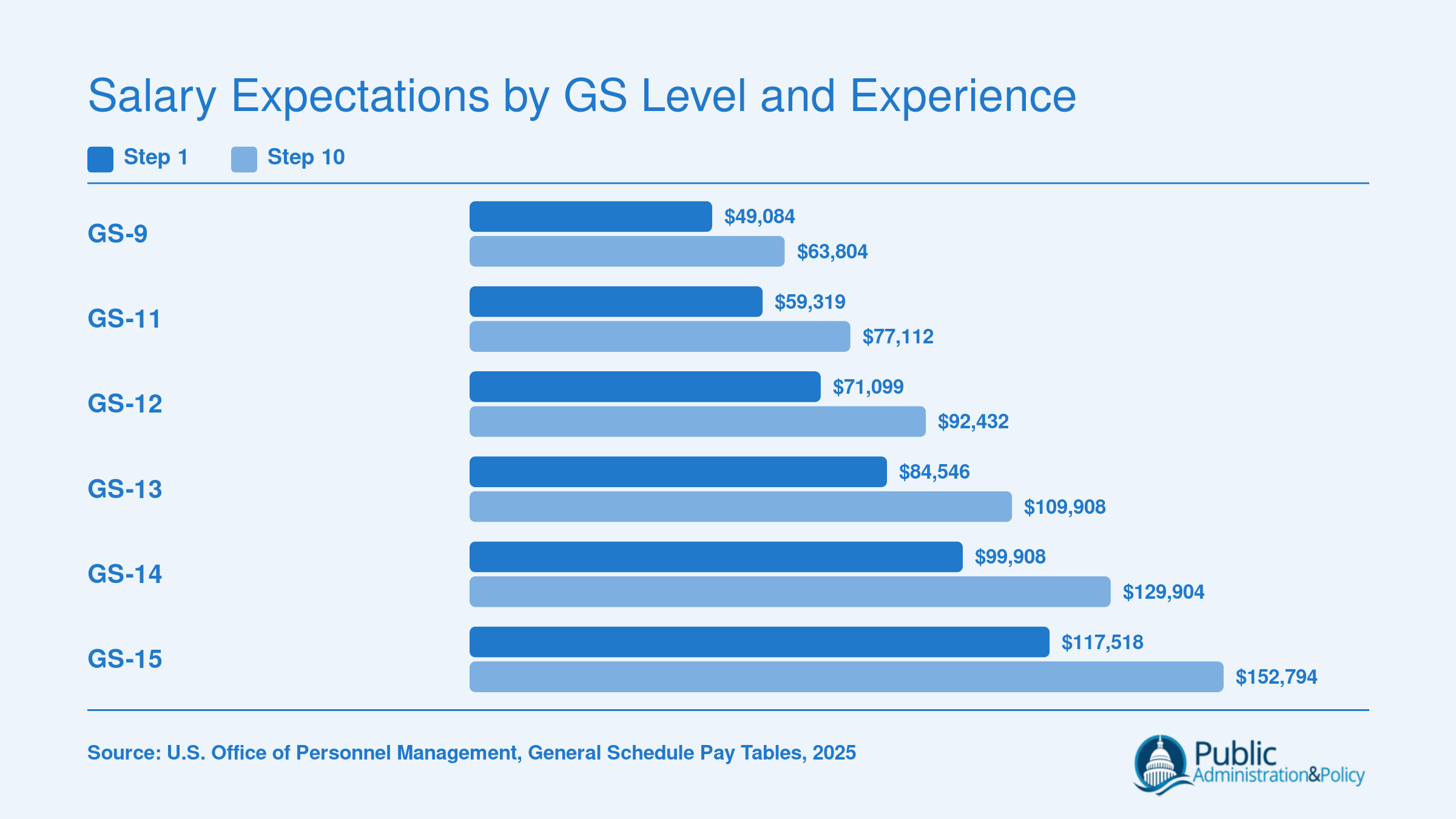
Salary Expectations by GS Level and Experience
Federal program manager salaries vary widely depending on your General Schedule grade and step. The ranges below show 2025 base pay from Step 1 (entry for that grade) to Step 10 (the top longevity step). Keep in mind that locality pay adjustments can add roughly 15% to 30% on top of these base figures in high-cost metro areas such as Washington, D.C., San Francisco, and New York.
The most direct route into federal program management starts with a bachelor's degree, one to three years of relevant experience in project coordination or government operations, and a PMP certification. That combination makes you competitive for GS-11 and GS-12 program manager postings on USAJobs. Once you are on board, you can earn your FAC-P/PM credential through your agency's training program.
Frequently Asked Questions About Becoming a Government Program Manager
Below are answers to some of the most common questions prospective government program managers ask. Each response draws on the education, certification, and career progression details covered throughout this guide on publicadministrationpolicy.org.
Do you need a degree to become a government program manager?
A bachelor's degree is typically the minimum requirement for federal program management positions, particularly at the GS-9 level and above. Most competitive candidates hold a master's degree in public administration (MPA), business administration (MBA), or a related field. While specialized experience can sometimes substitute for education at lower grade levels, a graduate degree significantly accelerates career progression and is often expected for senior roles at GS-13 and above.
What is the difference between a project manager and a program manager in government?
A project manager oversees a single, defined effort with a specific deliverable and timeline. A program manager, by contrast, coordinates multiple related projects that align with broader agency goals and strategic objectives. Program managers operate at a higher organizational level, managing interdependencies across projects, stakeholder relationships, and long-term outcomes. In federal settings, program managers also carry greater accountability for budget oversight, policy compliance, and lifecycle acquisition decisions.
What GS level is a program manager in the federal government?
Federal program managers typically fall between GS-12 and GS-15 on the General Schedule pay scale. Entry-level or junior program management roles may start around GS-11 or GS-12, while experienced program managers generally hold GS-13 or GS-14 positions. Senior or chief program managers, especially those leading major acquisition programs, often reach GS-15 or move into the Senior Executive Service (SES).
How long does it take to become a government program manager?
The timeline varies, but most professionals need roughly 8 to 12 years of combined education and experience. A typical path includes earning a bachelor's degree (four years), gaining several years of progressively responsible federal experience, and completing required certifications. Candidates with a master's degree or prior military and private-sector management experience may reach program manager roles somewhat faster, potentially within six to eight years of starting their careers.
What certifications do you need for federal program management?
The Federal Acquisition Certification for Program and Project Managers (FAC-P/PM) is the primary credential required for federal program management positions. It has three tiers: Entry, Mid, and Senior. Many agencies also value the Project Management Professional (PMP) certification from PMI, and the Program Management Professional (PgMP) credential is recognized for senior roles. Earning FAC-P/PM Senior level typically requires documented experience, training hours, and a current PMP or equivalent.
Can I transition from a private-sector PM role to a federal program manager position?
Yes, transitioning from the private sector is possible and increasingly common. Federal agencies recognize PMP and PgMP certifications, and relevant program or project management experience counts toward qualification standards. To strengthen your candidacy, tailor your resume to the federal format, highlight experience with large budgets and cross-functional teams, and pursue FAC-P/PM certification once you enter government service. Applying through USAJobs and targeting agencies with high program management hiring volumes can help you find the right opportunity.