Step 1: Choose the Right Degree, MPP Vs. MPA Vs. MUP
Your graduate degree shapes the analytical toolkit you carry into every policy debate, budget hearing, and community engagement session for years to come. Choosing between a Master of Public Policy (MPP), Master of Public Administration (MPA), and Master of Urban Planning (MUP) is one of the most consequential decisions in this career path, so it pays to understand what each program actually requires you to study, not just what the degree title implies.1
Start with the Right Undergraduate Foundation
No single major is mandatory, but admissions committees and future employers both value a strong quantitative foundation. The most common undergraduate backgrounds among successful urban policy planners include:
- Political science: Builds fluency in governance structures and legislative processes.
- Economics: Develops the regression analysis and cost-benefit reasoning central to policy work.
- Geography or urban studies: Provides spatial thinking and familiarity with GIS tools.
- Sociology: Strengthens qualitative research methods and equity-focused analysis.
- Public health: Offers experience with population-level data and program evaluation.
If your undergraduate transcript is light on statistics or microeconomics, consider bridging that gap before applying. Nearly every top MPP and MPA program requires at least one semester of each, and comfort with quantitative reasoning will set you apart once you are in the field.
How the Three Degrees Differ in the Classroom
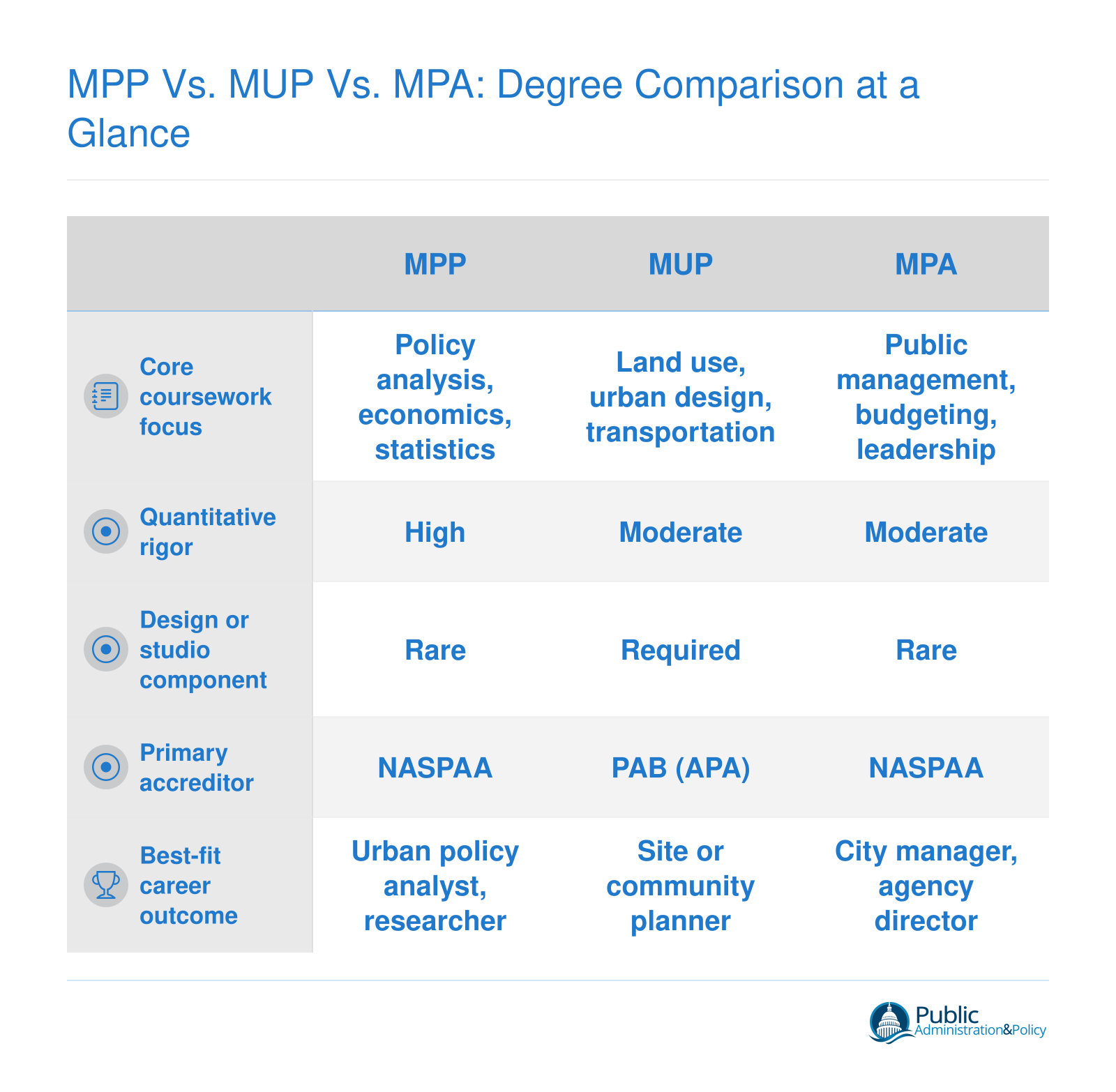
The labels MPP, MPA, and MUP can look interchangeable at first glance, but the required coursework tells a clearer story.
MPP programs center on quantitative policy analysis.2 A typical core includes microeconomics for policy, statistical methods, program evaluation, and a capstone policy analysis exercise. Harvard Kennedy School and the University of Michigan Ford School both structure their MPP curricula around this analytical spine, preparing graduates to evaluate trade-offs in proposed legislation, regulatory changes, or public investment strategies.
MPA programs shift the emphasis toward public management and organizational leadership.3 Core courses lean into budgeting, human resource management, nonprofit administration, and organizational behavior. NYU Wagner, for example, structures its MPA around managing public and nonprofit institutions, with elective concentrations that can tilt toward urban policy but keep management at the center.
MUP programs (sometimes labeled MURP, as at UCLA Luskin) ground students in design studios, land-use law, transportation planning, and the physical dimensions of city building. The core is oriented toward zoning, environmental review, and community design. Policy appears as an elective concentration rather than the default analytical framework.
Answering the Big Question: MPP vs. MUP for Urban Policy
If your goal is a pure policy role, where you draft housing legislation, run cost-benefit analyses on transit proposals, or advise a mayor on equitable development strategy, an MPP gives you the most direct preparation. The quantitative core trains you to do the kind of rigorous analysis that policy shops and government agencies expect. For a broader look at what this analytical work involves day to day, see our guide to importance of public policy.
If you want a hybrid role that blends physical planning with policy advocacy, consider an MUP program that offers a dedicated policy concentration. UCLA Luskin is a strong example: it houses both an MPP and an MURP under the same school and even offers a dual-degree option that lets you earn both. The University of Michigan follows a similar model, with the Ford School (MPP) and Taubman College (MUP) offering complementary coursework that students can combine.
Harvard takes a different structural approach. The Kennedy School offers the MPP and MPA but does not house an MUP. Students interested in design-oriented planning pair the Kennedy School with the Graduate School of Design through a formal joint-degree arrangement, blending policy analysis with urban design.
Online and Part-Time Pathways for Working Professionals
If you are already working in local government or a nonprofit and cannot step away for two full-time years, online and part-time options exist. NYU Wagner offers an online MPA programs track that maintains the same NASPAA-accredited curriculum as its on-campus counterpart. Several other NASPAA-accredited programs have added flexible-format MPP and MPA tracks. Students who prefer to skip the entrance exam may also want to explore No-GRE MPA options. Fully online MUP programs are rarer, partly because design studio courses are harder to replicate remotely, but some programs have introduced hybrid formats.
Why Accreditation Matters
Pay close attention to two accrediting bodies. The Planning Accreditation Board (PAB) accredits MUP programs, and the Network of Schools of Public Policy, Affairs, and Administration (NASPAA) accredits MPP and MPA programs. Accreditation is not just a prestige marker. If you plan to pursue AICP certification later (covered in Step 4), graduating from a PAB-accredited program can reduce the experience requirement. Similarly, NASPAA accreditation signals to government hiring managers that your program meets nationally recognized standards for public service education. Before you commit tuition dollars, verify that your target program holds the relevant accreditation.