How to Become an International Policy Specialist (2026)
Degrees, skills, salaries, and career pathways to shape global policy across government, NGOs, and international organizations
By Max SheltonReviewed by PAP Editoral TeamUpdated August 14, 202625+ min read
What you’ll learn in this article…
Most specialist roles require a graduate degree in international affairs, public policy, or a related concentration.
Salaries vary dramatically by sector, with multilateral organizations and private consulting typically offering the highest compensation.
The career path from entry-level intern to senior policy specialist generally spans 12 to 15 years.
Mid-career professionals from law, military, journalism, or data science can transition in with relevant transferable experience.
From trade disputes with major manufacturing economies to binding climate commitments under the Paris framework, cross-border policy challenges now require dedicated specialists, not generalists who dabble in international issues. The Bureau of Labor Statistics counted roughly 5,580 political scientists employed in the U.S. as of its latest occupational survey, and only a fraction of those hold roles focused specifically on international policy. Competition is steep.
An international policy specialist differs from a standard policy analyst or international relations generalist in a critical way: the role demands both technical research capability and the diplomatic skill to translate findings into actionable agreements between sovereign governments, multilateral bodies, or global NGOs. Most specialist-level positions expect a relevant graduate degree, often paired with regional expertise and at least one foreign language. The field rewards deep specialization, yet the entry path remains surprisingly opaque for many candidates. This guide breaks down what international affairs specialists actually do, the education and skills you need, realistic salary expectations by sector, and step-by-step strategies for breaking in.
What Does an International Policy Specialist Do?
An international policy specialist analyzes how global political, economic, and security dynamics affect a nation's interests, helping leaders craft foreign policy, negotiate agreements, and respond to international crises. Unlike academic researchers, these specialists deliver actionable intelligence: briefing memos, risk assessments, and strategic recommendations that influence real-time decisions.
Core Responsibilities
Researching foreign policy issues is the foundation. Specialists monitor geopolitical developments, such as elections, conflicts, and sanctions, and distill complex information into concise policy briefs. They advise decision-makers, from diplomats to cabinet officials, on the likely outcomes of proposed actions. Drafting official policy positions, preparing talking points for international summits, and contributing to multilateral negotiation strategies are routine. Success hinges on turning fragmented intelligence into coherent, evidence-based guidance that elected officials and agency heads can act on immediately.
Distinguishing the Specialist from Adjacent Roles
A policy analyst often has a domestic or broad public-policy lens, analyzing legislation, budgets, and regulatory impacts without a specific foreign affairs mandate. An international relations generalist typically works in academic settings, publishing theoretical research without the applied, time-sensitive demands of government or consulting. The international policy specialist bridges these worlds: they operate in fast-paced environments where their regional expertise and topical knowledge directly shape diplomatic strategy, trade negotiations, or security posture.
Typical Work Settings
Government agencies are the largest employer. In the United States, specialists staff the State Department, embassies overseas, the Department of Defense, and intelligence community.1 International organizations such as the United Nations, World Bank, and regional bodies hire specialists to design and evaluate cross-border programs. Think tanks (Council on Foreign Relations, Stimson Center, ETH Zurich's Center for Security Studies) employ specialists to conduct independent policy research and influence public debate. Private consulting firms and multinational corporations also maintain foreign policy expertise to navigate regulatory risks and market entry in volatile regions.
Specializations that Define the Field
The label "international policy specialist" conceals enormous diversity. Common sub-domains include:
- Trade policy: analyzing tariffs, sanctions, and economic agreements.
- Security and defense: assessing threats, arms control, and military alliances.
- International development: designing aid programs and evaluating poverty-reduction strategies.
- Climate and environmental governance: negotiating emissions targets and sustainability standards.
- Human rights: monitoring abuses and advocating for international legal compliance.
Each specialization demands deep regional knowledge, often including language proficiency, and the ability to integrate technical data with political judgment, as well as strong negotiation skills.
The Daily Reality
Most days blend desk research, writing, and stakeholder calls. Specialists may brief senior officials before a bilateral meeting, coordinate with embassy staff to verify intelligence, or draft testimony for legislative hearings. International travel, while not daily, occurs regularly for on-the-ground assessments, conference participation, or multilateral negotiations. As global challenges grow more interconnected, the 2026 specialist must synthesize across previously siloed domains; for instance, understanding how climate migration affects security or how trade policy influences human rights, making the role both more demanding and more influential than ever.3
Education Requirements: Degrees and Concentrations
International policy is a field where credentials matter. While entry-level research or advocacy positions may accept candidates with a bachelor's degree, the specialist-level roles that shape trade agreements, security frameworks, and development programs almost universally expect a graduate education. Understanding which degrees open which doors is essential to building a deliberate career path.
The Bachelor's Degree Foundation
A bachelor's degree in international relations, political science, economics, or area studies (such as Middle Eastern studies or East Asian studies) provides the analytical grounding you need to enter the field. Some aspiring specialists major in a technical discipline like statistics, public health, or environmental science and pair it with a minor or certificate in international affairs, a combination that can be especially attractive to employers seeking domain expertise. Regardless of your major, strong undergraduate coursework in economics, research methods, and at least one foreign language will position you well for graduate admissions and early-career opportunities.
The Master's Degree: The De Facto Standard
For specialist-level work, a master's degree is effectively required rather than merely preferred. The most common graduate pathways include:
Master of Public Policy (MPP): Emphasizes quantitative analysis, program evaluation, and evidence-based decision-making, with international concentrations available at many schools.
Master of Public Administration (MPA): Focuses on organizational management and policy implementation, well suited to careers in multilateral organizations and government agencies.
MA in International Affairs or International Studies: Offers broad training in diplomacy, political economy, and regional expertise.
MA in Security Studies: Targets careers in defense policy, intelligence analysis, and conflict resolution.
Candidates pursuing the MPP route can explore online MPP programs to compare curricula and concentrations. Those drawn to organizational leadership and implementation may find that an online MPA better aligns with their goals. Well-known programs include Johns Hopkins SAIS, the Fletcher School at Tufts, Georgetown's School of Foreign Service, and George Washington University's Elliott School of International Affairs. These are mentioned as reference points, not endorsements; many other programs produce accomplished specialists.
Working professionals who cannot relocate or study full time have viable options. American University and Johns Hopkins' Advanced Academic Programs, among others, offer online and part-time master's formats that accommodate career obligations while delivering substantive international affairs curricula.
Choosing a Concentration
Your choice of concentration within a graduate program does more than satisfy an academic requirement. It shapes the trajectory of your career in concrete ways:
International security positions you for roles in defense departments, intelligence agencies, and think tanks focused on geopolitical risk.
Trade and economic policy leads toward positions in finance ministries, the World Trade Organization, or consulting firms advising governments on market access.
International development aligns with careers at USAID, the World Bank, and global NGOs focused on poverty reduction, health, or education.
Environmental governance prepares you for work on climate negotiations, sustainability frameworks, and agencies like the UN Environment Programme.
Selecting a concentration early allows you to target internships, build a relevant professional network, and develop a writing portfolio that signals expertise to future employers.
When Does a PhD Make Sense?
A doctoral degree is valuable in a narrow set of circumstances. If your goal is a tenure-track faculty position, a senior research role at a major think tank, or leadership of a policy research division, a public policy phd programs option provides the methodological depth and publication record those roles demand. For most government positions, consulting engagements, and NGO operations roles, however, a PhD is unnecessary and may even slow your career progression by delaying the practical experience that hiring managers prioritize. The decision should hinge on whether your career vision centers on producing original research or on applying research to policy implementation.
Questions to Ask Yourself
Do you gravitate toward security and defense, economic and trade policy, humanitarian development, or environmental governance?
Each domain demands distinct expertise and connects you to different employer ecosystems. A security focus channels you toward defense agencies and think tanks, while environmental governance may point to multilateral organizations and climate finance bodies.
Are you energized by fast-paced crisis response or by designing long-term structural reforms?
Crisis response roles in humanitarian aid or conflict mediation require comfort with ambiguity and rapid decision cycles. Structural reform work, such as trade negotiation or institution building, rewards patience, deep analytical skills, and coalition management over years or even decades.
Would you thrive inside a government hierarchy, a lean nonprofit, or a corporate advisory team?
Organizational culture shapes your daily experience as much as subject matter does. Government positions offer policy influence and stability but slower promotion timelines, NGOs provide mission intensity with tighter budgets, and private sector consultancies trade purpose breadth for higher compensation and client variety.
Do you want to specialize in one geographic region or work across multiple regions throughout your career?
Regional specialists build deep language fluency and contextual knowledge that is hard to replicate, making them invaluable for embassy postings or area-focused research institutes. Generalists gain broader versatility, which is often rewarded in multilateral bodies like the United Nations or the World Bank.
Essential Skills, Languages, and Certifications
International policy specialists draw on three distinct skill categories, and the mix you need depends on your target sector and region. Employers consistently look for candidates who combine strong analytical capabilities with polished communication and genuine cultural fluency. The comparison below breaks down each category so you can identify gaps in your profile and prioritize your professional development.
Dimension
Analytical and Quantitative
Communication
Regional and Cultural
Core competencies
Econometrics, statistical modeling, cost-benefit analysis, data visualization (Tableau, Power BI)
Policy memo and brief writing, oral briefings for senior officials, public speaking, stakeholder engagement
Working-level or professional fluency in a priority language, area studies expertise, cross-cultural negotiation and mediation
Common tools and platforms
Stata, R, Python for data analysis; GIS mapping for development or security roles
Microsoft 365 and Google Workspace for collaborative drafting; presentation software; media training platforms
Language certification exams (DLPT, ACTFL OPI); cultural immersion programs; country-specific policy databases
Highest-demand languages by sector
Quantitative skills are sector-neutral, though security roles increasingly value open-source intelligence (OSINT) techniques
Strong English writing is baseline; French is essential for multilateral organizations and Africa-focused policy work
Arabic and Mandarin for security and diplomacy roles; Spanish for Latin America and international development; French for UN system and Francophone Africa
Certifications that boost competitiveness
Certificates in applied econometrics or program evaluation from recognized universities; data science micro-credentials
USIP (United States Institute of Peace) certificate programs in conflict analysis and peacebuilding; negotiation certificates from programs such as Harvard PON
PMP (Project Management Professional) for project-based roles in development agencies; security clearances (Secret or Top Secret/SCI) for federal government and intelligence positions
Where the skill matters most
Think tanks, multilateral development banks (World Bank, IMF), monitoring and evaluation units at USAID
Congressional offices, embassies, advocacy organizations, public affairs divisions of international NGOs
Foreign Service posts, regional bureaus at the State Department, UN country offices, bilateral aid programs
Typical development timeline
One to two years of graduate coursework plus hands-on research experience; proficiency grows through applied projects
Developed throughout graduate study and early career placements; sharpened by regular briefing and writing practice
Language fluency often requires two or more years of sustained study or immersion; area expertise deepens over an entire career
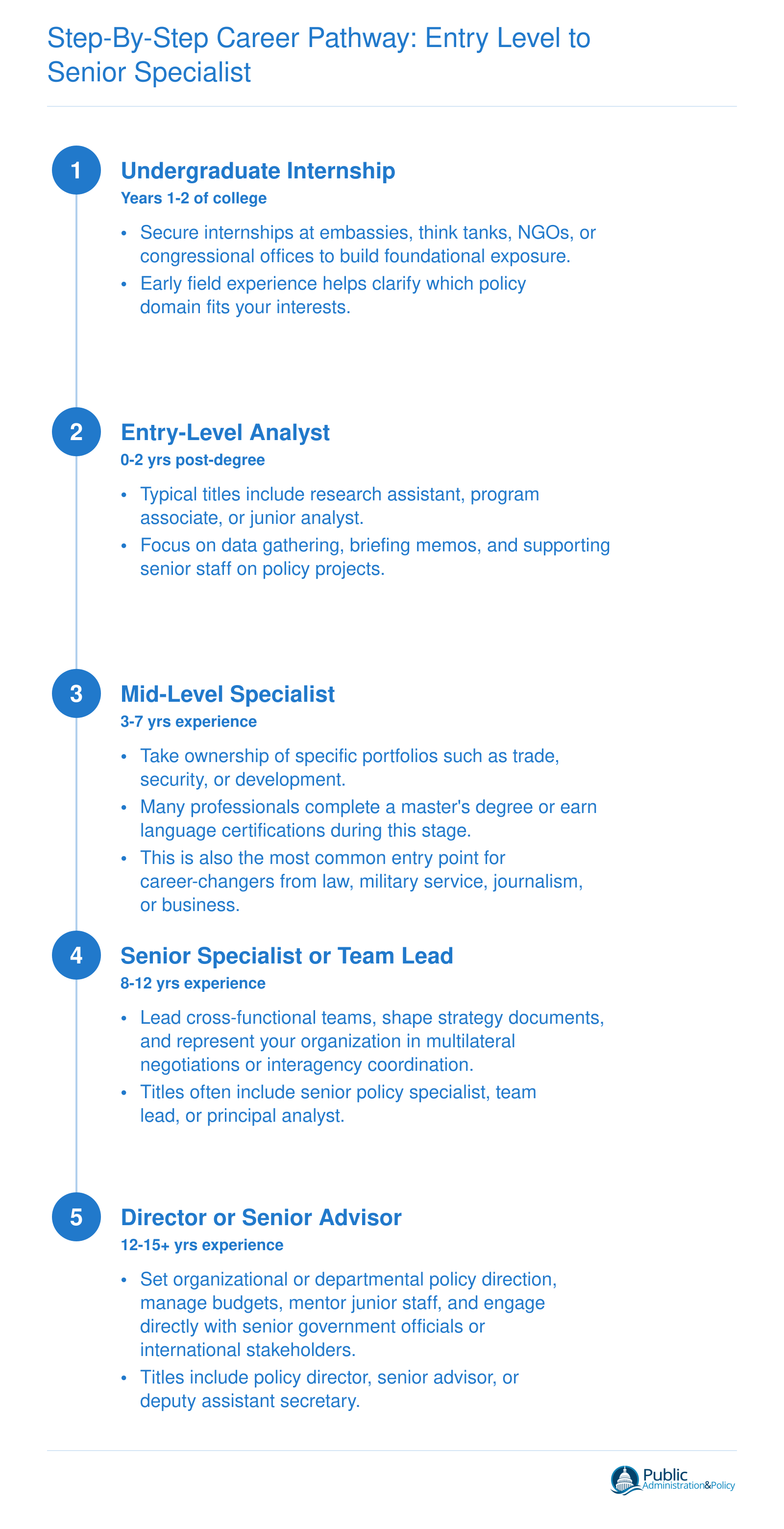
Step-By-Step Career Pathway: Entry Level to Senior Specialist
The path from first internship to senior policy leadership typically spans 12 to 15 years, though career-changers from law, military, journalism, or business can enter at the mid-level stage with relevant transferable experience. Below is a common progression for international policy specialists across government, nonprofit, and private-sector tracks.
Mid-Career Transitions: Breaking Into International Policy From Another Field
If you spent your early career in law, the military, journalism, data science, or the private sector, you are not starting from scratch. International policy organizations actively seek professionals with cross-sector experience, and a surprising number of senior specialists entered the field through a lateral move rather than a straight-line trajectory. The key is translating what you already know into the language and frameworks of international affairs.
Three Common Transition Paths
Most mid-career pivots follow one of three routes:
Policy-focused graduate degree: A one- or two-year master's in international affairs, public policy, or a related concentration lets you formalize your knowledge, build an alumni network, and access recruiting pipelines at multilateral institutions, federal agencies, and think tanks. Many programs offer executive or part-time formats designed for working professionals.
Lateral move within your current organization: Large employers in government, consulting, finance, and defense often maintain international divisions. Moving internally lets you gain relevant experience without resetting your seniority. A corporate attorney, for example, might transition to a trade compliance team before making a broader jump.
Fellowships and short-term details: Programs such as the Council on Foreign Relations International Affairs Fellowship, the Presidential Management Fellowship, and agency-specific rotational details provide credentialing and high-level exposure over 12 to 24 months. These are especially valuable if you need to demonstrate policy fluency quickly.
Leveraging Transferable Skills
Your prior career likely maps onto international policy more directly than you think. Attorneys bring treaty negotiation, regulatory analysis, and legal drafting skills that are in high demand at organizations like the Office of the U.S. Trade Representative. Military and intelligence professionals understand security policy, threat assessment, and interagency coordination. Data scientists and engineers can fill a growing need for quantitative policy analysis, program evaluation, and modeling. Journalists bring investigative research, clear writing, and source development.
Regardless of your background, build a writing portfolio of policy briefs and op-eds that demonstrate your ability to translate complex issues into actionable recommendations. Even two or three well-placed publications signal seriousness to hiring committees. Understanding the fundamentals of public policy making will help you frame your existing expertise in terms that resonate with hiring managers and review panels.
Security Clearances and Citizenship Considerations
If you already hold an active security clearance or have prior government service, you carry a significant competitive advantage. Agencies such as the Department of State, the Department of Defense, and organizations within the intelligence community require U.S. citizenship and often mandate clearances at the Secret or Top Secret level. These requirements can add months or even years to the onboarding process for candidates without prior government experience, so having a clearance in hand makes you immediately deployable.
Keep in mind that some international organizations, including the United Nations and World Bank, have their own nationality and visa requirements that differ from U.S. government standards. Research the specific eligibility criteria for each employer early in your transition planning so you can focus your energy on realistic targets. Candidates interested in exploring a broader range of options may also benefit from reviewing career in public policy pathways that overlap with international work.
International Policy Specialist Salary by Sector and Experience
Compensation for international policy specialists varies dramatically depending on the sector you choose, your years of experience, and where in the world you are stationed. Understanding these differences early helps you set realistic expectations and weigh trade-offs between salary, benefits, and mission alignment.
U.S. Federal Government (GS Scale)
Federal roles in agencies like the State Department, USAID, and the Department of Defense follow the General Schedule pay system. The 2026 base pay ranges (before locality adjustments) offer a clear progression:1
GS-9 (entry level): $52,727 to $68,549
GS-11 (early career): $63,795 to $82,938
GS-13 (mid-career): $90,925 to $118,204
GS-15 (senior specialist): $126,384 to $164,301
These figures reflect base salary only. If you work in a high-cost locality such as Washington, D.C., the San Francisco Bay Area, or New York, locality pay can increase your total compensation by 15 to 35 percent or more. Federal employees within the civil service system also receive substantial non-salary benefits, including the FERS pension, Thrift Savings Plan matching, comprehensive health coverage, and generous paid leave. When factored together, these benefits can add 30 to 40 percent to the value of the base salary.
United Nations and International Organizations (P Bands)
UN Professional staff salaries are set through a separate international framework. Entry-level P-2 positions typically start around $57,000 to $73,000 net, while mid-career P-4 roles range from roughly $80,000 to $110,000 net. Senior P-5 positions can exceed $120,000. A critical nuance here is that UN salaries are generally exempt from income tax for U.S. citizens (though the U.S. reimburses staff through a tax equalization mechanism). The UN also provides post adjustments tied to the cost of living at your duty station, which can significantly increase take-home pay in cities like Geneva or New York. Housing allowances, education grants for dependents, and home leave travel are additional benefits that make direct comparisons with domestic salaries misleading if you only look at base figures.
NGOs and Nonprofits
Nonprofit compensation tends to be lower, and salary compression is a well-known challenge in this sector. Entry-level policy analysts at international NGOs often earn between $45,000 and $60,000, while mid-career specialists with a decade of experience may reach $70,000 to $95,000. Senior directors at large organizations like the International Rescue Committee or Oxfam can earn $100,000 to $140,000, but upward movement is slower and the gap between junior and senior pay is narrower than in government or consulting. Mission-driven work and flexible cultures offset some of this gap for many professionals, though it remains a real consideration for long-term financial planning.
Think Tanks
Think tank salaries sit between the nonprofit and government ranges. A research associate or junior public affairs specialist might start at $50,000 to $65,000, while a senior fellow or program director at a prominent institution can earn $110,000 to $160,000 or more. Compensation varies considerably based on the size and endowment of the organization. Larger institutions like Brookings, RAND, or the Council on Foreign Relations generally pay at the higher end of these ranges.
Private-Sector Consulting
International policy consulting, whether at large firms or specialized boutiques, offers the highest salary ceiling. Entry-level analysts at major firms typically start between $70,000 and $95,000, with mid-career consultants earning $110,000 to $160,000. Senior principals and partners can command $180,000 to well over $250,000, especially when performance bonuses and profit-sharing are included. Bonuses in consulting can add 10 to 30 percent on top of base salary, which is a significant differentiator from the public and nonprofit sectors. The trade-off often involves longer hours, less job security tied to contract cycles, and work that may feel further removed from direct policy impact.
Putting It All Together
When comparing offers across sectors, resist the temptation to look at base salary alone. Federal pensions and benefits, UN tax advantages and allowances, and consulting bonuses all shift the real value of compensation in ways that a single number cannot capture. Your sector choice shapes not just your starting salary but your entire earnings trajectory, so consider where you want to be in 10 or 15 years, not just on day one.
Top Employers and Industries Hiring International Policy Specialists
The international policy landscape spans five broad employer categories, each with distinct cultures, hiring expectations, and career trajectories. Understanding what each sector values will help you target your applications more effectively and build the right profile well before you start applying.
U.S. Government Agencies
Federal agencies represent the largest single source of international policy positions in the United States. The Department of State, USAID, the Department of Defense, the intelligence community, and the Department of the Treasury all maintain dedicated international policy teams. Hiring typically runs through USAJobs and, for the Foreign Service, through a multi-stage exam process. Most roles require U.S. citizenship, and many demand a security clearance at the Secret or Top Secret level. Candidates who begin the clearance process early, sometimes during graduate school, gain a meaningful advantage. Civil service hiring timelines can stretch six months or longer, so patience and parallel applications are essential.
International Organizations
UN agencies, the World Bank, the International Monetary Fund, the World Trade Organization, and NATO hire policy specialists through competitive processes that emphasize geographic diversity. These organizations follow nationality balance quotas designed to ensure representation across member states, which means your country of citizenship can influence your competitiveness for certain posts. Fluency in at least two official languages (English plus French, Spanish, Arabic, Chinese, or Russian) is often a baseline expectation rather than a bonus. Contract lengths and duty station rotations vary widely, so flexibility is part of the job.
Think Tanks and Research Institutions
Organizations like Brookings, the Center for Strategic and International Studies, the Council on Foreign Relations, RAND, and the Carnegie Endowment for International Peace occupy a unique space between academia and importance of public policy. Hiring committees look for a strong publication record, evidence of original research, and the ability to translate complex analysis into actionable policy recommendations. Even at the entry level, having a few well-placed articles, policy briefs, or working papers can set you apart from candidates with similar academic credentials.
Nongovernmental Organizations
NGOs such as the International Rescue Committee, Mercy Corps, Human Rights Watch, and Oxfam tend to prioritize field experience and demonstrated commitment to a specific issue area, whether that is refugee protection, humanitarian response, or human rights documentation. These organizations are generally more flexible on citizenship and visa status than government employers, making them an attractive entry point for non-U.S. nationals seeking international policy careers. Salaries are typically lower than government or private sector equivalents, but the direct connection to on-the-ground impact draws many mission-driven professionals.
Private Sector and Emerging Hybrid Roles
Consulting firms like McKinsey Global Institute, Albright Stonebridge Group, and FTI Consulting hire international policy specialists who can pair qualitative regional expertise with quantitative analytical skills. Defense contractors also maintain sizable international policy divisions, often requiring security clearances similar to those needed in government.
A growing category worth watching is the tech sector. Companies such as Google and Meta now employ policy specialists focused on global regulatory affairs, platform governance, and digital sovereignty issues. These hybrid roles blend traditional policy analysis with technology fluency and represent one of the fastest-expanding niches in the field.
Government: Values clearances, civil service pathways, and citizenship.
International organizations: Prioritize language skills and geographic balance.
Think tanks: Expect a publication record and analytical depth.
NGOs: Reward field experience and flexible on nationality.
Private sector: Seeks quantitative chops and client-facing polish.
Mapping your own strengths against these expectations is a practical first step. If you are still building your profile, consider that many successful international policy specialists move across sectors over the course of a career, so an entry point in one category does not lock you out of the others.
How to Break In: Internships, Fellowships, and Networking Strategies
One of the most common questions aspiring international policy specialists ask is: how do I get a job in foreign policy with no experience? The honest answer is that you build experience before you finish school, and you treat fellowship applications, networking, and portfolio development as parallel tracks rather than sequential ones. Below is a practical breakdown of the pipelines and strategies that actually work.
Competitive Fellowships Worth Targeting
Several federally funded and institutional programs serve as the gold-standard on-ramps into international policy careers. Each is highly selective, so apply to multiple programs.
Pickering Fellowship (State Dept): A two-year program that covers up to $42,000 in graduate funding, includes two summer internships, and leads directly to a career as a Foreign Service Officer.1 Applicants must be U.S. citizens, demonstrate financial need, and hold at least a 3.2 GPA. The program is administered by Howard University and requires a five-year service commitment.1 Note that the 2026 cycle has been postponed; check the State Department site for updated timelines.2
Rangel Fellowship (State Dept): Structured similarly to the Pickering Fellowship but focused specifically on increasing diversity in the Foreign Service. It also funds graduate study and pairs fellows with mentors across diplomatic career tracks.
Presidential Management Fellowship (PMF): Open to students completing any advanced degree, the PMF places fellows across dozens of federal agencies, including USAID, the National Security Council, and the Office of the U.S. Trade Representative. It is one of the broadest federal pipelines for policy generalists.
UN Junior Professional Officer (JPO) Programme: Sponsored by member-state governments, the JPO programme places early-career professionals in UN agencies for two to three years. Eligibility and sponsorship rules vary by country.
Herbert Scoville Jr. Peace Fellowship: A Washington, D.C.-based program that places fellows at leading arms control and international security organizations. Ideal for those drawn to nonproliferation, defense policy, or conflict resolution.
Think Tank Fellowships (Brookings, CSIS): Major research institutions run their own fellowship and research assistant programs. These positions offer unmatched exposure to high-level policy debates and often lead to analyst or associate roles.
Networking That Actually Moves the Needle
Attending at least one major policy conference each year is a high-return investment. The International Studies Association (ISA) annual convention and the American Political Science Association (APSA) meeting both draw practitioners alongside academics. Panels, receptions, and side events are where informational conversations happen organically.
Professional associations provide year-round community and job boards. Women in International Security (WIIS) and Young Professionals in Foreign Policy (YPFP) host events in Washington, D.C., New York, and other cities, and both welcome graduate students. On LinkedIn, sending a short, specific message to a current specialist requesting a 20-minute informational interview yields surprisingly high response rates, especially if you reference a piece they published or a project they led.
Building a Portfolio Without a Full-Time Job
Volunteer policy writing is one of the most underused strategies for breaking in. Contributing analysis to outlets such as The Diplomatic Courier or War on the Rocks demonstrates subject-matter depth and gives you published clips to attach to fellowship or job applications. Even a single well-argued op-ed on a live policy issue can distinguish your candidacy.
Capitol Hill internships and state-level legislative staff roles also serve as legitimate stepping stones. Legislative work sharpens your ability to translate complex public policy into actionable briefs, a skill every hiring manager in international affairs values.
Look Beyond the "Specialist" Title
Many entry-level positions in this field carry titles that never mention the word specialist. If you limit your job search to that single keyword, you will miss most of the real on-ramps. Search instead for research assistant, program coordinator, policy associate, and analyst roles at agencies, nonprofits, and multilateral organizations. These positions build the substantive expertise and institutional knowledge that qualify you for specialist-level roles within a few years.
Students completing a master of public administration or related graduate degree should begin applying for internships and fellowships during their first semester, write and publish while they study, and treat every conference and informational interview as a chance to learn what a career in public policy actually looks like day to day. The field rewards people who show up prepared.
Career Outlook and Advancement Opportunities
The demand for professionals who can navigate complex international policy landscapes continues to grow, though the field remains competitive due to its relatively small size. According to the Bureau of Labor Statistics, approximately 5,580 political scientists were employed in the United States as of 2023, with roughly 3,620 of those positions in government.1 The broader category of life, physical, and social science occupations is projected to grow faster than average through 2034, with about 144,700 annual openings across all related roles.2 For political scientists specifically, projections call for around 500 openings over the 2024 to 2034 decade.3 These figures serve as a rough proxy for international policy demand, since many international affairs specialists hold titles that fall under different occupational codes, including management analysts, program analysts, and foreign affairs specialists within federal agencies.
Typical Advancement Timeline
Career progression for international policy specialists follows a recognizable arc, though individual timelines vary based on sector, education, and network strength. A common trajectory moves from entry-level policy analyst or program officer to team lead within three to five years, then to director of policy or equivalent within seven to ten years. Reaching senior leadership, such as vice president or chief of staff at an NGO, or a deputy assistant secretary-level role in government, typically takes 10 to 15 years of sustained, strategic career building. Completing a doctoral degree or holding a senior fellowship at a recognized institution can accelerate that timeline modestly.
Cross-Sector Mobility as a Career Strategy
One distinctive feature of international policy careers is that cross-sector movement is not just tolerated but often expected and rewarded. A well-constructed career might begin at the State Department, shift to a think tank where the specialist publishes research and gains public visibility, pivot to a consulting firm for higher compensation and private-sector experience, and then return to government at a more senior level. Each transition builds credibility across sectors. Hiring managers at organizations like the World Bank, USAID, or major foreign policy think tanks frequently value candidates who bring perspectives from multiple institutional settings.
Common Career Pitfalls to Avoid
Despite the field's opportunities, certain missteps can stall even talented professionals.
Getting stuck in program coordination: Administrative roles are necessary stepping stones, but staying too long without developing analytical or strategic depth can pigeonhole you. Seek assignments that involve policy drafting, data analysis, or direct engagement with decision-makers.
Over-specializing too early: Deep expertise in a single region or issue area is valuable, but neglecting to broaden your portfolio can limit senior-level opportunities, where leaders are expected to manage across multiple domains.
Neglecting quantitative skills: The field increasingly demands comfort with data analysis, impact evaluation, and evidence-based policy design. Professionals who rely solely on qualitative expertise may find themselves at a disadvantage as organizations prioritize measurable outcomes.
Underinvesting in networks: Relationships with peers across government, academia, and the private sector are not optional. Career-defining opportunities, from fellowship nominations to senior appointments, often flow through professional networks rather than formal job postings.
For those willing to invest strategically in their skills and professional relationships, international policy offers a career in public policy with genuine impact and meaningful upward mobility across sectors.
Frequently Asked Questions About International Policy Careers
International policy careers attract professionals from a wide range of academic backgrounds and professional experiences. Below, we address the most common questions prospective international policy specialists ask when exploring this career path.
What does an international policy specialist do?
An international policy specialist researches, analyzes, and develops recommendations on issues that cross national borders, such as trade agreements, security alliances, humanitarian aid, and climate accords. Day to day, they draft policy briefs, monitor geopolitical developments, advise decision makers, and coordinate with foreign governments or multilateral organizations. Depending on the employer, they may also represent their organization in diplomatic negotiations or at international forums.
What degree do you need to become an international policy specialist?
Most positions require at least a bachelor's degree in international relations, political science, public policy, or a related field. A master's degree, such as a Master of Public Policy (MPP) or Master of International Affairs (MIA), is strongly preferred and often required for mid-level and senior roles. Concentrations in areas like security studies, international development, or global economics can help you stand out in a competitive applicant pool.
How much does an international policy specialist make?
Salaries vary significantly by sector, experience level, and geographic location. As of 2026, entry-level positions in the federal government often start in the GS-9 to GS-11 range, while senior specialists and those at multilateral organizations or major think tanks can earn six figures. Private sector consulting roles frequently offer the highest compensation. Nonprofit and NGO salaries tend to be more modest but may include benefits like housing allowances for overseas posts.
What is the difference between a policy analyst and a policy specialist?
A policy analyst typically focuses on quantitative and qualitative research to evaluate existing or proposed policies. A policy specialist, by contrast, usually carries a broader portfolio that includes stakeholder engagement, program implementation, and strategic advising alongside analysis. In international affairs, the specialist role often involves deeper subject matter expertise in a specific region or issue area, while analysts may work across multiple topics with an emphasis on data-driven evaluation.
What skills do you need for international policy careers?
Core skills include advanced research and analytical writing, cross-cultural communication, and fluency in at least one foreign language. Quantitative skills such as data analysis and familiarity with statistical software are increasingly valued. Strong negotiation and diplomacy abilities are essential, along with adaptability, since international policy professionals often navigate complex bureaucratic and political environments across different countries and institutions.
How do I get a job in foreign policy with no experience?
Start by pursuing internships or fellowships at organizations like the U.S. Department of State, the United Nations, or policy-focused think tanks. Programs such as the Pathways Internship Program or the Pickering and Rangel Fellowships are designed to build pipelines for early career professionals. Volunteering with internationally focused nonprofits, joining professional associations, and attending policy conferences can also help you build a network and demonstrate commitment to the field.
Do I need a security clearance to work in international policy?
Not always. Many roles at think tanks, NGOs, multilateral organizations, and private consulting firms do not require a security clearance. However, positions within U.S. government agencies such as the State Department, Department of Defense, or intelligence community typically require at least a Secret clearance, and some demand Top Secret or higher. The clearance process can take several months, so factor that timeline into your job search if you are targeting government roles.