What Is Public Policy? A Complete Guide to How It Works
From definition to real-world impact — understand how public policies are made, who shapes them, and why they affect every aspect of daily life.
By Max SheltonReviewed by PAP Editoral TeamUpdated August 12, 202625+ min read
What you’ll learn in this article…
Public policy is what a government chooses to do or not do about a collective problem, following Thomas Dye's foundational definition.
Theodore Lowi's four types (distributive, regulatory, redistributive, constituent) remain the standard framework for classifying government action.
Policy evaluation through measurable outcomes separates effective governance from guesswork and drives real accountability.
Career paths in public policy span analysis, advocacy, and community development, supported by degrees in public administration and related fields.
Every time you drive on an interstate, enroll a child in a public school, or breathe air that meets federal quality standards, public policy is at work. The term names something specific: public policy is a deliberate system of laws, regulations, actions, and funding priorities adopted by government to address societal problems. It is not a single statute or executive order but the full architecture of decisions, including the decision to do nothing, that shapes collective life.
That architecture is far more contested than most people realize. Hundreds of billions in federal spending hinge on how a problem gets defined, which stakeholders gain access, and whether evaluation data ever feed back into reform. Understanding this process is essential whether you are pursuing public administration jobs or studying the forces that drive Introduction to Public Policy-Making.
What Public Policy Really Means, and Why It Matters
At its simplest, public policy is what a government decides to do, or deliberately decides not to do, about a collective problem. Political scientist Thomas Dye captured this idea in a formulation that has shaped the field for decades: public policy is "whatever governments choose to do or not to do." That definition is deceptively broad, and intentionally so. It reminds us that inaction is itself a policy choice. More contemporary scholars have refined the concept to emphasize outcomes, defining public policy as a purposeful course of action taken by government actors to address a public problem, evaluated by the results it produces for society. Both framings are useful. Together, they help general readers understand the meaning of public policy as something far more dynamic than a dusty government document. Policy is the living process through which governance shapes daily life, from the roads you drive on to the safety standards that protect the food on your table.
Why Public Policy Matters in Concrete Terms
Understanding the importance of public policy starts with recognizing the practical work it does. Consider four core functions:
Allocating scarce resources: Governments have limited budgets and must decide where to direct funding, whether that means investing in infrastructure, education, defense, or public health.
Setting societal priorities: Policy signals what a society values. Funding for scientific research, for example, reflects a collective commitment to innovation and knowledge.
Protecting rights and safety: From clean air standards to anti-discrimination statutes, public policy establishes the baseline protections citizens can expect.
Mediating conflicts between competing interests: When industries, communities, advocacy groups, or individuals disagree, the policy process provides structured mechanisms for negotiation, compromise, and resolution.
These functions make public policy relevant to virtually every aspect of modern life, and they explain why so many career paths, from health administration to public policy urban planning, intersect with policy work.
A Brief History of Public Policy as an Academic Discipline
Public policy has existed as a practice for as long as governments have, but it became a formal academic discipline in the mid-twentieth century. In 1951, Harold D. Lasswell introduced the concept of "policy sciences," arguing that rigorous, interdisciplinary analysis should inform government decisions.1 His work laid the intellectual foundation for the field.
The discipline grew rapidly alongside the expansion of the federal government. The New Deal era (1933 to 1939) demonstrated the scale at which government could intervene in economic and social life.2 The Great Society programs of the mid-1960s pushed further: the Civil Rights Act of 1964, the Economic Opportunity Act of 1964, and the creation of Medicare and Medicaid in 1965 all demanded new analytical frameworks for designing, implementing, and evaluating policy.3 By 1970, the first dedicated policy schools opened at major universities, formalizing the training of policy professionals.2 More recently, landmark legislation like the Affordable Care Act of 2010, which expanded health insurance regulation and coverage, illustrated how policy continues to evolve in response to new societal challenges.4
Policy Is a Process, Not Just a Product
One of the most common misconceptions is that public policy is simply a law or a regulation sitting in a binder. In reality, policy encompasses the entire cycle of identifying a problem, crafting a response, securing political support, implementing programs, and evaluating results. A law is one expression of policy, but the funding decisions, agency rules, executive orders, and day-to-day administrative choices that follow are equally important. For students and professionals exploring careers in public administration, this distinction matters: the work of governance happens at every stage of this process, not just in the legislative chamber.
How Public Policy Differs From Law, Regulation, and Politics
People often use the terms policy, law, regulation, and politics interchangeably, but each plays a distinct role in how governments address public problems. Think of it as a chain: politics determines which issues rise to the top, policy sets the broad strategy for addressing them, law codifies that strategy into enforceable statute, and regulation translates the statute into specific, actionable rules. Understanding these distinctions is essential for anyone studying or working in public administration, because each stage involves different actors, processes, and forms of accountability.
Dimension
Public Policy
Law
Regulation
Executive Order
Politics
Definition
A broad strategy or plan adopted by government to address a societal issue
A statute formally enacted by a legislative body (e.g., Congress, state legislature)
A specific rule created by an executive agency to implement and enforce a law
A directive issued by the head of the executive branch (e.g., the president or a governor)
The process of competing interests, debate, and negotiation that determines which policies are pursued
Who Creates It
Policymakers across branches of government, often guided by research, advocacy, and public input
Legislators who draft, debate, and vote on bills that the executive signs into law
Administrative agencies such as the EPA, FDA, or state equivalents, using authority granted by statute
The president, governor, or other chief executive acting within constitutional or statutory authority
Elected officials, interest groups, voters, lobbyists, media, and other stakeholders participating in the democratic process
Concrete Example (Environmental Context)
A national commitment to reduce greenhouse gas emissions and transition to cleaner energy sources
The Clean Air Act, which establishes federal authority to regulate air pollution
EPA emission standards that set maximum allowable pollutant levels for power plants and vehicles
A presidential executive order directing federal agencies to meet specific climate targets by a set date
Debates among industry groups, environmental organizations, and lawmakers over the scope and pace of climate action
Legal Force
Sets direction and priorities but is not independently enforceable in court
Carries the full force of law, enforceable through penalties, fines, or legal proceedings
Carries the force of law within the scope authorized by statute, enforceable by the issuing agency
Binding on federal (or state) agencies and employees, though subject to judicial and legislative review
Has no direct legal force; it shapes outcomes indirectly by influencing which policies, laws, and orders are adopted
Scope and Flexibility
Broad and adaptable; can shift with new administrations, data, or public priorities
Relatively fixed once enacted; changing a law requires a new legislative process
Narrower in scope than law; agencies can update regulations through formal rulemaking procedures
Can be issued quickly and unilaterally, but a successor executive can revoke or replace it
Fluid and ongoing; political dynamics evolve continuously with elections, public opinion, and current events
Relationship to the Others
Serves as the overarching framework that laws, regulations, and executive orders are designed to advance
Translates broad policy goals into binding statutory language
Provides the detailed, technical rules needed to put a law into practice
Supplements or directs the implementation of policy when legislative action is slow or absent
Acts as the driving force behind all of the above, determining which issues receive attention and resources
Types of Public Policy: Distributive, Regulatory, Redistributive, and Constituent
Political scientist Theodore Lowi introduced a typology in the 1960s that remains the most widely taught framework for classifying government action. His four categories (distributive, regulatory, redistributive, and constituent) help clarify the purpose behind any given policy and the political dynamics it generates.
Distributive Policy
Distributive policies allocate benefits, usually funded by general tax revenue, to specific groups, industries, or communities. Because the costs are spread broadly while the benefits are concentrated, these policies tend to generate relatively little opposition.
Example: Federal farm subsidies channel funding to agricultural producers to stabilize food prices and support rural economies. Infrastructure grants for highway construction follow the same logic.
Regulatory Policy
Regulatory policies impose rules on individuals, businesses, or organizations to protect public welfare. They restrict certain behaviors and establish standards, often backed by penalties for noncompliance.
Example: The FDA's food safety rules set standards for how products are processed, labeled, and sold, directly shaping what consumers find on grocery shelves.
Redistributive Policy
Redistributive policies transfer resources from one group to another, typically from higher-income populations to lower-income populations. These tend to be the most politically contentious because the costs and benefits are both clearly visible.
Example: Medicaid provides health coverage to eligible low-income individuals and families, funded largely through federal and state tax revenues.
Constituent Policy
Constituent policies (sometimes called structural policies) address how the government itself is organized and operates. Rather than targeting citizens or businesses directly, they shape the rules, boundaries, and institutions through which all other policies are made.
Example: Congressional redistricting laws determine how legislative districts are drawn, influencing representation and the balance of political power for a decade at a time.
Why the Lines Blur in Practice
Real-world policies rarely fit neatly into a single category. The Affordable Care Act, for instance, is simultaneously regulatory (mandating coverage standards for insurers), redistributive (expanding Medicaid eligibility), and distributive (providing premium subsidies to qualifying individuals). Recognizing where a policy falls in Lowi's typology helps analysts anticipate the political coalitions and conflicts likely to form around it, but expecting rigid boundaries will lead to oversimplification.
Connecting the Typology to Major Policy Areas
Lowi's framework applies across every domain where government acts. The areas of public policy that students and professionals encounter most frequently include healthcare, education, the environment, criminal justice, economic policy, and foreign policy. Each of these fields contains policies that span multiple categories. Environmental regulation, for example, can be regulatory (emissions standards), distributive (clean energy grants), and redistributive (carbon tax revenue returned to lower-income households) all at once. Understanding the typology gives you a sharper lens for analyzing proposals in any of these areas, whether you are studying them in a degree program or shaping them in a career in public policy. A policy analyst, for example, routinely applies frameworks like Lowi's to evaluate competing proposals and advise decision-makers on likely outcomes.
Questions to Ask Yourself
Which type of public policy, whether distributive, regulatory, or redistributive, has most directly affected your daily life in the past year?
Identifying the policy type helps you see how government decisions shape everything from the roads you drive on to the taxes withheld from your paycheck. Recognizing these categories turns abstract theory into something personal and concrete.
Do you know which specific government agency was responsible for implementing that policy?
Most people experience the effects of policy without knowing which agency designed or enforced it. Tracing a policy back to its institutional source reveals how authority is distributed across federal, state, and local levels.
Could you name the actual law or executive action that authorized the policy you identified?
Distinguishing the legal foundation from the policy it enables is a skill you will need in the next section, where we walk through how policies move from problem identification to formal implementation and evaluation.
The Public Policy Process: From Problem to Implementation
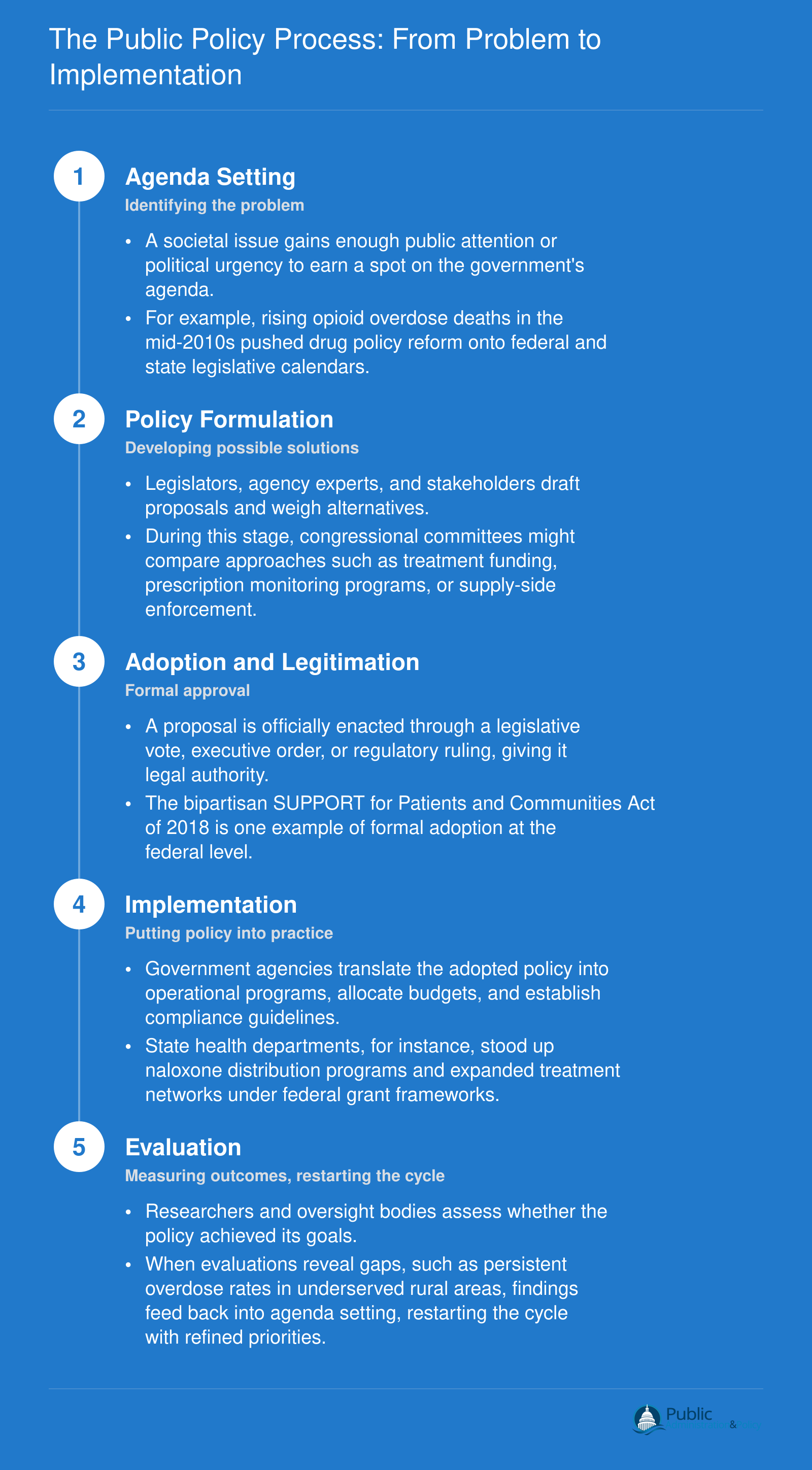
Public policy does not emerge in a single moment. It follows a cyclical process in which each stage builds on the last, and evaluation frequently sends decision-makers back to the starting line when results reveal new challenges or unintended consequences.
How Public Policy Is Actually Made: A Deeper Look at Each Stage
Understanding the textbook stages of Public Policy-Making is useful, but the real process is far messier. At every stage, competing interests collide, timelines stretch, and decisions hinge on factors that range from rigorous data analysis to raw political calculation. Here is a closer look at what actually happens inside each phase, who drives it, and where the process commonly stalls.
Stage 1: Agenda Setting
Before any policy can be crafted, a problem must capture the attention of decision-makers. This does not happen automatically. Three forces typically push an issue onto the government's agenda:
Media coverage: Sustained reporting on an issue (homelessness, opioid overdoses, infrastructure failures) raises public awareness and pressures elected officials to respond.
Public opinion shifts: Polling data showing a dramatic change in voter priorities can prompt legislators to act, especially ahead of election cycles.
Focusing events: A crisis or disaster can accelerate debate overnight. A mass shooting, for example, often reopens gun-policy discussions that had stalled for months or years. Similarly, a financial collapse or pandemic can vault economic or health policy to the top of the legislative calendar.
Agenda setting is also where the process frequently stalls. If no coalition of advocates, media outlets, or political leaders sustains pressure, even widely recognized problems can languish without action for decades.
Stage 2: Policy Formulation and Adoption
Once an issue is on the agenda, proposals must be developed and debated. This stage involves multiple actors working in parallel:
Congressional committees and subcommittees hold hearings, invite expert testimony, and draft bills. The committee process is where much of the substantive language in legislation takes shape.
Think tanks and research organizations produce policy briefs, cost-benefit analyses, and model legislation. Groups spanning the ideological spectrum, from the Brookings Institution to the Heritage Foundation, compete to influence the framing of solutions.
Lobbyists and interest groups advocate for specific provisions, propose amendments, and sometimes draft bill language themselves.
Compromise is the defining feature of adoption. A bill that passes a committee may look quite different from the original proposal after floor amendments, negotiations between legislative chambers, and executive branch input. Policies are rarely adopted in their ideal form; they are adopted in the form that enough stakeholders can accept. When compromise proves impossible, promising proposals die in committee or fail floor votes, sometimes repeatedly across multiple legislative sessions.
Stage 3: Implementation
This is arguably the most consequential stage, and the one most often underestimated. A well-designed policy can fail entirely if implementation is poorly managed. Federal, state, or local agencies are typically charged with translating legislation into programs, rules, and services.
One of the most important concepts in implementation research comes from political scientist Michael Lipsky, who coined the term "street-level bureaucrats." These are the teachers, social workers, police officers, and caseworkers who interact directly with the public. Because they operate under resource constraints and ambiguous guidelines, they inevitably exercise discretion in how they apply policy. A welfare caseworker decides which applicants receive expedited processing. A building inspector determines how strictly to enforce a new code. These individual decisions, multiplied across thousands of frontline workers, collectively determine whether a policy achieves its intended outcomes or drifts from its original purpose.
Implementation can stall due to inadequate funding, unclear agency mandates, resistance from state or local governments, or simple administrative overload. Students interested in this dimension of the policy cycle may find that pursuing a career as a think tank analyst offers a direct path into implementation research and advisory work.
Stage 4: Evaluation
The final stage asks a deceptively simple question: did the policy work? Evaluation involves measuring outcomes against the goals that were set during formulation. Analysts look at data on program participation, costs, and real-world impact to determine whether a policy should be continued, expanded, modified, or terminated.
Evaluation is where accountability lives, and it deserves a dedicated discussion. The section that follows explores how public policy success is measured, what tools analysts use, and why rigorous evaluation remains one of the most challenging aspects of the entire policy cycle.
Real-World Public Policy Examples That Affect Daily Life
Public policy is not an abstraction confined to textbooks. The policies enacted in recent years touch prescription drug costs, highway safety, student debt, air quality, and criminal sentencing. Examining concrete examples helps illustrate how the policy cycle (problem identification, formulation, adoption, implementation, and evaluation) plays out in practice.
Healthcare: Medicare Drug Price Negotiation Under the Inflation Reduction Act
The problem was straightforward: Medicare beneficiaries were paying some of the highest prescription drug prices in the world, with certain medications costing tens of thousands of dollars per year. The policy response came through the Inflation Reduction Act, which authorized Medicare to negotiate prices directly with pharmaceutical manufacturers for the first time.1
The first round of negotiations, covering ten high-cost drugs, produced negotiated prices roughly 38 percent below prior list prices.1 The second round expanded the effort, targeting additional medications including Trelegy Ellipta, Xtandi, Pomalyst, Ibrance, and Linzess, with estimated savings of approximately $12.5 billion for Part D plans and negotiated prices averaging 44 percent below pre-negotiation net prices.2 By the third round, every selected manufacturer opted into the program.3 Medicare beneficiaries are projected to save around $1.5 billion in out-of-pocket costs beginning in 2026.1 This example traces the full policy cycle: problem identification (unsustainable drug costs), formulation and adoption (legislative action), implementation (successive negotiation rounds), and ongoing evaluation (tracking savings against Congressional Budget Office targets, which still require roughly 10 percent in additional reductions to fully meet projections).4
Infrastructure: Outcomes from the Infrastructure Investment and Jobs Act
Aging roads, bridges, and broadband gaps represented a well-documented problem. The Infrastructure Investment and Jobs Act (IIJA), signed in late 2021, directed over $1 trillion toward physical infrastructure. By 2025, thousands of projects were underway, including bridge repairs, electric vehicle charging networks, and rural broadband expansion. Early implementation has shown measurable progress, though some communities have experienced delays in permitting and labor shortages that slowed project timelines. The IIJA illustrates how even well-funded policies face friction during the implementation stage.
Education: Federal Student Loan Policy Changes
Millions of borrowers faced mounting student loan debt, prompting a series of federal responses. Between 2024 and 2026, the administration pursued multiple rounds of targeted loan relief and revisions to income-driven repayment plans. However, legal challenges blocked or delayed several initiatives, leaving many borrowers uncertain about their repayment obligations. This is a useful case study in how the adoption stage does not guarantee smooth implementation: court rulings, changing political priorities, and administrative complexity can stall or reshape a policy after it is formally announced.
Environment: EPA Emissions Regulations
Climate change and air quality concerns prompted the EPA to finalize stricter emissions standards for power plants and vehicles between 2024 and 2026. These rules aimed to accelerate the transition to cleaner energy sources and reduce greenhouse gas output. Early status reports suggest that automakers have begun adjusting production plans in response, though some industry groups have pushed back on compliance timelines. Students interested in this area may want to explore how to become an environmental policy advisor, a role at the intersection of science and governance. This example shows how regulatory policy (distinct from legislation) moves through its own cycle of proposal, public comment, finalization, and judicial review.
Criminal Justice: Sentencing Reform and Unintended Consequences
Sentencing reform efforts at both federal and state levels sought to reduce mass incarceration by lowering mandatory minimums for nonviolent drug offenses. While several states reported declining prison populations and modest cost savings, evaluators also identified an unintended consequence: inconsistent application of new guidelines across jurisdictions meant that similar offenders sometimes received vastly different sentences depending on where they were prosecuted. Some reform measures also lacked adequate funding for reentry programs, resulting in higher recidivism in areas without support services. This outcome underscores why evaluation is essential. A policy can succeed in its primary goal (reducing incarceration rates) while simultaneously revealing gaps that demand a new round of problem identification and formulation.
Connecting Examples to the Policy Cycle
Each of these cases reinforces a core lesson: public policy does not end when a bill is signed or a rule is finalized. Implementation determines whether a policy achieves its intended effect, and evaluation reveals where adjustments are needed. For students and professionals considering careers in this field, pursuing a Master of Public Policy can build the analytical skills, stakeholder engagement capacity, and adaptability that these examples demand.
Key Stakeholders: Who Shapes Public Policy?
Public policy is never the product of a single decision maker. It emerges from a web of actors who compete, collaborate, and compromise across every branch and level of government, along with powerful forces outside government altogether. Understanding who these stakeholders are is essential for anyone looking to work in, study, or simply navigate the policy landscape.
Government Actors Across Branches and Levels
Within the federal government alone, three branches each play a distinct role:
Legislators: Members of Congress draft, debate, and vote on bills that become law. State legislatures carry out the same function at the state level, often serving as laboratories for policy innovation.
Executives: The president, governors, and mayors set agendas, issue executive orders, and sign or veto legislation. Their budget proposals shape which policies receive funding.
Agencies and Bureaucracies: Federal agencies like the Environmental Protection Agency or the Department of Education translate broad legislative mandates into specific rules and programs. State and local agencies do the same within their jurisdictions.
Courts: Through judicial review, courts interpret laws, strike down unconstitutional provisions, and settle disputes about how policies should be applied. A single Supreme Court ruling can reshape policy across the entire country.
The multi-level dimension adds considerable complexity. Federal, state, and local governments frequently pursue competing or complementary policies on the same issue. Marijuana legalization is a clear example: as of 2026, numerous states have legalized recreational cannabis even though federal law still classifies it as a controlled substance. This tension illustrates how overlapping authority creates a patchwork of policy realities.
Non-Government Influencers
Outside of government, several groups exert significant influence:
Interest Groups and Lobbyists: Organizations representing industries, professions, or causes invest substantial resources in shaping legislation, funding campaigns, and providing technical expertise to policymakers.
Media: Journalists and media outlets frame public discourse, elevate certain issues, and hold officials accountable. Coverage decisions often determine which problems receive political attention.
Think Tanks and Researchers: Policy research organizations generate evidence and proposals that feed directly into legislative debates and agency rulemaking.
How Citizens Shape Policy
Ordinary citizens are not passive bystanders. Multiple channels exist for direct influence:
Voting: Elections determine which officials, and which policy priorities, hold power.
Public Comment Periods: When federal or state agencies propose new rules, they are often required to accept and respond to public comments before finalizing regulations.
Ballot Initiatives: In many states, citizens can place measures directly on the ballot, bypassing the legislature entirely.
Grassroots Advocacy: Organizing campaigns, attending town halls, and contacting representatives all apply pressure that elected officials track closely.
Ballot initiatives offer some of the most tangible evidence of citizen-driven policy change. Between 2014 and 2024, voters in states including Arizona, Florida, Missouri, and Nebraska approved ballot measures to raise their state minimum wages, often by wide margins, even in states where legislatures had declined to act on the issue. These initiatives demonstrate that when formal institutions stall, citizens retain meaningful tools to advance policy change on their own terms.
For students and professionals considering careers in public policy, mapping these stakeholders is more than an academic exercise. It reveals where leverage exists, where decisions actually get made, and where your own career might fit into the process. Those interested in advising policymakers directly might explore becoming a public policy consultant, while others may find their niche within the agencies and bureaucracies that translate public policy-making into real-world programs.
How Public Policy Success Is Measured
Creating a policy is only half the challenge. Determining whether that policy actually works requires rigorous evaluation, and this is where many well-intentioned initiatives either prove their value or reveal their shortcomings. Government agencies at every level rely on established evaluation frameworks and clearly defined metrics to assess whether public dollars are achieving their intended purpose.
Evaluation Frameworks Used by Government Agencies
Federal evaluation rests on several core methodologies, each suited to different questions and contexts.1
Cost-benefit analysis (CBA): Compares a policy's total costs against its total benefits, expressed in monetary terms, to determine whether net benefits are positive. CBA is one of the most widely used tools across federal agencies and is central to the GAO's evaluation methodology.
Cost-effectiveness analysis: Similar to CBA but used when outcomes are difficult to monetize, such as lives saved or diseases prevented. It calculates the cost per unit of a desired outcome.
Randomized controlled trials (RCTs): Considered the gold standard for causal evidence, RCTs randomly assign participants to treatment and control groups to isolate a policy's treatment effect from other variables.
Quasi-experimental methods: When randomization is not feasible, techniques like difference-in-differences allow evaluators to estimate causal effects by comparing trends between groups affected and unaffected by a policy.
These frameworks are not optional preferences. The Foundations for Evidence-Based Policymaking Act of 2018 requires federal agencies to develop evidence-building plans, appoint evaluation officers, and use data strategically in decision-making. The Office of Management and Budget (OMB) oversees compliance, pushing agencies to ground their program decisions in credible evidence rather than anecdote or political convenience.
The Metrics That Matter
Evaluation is only as useful as the metrics it tracks. The GAO's standards, outlined in the Yellow Book, emphasize several categories that together paint a complete picture of policy performance.1
Output metrics: These count what a program delivers, such as the number of people served, applications processed, or grants distributed. Outputs confirm a program is operational, but they say nothing about whether it is effective.
Outcome metrics: These capture measurable change in the problem a policy targets. Did poverty rates decline? Did air quality improve? Outcomes are harder to track but far more meaningful.
Efficiency metrics: These relate cost to results, calculating the cost per unit of outcome. An efficient program achieves its goals without unnecessary expenditure.
Equity metrics: These assess distributional impact across different populations. A policy might succeed in the aggregate while leaving marginalized communities behind. Equity metrics reveal whether benefits and burdens are shared fairly.
The GAO's evaluation principles stress objectivity, independence, and the use of sufficient and appropriate evidence.1 Logic models, which map how a program's inputs are expected to produce specific outputs and outcomes, are a standard component of this process. In 2026, the GAO reviewed five federal programs and recommended that agencies improve risk-based monitoring of their grant programs, reflecting an ongoing push toward accountability.2
Common Pitfalls in Policy Evaluation
Even with robust frameworks, measuring policy success is fraught with challenges that evaluators and policymakers must confront honestly.
Attribution is perhaps the most persistent difficulty. When a community's health outcomes improve after a new wellness initiative launches, did the policy cause the change, or did economic growth, demographic shifts, or other programs contribute? Establishing causation rather than mere correlation requires careful study design and often years of data collection.
Data lags present another obstacle. Many federal datasets are published months or even years after the period they describe, meaning evaluators are sometimes assessing yesterday's reality while today's conditions have already shifted.
Political pressure compounds these technical challenges. Elected officials and agency leaders face incentives to declare early success, sometimes highlighting favorable output numbers (people enrolled, dollars spent) before outcome data is available. This tendency can distort public understanding of whether a policy is genuinely working.
Finally, long-term outcomes are inherently difficult to measure. An early childhood education program might show modest short-term gains but produce transformative effects on earnings and health decades later. Evaluation timelines rarely extend far enough to capture these impacts, which means some of the most consequential policies may appear unremarkable in their early assessments.
For students and professionals considering careers in public policy, understanding these evaluation methods is not academic background knowledge. It is a core professional skill. The ability to design evaluations, interpret evidence, and communicate findings honestly is what separates policy practitioners who drive real improvement from those who merely manage programs. Graduate programs in master of public administration and public policy prepare students for exactly this kind of evidence-driven work, equipping them with the analytical tools the field demands.
Careers in Public Policy: Paths, Degrees, and Salary Outlook
Public policy touches every sector of government and civic life, which means career options are remarkably diverse. Whether you are drawn to data-driven analysis, community development, or advocacy, there is a clear professional path worth exploring.
Common Career Paths
Five roles illustrate the breadth of the field:
Policy Analyst: Researches issues, models potential outcomes, and writes briefs that inform decision-makers at every level of government.
Legislative Aide: Supports elected officials by tracking legislation, coordinating constituent outreach, and drafting policy memos.
Urban Planner: Designs land-use strategies, transportation systems, and community development plans that shape how cities grow.
Environmental Policy Advisor: Works with agencies or nonprofits to develop regulations and programs addressing climate, water quality, energy, and natural resource management.
Public Affairs Manager: Serves as the bridge between an organization and policymakers, managing communications, stakeholder engagement, and government relations.
Degree Pathways
A Master of Public Policy (MPP) is the most direct credential, emphasizing quantitative analysis, program evaluation, and policy design. A Master of Public Administration (MPA) takes a broader approach, covering organizational leadership and public management alongside policy coursework. To understand the distinctions, see our guide on public administration vs public policy. Graduate degrees in economics, political science, sociology, or environmental studies also provide strong foundations. Readers interested in comparing curricula and admission requirements can explore best online public administration degree programs on our site.
Salary and Job-Growth Snapshot
Compensation varies by role and experience, but federal data offers useful benchmarks. According to the Bureau of Labor Statistics Occupational Outlook Handbook:
Political scientists earned a median annual wage of $139,380 as of 2024. The occupation is small, with roughly 500 openings projected per year through 2034, and overall employment is expected to decline about 3 percent over that period.1
Urban and regional planners earned a median of $81,800, with about 1,700 annual openings and a projected growth rate of 4 percent through 2034.2
Management analysts, a category that includes many consulting and policy-evaluation roles, earned a median of $101,190. This occupation is growing at 9 percent, with approximately 95,500 openings per year.3
These figures reflect 2024 data, so current salaries may be somewhat higher by 2026. For a broader look at compensation across the field, visit our public administration & policy salary overview.
Entry Points Without a Graduate Degree
You do not need a master's degree to start building a policy career. Several pathways can provide foundational experience:
Government internships at local, state, or federal agencies
National service programs such as AmeriCorps or VISTA, which place participants in community-focused policy roles
Campaign work, where staffers gain firsthand exposure to issue framing and voter engagement
Entry-level positions at nonprofits focused on housing, health, education, or civil rights policy
Each of these routes helps you develop research, communication, and stakeholder-management skills that transfer directly into graduate study or mid-career policy roles. Many professionals combine a few years of hands-on experience with a graduate degree later, which often strengthens both the application and the classroom experience.
Frequently Asked Questions About Public Policy
Public policy touches nearly every aspect of daily life, yet the concept can feel abstract without clear definitions. Below are concise answers to the questions students, professionals, and engaged citizens ask most often about how government decisions are shaped, implemented, and evaluated.
What is public policy in simple terms?
Public policy is a deliberate course of action (or inaction) that a government chooses in order to address a societal problem or goal. It can take the form of legislation, executive orders, regulations, or funded programs. In essence, it is the way governments translate priorities into tangible outcomes that affect communities, economies, and individual rights.
What are the 4 types of public policy?
The four widely recognized types are distributive, regulatory, redistributive, and constituent. Distributive policies allocate resources broadly (such as infrastructure spending). Regulatory policies set rules for industries or behaviors. Redistributive policies shift resources from one group to another through mechanisms like progressive taxation. Constituent policies shape how government itself operates, including administrative reforms and electoral processes.
What is the difference between public policy and law?
A law is a specific, enforceable statute passed by a legislative body, while public policy is the broader strategy or set of goals that a law may help accomplish. Policy can also be carried out through executive actions, agency regulations, or budget decisions that never become formal statutes. In short, law is one tool within the larger policy toolkit.
Why is public policy important?
Public policy determines how governments respond to challenges such as healthcare access, environmental protection, education quality, and economic inequality. Well-designed policies improve quality of life, promote fairness, and allocate limited public resources efficiently. Without intentional policy, societal problems tend to persist or worsen, making the study and practice of policy essential for meaningful civic progress.
How is public policy made?
The process typically follows several stages: problem identification, agenda setting, policy formulation, adoption by a legislative or executive body, implementation by agencies, and evaluation. Each stage involves input from elected officials, interest groups, researchers, and the public. Evaluation results often feed back into the cycle, prompting revisions or entirely new policy proposals.
What are some examples of public policy?
Common examples include the Affordable Care Act (healthcare), the Clean Air Act (environmental regulation), federal student loan programs (education), and Social Security (income support for retirees). At the state and local level, zoning ordinances, minimum wage laws, and public transit funding are all expressions of public policy that shape daily life.
Can ordinary citizens influence public policy?
Yes. Citizens influence policy through voting, contacting elected representatives, participating in public comment periods on proposed regulations, joining advocacy organizations, and attending town halls. Grassroots campaigns, petition drives, and community organizing have historically prompted significant policy changes at every level of government, from local school boards to federal agencies.