Administration & Policy Degree Programs: Find Your Best Path
Compare bachelor's, master's, doctoral, and certificate options to launch or advance your public service career.
By Max SheltonReviewed by PAP Editoral TeamUpdated August 7, 202622 min read
What you’ll learn in this article…
NASPAA accreditation signals specialized quality for MPA and MPP programs.
Most online MPA students are mid-career professionals balancing work and study.
Political science is the most common undergraduate feeder into MPA programs.
What credentials do you actually need for a career in government, nonprofit leadership, or policy work? Public administration sits at the intersection of management science and civic mission, providing the academic framework behind roles from city manager to federal program director. The field spans bachelor's degrees for entry-level analysts, graduate certificates for mid-career pivots, master's programs for leadership tracks, and doctorates for those shaping policy research or teaching the next generation.
Whether you finished a political science degree and want practical skills, are switching sectors after a decade in private industry, or need a credential to move from analyst to director, the degree landscape can feel cluttered. Programs vary dramatically in cost, format, and specialization. Accreditation standards differ between an MPA and an MPP, and salary outcomes depend as much on your sector and region as your diploma.
Choosing Your Degree Level: Bachelor's Through Doctorate
Choosing between a bachelor’s and a master’s often comes down to how much time and money you can invest now versus the career advancement you need later. The right degree level aligns with where you are in your career and where you want to go. Public administration offers pathways at every stage, from foundational credentials to terminal research degrees. This section breaks down four credential tiers so you can match your goals to the appropriate program.
Bachelor’s Degree: The Broad Foundation
A bachelor’s in public administration typically requires 120 credits and takes four to five years to complete as a full-time student. Per-credit costs range from about $250 to $700, and you can find fully online programs at schools like the University of Central Florida, Texas State University, and the University of Colorado Denver. This degree is designed for first-time college students, associate degree holders looking to complete a four-year degree, or anyone seeking entry-level roles in local, state, or federal government. Coursework covers policy, budgeting, public management, and ethics, giving you a solid baseline for a public service career.
Graduate Certificate: Targeted Skill Building
A graduate certificate is a short, focused option that usually requires 12 to 18 credits and can be finished in six to twelve months. Per-credit costs are generally $400 to $900. It is best for mid-career professionals who already hold a bachelor’s and want to add a specific competency like nonprofit management, policy analysis, or public finance without committing to a full master’s. Certificates can sometimes ladder into an MPA later, but their immediate value is in deepening expertise quickly and at a lower total cost than a degree program.
Master’s Degree: Leadership and Advancement
The Master of Public Administration (MPA) is the standard management credential for public administration and the nonprofit sector. Programs typically span 36 to 42 credits and take two to three years to complete part-time while working. Per-credit rates mirror certificate pricing at $400 to $900, though total tuition is higher because of the credit load. This degree targets early- to mid-career professionals who want to move into supervisory, director, or executive roles. Even if your undergraduate degree is in another field, an MPA can pivot your career toward public service leadership. Related degrees like the Master of Public Policy (MPP) or Master of Health Administration (MHA) serve more specialized career tracks, which we compare in the next section.
Doctoral Programs: Research and Top-Level Leadership
Doctoral options include the Doctor of Public Administration (DPA) and the PhD in Public Administration or Policy. They demand 48 to 60 credits beyond the master’s level, often stretched over three to six years of part-time study. Per-credit costs climb to $600-$1,200. These programs are intended for senior practitioners who want to reach the highest executive or policy-influencing positions, or for those aiming for tenure-track faculty roles. The DPA emphasizes applied problem-solving, while the PhD focuses on original research and theory building.
Which Path Is Right for You?
If you lack a four-year degree, the bachelor’s is your entry point. If you already hold a bachelor’s and want rapid career mobility, the MPA is the most direct route to management. A graduate certificate works when you need just one or two new skills and cannot commit to a full degree. The doctorate is reserved for deep specialization or academic ambitions. As you weigh these options, remember that the hub links on this page connect you to detailed guides for each program level, so you can explore specifics once you have a direction in mind.
Questions to Ask Yourself
Are you entering public service for the first time, or do you already have 5+ years of experience?
If you are new to the field, a bachelor's degree provides the broad foundation you need. With substantial experience, a master's can help you pivot into leadership or specialized policy roles.
Do you need a credential for a specific promotion, or are you seeking broader leadership preparation?
A graduate certificate targeted to a specific skill can meet an immediate promotion requirement. A full master's degree cultivates the comprehensive management and analytical capacity for senior-level roles.
Can you commit to two or more years of graduate study, or do you need a shorter on-ramp like a certificate?
A master's requires sustained investment but builds deep networks and a durable credential. A certificate provides a faster, lower-cost path to demonstrate focused competency when time is limited.
MPA Vs. MPP Vs. MHA: Which Master's Degree Fits Your Goals?
Selecting the right graduate degree is one of the most consequential decisions you will make in shaping your public service career. The Master of Public Administration (MPA), Master of Public Policy (MPP), and Master of Health Administration (MHA) each open distinct doors, and understanding their core differences ensures you invest your time and tuition where it will pay the greatest return.
What Each Degree Actually Prepares You to Do
MPA: A degree in managing and leading public and nonprofit organizations. You will study budgeting, human resources, organizational theory, and program implementation. The MPA is built for practitioners who run agencies, coordinate services, and translate policy directives into daily operations.1
MPP: A degree in analyzing and designing public policy. The curriculum emphasizes econometrics, statistical methods, program evaluation, and cost-benefit analysis. MPP graduates typically serve as analysts, legislative staff, or consultants who shape the policy agenda with evidence rather than manage teams.1
MHA: A degree focused on the business side of healthcare delivery. Core coursework includes health finance, quality and performance improvement, health law, and population health management. The MHA is for professionals who intend to run hospitals, clinic networks, or health system operations.3
Real-World Career Trajectories
The school names on your diploma matter less than the functional skills you build and the public administration salary they can lead to. Career outcomes track these patterns:
MPA → City manager, county administrator, nonprofit executive director, budget director, or chief of staff for a government agency. The role is about operational leadership.
MPP → Policy analyst at a think tank, legislative aide on Capitol Hill or a state legislature, program evaluator for a foundation, or regulatory specialist. The role is about data-driven recommendation and advocacy.
MHA → Hospital administrator, health system vice president, clinic operations director, or public health department manager. The role is about running healthcare organizations efficiently and safely.
The Health Policy Divergence Point
Many students arrive at graduate school knowing they care about health , but unclear whether that means an MPA, an MPP, or an MHA. Here is a practical filter: if your passion lies in analyzing health policy, designing insurance reforms, or evaluating population health interventions, a health policy masters , typically an MPP or MPA with a health concentration , is your home. If you want to manage a hospital, lead a community health center, or oversee a health system's financial and operational performance, the MHA is purpose-built for that outcome and is typically preferred by healthcare employers.3 The MPA can also prepare you for public health leadership roles, especially in government health agencies, but it will not provide the depth of health-specific operations and finance that an MHA delivers.
Accrediting Bodies and What They Signal
The accreditation behind each degree tells you about its standards. MPA and MPP programs are typically accredited by the Network of Schools of Public Policy, Affairs, and Administration (NASPAA), which ensures a common competency framework rooted in public service values.4 MHA programs are accredited by the Association of University Programs in Health Administration (AUPHA), which focuses on healthcare management competencies. Both designations matter when employers screen candidates, but within healthcare, AUPHA accreditation is often a baseline expectation.3
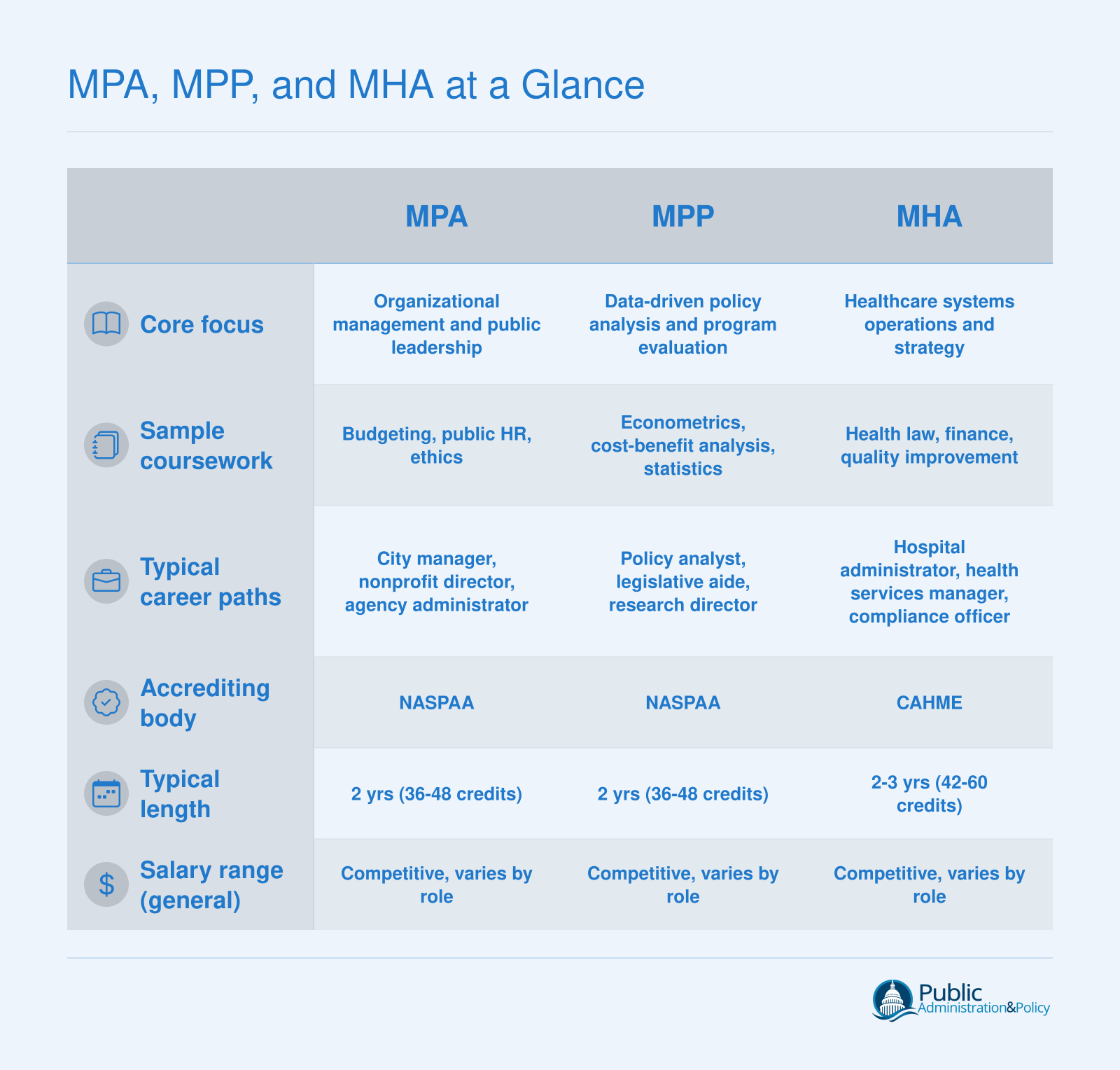
MPA, MPP, and MHA at a Glance
Each of these master's degrees prepares you for leadership in a different slice of the public sector. For the most current program details, check individual school websites; for salary benchmarks, visit BLS.gov; and for accreditation standards, consult NASPAA (MPA and MPP) or CAHME (MHA).
Online Format Options: Asynchronous, Synchronous, and Hybrid
Online public administration programs come in three main formats, each offering a different balance of flexibility and structured interaction. Knowing how each one works week to week helps you choose a path that fits your job schedule, learning style, and career networking goals.
Asynchronous Programs: Flexibility on Your Schedule
Fully asynchronous programs deliver all coursework through pre-recorded lectures, discussion boards, and self-paced assignments, with no required live class meetings. This format is the most common among many NASPAA-accredited online MPA programs. A typical working professional might watch a week's lecture on Tuesday evening, contribute to a discussion thread by Thursday, and submit a policy memo by Sunday night. Course terms often run 7 to 8 weeks, letting you stack one or two courses at a time. Programs like Marist University's online MPA illustrate the model: 100 percent online, five entry points a year, and completion possible in as little as 14 months for full-time students3. Because there are no fixed class times, asynchronous programs are especially compatible with unpredictable government work cycles or shift schedules.
Synchronous and Hybrid Programs: Real-Time Connection and On-Campus Residencies
Synchronous programs build live, scheduled class meetings into the design, typically on weekday evenings or weekends to accommodate working professionals. For example, Northern Kentucky University's online MPA offers synchronous sessions held on weekday evenings1. Hybrid programs go a step further by blending online coursework with short on-campus residencies, usually one to three visits per year. These residencies often span a weekend or a full week and are designed for capstone presentations, simulation exercises, networking with faculty and peers, and cohort-building activities. A hybrid model, like the one at California State University San Bernardino, requires some synchronous attendance and cannot be completed entirely asynchronously2. While less flexible, hybrid and synchronous programs build stronger alumni networks because of the consistent face-to-face and live interactions.
Part-Time Pacing and Scheduling Around a Government Job
Most online MPA programs accommodate part-time enrollment, which is critical for the many students holding full-time positions in local, state, or federal agencies. Full-time students can complete an asynchronous online MPA in 12 to 24 months, while part-time learners typically need two to three years. When evaluating a program, map the required synchronous sessions against your typical work schedule. A program that holds live classes Tuesdays at 6:30 p.m. Eastern may simply be a late night for a West Coast employee who gets off at 5:00 p.m. Pacific. On the other hand, a 4:00 p.m. session four days a week could conflict with core office hours. Reach out to program coordinators and ask for a sample weekly schedule before committing.
Choosing the Format That Fits
Fully asynchronous programs dominate the market and give you the most control over your weekly rhythm. Hybrid and synchronous options trade some of that flexibility for deeper connections that can pay off in career advancement and mentorship. Your decision comes down to whether you need maximum schedule independence or value live collaboration and in-person networking enough to adjust your routine.
Most NASPAA-accredited online MPA programs share the same faculty, curriculum, and diploma as their on-campus counterparts, so the credential carries identical weight to employers. In fact, the majority of online MPA students are already mid-career professionals working in government or nonprofit roles, making the format a practical extension of their careers rather than a lesser alternative.
Careers and Salary Outcomes in Public Administration
Public administration is the operational backbone of government and mission-driven organizations, and the career map is wider than most students realize when they enroll. A graduate with training in this field might run a city's budget cycle, redraw a zoning plan, coordinate a county's disaster response, lobby a state legislature, direct a homeless services nonprofit, or analyze education policy for a think tank. The common thread is stewardship of public resources and outcomes, not a single job title.
Where Graduates Actually Work
Most public administration careers cluster into a handful of functional areas:
City and county management: administrative services managers oversee operations, procurement, and facilities for local governments and agencies.
Budget and financial analysis: budget analysts build, defend, and monitor spending plans for public agencies and departments.
Urban and regional planning: planners shape land use, transportation, and community development at the municipal and regional level.
policy adjacent careers: political scientists and policy analysts evaluate legislation, model outcomes, and advise elected officials.
Nonprofit and human services leadership: social and community service managers direct programs at nonprofits, community health organizations, and public agencies.
Legislative affairs and emergency management: roles range from legislative aide to state emergency management director.
What the Numbers Look Like
Bureau of Labor Statistics data for 2024 gives a reasonable benchmark for what these roles pay and how demand is trending through 2034.
Administrative services managers (SOC 11-3012): median wage around $106,880, with projected growth near 4 to 5 percent. Bachelor's degree typical entry.
Political scientists (SOC 19-3094): median wage around $136,550, with roughly 3 percent projected growth. A master's or Ph.D. is the standard credential.2
Social and community service managers (SOC 11-9151): median wage around $69,990, with faster than average growth in the 9 to 12 percent range. Bachelor's degree typical entry.2
Budget analysts (SOC 13-2031): projected growth of 3 to 4 percent, bachelor's degree typical entry.2
Urban and regional planners (SOC 19-3051): projected growth of 4 to 6 percent, master's degree typical entry.2
Wages vary substantially by region, sector (federal roles generally pay more than local government), and years of experience. For a fuller occupation-by-occupation breakdown, see our career in public administration library and detailed pay data at /resources/salary/.
The Political Science Crossover
A large share of MPA and MPP applicants arrive with a political science bachelor's degree, and the transition into public administration is one of the most common career pivots we see. A poli-sci undergrad typically enters the workforce as a legislative aide, campaign staffer, constituent services coordinator, or program assistant at a nonprofit or agency. These are solid first jobs, but the ceiling without a graduate credential is real.
The two most effective bridges are an MPA career paths (which retools a political science background into applied management, budgeting, and program evaluation skills), or a graduate certificate in public administration, nonprofit management, or policy analysis for students who want a faster, cheaper credential. Certificates work well for early-career staff who already have a foot in the door and need a formal signal of administrative competence. An MPA makes more sense for anyone targeting a director-level or city manager track. The campaign-to-government pipeline (campaign staff moving into policy or chief of staff roles after an election) is another well-worn path, and graduate training is what makes it durable rather than cyclical.
Public Administration Salary Snapshot by Role
Salaries in public administration vary widely by role, experience level, and sector. Rather than relying on a single snapshot, the most reliable approach is to check multiple authoritative sources yourself. The Bureau of Labor Statistics (BLS.gov) publishes median annual wages for occupations such as budget analysts, urban and regional planners, administrative services managers, social and community service managers, political scientists, and management analysts. School websites detail program costs and reported graduate outcomes, while professional associations like NASPAA and ASPA publish industry benchmarks and career guides. Cross-referencing these sources gives you the most accurate, up-to-date picture for your target role and region.
Political science is the most common undergraduate feeder into MPA programs, but the leap from theory to practice can feel abrupt. If you're unsure whether administration is the right fit, a graduate certificate in public administration offers a low-commitment bridge: a handful of courses that test the waters, build practical skills, and often count toward a future master's if you decide to continue.
Accreditation: NASPAA, Regional, and What Matters for Your Career
Choosing between a program with NASPAA accreditation and one with only regional accreditation can feel like weighing specialized public service quality against broader institutional legitimacy. Both matter, but they serve different purposes in your education and career.
What NASPAA Accreditation Means
NASPAA, the Network of Schools of Public Policy, Affairs, and Administration, accredits the master of public administration and master of public policy programs. It is a mission-based peer review process that examines how well a program prepares students for public service.1 Rather than checking box-ticking inputs, NASPAA's seven standards2 assess mission alignment, faculty qualifications, diversity, student support, and competency-based outcomes. The competencies include leadership, policy analysis, communication, and analytic reasoning.3 To be eligible for NASPAA review, a program must already hold regional, national, or international institutional accreditation,3 which makes NASPAA a program-level quality marker on top of that baseline.
This differs from regional accreditation, which evaluates an entire institution for broad academic legitimacy, financial stability, and student aid eligibility. A regionally accredited university may have a perfectly sound MPA program that never sought NASPAA recognition, often because the program is newer or very specialized.
Career Implications of NASPAA Accreditation
For most public-sector hiring, NASPAA accreditation is not a formal requirement. The federal Senior Executive Service and the Presidential Management Fellows program do not explicitly mandate it,4 though a NASPAA-accredited degree can strengthen your competitiveness. Some state government HR systems and competitive fellowship programs may list NASPAA as a preference, and it can streamline credential verification when applying to positions where an MPA is expected. In practice, a NASPAA-accredited MPA signals that your training meets a widely recognized public service standard, which can offer extra portability if you change agencies, move to a federal role, or seek a position in a different state.
Regional Accreditation as Foundation
Regional accreditation is the non-negotiable baseline. It affects your ability to transfer credits, qualify for federal financial aid, and have your degree recognized by employers. A program can be regionally accredited without NASPAA, and for many professional paths, that combination serves graduates well. If you do not plan to work in a setting where the NASPAA seal adds value, the additional layer may not be worth the cost or the narrower list of program options.
Making the Choice: NASPAA or Regional?
The decision rule is straightforward: prioritize NASPAA if you intend to work in the federal government, want maximum credential portability, or anticipate applying for competitive public service fellowships. If your career goal is a niche specialization at a regionally accredited school with strong local ties, or if you need maximum flexibility in format and location, a non-NASPAA program can still deliver a rigorous, respected education. Just verify the school's regional accreditation status and reputation in your target job market.
The GRE Question
Many online MPA programs no GRE have moved away from requiring the GRE. Test-optional policies are common, and some programs automatically waive the exam for applicants with substantial professional experience or a strong undergraduate GPA. This shift reflects the field's emphasis on practical aptitude over standardized testing, making it easier for working professionals to apply without additional test prep.
Frequently Asked Questions About Public Administration Degrees
The questions below reflect what prospective students most often ask when exploring public administration programs. Because program details, costs, and requirements change regularly, we point you toward the most reliable primary sources so you can verify the latest information before applying.
What can you do with a public administration degree?
Graduates work across city, state, and federal agencies, nonprofit organizations, healthcare systems, and international development bodies. Common roles include city manager, policy analyst, budget director, program evaluator, and nonprofit executive director. For the most current list of occupations and projected demand, visit BLS.gov and search occupational categories such as 'Administrative Services Managers' or 'Social and Community Service Managers.' You can also explore the career and salary sections of publicadministrationpolicy.org for role-by-role guidance.
Is an online MPA degree worth it?
For working professionals who need scheduling flexibility, an online MPA can deliver the same curriculum, faculty, and accreditation status as an on-campus program. The key is to confirm that the program holds NASPAA (Network of Schools of Public Policy, Affairs, and Administration) accreditation, which is the recognized quality standard for graduate public service education. Check each school's accreditation page and cross-reference with the NASPAA program directory to verify current status.
What is the difference between an MPA and an MPP?
An MPA (Master of Public Administration) emphasizes management, budgeting, leadership, and organizational operations in public and nonprofit settings. An MPP (Master of Public Policy) focuses on research methods, policy analysis, and program evaluation. Some careers, such as city management, lean heavily toward the MPA, while legislative analysis or think-tank research roles often favor the MPP; comparing online MPP programs and MPA curricula side by side is the best way to judge fit.
Which online MPA programs hold NASPAA accreditation?
NASPAA maintains a searchable directory on its website where you can filter by delivery format, including online and hybrid options. Because schools gain or lose accreditation over time, always confirm directly with the program and the NASPAA directory rather than relying on third-party lists that may be outdated.
Do online MPA programs require the GRE?
Admissions requirements vary widely. Many programs have adopted GRE-optional or GRE-waiver policies, especially for applicants with professional experience or an existing graduate degree. Check the admissions page of each program you are considering, and contact the admissions office directly if the policy is unclear. Requirements can change from one application cycle to the next.
How long does it take to complete an online public administration degree?
A bachelor's program typically requires around 120 credits and takes about four years of full-time study, though transfer credits can shorten that timeline. Most master's programs range from 36 to 48 credits and can be completed in roughly two years at a full-time pace. Doctoral programs generally require three to five years beyond the master's level. Part-time schedules, which are common in online formats, extend these timelines. Each school's program page will list the expected time to completion for both full-time and part-time tracks.
How much does an online public administration degree cost?
Tuition varies significantly based on the institution type (public vs. private), residency status, and degree level. Many public universities offer reduced per-credit rates for online students regardless of state residency. To compare costs accurately, look at each school's tuition and fees page and factor in any technology fees, course material charges, or capstone-related travel costs. The U.S. Department of Education's College Scorecard (collegescorecard.ed.gov) also lets you compare net price estimates across institutions.
Where can I find reliable salary data for public administration careers?
The Bureau of Labor Statistics (BLS.gov) publishes detailed wage data organized by occupation, geography, and industry. For federal positions specifically, the Office of Personnel Management (OPM.gov) maintains General Schedule pay tables. Professional associations such as the International City/County Management Association (ICMA) periodically survey compensation for local government managers. These primary sources are more dependable than aggregator sites, which may blend outdated figures or mix job titles together.