Best Affordable Online MPA Programs Worth Your Investment
NASPAA-accredited and budget-friendly Master of Public Administration programs ranked by total cost, career ROI, and flexibility for working professionals.
By Max SheltonReviewed by PAP Editoral TeamUpdated May 22, 202610+ min read
Key Points
Several NASPAA-accredited online MPA programs cost under $16,000 in total tuition for 2026.
Non-tuition fees and hidden expenses can add $2,500 to $4,000 on top of advertised tuition rates.
Graduates of top affordable MPA programs report median earnings between roughly $60,000 and above within a decade.
Most affordable online MPA programs no longer require the GRE for admission.
The median salary for state and local government workers with a master's degree hovers near $75,000 nationally, yet many MPA graduates start in entry-level policy analyst or program coordinator roles paying $48,000 to $55,000. That gap between credential cost and early-career earnings makes tuition the single most consequential variable in any MPA decision. In 2026, the cheapest online MPA programs we identified carry in-state tuition as low as roughly $6,650 to $11,400 for the full degree, with effective net prices at some institutions falling below $5,000 after aid.
Affordability alone is not a strategy, though. NASPAA accreditation, GRE requirements, hidden fees, and post-graduation earnings all shape whether a low sticker price translates into genuine long-term value. The programs pulling double duty on cost and quality tend to be mid-size public universities rather than flagship research institutions. If you are still comparing the broader landscape, our guide to the best online mpa programs provides additional context on how these affordable options stack up.
How We Ranked the Most Affordable Online MPA Programs
Building a ranking of the cheapest online MPA programs requires more than simply listing the lowest tuition figures. Our approach prioritizes what students actually pay over what appears on a university website, and it layers in institutional outcomes so that affordability never comes at the expense of a reasonable chance of finishing the degree.
What We Weighted Most Heavily
The single most important factor in our ranking is the effective net price: the institution-level average cost of attendance after grants and scholarships have been applied. This figure comes closer to what a typical student pays out of pocket than any published tuition rate. We pair that with financial aid metrics, including the share of students receiving institutional grants, to gauge how aggressively a school works to lower the real cost for its enrollees.
Secondary factors include the institution-wide graduation rate and available program outcome data. Together, these signals help separate programs that are genuinely affordable from programs that are simply cheap.
Sticker Price vs. What You Actually Pay
You will notice two types of tuition figures throughout this article. Published graduate tuition rates (sometimes split into in-state and out-of-state tiers) represent the sticker price a university advertises. The net price after aid is usually lower, sometimes significantly so, because it accounts for scholarships, employer tuition benefits, and other forms of assistance averaged across the student body.
Keep in mind that the net price is an institutional average, not a personalized quote. Your actual cost will depend on your residency status, enrollment intensity, employer benefits, and the aid package you negotiate. Treat these numbers as a reliable starting point for comparison rather than as a guarantee.
Why We Use Institution-Wide Graduation Rates
Graduation rates cited in our ranking reflect the entire institution, not the MPA program alone. Program-specific completion data for graduate degrees is rarely published in a standardized, comparable format. Even so, the institution-wide rate matters: it signals the quality of advising infrastructure, financial support systems, and overall student services that master of public administration candidates will rely on. A university with strong completion outcomes across its portfolio is more likely to support you through to your own finish line.
What This Ranking Does Not Measure
Transparency about limitations is just as important as transparency about methodology. Our ranking does not evaluate curriculum design, faculty-to-student ratios, capstone or fieldwork requirements, or the depth of any particular concentration. Those qualitative dimensions matter enormously, but they resist the kind of standardized, apples-to-apples comparison that a cost-focused ranking demands.
We draw our data from federal sources, primarily the College Scorecard and the Integrated Postsecondary Education Data System (IPEDS), which are updated on a rolling schedule. Where program-level earnings or employment outcomes are not yet available for a specific MPA program, we say so plainly rather than fill in gaps with estimates.
This combination of rigorous cost data and honest disclosure of blind spots is what sets our ranking apart. You get a clear view of affordability without the illusion that any single list can capture every dimension of program quality.
Best Affordable Online MPA Programs Ranked by Cost
The programs below represent the most affordable online and hybrid MPA options we identified for 2026, ranked by a composite score that weighs net price alongside graduation outcomes, earnings potential, and program quality. Net prices shown reflect institution-wide averages after financial aid and may differ from your individual cost, but they provide a reliable baseline for comparing value across schools. Notably, these affordable programs span specializations from nonprofit management to emergency management and health care administration, proving that a lower price tag does not limit your career options.
NCES-IPEDS federal institutional data — nces.ed.gov
Independent program research
Internal program database
#1
CUNY City College
New York, NY · ~$4,000/yr (est.)
Best for: NYC public servants seeking hybrid flexibility
CUNY City College delivers one of the lowest net prices for an MPA in a major metropolitan area, making it an exceptional value for New York residents and unionized public employees who may qualify for additional tuition benefits. Based at the Colin Powell School's Moynihan Center, the program emphasizes strategic management, data-driven decision-making, and leadership through a hybrid format that pairs online coursework with in-person experiences in one of the world's largest public-sector labor markets. Applicants should note that relevant work experience is expected, and the curriculum culminates in a capstone project with community partners.
View program
Master in Public Administration (MPA) — Hybrid
Hybrid format blending online and in-person sessions
Work experience required for admission
Capstone project partnered with community organizations
Best for: Out-of-state learners wanting flat-rate tuition
The University of Texas Rio Grande Valley offers one of the most affordable fully online MPA options in the country, with a flat per-credit rate that applies to both in-state and out-of-state students. The accelerated 36-credit program can be completed in roughly 12 months, making it ideal for working professionals who want a fast, budget-friendly path into public service. Coursework covers public budgeting, policy analysis, and grant writing, and no application fee is charged.
View program
Master of Public Affairs, Public Administration — Online
100% online, accelerated 12-month completion
Flat per-credit rate for all students regardless of state
36 credit hours with a concentration in Public Administration
No application fee required
Covers public budgeting, policy analysis, and grant writing
Capstone requirement to demonstrate applied learning
Best for: California residents exploring multiple specializations
Cal State San Bernardino pairs standard CSU-level tuition with three distinct MPA concentrations, giving students meaningful specialization choices at a fraction of private-university costs. The hybrid program is especially well positioned for California residents working in Inland Empire government agencies or nonprofits who can attend some sessions on campus while completing the rest online. Students select a concentration at application and complete coursework mentored by faculty focused on public service leadership, financial stewardship, and nonprofit capacity building.
View program
Master of Public Administration, Leadership — Hybrid
Leadership concentration for aspiring managers and executives
Hybrid delivery with online and in-person components
Concentration selected during the application process
Faculty mentorship focused on strategic leadership
Prepares graduates for government and nonprofit roles
Emphasizes transparency, due process, and effectiveness
Texas A&M International University's fully online, NASPAA-accredited MPA is one of the cheapest online MPA programs in the nation on a total-cost basis, even though it requires 42 credit hours rather than the more common 36. No GRE is needed, and the program is designed for mid-career public servants and those entering the field, with an optional Nonprofit Leadership and Management certificate built into the elective structure. As a Texas A&M System campus, TAMIU is frequently eligible for state and local agency tuition reimbursement in Texas.
View program
Master of Public Administration — Online
Entirely online, NASPAA-accredited program
42 credit hours: 33 core plus 9 electives
No GRE required; personal interview for admission
Comprehensive exam required for completion
Courses expire after five years; continuous enrollment expected
Designed for mid-career and aspiring public servants
Cal State Fresno's hybrid MPA is frequently cited as one of the lowest-cost NASPAA-accredited options in California, serving Central Valley public servants who benefit from CSU-level tuition without relocating to a higher-cost coastal city. The 36-unit program covers core competencies in administration, quantitative methods, human resources, budgeting, and policy. The GRE is not required, and students can choose among a comprehensive exam, capstone class, or thesis to complete the degree.
View program
Master of Public Administration (MPA) — Hybrid
Minimum 36 units: 21 core plus advisor-approved electives
Hybrid format serving Central Valley professionals
GRE not required for admission
Three completion paths: exam, capstone, or thesis
Core courses in budgeting, HR, and policy analysis
Focus on ethical administration and public governance
Two letters of recommendation and writing sample needed
Stanislaus State has offered its NASPAA-accredited MPA since 1973, making it one of the longest-running public administration programs in Northern and Central California. The hybrid curriculum requires 36 to 39 semester units with nine core courses spanning public finance, ethics, and policy analysis. Pre-service students complete a 300-hour internship, while in-service professionals can draw directly on workplace experience. Total tuition for California residents typically falls in the lower range among CSU campuses thanks to modest campus fees.
View program
Master of Public Administration — Hybrid
36 to 39 semester units with nine core courses
NASPAA accredited since 1973
Hybrid delivery for Northern and Central California
300-hour internship required for pre-service students
Core courses in public finance, ethics, and budgeting
Thesis or comprehensive case analysis completion options
Florida State University brings the cachet of a top-tier research institution to its fully online MPA, which offers concentrations in Local Government Management and Emergency Management alongside a general track. While FSU's net price is higher than some Texas and California options on this list, Florida residents and state employees who can tap agency tuition waivers often find it competitively priced. The university's 85.6% institution-wide graduation rate (note: this is not MPA-specific) signals strong student support infrastructure.
View program
Master of Public Administration — Online
100% online delivery through Florida State's Graduate School
Coursework in administrative and policy analysis skills
Prepares for leadership in government and nonprofits
Strong student support reflected in high institutional outcomes
Florida residents benefit from comparatively low in-state rates
Core public administration courses with elective options
UTEP's NASPAA-accredited MPA stands out for its dual delivery: a fully online concentration in Public Policy and Management plus a hybrid cohort for senior enlisted Army personnel at the U.S. Army Sergeants Major Academy. In-state tuition runs roughly $481 per credit hour, and the out-of-state differential is relatively modest, which helps non-Texas students keep costs manageable. Military students frequently complete the degree with minimal out-of-pocket expense thanks to tuition assistance and GI Bill benefits.
View 2 programs
Master of Public Administration with a Concentration in Public Policy and Management, Public Policy and Management — Online
36 credit hours, 100% online format
In-state tuition approximately $481 per credit hour
NASPAA-accredited program
Emphasis on analytical skills and program evaluation
Internship option and community engagement components
Suitable for working professionals and career changers
Cal State East Bay's fully online MPA is frequently highlighted for strong salary outcomes relative to its CSU-level tuition, making it one of the best return-on-investment picks on this list. The program offers concentrations in Public Management and Policy Analysis as well as Health Care Administration, delivered through a mix of synchronous and asynchronous sessions. Rolling admissions with priority deadlines give applicants flexibility, and Bay Area proximity opens doors to public-sector internships and networking even in an online format.
View program
Master of Public Administration, Public Management and Policy Analysis — Online
100% online with synchronous and asynchronous sessions
Concentration in Public Management and Policy Analysis
Rolling admissions with priority deadline in January
Requires transcripts, statement of purpose, and resume
San Francisco State University markets its NASPAA-accredited MPA as the best value in the Bay Area, and for California residents working in the region's extensive government and nonprofit ecosystem, the claim holds up. The hybrid program blends theory with applied work across main and downtown campus locations, and its strong alumni network spans government agencies, nonprofits, and the private sector. While its net price is the highest on this list, it remains far below private Bay Area alternatives and frequently appears on California-specific affordable MPA rankings.
View program
Master of Public Administration — Hybrid
Hybrid format across main and downtown SF campuses
NASPAA accredited with seasoned faculty
Designed for working professionals and pre-service students
Strong alumni network in government and nonprofits
Balance of theoretical grounding and applied coursework
Flexible scheduling to accommodate work-life balance
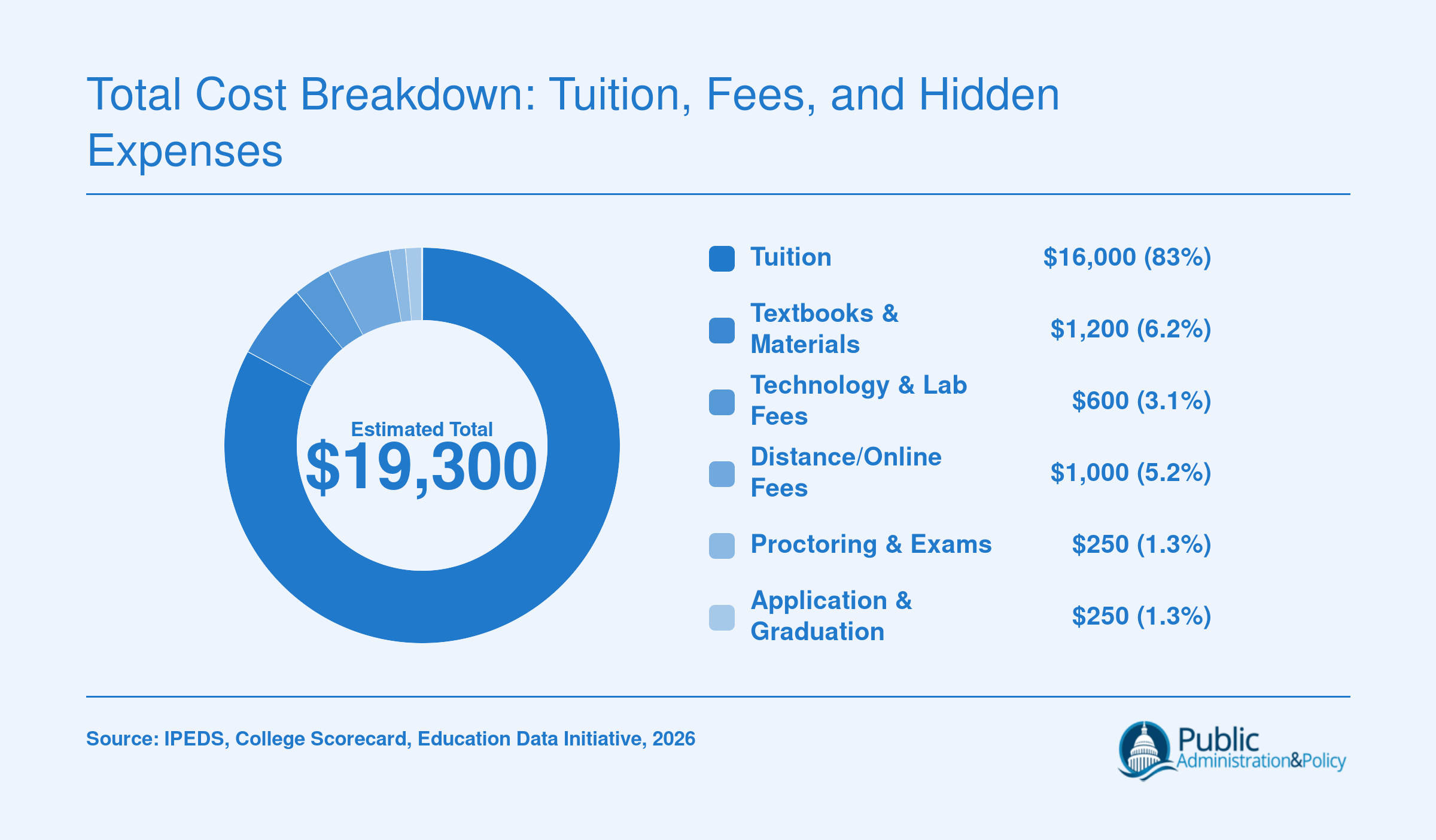
Total Cost Breakdown: Tuition, Fees, and Hidden Expenses
Tuition is the number that grabs your attention, but it rarely tells the full story. For a typical 36-credit affordable online MPA program priced around $16,000 in tuition, non-tuition costs can quietly add $2,500 to $4,000 or more to the final bill. The example below uses a mid-range estimate to show how those extras stack up, and why the effective net price after aid can look dramatically different from the sticker price.
Questions to Ask Yourself
Does the program offer a concentration that aligns with your specific career goals?
An affordable MPA with no relevant specialization in healthcare administration, urban planning, or nonprofit management may leave you underprepared for the roles you actually want. A program that costs slightly more but includes your target concentration can deliver far greater long-term value.
Is NASPAA accreditation a priority for your career path, and does this program hold it?
Many government agencies and nonprofits treat NASPAA accreditation as a quality benchmark during hiring. Choosing an unaccredited program solely because it is cheaper could limit your competitiveness for positions where accreditation is preferred or expected.
What will your actual out-of-pocket cost be after employer tuition assistance, scholarships, or federal financial aid?
A program with a higher sticker price may end up costing you less if your employer reimburses tuition or if the school offers generous merit aid. Always compare net cost, not just published tuition rates, before making a final decision.
Does the program's format and schedule realistically fit your life as a working professional?
A low-cost program with rigid synchronous class times or limited evening sections could force you to cut work hours, reducing your income. Flexibility in course delivery can protect your earnings while you complete the degree.
NASPAA-Accredited Affordable MPA Programs
Earning your MPA from a program accredited by the Network of Schools of Public Policy, Affairs, and Administration (NASPAA) signals to employers that your degree meets rigorous standards in curriculum design, faculty qualifications, and student outcomes. For anyone targeting a career in public service, that distinction can be the difference between landing on a shortlist and getting screened out. Below is a practical, step-by-step approach to finding NASPAA-accredited online MPA programs that also respect your budget.
Start With the NASPAA Program Directory
The most reliable starting point is the official NASPAA membership directory at naspaa.org. You can filter results by delivery format to isolate programs offered fully online or in a hybrid model. One important caveat: the directory does not display tuition figures. You will need to visit each school's MPA program page directly to gather cost information. Keep a simple spreadsheet as you go, noting the school name, delivery format (fully online versus hybrid), total credit hours required, and per-credit or total tuition rate.
Cross-Reference Costs With College Navigator
Once you have a shortlist, verify tuition data through the College Navigator tool hosted by the National Center for Education Statistics at nces.ed.gov. This federal database provides standardized cost-of-attendance figures reported by institutions themselves. Pay close attention to the distinction between in-state and out-of-state rates. Many public universities now offer a flat online tuition rate regardless of residency, which can dramatically lower costs for out-of-state learners.
Understand Why NASPAA Accreditation Matters for Your Career
Federal hiring portals like USAJOBS frequently list NASPAA accreditation as a preferred or required credential for mid-level and senior public administration roles. The Presidential Management Fellowship (PMF), one of the most prestigious entry points into federal service, recognizes NASPAA-accredited programs as a qualifying credential on its application portal at pmf.gov. State and local governments increasingly mirror this preference. A quick search of current openings on your state's civil service job board will often confirm that NASPAA accreditation appears in the "preferred qualifications" section.
The Bureau of Labor Statistics at bls.gov is another resource worth consulting. Occupational profiles for roles like administrative services managers, urban and regional planners, and political scientists outline typical education requirements and projected job growth, helping you confirm that an MPA aligns with your target career path.
Verify Employer Recognition Before You Enroll
Do not rely on a program's marketing alone. Spend 15 minutes on USAJOBS or your state government's job board searching for titles like "program analyst," "management analyst," or "policy advisor." Note which postings mention NASPAA accreditation. This real-world check gives you confidence that hiring managers in your target sector actually value the credential. If a cheaper, non-accredited program tempts you, weigh the savings against the possibility of being filtered out of competitive federal or state positions that explicitly prefer NASPAA graduates.
Directory search: Use naspaa.org to build your initial list of accredited online and hybrid programs.
Cost verification: Cross-check tuition on each school's site and through College Navigator at nces.ed.gov.
Career alignment: Review BLS occupational outlooks and PMF eligibility requirements at pmf.gov.
Employer validation: Scan USAJOBS and state government postings to confirm that accreditation matters in your target roles.
Taking these steps before you apply ensures that you are not just chasing the cheapest online MPA programs but investing in a credential that employers in the public sector genuinely recognize and reward.
Salary ROI: Do Cheap MPA Programs Pay Off?
One of the most common concerns about choosing a low-cost MPA is whether the degree will actually deliver a meaningful return on investment. The short answer: for most graduates, affordable MPA programs offer one of the better ROI profiles in graduate education, thanks to modest debt loads, stable public-sector demand, and a salary ceiling that rises considerably with experience.
What the Early Earnings Data Tells Us
Program-level earnings data for many affordable MPA programs is not yet available through federal reporting, which means we cannot pinpoint exact median salaries at the one-year or five-year mark for every school on our list. What we can observe, however, is how overall institutional outcomes line up. Schools like CUNY City College, California State University-Stanislaus, San Francisco State University, and the University of Georgia all show institutional-level ROI ratios well above 3.5, meaning graduates at these schools generally earn multiples of their median debt within a reasonable timeframe. Several California State University campuses and the University of Texas Rio Grande Valley push that ratio above 4.0, reflecting a combination of low tuition and solid post-graduation earnings across all programs.
These ratios matter because they account for the relationship between what students borrow and what they earn afterward. When total program tuition falls in the $9,000 to $16,000 range (as it does for many of the most affordable MPA options), even a starting salary in the mid-$40,000s produces a favorable debt-to-income picture. That is a meaningful advantage over higher-cost graduate programs where six-figure debt can take a decade or more to recoup.
Livable Wages After Graduation
Another important lens is whether graduates of affordable MPA programs earn enough to live comfortably, not just enough to make loan payments. While program-specific data on the share of completers earning well above the poverty line is not reported for every MPA we reviewed, the broader pattern across these institutions is encouraging. Public universities with low net prices tend to serve students who enter the workforce in government, nonprofit, and community-facing roles where wages, while not extravagant, consistently clear livable thresholds in most metropolitan areas. For a deeper look at compensation benchmarks across the field, our public administration salary guide breaks down earnings by role and experience level.
The stability of public-sector employment also plays a role here. MPA holders are less exposed to the cyclical layoffs that hit private-sector industries, which means income disruptions are rarer and long-term earnings trajectories are smoother.
Career Ceiling: Where MPA Salaries Can Go
Early-career earnings are only part of the story. As MPA graduates gain experience and move into leadership positions, salary potential climbs substantially. Consider a few common career tracks and their 2024 median annual wages reported by the Bureau of Labor Statistics:
Administrative Services Managers: $108,390 median annual wage, with a projected job growth rate of 4% through 2032.1
Social and Community Service Managers: Median wages typically land in the mid-$70,000s to low $80,000s, with steady demand driven by expanding social programs.
Urban and Regional Planners: Median pay generally falls in the mid-$70,000s to low $80,000s, with growth fueled by infrastructure investment and climate adaptation planning.
Policy Analysts and Political Scientists: These roles often command salaries above $120,000 at the median, though positions can be more competitive and geographically concentrated.
These figures represent mid-career and experienced professionals, not entry-level graduates. But they illustrate the ceiling. An MPA graduate who starts at $48,000 in a city budget office and advances to an administrative services director role over 10 to 15 years can realistically reach six figures, particularly in metro areas or state government.
The Verdict: Low Cost, Strong Returns, With Caveats
Affordable MPA programs generally deliver strong ROI because the math works in your favor on both sides of the equation. Debt stays low (often under $15,000 for in-state students), while public policy and administration salary levels are dependable and grow meaningfully with seniority. That combination is hard to beat.
Two variables can shift the equation, though. First, your concentration matters. Graduates who specialize in budgeting, data analytics, or public finance tend to command higher starting salaries than those in more generalist tracks. Second, geography plays a significant role. An MPA holder working in San Francisco or the D.C. metro area will earn more in raw dollars than one in a rural county seat, though cost-of-living differences can narrow the gap in real purchasing power.
The bottom line: do not assume that a low sticker price means low value. Many of the cheapest online MPA programs on our list sit at public universities with decades-long track records of placing graduates into government and nonprofit careers where earnings grow steadily and employment is remarkably secure.
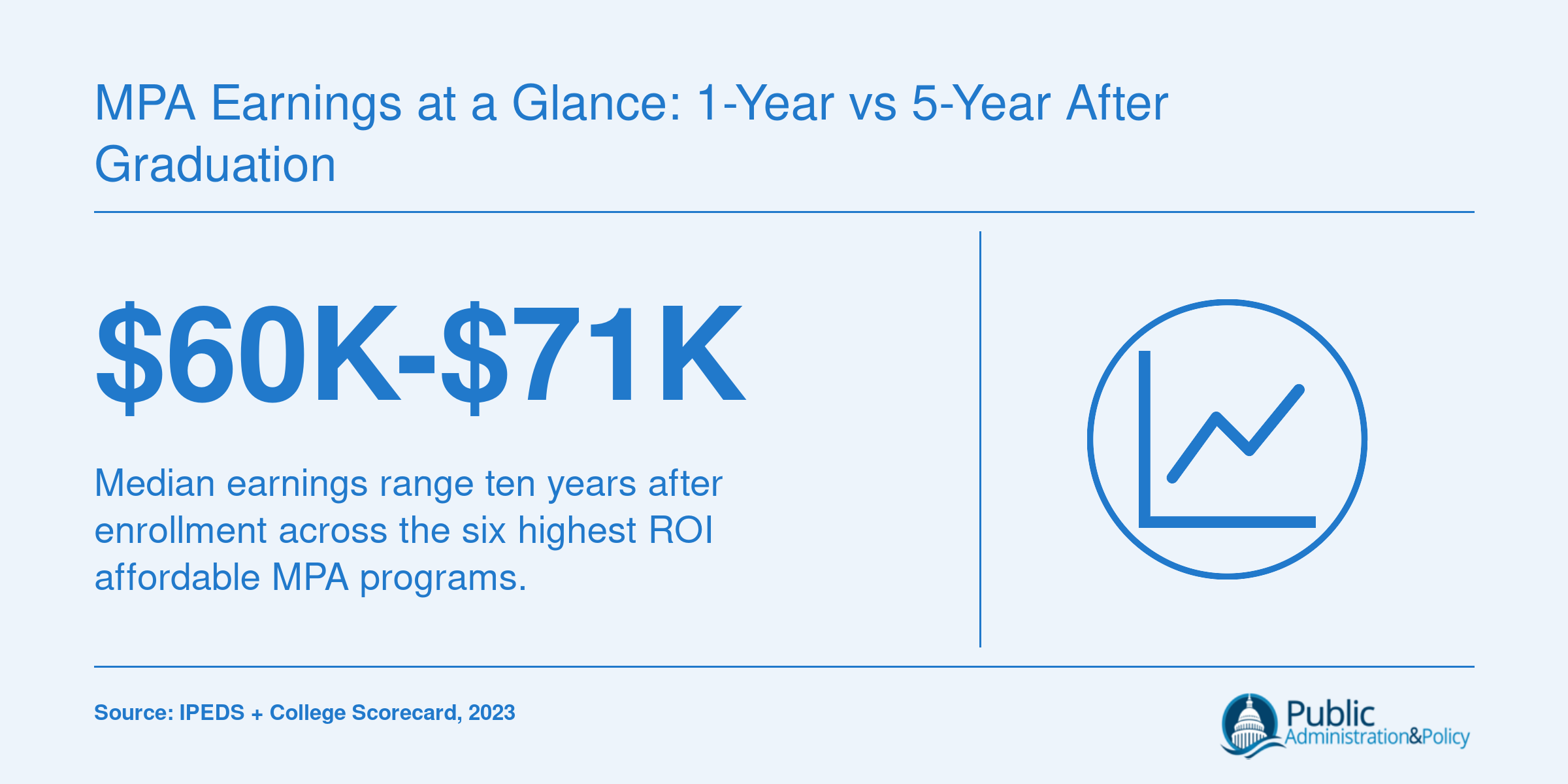
MPA Earnings at a Glance: 1-Year vs 5-Year After Graduation
Program-level earnings data for one-year and five-year post-completion benchmarks are not yet published for these affordable MPA programs. However, institution-wide median earnings ten years after enrollment offer a useful proxy. Graduates of these top ROI schools earn between roughly $60,000 and $71,400, a strong return given total program costs that often fall below $12,000.
Affordable MPA Programs That Don't Require the GRE
The GRE has been losing its grip on graduate admissions in public administration for years. What began as a temporary accommodation during the pandemic has become a permanent policy shift at dozens of programs, and the trend continues to accelerate in 2026. For budget-conscious applicants, skipping the GRE removes a real financial barrier while opening the door to quality programs faster.
Why Going GRE-Free Saves More Than You Think
The test fee itself runs about $220, but that is only one piece of the equation. Factor in the full cost of applying with a standardized exam and the savings become more meaningful:
GRE prep courses: Range from $150 for a basic self-study guide to $1,500 or more for structured tutoring programs.
Test fee: Approximately $220, plus additional charges if you need to reschedule or retake the exam.
Score-sending fees: Each school beyond the four included with your test costs extra.
Time cost: Weeks or months of preparation that working professionals can rarely spare.
Eliminating the GRE can easily save applicants $400 to $2,000 before they even pay a single tuition bill.
Programs That Have Dropped the GRE Entirely
Several affordable online MPA programs require no standardized test at all, with straightforward GPA thresholds as the primary academic benchmark.
Liberty University charges just $290 per credit and requires a minimum 2.5 GPA for admission, with no GRE or GMAT of any kind.
Arkansas State University offers its online MPA at $317 per credit and asks for a 3.2 GPA instead of test scores.
Texas A&M International University delivers a fully online, NASPAA-accredited MPA with no GRE requirement, asking applicants to maintain a 3.0 GPA and complete a personal interview.
Capella University sets the lowest GPA floor at 2.3, making it one of the most accessible options at $553 per credit.
Lamar University requires a GPA between 2.5 and 3.0 depending on the applicant's background, with no standardized test needed.
Auburn University at Montgomery runs a compact 30-credit online MPA with no exam requirement.2
Programs Offering GRE Waivers With Conditions
Other schools have not eliminated the GRE outright but offer waivers for applicants who meet specific criteria. These programs still deserve a spot on your shortlist:
Florida International University waives the GRE for applicants with a 3.0 to 3.25 GPA and at least three years of professional experience. Total program cost falls between $9,000 and $12,000, making it one of the most affordable NASPAA-accredited options available.
University of North Dakota grants waivers to applicants holding a 3.0 or higher undergraduate GPA.
Clemson University considers waiver requests from applicants with a GPA in the 3.0 to 3.2 range.
American University offers waivers for its online Master of Public Administration and Policy program if you bring at least five years of relevant work experience.
Quality Is Not Tied to a Test Score
One concern that surfaces frequently is whether GRE-free programs sacrifice academic rigor. The data does not support that worry. Multiple NASPAA-accredited programs, including Texas A&M International University and Florida International University, have dropped or waived the requirement while maintaining the same accreditation standards that govern the field's most respected degrees. NASPAA accreditation evaluates curriculum design, faculty credentials, student outcomes, and public service mission, not whether applicants sat for a standardized exam.
If you already hold a solid undergraduate GPA or bring years of professional experience to your application, a GRE-free program lets you redirect both your money and your energy toward the coursework that actually advances your career in public service.
Many of the most affordable online MPA programs in 2026 are housed at established public universities that hold NASPAA accreditation and maintain strong institutional graduation rates. Low net price paired with solid career outcomes is not a compromise: it is a smart, strategic investment for anyone building a career in public service.
How to Reduce Your MPA Degree Costs Even Further
Even after choosing an affordable program, there are concrete steps you can take to drive your out-of-pocket costs down further. The strategies below can shave thousands, sometimes tens of thousands, off your total MPA investment.
Start With the FAFSA and Federal Student Aid
Graduate students are eligible for federal financial aid, and completing the Free Application for Federal Student Aid (FAFSA) is the gateway. Once processed, you can access Direct Unsubsidized Stafford Loans (up to $20,500 per year in 2026) and, if additional funding is needed, Grad PLUS Loans covering the remaining cost of attendance. While most federal grants target undergraduates, filing the FAFSA also positions you for university-administered need-based aid, institutional grants, and state-level graduate fellowships that many students overlook. File early each cycle to maximize your eligibility window.
Employer Tuition Assistance
If you are already working in the public sector, your employer may cover a significant portion of your tuition. Federal employees can receive up to $10,000 per year through the Federal Student Loan Repayment Program, and many agencies pair this with separate tuition assistance benefits. State and local governments often provide their own reimbursement programs. The City of Phoenix, for example, reimburses eligible employees for graduate coursework, and New York State offers tuition benefits for certain CSEA-represented employees. Private-sector employers with public-affairs divisions sometimes extend similar benefits. Always check with your human resources office before enrolling, because some programs require pre-approval or a service commitment after graduation.
MPA-Specific Scholarships and Fellowships
Pi Alpha Alpha: NASPAA's national honor society awards competitive scholarships to MPA students who demonstrate academic excellence and commitment to public service.
ASPA Scholarships: The American Society for Public Administration offers several awards targeting students from underrepresented backgrounds and those pursuing careers in specific policy areas.
Graduate Assistantships: Many universities fund online MPA students through research or teaching assistantships that include tuition waivers and stipends. These positions are sometimes available even for distance learners, particularly at programs with hybrid components.
Public Service Loan Forgiveness
Public Service Loan Forgiveness (PSLF) functions as a powerful post-graduation cost reducer for MPA graduates who work in government or qualifying nonprofits. After making 120 qualifying monthly payments (roughly 10 years) under an income-driven repayment plan while employed full-time in eligible public service, your remaining federal loan balance is forgiven entirely. For graduates carrying $30,000 or more in federal loans, PSLF can eliminate a substantial portion of debt. Enroll in the program early and certify your employer annually to avoid processing delays.
Choose In-State Tuition, Even Online
Public universities often extend in-state tuition rates to all online students regardless of where they live, but this is not universal. Some programs require you to establish residency or apply for a specific waiver. Before you commit, contact the admissions office directly and ask whether an online-only residency waiver is available. Programs participating in the State Authorization Reciprocity Agreement (SARA) sometimes simplify this process. Choosing a program that offers flat-rate or in-state pricing for distance learners can save $5,000 to $15,000 or more over the life of the degree compared to out-of-state rates.
Layering several of these strategies together, filing the FAFSA, securing employer reimbursement, applying for targeted scholarships, and planning for PSLF, can transform an already affordable MPA into one of the highest-ROI graduate degrees available in public service.
Frequently Asked Questions About Affordable MPA Programs
Choosing an affordable MPA program raises plenty of practical questions, from total costs and accreditation to admissions requirements and time commitments. Below we answer the questions prospective students ask most often, drawing on the program data and rankings featured throughout this guide.
What is the most affordable online MPA program?
Among the programs we reviewed for 2026, Texas A&M International University in Laredo, TX, stands out with in-state graduate tuition around $6,650 per year and a 42-credit, fully online MPA. The University of Texas Rio Grande Valley is another strong contender, advertising a total program cost of roughly $16,000 for its accelerated 36-credit online Master of Public Affairs. Both are public institutions that extend competitive rates to out-of-state online learners.
Are cheap MPA programs worth it?
Yes, provided you evaluate quality alongside price. Several of the most affordable programs on our list hold NASPAA accreditation, the gold standard for public administration education. Institutional median earnings ten years after enrollment at these schools range from roughly $48,000 to $66,000, demonstrating solid long-term value. A lower sticker price combined with accreditation and strong career outcomes can actually deliver a better return on investment than a costlier alternative.
Which online MPA programs are NASPAA-accredited?
From our ranked list, Texas A&M International University and California State University, Stanislaus both hold NASPAA accreditation and offer online or hybrid MPA formats. NASPAA accreditation signals that a program meets rigorous standards for curriculum, faculty qualifications, and public service mission. We recommend checking the NASPAA directory directly, as accreditation status can change, and additional programs earn approval each cycle.
Do you need a GRE for an online MPA program?
Many affordable online MPA programs have dropped the GRE requirement entirely. Texas A&M International University, for example, does not require GRE scores and instead uses a personal interview as part of its admissions process. The University of Texas Rio Grande Valley's accelerated online program also focuses on GPA and references rather than standardized test scores. Always verify current requirements on each school's admissions page, as policies can shift year to year.
How much does an MPA degree cost in total, including fees?
Total cost depends on credit requirements, residency status, and ancillary fees. For the most affordable programs in our 2026 rankings, in-state tuition alone ranges from roughly $6,650 to $9,800 per year. A typical 36 to 42-credit program may total between $16,000 and $25,000 before fees. Add technology fees, graduation fees (often $50 to $150), and textbook costs, and you should budget an additional 5 to 15 percent above posted tuition.
How long does it take to complete an online MPA program?
Most online MPA programs require 36 to 42 credit hours and can be finished in two years of part-time study. Accelerated options exist: the University of Texas Rio Grande Valley advertises a 12-month completion timeline with seven-week course sessions. If you take only one course per semester, as some programs allow, expect three to four years. Check each school's course expiration policy; Texas A&M International, for instance, requires all coursework to be completed within five years.
Can I work full-time while completing an online MPA?
Absolutely. Most affordable online MPA programs are designed with working professionals in mind, offering asynchronous coursework, evening sessions, or accelerated terms. Programs like the one at Texas A&M International explicitly target mid-career professionals and allow enrollment at a pace of one class per semester. Hybrid programs such as those at Cal State San Bernardino and Cal State Stanislaus also build flexibility into their schedules, though occasional campus visits may be required.
More Affordable Online MPA Programs to Consider
Beyond our top 10 ranked list, many other schools offer affordable online MPA programs that may align better with your location, specialization, or schedule preferences. Below is a directory of additional programs organized alphabetically by state to help you compare options. Note: the ranking section above covers the highest-ranked programs by cost; this listing provides a broader view without a numeric rank.
University of Georgia
The University of Georgia's MPA program prepares students for public service careers in government and nonprofit organizations. It offers a rigorous curriculum with small class sizes and hands-on learning opportunities.
The University of New Mexico's MPA program prepares leaders for public, nonprofit, and tribal sectors. It offers evening and Saturday classes with face-to-face or Zoom options, accommodating working professionals.
Arkansas State University's online MPA program offers a Public Management concentration. The 36-credit program costs $12,600 total and can be completed in as few as 18 months.
UT Tyler's online MPA program is designed for working professionals, offering specializations in criminal justice, local government, and nonprofit administration. The 36-credit program can be completed in about two years.
Clayton State University's online MPA program prepares students for careers in public service, government, and non-profit sectors. The 36-credit graduate degree can be completed in as few as 12 months.
Sul Ross State University's MPA program focuses on public sector leadership and policy analysis, preparing students for careers in government, nonprofit organizations, and public service.
UM-Dearborn's Master of Public Administration and Policy (MPAP) integrates public policy into its curriculum, focusing on leadership, policy analysis, financial management, and program evaluation. It offers concentrations in Public Policy, Human Resources, or Evaluation and Assessment.
Southern Arkansas University's online MPA program includes 36 credit hours covering public administration principles, budgeting, policy analysis, and research methods. It takes approximately 2 years to complete.
Empire State University's online MPA program prepares professionals for leadership roles in public and nonprofit sectors. The 30-credit degree can be completed in 16-28 months, accommodating full-time and part-time schedules.
Arizona State University's MPA program develops skills in management, policy analysis, budgeting, and ethical governance. It offers concentrations in emergency management, nonprofit administration, public finance, and urban management.
Western Carolina University's Master of Public Affairs (MPA) program prepares students for leadership roles in government and nonprofit sectors. It offers hybrid coursework and evening classes with no GRE required.
UNO's hybrid MPA program blends in-person and online learning with classes held once weekly. It offers specializations in Nonprofit Leadership or Hazard Policy, and emphasizes real-world skills through a capstone project.
Indiana University South Bend's MPA program offers a Government Administration and Policy concentration. Evening and online classes accommodate working professionals, and the program requires 39 credits with a capstone project.
The University of Wyoming's MPA program prepares students for leadership roles in public service and non-profit sectors, covering policy design, organizational management, budgeting, and personnel administration.
UT Arlington's MPA program prepares leaders for public service roles in government and nonprofit sectors. It offers flexible delivery options including online, on-campus, and city cohort formats.