Best Online MPA Programs in Arkansas (2026 Rankings)
Compare costs, accreditation, and career outcomes for every Arkansas online MPA option.
By Carrie HirschReviewed by PAP Editoral TeamUpdated August 14, 202623 min read
What you’ll learn in this article…
Arkansas State University offers the only NASPAA accredited online MPA program in the state as of 2026.
Full time students can finish an online MPA in Arkansas in roughly two years, while part time takes about three.
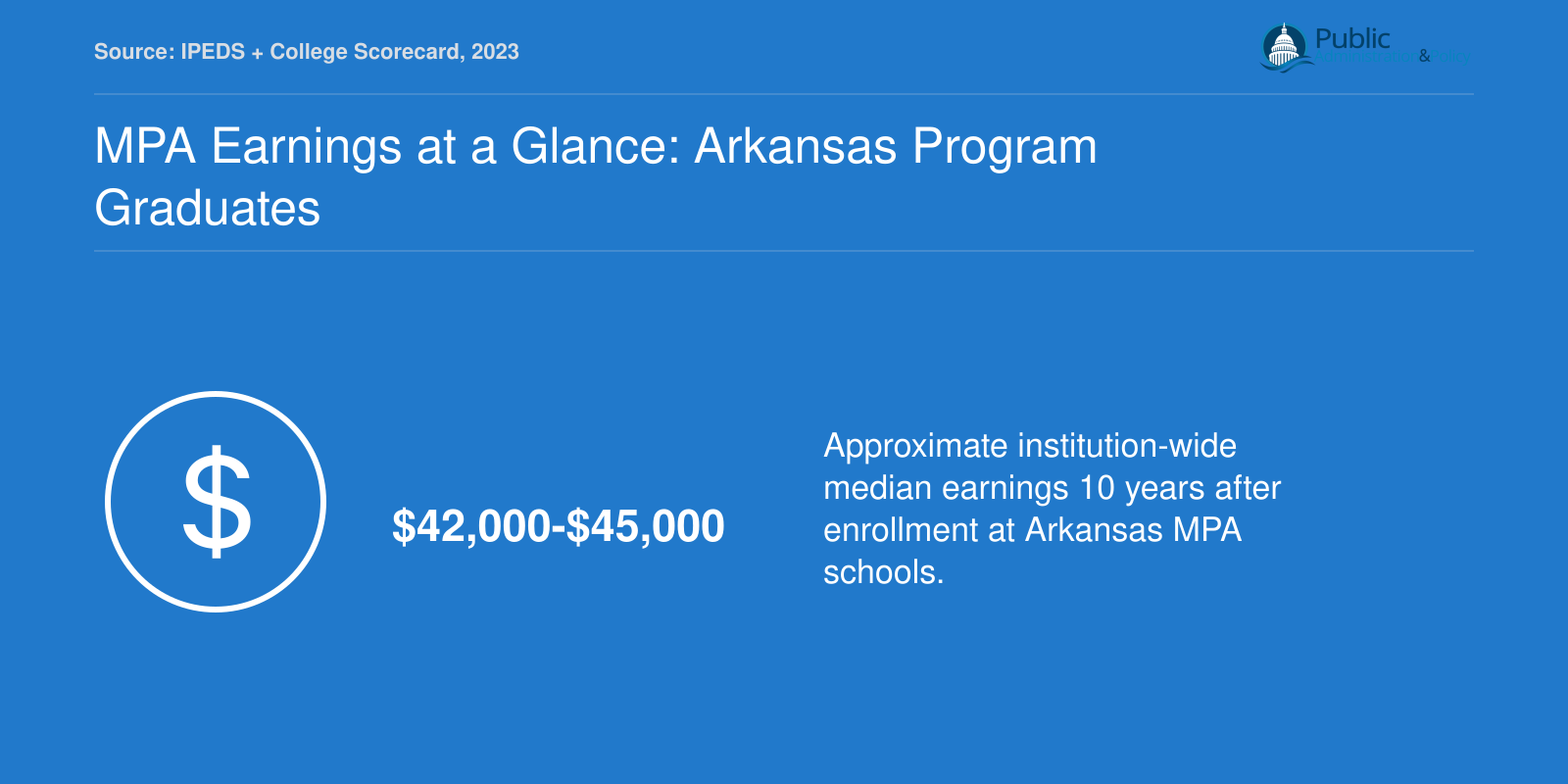
Institution wide median earnings ten years after enrollment range from approximately $42,000 for Arkansas MPA graduates.
Graduate assistantships, federal aid, and employer tuition benefits can substantially reduce out of pocket MPA costs in Arkansas.
Arkansas has just three institutions offering online or hybrid MPA programs, yet two of them carry NASPAA accreditation, the field's most recognized quality marker. For working professionals in state agencies, county health departments, or regional nonprofits, that concentration means fewer choices but surprisingly strong options, with total tuition ranging from roughly $12,600 at Arkansas State University to around $15,500 at the University of Arkansas at Little Rock.
The real tension is fit, not selection volume. Program delivery differs (fully online versus hybrid), completion timelines span 18 months to three years depending on enrollment pace, and concentration tracks vary from public management jobs to social entrepreneurship. Accreditation status also matters more than many applicants realize: federal hiring panels and some state HR offices treat NASPAA credentials as a screening filter, making the distinction between accredited and non-accredited best online MPA programs a practical career consideration.
Best Online MPA Programs in Arkansas: 2026 Rankings
The following 2026 rankings spotlight online-eligible Master of Public Administration programs at Arkansas institutions, ordered by a composite quality score that weights online accessibility alongside institutional outcomes and program-level features. This is not a cost ranking or a speed ranking. Instead, the composite considers factors such as accreditation status, graduation and retention indicators, tuition value, and the depth of each program's online curriculum. Arkansas currently has three universities offering fully online or hybrid MPA programs, each serving a distinct niche within the state's public service landscape.
Factors considered
Online delivery availability
Accreditation and institutional quality
Tuition affordability and value
Graduation and retention rates
Program depth and concentrations
Sources
Internal program database
NCES-IPEDS federal institutional data — nces.ed.gov
Best for: Mid-career Arkansas public sector professionals
Arkansas State University's NASPAA-accredited online MPA is widely recognized as one of the most affordable accredited options in the nation, with a flat per-credit tuition rate that eliminates in-state versus out-of-state pricing distinctions. The program offers two distinct concentrations, Public Management and Nonprofit Management, both completable in as few as 18 months. Strong ties with Northeast Arkansas local governments and regional nonprofits give students applied capstone and internship opportunities rooted in real Arkansas public sector challenges, making A-State a particularly strong fit for mid-career public employees statewide.
View 2 programs
Master of Public Administration, Public Management — Online
NASPAA-accredited 36-credit online program
Public Management concentration available
Flat tuition of $350 per credit hour, no residency differential
Completable in as few as 18 months
Capstone project with Arkansas agency or nonprofit placements
No entrance exam required; 3.0 GPA and statement of purpose needed
Core courses cover budgeting, ethics, and policy analysis
Optional internship with local government or nonprofit organizations
Best for: Rural community leaders and social entrepreneurs
Southern Arkansas University delivers a fully online MPA designed to serve working professionals in rural and small-town public service settings across the state. The 36-credit curriculum combines 21 hours of core coursework with 12 hours of electives and a required professional project, typically completed in about two years. SAU also offers a distinctive Social Entrepreneurship emphasis that is uncommon among Arkansas MPA programs, making it especially appealing for students interested in community-based innovation, nonprofit startups, or rural economic development.
View 2 programs
Master of Public Administration — Online
Fully online 36-credit MPA for government and nonprofit careers
In-state graduate tuition of $6,894 per year
Out-of-state graduate tuition of $9,810 per year
Approximately two years to complete at two courses per semester
Professional project tailored to Arkansas community issues
Electives include grant writing, civic engagement, and rural politics
Best for: Aspiring state government policy professionals
The University of Arkansas at Little Rock provides a NASPAA-accredited MPA in a hybrid format that blends online coursework with in-person opportunities near the state capital. This proximity to Arkansas's legislative and executive agencies, along with Little Rock's concentration of statewide nonprofits, gives students direct access to internship and capstone partnerships that are difficult to replicate elsewhere. The 36-credit program accommodates both full-time and part-time schedules, with evening and weekend classes tailored to working professionals commuting from across central Arkansas. The institution-wide graduation rate is 41.7%, and the institution-wide median earnings ten years after enrollment reach $45,265, the highest among the three Arkansas MPA providers.
View program
Master of Public Administration — Hybrid
NASPAA-accredited 36-credit hybrid MPA program
Online, in-person, and hybrid course options available
Located near Arkansas state agencies and capitol offices
In-state tuition of $7,915 per year; out-of-state $15,547
Capstone seminar with service-learning project required
Graduate assistantships available through campus public affairs units
Evening and weekend scheduling for working professionals
Accepts bachelor's degrees from any discipline; 3.0 GPA expected
Tuition is one of the most important factors when choosing an online MPA program in Arkansas. The table below compares published tuition rates, estimated per-credit costs, institution-wide average net price after aid, and median graduate debt for each program. Note that the net price figures reflect an institution-wide average for all undergraduate students receiving aid and are not guaranteed per-student amounts for graduate programs. Program-level median debt data is not yet available for these MPA programs. Tuition data is current as of the 2024-25 academic year via College Scorecard and verified program sources; always confirm rates directly with each school before enrolling.
School
Delivery
Total Credits
Per-Credit Rate
Est. Total Program Tuition
In-State Tuition (Institutional)
Out-of-State Tuition (Institutional)
Avg. Net Price (Institution-Wide)
Median Graduate Debt
Arkansas State University
Online
36
$350
$12,600
$7,322
$13,028
$12,366
$20,500
Southern Arkansas University
Online
36
~$192 in-state / ~$273 out-of-state
~$6,894/yr in-state / ~$9,810/yr out-of-state
$7,380
$10,656
$14,027
$18,750
University of Arkansas at Little Rock
Hybrid
36
Contact school for current rate
Contact school for current rate
$7,915
$15,547
$17,248
$22,000
NASPAA Accreditation: Which Arkansas MPA Programs Have It?
NASPAA (Network of Schools of Public Affairs and Administration) accreditation is the gold standard for MPA programs in the United States. It signals that a program meets rigorous quality benchmarks in curriculum design, faculty qualifications, and student outcomes. Federal agencies and many state governments give hiring preference to candidates who hold degrees from NASPAA-accredited programs, and the credential also strengthens transcript transferability if you pursue doctoral work or move between states. In Arkansas, two of the three institutions offering online or hybrid MPA programs carry NASPAA accreditation as of the 2025 to 2026 academic year, according to the NASPAA Roster of Accredited Programs. Southern Arkansas University's MPA is not NASPAA-accredited, but it remains regionally accredited and can be an excellent fit for students focused on local government, nonprofit management, or social entrepreneurship, especially given its competitive tuition.
Feature
Arkansas State University
University of Arkansas at Little Rock
Southern Arkansas University
NASPAA Accreditation
Yes (accredited through 2025 to 2026 cycle)
Yes (accredited through 2025 to 2026 cycle)
No
Regional Accreditation
Yes (HLC)
Yes (HLC)
Yes (HLC)
Delivery Format
Fully online
Hybrid (online and in-person)
Fully online
Total Credit Hours
36
36
36
Federal Hiring Preference Eligibility
Yes, NASPAA credential recognized by OPM
Yes, NASPAA credential recognized by OPM
Not applicable (regionally accredited only)
Concentrations Available
Public Management, Nonprofit Management
Nonprofit Management focus area
General MPA, Social Entrepreneurship emphasis
Student to Faculty Ratio
17:1
13:1
16:1
In-State Tuition (institutional level)
$7,322
$7,915
$7,380
Best Fit For
Aspiring federal or state managers seeking nationally recognized credentials online
Professionals near Little Rock who want proximity to state government and NASPAA recognition
Students prioritizing affordability, local government roles, or nonprofit leadership
Admission Requirements for Arkansas Online MPA Programs
Getting into an online MPA program in Arkansas is generally straightforward, but each institution has its own nuances. Below is a consolidated checklist of what you can expect, along with program-specific details that could affect your application strategy.
Standard Admission Checklist
Most online MPA programs in Arkansas share a common set of requirements. Before you begin your application, make sure you have the following ready:
Bachelor's degree: A completed undergraduate degree from a regionally accredited institution is universally required. Your major does not need to be in political science or public administration.1
Minimum GPA: Expect thresholds in the 2.7 to 3.0 range. Arkansas State University, for example, requires a cumulative GPA of 3.0 or a 3.2 GPA across your last 60 credit hours of undergraduate coursework.1
Statement of purpose: A written essay explaining your goals and interest in public administration. At Arkansas State University, this should be approximately 500 words.1
Resume or CV: Programs want to see your professional and academic background, even if formal work experience is not a hard requirement.
Application fee: Most programs charge a processing fee submitted with the online application.1
GRE and GMAT Policies
One of the more encouraging trends for prospective MPA students in Arkansas is the relaxation of standardized testing requirements. Arkansas State University's online MPA does not require a GRE or GMAT for admission as of 2024, which removes a significant barrier for working professionals.2 If you are evaluating other programs in the state, confirm testing policies directly with admissions offices, as requirements can shift from one cycle to the next.
Work Experience and Conditional Admission
Professional experience in government, nonprofit organizations, or related public administration careers can strengthen your application, but it is typically not a strict prerequisite. Arkansas State University does not require work experience for admission to its online MPA.1
For applicants whose GPA falls slightly below the standard cutoff, conditional or provisional admission may be available. At Arkansas State, applicants with a cumulative GPA between 3.0 and 3.199 can be admitted on the condition that they earn a grade of B or better in their first nine graduate credit hours.1 This path gives motivated students a chance to demonstrate readiness for graduate-level work without being turned away at the door. Note, however, that a prior grade of F or D in any graduate program, or an F in an Arkansas State MPA course, is considered a disqualifier.1
Program-Specific Differences Worth Noting
Some programs layer additional requirements on top of the standard checklist. Arkansas State University requires a prerequisite course in American National Government, which can be completed before or during your first semester of enrollment.1 If you are pursuing the Nonprofit Management track specifically, you will also need a prerequisite in Research Methods.3
Letters of recommendation are not required at Arkansas State, which is somewhat uncommon among graduate programs.1 Other institutions may still ask for two or three references, so check individual program pages carefully.
Before submitting any application, reach out directly to the program's admissions coordinator. Requirements published on program websites reflect a snapshot in time, and advisors can clarify whether additional materials, such as writing samples or interviews, apply to your specific situation.
Questions to Ask Yourself
Do you need NASPAA accreditation for your target career path?
Federal agencies and some state hiring systems favor or require degrees from NASPAA-accredited programs. If your goal is local nonprofit leadership, accreditation may matter less, which widens your program options and could lower costs.
Can your employer reimburse tuition, and how does that affect your program choice?
If your agency or organization covers part of the cost, a higher-tuition NASPAA-accredited program may become the smarter investment. Confirm reimbursement caps and any service commitment before you compare sticker prices.
Will you study full time or part time, and does your preferred program support that pace?
Arkansas online MPA programs vary in scheduling flexibility. Some lock you into cohort-based timelines while others let you adjust your course load each semester, which directly impacts how quickly you finish.
How Long Does an Online MPA Take in Arkansas?
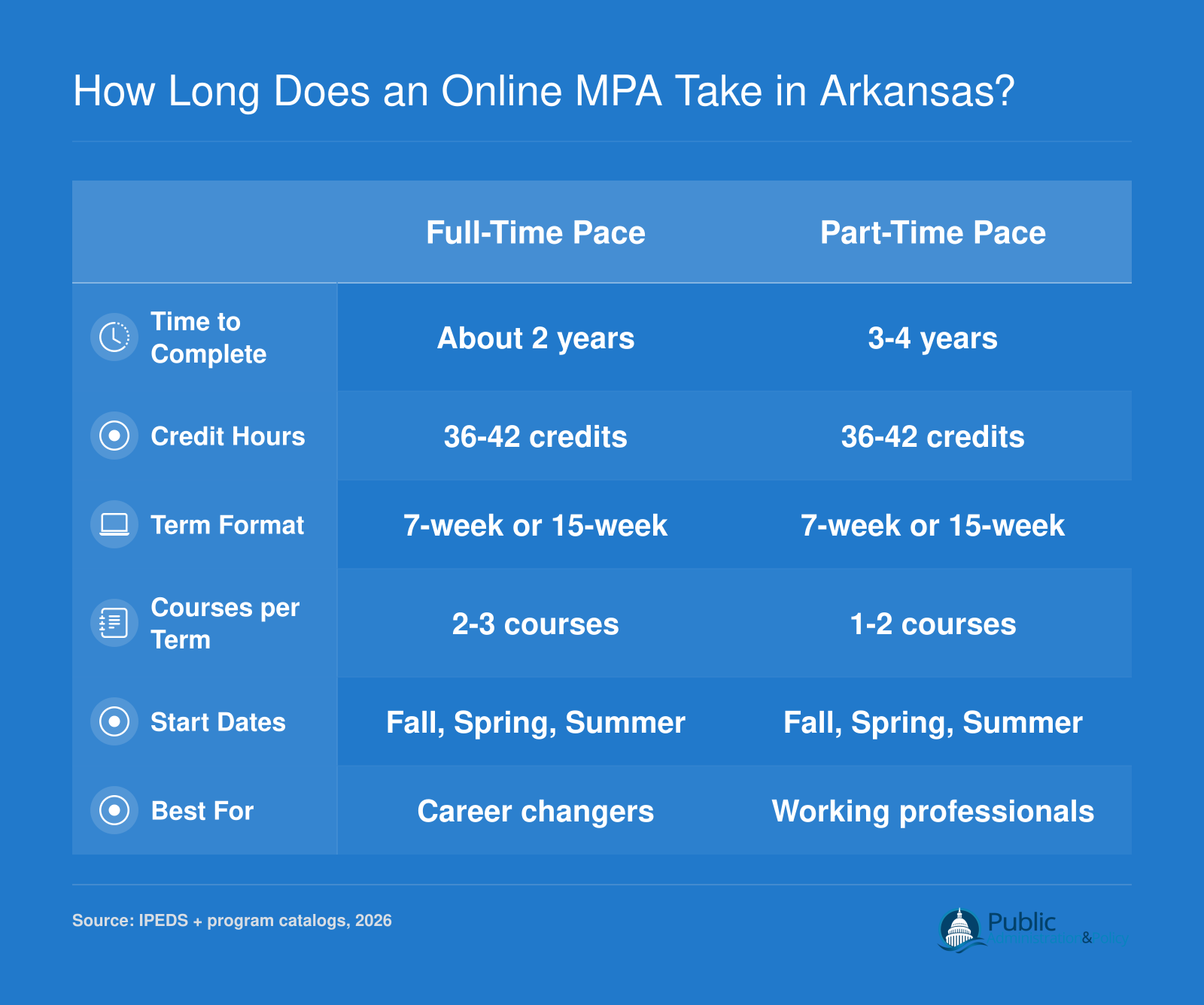
The time it takes to complete an online MPA in Arkansas depends on your enrollment pace and the term format your program uses. Full-time students can typically finish in about two years, while part-time students should plan for three to four years. Accelerated term structures can shorten that timeline significantly.
Career Outcomes and Salaries for Arkansas MPA Graduates
An online MPA opens doors to a range of public sector and nonprofit leadership positions in Arkansas, and the salary data makes a compelling case for the investment. Below, we break down what graduates can expect to earn, which roles are in demand, and whether the degree pencils out financially for working professionals.
Program-Level Earnings: What the Data Shows
Program-specific earnings data for each of the three ranked Arkansas MPA programs (Arkansas State University, University of Arkansas at Little Rock, and Southern Arkansas University) are not yet available at the granular level needed to trace one-year, two-year, and five-year salary trajectories. Federal reporting for these smaller graduate cohorts has not caught up with the programs' recent growth. That said, institution-wide return-on-investment ratios offer a useful proxy. All three schools show ROI ratios above 2.0, meaning graduates generally earn more than double what they invested in their education over the measurement period. Southern Arkansas University posts the strongest ratio at roughly 2.26, followed closely by Arkansas State University at about 2.08 and UA Little Rock at approximately 2.06.
Detailed job placement rates and poverty-threshold outcomes are similarly not yet published for these specific MPA programs. As federal data collection expands, publicadministrationpolicy.org will update program profiles with those figures.
Arkansas Salary Benchmarks by Occupation
Bureau of Labor Statistics state-level wage estimates (2024) and Little Rock metro-level data (2025) fill in the picture for the occupations MPA graduates most commonly enter.12 For a broader look at public administration salary trends across disciplines, our salary guide offers additional context.
General and Operations Managers (SOC 11-1021): This broad management category captures many MPA holders who oversee government departments or large nonprofit divisions. The Arkansas median annual wage sits well above the state's overall median, and Little Rock metro wages tend to run higher still given the concentration of state agencies.
Budget Analysts (SOC 13-2031): A core MPA career track, budget analysts in Arkansas earn a solid mid-career salary and are employed across state government, school districts, and healthcare systems.
Urban and Regional Planners (SOC 19-3051): Demand is growing as Arkansas communities invest in infrastructure and economic development. Planners in the Little Rock metro area generally see stronger compensation than those in rural regions.
Social and Community Service Managers (SOC 11-9151): Graduates who gravitate toward nonprofit leadership or social services management find steady demand in Arkansas, with wages that climb meaningfully after the first few years of experience.
Across these four occupations, entry-level salaries in Arkansas typically range from the low-to-mid $40,000s, while experienced professionals in the Little Rock metro area can earn considerably more. Exact figures shift with each annual BLS release, so prospective students should check the latest State Occupational Employment and Wage Estimates and the Metropolitan Area Occupational Employment and Wage Estimates for current numbers.
Is an Online MPA Worth It for Working Professionals?
The short answer: yes, particularly in Arkansas where program costs are among the lowest in the nation. Arkansas State University's online MPA can be completed for roughly $12,240 to $12,600 in total tuition, and Southern Arkansas University's in-state total comes in near $13,788 over two years. Compare those figures to the salary bumps that accompany a move into management or analyst roles, and the math works quickly in a graduate's favor.
Consider a working professional currently earning in the mid-$30,000s who completes the Arkansas State MPA for about $12,600. Even a modest promotion to a budget analyst or community service manager role, bringing annual earnings into the mid-$40,000s or higher, generates an additional $8,000 to $12,000 per year. At that pace, the degree pays for itself within roughly one to two years, before factoring in further career advancement. Students comparing programs nationally can explore our guide to best online MPA programs for additional benchmarks.
Monthly loan payments on typical graduate debt for these programs would be modest, often well under $200 per month on a standard ten-year repayment plan. When weighed against the earning potential of management-track public administration jobs, the debt burden is manageable for most graduates.
Key Takeaways for Prospective Students
All three Arkansas MPA programs deliver institution-wide ROI ratios above 2.0, signaling strong long-term value.
MPA-aligned occupations in Arkansas offer median wages that exceed the state average, especially in the Little Rock metro.12
Low total tuition costs mean graduates can recoup their investment quickly, often within one to two years of completing the degree.
Program-specific employment and earnings outcomes are not yet published at the detailed level; check back on publicadministrationpolicy.org as new data becomes available.
MPA Earnings at a Glance: Arkansas Program Graduates
Program-level median earnings after completion are not yet published for the MPA programs at Arkansas State University, the University of Arkansas at Little Rock, or Southern Arkansas University. While institution-wide median earnings ten years after enrollment range from roughly $42,000 to $45,000 across these schools, granular salary data specific to MPA graduates at one year and five years post-completion is not currently available through the College Scorecard.
Scholarships and Financial Aid for Arkansas MPA Students
Funding a graduate degree requires planning, but Arkansas MPA students have several avenues to reduce out-of-pocket costs. From institutional awards to federal aid and employer benefits, assembling a layered financial strategy can make even a full-length master of public administration program considerably more affordable.
Institutional Assistantships and Departmental Awards
Graduate assistantships remain one of the most valuable funding sources for MPA students. Arkansas State University, for example, offers graduate assistantships within its Department of Political Science that typically include a tuition waiver and a monthly stipend in exchange for research or teaching support. Availability varies by semester, and online students should confirm whether assistantships require any on-campus presence. Some programs also maintain departmental scholarships reserved for public administration students, though these awards tend to be competitive and limited in number. Contacting each program's financial aid office early in the application cycle is the best way to learn about current openings.
Arkansas State Employee Education Benefits
If you already work in the public sector, employer tuition reimbursement can significantly offset costs. The State of Arkansas offers an education benefit for eligible state employees, and many county and municipal governments maintain similar programs. Reimbursement amounts and eligibility rules differ by agency, so check with your human resources department before enrolling. Outside state government, federal employers and many nonprofit organizations also provide tuition assistance that can be applied to an accredited MPA program.
Federal Financial Aid
All students enrolled at least half-time in an eligible MPA program can apply for federal financial aid by completing the FAFSA. Graduate students typically qualify for Direct Unsubsidized Stafford Loans and, if additional funding is needed, Grad PLUS Loans. Keep in mind that any debt figures published on federal reporting tools reflect federal borrowing only and do not capture institutional aid, private loans, or employer reimbursements. Your actual borrowing picture may look quite different once all funding sources are factored in.
A Note on the Arkansas Academic Challenge Scholarship
The Arkansas Academic Challenge Scholarship is a well-known state award, but it is designed for undergraduate students and does not extend to graduate study. MPA applicants should not count on this program and should instead focus on graduate-specific funding options.
Practical Steps to Maximize Aid
File the FAFSA early: Submitting as soon as the application window opens improves your chances of receiving the maximum aid available.
Ask about assistantships at admission: Many departments allocate assistantships alongside admissions decisions, so express interest in your application materials.
Confirm employer benefits before enrolling: Secure written approval from your employer so you know exactly how much tuition assistance to expect each term.
Monitor departmental announcements: MPA-specific scholarships may be posted on department websites or distributed through program newsletters with short application windows.
Compare net cost, not sticker price: After layering assistantships, employer aid, and federal loans, the true cost of each program may look very different from published tuition rates.
A proactive approach to financial aid research, ideally starting several months before your intended start date, puts you in the strongest position to minimize debt and focus on your studies.
How to Choose the Right Arkansas Online MPA Program
Selecting the right online MPA program is a decision that ripples across your entire career in public service. With several options available in Arkansas, the best approach is to weigh a handful of concrete factors before submitting a single application.
Start with Accreditation and Cost
NASPAA accreditation should sit near the top of your checklist. Programs that carry this credential have been independently verified for curriculum quality, faculty qualifications, and student outcomes, and many government employers and fellowship programs treat it as a baseline expectation. Once you have confirmed accreditation status, compare total program costs side by side. Tuition is the most visible expense, but factor in fees, technology charges, and any required on-campus residency weekends that could add travel costs. Even a modest per-credit-hour difference can translate into thousands of dollars over a full degree.
Match Concentrations to Career Goals
Not every MPA curriculum is built the same way. Some programs offer concentrations in areas like nonprofit management, public policy analysis, or emergency management, while others follow a generalist track. Think honestly about where you want to land after graduation. If you aim to lead a nonprofit, a program with dedicated coursework in fundraising strategy and board governance will serve you better than one focused primarily on municipal budgeting. Aligning your concentration with your professional target shortens the bridge between coursework and real-world impact.
Evaluate Flexibility and Delivery Format
Working professionals should prioritize programs that deliver coursework asynchronously, allowing you to watch lectures and complete assignments on your own schedule rather than logging in at a fixed time. Flexible start dates, such as multiple entry points per year, also matter if you need to time enrollment around a demanding work cycle. Before you apply, contact the program's admissions advisor and request a sample course schedule. Reviewing an actual semester layout reveals how weekly workloads are distributed and whether the pacing is realistic alongside a full-time job.
Look Ahead at Arkansas's Public-Sector Landscape
Arkansas's growing public-sector workforce, spanning state agencies, municipal governments, healthcare systems, and regional nonprofits, continues to generate steady demand for professionals trained in public administration. An MPA positions you to step into leadership roles as experienced administrators retire and new initiatives require skilled managers. If you are still exploring whether a master of public administration or a related graduate credential best fits your goals, reviewing program comparisons can help clarify the right path. Choosing a program that balances rigorous academics with practical flexibility puts you in the strongest position to meet that demand and advance meaningful change in your community.
Frequently Asked Questions About Online MPA Programs in Arkansas
Below are answers to the most common questions prospective students ask about pursuing an online Master of Public Administration in Arkansas. Each response draws on program details, accreditation status, and career data covered earlier in this guide.
How long does an online MPA take in Arkansas?
Most online MPA programs in Arkansas require 36 to 42 credit hours and can be completed in roughly two years of full-time study. Part-time students typically finish in three to four years. Accelerated options or prior graduate coursework may shorten the timeline. Check with your chosen program for specific scheduling formats and semester availability.
What is the cost of online MPA programs in Arkansas?
Tuition for online MPA programs in Arkansas generally ranges from approximately $7,000 to $12,000 per year depending on the institution, residency status, and any special online tuition rates. Total program costs typically fall between $15,000 and $30,000. Additional fees for technology, course materials, and capstone projects may apply, so review each school's published cost of attendance carefully.
Which Arkansas MPA programs are NASPAA accredited?
The University of Arkansas (Fayetteville) holds NASPAA accreditation for its MPA program, which is widely regarded as the gold standard in public administration education. Arkansas State University's online MPA is not currently NASPAA accredited but remains a popular choice due to its flexibility and affordability. NASPAA accreditation signals that a program meets rigorous standards in curriculum, faculty qualifications, and student outcomes.
What jobs can you get with an MPA in Arkansas?
An MPA opens doors to roles such as city manager, budget analyst, policy advisor, nonprofit director, and public affairs specialist. In Arkansas, graduates commonly find positions in state agencies, municipal government, healthcare administration, and nonprofit organizations. Federal employers, including agencies with regional offices in the state, also recruit MPA holders for management and analyst positions.
Is an online MPA worth it for working professionals?
For most working professionals, an online MPA is a strong investment. The degree builds leadership, budgeting, and policy analysis skills that translate directly into promotions and higher earning potential in the public and nonprofit sectors. Online delivery allows you to apply coursework to your current role in real time, and many employers in Arkansas offer tuition assistance for graduate programs aligned with public service.
Do Arkansas online MPA programs require the GRE?
Requirements vary by institution. Arkansas State University's online MPA program does not require GRE scores for admission, making it accessible to experienced professionals. Other programs may require or recommend the GRE, particularly for applicants without significant professional experience. Always confirm testing requirements on the program's admissions page, as policies can change from year to year.
Can I complete an Arkansas MPA while working full-time?
Yes. Arkansas online MPA programs are specifically designed to accommodate working professionals. Courses are typically delivered asynchronously, meaning you can complete lectures and assignments on your own schedule. Many students maintain full-time employment throughout their studies by enrolling in one or two courses per semester and taking advantage of evening or weekend support services offered by their program.