Best Online Master of Public Administration Programs in Florida
Compare NASPAA-accredited Florida MPA programs by cost, format, GRE requirements, and career outcomes.
By Carrie HirschReviewed by PAP Editoral TeamUpdated June 24, 202625+ min read
What you’ll learn in this article…
Florida online MPA tuition in 2026 ranges from about $9,000 at public universities to nearly $47,000 at private institutions.
Several Florida programs waive the GRE requirement, making admission easier for experienced working professionals and career changers.
NASPAA accreditation remains the gold standard, and some government employers specifically prefer candidates from accredited programs.
Accelerated tracks, dual degree options, and graduate assistantships can shorten your timeline and reduce out of pocket costs.
Florida employs more than one million state and local government workers, and its population growth continues to drive demand for trained administrators in areas like emergency management, urban planning, and municipal finance. An online MPA is one of the most direct routes into mid- and senior-level public service roles, yet choosing the right program means weighing real tradeoffs: in-state tuition at a public university can run under $11,000 per year, while private institutions charge upward of $46,000.
Admissions requirements vary just as widely. Several Florida programs have dropped the GRE entirely, and completion timelines range from a single year to a more traditional two-year track. NASPAA accreditation, the field's recognized quality standard, is held by only a subset of the state's offerings, a distinction that matters for federal hiring preferences and long-term career mobility. Whether you are exploring a graduate certificate in public administration as a first step or committing to a full master's degree, understanding these differences upfront will help you invest wisely.
Best Online MPA Programs in Florida: Rankings Overview
The following programs represent Florida's strongest online and hybrid options for earning a graduate degree in public administration or public policy in 2026. They are ordered by a mixed quality composite that weighs institutional outcomes, program accessibility, and value, not by a single metric such as cost or earnings alone. Because several schools offer multiple concentrations under one degree umbrella, you will see distinct listings where the curriculum and career focus differ meaningfully. Program-level earnings data is not yet available for these listings, so we rely on institution-wide outcome indicators where noted.
Factors considered
Institutional graduation and retention rates
Net price and student debt
Graduate earnings outcomes
Program delivery and flexibility
Accreditation and specialization depth
Data sources
NCES-IPEDS federal institutional data — nces.ed.gov
Best for: Florida government professionals seeking career advancement
Florida State University's Askew School delivers one of the state's most established online MPA programs, offering three distinct tracks that collectively span general public administration, local government management, and emergency management. With an 85.6% institution-wide graduation rate and a net price of roughly $11,297 for in-state students, FSU combines strong academic reputation with public-university affordability. The program does not require an entrance exam and leverages deep ties to Florida state agencies, county governments, and emergency management offices across the state.
View program
Master of Public Administration — Online
Fully online delivery with no entrance exam required
Covers policy analysis, strategic management, and governance
Strong ties to Florida state agencies and nonprofits
In-state net price approximately $11,297 per year
Schools offering this program have graduation rates of 85.6%
Eligible Florida state employees may qualify for tuition waivers
Best for: Budget-minded Panhandle and military professionals
The University of West Florida offers an online Master of Science in Administration with three public administration concentration paths, each built around a 36-credit, 24-month framework with accelerated 8-week terms. UWF stands out for its affordability: in-state tuition starts at $384.60 per credit hour, and out-of-state students can access a 90% tuition waiver. The program is especially well-suited for Northwest Florida professionals and military-connected students near NAS Pensacola, with applied projects tied to Gulf Coast resilience and local government operations.
View program
Master of Science in Administration, Public Administration — Online
Fully online 36-credit program with 8-week course terms
In-state tuition of $384.60 per credit; waivers for out-of-state
No entrance exam required; bachelor's degree needed
Two embedded certificate options available
Reported median salary of $95,035 for program graduates
Net price approximately $9,364; schools have a 58.8% graduation rate
Best for: South Florida leaders tackling urban policy challenges
The University of Miami's fully online MPA is a 36-credit program designed for working professionals who want access to a selective private research university without relocating. Tuition runs approximately $1,454 per credit (roughly $52,344 total), but the program pairs that investment with an 11:1 student-to-faculty ratio and a curriculum that uses South Florida as a living laboratory for climate adaptation, urban governance, and diversity-focused policy. No GRE or GMAT is required, and the asynchronous format with seven-week courses gives maximum scheduling flexibility.
View program
Master of Public Administration — Online
100% online asynchronous format with 12 seven-week courses
36 credits; approximately $52,344 total tuition
GRE/GMAT not required for admission
Curriculum covers digital governance, ethics, and global policy
11:1 student-to-faculty ratio at the institution level
Schools offering this program have graduation rates of 83.7%
Rolling start dates with same faculty as on-campus sections
South Florida case studies in climate, infrastructure, and equity
Nova Southeastern University's NASPAA-accredited MPA follows a hybrid executive format, blending synchronous online classes with occasional Saturday sessions at its Fort Lauderdale campus. The 36-credit program can be completed in as few as 12 months full-time or 24 months part-time, drawing heavily from South Florida's public sector workforce. Government and nonprofit employees may qualify for a 20% tuition discount, and schools offering this program have graduation rates of 63.3%.
View program
Master of Public Administration — Hybrid
NASPAA-accredited 36-credit hybrid program
Completable in 12 months full-time or 24 months part-time
Saturday residencies in Fort Lauderdale plus online sessions
No entrance exam required; 3.1 GPA recommended
20% tuition discount for government and nonprofit employees
Strong ties to Broward, Miami-Dade, and Palm Beach agencies
Net price approximately $30,371; alumni discounts available
Lynn University's fully online MPA is one of the few Florida programs that can be completed in as little as one year, making it a strong option for professionals who need to upskill quickly. At $750 per credit ($27,000 total for 36 credits), it offers competitive private-university pricing with a mobile-friendly platform built for on-the-go learners. Schools offering this program have graduation rates of 52.1%, and the curriculum covers public budgeting, personnel management, economic development, and government ethics.
View program
Master of Public Administration — Online
Fully online 36-credit program completable in one year
$750 per credit; $27,000 total program cost
No entrance exam required for admission
Mobile-friendly platform for working professionals
Covers budgeting, ethics, economic development, and policy
Fall, spring, and summer admission cycles available
Applied research and program evaluation capstone components
Jacksonville University offers a 48-credit Master in Public Policy in a hybrid format, positioning itself as Northeast Florida's dedicated graduate public policy program. While technically an MPP rather than an MPA, its interdisciplinary curriculum in policy analysis, quantitative methods, law, and ethics prepares graduates for many of the same leadership roles. The program maintains strong partnerships with the City of Jacksonville, Duval County agencies, and regional nonprofits. Schools offering this program have graduation rates of 50.6%, with a net price of approximately $25,180.
Florida MPA Cost Comparison: Tuition & Fees at a Glance
Tuition for Florida MPA programs in 2026 ranges from roughly $9,000 at public universities to nearly $47,000 at private institutions, so understanding the full cost picture is essential before you apply. The table below compares published annual tuition rates, institution-level average net price after financial aid, and median graduate debt for each school. Keep in mind that the net price shown is an institution-wide average for all students receiving aid; your actual out-of-pocket cost will vary based on your financial aid package, residency status, and enrollment intensity.
School (Sector)
In-State Tuition
Out-of-State Tuition
Avg. Net Price After Aid
Median Graduate Debt
University of West Florida (Public)
$9,062
$24,894
$9,364
$16,624
Florida State University (Public)
$10,553
$26,707
$11,297
$18,000
Jacksonville University (Private)
$21,818
$21,818
$25,180
$22,000
Nova Southeastern University (Private)
$24,830
$24,830
$30,371
$24,250
Lynn University (Private)
$27,200
$27,200
$44,089
$17,940
University of Miami (Private)
$46,870
$46,870
$37,244
$17,500
Questions to Ask Yourself
Are you already working in government or nonprofit and seeking a credential for promotion?
Many mid-career professionals pursue an online MPA specifically to meet educational requirements for senior roles. If your employer values or requires a graduate degree for advancement, an MPA can offer a direct return on investment.
Do you need the flexibility of asynchronous coursework to balance work and family commitments?
Fully online MPA programs in Florida vary widely in format. Some use asynchronous modules you can complete on your schedule, while others require real-time virtual sessions, so confirming the delivery model upfront prevents scheduling conflicts later.
Is NASPAA accreditation a requirement for your target employer or career path?
Certain federal agencies, state governments, and competitive fellowships prefer or require degrees from NASPAA-accredited programs. If your goal involves these employers, narrowing your search to accredited options early saves time and tuition dollars.
Does your budget align with in-state tuition rates, or will you need financial aid and employer tuition reimbursement?
Total costs for Florida online MPA programs can range from roughly $15,000 to over $40,000. Knowing whether you qualify for in-state rates or have access to employer sponsorship shapes which programs are financially realistic for you.
Naspaa-Accredited Online MPA Programs in Florida
When you are evaluating MPA programs, one credential stands above the rest in public administration education: accreditation from the Network of Schools of Public Policy, Affairs, and Administration (NASPAA). Understanding what this designation means, and which Florida programs hold it, can sharpen your decision and protect your investment.
What NASPAA Accreditation Means
NASPAA is the global standard for graduate education in public policy, public affairs, and public administration. Programs that earn this accreditation have undergone a rigorous peer-review process confirming that their curriculum, faculty qualifications, student learning outcomes, and mission alignment meet profession-wide benchmarks. The designation matters for several practical reasons:
Employer recognition: Many federal, state, and local government agencies specifically prefer or require candidates who hold degrees from NASPAA-accredited programs.
Curriculum rigor: Accredited programs must cover core competency areas including policy analysis, public management, quantitative methods, and ethical governance.
Career mobility: If you plan to pursue senior civil service positions, ICMA credentialing, or competitive federal fellowships, a NASPAA-accredited MPA strengthens your eligibility.
One critical distinction: NASPAA accredits the individual program, not the university as a whole. A school can hold regional accreditation (such as SACSCOC) for its institution while its MPA program lacks NASPAA recognition. The reverse is also true: a university may have a NASPAA-accredited MPA even if other graduate programs on campus do not carry specialized accreditation.
Which Florida Programs Hold NASPAA Accreditation in 2026?
As of the 2025-2026 accreditation cycle, seven Florida universities hold active NASPAA accreditation for their MPA (or MPA-equivalent) programs.1 Not all of them deliver coursework in a fully online format, so format flexibility varies.
Florida State University (FSU): Fully online MPA available. Long-standing, continuously accredited with no probation.2
Florida International University (FIU): Fully online MPA. The online modality is covered under FIU's accredited program.2
University of Central Florida (UCF): Online and on-campus MPA options. Note that UCF's separate Nonprofit Management degree is not covered by NASPAA accreditation.2
University of West Florida (UWF): Fully online Master of Science in Administration with a Public Administration concentration. Designed for working professionals seeking flexible scheduling.2
Florida Atlantic University (FAU): NASPAA-accredited MPA delivered primarily in a hybrid format. Fully online availability can vary by term, so prospective students should confirm current course scheduling directly with FAU.2
University of South Florida (USF): Accredited MPA offered in a hybrid model. Like FAU, fully online course availability may shift, and checking with the program office is recommended.2
Nova Southeastern University (NSU): NASPAA-accredited MPA delivered in online and hybrid formats, with Saturday on-campus sessions at the Fort Lauderdale campus.2
NASPAA-Accredited vs. Regionally Accredited Only
Several other Florida universities offer best online MPA programs or public policy degrees that hold regional accreditation (through SACSCOC, for example) but do not carry NASPAA accreditation. These programs can still deliver a quality education and open doors in many sectors, particularly in nonprofit management and private-sector consulting.
However, NASPAA accreditation becomes especially important when:
You are targeting senior-level government management positions that list it as a preference or requirement in job postings.
You plan to pursue credentials such as the ICMA Credentialed Manager designation.
You want assurance that the program's competency framework aligns with nationally recognized public administration standards.
If your career goals lean more toward nonprofit leadership or general organizational management, a regionally accredited program without NASPAA status may still serve you well, often at a lower cost. But for candidates focused squarely on government careers or competitive public service fellowships, NASPAA accreditation is less of a "nice to have" and more of a strategic necessity.
For working professionals and career changers, the GRE can feel like an unnecessary hurdle, especially when years of public-sector experience already demonstrate readiness for graduate work. The good news is that several Florida online MPA programs have relaxed or eliminated the GRE requirement as of 2026. Still, policies vary widely from school to school, so understanding the specifics is essential before you apply.
Program-by-Program GRE Policies
Here is a snapshot of GRE requirements across major Florida online MPA programs:
Florida State University (FSU): GRE waiver available. FSU currently offers a path to admission without the GRE, making it one of the more accessible NASPAA-accredited options in the state.
Florida International University (FIU): Conditional waiver. Applicants may qualify for a GRE waiver with a minimum undergraduate GPA of 3.25 or completion of at least 18 graduate-level credits.2 If you do not meet either threshold, you will need to submit GRE scores.
University of West Florida (UWF): Conditional waiver. UWF may waive the GRE for applicants who hold at least a 3.0 undergraduate GPA and can document a minimum of three years of relevant professional experience. Those who do not meet both conditions should plan to take the GRE.
University of Central Florida (UCF), University of South Florida (USF), Florida Atlantic University (FAU), and Nova Southeastern University: GRE policies at these institutions can shift from one admissions cycle to the next. Some have adopted test-optional or conditional waiver approaches in recent years, but confirmed details for the current cycle should be verified directly with each program's admissions office.
Conditional Waivers: What Counts?
Conditional waivers typically hinge on one or more of the following:
A strong undergraduate GPA (commonly 3.0 or above)
A specified number of years in professional roles related to public administration, nonprofit management, or government
Completion of prior graduate-level coursework (often 12 to 18 credits)
Programs may accept any combination of these, or they may require all criteria to be met simultaneously. If your profile falls just short of one threshold, it is worth reaching out to the admissions team. Some programs evaluate waiver requests holistically rather than applying rigid cutoffs.
Does Skipping the GRE Hurt Your Application?
A common concern is whether forgoing the GRE puts you at a disadvantage for admission or scholarship consideration. In most cases, programs that grant waivers treat waived applicants on equal footing during the review process. However, a strong GRE score can still serve as supplemental evidence of academic readiness, particularly if your GPA is on the lower end or your professional background is outside the public sector. Some merit-based scholarships may weight standardized test performance as one factor among many, so applicants who are competitive test-takers might consider submitting scores voluntarily even when a waiver is available. If you are still exploring whether a master of public administration is the right fit, clarifying GRE expectations early can help you plan your application timeline more effectively.
A Word of Caution
GRE waiver policies change frequently. Programs may tighten or relax requirements between admissions cycles, and the conditions listed here reflect what was in effect as of early 2026. Before finalizing your application strategy, contact each program's admissions office directly to confirm the current policy and ask about any documentation you will need to support a waiver request. A quick phone call or email can save you weeks of unnecessary test preparation.
Online Vs. Hybrid Vs. On-Campus: Florida MPA Format Guide
Florida MPA programs come in three distinct delivery formats, each designed for a different type of student. Understanding the tradeoffs between schedule flexibility, peer networking, and immersive learning can help you choose the format that best supports your career trajectory. Among the Florida schools featured on publicadministrationpolicy.org, fully online programs are the most common, though hybrid options at Nova Southeastern University and Jacksonville University offer a middle ground worth considering.
Dimension
Fully Online
Hybrid
On-Campus
Schedule Flexibility
Highest: asynchronous coursework lets you study on your own schedule, ideal for working professionals with demanding jobs
Moderate: most coursework is online, but periodic in-person sessions (e.g., Saturday classes) require some schedule coordination
Lowest: fixed class times during weekdays or evenings require proximity to campus
Networking Opportunities
Virtual forums, group projects, and online cohort communities; strong alumni networks at schools like FSU and the University of Miami help bridge the gap
Blends online collaboration with face-to-face cohort sessions, creating stronger peer bonds than fully online formats
Richest in-person networking through seminars, campus events, faculty office hours, and local government partnerships
Residency or In-Person Requirements
None: programs at FSU, University of West Florida, University of Miami, and Lynn University can be completed entirely from home
Limited: Nova Southeastern requires Saturday on-campus sessions in Fort Lauderdale; Jacksonville University includes periodic in-person components
Full residency required, with regular attendance at a physical campus location
Typical Student Profile
Mid-career government or nonprofit professionals, military-affiliated students, and those balancing family responsibilities
Professionals who want online convenience but value occasional face-to-face learning and live near a Florida campus
Career changers, recent undergraduates, and students seeking a fully immersive academic and professional development experience
Florida Schools Offering This Format
Florida State University, University of West Florida, University of Miami, Lynn University
Nova Southeastern University (NASPAA accredited), Jacksonville University
Select Florida institutions offer traditional on-campus MPA tracks; check individual school listings for current availability
Completion Timeline
Typically 12 to 24 months depending on enrollment pace; Lynn University offers a one-year accelerated option
12 to 24 months; Nova Southeastern can be completed in as few as 12 months full time
Generally two years of full-time study
Best For
Working professionals who need maximum flexibility and geographic freedom
Students who want a blend of online convenience and in-person collaboration without committing to a full on-campus schedule
Students seeking deep immersion, on-campus research opportunities, and intensive faculty mentorship
MPA Concentrations & Specializations Available in Florida
Not every Florida MPA program is built the same way. Some schools offer multiple named concentrations that let you tailor coursework to a specific career path, while others deliver a general MPA curriculum designed to prepare you broadly for public service leadership. The table below maps each school's available specialization tracks. Given Florida's unique challenges, emergency management stands out as a high-demand concentration because of the state's recurring hurricane exposure, while healthcare administration and nonprofit management align with the needs of Florida's large aging population and robust nonprofit sector.
School
Degree Offered
Named Concentrations or Specializations
Format
General MPA (No Named Concentration)
Florida State University
Master of Public Administration
Local Government Management; Emergency Management
Online
Also available as a general MPA with no concentration
University of West Florida
Master of Science in Administration
Public Administration; Acquisition and Contract Administration (certificate); Managing Sustainability and Resiliency (certificate)
Online
No
University of Miami
Master of Public Administration
None listed; curriculum covers policy analysis, digital governance, budgeting, and global governance
Online
Yes
Nova Southeastern University
Master of Public Administration
None listed; curriculum emphasizes state, local, and nonprofit management
Hybrid
Yes
Lynn University
Master of Public Administration
None listed; coursework spans public budgeting, economic development, nonprofit leadership, and personnel management
Online
Yes
Jacksonville University
Master in Public Policy
None listed; interdisciplinary curriculum in policy analysis, law, ethics, and leadership
Hybrid
Yes
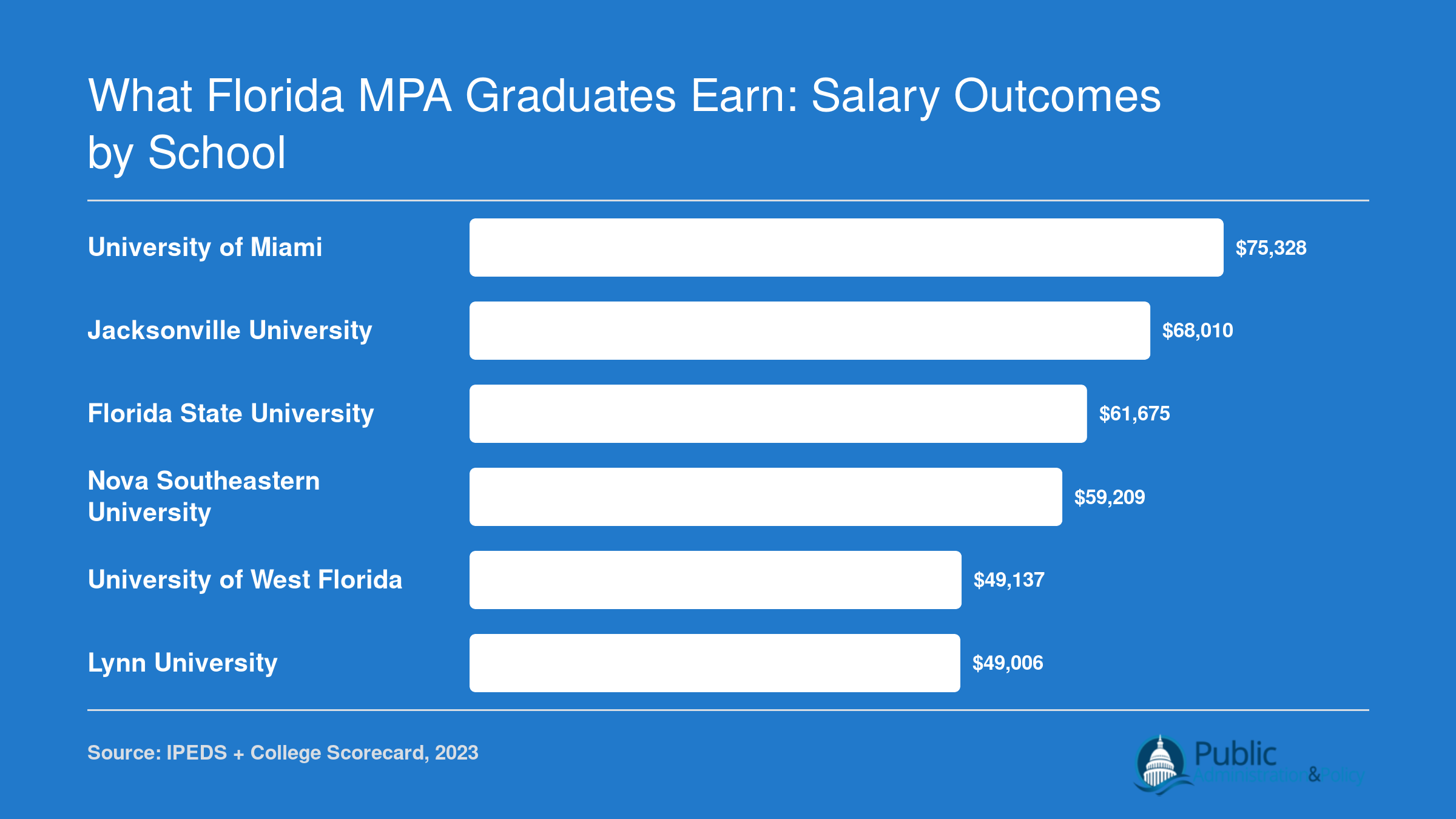
What Florida MPA Graduates Earn: Salary Outcomes by School
Program-level earnings data at one year and four years post-completion are not yet published for Florida MPA programs. However, institution-wide median earnings at ten years after enrollment offer a useful proxy for comparing long-term earning potential across schools. The University of Miami leads the group at $75,328, while public universities like Florida State and the University of West Florida deliver strong returns relative to their lower tuition. Detailed program-specific employment rates and poverty-threshold outcomes are also not yet reported for these MPA programs.
Career Outcomes & Salaries for Florida MPA Graduates
An online MPA from a Florida institution opens doors to a range of public service careers, and the salary data is encouraging. While program-level earnings outcomes are not yet available for most Florida MPA programs, occupation-level wage data from the Bureau of Labor Statistics and self-reported graduate outcomes paint a clear picture of what you can expect.
Key MPA Career Paths and Florida Wages
Florida employs thousands of professionals in roles that typically require or reward a master's in public administration. According to May 2025 BLS Occupational Employment and Wage Statistics, here are four of the most common career paths for MPA holders:1
Chief Executives / City and County Managers (SOC 11-1011): This category covers city managers, county administrators, and similar top-level roles in local government. Florida's statewide median wages for chief executives are among the highest for MPA graduates, with the Miami metro area leading the state in pay. Salaries vary widely based on municipality size, but seasoned city managers in mid-size and large jurisdictions routinely earn six figures.
Budget Analysts (SOC 13-2031): Budget analysts working for state agencies, counties, and school districts are in steady demand across Florida. The Miami and Jacksonville metros tend to offer the strongest compensation for this role statewide.
Social and Community Service Managers (SOC 11-9151): These professionals oversee programs at nonprofits, government agencies, and community organizations. Miami again ranks as a top-paying metro for this occupation in Florida.
Urban and Regional Planners (SOC 19-3051): Planners help shape land use, transportation, and growth management, roles that are especially relevant in a state adding hundreds of thousands of residents each year. The Miami and Tampa metros are among the best-compensated areas for planners in Florida.
Is an MPA Worth It for a Career in Florida Government?
The return-on-investment case for a Florida MPA is strong, especially at public institutions. Consider that in-state graduate tuition at Florida State University runs roughly $10,500, and even programs at private universities like the University of Miami or Lynn University top out in the mid-$40,000 to low-$50,000 range for the full degree. Median graduate debt at the schools profiled on publicadministrationpolicy.org ranges from approximately $16,600 to $24,300.
Set that against the earning power of the career paths above, and most graduates can expect to recoup their investment within a few years of completing the degree. The University of West Florida, for instance, reports a median graduate salary of $95,035, a figure that dwarfs even the most expensive programs' total tuition.
The Florida Income-Tax Advantage
One factor that is easy to overlook but genuinely matters: Florida has no state income tax. For a budget analyst or city manager earning $75,000 to $110,000, that translates into thousands of extra dollars in take-home pay each year compared to peers in states like California, New York, or Illinois, where state income tax rates can reach 5% to 13%. When you layer this tax advantage on top of competitive public-sector salaries, Florida MPA graduates often enjoy a real-income edge that strengthens the ROI of their degree.
What to Keep in Mind
Salary outcomes depend on experience, employer type, and metro area. Graduates who target rapidly growing regions like South Florida, Tampa Bay, and the Orlando corridor will generally find both more openings and higher compensation. An MPA also qualifies you for careers in public administration that a bachelor's degree alone typically cannot unlock, making the credential a practical stepping stone whether you work in government, nonprofits, or consulting.
Not every MPA student follows the same two-year timeline. Florida universities offer several ways to speed up your degree, combine it with a complementary credential, or reduce what you pay out of pocket. Understanding these options early can save you a full year of tuition or open career doors that a standalone MPA might not.
Accelerated and 4+1 MPA Pathways
If you are finishing an bachelor of public administration or a related undergraduate degree at a Florida institution, a 4+1 (or accelerated) pathway lets you begin graduate coursework during your senior year, shaving months off the total time to completion.
Florida International University offers a structured 4+1 option that allows undergraduates to bank up to 12 graduate credits before they officially enroll in the MPA.1 Specific pathways exist for students earning a BA in Psychology, a BS in Criminal Justice, or a BS in Crime Science.2
Florida Southern College provides an early-admission track in which undergraduates can complete up to 8 graduate credits at the undergraduate tuition rate, a meaningful cost savings at a private institution.3
Florida Gulf Coast University structures its MPA at 36 to 42 credits depending on concentration, and fully online delivery makes it feasible for working professionals who want to finish on a compressed schedule.4
Standard MPA programs at Florida State University, FIU, and FAU typically require 42 credits and take about 24 months of full-time study.57 Students who enter with relevant graduate credits or choose a lighter elective load may finish somewhat faster, but true one-year MPA completion in Florida generally depends on entering through a 4+1 pipeline rather than starting from scratch.
Dual-Degree Combinations
Florida State University stands out for offering three dual-degree pairings alongside its MPA.5
MPA/JD: Designed for students who want to practice law in a public-sector or regulatory context. Overlapping credits reduce the combined timeline compared to earning each degree separately.
MPA/MPH: A strong fit for professionals aiming at health policy, emergency management, or nonprofit health organizations.
MPA/MURP: Combines public administration with urban policy planner career preparation, ideal for roles in local government, land-use policy, or community development.
Dual-degree students should plan for a longer overall program (typically three to four years), but the shared credit hours make the investment more efficient than pursuing two degrees sequentially.
Funding Your Florida MPA
Florida's public universities participate in a state employee tuition waiver program, which can cover a significant portion of costs for current employees of state agencies, the State University System, and other eligible public entities. This benefit applies at FSU, FIU, FAU, and FGCU, among others.574 Florida Southern College, as a private institution, does not participate in this waiver.3
Beyond waivers, common funding sources include:
Graduate assistantships: FSU and other public universities offer assistantships that typically pair a tuition waiver with a modest stipend in exchange for research or teaching support.5
Employer tuition reimbursement: Many local and county governments in Florida offer partial reimbursement for employees pursuing graduate degrees in public administration or related fields. Check with your HR office before enrolling.
Named scholarships and fellowships: Individual programs may offer merit-based or need-based awards. Availability and amounts change each cycle, so contact the program directly for current offerings.
MPA vs. MPP: Choosing the Right Degree
If your research has led you to both MPA and MPP (Master of Public Policy) programs, the distinction matters. An MPA emphasizes management, leadership, and organizational operations within the public and nonprofit sectors. An MPP focuses more heavily on policy analysis, research methods, and quantitative evaluation. In practical terms, MPA graduates often move into agency director, city manager, or nonprofit executive roles, while MPP graduates lean toward analyst, researcher, or legislative staff positions. Most Florida programs highlighted here are MPA-focused, though dual-degree and elective options at schools like FSU allow you to build policy analysis skills into an MPA curriculum. Students interested in advancing beyond the master's level may also want to explore an online phd in public administration.
NASPAA accreditation is to public administration what AACSB is to business schools: the recognized gold standard for program quality. Some federal and state government employers specifically require or prefer candidates who hold an MPA from a NASPAA-accredited program, especially for management track positions. If your career goals include senior roles in government, prioritize NASPAA-accredited programs when evaluating your options.
Frequently Asked Questions About Florida Online MPA Programs
Prospective students often share similar questions when evaluating online MPA programs in Florida. Below, we address the most common concerns using data and insights discussed throughout this guide. If you still have questions after reading, publicadministrationpolicy.org offers additional resources to help you compare programs and plan your next step.
How much does an online MPA cost in Florida?
Total tuition for an online MPA in Florida generally ranges from roughly $12,000 at public universities with in-state rates to over $40,000 at private institutions. Costs vary by school, residency status, and credit-hour requirements (typically 36 to 42 credits). Many programs offer financial aid, graduate assistantships, or employer tuition reimbursement. Check the cost comparison table earlier in this article for school-by-school figures.
Which Florida MPA programs are NASPAA accredited?
Several Florida universities hold NASPAA accreditation for their MPA programs, including Florida State University, the University of Central Florida, Florida Atlantic University, and Florida International University. NASPAA accreditation signals that a program meets rigorous standards for curriculum, faculty qualifications, and student outcomes. We recommend prioritizing accredited programs, as detailed in our NASPAA section above, because they carry greater weight with public sector employers.
Can you get an MPA online in Florida without the GRE?
Yes. Multiple Florida MPA programs have waived the GRE requirement or offer conditional waivers based on professional experience, prior graduate coursework, or a minimum undergraduate GPA (often 3.0 or higher). Schools such as UCF and FAU have adopted flexible admissions policies in recent years. Review our GRE-free program section earlier in this guide for a full list of options available in 2026.
How long does it take to complete an online MPA in Florida?
Most online MPA programs in Florida require two years of full-time study, though part-time students commonly finish in three years. Some universities offer accelerated tracks that can be completed in as little as 12 to 18 months, depending on transfer credits and course load. Programs with a capstone or internship component may require additional time, so confirm the specific timeline with your chosen school.
What is the difference between an MPA and an MPP degree?
An MPA (Master of Public Administration) focuses on organizational management, budgeting, and leadership within government and nonprofit agencies. An MPP (Master of Public Policy) emphasizes policy analysis, research methods, and program evaluation. In practice, the two degrees overlap considerably. If your goal is managing teams and operations in Florida's public sector, the MPA is typically the stronger fit. Policy analysts may lean toward the MPP.
Is an MPA worth it for a career in Florida government?
For most professionals, yes. Florida's state agencies, county governments, and municipalities frequently list an MPA (or equivalent graduate degree) as preferred or required for mid-level and senior management roles. MPA graduates in Florida report median salaries well above the state average for bachelor's degree holders, and the degree opens pathways into city management, budget analysis, emergency management, and nonprofit leadership across the state.