Best Online MPA Programs in Indiana | 2026 Rankings
Compare tuition, accreditation, career outcomes, and admissions requirements across Indiana's top online MPA programs.
By Carrie HirschReviewed by PAP Editoral TeamUpdated August 14, 202625+ min read
What you’ll learn in this article…
Indiana offers several NASPAA-accredited online MPA programs, including options at Indiana University and other state institutions.
Most online MPA students in Indiana finish their degrees within two to three years depending on enrollment pace.
Roughly 30 percent of state and local government employees are expected to retire by 2030, fueling strong demand for MPA graduates.
Tuition costs vary significantly by residency status, so comparing in-state, out-of-state, and net price figures is essential before applying.
Indiana is home to roughly 430,000 state and local government employees, and Indianapolis alone anchors one of the Midwest's densest clusters of federal regional offices, nonprofit headquarters, and public health agencies. That concentration of public-sector activity makes an MPA earned in-state unusually practical: capstone projects, internships, and professional networks connect directly to the employers most likely to hire graduates.
The tradeoff is a narrow field. Only a handful of Indiana universities offer an online MPA, and graduate tuition for these programs ranges from about $8,600 to over $13,000 per year depending on the institution and residency status. Several carry NASPAA accreditation, the recognized quality benchmark, but curriculum structures, credit requirements, and concentration options differ enough to reward careful comparison.
Best Online MPA Programs in Indiana: Our Rankings
The following online and hybrid MPA programs in Indiana are ranked using a composite quality score that weighs institutional outcomes, affordability, and program-level features rather than relying on a single metric like cost or speed. Each school offers a distinct path into public service, so the best fit depends on your career goals, budget, and preferred learning format. Program-level earnings data is not yet available for these Indiana MPA programs, but institution-wide figures are included as a general return-on-investment signal.
Factors considered
Institutional graduation and retention rates
Net price and tuition affordability
Accreditation and program quality signals
Concentration breadth and flexibility
Student faculty ratio
Sources
NCES-IPEDS federal institutional data — nces.ed.gov
Best for: Budget-conscious mid-career public servants
Indiana State University delivers a fully online, NASPAA-accredited MPA through a 36-credit curriculum that blends asynchronous coursework with live online sessions. With the lowest net price among ranked programs at $10,873, ISU is built for mid-career professionals in Indiana's public and nonprofit sectors who need affordability without sacrificing accreditation quality. Four distinct concentrations, including Criminology and Criminal Justice, Human Resources Development, and Public Health, let students tailor the degree to their agency or sector. No entrance exam is required, and the capstone research project can be aligned with Indiana state or local government partners.
View program
Master of Public Administration — Online
36-credit NASPAA-accredited online program
Concentrations in criminal justice, HR, public health, nonprofit
No GRE or entrance exam required for admission
Mix of asynchronous and live online course sessions
Capstone research project with applied focus
Optional internship for students without professional experience
Seven core courses in administration and policy analysis
Best for: Michiana-area professionals seeking hybrid flexibility
Indiana University-South Bend's NASPAA-accredited Master of Public Affairs is a 39-credit hybrid program with deep roots in the Michiana region, supported by a network of more than 700 alumni working in local government and nonprofits. Three concentrations cover Government Administration and Policy, Nonprofit Administration, and Health System Administration. Evening and select online classes accommodate full-time employees, and the program can be completed in two years. At a net price of $8,653, IU South Bend offers the most affordable entry point in this ranking, though out-of-state online students should note tuition jumps to roughly $20,256 per year.
View program
Master of Public Affairs, Government Administration and Policy — Hybrid
39-credit NASPAA-accredited hybrid degree
Concentrations in government policy, nonprofit, health systems
Completable in two years with part-time options
Capstone project replaces traditional thesis requirement
No entrance exam required with qualifying GPA
Professional work experience may count toward credit
Cohort model with small class sizes
Professional certificate stackable pathways available
Best for: Aspiring planners or custom-track learners
Ball State University's hybrid MPA features six interdisciplinary concentration options, including Urban Planning, Adult Education, and a Custom Course of Study that lets students design coursework around specific Indiana sector needs. The 36 to 39 credit program is closely tied to the Bowen Center for Public Affairs, which runs Indiana-focused civic research and connects students with state and local officials. The institution-wide graduation rate of 62.3% is the highest among the public regional universities on this list. Graduate assistantships through the Bowen Center can offset the $14,940 net price while providing paid, Indiana-relevant policy experience.
View program
Master of Public Administration, Adult Education — Hybrid
36 to 39 credits with six concentration options
Custom Course of Study lets students tailor their focus
No entrance exam required; military-friendly program
Immersive learning projects with Indiana communities
Graduate assistantships available through Bowen Center
Evening classes designed for working professionals
Indiana University-Bloomington's O'Neill School of Public and Environmental Affairs houses what is widely regarded as one of the nation's top-ranked Master of Public Affairs programs. The hybrid format offers 12 specialized concentrations, including Nonprofit Management and Public Finance and Budgeting, with both asynchronous and live online components. The institution posts the highest graduation rate in this ranking at 80.2% and the strongest institution-wide median earnings at $63,742 ten years after enrollment. In-state tuition is competitive at about $11,756 per year, but out-of-state students face roughly $33,454, making residency status an important cost consideration for online learners.
View program
Master of Public Affairs, Nonprofit Management — Hybrid
12 customizable concentrations across policy domains
Hybrid delivery with asynchronous and live sessions
GRE generally not required for experienced professionals
Experiential learning with real public and nonprofit clients
Deep alumni network in Indiana government and nonprofits
Valparaiso University's hybrid Master of Public Health with an Epidemiology concentration is the only private-university option on this list. While technically classified under public administration programs, this is an MPH rather than an MPA, so prospective students should confirm it aligns with their career goals in public health leadership rather than general public administration. The 10:1 student-to-faculty ratio is the most intimate in this ranking, and the flat tuition of $13,250 applies regardless of residency. The institution-wide graduation rate of 70.4% is strong, and experiential service learning projects give students hands-on community health experience.
View program
Master of Public Health, epidemiology — Hybrid
Hybrid MPH with epidemiology concentration (not an MPA)
Flat tuition of $13,250 for in-state and out-of-state students
10:1 student-to-faculty ratio for personalized mentorship
Interdisciplinary curriculum in biostatistics and health policy
Experiential service learning with global health partners
No entrance exam required for admission
Net price of $18,578 at a private Lutheran-affiliated university
Rankings that offer no explanation of how they were built do not deserve your trust. Many competing "best of" lists present numbered programs with no visible criteria, leaving readers to wonder whether the order reflects genuine quality or editorial whim. Our approach is different: every program earns a composite quality score built from measurable, publicly available data, so you can evaluate the ranking logic yourself.
What Goes Into the Composite Score
Each program's score reflects a blend of factors designed to capture both academic quality and real-world return on investment. Programs delivered fully online receive a delivery-format boost that acknowledges the distinct flexibility and accessibility advantages online learners are seeking. If you are comparing options across the country, our broader guide to the best online mpa programs provides additional context. Beyond that, the baseline quality factors include:
Graduation rate: A widely used institutional indicator of student support and follow-through.
Net price: A sector-conditional average that approximates the actual cost students pay after grants and scholarships.
Program-level earnings: Post-completion median earnings at multiple time horizons (one, two, four, and five years out) where federal data is available.
Debt metrics: Median borrowing levels at the program level, feeding into signals about whether a degree's cost aligns with its earning potential.
Together, these elements create an ROI-informed picture that goes well beyond a simple prestige ranking.
Important Caveats to Keep in Mind
Transparency means acknowledging limitations. Graduation rates used here are institution-wide figures, not specific to MPA cohorts, because program-level completion data is not consistently reported. Likewise, the net price figure is a sector-conditional average, meaning it reflects a broad student population at a given type of institution rather than an exact per-student quote. Your personal cost will vary based on residency, financial aid, and course load.
Program-level earnings and debt data come from federal sources and are only included where they have been published. Not every program has earnings reported at every time horizon, so coverage can be uneven. When data is not yet available for a program, we note that plainly rather than filling in estimates.
Why This Matters for Your Decision
Public administration careers span city management, nonprofit executive director career path roles, healthcare policy, and federal service. The financial stakes of choosing the right program are real, especially for working professionals who may be balancing tuition payments against existing obligations. A methodology grounded in graduation outcomes, cost, earnings, and debt gives you a structured way to compare options. It is not a perfect crystal ball, but it is a far more honest foundation than an unexplained numbered list. Use these rankings as a starting point, then dig deeper into the program profiles that follow to find the fit that matches your career goals and budget.
Indiana MPA Tuition and Cost Comparison
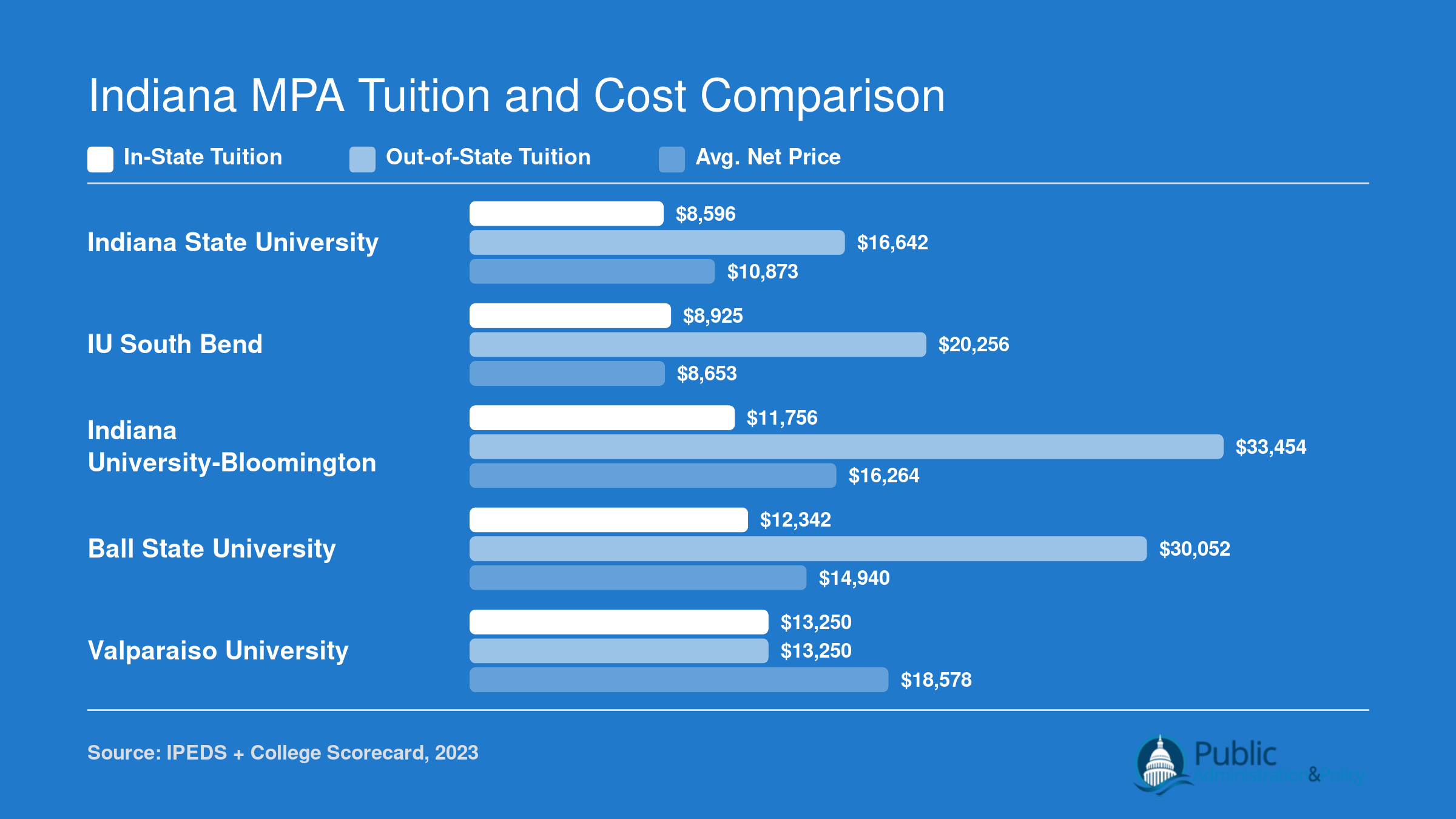
Tuition costs for online MPA programs in Indiana vary significantly depending on residency status and institution type. The chart below compares graduate-level in-state tuition, out-of-state tuition, and average net price for each school. Note that net price figures reflect an institution-wide average after financial aid and are not guaranteed quotes for any individual student. Always verify current rates directly with each school before making enrollment decisions.
The Network of Schools of Public Policy, Affairs, and Administration (NASPAA) is the gold-standard accreditor for graduate programs in public administration and public affairs. If you are searching for a NASPAA-accredited online MPA in Indiana, the state offers several strong options, but it is important to understand which programs carry that credential and why it matters.
Which Indiana Programs Hold NASPAA Accreditation?
As of the 2025-2026 academic year, four Indiana University system programs hold NASPAA accreditation for their Master of Public Affairs degrees.1
Indiana University Bloomington: Master of Public Affairs, available online through the O'Neill School of Public and Environmental Affairs.2
Indiana University Indianapolis: Master of Public Affairs, available online through the O'Neill School.3
Indiana University Northwest: Master of Public Affairs, available online.1
Indiana University South Bend: Master of Public Affairs, NASPAA-accredited but currently offered in a campus-based format rather than fully online.1
If your priority is a fully online, NASPAA-accredited program, IU Bloomington, IU Indianapolis, and IU Northwest are the three options to focus on. IU South Bend's program includes select online courses but is primarily delivered on campus.
Other Indiana universities, such as Indiana State University and Ball State University, offer well-regarded MPA or related programs. However, it is worth noting that NASPAA membership and NASPAA accreditation are not the same thing. A school may be a NASPAA member institution without holding program-level accreditation. Always confirm a program's current accreditation status directly through the official NASPAA accredited programs roster.
Why NASPAA Accreditation Matters
NASPAA accreditation signals that a program meets rigorous standards for curriculum design, faculty qualifications, student learning outcomes, and public service mission alignment. Beyond prestige, this credential carries real practical advantages:
Federal and state hiring preferences: Many government agencies at the federal and state level give preference to candidates who hold degrees from NASPAA-accredited programs. For competitive positions in agencies like the Government Accountability Office or state budget offices, accreditation can be a differentiator.
Fellowship eligibility: Prestigious fellowship programs, including the Presidential Management Fellows Program, typically require or strongly prefer applicants with degrees from NASPAA-accredited institutions.
Credit transferability: Coursework from accredited programs is more likely to be recognized and accepted if you later pursue additional graduate study or a doctorate in public administration.
Employer confidence: Hiring managers in public and nonprofit sectors often view NASPAA accreditation as a quality assurance marker, similar to how AACSB accreditation functions for business schools.
Accreditation Status Can Change
Accreditation is not permanent. Programs undergo periodic reviews, and accreditation can be granted, renewed, or revoked based on ongoing compliance with NASPAA standards. Before committing to any program, verify its current accreditation status on the official NASPAA accredited programs roster.1 This is especially important if you are comparing programs across multiple application cycles, since a program's status in one year does not guarantee the same standing in the next.
For Indiana students and professionals who want the strongest credential in public affairs, the IU system's NASPAA-accredited online offerings provide a clear path. That said, non-accredited programs can still deliver valuable education, particularly if your career goals do not require the accreditation credential. Weigh your specific professional objectives when making this decision.
Questions to Ask Yourself
Does the career path you're targeting require NASPAA accreditation?
Some government agencies and nonprofits prefer or require a NASPAA-accredited MPA, while others focus on skills and experience. If you're aiming for federal management roles, accreditation may matter more than if you plan to stay in local government or the private sector.
Will you qualify for in-state tuition, or does the program offer a flat online rate?
Indiana residents can save thousands through in-state pricing, but several programs charge a single online tuition rate regardless of where you live. Comparing net cost across both models could change which program is the best financial fit.
Can you handle a part-time schedule alongside full-time work, or do you need an accelerated track?
Part-time formats let you keep earning while you learn, but they extend your timeline to three years or more. If career advancement is time-sensitive, look for programs offering an accelerated full-time option that can be completed in under two years.
Admissions Requirements and GRE Policies for Indiana Online MPA Programs
Admissions standards for online MPA programs in Indiana vary from one university to the next, and policies can shift from one application cycle to another. Rather than relying on secondhand summaries, treat each program's official graduate admissions page as your primary source of truth. Below is a practical framework for navigating the process.
Typical Admissions Criteria
Most Indiana universities offering an online MPA expect applicants to hold a bachelor's degree from a regionally accredited institution. Beyond that baseline, look for details on the following:
Minimum GPA: Many programs set a floor around 2.75 to 3.0 on a 4.0 scale, though some will consider applicants below the threshold if other credentials are strong.
Letters of recommendation: Two or three professional or academic references are standard.
Personal statement or statement of purpose: Programs typically want to see your motivation for pursuing public service and how the degree fits your career trajectory.
Resume or CV: Especially relevant for programs that value professional experience in lieu of other admissions components.
GRE Policies: Required, Optional, or Waived?
GRE requirements across Indiana's online MPA landscape have evolved considerably in recent years. Some programs have moved to a test-optional or GRE-waived model, while others still require scores under certain conditions (for example, if your GPA falls below a specified threshold). When reviewing a program's website or application instructions, look for explicit language such as "waived," "optional," or "required." If the policy is ambiguous, contact the admissions office directly. A brief email or phone call can save you the time and expense of an unnecessary exam.
Work Experience and Prerequisites
Several Indiana MPA programs, including those with NASPAA accreditation, place value on professional experience in government, nonprofit organizations, or related fields. Some may require a minimum number of years in the workforce, while others simply weigh it favorably during holistic review. Prerequisite coursework in statistics, economics, or American government may also apply, though requirements differ by institution. If you are missing a prerequisite, ask whether it can be completed concurrently with your MPA coursework. Applicants who already hold a graduate certificate in public administration may find that some of those credits satisfy prerequisite or elective requirements.
Transfer Credits and Program Handbooks
Transfer credit policies tend to be program-specific and can affect both your timeline and total cost. Most programs cap the number of transferable credits, often between six and twelve semester hours. Confirm that any previously completed graduate coursework aligns with the program's curriculum before assuming it will count. Program handbooks, which many universities publish online, are an underused resource. They often spell out policies on transfer credits, course sequencing, and academic standing that the main admissions page only summarizes.
Verify Accreditation Through NASPAA
Before you apply, visit naspaa.org to confirm whether a program holds NASPAA accreditation. Accredited programs meet peer-reviewed standards for curriculum, faculty qualifications, and student outcomes. NASPAA's directory also links directly to member program pages, giving you a convenient starting point for reviewing admissions standards side by side.
Admissions requirements are a moving target. Bookmark the specific program pages you are considering, check them periodically for updates, and do not hesitate to reach out to admissions advisors with questions. A short conversation early in the process can clarify expectations and help you assemble the strongest possible application.
Career Outcomes and Salary Potential for Indiana MPA Graduates
An MPA from an Indiana university opens doors across government, nonprofit, and healthcare management, and the salary landscape in the state is encouraging for graduates ready to step into mid-level and senior roles. While program-level earnings data for Indiana's online MPA offerings are not yet published at the granular post-completion level, broader occupation data and institutional benchmarks paint a useful picture of what graduates can expect.
What MPA-Related Roles Pay in Indiana
Bureau of Labor Statistics wage estimates and Indiana Department of Workforce Development data highlight strong earning potential for occupations commonly held by MPA graduates:12
General and operations managers (government): Median annual wage of approximately $108,926, with earners at the 75th percentile reaching roughly $143,011.
Social and community service managers: Median annual wage near $60,409, with experienced professionals at the 90th percentile earning above $93,569.
Urban and regional planners: Typically compensated in a range comparable to social service managers, though Indiana-specific published figures are limited. Nationally, this occupation trends between $55,000 and $85,000 for most practitioners.
These figures suggest that MPA holders who target operations management or senior administrative positions can reach six-figure salaries within a few years of graduation, while those drawn to community-facing nonprofit or planning roles should expect a more moderate but still competitive pay range. For a deeper look at compensation benchmarks across the field, our public administration salary guide provides national and state-level context.
Major Employers Hiring MPA Graduates
Indiana's public-sector job market is anchored by state government agencies headquartered in Indianapolis, including the Family and Social Services Administration, the Indiana Department of Health, and the Office of Management and Budget. Large municipal governments in Fort Wayne, Evansville, and South Bend also recruit regularly for budget analysts, city planners, and department directors. On the nonprofit side, organizations such as the United Way of Central Indiana, Gleaners Food Bank, and Goodwill Industries of Central and Southern Indiana represent significant employers that value MPA-trained leadership. Exploring the full range of public administration jobs can help you identify which sectors align with your career goals.
Framing the Return on Investment
Program-specific debt and earnings breakdowns at the one-year, two-year, and four-year marks are not yet available for the Indiana MPA programs featured in our rankings. However, in-state graduate tuition at the public institutions on our list ranges from roughly $8,600 to $12,300 per year, which keeps total program costs well below $30,000 for most resident students completing 36 to 39 credits.
When you compare that investment against a median starting trajectory that, for government management roles, sits near $87,395 at the 25th percentile and climbs past $108,926 at the median, the math is favorable.2 Even graduates entering social and community service management at the median of about $60,409 can expect to recover their degree costs within a relatively short window, particularly if they minimize borrowing by working while enrolled, a scenario most of these programs are designed to support through evening and asynchronous coursework.
Positioning Yourself for the Strongest Outcomes
To maximize salary potential, consider these strategies:
Choose a concentration aligned with higher-paying sectors, such as public finance, health systems administration, or urban planning.
Pursue internships or capstone projects with state agencies or large municipal departments where hiring pipelines favor candidates with direct organizational exposure.
Leverage NASPAA accreditation on your resume, as many federal and state hiring frameworks recognize it as a quality benchmark.
Build connections through alumni networks. Indiana University-South Bend, for example, reports over 700 MPA alumni working throughout the Michiana region, a built-in professional community that can accelerate career placement.
Indiana's cost of living remains below the national average, which amplifies the purchasing power of these salaries compared to what MPA graduates earn in coastal metropolitan areas. Those interested in becoming an urban policy planner will find Indiana's growing cities offer expanding opportunities at a lower cost of entry. For professionals rooted in the state, an online MPA from one of Indiana's ranked programs represents a practical, high-return investment in long-term career growth.
How Long Does an Online MPA Take in Indiana?
How long does an online MPA take in Indiana? The answer depends on which program you choose and whether you enroll part-time or full-time, but most students can expect to finish within two to three years. Here is what the available Indiana programs look like in terms of timeline and structure.
Credit Requirements Vary Significantly
Indiana's online MPA programs differ in total credit hours, which directly affects how long you will spend in the program.
Indiana University Bloomington: Requires 48 credits in total, broken into 24 core credits, 15 concentration credits, and 9 elective credits. However, students with relevant professional experience may be eligible to reduce their requirement by up to 9 credits, bringing the minimum down to 39 credits.1
Indiana State University: Requires 36 credits, making it one of the more streamlined options in the state. Up to 9 transfer credits may be accepted, potentially shortening the path further.2
For context, most online mpa programs nationally fall in the 36 to 42 credit range, so Indiana State aligns with the norm while IU Bloomington sits on the higher end. That said, IU's deeper credit requirement reflects the breadth of its NASPAA-accredited curriculum and concentration options.
Part-Time and Full-Time Timelines
IU Bloomington's online MPA is designed for completion in approximately 24 months, with courses delivered 100 percent online.3 Indiana State's program is structured for completion in roughly 25 months with a mostly online delivery format, and the university allows a maximum completion window of seven years for students who need additional flexibility.2
Most online MPA students nationwide are working professionals who enroll part-time, and a two-to-three-year timeline is typical. If you are able to study full-time, some programs across the country offer accelerated tracks that compress completion into 18 months or less. Neither IU Bloomington nor Indiana State currently advertises a formally designated accelerated track, though IU's credit reduction option for experienced professionals can effectively shorten your time to degree.
Dual-Degree Options That Extend the Timeline
If you are interested in broadening your career flexibility, it is worth asking admissions advisors about dual-degree pathways. Programs like MPA/JD or MPA/MBA combinations are offered at select institutions and typically add one to two additional years beyond a standalone MPA. Indiana University, given the breadth of its graduate offerings, is a natural place to explore these options, though availability and format for online students should be confirmed directly with the program.
Planning Your Timeline
Before committing, consider a few practical factors that will shape your personal completion timeline:
How many courses per semester can you realistically take alongside work and family obligations?
Do you have prior graduate credits or professional experience that might reduce your total requirement?
Will you need to complete an internship or capstone, and can those be completed in your current role?
Indiana State, for example, has a conditional internship requirement, meaning some students may be exempt based on their professional background.2 IU Bloomington similarly allows its experiential component to be waived in certain cases.1 These details matter because they can shave a semester or more off your expected finish date.
The bottom line: if you are weighing Indiana's online MPA programs, plan for roughly two years of coursework. Your actual timeline will hinge on enrollment pace, credit reductions, and whether you pursue a single degree or a dual-degree combination.
According to the Center for State and Local Government Excellence, roughly 30 percent of state and local government employees are expected to retire by 2030, creating a significant wave of leadership vacancies across the public sector. This surge in turnover is a major reason demand for MPA graduates continues to climb nationwide, including in Indiana.
Frequently Asked Questions About Indiana MPA Programs
Choosing an online MPA program in Indiana involves weighing factors like accreditation, cost, admissions requirements, and career outcomes. Below are answers to the most common questions prospective students ask when evaluating their options.
What is the best online MPA program in Indiana?
Indiana University Bloomington's O'Neill School of Public and Environmental Affairs consistently ranks among the top programs nationally, holding a #2 national ranking for its Master of Public Affairs. It offers 12 customizable concentrations and a hybrid delivery format. Indiana State University also stands out as a strong, fully online option with NASPAA accreditation and multiple concentrations in areas like public health, human resources, and criminal justice.
Does Indiana University require the GRE for its online MPA?
No. Indiana University Bloomington's Master of Public Affairs program does not require an entrance exam for admission. The same is true at Indiana State University and Indiana University South Bend, as well as Ball State University's hybrid MPA. This trend toward test-optional admissions makes Indiana's MPA programs more accessible for working professionals who want to advance their careers without the added burden of standardized testing.
Which Indiana MPA programs are NASPAA accredited?
NASPAA accreditation is the gold standard for public administration graduate programs. In Indiana, both Indiana State University's MPA and Indiana University South Bend's Master of Public Affairs hold NASPAA accreditation. Indiana University Bloomington's O'Neill School program is also NASPAA accredited. If peer-reviewed quality assurance matters to you (and it should), prioritize these programs when building your shortlist.
How much does an online MPA cost in Indiana?
In-state graduate tuition varies considerably. Indiana State University's MPA runs approximately $8,596 per year for in-state students, while Indiana University South Bend's program costs around $8,925. Ball State University comes in near $12,342, and Indiana University Bloomington is approximately $11,756 for residents. Out-of-state rates are significantly higher, ranging from roughly $16,642 at Indiana State to over $33,000 at IU Bloomington, so confirming residency-based pricing is essential before applying.
What can you do with an MPA degree in Indiana?
An MPA opens doors to leadership roles in government agencies, nonprofit organizations, healthcare administration, and public policy. Graduates commonly pursue positions such as city manager, policy analyst, budget director, program coordinator, or nonprofit executive director. Indiana's public sector and large nonprofit community provide a steady demand for these skills, and the degree is widely recognized for career advancement across local, state, and federal government.
Can I complete an Indiana online MPA while working full-time?
Yes. Indiana's MPA programs are specifically designed to accommodate working professionals. Indiana State University offers fully online and evening courses, and its 36-credit program can be completed at a flexible pace. Indiana University South Bend and Ball State both feature evening class schedules and part-time study options alongside their hybrid formats. Most programs can be finished in about two years of full-time study, or longer if you prefer a reduced course load.