Best Online MPA Programs in Iowa | 2026 Rankings & Guide
Compare Iowa's online MPA programs side by side — accreditation, cost, career outcomes, and flexibility for working professionals.
By Holly AbramsonReviewed by PAP Editoral TeamUpdated August 14, 202622 min read
What you’ll learn in this article…
Buena Vista University, partnering with Drake University, is the sole ranked online MPA option in Iowa for 2026.
Flat tuition applies equally to in-state and out-of-state students, making Iowa's online MPA competitively priced.
NASPAA accreditation options in Iowa are limited, so applicants should verify program credentials before enrolling.
Iowa MPA graduates pursue leadership roles across public, nonprofit, and health care sectors with favorable debt-to-earnings ratios.
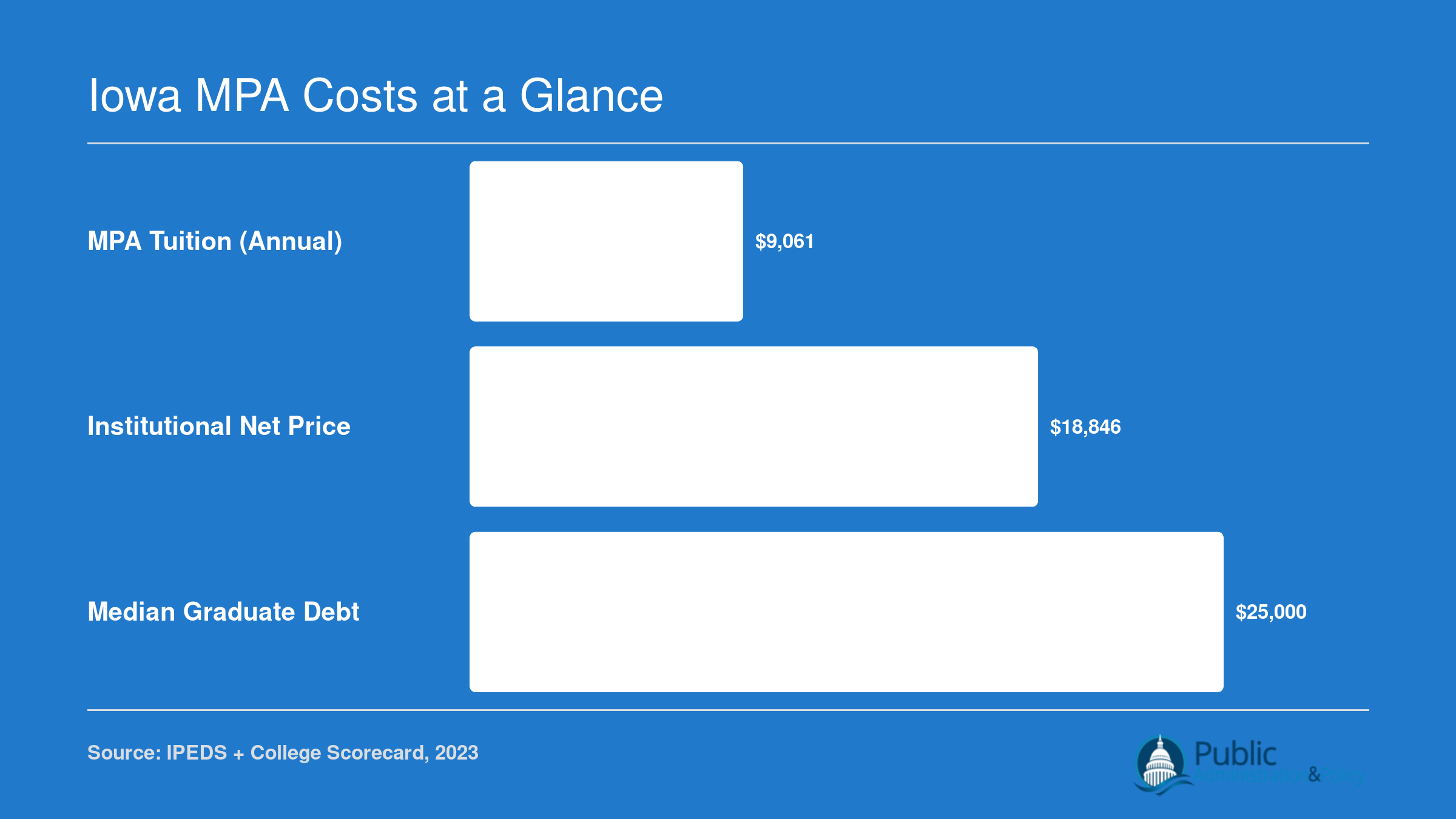
Iowa employs roughly 230,000 state and local government workers, and cities from Des Moines to Cedar Rapids regularly recruit MPA holders for management, budgeting, and policy roles. Yet fully online MPA programs based in the state are remarkably limited. For 2026, the primary in-state pathway is Buena Vista University's accelerated 4+1 program, offered in partnership with Drake University, with graduate-level tuition near $9,061 per year and a hybrid delivery format.
That narrow field creates a real tension: Iowa residents committed to public service leadership may need to weigh a single in-state program against NASPAA-accredited online options from neighboring states. Understanding accreditation status, true cost after aid, admissions requirements, and post-degree earning power is essential before committing. For many working professionals, the calculus comes down to whether an in-state hybrid model or an out-of-state fully online program better fits their career timeline and budget.
Best Online MPA Programs in Iowa: Side-By-Side Comparison
Iowa offers a distinctive path to a Master of Public Administration through a collaborative model that pairs undergraduate study with accelerated graduate coursework. The ranking below reflects online-delivery-eligible MPA programs sorted by a quality composite that weighs institutional outcomes, program structure, and affordability rather than cost or completion speed alone. Because Iowa's online MPA landscape is focused rather than sprawling, prospective students benefit from understanding exactly what the state's primary offering delivers.
Factors considered
Institutional graduation and retention rates
Program format and delivery flexibility
Tuition and net price affordability
Career preparation and experiential opportunities
Partnership strength and alumni networks
Sources
Independent program research
NCES-IPEDS federal institutional data — nces.ed.gov
Best for: Iowa undergrads seeking accelerated graduate study
Buena Vista University, based in Storm Lake, partners with Drake University in Des Moines to offer an accelerated 4+1 MPA pathway that functions as an Iowa talent pipeline into public service leadership. BVU undergraduates in political science or public administration can begin Drake MPA coursework during their senior year, with the graduate portion delivered primarily online. The university maintains a 13:1 student-to-faculty ratio and an institution-wide graduation rate of approximately 62%, reflecting a supportive learning environment. This partnership leverages Drake's deep network of Iowa government and nonprofit professionals alongside BVU's regional community connections.
Accreditation is one of the most important filters you can apply when evaluating online MPA programs, yet it is also one of the most misunderstood. In Iowa, the accreditation landscape is narrower than many applicants expect, so understanding what it means and which programs hold it will help you make a sharper decision.
What NASPAA Accreditation Means and Why It Matters
The Network of Schools of Public Policy, Affairs, and Administration (NASPAA) is the recognized accrediting body for graduate programs in public administration, public policy, and public affairs. A NASPAA-accredited program has undergone a rigorous peer review of its curriculum, faculty qualifications, student learning outcomes, and mission alignment with public service values.1
Why should you care? Three practical reasons stand out:
Career credibility: Many government agencies, nonprofits, and international organizations view a NASPAA-accredited degree as the professional standard. Hiring managers in the public sector often treat it the way AACSB accreditation functions for MBA holders.
Federal hiring preferences: Certain federal positions reference NASPAA accreditation when evaluating educational qualifications. While it is not always a hard requirement, it can give your application a meaningful edge in competitive OPM classification reviews.
Credit transferability: If you ever pursue a doctoral program or transfer between institutions, credits from an accredited program are far more likely to be accepted without friction.
Which Iowa Programs Hold NASPAA Accreditation?
As of the 2025-2026 NASPAA accreditation roster, only one program in Iowa carries NASPAA accreditation: the University of Iowa's Master of Public Affairs.1 No other MPA or related graduate program in the state, including those at Drake University, Iowa State University, the University of Northern Iowa, or Upper Iowa University, currently holds NASPAA accreditation.
This does not mean those programs lack value. Drake's MPA, for example, has a long track record of placing graduates in state and local government roles. However, if NASPAA accreditation is a priority for your careers in public administration, the University of Iowa is the only in-state option that meets that bar.
It is also worth noting that the University of Iowa's program is a Master of Public Affairs rather than a Master of Public Administration.2 The distinction is largely semantic at the professional level; both degrees cover core competencies in budgeting, organizational management, policy analysis, and public leadership. NASPAA accredits both degree titles under the same standards.
What If You Need a Fully Online, NASPAA-Accredited Option?
The University of Iowa's program offers some online coursework, but students considering a fully online path should verify current delivery formats directly with the university, as offerings can shift from year to year.
If a fully online, NASPAA-accredited program is non-negotiable for you and no Iowa institution meets that need, two national alternatives are worth exploring. Indiana University Bloomington's O'Neill School of Public and Environmental Affairs offers a well-regarded NASPAA-accredited online MPA with concentrations that align closely with Midwest public sector careers. The University of Nebraska at Omaha, just across the state line, also holds NASPAA accreditation for its MPA and delivers the program in a format designed for working professionals. Both accept students nationwide and provide the accreditation credential that Iowa's remaining programs do not.
The Bottom Line for Iowa Applicants
If NASPAA accreditation ranks high on your checklist, your in-state options narrow to one. Weigh that accreditation advantage against other factors like cost, schedule flexibility, and concentration offerings. For many public sector career paths, accreditation carries real weight in hiring and advancement, so it deserves serious consideration as you build your shortlist.
Questions to Ask Yourself
Is NASPAA accreditation a must-have for your career goals?
Some federal agencies and competitive fellowships prioritize NASPAA-accredited degrees. If you plan to stay in Iowa state or local government, a regionally accredited MPA may serve you equally well at a lower cost.
Are you planning to build your career in Iowa's public sector, or do you see yourself pursuing federal roles?
Iowa city and county employers typically weigh experience and regional connections as heavily as program pedigree. Federal positions and national nonprofits, however, often use NASPAA accreditation as a screening filter.
Do you need a fully asynchronous program, or would live virtual sessions add value?
Asynchronous coursework fits unpredictable schedules common in public service jobs. Synchronous sessions, on the other hand, let you build real-time relationships with Iowa-based peers who may become professional contacts in the same job market.
Iowa Online MPA Tuition and Financial Aid
Tuition is one of the most consequential variables in choosing an online MPA program, and Iowa offers a relatively favorable landscape compared to coastal states. Understanding published tuition rates, however, is only the starting point. The real cost depends on whether in-state pricing extends to online learners, what employer benefits you can tap, and how federal loan forgiveness factors into your long-term plan.
Published Tuition Rates and In-State vs. Out-of-State Pricing
Among Iowa-based options, Buena Vista University's accelerated 4+1 MPA pathway (offered in partnership with Drake University) lists graduate tuition at roughly $9,061 per year, with no differential between in-state and out-of-state students. That flat-rate structure is common among private institutions and is worth noting: if you live outside Iowa, you will not face a surcharge.
Public universities in Iowa sometimes extend in-state or reduced online tuition rates to distance learners regardless of residency, but policies vary by institution and program. Always confirm directly with the graduate admissions office whether the online MPA carries a separate tuition schedule.
As an approximate benchmark, institution-wide net price figures can offer context. At Buena Vista, that figure sits near $18,846 for the broader student body, though this reflects undergraduate financial aid patterns and should not be read as the precise cost of the MPA itself.
Employer Tuition Assistance in Iowa
If you already work for an Iowa university or a local government agency, employer tuition benefits can meaningfully reduce your out-of-pocket cost.
Iowa State University employees: Eligible staff working at least 20 hours per week can receive tuition reimbursement for up to 12 credits per year, provided they earn a B or above in each graduate course and have completed at least one year of employment.1
University of Iowa employees: Staff with an appointment of 50% or greater who have been employed for at least one year may receive tuition assistance for up to 4 credits per academic session.2
University of Northern Iowa employees: The staff tuition reimbursement program covers per-credit costs (approximately $526.80 per credit for the 2025-2026 year), with reimbursement above $5,250 in a calendar year becoming taxable income under federal guidelines.3
Iowa's state government does not operate a centralized tuition reimbursement program for employees across all agencies, so benefits at the state level depend on individual agency policies and collective bargaining agreements.4 Municipal and county employers in Iowa more commonly offer tuition reimbursement, though amounts typically range from $1,000 to $5,000 per year.
On the federal side, employer-provided education assistance up to $5,250 per year is excluded from taxable income, a threshold that applies whether your employer is public or private.1
Public Service Loan Forgiveness for MPA Students
For anyone planning a career in government or the nonprofit sector, Public Service Loan Forgiveness (PSLF) deserves serious attention. After making 120 qualifying monthly payments under an income-driven repayment plan while working full-time (at least 30 hours per week) for a qualifying employer, your remaining federal loan balance is forgiven. Qualifying employers include all levels of government and 501(c)(3) nonprofit organizations.1
Because public administration degrees disproportionately lead to public-sector and nonprofit roles, PSLF aligns naturally with the MPA. If you plan to take on federal student loans for your MPA, enrolling in an income-driven repayment plan and submitting an employer certification form early in your career can set you on the path toward forgiveness.
Scholarships and Additional Aid
University-specific graduate scholarships and assistantships are available at many Iowa institutions, though award amounts and eligibility criteria change annually. Contact each program's graduate coordinator to ask about merit-based awards, diversity fellowships, and graduate assistantship opportunities that may include partial tuition waivers.
The bottom line: between employer tuition benefits, PSLF, and competitive tuition at Iowa institutions, many students find that the effective cost of an online MPA is substantially lower than the sticker price. Build a layered funding strategy rather than relying on a single source, and verify every benefit's current terms before committing.
Because Buena Vista University is the sole ranked online MPA option in Iowa for 2026, we compare its program-level tuition alongside institution-wide financial benchmarks. The flat tuition rate applies equally to in-state and out-of-state students, which is a meaningful advantage for distance learners residing outside Iowa.
Admissions Requirements and Deadlines for Iowa Online MPA Programs
Getting into an online MPA program in Iowa is more accessible than you might expect, but each institution sets its own standards. Understanding the specific requirements for each school will help you plan a stronger application and avoid last-minute surprises.
GRE Requirements and GPA Expectations
One welcome trend across Iowa's MPA landscape: none of the major programs currently require the GRE or any standardized entrance exam. This aligns with a broader national shift toward No-GRE MPA programs that remove a significant barrier for working professionals. Drake University, Upper Iowa University, and the University of Iowa's Master of Public Affairs all admit students without a test score.123
Minimum GPA thresholds vary slightly:
Drake University: 2.75 cumulative undergraduate GPA on a 4.0 scale3
University of Iowa (MPAff): 3.0 cumulative undergraduate GPA2
All three programs require a completed bachelor's degree, though the University of Iowa explicitly notes that applicants may hold a degree in any major.2 No specific prerequisite coursework has been listed for these programs, making them accessible to career changers coming from fields outside political science or a public policy degree.
Work Experience and Professional References
None of these Iowa programs impose a formal minimum for professional work experience. That said, admissions committees at graduate-level best online MPA programs generally look favorably on candidates who bring relevant professional or volunteer experience in government, nonprofit organizations, or community-based work. Professional letters of recommendation are a standard component of the application at each institution, so cultivating strong relationships with supervisors or civic leaders before you apply is well worth the effort.
Application Deadlines and Admissions Formats
Deadline structures differ depending on the program:
Upper Iowa University operates on rolling admissions, meaning you can apply and start in multiple terms throughout the year. This is ideal if you need flexibility in your timeline.1
University of Iowa sets fixed deadlines: July 15 for fall enrollment and December 1 for spring.2
Drake University also uses term-specific deadlines. Applicants should check directly with Drake's admissions office for the most current cycle dates, as deadlines shift from year to year.3
If you are considering the University of Iowa's hybrid MPAff, keep in mind that its structured deadline calendar means you will need to plan further ahead than you would with a rolling-admissions program.
Strengthening a Borderline Application
If your undergraduate GPA falls near or slightly below the stated minimum, do not assume you are out of the running. Programs routinely consider the full picture, and there are concrete steps you can take to bolster your candidacy:
Craft a compelling statement of purpose that connects your professional goals directly to public service. Admissions readers want to see genuine motivation and a clear sense of how the degree fits into your career trajectory.
Highlight any leadership roles, community engagement, or government-adjacent experience on your resume, even if it was unpaid or volunteer-based.
Choose recommenders who can speak specifically to your readiness for graduate-level work, your analytical abilities, or your contributions in a professional setting.
If your GPA is below threshold, consider whether recent coursework, professional certifications, or graduate-level credits elsewhere might demonstrate academic growth since your undergraduate years.
Applying early in the cycle, particularly at programs with fixed deadlines, can also work in your favor. Admissions offices may have more flexibility before seats fill, and you will have extra time to address any gaps the committee identifies in your materials.
MPA vs MPP vs Related Degrees in Iowa
Choosing the right graduate degree in public affairs depends on how you want to spend your career. Iowa institutions offer several pathways, each with a distinct curricular focus and professional trajectory. The table below compares three common options so you can match your goals to the degree that fits best.
Feature
Master of Public Administration (MPA)
Master of Public Policy (MPP)
MS in Political Science
Curriculum Focus
Public management, budgeting, human resources, organizational leadership, and program evaluation
Quantitative policy analysis, economics, statistical methods, and evidence-based policy design
Political theory, comparative politics, research methodology, and academic writing
Typical Career Trajectory
City manager, nonprofit executive director, agency administrator, budget director
Policy analyst, legislative staffer, research director, program evaluator
University faculty, think tank researcher, doctoral studies, political consultant
Iowa Schools Offering the Degree
University of Iowa (NASPAA accredited); Drake University (NASPAA accredited); Iowa State University
University of Iowa (offered within the public affairs program)
University of Iowa; Iowa State University
Best Fit If You Want To
Manage a department, lead a team, or run day-to-day operations in government or nonprofits
Design, evaluate, or advocate for public policies using data and research
Pursue doctoral studies or conduct academic research on governance and political systems
Core Skills Developed
Leadership, strategic planning, public budgeting, stakeholder engagement
Econometrics, cost-benefit analysis, program evaluation, data visualization
Critical analysis, scholarly research design, qualitative and quantitative methods
Practicum or Capstone Requirement
Typically requires a supervised practicum or capstone project with a public or nonprofit organization
Usually includes a policy analysis capstone or client-based research project
Thesis or comprehensive exam; field research may be optional
Typical Credit Hours
39 to 42 credits
42 to 48 credits
30 to 36 credits
Iowa MPA Career Outcomes and Salary Expectations
An online MPA from an Iowa institution positions you for a wide range of leadership roles across the public, nonprofit, and health care sectors. Understanding what graduates actually earn, and where they find work, is essential for making a confident investment in your education.
What MPA Graduates Earn in Iowa's Major Metro Areas
Bureau of Labor Statistics data from May 2024 offers a useful snapshot of salaries for positions commonly held by master of public administration graduates in Iowa's two largest employment centers.12
Management Analysts (Des Moines): Mean annual wage of approximately $89,490, with roughly 2,550 people employed in this role across the metro area.1
Management Analysts (Cedar Rapids): Median annual wages generally fall in the $70,000 to $85,000 range.2
Budget Analysts: Median wages in Des Moines land between $70,000 and $85,000, while Cedar Rapids reports slightly lower medians of $65,000 to $80,000.12
Social and Community Service Managers: Expect median pay of roughly $70,000 to $80,000 in Des Moines and $65,000 to $75,000 in Cedar Rapids.12
Administrative Services Managers: Among the higher-paying MPA-aligned roles, with Des Moines medians between $80,000 and $95,000 and Cedar Rapids medians between $75,000 and $90,000.12
Federal employees working in the Des Moines-Ames-West Des Moines locality also benefit from an 18.01 percent General Schedule locality pay adjustment in 2026, which can meaningfully boost take-home compensation for roles in federal regional offices.3
Program-level earnings data for Iowa MPA graduates, such as median salaries at one, two, and four years after completion, are not yet available through federal reporting for the programs featured in this guide. As those figures become published, publicadministrationpolicy.org will incorporate them to give you a clearer picture of the post-graduation salary trajectory specific to each program.
Iowa's MPA Employer Landscape
Iowa's public sector is the natural home for MPA talent, but the employer landscape is broader than many applicants realize. Exploring public administration jobs can help you map the full range of opportunities available to graduates.
State government: The Iowa Department of Management, Department of Human Services, and dozens of other agencies hire budget analysts, policy advisors, and program managers. Des Moines, as the state capital, concentrates these opportunities.
City and county government: City manager and assistant city manager positions are found in municipalities of all sizes, from Des Moines and Cedar Rapids to smaller communities like Ames, Dubuque, and Iowa City. County administrators oversee budgets and operations across Iowa's 99 counties.
Health systems: Major employers like UnityPoint Health and MercyOne operate hospitals and clinics statewide and employ administrators who manage community health programs, regulatory compliance, and organizational strategy. An MPA with a health policy concentration is particularly valued here.
Nonprofits and advocacy organizations: Groups ranging from United Way chapters across the state to regional economic development councils seek leaders with public administration training to manage grants, coordinate programs, and shape policy.
Labor Market Strength and Outlook
While program-specific employment rates and poverty-threshold outcomes are not yet reported for Iowa's featured MPA programs, the broader labor market signals are encouraging. Des Moines alone supports thousands of management analyst positions, and Iowa's relatively low cost of living means that a salary in the $70,000 to $95,000 range stretches further here than in many coastal metros. The combination of stable government employment, growing health care systems, and an active nonprofit sector creates durable demand for MPA-trained professionals. If you are weighing the return on your degree investment, the data suggest that Iowa offers a favorable balance between competitive salaries and manageable living costs.
Is an Online MPA in Iowa Worth It?
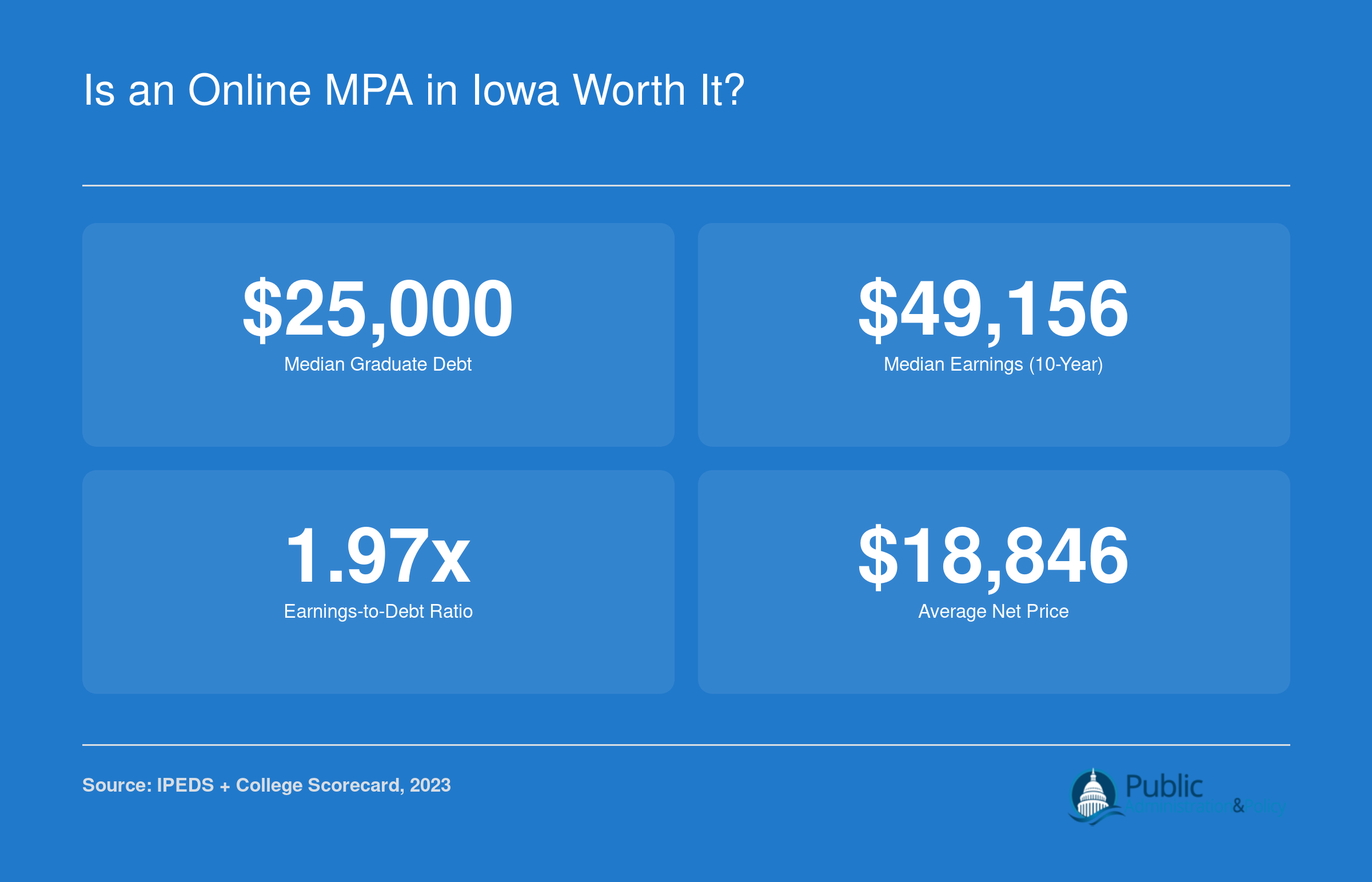
Evaluating the return on investment for an online MPA in Iowa requires weighing total debt against post-graduation earning power. Based on available institutional data for Buena Vista University's accelerated MPA pathway (offered in partnership with Drake University), the numbers suggest a favorable debt-to-earnings picture. With median graduate debt well below median earnings at the 10-year mark, graduates can expect manageable monthly payments relative to their income, making this a sound investment for aspiring public service leaders.
Frequently Asked Questions About Iowa Online MPA Programs
Prospective students often have similar questions when researching online MPA programs in Iowa. Below, we address the most common concerns about accreditation, costs, admissions, and career outcomes to help you make an informed decision.
Is there a NASPAA-accredited online MPA program in Iowa?
The University of Iowa offers a NASPAA-accredited MPA program, which is widely regarded as the gold standard for public administration education. NASPAA accreditation ensures the curriculum meets rigorous peer-reviewed standards in areas such as public service values, analytical skills, and management competencies. If accreditation is a priority, verify each program's current status directly through the NASPAA website, as accreditation cycles are updated periodically.
How much does an online MPA cost in Iowa?
Tuition for online MPA programs in Iowa varies by institution and residency status. In-state students can generally expect to pay between roughly $20,000 and $35,000 for the full degree, while out-of-state rates may be higher. Some programs offer flat per-credit-hour rates for online learners regardless of residency. Always check each university's current tuition schedule and factor in fees, textbooks, and technology costs for a complete picture.
Can I complete an MPA fully online from an Iowa university?
Yes. Several Iowa universities offer MPA programs that can be completed entirely online, with no required campus visits. These programs use asynchronous coursework, live virtual sessions, or a combination of both. This flexibility is especially valuable for working professionals and students outside the state who want an Iowa-based degree without relocating.
Do Iowa online MPA programs require the GRE?
GRE requirements vary by program. Some Iowa MPA programs have moved to GRE-optional or test-free admissions, particularly for applicants with significant professional experience or strong undergraduate records. Others may still require standardized test scores. Check directly with each program's admissions office for the most up-to-date testing policy, as these requirements have shifted frequently in recent years.
What is the difference between an MPA and an MPP degree?
An MPA (Master of Public Administration) focuses on organizational management, leadership, and the implementation of public programs. An MPP (Master of Public Policy) emphasizes policy analysis, research methods, and program evaluation. In practice, the two degrees overlap considerably, but MPA graduates often gravitate toward management roles in government and nonprofits, while MPP graduates frequently pursue positions in policy research or legislative analysis.
What careers can I pursue with an MPA in Iowa?
An MPA opens doors to a wide range of careers in Iowa's public and nonprofit sectors. Common roles include city or county manager, budget analyst, program director, public affairs specialist, and nonprofit executive. Iowa's state government, municipal agencies, healthcare organizations, and community development nonprofits all actively recruit MPA graduates. Federal agencies with regional offices in Iowa also represent a strong employment pathway.
Does Iowa offer tuition reimbursement for state employees pursuing an MPA?
Iowa state government does provide educational assistance programs for eligible employees, though the specifics (including reimbursement caps and qualifying programs) depend on the employee's agency and bargaining unit. Many state employees have used these benefits to offset MPA tuition costs. Contact your agency's human resources office or the Iowa Department of Administrative Services for current eligibility details and reimbursement limits.