Best Online Master of Public Administration Programs in North Dakota

Compare costs, accreditation, and career outcomes for every ND online MPA option

By Max SheltonReviewed by PAP Editoral TeamUpdated June 18, 202625+ min read

What you’ll learn in this article…

  • UND offers North Dakota's only NASPAA-accredited online MPA, combining national recognition with competitive in-state tuition.
  • No GRE is required for admission, and the program's asynchronous format fits working professionals' schedules.
  • Graduates report strong first-year earnings relative to typical student debt, reinforcing the degree's return on investment.
  • Federal financial aid, veteran benefits, employer tuition programs, and institutional scholarships help most students reduce out-of-pocket costs.

North Dakota employs roughly 50,000 state and local government workers spread across 53 counties, many of them rural, and maintains unique administrative partnerships with tribal nations. That combination creates steady demand for public administrators who understand small-population budgeting, intergovernmental relations, and community-level policy implementation.

The state's online MPA options are narrow: only the University of North Dakota offers a NASPAA-accredited Master of Public Administration available fully online. UND's 36-credit-hour program charges the same tuition rate regardless of residency and does not require the GRE, removing two common barriers for working professionals. Candidates who want to strengthen their credentials further can also pursue public administration certifications alongside the degree.

A focused market like North Dakota rewards credentials that carry recognized accreditation and practical skill sets, which makes program quality and cost efficiency especially consequential.

Best Online MPA Programs in North Dakota: Rankings & Comparison

North Dakota offers a single NASPAA-accredited online Master of Public Administration through the University of North Dakota, a program nationally recognized for affordability, flexibility, and deep ties to the state's public and nonprofit sectors. Because only one institution in the state delivers an online MPA, this ranking focuses on what makes UND's offering distinctive rather than comparing multiple in-state options. Prospective students considering out-of-state alternatives should weigh UND's unified online tuition rate, regional case-study curriculum, and strong employer pipeline with North Dakota agencies and tribal governments.

Factors considered
  • NASPAA accreditation status
  • Online delivery and flexibility
  • Tuition and net price
  • Institutional graduation and retention rates
  • Regional career and employer relevance
Data sources
  1. #1

    University of North Dakota

    Grand Forks, ND · $19,000/yr

    Best for: Mid-career North Dakota public servants

    The University of North Dakota, located in Grand Forks, is North Dakota's flagship research institution and the only school in the state offering a NASPAA-accredited online MPA. UND charges a single tuition rate for all online students regardless of residency, making it cost-competitive for learners across the Northern Plains and beyond. The program draws heavily on North Dakota legislative examples, Great Plains policy challenges, and partnerships with state agencies and tribal governments, giving students applied experience rooted in regional realities. With a 60.5% institution-wide graduation rate, an 84% retention rate, and a student-to-faculty ratio of 17:1, UND pairs a large-university resource base with accessible class sizes.

    View program
    Master of Public Administration — Online
    • NASPAA-accredited, 36-credit-hour program completable in about two years
    • No GRE required for admission
    • Same tuition rate for all online students, in-state or out-of-state
    • Synchronous evening classes designed for Central and Mountain time zones
    • Optional health administration focus aligned with rural workforce needs
    • Internship and capstone required; waiver available for experienced professionals
    • Embedded graduate certificates in policy analysis and public administration
    • Career support through the Pancratz Center and partnerships with ND agencies

Tuition & Total Cost Breakdown for North Dakota Online MPA Programs

Understanding the full cost of an online MPA is essential for budgeting, especially if you are balancing tuition against a working professional's salary. The University of North Dakota, the state's primary option for an online Master of Public Administration, offers a pricing structure that is notably transparent and favorable to distance learners.

Per-Credit Rates and Total Tuition

For the 2025-2026 academic year, UND charges online MPA students $506.79 per credit hour in tuition plus $77.27 per credit in fees, bringing the combined per-credit cost to roughly $584.06.1 The program requires 36 credit hours, so the estimated total cost of attendance for tuition and fees alone comes to approximately $21,026. That figure holds whether you complete the degree in two years or stretch it over a longer timeline, since costs are assessed per credit rather than per semester.

At the institutional level, UND's published annual undergraduate and graduate tuition figures (around $10,951 in-state and $15,570 out-of-state) may appear in federal databases, but those numbers reflect blended averages across all programs and enrollment types. The MPA-specific per-credit rate is the figure that matters for your personal budget.

Flat Online Tuition: No Out-of-State Penalty

This is the detail that many program comparison sites overlook. UND charges the same tuition rate for online students regardless of residency.1 Whether you live in Bismarck, Minneapolis, or Phoenix, you pay $506.79 per credit. There is no out-of-state differential for fully online enrollment, which makes UND one of the more affordable online MPA programs in the Upper Midwest and nationally.

How Financial Aid Narrows the Gap

UND's institution-wide average net price after aid sits at approximately $18,551, based on the most recent federal data. Keep in mind that this figure spans all degree levels and student populations, so it serves only as a rough benchmark rather than a precise predictor for graduate students. Still, it illustrates that grants, scholarships, employer tuition assistance, and federal loans can meaningfully reduce what you pay out of pocket. We cover specific aid options in the financial aid section below.

Additional Costs to Plan For

Tuition and mandatory fees do not capture every expense. Budget for the following as well:

  • Textbooks and course materials: Expect $200 to $500 per semester depending on the courses you take and whether you opt for digital or used editions.
  • Technology fees: UND bundles most technology costs into its per-credit fee structure, but you should confirm whether any course-specific software requires a separate license.
  • Capstone or internship expenses: If your capstone project or internship involves travel, site visits, or professional conference attendance, those costs fall on the student. Experienced professionals who qualify for an internship waiver can avoid some of these expenses.
  • Proctoring or exam fees: Some online courses use remote proctoring services that may carry a small per-exam charge.

All told, a realistic total budget for UND's 36-credit online MPA falls in the range of $21,500 to $23,000 when you factor in course materials and incidental fees. That positions the program as one of the more affordable accredited MPA pathways available to North Dakota residents and out-of-state students alike.

At a Glance: UND Online MPA by the Numbers

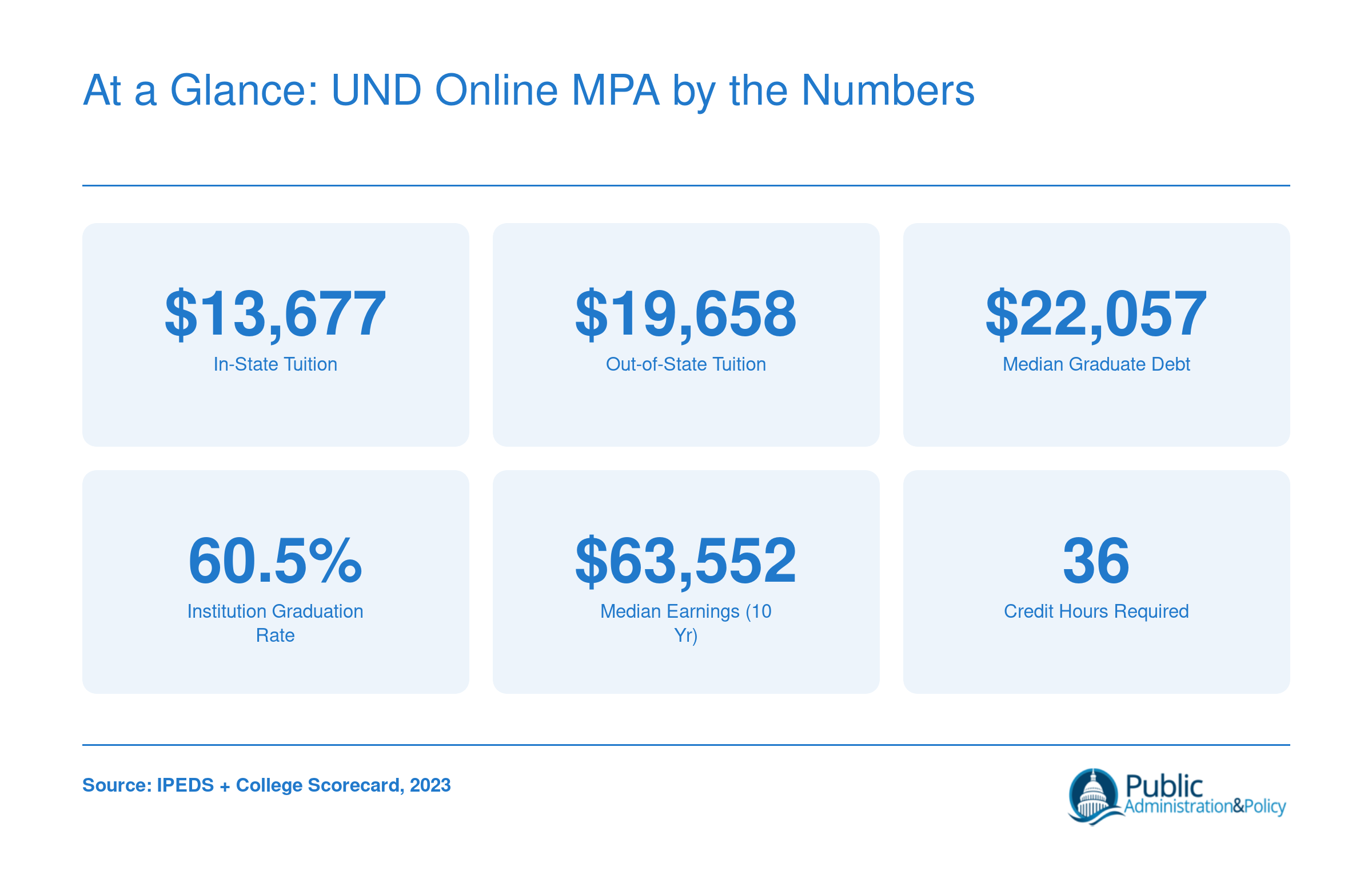
The University of North Dakota offers the only online Master of Public Administration in the state. Here are the key figures prospective students should know before applying.

Six key stats for UND's online MPA: in-state tuition $13,677, out-of-state tuition $19,658, median debt $22,057, graduation rate 60.5%, median earnings $63,552, and 36 credit hours

NASPAA Accreditation & Why It Matters in North Dakota

When evaluating online MPA programs, accreditation should be one of the first things you verify. Not all accreditation is created equal, and for public administration specifically, NASPAA (the Network of Schools of Public Policy, Affairs, and Administration) is the gold-standard accrediting body. Understanding what it means, and confirming whether your target program holds it, can shape your career trajectory for years to come.

What NASPAA Accreditation Means

NASPAA accreditation is earned through a strict peer-review quality-assurance process that evaluates a program's curriculum, faculty qualifications, student support services, and alignment with public service values.1 It serves as a reliable and trustworthy indication of value and quality for prospective students.2 For employers, it functions as a signal of quality and reliability, essentially a stamp of approval that the graduate was trained in a program meeting nationally recognized standards.1

One critical distinction: NASPAA accreditation applies to the specific MPA (or MPP) program, not to the university as a whole. A school can hold regional accreditation while its public administration program lacks NASPAA recognition. Always verify program-level accreditation directly on the NASPAA accreditation directory rather than relying on a school's general accreditation claims.

UND's Accreditation Status

As of 2026, the University of North Dakota's MPA program holds full NASPAA accreditation.3 UND is currently the only NASPAA-accredited MPA option in the state. This makes it the sole North Dakota program that meets the rigorous peer-reviewed benchmarks NASPAA requires, an important consideration if you plan to pursue federal career tracks, transfer credits to another institution, or compete for positions where hiring managers specifically look for graduates of accredited programs.

Why Accreditation Matters for Your Career

The career data from NASPAA-accredited programs underscores why this designation carries real weight. According to NASPAA data, roughly 48 percent of recent graduates from accredited programs entered government positions, while 23 percent joined the nonprofit sector and 17 percent moved into private-sector roles.4 Among alumni further along in their careers, the public-sector share rises to 55 percent, with 22 percent in nonprofits.5 These numbers reflect the strong pipeline accredited programs maintain into mission-driven work.

For federal employment in particular, graduating from a NASPAA-accredited program can matter during the hiring process. Many federal agencies and state governments recognize the accreditation when evaluating candidates, and some leadership development programs or fellowships list it as a preferred or required credential. If you are weighing options in neighboring states, you may also want to compare online MPA programs for Nebraska students or programs in other regions to see how accreditation availability differs.

Graduates of non-accredited programs may still find rewarding careers, but they can face additional hurdles. Employer perception tends to favor candidates from accredited programs, and credit transferability can become an issue if you later pursue a doctoral degree or additional graduate work at a NASPAA-member institution.

How to Verify Accreditation

Before committing to any program, take these steps:

  • Visit NASPAA.org directly: Search the accredited program directory to confirm the specific degree you are considering (not just the school) is listed.
  • Check the accreditation cycle: Programs undergo periodic reaccreditation reviews. Confirm the program is in active, good-standing status for the year you plan to enroll.
  • Ask admissions directly: Request the program's most recent accreditation review date and the next scheduled review, so you know the credential will remain valid throughout your enrollment.

For North Dakota students and professionals, the practical takeaway is straightforward: UND's MPA is the state's only NASPAA-accredited option, and that accreditation carries measurable advantages for public-sector hiring, credit portability, and long-term career advancement.

Admissions Requirements & GRE Policies for North Dakota MPA Programs

One of the most common questions prospective students ask is whether they need to take the GRE before applying. The short answer for North Dakota's primary online MPA option: no, you do not. Here is a closer look at what you will need to submit and how flexible the admissions process can be.

GRE Policy at UND

The University of North Dakota's MPA program does not require GRE scores for admission as of the most recent admissions cycle.1 This policy applies broadly rather than through an individual waiver request, meaning applicants can focus their preparation time and budget on other parts of the application. For students searching specifically for an online MPA with no GRE in North Dakota, UND checks that box outright.

Standard Admissions Requirements

To be considered for regular admission to UND's online MPA program, you will generally need to meet the following criteria:1

  • Bachelor's degree: A completed undergraduate degree from a regionally accredited institution is required.
  • Minimum GPA: Applicants should hold a cumulative GPA of at least 2.75, or a 3.0 in their final 60 undergraduate credits. These thresholds align with the UND Graduate School's baseline requirements.2
  • Statement of purpose: A written essay outlining your professional goals and reasons for pursuing the MPA.
  • Letters of recommendation: Typically two or three letters from academic or professional references who can speak to your readiness for graduate work.
  • Resume or CV: Documentation of relevant work, internship, or volunteer experience in public service, nonprofit management, or related fields.

UND generally accepts applications on a rolling basis, with primary entry points in the fall and spring semesters. Prospective students should check the UND Graduate School's minimum admission requirements for specific deadline dates, as these can shift from year to year.

Accelerated Bachelor's-to-Master's (ABM) Pathway

Current UND undergraduates may be eligible for the Accelerated MPA track, which allows students to begin earning graduate credits before completing their bachelor's degree. This pathway has slightly different thresholds: a cumulative GPA of 3.0 and a minimum 2.5 GPA in the major, with at least 60 undergraduate credits completed at the time of application.3

Transfer Credit Policies

UND does allow a limited number of graduate-level transfer credits to count toward the MPA degree, though the exact cap and eligibility criteria can vary. Credits typically must come from regionally accredited institutions and align with courses in the MPA curriculum. If you have completed relevant graduate coursework elsewhere, it is worth contacting the MPA program director early in the application process to confirm which credits may apply.

Conditional and Provisional Admission

Applicants who fall slightly below the standard GPA thresholds or who have other gaps in their application materials may still have a path forward. UND's Graduate School offers provisional or conditional admission in some cases, allowing students to enroll with the expectation that they meet specific academic benchmarks during their first semester of coursework. This can be a valuable option for career changers or professionals returning to school after time away from academics. Exact terms for conditional admission are determined on a case-by-case basis, so reaching out to the admissions office directly is the best way to understand your options.

Overall, UND has structured its MPA admissions process to be accessible for working professionals. The absence of a GRE requirement, combined with rolling admissions and provisional pathways, lowers common barriers that keep experienced public servants from advancing their education. If you eventually want to pursue doctoral-level work, you can explore online doctoral programs public administration after completing the MPA.

Questions to Ask Yourself

Most online MPA options in North Dakota use asynchronous delivery, which suits professionals juggling work schedules. If real-time interaction with faculty and peers is critical to your learning style, confirm whether the program offers synchronous sessions or residency components.

North Dakota's public sector landscape includes unique opportunities in tribal administration and energy policy. Choosing a concentration that matches your career goals ensures the coursework builds directly relevant skills rather than leaving gaps you would need to fill later.

Part-time enrollment lets you keep earning while studying, but it extends the time to degree completion. If career advancement is time-sensitive, look for programs that offer accelerated tracks or the ability to take heavier course loads during lighter work periods.

Some North Dakota online MPA programs charge a flat per-credit rate regardless of residency, while others add surcharges for out-of-state students. Calculating the full cost before you apply helps you compare financial aid packages and avoid surprises.

Curriculum, Concentrations & Online Format

Online Delivery Format at UND

The University of North Dakota's Master of Public Administration is designed as a fully online program, making it accessible to working professionals across the state and beyond. Coursework is delivered asynchronously, meaning students can log in, view lectures, and complete assignments on their own schedule rather than attending class at a set time. There is no mandatory on-campus residency or in-person component required to complete the degree. The capstone experience, which typically involves an applied research project or professional portfolio, can also be completed remotely. This format is especially practical for students in rural parts of North Dakota who may be hours from the Grand Forks campus.

Core Curriculum and Public-Sector Competencies

The MPA curriculum at UND is built around foundational areas that align with the competencies public-sector employers expect. Core coursework generally covers:

  • Public Budgeting and Finance: Prepares graduates to manage government and nonprofit budgets, analyze fiscal policy, and navigate public revenue systems.
  • Policy Analysis: Teaches students to evaluate existing policies, model outcomes, and draft evidence-based recommendations.
  • Organizational Management: Covers leadership, human resource management, and strategic planning within public agencies.
  • Research Methods: Equips students with quantitative and qualitative tools for program evaluation, data-driven decision-making, and performance measurement.
  • Ethics and Public Service Values: Grounds all other coursework in the ethical obligations unique to serving the public interest.

These areas map directly to competency domains outlined by NASPAA accreditation standards, ensuring graduates are prepared for leadership roles in government, tribal organizations, and nonprofits.

North Dakota-Relevant Concentrations and Electives

One of the distinguishing features of pursuing an MPA in North Dakota is the opportunity to tailor elective work toward issues that define the state's governance landscape. Students can explore coursework related to rural governance, addressing the unique challenges of administering services across sparsely populated areas. Similar dynamics exist for students pursuing online MPA programs in Alaska, where geographic isolation shapes public administration in comparable ways. Tribal administration electives are also notable given North Dakota's significant Native American population and the complex intergovernmental relationships between tribal, state, and federal entities. Nonprofit management coursework rounds out the options, reflecting the outsized role that nonprofits play in delivering health, education, and social services in smaller communities. These focus areas set UND's program apart from more generic MPA offerings that tend to emphasize large metropolitan governance.

MPA vs. MPP vs. MPAP: Choosing the Right Degree

Prospective students sometimes confuse the Master of Public Administration with the Master of Public Policy (MPP) or the Master of Public Affairs and Policy (MPAP). While there is overlap, the degrees serve different career trajectories. The MPA emphasizes management, leadership, and the operational side of running public organizations. It is the degree of choice for professionals who want to direct programs, manage budgets, or lead agencies. The MPP, by contrast, leans more heavily into research, econometrics, and the analytical process of designing and evaluating policy. The MPAP blends elements of both. If your goal is to manage a city department, lead a tribal housing authority, or direct a statewide nonprofit, the MPA is typically the strongest fit. If you see yourself working in a legislative research office or a policy think tank, an MPP may serve you better. North Dakota's public-sector job market, which is heavily oriented toward direct service delivery and agency management, tends to reward the practical, leadership-focused skill set that an MPA provides. For a broader look at where that skill set can take you, explore careers in public administration.

Career Outcomes for MPA Graduates in North Dakota

North Dakota's public sector offers a distinctive landscape for MPA graduates, one shaped by rural service delivery, tribal governance, and a state government that relies heavily on a relatively small pool of credentialed administrators. Understanding what those careers actually pay, and how they compare to the cost of earning the degree, can help you decide whether the investment makes sense.

What MPA Graduates Can Expect to Earn

Program-level earnings data for the University of North Dakota's MPA are not yet available through federal reporting. However, real-world salary ranges from current North Dakota job postings provide a useful benchmark. Positions on the North Dakota Legislative Branch staff, including policy analyst, program evaluator, and legislative administrative specialist roles based in Bismarck, advertise salaries in the $50,000 to $85,000 range.1 Mid-level county support staff across the state earn roughly $52,000 to $58,000 annually.2 At the senior end, a county administrator position in Burleigh County lists a salary range of approximately $119,683 to $153,940, with an MPA noted as a preferred credential.2 For broader context on how these figures compare nationally, our public administration salary guide breaks down earnings across roles and regions.

These figures suggest a clear earnings trajectory: entry-level and mid-career public servants can expect solid five-figure salaries, while senior administrative roles push well into six figures.

Top Employers and Career Paths

MPA holders in North Dakota fill roles across a wide range of organizations, spanning many of the public administration jobs outlined in national career frameworks:

  • State government: The North Dakota Legislature, Governor's office, and executive agencies hire policy analysts, budget specialists, and program managers.
  • City and county government: City managers, county administrators, planning directors, and finance officers are common MPA career paths, especially in growing communities like Bismarck, Fargo, and Grand Forks.
  • Tribal nations: North Dakota is home to five federally recognized tribes, each operating complex governmental structures that need professionals trained in public budgeting, grant management, and intergovernmental relations.
  • Nonprofits and healthcare: Rural healthcare systems and community development organizations value MPA skills in strategic planning and grant administration, particularly in underserved areas.
  • Federal field offices: Agencies such as the USDA Rural Development office, the Bureau of Indian Affairs, and the Army Corps of Engineers maintain a presence in the state.

North Dakota-Specific Career Niches

Several career paths stand out as especially relevant in the state. Rural community development is a perennial need; small towns across western and central North Dakota require administrators who can manage municipal services with lean budgets. Tribal governance administration is another growth area, combining public finance, federal compliance, and culturally informed leadership. Healthcare administration in rural settings draws on MPA competencies in organizational management and public policy, and the state's aging population intensifies demand. Legislative staff positions in Bismarck offer a direct policy influence that is harder to access in larger, more competitive state capitals.

The ROI Picture

UND's in-state graduate tuition for the MPA program runs approximately $13,677 for the full 36-credit curriculum, while out-of-state online students pay closer to $19,658. Even when factoring in fees and course materials, the total investment remains modest compared to many graduate programs nationally. When you weigh that cost against starting salaries in the $50,000 to $60,000 range and the potential to reach six figures in senior roles, the return on investment is compelling. It is also worth noting that 2026 has brought some flux to North Dakota's state workforce: over 101 state employees recently accepted voluntary buyout packages, which may create openings that MPA graduates are well positioned to fill.3

For professionals already working in North Dakota government or nonprofits, the degree often accelerates promotion timelines rather than opening an entirely new career, making the cost-to-benefit calculation even more favorable.

Accelerated & Part-Time Pathways for Working Professionals

One of the most common questions prospective students ask is how long it takes to complete an online MPA part-time. The answer depends on how many credits you take per semester and whether the program follows a cohort model or allows self-paced enrollment. At the University of North Dakota, the online MPA program is designed with working professionals in mind, offering flexible scheduling that accommodates both full-time and part-time enrollment. UND typically provides multiple entry points throughout the academic year rather than a single fixed cohort start, giving students added flexibility when planning their studies.

FeatureFull-Time PathwayPart-Time Pathway
Typical Completion TimelineApproximately 2 years (4 semesters)Approximately 3 to 4 years, depending on course load per semester
Credits Per Semester9 to 12 credits per semester3 to 6 credits per semester
Course StructureMultiple courses running concurrently each termOne or two courses per term, allowing balance with professional responsibilities
Entry PointsFall and spring admission availableFall and spring admission available, with flexibility to start in summer terms when offered
Enrollment ModelSelf-paced within structured semester terms (not a lock-step cohort)Self-paced within structured semester terms (not a lock-step cohort)
4+1 or Accelerated OptionUND does not currently advertise a formal 4+1 accelerated bachelor's-to-MPA pathway; students should contact the department for any combined degree arrangementsNot applicable for part-time graduate students
Best Suited ForStudents who can dedicate significant weekly hours to courseworkWorking professionals, military personnel, and those balancing family or career obligations

Financial Aid, Veteran Benefits & Scholarships for ND MPA Students

Paying for a graduate degree is a legitimate concern, but MPA students in North Dakota have multiple avenues to reduce out-of-pocket costs. Between federal aid, institutional support, military benefits, and employer programs, most students can piece together a funding strategy that makes an online MPA financially manageable.

Federal Financial Aid

Every MPA student should start by filing the FAFSA. Graduate students are automatically considered independent for federal aid purposes, which simplifies the process. Key federal options include:

  • Direct Unsubsidized Stafford Loans: Available up to $20,500 per year at fixed interest rates, regardless of financial need.
  • Grad PLUS Loans: Cover remaining cost of attendance after Stafford limits are reached. These require a credit check but offer flexible repayment options, including income-driven plans that are especially relevant for public service careers.
  • Public Service Loan Forgiveness (PSLF): MPA graduates working in government or qualifying nonprofits may have remaining federal loan balances forgiven after 120 qualifying payments, a powerful incentive for those planning public sector careers in North Dakota.

UND Graduate Assistantships and Scholarships

The University of North Dakota offers graduate assistantships that can include tuition waivers and monthly stipends, though availability for fully online students may be limited. The Department of Political Science and Public Administration periodically awards merit-based scholarships to MPA students. Prospective applicants should contact the department directly about current opportunities, as funding varies by academic year. UND's Graduate School also maintains a searchable database of institutional fellowships and awards. Students who are not yet ready for a full master's program might consider a graduate certificate in public administration as a lower-cost entry point that often carries transferable credits.

Veteran and Military Benefits

North Dakota is home to Grand Forks Air Force Base and Minot Air Force Base, making military-connected students a significant part of the MPA applicant pool. UND participates in the Yellow Ribbon Program, which can cover tuition costs that exceed standard GI Bill benefits. Active-duty service members, veterans, and eligible dependents should explore:

  • Post-9/11 GI Bill: Covers tuition and fees and provides a monthly housing allowance, even for online students (at a reduced rate).
  • Yellow Ribbon Program: UND partners with the VA to bridge any gap between GI Bill maximums and actual tuition charges.
  • North Dakota National Guard Tuition Assistance: Guard members in North Dakota may qualify for state-funded tuition assistance that stacks with federal benefits.

UND holds Military Friendly designation, and a dedicated Veterans Services office helps students navigate benefit applications and enrollment certification.

Employer Tuition Reimbursement

Many working professionals in North Dakota state agencies, tribal governments, and local municipalities take advantage of employer tuition reimbursement programs. State of North Dakota employees, for instance, may access professional development funding through their agencies. This strategy is especially common among mid-career professionals pursuing an MPA to qualify for management roles. If your employer offers reimbursement, coordinate early with both your HR department and UND's billing office to align payment timelines.

What Students Typically Pay After Aid

After factoring in grants, scholarships, military benefits, or employer support, many students pay considerably less than the published sticker price. Federal data indicates that the average net price at UND for graduate students is well below the full listed tuition, though individual costs depend on aid eligibility and the specific funding sources a student secures. Planning ahead and layering multiple forms of support is the most reliable way to keep your total investment in line with what the degree will return over a public administration career.

Frequently Asked Questions About Online MPA Programs in North Dakota

Prospective MPA students in North Dakota often share similar questions about program format, cost, and career value. Below, we answer the most common questions to help you make a confident, well-informed decision about pursuing your Master of Public Administration online in 2026.

The University of North Dakota offers its MPA program in a fully online format, meaning students can complete all required coursework remotely without traveling to campus. This makes it especially convenient for working professionals and students in rural areas of North Dakota. Some elective or capstone experiences may involve community-based projects, but these can typically be completed in your local area.

Tuition for UND's online MPA program is structured on a per-credit basis and applies the same rate to both in-state and out-of-state students. Total program costs generally fall in a range that is competitive with other public university MPA programs in the Upper Midwest. Always confirm the latest tuition schedule directly with UND, as rates may adjust each academic year. Additional fees for technology and student services may also apply.

UND's MPA program does not require GRE scores for admission as of 2026, which lowers a significant barrier for experienced professionals looking to advance their careers. Applicants are evaluated based on undergraduate GPA, professional experience, a personal statement, and letters of recommendation. This no-GRE policy reflects a broader national trend among NASPAA-accredited programs.

Yes, as of 2026, the University of North Dakota is the only institution in the state that holds NASPAA (Network of Schools of Public Policy, Affairs, and Administration) accreditation for its MPA program. NASPAA accreditation is the gold standard for public administration education and signals that the curriculum, faculty, and student outcomes meet rigorous national benchmarks.

Part-time students at UND typically complete the online MPA in approximately three years, though timelines vary depending on the number of credits taken each semester. Full-time students can often finish in about two years. UND offers flexible scheduling with asynchronous coursework, allowing students to balance professional and personal responsibilities while progressing through the program at a sustainable pace.

MPA graduates in North Dakota pursue careers in city and county management, state government administration, nonprofit leadership, tribal governance, healthcare administration, and policy analysis. Common roles include budget analyst, program manager, planning director, and public affairs specialist. North Dakota's growing public sector needs, particularly in energy policy and rural development, create steady demand for MPA-trained professionals.

An MPA (Master of Public Administration) focuses on organizational management, budgeting, and leadership within government and nonprofit settings. An MPP (Master of Public Policy) emphasizes policy analysis, research methods, and evaluation. An MPAP (Master of Public Administration and Policy) blends elements of both. For students seeking hands-on management roles in North Dakota's public or nonprofit sectors, the MPA is typically the most practical choice.

Recent Articles