Compare accredited, affordable online MPA programs that don't require the GRE — with cost, outcomes, and career data.
By Holly AbramsonReviewed by PAP Editoral TeamUpdated August 5, 202625+ min read
What you’ll learn in this article…
Programs that dropped GRE requirements roughly doubled enrollment among underrepresented minority students, per Council of Graduate Schools data.
NASPAA accreditation remains the clearest quality signal when comparing no-GRE MPA programs for 2026.
Several fully online no-GRE MPA programs cost under $15,000 per year after grants and scholarships are applied.
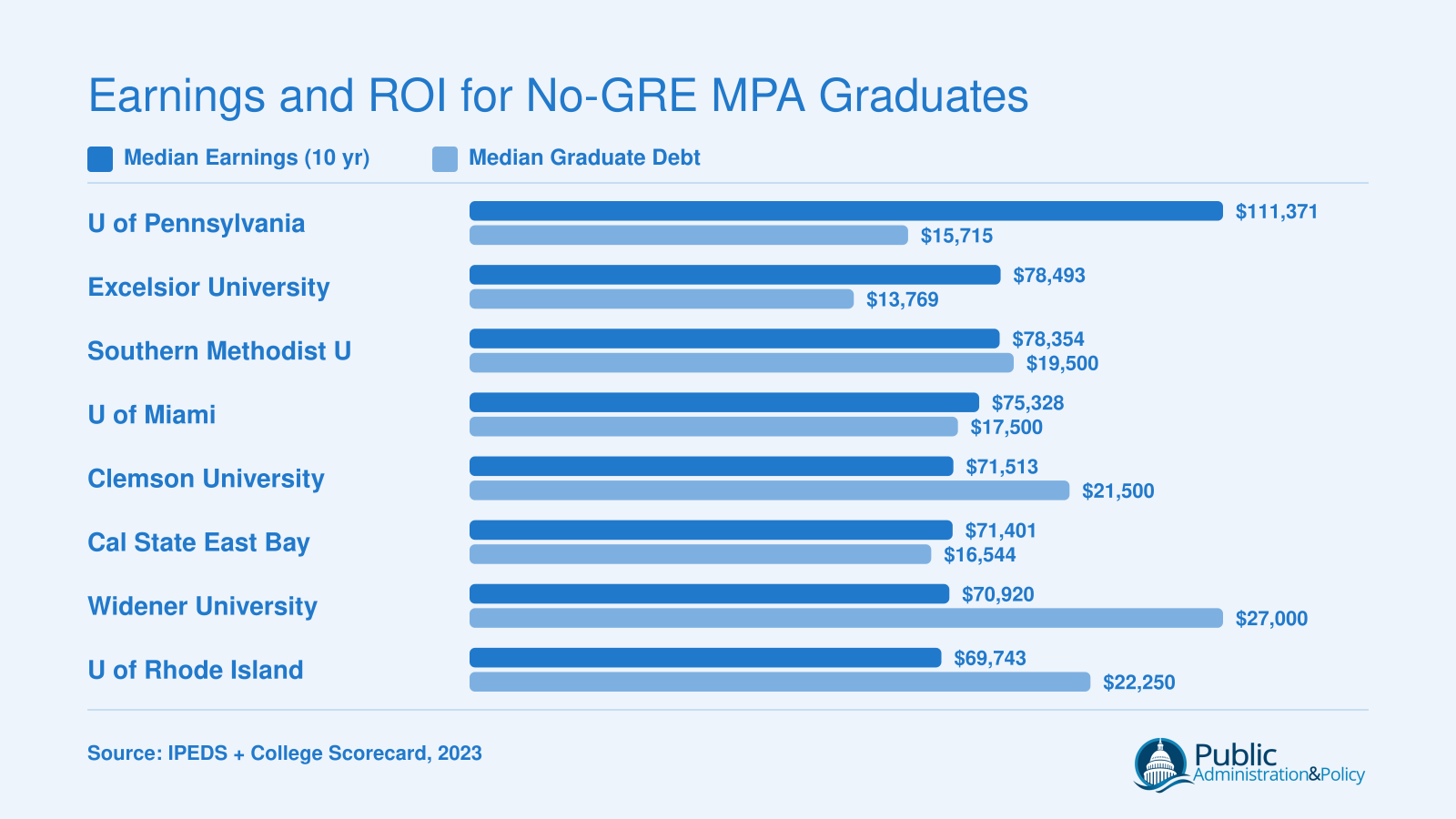
Median earnings ten years after enrollment at top no-GRE MPA institutions confirm strong long-term return on investment.
More than half of NASPAA-accredited MPA programs now accept applicants without GRE scores, a sharp increase from fewer than one in five a decade ago. That shift has not diluted program rigor. Many of the same universities that top public affairs rankings simply moved their evaluation weight toward professional experience, writing samples, and undergraduate GPA.
The practical tension for applicants is real: dropping a $220 exam fee and weeks of test prep sounds appealing, but the range in tuition, format, and career outcomes across no-GRE MPA programs is wide. Annual costs span roughly $7,000 to over $40,000, and not every test-optional program carries the NASPAA seal that federal and state hiring managers increasingly treat as a baseline credential. If budget is a driving factor, comparing affordable online MPA programs early in your search can help you separate strong value from sticker shock.
Best No-GRE MPA Programs for 2026
The following no-GRE MPA programs represent some of the strongest options available in 2026 for students who want to earn a Master of Public Administration without submitting standardized test scores. Each program listed below has been identified as test-optional or test-free based on publicly available admissions information; however, policies can change, so we recommend confirming directly with each program before applying. Programs are evaluated on a composite of affordability, institutional graduation rate, and post-graduation outcomes to help you find the best fit for your career goals and budget.
Factors considered
Tuition and net price
Institutional graduation rate
Post-graduation earning potential
Program format and flexibility
Concentration and credential options
Data sources
NCES-IPEDS federal institutional data — nces.ed.gov
Best for: Mid-career professionals seeking accelerated completion
The University of New Hampshire's Carsey School of Public Policy delivers a fully online MPA with a firmly test-free, holistic admissions process that weighs professional experience alongside academic records. Students can choose between a standard 16-month track or an accelerated 12-month Executive MPA designed for seasoned professionals, all while remaining fully employed. Optional in-person electives at the Durham campus and an annual Washington, D.C. Colloquium with policymakers add experiential depth that few online programs can match.
View program
Master of Public Administration — Online
36 credit hours, completable in 12 or 16 months
No GRE required; holistic admissions review
Concentrations in Management and Leadership, Program Planning and Development
Fully asynchronous online delivery with optional on-campus electives
Fall, spring, and summer start dates available
Capstone experience required; Executive MPA track for experienced professionals
Partner scholarships from public service organizations
Best for: Out-of-state students wanting flat tuition
The University of Kentucky's Martin School of Public Policy and Administration offers a NASPAA-accredited online MPA where GRE scores are explicitly not considered in admissions decisions. One flat tuition rate applies to all online students regardless of residency, and a graduate tuition cap keeps costs predictable for students taking heavier course loads. The diploma does not indicate online delivery, giving graduates a credential indistinguishable from the on-campus degree.
View program
Master of Public Administration, Public Financial Management — Online
40 credit hours at $790 per credit
No GRE required or accepted in the review process
Concentrations in Public Financial Management and Nonprofit
NASPAA accredited; ranked among top 30 programs nationally
Fully asynchronous except one capstone course
Same tuition rate for in-state and out-of-state online students
Graduate tuition cap available for full-time enrollees
Louisiana State University and Agricultural & Mechanical College
Baton Rouge, LA · $15,000 – $20,000/yr
Best for: Public safety workers needing flexible scheduling
Louisiana State University's online MPA, offered through the E. J. Ourso College of Business, combines NASPAA accreditation with four annual start dates and a 100% online, no-campus-visit format. The program is particularly well suited to students juggling irregular work schedules in public safety or emergency management. At $730 per credit hour, the 36-credit degree totals roughly $26,280, and stackable certificates let students earn credentials along the way.
View program
Master of Public Administration — Online
36 credit hours at $730 per credit; total approximately $26,280
No GRE or GMAT required for admission
NASPAA accredited with strong alumni network
Four start dates per year for maximum entry flexibility
Curriculum covers data analytics, budgeting, and capstone project
Stackable certificates overlap with MPA coursework
The University of North Dakota's MPA program does not require the GRE for any modality, whether online or on campus. Online students pay a unified tuition rate with no nonresident premium, and synchronous classes are recorded for students who cannot attend live sessions. An internship waiver for applicants with substantial public or nonprofit experience allows mid-career professionals to focus on advanced coursework and finish more efficiently.
View program
Master of Public Administration — Online
36 credit hours; estimated two-plus years to complete
No GRE required regardless of delivery format
Unified online tuition rate for all students, no out-of-state surcharge
Synchronous classes with recordings for asynchronous access
Internship waiver available for experienced professionals
NASPAA accredited; career support through Pancratz Center
Covers ethics, public budgeting, policy analysis, and management
Ohio University's online MPA from the Voinovich School offers three distinct concentrations and a unique single-course pacing model, where students focus on one class every seven weeks. This approach is designed to minimize time conflicts for full-time workers, especially those in shift-based public service roles. Up to nine transfer credits are accepted, and the program costs $836 per credit hour with no distinction between in-state and out-of-state online students.
View program
Master of Public Administration, Public Leadership and Management — Online
36 credit hours at $836 per credit; completable in two years
No GRE or GMAT required for admission
Concentrations: Public Leadership, Non-Profit Management, State/Local Government
One course every seven weeks for focused, manageable pacing
Up to 9 transfer credits accepted from prior graduate work
Fully asynchronous online delivery
Optional Project Management or Nonprofit Leadership certificates
Widener University's online MPA stands out for its small, seminar-style synchronous classes and an 11-to-1 student-faculty ratio that fosters close mentorship. The 34-credit program costs $870 per credit and admits on a rolling basis with no GRE requirement, making it especially welcoming for career changers and those returning to school after extended breaks. Four specialization options let students align their studies with specific public or nonprofit career paths.
View program
Master of Public Administration — Online
34 credits at $870 per credit; average two-year completion
No GRE required; rolling admissions year-round
Specializations in Criminal Justice, Local Government, Nonprofit Leadership, Human Sexuality Studies
Synchronous evening classes with small seminar-style discussions
11:1 student-faculty ratio for personalized support
Financial aid and transfer credits available
Institutional median earnings of $70,920 ten years after enrollment
Norwich University's online MPA is built around sequential 11-week courses with a maximum of 15 students per class, creating an intimate cohort experience. The program is especially accessible to military-connected students through extensive tuition discounts and Yellow Ribbon participation. Three concentrations, an exit portfolio capstone, and acceptance of up to 12 transfer credits (including eligible military training) make the 36-credit degree adaptable to a wide range of professional backgrounds.
View program
Master of Public Administration, public works and sustainability — Online
36 credit hours; completable in 18 months
No GRE or GMAT required; 2.75 minimum GPA
Concentrations: Public Works/Sustainability, Criminal Justice, Leadership/Crisis Management
Maximum 15 students per class for high-interaction learning
Up to 12 transfer credits accepted, including military training
Military tuition discounts and Yellow Ribbon participation
Texas A&M International University offers one of the most affordable NASPAA-accredited, no-GRE MPA programs in the country, with a net price of approximately $3,637 and in-state tuition of about $6,650. The 42-credit program uses a personal admissions interview instead of standardized testing to evaluate candidates. As a Hispanic-Serving Institution with deep ties to South Texas and border communities, TAMIU is especially well positioned for students interested in public service in diverse, underserved areas.
View program
Master of Public Administration — Online
42 credit hours: 33 core hours plus 9 elective hours
No GRE required; personal admissions interview used instead
NASPAA accredited since 2013
Optional Nonprofit Leadership and Management Certificate
In-state tuition approximately $6,650; net price around $3,637
Entirely online delivery designed for mid-career professionals
The University of New Haven's online MPA offers six concentration options, from Municipal Management to Fire and EMS, making it one of the most specialized no-GRE programs available. A 30% tuition discount for state employees, nonprofit workers, social workers, and local government employees meaningfully reduces costs. Courses run in six- to eight-week blocks with one course at a time, a structure that works well for public safety professionals managing demanding schedules.
View program
Master of Public Administration — Online
36 credits with six concentration options
No GRE or GMAT required for admission
30% tuition discount for public and nonprofit employees
Concentrations include Municipal Management, Fire/EMS, Public Safety
Six- to eight-week course blocks, one course at a time
Fully online with 24/7 access and flexible scheduling
Designed for both early-career and experienced professionals
West Texas A&M University's 100% online MPA is tailored for professionals serving rural and regional communities, with concentrations in Rural/Local Government, Criminal Justice Administration, and Public Management. In-state tuition of roughly $7,284 and acceptance of Texas-specific tuition waivers (including the Firefighter Tuition Waiver) make it one of the most budget-friendly no-GRE options. Rolling admissions and both thesis and non-thesis completion paths give students additional control over their timeline and academic experience.
View program
Master of Public Administration — Online
36 credit hours; 100% online delivery
No GRE required; minimum 2.75 GPA for admission
Concentrations: Rural/Local Government, Criminal Justice, Public Management
In-state tuition approximately $7,284; out-of-state about $8,574
Program scholarships up to $2,000; over $26,000 awarded recently
Thesis and comprehensive exam completion options available
Rolling admissions with priority and final deadlines each term
Dropping the GRE from your checklist does not mean dropping your standards. The best no-GRE MPA programs still meet every benchmark that separates a career-launching degree from a credential that collects dust. Here is how to evaluate them on the dimensions that actually matter.
Four Pillars That Separate Strong Programs From the Rest
When comparing no-GRE MPA options, anchor your research to four measurable pillars:
NASPAA accreditation: This is the gold standard for public affairs education. A program holding NASPAA accreditation has been peer-reviewed for curriculum quality, faculty qualifications, and mission alignment with public service values. It also signals that employers and federal agencies will recognize your degree.
Total cost of attendance: Tuition varies enormously across no-GRE programs, from under $15,000 to well above $60,000. Looking at the full cost, including fees, course materials, and any residency travel, gives you a realistic picture of the financial commitment.
Post-graduation earnings and ROI: A degree is an investment. Median earnings after graduation help you gauge whether a program's graduates are landing roles that justify the tuition. When earnings data is paired with cost, you can compare return on investment across schools.
Format flexibility: Some programs are fully online, others blend online coursework with in-person intensives, and a few remain campus-based with test-optional policies. The right format depends on whether you are working full time, managing family responsibilities, or relocating.
If budget is a top concern, exploring affordable online MPA programs can help you identify options that balance cost with quality.
Not All "No GRE" Policies Are the Same
Read the fine print before you assume you are off the hook. Admissions policies fall into three broad categories:
Permanent waivers: The program does not accept or consider GRE scores at all. UC Berkeley's Goldman School of Public Policy and the University of Michigan's Ford School, for example, do not accept the GRE for their MPP programs as of the 2024 to 2026 admissions cycles.1
Conditional waivers: You qualify for a waiver if you meet a GPA threshold, hold a certain number of years of professional experience, or both. The University of Chicago's Harris School, for instance, offers a GRE waiver under specific criteria for 2026 entry.2
Holistic or test-optional review: Programs like Princeton's School of Public and International Affairs list the GRE as optional, while Columbia's SIPA describes it as recommended. Syracuse Maxwell's MPA program takes a similar approach, calling the exam optional but recommended.1
Knowing which category a school falls into saves you time and application fees. A "waiver available" program still requires you to demonstrate eligibility, which is a different experience from applying to a school that simply never asks.
No GRE Does Not Mean Less Rigorous
A persistent myth holds that programs dropping the GRE must be lowering their bar. The reality is the opposite in many cases. Several elite NASPAA-accredited schools eliminated the exam after accumulating evidence that GRE scores are weak predictors of graduate-level success in public affairs. These institutions shifted toward evaluating professional experience, writing samples, and demonstrated commitment to public service, criteria that arguably tell admissions committees more about your readiness than a standardized test score.
The trend accelerated during and after the pandemic, but it is rooted in longer-running research questioning the GRE's predictive validity across many graduate disciplines, not just public administration.
A Note on Graduation Rates
You will see institution-wide graduation rates referenced as a quality indicator across program profiles. These rates reflect the overall undergraduate and graduate completion environment at a university rather than the MPA program specifically. Think of them as a proxy for the school's broader student support infrastructure: advising, financial aid responsiveness, career services, and academic resources. A university with strong completion rates tends to invest in the systems that help all students, including MPA candidates, finish what they started.
According to a Council of Graduate Schools report on holistic review in graduate admissions, programs that adopted test-optional policies saw enrollment rates among underrepresented minority students roughly double. For prospective MPA students in 2026, this trend signals that dropping the GRE requirement can meaningfully expand access to public service education.
Cheapest Online No-GRE MPA Programs
Tuition is one of the biggest factors when choosing a no-GRE MPA program, but published sticker prices rarely tell the full story. The "net price" column below reflects the average annual cost after grants and scholarships are applied, giving you a more realistic picture of what students actually pay. One critical savings lever to watch for: some schools extend in-state tuition rates to all online students regardless of where they live, effectively erasing the out-of-state premium. Arkansas State University, for example, advertises no difference between in-state and out-of-state online tuition. Always confirm current GRE policies directly with each program before applying, as test requirements can change between admissions cycles.
If you are weighing no-GRE MPA programs, accreditation should be near the top of your checklist. Not every MPA carries the same weight with employers, and the distinction often comes down to whether the program holds NASPAA accreditation.
Why NASPAA Accreditation Matters
The Network of Schools of Public Policy, Affairs, and Administration (NASPAA) is the recognized global accreditor for master's programs in public affairs, public policy, and public administration.1 A NASPAA-accredited program has undergone a rigorous peer review of its curriculum, faculty qualifications, student outcomes, and mission alignment with public service values. For students, this translates into three practical advantages:
Employer recognition: Many federal agencies and state civil-service systems give preference (or outright require) degrees from NASPAA-accredited programs when filling management-track positions.
Curriculum rigor: Accredited programs must cover core competencies such as public budgeting, policy analysis, organizational management, and ethical governance, so you graduate with a well-rounded skill set.
Portability: The credential is understood nationwide, which matters if your career takes you across state lines or into international development work.
NASPAA-Accredited Online MPA Programs That Do Not Require the GRE
The list below draws on the 2025-2026 NASPAA roster of accredited programs and confirmed admissions policies.2 Each program is delivered fully online (unless noted) and either permanently waives the GRE or offers a conditional waiver tied to GPA or experience.
Arizona State University: Fully online. Permanent GRE waiver. Offers concentrations in areas such as public management and nonprofit leadership.
American University: Fully online. Permanent GRE waiver. Known for its Washington, D.C. policy network and specialized tracks in public financial management and organizational management.
University of Delaware: Fully online. Permanent GRE waiver. A compact program well suited to working professionals in the Mid-Atlantic region.
University of Kentucky: Fully online. No GRE required. NASPAA-accredited with a concentration in public financial management. Requires a minimum 2.75 GPA and charges $790 per credit (40 credits total).
Louisiana State University: Fully online. No GRE required. NASPAA-accredited, 36 credit hours at $730 per credit. Four start dates per year and a non-thesis capstone structure.
University of North Dakota: Fully online. Conditional GRE waiver for applicants with a 3.25 GPA or higher. NASPAA-accredited; 36 credit hours with synchronous class sessions and the same tuition rate for in-state and online students.
California State University, Dominguez Hills: Fully online. Permanent GRE waiver. A strong option within the Cal State system for students seeking affordability.
California State University, San Bernardino: Fully online. Conditional GRE waiver for applicants holding a 3.0 GPA. Another affordable Cal State option with NASPAA backing.
Marist College: Fully online. Permanent GRE waiver. A private institution in New York offering a focused public administration curriculum.
Seton Hall University: Fully online. Permanent GRE waiver. Located in New Jersey with deep ties to public service employers in the Northeast.
Tennessee State University: Fully online. Conditional GRE waiver. A NASPAA-accredited HBCU offering graduate certificate bridge pathways in public policy, nonprofit management, and local government management.
Texas A&M International University: Fully online. No GRE required. NASPAA-accredited since 2013 with 42 credit hours and a nonprofit certificate option.
Villanova University: Fully online. Permanent GRE waiver. Combines a strong reputation in the Philadelphia region with flexible online delivery.
Penn State: Fully online. Permanent GRE waiver. Backed by one of the largest alumni networks in public affairs education.
Texas Southern University also holds NASPAA accreditation and permanently waives the GRE for its Executive Online MPA, though that program requires short on-campus visits rather than a purely online format.
A Note on Conditional Waivers
Several programs on this list label their GRE waiver as "conditional," meaning you must meet a minimum GPA threshold or demonstrate qualifying professional experience. If your undergraduate GPA falls below the stated cutoff, you may still be evaluated holistically, but you could be asked to submit test scores. Always confirm the latest waiver criteria directly with the admissions office before assuming you are exempt.
Verify Before You Commit
Accreditation status can change. Programs may enter or exit the NASPAA review cycle, and new online offerings are added each year. Before finalizing your application list, visit the 2025-2026 roster of accredited programs to confirm a school's current standing. Cross-referencing takes only a few minutes and protects you from enrolling in a program that has let its accreditation lapse.
Earnings and ROI for No-GRE MPA Graduates
How does an MPA translate into earning power? The chart below compares median earnings ten years after enrollment at top no-GRE MPA institutions. While program-level earnings shortly after completion are not yet reported for these programs, the institution-wide figures offer a useful benchmark. For context, the Bureau of Labor Statistics reports that administrative services managers earn a median of $106,880, urban and regional planners earn $83,720, and political scientists earn $139,380, placing MPA graduates squarely in competitive salary territory across common public administration career paths.
Questions to Ask Yourself
Do I need a NASPAA-accredited program for my career goals, or is regional accreditation sufficient?
Some federal and state agencies prefer or require NASPAA accreditation for hiring and promotion. If your target roles list it as preferred, choosing a regionally accredited but non-NASPAA program could narrow your competitiveness in those applicant pools.
Am I comparing total cost of attendance, including fees and out-of-state tuition differentials, or just headline per-credit rates?
Many online MPA programs charge technology fees, course materials fees, or higher rates for out-of-state students. A program advertising a low per-credit tuition may actually cost thousands more than a slightly higher-priced competitor once all charges are factored in.
Does my professional experience qualify me for a GRE waiver, and have I confirmed which of my target programs offer conditional waivers?
Waiver policies vary widely: some schools waive the GRE for applicants with three or more years of relevant experience, while others have eliminated the requirement entirely. Confirming each program's current policy prevents wasted application fees or last-minute test prep.
Can I realistically meet residency, practicum, or capstone requirements given my current work schedule?
Even fully online no-GRE MPA programs may require an in-person capstone weekend, a local practicum placement, or synchronous evening sessions. Overlooking these requirements can derail your timeline if your employer or location makes them difficult to fulfill.
Admissions Requirements for No-GRE MPA Programs
Dropping the GRE from your application checklist does not mean the rest of the process is light. Most no-GRE MPA programs have shifted their evaluation weight toward other components that, in many cases, tell admissions committees far more about your readiness for graduate-level public administration coursework than a standardized test score ever could.
Typical Application Components
Even without a GRE requirement, expect programs to ask for several of the following:
Minimum GPA: Most programs set a floor between 2.75 and 3.0 on a 4.0 scale. A cumulative undergraduate GPA at or above 3.0 will keep you competitive at nearly every school on the market.
Professional work experience: Many programs look for two to five years of professional experience, particularly in government, nonprofit, or policy-adjacent roles. Experience often carries extra weight when it replaces a test score in the admissions equation.
Personal statement or statement of purpose: This is your chance to articulate career goals, connect your background to the program's mission, and demonstrate clear writing ability.
Letters of recommendation: Two to three letters from supervisors, professors, or professional mentors are standard.
Résumé or CV: A current résumé that highlights leadership roles, community involvement, or relevant project management strengthens your overall profile.
Some programs go further and require writing samples, professional portfolios, or short analytical essays as part of the application. These additional components are not filler. They serve as direct evidence of your ability to think critically and communicate effectively, skills that sit at the core of any MPA curriculum.
Three GRE Policy Types You Should Know
Not every "no-GRE" label means the same thing. Understanding the differences can save you time and prevent surprises mid-application.
Permanent no-GRE: The program has formally eliminated the GRE from its admissions process. No applicant submits scores, and none are considered.
Conditional waiver: The GRE is waived only if you meet specific triggers, such as holding a minimum GPA (often 3.0 or higher) or demonstrating a set number of years of professional experience. If you fall below those thresholds, you may still need to submit scores.
Holistic review with optional GRE: Scores are not required but will be reviewed if submitted. This model gives applicants with strong test results a way to supplement a weaker GPA or limited work history.
Always verify which policy a program follows before assuming you can skip the exam entirely.
Does No-GRE Mean Lower Standards?
This is one of the most persistent misconceptions in graduate admissions. Removing the GRE does not water down selectivity. Programs that dropped the test typically did so after reviewing internal data showing that GRE scores added little predictive value for graduate success in public administration. In its place, many schools now require more substantive evidence of readiness, such as analytical writing samples or documented professional accomplishments, that directly relate to the work you will do in the program.
It is also worth noting that several programs offer conditional admission for applicants whose GPA falls below the stated threshold. Under conditional admission, you are typically required to maintain a minimum GPA (often 3.0 or higher) during your first semester of coursework. Meeting that benchmark converts your status to full admission. This pathway keeps the door open for career changers and applicants whose undergraduate records do not fully reflect their current abilities, while still holding incoming students to a clear performance standard.
Online Vs. Hybrid No-GRE MPA Programs: Format Comparison
Most no-GRE MPA programs featured on publicadministrationpolicy.org are fully online, but some universities also offer hybrid formats that blend virtual coursework with periodic on-campus sessions. Both formats eliminate the GRE barrier, yet they differ in meaningful ways that can affect your schedule, budget, and professional network. The comparison below breaks down the key dimensions to help you decide which format aligns with your career goals and lifestyle.
Dimension
Fully Online No-GRE MPA
Hybrid No-GRE MPA
Scheduling Flexibility
Primarily asynchronous, allowing students to complete lectures and assignments on their own schedule. Some programs include occasional live sessions for group work.
Combines asynchronous online coursework with scheduled synchronous or in-person components, typically on evenings or weekends. Less flexibility overall than fully online formats.
Residency or On-Campus Requirements
No campus visits required. All coursework, exams, and capstone projects are completed remotely.
Requires periodic campus visits, often structured as weekend intensives or week-long residencies once or twice per semester. Best suited for students within commuting distance of the campus.
Networking Opportunities
Networking happens through virtual discussion boards, online group projects, and digital alumni communities. Some programs host optional virtual networking events or connect students with local government professionals.
Stronger in-person networking during residency weekends, with direct access to faculty, guest speakers, and local public sector leaders. Face-to-face cohort bonding can build lasting professional relationships.
Typical Time to Completion
Ranges from about 18 months on an accelerated full-time track to 3 or more years for part-time students. Most programs offer both pacing options so working professionals can adjust their course load each semester.
Generally follows a cohort model with a more structured timeline, typically 2 to 2.5 years. Accelerated options are less common because in-person sessions are scheduled at fixed intervals.
Cost Implications
Often lower total cost because there are no travel, housing, or campus fee expenses. Tuition rates for online students may also be lower or set at a flat rate regardless of residency state.
Tuition is comparable to fully online programs, but students should budget for travel, lodging, and meals during on-campus residencies. Campus-based fees may also apply, adding several hundred dollars per semester.
Part-Time vs. Full-Time Pacing
Maximum flexibility to switch between part-time and full-time enrollment from one term to the next. Ideal for professionals managing shifting work responsibilities or career transitions.
Part-time enrollment is available at most hybrid programs, though the cohort schedule can limit how freely students adjust their pace. Full-time tracks are more common and typically follow a set sequence of courses.
How to Choose the Right No-GRE MPA Program
Choosing an MPA program without a GRE requirement is not simply about convenience. The right program should align with your career trajectory, meet professional credibility standards, and fit your financial reality. Use the decision framework below to move from a long list of options to a confident shortlist.
Start With Your Career Goal
Before you compare tuition rates or class schedules, clarify where you want to work after graduation. Someone aiming for a federal policy analyst role has different needs than a candidate planning to lead a local nonprofit or manage a city department. Your target sector shapes everything that follows.
Federal government careers: Look for programs with concentrations in policy analysis or public finance, and check whether the curriculum maps to OPM qualification standards for GS-series positions.
State or local government: Programs emphasizing public management, budgeting, or urban affairs tend to be the strongest fit. Fieldwork or capstone partnerships with local agencies are a valuable bonus.
Nonprofit sector: Seek out concentrations in nonprofit management or community development. Programs that include grant writing, fundraising strategy, or social enterprise coursework will give you a practical edge.
Healthcare or emergency management: These specialized tracks are increasingly common. If either field is your goal, verify that the concentration includes enough depth to be meaningful, not just a couple of electives carrying a label.
Filter by Accreditation
Once you know your career direction, narrow your list by accreditation status. NASPAA accreditation is the recognized quality benchmark for public affairs education in the United States. While a non-accredited program is not automatically inferior, NASPAA accreditation signals that the curriculum, faculty qualifications, and student outcomes meet rigorous peer-reviewed standards. For some government positions and fellowships, graduating from a NASPAA-accredited program is either required or strongly preferred.
Get Real Cost Figures
Published tuition is a starting point, not the final number. Institutional aid, employer tuition assistance, graduate assistantships, and state-based grants can all reduce what you actually pay. Contact each program's financial aid office directly and request a net price estimate based on your specific situation. The difference between sticker price and net cost can be thousands of dollars per year, and that gap varies dramatically from one school to another.
Compare Format and Flexibility
Online, hybrid, and evening cohort formats each come with tradeoffs. Fully online programs offer the most scheduling flexibility, which matters if you are working full time or living far from campus. Hybrid programs, on the other hand, can provide stronger networking and in-person mentorship. Weigh how each format fits your daily life and your learning preferences.
Take a Concrete Next Step
Narrowing your options is only useful if it leads to action. Shortlist three to five programs that survive the filters above. Then visit each school's current admissions page to verify that the GRE waiver or test-optional policy is still in effect for the upcoming application cycle, since these policies can change from year to year. Compare your finalists using the criteria discussed throughout this article: accreditation, specialization alignment, net cost, and format. Reaching out to admissions counselors or current students at each program can surface details that no website captures, from cohort culture to capstone project quality. That combination of structured comparison and direct conversation will put you in the strongest position to choose well.
Frequently Asked Questions About No-GRE MPA Programs
Prospective MPA students frequently wonder whether skipping the GRE limits their options or the value of their degree. The answers below address the most common concerns, drawing on accreditation standards, employer expectations, and admissions trends covered throughout this article.
Can I get an MPA without taking the GRE?
Yes. A growing number of universities offer MPA programs that do not require the GRE for admission. Some have permanently dropped the requirement, while others grant GRE waivers based on professional experience, GPA thresholds, or both. As detailed in the admissions requirements section above, many NASPAA-accredited programs now fall into the no-GRE category, giving applicants strong options without standardized testing.
Do no-GRE MPA programs have lower admissions standards?
Not necessarily. Removing the GRE does not mean lowering the bar. Programs typically compensate by placing greater weight on undergraduate GPA, professional experience, personal statements, and letters of recommendation. Many schools that waive the GRE still maintain competitive admissions, and NASPAA accreditation ensures consistent academic rigor regardless of whether a standardized test is required.
Which no-GRE MPA programs are NASPAA accredited?
Several NASPAA-accredited programs have adopted GRE-optional or GRE-free policies. The NASPAA-accredited section of this article highlights specific schools that combine national accreditation with test-free admissions. Because accreditation signals that a program meets rigorous peer-reviewed standards in curriculum, faculty qualifications, and student outcomes, choosing a NASPAA-accredited no-GRE program is a strong strategy.
How do no-GRE MPA programs compare to GRE-required programs in career outcomes?
Career outcomes depend far more on program quality, accreditation, and the student's own experience than on whether the GRE was part of admissions. Employers in government, nonprofits, and healthcare administration generally evaluate candidates on skills, internships, and degree accreditation. The earnings and ROI section above shows that graduates of well-regarded no-GRE programs achieve competitive salaries and employment rates.
What are the typical admissions requirements for a no-GRE MPA program?
Most no-GRE MPA programs require a bachelor's degree from an accredited institution, a minimum undergraduate GPA (commonly 2.75 to 3.0), a resume or CV, a statement of purpose, and two to three letters of recommendation. Some programs also ask for a writing sample or relevant professional experience. Specific requirements vary by school, so review each program's admissions page carefully.
Are online no-GRE MPA degrees respected by employers?
Yes, provided the program holds recognized accreditation. Public sector employers, nonprofit organizations, and consulting firms increasingly view online degrees as equivalent to on-campus credentials, especially when the program is NASPAA accredited. What matters most is the curriculum's rigor, the institution's reputation, and the practical skills you develop. The online vs. hybrid comparison section above outlines how each format supports career readiness.
More Online MPA Programs to Explore
Beyond the top-ranked programs, these additional no-GRE MPA options offer flexible online formats and specialized concentrations. Always verify current GRE waiver policies directly with each school before applying.
University of Pennsylvania
The Global Master of Public Administration is an online program focusing on comparative public administration, global leadership, and public-private problem-solving through asynchronous courses with weekly synchronous advising.
This online MPA is designed for working professionals, requiring 30 credit hours with up to 27 transferable credits, emphasizing ethics, policy implementation, and management skills for government and nonprofit roles.
A 100% online Master of Arts in Public Administration that can be completed in one year full-time, with tuition at $500 per credit, no GRE required, and 8-week course sessions.
A fully online NASPAA-accredited MPA with no GRE requirement, offering concentrations in Public Policy, Nonprofit Management, Local Government Management, and Executive Leadership.
An online Master of Public Administration and Leadership for mid-career professionals, requiring 32 credit hours with specializations such as Strategic Management or Nonprofit Management.
The online MPA program offers concentrations in Local Government Management and Emergency Management, preparing students for leadership in government and nonprofit sectors.
This online MPA features synchronous and asynchronous coursework with two on-campus immersions, no GRE required, and a two-year part-time completion path.
An online MPA from Tulane SoPA requiring 12 graduate courses, no test scores, and a New Orleans residency, with concentrations in Emergency Management and Economic Development.
ASU's online MPA offers concentrations in emergency management, nonprofit administration, public finance, and urban management, with a 42-credit curriculum and no GRE requirement.
A 100% online asynchronous MPA with no GMAT/GRE required, 36 credits, and a curriculum covering public management, policy analysis, budgeting, ethics, and global governance.
An online MPA from the Baker School of Public Policy, delivered asynchronously, with concentrations in Policy Analytics, Economic and Community Development, Emergency Management, and Non-Profit Management.
UTA's online MPA requires 39 credit hours, offers flexible delivery options including online, on-campus, or city cohort, and does not require GRE scores.
An 18-month cohort-based online MPA for senior leaders with at least five years of experience, featuring six in-person residency workshops and a focus on ethical leadership and crisis management.