Your Guide to Earning an MPA in Homeland & National Security
How a homeland security concentration within an MPA prepares you for leadership roles in public safety and emergency management
By Max SheltonReviewed by PAP Editoral TeamUpdated August 7, 202625+ min read
What you’ll learn in this article…
NASPAA accredited MPA homeland security programs carry the same credential weight whether completed online or on campus.
Federal GS 11 through GS 15 roles in emergency management and intelligence oversight actively favor MPA holders with security concentrations.
Core coursework spans public budgeting, threat assessment, emergency preparedness, and intelligence policy across roughly 36 to 42 credit hours.
Most programs no longer require the GRE, making admissions more accessible for working professionals already in the security field.
The Department of Homeland Security alone employs over 260,000 people, and nearly every senior leadership post in federal security agencies lists a graduate degree in public administration, public policy, or a related field as preferred or required. An MPA in homeland security is not a standalone security degree. It is a Master of Public Administration built on governance, public budgeting, and organizational management, with a concentration that channels those competencies toward emergency management, counterterrorism policy, or national security oversight.
That dual foundation creates a practical tension for applicants: the degree competes with standalone Master of Science programs in homeland security that offer deeper technical training but lack the broad public management credential federal HR panels recognize under the GS-0301 and GS-0343 job series. For professionals whose career arc points toward policy making rather than operational specialization, the MPA route carries distinct advantages in federal hiring and interagency mobility. The sections that follow break down how the curriculum works, how it compares to a standalone MS, what admissions look like, and where graduates land in terms of career paths and salary.
Best Online MPA Programs in Homeland & National Security
The following ranking spotlights online-delivery-eligible MPA and closely related master's programs that include homeland security, emergency management, or national security concentrations. Programs are ordered by a composite quality score that weighs institutional metrics, program relevance, and affordability, so working professionals can compare options that fit both career goals and real-life schedules.
Factors considered
Institutional graduation and retention rates
Tuition and net price affordability
Student-to-faculty ratio
Program-topic alignment and depth
Graduate debt levels
Data sources
Independent program research
NCES-IPEDS federal institutional data — nces.ed.gov
Best for: Security professionals seeking cyber-focused depth
Texas A&M University-Central Texas offers a dedicated Master of Science in Homeland Security built around terrorism studies, cybersecurity, emergency management, and research methods. Students choose from an unusually deep elective pool that spans digital forensics, critical infrastructure vulnerabilities, religious terrorism, and Middle East security, giving the program more concentration flexibility than most competitors. With in-state tuition near $6,200 and both face-to-face and online course options, it is one of the most affordable security-focused graduate degrees in the state.
View program
Master of Science in Homeland Security — Hybrid
36 credit hours with thesis or capstone option
Core courses in domestic extremism and international terrorism
Cybersecurity electives: digital forensics, enterprise security
Electives cover religious terrorism and conflict studies
Hybrid delivery with online and face-to-face sections
Requires a B or better in all program courses
Prepares for FBI, Border Patrol, and analyst careers
Best for: Military and federal employees studying part-time
American Public University System delivers a fully online Master of Arts in Homeland Security with eight concentration options, including counter-terrorism, cybersecurity policy, emergency and disaster management, and border security. The 36-credit-hour program is designed for active-duty military, federal employees, and other working professionals who need maximum scheduling flexibility. Flat tuition of $8,700 regardless of residency and practitioner-focused instructors keep costs predictable and coursework applied.
View program
Master of Arts in Homeland Security — Online
36 credit hours, fully online delivery
Eight concentrations spanning border security to cybersecurity
Capstone project required for graduation
Flat tuition rate for all students regardless of state
Instructors drawn from homeland security practitioner ranks
Emphasizes analyst and manager career readiness
Customizable elective courses within each concentration
Best for: Emergency management career changers at R1 value
Florida State University's NASPAA-eligible MPA includes an Emergency Management concentration delivered entirely online. The program sits within FSU's well-regarded social science and public policy ecosystem, giving students access to research faculty and state-capital policy networks in Tallahassee. A median graduate debt of $18,000 and strong institutional graduation rate (85.6%) make FSU a solid value pick among R1 universities.
View program
Master of Public Administration, Emergency Management — Online
Online MPA with dedicated emergency management track
Situated in Florida's capital for state-agency networking
In-state graduate tuition approximately $10,550
Institutional graduation rate of 85.6%
17:1 student-to-faculty ratio
Additional concentration in Local Government Management available
The University of Georgia's MPA, housed in the School of Public and International Affairs, is consistently ranked among the top public affairs programs nationally. Small cohort sizes, internship placements in Georgia state government, and a hybrid format give working professionals a blend of peer collaboration and scheduling flexibility. While UGA does not advertise a standalone homeland security track, its policy analysis and public management curriculum builds the analytical foundation agencies like FEMA and DHS value.
View program
Master of Public Administration — Hybrid
Hybrid delivery with small cohort classes
Ranked among the top 10 MPA programs nationally
Internship opportunities across Georgia government agencies
Ohio State's John Glenn College of Public Affairs runs both a 52-credit on-campus MPA and a 32-credit online Master of Public Administration and Leadership designed for mid-career professionals with at least three years of experience. The online track finishes in five semesters through asynchronous coursework, and specializations in Strategic Management and Nonprofit Management round out the leadership toolkit. No GRE is required for the online pathway.
View program
Master of Public Administration and Leadership — Online
32 credit hours, typically completed in 5 semesters
The University of Pennsylvania's Fels Institute of Government offers both an Executive MPA (hybrid with monthly Philadelphia campus weekends) and a fully online Global MPA. The Executive track requires five or more years of professional experience and finishes in under two years. Access to electives across Penn's other graduate schools, including Wharton, gives students an Ivy League credential with interdisciplinary reach.
View 2 programs
Executive Master of Public Administration — Hybrid
Hybrid format: weekly online classes plus monthly campus weekends
Cornell University's Executive MPA through the Brooks School of Public Policy blends online coursework with residential intensives in Ithaca. The program targets senior professionals in the public, private, and nonprofit sectors, with a curriculum centered on strategic management, corporate responsibility, and comparative public administration. International field treks add a global dimension that few executive programs match.
View program
Executive Master of Public Administration — Hybrid
Hybrid: online classes plus Ithaca campus intensives
Focus on public, private, and nonprofit leadership
CUNY City College's MPA, based at the Moynihan Center in upper Manhattan, focuses on strategic management, data-driven decision-making, and community-partnered capstone projects. The program serves a highly diverse student body, including first-generation graduates and mid-career public servants, at one of the lowest net prices on this list (approximately $3,776). Its hybrid format and New York City location open doors to municipal, state, and federal agency placements.
View program
Master in Public Administration — Hybrid
Hybrid delivery based at Moynihan Center, NYC
Net price approximately $3,776 for eligible students
Capstone project partnered with community organizations
Work experience requirement for admission
Emphasis on data-driven strategic management
15:1 student-to-faculty ratio
Part of the Colin Powell School for Civic and Global Leadership
California State University-San Bernardino's MPA offers concentrations in Nonprofit Management, Public Financial Management, and Leadership through a hybrid format. Located in an inland region with a strong emergency services and public safety presence, the program positions graduates well for local and state government roles. In-state tuition near $9,600 and a net price around $4,564 make it one of the most affordable options in the California State University system.
View 2 programs
Master of Public Administration, Leadership — Hybrid
Hybrid delivery with online and in-person components
Leadership concentration for aspiring agency executives
In-state tuition approximately $9,600
Net price around $4,564 for eligible students
Core MPA curriculum plus concentration electives
Concentration selected during the application process
Clemson University delivers its MPA entirely online through live evening Zoom sessions, making it accessible to professionals anywhere in the country without relocating to South Carolina. The 39 to 42 credit-hour program blends public policy, financial management, and research methods, with specialization options in Local and State Government and Regional Sustainability. No GRE is required, and tuition rates are competitive for both in-state and out-of-state students.
MPA in Homeland Security Vs. A Standalone Master's in Homeland Security
Prospective students often weigh two paths: a master of public administration with a homeland security concentration or a standalone Master of Science (or Master of Arts) in Homeland Security. Both can lead to rewarding federal careers, but they differ in meaningful ways that affect long-term flexibility and hiring competitiveness.
Curriculum Focus
An MPA in homeland security roots you in public management, budgeting, policy analysis, and organizational leadership, then layers on security-focused electives such as counterterrorism policy, critical infrastructure protection, and emergency preparedness. A standalone MS in Homeland Security flips that ratio: the core is built around security operations, intelligence analysis, and threat assessment, with lighter coverage of general management principles.2 The practical difference is that MPA students learn how to run a government office and apply that skill to security missions, while MS students learn the security domain first and pick up management tools along the way.
Career Flexibility
This is the biggest differentiator. An MPA equips you to pivot across public-sector roles, from city management and legislative affairs to nonprofit leadership and program budgeting.3 If the security field contracts or your interests shift, the degree travels with you. A standalone MS in Homeland Security offers deep expertise within the homeland security ecosystem but is narrower once you step outside it.2
Federal Hiring and OPM Job Series Alignment
Federal agencies such as DHS and FEMA accept both credentials, yet each degree aligns more naturally with different Office of Personnel Management job series:
MPA graduates: Strongest alignment with GS-0340 (Program Management) and GS-0343 (Management and Program Analysis), the series most common in policy shops, program offices, and leadership pipelines at FEMA and DHS headquarters.
MS graduates: Strongest alignment with GS-0089 (Emergency Management), GS-0080 (Security Administration), and GS-0132 (Intelligence), the series tied to operational and field-oriented roles.2
Within DHS, the MPA is viewed as a strong fit for program analysis and policy positions, while the MS is favored for intelligence and operational assignments. At FEMA specifically, MPA holders tend to land program analyst and leadership roles, whereas MS holders more often enter emergency management specialist tracks.4
Accreditation Pathways
MPA programs can earn NASPAA accreditation, a recognized quality benchmark across the public administration field. No equivalent specialized accreditor exists for standalone homeland security master's degrees. That NASPAA seal can matter during federal hiring reviews and is sometimes referenced in position announcements for senior-level GS-0340 postings.
Which Should You Choose?
If your career vision extends beyond security operations, or if you want the widest possible runway in government and nonprofit leadership, an MPA with a homeland security concentration is the stronger long-term investment. Those interested in the full range of public administration jobs will find the MPA especially versatile. If you are certain you want to stay in intelligence analysis, emergency operations, or a highly technical security role, a standalone MS may offer deeper subject-matter preparation from day one. Both doors lead to DHS and FEMA, but the MPA opens more doors beyond them.
Typical Curriculum and Core Courses
An MPA in homeland security blends the foundational public administration toolkit with specialized coursework in security, emergency preparedness, and intelligence oversight. Understanding how the curriculum breaks down helps you gauge whether a program truly integrates homeland security into every layer of your training or simply tacks on a few electives.
MPA Core Courses
Regardless of concentration, NASPAA-accredited programs must cover a defined set of public-affairs competencies. That means every student, whether focused on homeland security or urban management, completes core courses in areas such as:
Public Budgeting and Financial Management: How agencies at every level of government allocate, track, and justify resources.
Organizational Theory and Behavior: Frameworks for leading complex bureaucracies, from small municipal offices to sprawling federal departments.
Policy Analysis: Techniques for evaluating proposed and existing policies, including cost-benefit analysis and stakeholder mapping.
Quantitative Methods and Research Design: Statistical tools and program-evaluation strategies that inform evidence-based decision making.
These courses typically account for roughly 18 to 24 credits of a program's total load.
Homeland Security Concentration Courses
The concentration layer is where the degree becomes distinctive. Across programs reviewed for this guide, concentration coursework generally ranges from 9 to 15 credits (three to five courses) and covers topics like:
Threat Assessment and Risk Analysis: Identifying vulnerabilities and modeling the probability and impact of natural and human-caused threats.
Emergency Management: Planning, response, recovery, and mitigation cycles, often aligned with FEMA's National Incident Management System.
Critical Infrastructure Protection: Safeguarding systems such as the power grid, water supply, and transportation networks.
Intelligence Policy and Civil Liberties: Balancing information-sharing needs with constitutional protections.
Some schools, such as George Mason University's NASPAA-accredited program, package these courses into a certificate track worth around 15 credits that can be embedded in the broader MPA.2 Others, like Eastern Kentucky University, offer the concentration entirely online, making it accessible to working professionals in state and local agencies.
Total Credit Range and Program Length
Most NASPAA-accredited MPA programs with a homeland security or emergency management concentration require between 36 and 42 total credits. For example, the University of Colorado Denver sits at the lower end with 36 credits, while Indiana University Indianapolis requires 39 to 45 credits depending on prerequisite waivers and elective choices.3 Florida International University lands at 42 credits. Full-time students can typically finish in two years; part-time and online students often take three.
Capstone, Practicum, and Fieldwork
A capstone or applied project is required by the majority of programs in this space, usually carrying about three credits. The format varies: some schools assign a research-based capstone paper, while others require an applied practicum embedded in a government agency. This applied component is a genuine differentiator from a general MPA track. Programs with homeland security concentrations frequently arrange fieldwork placements with agencies such as DHS, FEMA, TSA, and state emergency management offices, giving students direct exposure to operational environments. Indiana University Indianapolis encourages (though does not mandate) an internship, and Regent University pairs its capstone with practical project work.4
If you are weighing programs, pay close attention to whether the practicum involves a formal placement or simply a research paper. Hands-on fieldwork with a federal or state agency can fast-track security clearance familiarity, build professional networks, and provide the kind of documented experience that hiring managers in the federal sector actively seek.
Questions to Ask Yourself
Do you want deep specialization in counterterrorism or emergency management, or would you prefer homeland security expertise paired with the flexibility to move into broader government leadership roles?
An MPA with a homeland security concentration builds general management, budgeting, and policy skills alongside security coursework. A standalone homeland security master's may go deeper into threat analysis but can feel narrow if you later pivot to city management, legislative affairs, or nonprofit leadership.
Are you currently a working professional in law enforcement, the military, or emergency services who needs a flexible online format?
Many online MPA programs are designed around the schedules of active-duty personnel and first responders, with asynchronous coursework and weekend residencies. Confirming a program's delivery model upfront prevents conflicts with shift work or deployments.
Would NASPAA accreditation matter for your specific career goals, particularly if you plan to apply for the Presidential Management Fellows program?
PMF eligibility requires graduation from a qualifying program, and NASPAA accreditation is the recognized quality standard for public affairs education. If federal leadership pipelines are on your radar, choosing an accredited program removes a potential barrier.
Can you leverage existing federal tuition benefits or employer reimbursement to offset program costs?
Active military members, veterans, and current federal employees often qualify for GI Bill funding, DoD tuition assistance, or agency professional development accounts. Matching a program's cost structure to your available benefits can significantly reduce out-of-pocket expenses.
Do you already hold a security clearance or plan to pursue one, and does the program's curriculum support that trajectory?
Coursework in intelligence analysis, critical infrastructure protection, or cybersecurity policy can strengthen a clearance application narrative and signal relevant expertise to hiring managers at DHS, the intelligence community, or defense contractors.
NASPAA Accreditation and Why It Matters for Homeland Security MPAs
The Network of Schools of Public Policy, Affairs, and Administration (NASPAA) serves as the recognized accreditor for graduate programs in public administration, public policy, and public affairs. Think of NASPAA as the equivalent of AACSB for business schools: it sets rigorous standards for curriculum design, faculty qualifications, student outcomes, and mission alignment. When an MPA program earns NASPAA accreditation, it signals to employers, especially in federal service, that graduates have met a nationally vetted threshold of competency.
How Accreditation Applies to Concentrations
One point that trips up many applicants is the relationship between program-level accreditation and individual concentrations. NASPAA accredits the MPA degree program as a whole, not each specialization or track within it. If you enroll in a NASPAA-accredited MPA and choose a homeland security concentration, your degree carries the full weight of that accreditation. The concentration itself does not need a separate seal of approval. This distinction matters because it means your transcript and diploma reflect the same accredited credential as every other graduate of that program, regardless of specialization.
Career Benefits You Should Not Overlook
NASPAA accreditation is more than a prestige marker. It has direct, practical consequences for career advancement in the public sector.
Presidential Management Fellows (PMF) eligibility: The PMF program, one of the most competitive entry points into the federal Senior Executive Service pipeline, typically requires applicants to hold a graduate degree from a program that meets specific quality criteria. A NASPAA-accredited MPA satisfies this requirement, giving homeland security graduates a clear path to apply.
General Schedule (GS) position preferences: Many federal job announcements in the Department of Homeland Security, FEMA, and intelligence-adjacent agencies list a NASPAA-accredited degree as preferred or advantageous when evaluating candidates for GS-9 through GS-13 roles.
Credit transfer and doctoral admissions: Accredited programs tend to produce coursework that transfers more smoothly and is recognized more readily by doctoral programs if you decide to pursue further study.
Not Every Homeland Security MPA Is Accredited
This is a critical filter during your program search. A growing number of universities offer MPA programs with homeland security, emergency management, or national security concentrations, but not all of those programs hold NASPAA accreditation. Some are regionally accredited at the institutional level yet lack the specialized program accreditation that federal hiring managers look for. Before committing tuition dollars, verify accreditation status directly on the NASPAA website, where you can search by institution or browse the full roster of accredited programs. If a program you are considering is not on the list, ask the admissions office whether accreditation is in progress and what timeline they project. A program "in candidacy" may earn the designation before you graduate, but that is not guaranteed.
Using NASPAA accreditation as a baseline filter, alongside factors like delivery format, cost, and faculty expertise, will help you build a shortlist of programs that open doors rather than limit them.
Admissions Requirements and What Programs Expect
Getting into an MPA program with a homeland security concentration is more accessible than many applicants assume. While standards vary by institution, most programs follow a broadly similar set of expectations, and several traditional barriers have been lowered in recent years.
GPA and Testing Requirements
A cumulative undergraduate GPA of 3.0 on a 4.0 scale is the standard minimum at most programs, though this figure is best understood as a floor rather than a ceiling. Many schools practice holistic review, meaning a GPA slightly below 3.0 does not automatically disqualify you if your professional record or personal statement tells a compelling story. Strong performance in upper-division coursework or a graduate-level course can also offset a lower overall average.
On the testing front, the GRE is increasingly optional. A growing number of programs, especially those offered online, have waived the GRE entirely or allow applicants to request a waiver based on professional experience or GPA thresholds. If you are returning to school after several years in the workforce, there is a good chance the programs on your shortlist will not require a standardized test at all.
Does Military or Law Enforcement Experience Matter?
This is one of the most common questions prospective students ask, and the answer is straightforward: a background in military service, law enforcement, or intelligence is not required. These programs are built on a public administration foundation, not a tactical one. That said, direct security experience genuinely strengthens an application. Some schools grant advanced standing or transfer credit for military education, federal training academies, or documented professional development in emergency management.
Programs also value professional experience in public service broadly. Work in local government, nonprofit disaster relief, public health, immigration services, or community development is viewed favorably. Admissions committees want to see evidence that you understand public sector challenges, regardless of the specific agency or sector where you gained that understanding.
Statement of Purpose
Your statement of purpose carries significant weight, particularly at NASPAA-accredited programs that emphasize mission-driven public service. Effective statements connect your past experience to a clear professional goal in homeland security or emergency management. Avoid generic language about "wanting to make a difference" and instead describe a specific policy problem, organizational challenge, or community need you intend to address. Students who later pursue an online phd in public administration often cite their statement of purpose as the document that first sharpened their research focus.
Program Length and Pacing Options
Full-time students typically complete an MPA in homeland security in about two years, covering roughly 36 to 48 credit hours depending on the program. Working professionals who enroll part-time should expect a timeline closer to two and a half to three years. Some online programs offer accelerated schedules with shorter terms, such as seven or eight-week sessions, that allow motivated students to finish somewhat faster. Flexible pacing is one of the primary reasons online formats have become popular in this concentration, since many students in the homeland security pipeline are active-duty military members, federal employees, or first responders whose schedules do not align neatly with a traditional academic calendar.
Career Paths, Federal Hiring, and Salary Outlook for MPA Homeland Security Graduates
An MPA with a homeland security concentration opens doors across multiple levels of government, as well as the nonprofit sector. The degree's blend of policy analysis, organizational management, and security-specific coursework aligns directly with several high-demand federal job series, and understanding how the federal hiring system works gives you a real edge when competing for these positions.
Federal Job Series Mapped to the MPA
The Office of Personnel Management (OPM) classifies federal positions by numbered occupational series.1 MPA homeland security graduates are especially competitive for the following:
Emergency Management Specialist (GS-0089): Entry-level hires typically come in at GS-7 or GS-9, with developmental positions reaching GS-11 and mid-career roles landing at GS-12 or GS-13.2 No individual occupational requirements beyond general qualifications apply, making this series accessible to MPA holders.3
Management and Program Analyst (GS-0343): Another natural fit, since the core work involves program evaluation, policy analysis, and organizational improvement.4 Entry is generally at GS-7 through GS-9, with mid-career professionals reaching GS-12 or GS-13.
Intelligence Analyst (GS-0132): Roles at agencies such as DHS and the intelligence community draw on the analytical and policy skills central to an MPA curriculum.
Administrative Officer and Homeland Security positions (GS-0301): This broad series covers a wide range of mission-support and program management roles throughout DHS, FEMA, TSA, and CISA.
A completed master's degree can substitute for specialized experience at the GS-9 level under OPM's general schedule qualification standards, which means MPA graduates can often enter at GS-9 without prior federal experience.6 With a few years of progressively responsible work, advancement to GS-12 through GS-14 is common for strong performers.
The Presidential Management Fellows Pipeline
The Presidential Management Fellows (PMF) Program is one of the most direct routes into the federal government for recent graduate-degree holders. Graduates of NASPAA-accredited programs who complete their degree within the preceding two years are eligible to apply. PMF appointments are typically rotational positions at the GS-9, GS-11, or GS-12 level, and participating agencies include DHS, FEMA, TSA, CISA, and the Department of Defense. Fellows gain exposure to multiple offices and leadership tracks, often converting to permanent positions upon completion of the fellowship.
If a career at a specific homeland security agency is your goal, the PMF program deserves serious attention during your final year of study. Application windows open annually, and competition is stiff, so early preparation matters.
Security Clearance Considerations
Many positions within DHS and the intelligence community require at least a Secret-level security clearance. The MPA itself does not grant or guarantee a clearance, but the federal hiring process initiates the investigation once you receive a conditional offer. Factors such as financial history, foreign contacts, and criminal background are reviewed. Knowing this in advance allows you to address potential issues before you apply.
State, Local, and Nonprofit Opportunities
Federal employment is not the only path. State emergency management agencies hire directors and coordinators who oversee preparedness planning, grant administration, and interagency coordination. Local governments employ homeland security coordinators tasked with translating federal guidance into community-level action. Nonprofit organizations focused on disaster preparedness, resilience planning, and humanitarian response also value the policy and management skills an MPA provides.
Salaries at the state and local level vary widely by jurisdiction and budget, but professionals in senior emergency management or homeland security coordination roles often earn compensation comparable to mid-range federal GS levels. For the most current federal salary figures tied to specific GS grades and localities, the OPM pay tables updated each January are the definitive reference. You can explore additional careers in public administration to see how these roles compare across the broader public service landscape.
Positioning Yourself for Hiring Success
Regardless of the level of government you target, a few practical steps strengthen your candidacy:
Build a USAJOBS profile early and set alerts for the 0089, 0343, 0301, and 0132 job series.7
Tailor your federal resume to mirror the language in vacancy announcements; federal hiring relies heavily on keyword matching during initial screening.
Pursue internships or fellowships during your MPA program, particularly at DHS component agencies, to build both experience and professional networks.
If you attend a NASPAA-accredited program, confirm your PMF eligibility timeline so you do not miss the application window.
The combination of a recognized public administration credential and targeted homeland security coursework places you in a strong position across a job market that continues to prioritize both analytical rigor and mission-driven leadership.
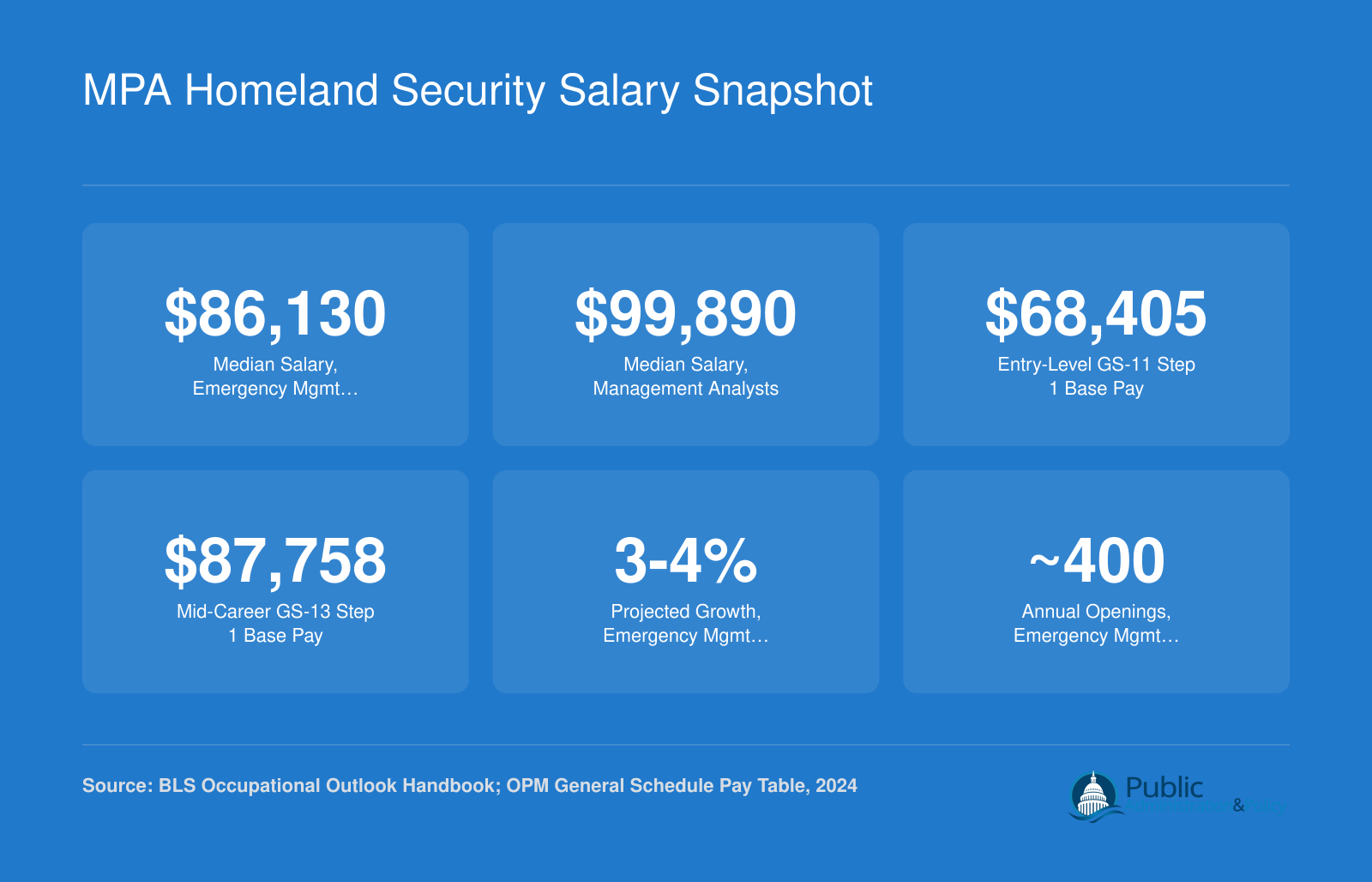
MPA Homeland Security Salary Snapshot
MPA homeland security graduates commonly pursue roles in emergency management, federal security agencies, and consulting. The figures below reflect median earnings for two of the most common occupational tracks, current federal pay scale benchmarks, and projected demand in emergency management.
Online Vs. On-Campus MPA Homeland Security Programs
Choosing between online and on-campus delivery is one of the most consequential decisions you will make when selecting an MPA in homeland security. The good news: NASPAA accreditation and degree recognition are identical regardless of how the program is delivered, so neither format puts you at a disadvantage on a federal resume or in a promotion board review. Many programs now also offer hybrid options that blend the strengths of both modes.
Pros
Online programs offer asynchronous schedules ideal for active military, law enforcement, and emergency management professionals who work rotating shifts.
Students in online programs can maintain their current security clearances and active roles without relocating, preserving career momentum.
On-campus cohorts provide immersive, in-person networking with agency professionals, guest speakers from DHS, FEMA, and state homeland security offices.
Campus-based students gain easier access to practicum and capstone placements at federal sites in the D.C. metro area, FEMA's National Emergency Training Center in Emmitsburg, or state capital agencies.
Hybrid models let students complete coursework online while attending periodic residencies or intensives, combining flexibility with face-to-face collaboration.
On-campus programs often foster tighter cohort bonds through group simulations, tabletop exercises, and joint crisis response projects conducted in real time.
Cons
Online learners may find it harder to build organic professional relationships with peers and visiting practitioners compared to on-campus cohorts.
On-campus programs typically require relocation or long commutes, which can be impractical for working professionals with families or active duty obligations.
Asynchronous online formats require strong self-discipline; students who thrive on structured classroom interaction may struggle with motivation.
Campus-based tuition and living costs near federal hubs like Washington, D.C. can be significantly higher than online program tuition.
Hybrid residencies may still require travel several times per year, adding costs and time-off demands that neither fully online nor fully on-campus students face.
Some online programs offer fewer elective concentrations in emergency management or cybersecurity compared to larger on-campus programs with deeper faculty rosters.
Is an MPA in Homeland Security Worth It?
The short answer for most professionals eyeing federal or state leadership roles in security, emergency management, or policy: yes, this concentration adds clear value. But the longer answer depends on how you weigh three distinct dimensions of return on investment.
The Salary Premium Over a Bachelor's Degree
A bachelor's degree in criminal justice, emergency management, or a related field can open entry-level doors, but it rarely positions you for the senior roles where salaries climb substantially. As highlighted in the salary snapshot earlier in this guide, Emergency Management Directors earn a median well above the national median for all occupations, and many federal homeland security analysts and program managers land in GS-12 through GS-15 pay bands that reward graduate credentials. Over a 20- to 30-year career, the cumulative public administration salary premium of a master's degree in this space can easily reach six figures, even after accounting for tuition costs.
Career Flexibility Compared to a Standalone MS
A standalone Master of Science in Homeland Security provides deep technical and operational knowledge, but it can pigeonhole graduates into security-specific roles. An MPA with a homeland security concentration, by contrast, trains you in budgeting, organizational leadership, policy analysis, and public management alongside your security coursework. That broader foundation means you can pivot into city management, nonprofit executive director career paths, legislative affairs, or other public administration roles if your career interests shift. You signal specialization without sacrificing breadth.
Federal Hiring Advantages
Graduates of NASPAA-accredited MPA programs are eligible for the Presidential Management Fellows (PMF) program, one of the most competitive and rewarding pipelines into the federal Senior Executive Service. A homeland security concentration makes your PMF application especially compelling to agencies like DHS, FEMA, the Department of Defense, and the intelligence community. Even outside PMF, a master's degree satisfies the education requirements for higher GS levels at the point of hire, letting you skip years of incremental advancement.
The Cost Question
Tuition for an MPA in homeland security typically ranges from roughly $20,000 to more than $60,000, depending on whether you qualify for in-state rates and which institution you choose. That sticker price rarely tells the full story. Federal tuition assistance programs, the GI Bill, and employer reimbursement policies (common across DHS, DOD, and many state agencies) can reduce out-of-pocket costs dramatically. Some online programs offered by public universities bring total tuition to the lower end of that range while still carrying NASPAA accreditation.
The Bottom Line
If your career trajectory points toward leadership in homeland security, emergency management, or national security policy at the federal or state level, an MPA with this concentration is a well-calibrated investment. It delivers the salary premium, the hiring advantages, and the career flexibility that a general MPA or a narrow standalone degree cannot match on their own. The key is choosing an accredited program whose cost structure aligns with the financial assistance available to you, so you capture the upside without unnecessary debt.
Common Questions About MPA Homeland Security Programs
Prospective students often have overlapping questions about how an MPA in homeland security fits into their career plans, what admissions look like, and whether the investment pays off. Below are concise, fact-based answers to the questions we hear most often.
What can you do with an MPA in homeland security?
Graduates move into leadership roles across federal, state, and local agencies. Common titles include emergency management director, intelligence analyst, cybersecurity policy advisor, and transportation security program manager. At the federal level, these positions typically fall within the GS-11 through GS-15 pay bands. Opportunities also exist at FEMA, CBP, TSA, the Department of Homeland Security's Office of Policy, and in nonprofit disaster preparedness organizations.
How does an MPA in homeland security compare to a Master's in Homeland Security?
An MPA with a homeland security concentration anchors your training in public budgeting, organizational leadership, and policy analysis, then layers on security-specific coursework. A standalone Master's in Homeland Security focuses more narrowly on threat assessment, intelligence, and law enforcement operations. If you want broad public management skills that transfer across agencies and sectors, the MPA route tends to be more versatile for long-term career mobility.
Do you need military or law enforcement experience to get into an MPA homeland security program?
No. While many students do come from military or law enforcement backgrounds, most programs welcome applicants from any professional field. Admissions committees typically look for relevant work experience in public service, nonprofit management, or a related area, along with a bachelor's degree and strong writing skills. Some programs accept candidates with no prior security experience at all, provided they demonstrate a clear interest in the field.
How long does it take to complete an MPA with a homeland security concentration?
Most full-time students finish in about two years, covering roughly 36 to 48 credit hours depending on the program. Part-time and online formats often extend the timeline to two and a half or three years. Some schools offer accelerated schedules with year-round enrollment that can shorten completion to 18 months, particularly for students who enter with graduate transfer credits or relevant professional experience.
Are MPA homeland security programs NASPAA accredited?
Many are. NASPAA (the Network of Schools of Public Policy, Affairs, and Administration) accredits the broader MPA degree, and the homeland security concentration falls under that umbrella. Not every program holds NASPAA accreditation, so always verify before enrolling. Accreditation matters because federal hiring managers and many state agencies recognize NASPAA-accredited degrees as meeting professional standards for public service leadership roles.
Is an MPA in homeland security worth it for federal government careers?
For most federal career tracks in security and emergency management, yes. An MPA satisfies the graduate-level education requirements for GS-9 and above positions, and the homeland security concentration directly aligns with qualification standards at DHS, FEMA, and related agencies. The degree also qualifies you for the Presidential Management Fellows program, one of the most competitive federal leadership pipelines. Combined with relevant experience, it positions graduates for senior roles at GS-13 and higher.