Essential Leadership Skills Every Healthcare Administrator Needs
A competency-based guide to building, assessing, and advancing your healthcare leadership abilities across every career stage.
By Max SheltonReviewed by PAP Editoral TeamUpdated August 5, 202625+ min read
What you’ll learn in this article…
ACHE identifies six core competencies that healthcare administrators need, from communication to financial acumen.
DEI and health equity are now recognized as essential leadership competencies by ACHE, AHA, and the Institute for Diversity and Health Equity.
Structured assessment tools like 360 degree feedback and the ACHE self assessment help pinpoint specific leadership gaps at every career stage.
Entry level, mid level, and executive administrators prioritize different skills, so leadership development plans should evolve as your career advances.
A single leadership misstep in a hospital or health system can cascade into patient-safety incidents, regulatory penalties, and staff attrition that takes years to reverse. Healthcare administrators routinely oversee budgets exceeding $100 million, workforces numbering in the thousands, and compliance obligations that shift with every new CMS rule cycle. The margin for error is thin.
Management keeps operations running: scheduling, billing, regulatory reporting. Leadership is different. It sets direction, shapes organizational culture, and steers complex change, from merging clinical service lines to implementing health-equity initiatives across a diverse patient population. Professionals in public health administration encounter the same dynamic, where operational competence alone cannot substitute for the ability to inspire and align teams around a shared mission.
The distinction matters because the competencies required for each are not interchangeable. Organizations that conflate the two tend to promote strong operators into roles that demand vision, coalition-building, and adaptive decision-making, then absorb the cost when the fit fails.
Why Leadership Skills Are Critical in Healthcare Administration
Healthcare administration sits at the intersection of clinical care, financial stewardship, and workforce management. When administrators lead well, the benefits ripple outward through every layer of the organization. When they do not, the costs are measurable in dollars, staff losses, and patient harm. Understanding exactly how leadership drives results helps explain why major professional bodies treat it as a standalone competency domain, not a soft add-on to technical expertise.
The Measurable Impact of Strong Leadership
Research consistently ties administrator and nurse-leader effectiveness to hard organizational outcomes. A 2023 study of 297 nurses found that transformational leadership behaviors explained roughly 23 percent of the variance in nurse retention, a striking figure given how many other factors (pay, scheduling, geography) also influence whether clinicians stay or leave.1 That matters enormously when the average acute-care hospital faced a registered nurse turnover rate of about 16 percent and a vacancy rate near 10 percent in 2024, with annual turnover costs reaching approximately $5 million per facility.2
Financial performance tells a parallel story. According to a 2024 Kaufman Hall analysis, hospitals recognized for top quality posted operating margins near 6 percent, while lower-quality counterparts operated in negative territory.2 Facilities that invested in structured leadership development programs saw first-year RN turnover drop by 4 to 8 percentage points, a reduction that simultaneously protects care quality and the bottom line.2
The Cascading Effect on Culture and Outcomes
Administrator leadership shapes organizational culture, which in turn shapes clinician engagement, which directly affects patient outcomes. When leaders set clear expectations, model accountability, and invest in frontline staff development, clinicians report higher job satisfaction and stronger commitment to safety protocols. Improved engagement correlates with better Hospital Consumer Assessment of Healthcare Providers and Systems (CAHPS) scores and fewer adverse events. The chain is direct: leadership quality at the top cascades into the daily experience of patients at the bedside.
Leadership as a Distinct Competency Domain
The American College of Healthcare Executives (ACHE) frames leadership as its own competency domain, deliberately separating it from clinical knowledge and technical management skills such as budgeting or regulatory compliance. The reasoning is straightforward. A financially savvy administrator who cannot inspire trust, navigate conflict, or communicate a compelling vision will struggle to retain talent or drive performance improvement. ACHE's competency model recognizes that leading people requires a different skill set than managing spreadsheets, and healthcare organizations need both. Professionals interested in the broader administrative landscape, including roles in public health administration, will find that this leadership imperative extends well beyond hospital walls.
The Post-Pandemic Urgency
The staffing crises, clinician burnout, and rapid shift toward value-based care models that accelerated during and after the COVID-19 pandemic have elevated leadership from a desirable trait to a survival skill for health systems. The 2025 AONL Nursing Leadership Insight Study identified staff recruitment and retention as the top concern among nurse leaders for another consecutive year.3 In that environment, administrators who lack the ability to build resilient teams, champion well-being initiatives, and adapt strategy under pressure put their organizations at serious risk. Those drawn to the policy dimensions of healthcare may also consider a health policy masters to complement operational leadership training. Leadership is no longer a "nice to have." It is the skill set that determines whether a health system can attract the workforce it needs, deliver the outcomes payers demand, and remain financially viable in an era of persistent uncertainty.
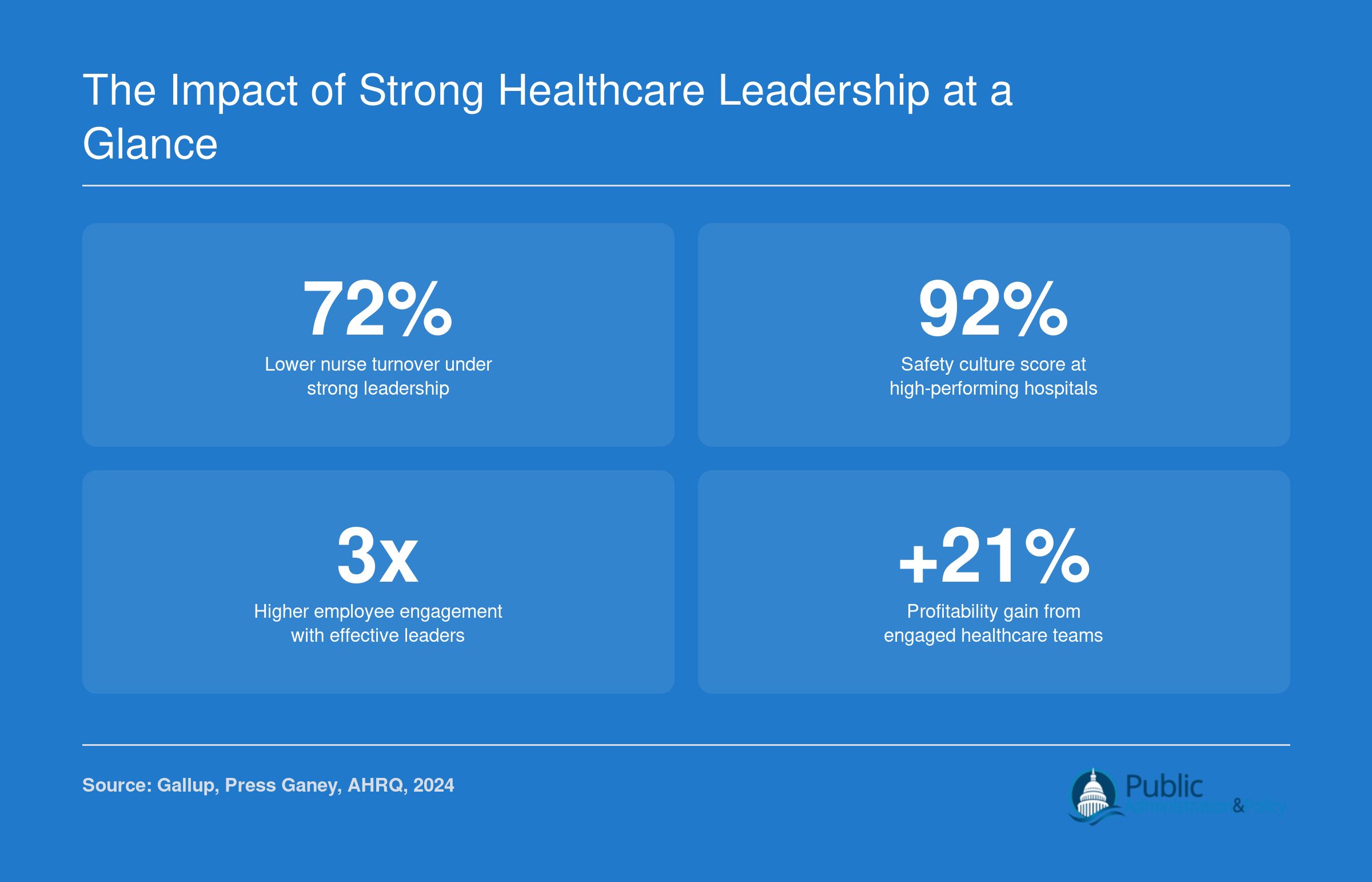
The Impact of Strong Healthcare Leadership at a Glance
Effective leadership in healthcare administration is not just a soft skill; it drives measurable outcomes across patient safety, workforce retention, and financial performance. These figures illustrate why organizations prioritize leadership development for their administrators.
6 Core Leadership Skills Every Healthcare Administrator Needs
Healthcare administration sits at the intersection of clinical care, public policy, and business operations. The six skills outlined below reflect what leading professional bodies, including the American College of Healthcare Executives (ACHE), identify as essential competencies. Each one maps to at least one domain in the ACHE Healthcare Leadership Competency Model, which organizes executive readiness across five core domains: Leadership; Communication and Relationship Management; Professionalism; Knowledge of the Healthcare Environment; and Business Skills and Knowledge.1
1. Strategic Thinking
Strategic thinking is the ability to anticipate market shifts, evaluate community health needs, and align organizational resources with long-term goals. It maps directly to ACHE's Knowledge of the Healthcare Environment and Leadership domains.1
Consider an administrator weighing whether to expand a cardiac service line into a suburban market. That decision requires population health data analysis, competitor positioning, payer mix modeling, and alignment with the organization's mission. Administrators who think strategically do not just react to quarterly financials; they shape the direction of care delivery for years to come.
2. Communication
Clear, audience-appropriate communication keeps every stakeholder, from bedside nurses to board members, aligned on priorities. ACHE places this squarely within its Communication and Relationship Management domain.1
A practical example: during a Joint Commission accreditation survey, the administrator must translate complex compliance language into actionable steps for clinical staff, reassure patients about care continuity, and present documentation to surveyors with precision. Miscommunication in any of those channels can derail accreditation outcomes and erode organizational trust.
3. Financial Acumen
Healthcare organizations operate on thin margins, making financial literacy non-negotiable. This skill falls under ACHE's Business Skills and Knowledge domain.1
Imagine managing a capitated contract with a regional insurer. The administrator must forecast utilization rates, negotiate per-member-per-month rates, monitor cost overruns in real time, and adjust care protocols to keep spending within budget without compromising quality. Financial acumen turns raw numbers into decisions that sustain the organization's ability to serve its community.
4. Adaptive Problem-Solving
Healthcare environments shift quickly, whether from a pandemic surge, a cybersecurity breach, or a sudden regulatory change. Adaptive problem-solving sits across ACHE's Leadership and Knowledge of the Healthcare Environment domains, particularly under the Managing Change sub-competency.1
When a hospital's electronic health record system goes down during peak census hours, the administrator who can stand up manual documentation workflows, coordinate with IT, and communicate a timeline to frustrated clinicians keeps patient safety intact. Rigid playbook followers struggle; adaptive problem-solvers thrive.
5. Team Leadership and Emotional Intelligence
These two competencies are grouped together intentionally. Emotional intelligence (EQ) is the mechanism through which administrators build trust, manage conflict, and retain talent. Without it, team leadership becomes positional authority rather than genuine influence. Both map to ACHE's Leadership domain, specifically under Organizational Climate and Culture and Leadership Skills and Behavior.1
A department director navigating high turnover among nursing staff, for example, must recognize burnout signals, hold candid retention conversations, and create psychological safety so frontline workers feel heard. Administrators with strong EQ do not wait for exit interviews to learn what went wrong. Those interested in broader public health administrator career paths will find that emotional intelligence is equally valued across the public sector.
6. DEI and Health Equity Leadership
Diversity, equity, and inclusion in healthcare administration is no longer just a compliance checkbox. ACHE, the American Hospital Association, and the American Public Health Association increasingly recognize health equity as a standalone leadership competency. Within the ACHE model, DEI threads through multiple domains: Professionalism (including Ethical Conduct and Social Consciousness), Leadership, Communication and Relationship Management, and Knowledge of the Healthcare Environment.2 ACHE also offers a dedicated Inclusive Leadership and Equity-Focused Assessment, signaling that the profession views this as a measurable skill, not merely a value statement.2
A concrete example: an administrator leading a community health needs assessment discovers that maternal mortality rates among Black patients in the service area far exceed the regional average. DEI and health equity leadership means designing targeted interventions, reallocating resources, partnering with community organizations, and tracking outcomes with the same rigor applied to any financial performance metric.
Taken together, these six skills form a practical framework for healthcare administrators at every career stage. The sections ahead explore how each skill shifts in emphasis as you move from entry-level roles to executive leadership, and how you can assess and strengthen your own competencies using validated tools.
Questions to Ask Yourself
Which of the six core skills do you practice daily, and which do you consistently avoid?
Honest self-assessment reveals blind spots before they become liabilities. Identifying the skill you sidestep most often points you toward the development area that will yield the biggest return.
Where would your direct reports say you are strongest as a leader?
Your own perception of your strengths rarely matches your team's experience. Gathering candid feedback from colleagues uncovers gaps between intent and impact that no self-reflection exercise can surface alone.
If a crisis hit your organization tomorrow, which skill gap would hurt you most?
High-pressure moments expose weaknesses that routine operations can mask. Pinpointing that vulnerability now gives you time to build competence before the stakes are highest.
Are you investing development time in the skills your current role demands, or in the skills your next role will require?
Balancing present performance with future readiness is a constant tradeoff. Overinvesting in today's needs can leave you unprepared when a promotion or organizational shift demands a different leadership profile.
How Leadership Skills Differ by Role and Setting
Healthcare leadership is not one size fits all. The six core skills outlined above carry different weight depending on whether you manage a small physician practice, oversee operations at a 500-bed teaching hospital, or direct public health programs for a county agency. Setting shapes everything: a rural critical access hospital COO, for example, must communicate across a tight knit community where every staff member wears multiple hats, while an urban academic medical center administrator may need to navigate complex faculty governance structures and coordinate messaging across dozens of departments. Understanding how each skill maps to your specific role helps you prioritize professional development and perform at the highest level.
Leadership Skill
Practice Manager
Hospital COO
Quality Director
Public Health Administrator
Long-Term Care Administrator
Strategic Thinking and Vision
Important: Focuses on practice growth, payer mix optimization, and patient volume forecasting
Critical: Drives multi-year capital planning, service line expansion, and competitive positioning across the health system
Important: Aligns quality improvement initiatives with organizational strategic goals
Critical: Shapes population health strategy, grant priorities, and legislative advocacy at the community or state level
Important: Plans for census management, regulatory compliance trends, and evolving reimbursement models
Communication and Stakeholder Engagement
Critical: Serves as the daily liaison between physicians, clinical staff, patients, and billing teams in a close knit setting
Critical: Coordinates messaging across medical staff, board members, community leaders, and regulatory bodies, often spanning dozens of departments
Important: Translates clinical data into actionable reports for frontline staff, leadership, and external accreditation bodies
Critical: Engages elected officials, community organizations, media, and diverse populations to build trust and drive public health messaging
Critical: Communicates with residents' families, ombudsmen, surveyors, and interdisciplinary care teams on sensitive issues daily
Financial Acumen
Critical: Manages tight operating margins, coding accuracy, and revenue cycle performance at the practice level
Critical: Oversees multimillion dollar budgets, capital expenditure decisions, and contract negotiations with payers and vendors
Foundational: Understands cost of quality failures and builds business cases for patient safety investments
Important: Administers grant funded budgets, justifies resource allocation to government funders, and monitors cost effectiveness of programs
Critical: Navigates Medicaid reimbursement complexities, manages per diem rates, and controls costs while maintaining quality of care
Team Building and Talent Development
Important: Recruits, mentors, and retains a small but essential team where each vacancy has outsized impact
Critical: Builds leadership pipelines, fosters interdepartmental collaboration, and manages performance across large, diverse workforces
Important: Develops multidisciplinary quality improvement teams and champions a culture of continuous learning
Important: Cultivates partnerships across agencies, trains community health workers, and builds capacity in under resourced settings
Critical: Addresses high staff turnover by investing in training, morale, and career development for CNAs, nurses, and support staff
Ethical Decision Making and Integrity
Foundational: Upholds patient privacy standards and manages conflicts of interest in physician owned practices
Critical: Navigates complex ethical dilemmas involving resource allocation, end of life care policies, and organizational transparency
Critical: Champions patient safety culture, leads root cause analyses with full transparency, and manages disclosure of adverse events
Critical: Balances community rights, health equity mandates, and politically sensitive decisions such as quarantine orders or resource rationing
Critical: Advocates for vulnerable elderly and disabled residents, ensures dignity in care, and manages guardianship and consent issues
Adaptability and Change Management
Important: Implements new EHR systems, adapts workflows to evolving payer requirements, and responds to regulatory changes quickly
Critical: Leads large scale organizational transformations such as mergers, technology rollouts, or pandemic response across the entire facility
Critical: Drives adoption of new evidence based protocols, manages resistance to process changes, and integrates emerging patient safety technologies
Critical: Pivots rapidly during public health emergencies, adapts programs to shifting funding landscapes, and responds to emerging community health threats
Important: Adjusts care models in response to new CMS regulations, infection control mandates, and changing resident acuity levels
Leadership Skills by Career Stage: Entry-Level, Mid-Level, and Executive
Healthcare leadership is not a single skill set you acquire once and carry unchanged throughout your career. The competencies that help you thrive at each stage evolve considerably, and understanding what to prioritize (and when) can mean the difference between steady upward movement and a frustrating plateau.
Entry-Level (0 to 3 Years): Building Credibility Through Fundamentals
In your first few years as a healthcare administrator, the leadership skills that matter most are the ones that earn trust. Communication tops the list: you need to convey information clearly to clinical teams, patients, and supervisors who have far more experience than you do. Team collaboration is equally critical, because early-career administrators rarely have direct authority. Instead, you influence outcomes by being reliable, well-prepared, and willing to pitch in.
Foundational financial literacy rounds out the entry-level toolkit. You do not need to build a system-wide operating budget on day one, but you should understand how revenue cycle basics, cost centers, and departmental budgets work. Developing these financial analyst skills early signals to leadership that you see the bigger picture.
Action item: Volunteer to lead or co-lead a quality improvement project. Even a small initiative, such as reducing patient wait times at a single clinic, demonstrates initiative and gives you a concrete achievement to reference when promotion conversations arise.
Mid-Level (4 to 10 Years): Shifting from Execution to Strategy
This is the stage where many capable administrators stall. Execution skills alone are no longer enough. Mid-level leaders must develop strategic thinking, the ability to solve complex problems that span departments, and comfort leading cross-functional teams whose members may outrank them clinically.
You will also face higher-stakes decisions involving compliance, resource allocation, and organizational change. Success at this level depends on your willingness to pursue deliberate skill development rather than coasting on what got you promoted in the first place.
Action item: Pursue board certification through the American College of Healthcare Executives (FACHE). The structured preparation process strengthens strategic and ethical reasoning, and the credential itself signals readiness for senior roles.
Executive (10-Plus Years): Leading at the Systems Level
Executive healthcare leaders operate in a fundamentally different environment. Strategy is no longer one part of the job; it is the job. At this stage, you must master organizational strategy across service lines, engage external stakeholders ranging from legislators to community organizations, champion diversity, equity, and inclusion at the systems level, and navigate the complexities of board governance.
Executive leadership also demands comfort with ambiguity. You will make high-consequence decisions with incomplete data, balance competing priorities from clinical and financial teams, and serve as the public face of your organization during crises. Those considering a path toward this level may find parallels in the nonprofit executive director career path, which similarly requires board governance expertise and stakeholder engagement.
Action item: Join a health system board committee or seek appointment to a community health board. Board-level experience sharpens governance skills, expands your professional network, and deepens your understanding of fiduciary responsibility.
The Common Thread Across All Stages
Regardless of where you are in your career, intentional development is what separates administrators who advance from those who do not. At every stage, identify the one or two competencies most relevant to your next move, seek feedback from mentors who have already made that transition, and commit to structured learning rather than relying solely on on-the-job experience. Leadership growth in healthcare does not happen by accident; it happens by design.
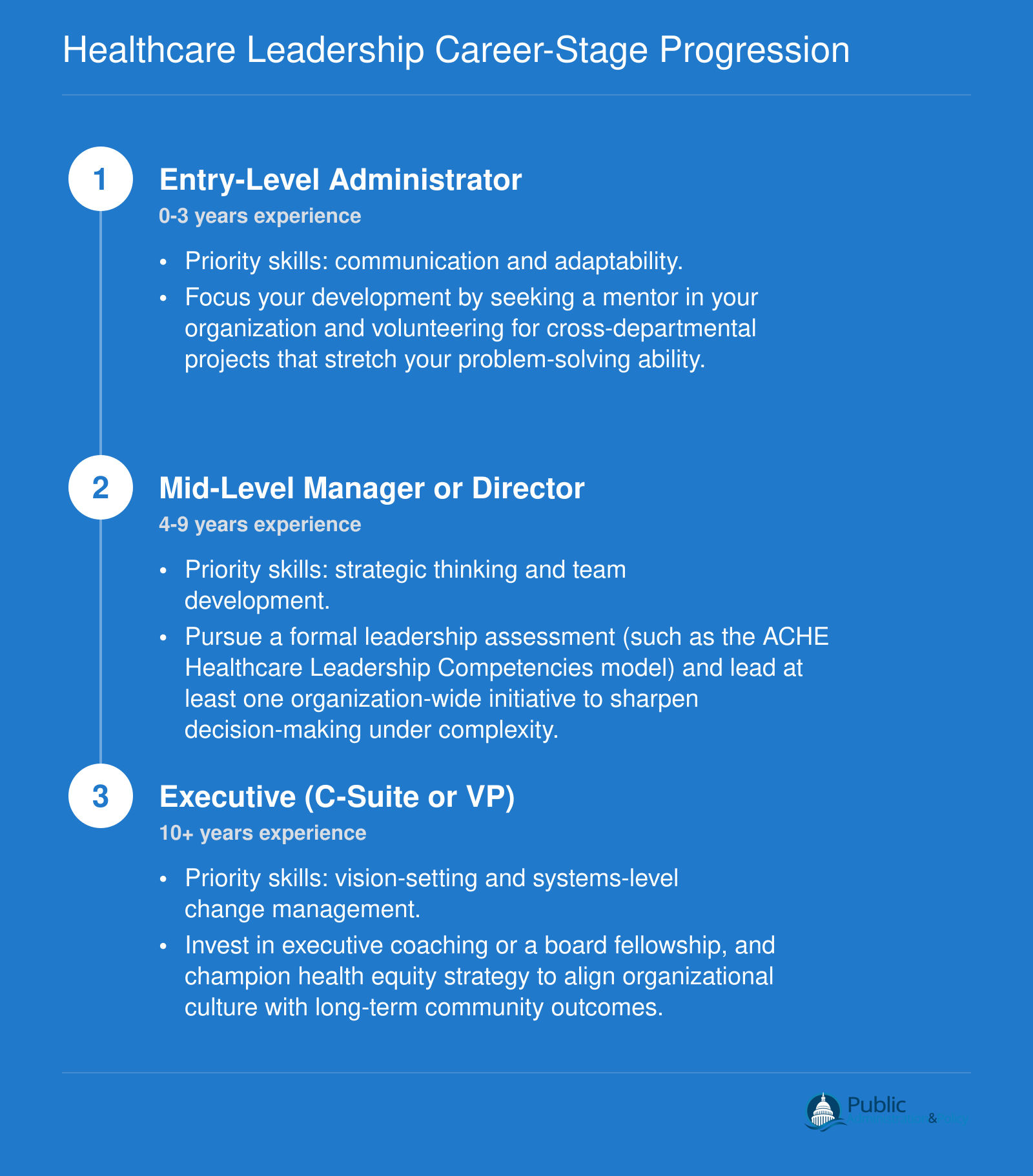
Healthcare Leadership Career-Stage Progression
Healthcare leadership competencies build on each other as your career advances. Use this progression to identify where you are now and which skills to prioritize next.
How to Assess Your Healthcare Leadership Skills
Honest self-assessment is the foundation of any leadership development plan, yet most healthcare administrators rely on intuition rather than structured evaluation. Before you can close a skills gap, you need to know exactly where it exists. The good news is that several validated tools can help you measure your competencies against industry benchmarks, and some of them cost nothing to use.
Validated Self-Assessment Tools Worth Knowing
Four instruments stand out for healthcare administrators at various career stages:
ACHE Healthcare Executive Competencies Assessment Tool: This free PDF self-assessment from the American College of Healthcare Executives covers five competency domains: Communication and Relationship Management, Professionalism, Leadership, Knowledge of the Healthcare Environment, and Business Skills and Knowledge.1 It is designed for individual use, making it one of the most accessible starting points for any administrator.
AONL Nurse Leader Self-Assessment: Developed by the American Organization for Nursing Leadership, this tool targets nurse leaders but overlaps significantly with general healthcare administration competencies. It spans similar domains and also offers an organizational-level assessment option. Members pay $55 and nonmembers pay $120, so it represents a modest investment for targeted insight.2
SHSMD ADVANCE Assess: Free to members of the Society for Health Care Strategy and Market Development, this tool asks you to rate yourself on both performance and perceived importance across domains like strategic planning, data analytics, collaboration, and change management. That dual-rating method helps you pinpoint not just where you are weak but where weakness matters most.3
NHS Healthcare Leadership Model: Originally developed for clinicians and managers in the United Kingdom, this free framework evaluates nine competency dimensions, including Inspiring Shared Purpose, Engaging the Team, Evaluating Information, and Influencing for Results.4 Its breadth makes it useful for administrators working in complex, multidisciplinary environments regardless of geography.
Running a Skills-Gap Analysis
Once you have chosen a tool, the next step is a structured gap analysis. Rate yourself on each of the six core leadership skills discussed earlier in this article. Then compare your self-ratings against the competency benchmarks provided by your chosen framework, particularly the ACHE domains, which align closely with common administrator responsibilities. Identify the two or three largest gaps between where you currently stand and where the benchmark suggests you should be. Those gaps become the priorities for your professional development plan over the next six to twelve months.
Resist the temptation to address every shortcoming at once. Concentrating on a handful of targeted areas leads to measurable improvement, while spreading yourself thin across a dozen goals rarely does.
Why Self-Perception Alone Is Not Enough
Research on leadership effectiveness consistently shows that self-perception diverges from how peers, subordinates, and supervisors experience your leadership. A 360-degree feedback process, in which colleagues at multiple levels provide anonymous ratings on the same competencies you assessed yourself on, reveals blind spots that no self-assessment can catch. If a formal 360-degree program is not available through your organization, you can achieve a similar effect by asking two or three trusted colleagues to independently rate you using the same ACHE or NHS framework you completed. Compare their scores to your own and pay close attention to the domains where the gap between self-rating and external rating is widest.
Combining at least one self-assessment tool with external feedback gives you a far more accurate picture of your leadership profile than either method in isolation. Professionals considering how to become a public health administrator will find that this kind of structured self-evaluation becomes even more critical as responsibilities scale.
Make It a Recurring Practice
Leadership skills are not static. Regulatory environments shift, teams turn over, and organizational priorities evolve. A practical habit is to schedule an annual leadership skills audit, treating it with the same seriousness you would give a performance review. Pick a consistent time each year, complete your chosen self-assessment, solicit fresh 360-degree feedback, and update your development priorities accordingly. Over multiple cycles, this practice creates a longitudinal record of your growth, one that proves invaluable when preparing for board-level roles or pursuing credentials like the FACHE designation.
How to Improve Leadership Skills as a Healthcare Administrator
Developing leadership skills is not a one-time event. It is a career-long process that blends formal education, credentialing, hands-on practice, and targeted continuing education. The strategies below are organized so you can layer them over time, starting wherever you are in your career.
Formal Education Pathways
Graduate programs offer structured frameworks for building leadership competencies, but the emphasis varies by degree type.
Master of Health Administration (MHA): Concentrates on operations, finance, and strategic planning within health systems. Coursework often includes organizational behavior, health law, and quality management, making it the most direct route to senior administrative roles.
MBA in Healthcare Management: Adds broader business acumen, covering marketing, entrepreneurship, and corporate finance alongside healthcare electives. This path tends to strengthen analytical decision-making and cross-industry strategic thinking.
Master of Public Health (MPH): Centers on population health, epidemiology, and health equity. Leaders who pursue an MPH often develop strong skills in data-driven advocacy, community engagement, and policy analysis.
Choosing among these programs depends on whether your career goals lean toward hospital operations, business strategy, or public health policy. Some professionals pursue dual degrees to cover more ground. Those drawn to the population health track may also want to explore how to become a public health administrator, a role that applies many of the same competencies in government and community settings.
Professional Certifications
Certifications signal specialized competence and commitment to the field. Several stand out for healthcare administrators.
FACHE (Fellow of the American College of Healthcare Executives): Widely regarded as the gold standard credential for healthcare leaders. Earning it requires a graduate degree, verified leadership experience, community involvement, and passing a comprehensive board exam.
CPHQ (Certified Professional in Healthcare Quality): Develops competencies in patient safety, performance measurement, and regulatory compliance.
CMPE (Certified Medical Practice Executive): Focuses on the business side of medical group management, including revenue cycle leadership and human resources.
Lean/Six Sigma Certifications: Build process improvement and data analysis skills at the Green Belt or Black Belt level, equipping administrators to lead efficiency initiatives across departments.
On-the-Job Strategies
Classroom knowledge only goes so far without practical application. Consider weaving these experiences into your current role.
Seek out a formal mentorship program through your organization or a professional association. Mentors can offer candid feedback on blind spots that self-assessments may not capture.
Request cross-departmental rotations to broaden your understanding of clinical, financial, and support operations. Even short-term projects in an unfamiliar department build systems-level thinking.
Volunteer to lead quality improvement projects. These initiatives require you to coordinate across disciplines, manage timelines, and present measurable outcomes to senior leadership.
Join professional governance committees, whether internal (ethics boards, credentialing committees) or external (state hospital association task forces). Committee service sharpens consensus-building and stakeholder management skills.
Continuing Education and Professional Development
Ongoing learning helps you close specific gaps identified during a leadership skills assessment.
The annual ACHE Congress on Healthcare Leadership brings together thousands of executives for sessions on emerging challenges, from AI integration to workforce retention.
State hospital association leadership academies offer regionally focused cohort programs that typically run six to twelve months and combine classroom instruction with applied projects.
Targeted workshops, whether in conflict resolution, health equity strategy, or financial modeling, let you address the precise competencies where your self-assessment or 360-degree feedback flagged room for growth.
The most effective development plans combine several of these strategies at once. Pairing a certification pursuit with a mentorship relationship, for example, creates a feedback loop where new knowledge gets tested in real conversations with an experienced guide. Revisit your plan at least annually, adjusting priorities as your responsibilities and the healthcare landscape evolve.
Organizations such as the American College of Healthcare Executives, the American Hospital Association, and the Institute for Diversity and Health Equity now recognize diversity, equity, and inclusion as a core leadership competency, not an optional initiative. Effective healthcare administrators weave health equity into strategic plans, workforce development pipelines, and community health programming, ensuring that reducing disparities is a measurable leadership responsibility rather than a peripheral goal.
Real-World Scenarios: Applying Leadership Skills in Healthcare
Theory matters, but healthcare administrators prove their value in the moments that test every skill at once. The three scenarios below illustrate how the six core leadership skills from our framework converge in high-stakes, real-world situations.
Scenario 1: Navigating a 30% Nursing Vacancy Rate
Imagine you lead operations at a mid-size community hospital and your nursing vacancy rate has climbed to 30 percent. Patient safety metrics are slipping, and the remaining staff are burning out fast. Here is where multiple skills activate simultaneously:
Communication: You hold transparent town halls with frontline nurses, explaining the staffing plan timeline and inviting feedback. Rather than issuing top-down mandates, you create a two-way dialogue that surfaces problems early.
Emotional intelligence: You recognize that exhausted clinicians need acknowledgment, not platitudes. Scheduled one-on-one check-ins and peer support programs help staff feel heard and reduce turnover among those still on board.
Adaptive problem-solving: You implement flexible scheduling, deploy travel nurses for critical units, and negotiate temporary cross-training agreements with a neighboring facility. Each solution is evaluated weekly, and you pivot when data shows a tactic is not working.
The takeaway: a staffing crisis is never purely logistical. Administrators who combine clear communication, genuine empathy, and creative problem-solving protect both patients and workforce morale.
Scenario 2: Leading a Resistant Staff Through an EHR Transition
Your health system is replacing its legacy electronic health record platform. Physicians are vocal about the disruption, and support staff worry about learning curves. Two core skills take center stage:
Strategic thinking: You phase the rollout by department, starting with a pilot unit whose physician champion volunteers to troubleshoot. Data from the pilot informs training adjustments before the system goes organization-wide.
Change management (a dimension of adaptive problem-solving): You appoint super-users in every department, build a feedback portal for real-time issue tracking, and schedule go-live support around shift changes so no clinician faces the new system alone.
Resistance rarely stems from technology itself. It stems from fear of lost productivity and autonomy. Administrators who pair a deliberate rollout strategy with hands-on support convert skeptics into advocates.
Scenario 3: Responding to a Sentinel Event
A serious adverse event occurs during a routine procedure. The patient's family, your clinical team, regulators, and the media all need different things at the same time. This scenario demands the broadest skill set:
Financial acumen: You coordinate immediately with risk management and legal counsel to understand liability exposure, ensure proper insurance notification, and budget for potential remediation costs.
Communication: Following established disclosure protocols, you lead a compassionate, transparent conversation with the patient's family. Internally, you brief department heads so consistent, accurate information flows across the organization.
Team leadership: The clinicians involved may be devastated. You activate a peer support or second-victim program, connect staff with counseling resources, and make clear that the root-cause analysis seeks system improvements, not individual blame.
Sentinel events test every dimension of leadership within hours. Administrators who respond with financial awareness, honest communication, and genuine support for their teams set the tone for organizational learning rather than organizational fear.
Reinforcing the Framework
Across all three scenarios, notice how skills rarely operate in isolation. Staffing crises call on emotional intelligence and communication together. Technology transitions blend strategic thinking with adaptive problem-solving. Crisis response requires financial acumen, transparency, and team leadership in concert. These competencies translate across sectors; professionals in public administration careers face similarly complex, multi-stakeholder challenges. Building strength in each of the six core competencies ensures you are prepared not just for routine management, but for the defining moments of your career.
Frequently Asked Questions About Healthcare Leadership Skills
Healthcare administrators at every career stage share common questions about which leadership competencies matter most, how to develop them, and how they translate into better organizational and patient outcomes. The answers below draw on the American College of Healthcare Executives (ACHE) competency frameworks and current best practices in the field.
What are the most important leadership skills for healthcare administrators?
The ACHE Healthcare Executive Competency Framework identifies five core domains: Communication and Relationship Management, Leadership, Professionalism, Knowledge of the Healthcare Environment, and Business Skills and Knowledge. Within the Leadership domain specifically, the ability to inspire excellence, create a shared vision, and manage change effectively ranks highest. ACHE also highlights five emerging competencies, including emotional and social intelligence, systems thinking, change management, adaptability, and open-mindedness, that are becoming essential in 2026 and beyond.
What is the difference between leadership skills and management skills in healthcare?
Leadership focuses on vision, inspiration, organizational culture, and guiding change, while management centers on operational execution, regulatory compliance, financial stewardship, and performance measurement. Both are necessary, but they serve different purposes. A strong manager ensures day-to-day processes run smoothly; a strong leader aligns people around a strategic direction and motivates them through uncertainty. The most effective healthcare administrators cultivate both skill sets deliberately.
How do leadership skills affect patient outcomes in healthcare?
Administrators who lead effectively shape organizational culture, which directly influences staff engagement, communication, and safety practices. When leaders prioritize quality improvement, equity, and transparent communication, clinical teams are better positioned to reduce errors, improve care coordination, and address health disparities. Strong leadership also drives population health strategies and risk management frameworks that measurably improve patient safety metrics across the organization.
What leadership competencies does ACHE recommend for health services managers?
ACHE's framework, aligned with the Healthcare Leadership Alliance model, outlines five core domains. The Leadership domain itself includes sub-competencies in leadership skills and behavior, organizational climate and culture, communicating vision, and managing change. ACHE's 2024 emerging competencies list adds emotional and social intelligence (encompassing self-awareness, empathy, and relationship management), systems thinking, change management, adaptability to chaos and complexity, and open-mindedness and introspection.
What certifications help healthcare administrators develop leadership skills?
The Fellow of the American College of Healthcare Executives (FACHE) credential is the most widely recognized leadership certification in the field. Earning it requires demonstrated leadership experience, continuing education, and passing a comprehensive board exam. Other valuable credentials include the Certified Healthcare Executive (CHE) designation and project management certifications such as the PMP. Each provides structured frameworks that reinforce competencies like strategic planning, ethical decision-making, and change leadership.
How can healthcare administrators improve their leadership skills without going back to school?
ACHE offers the Healthcare Executive 2026 Competencies Assessment Tool for self-assessment and targeted development planning. Administrators can also pursue ACHE's continuing education programs, attend industry conferences, and seek executive coaching or mentorship. Joining professional learning cohorts, volunteering for cross-functional committees, and using ACHE's Equity-Focused Leadership Assessment to build inclusive leadership practices are all practical, accessible strategies that do not require enrolling in a formal degree program.
The six core skills covered in this guide, from strategic communication to financial acumen, are not abstract ideals. They are the competencies that separate administrators who plateau at middle management from those who advance into C-suite roles shaping organizational strategy and health policy. As the career-stage progression illustrates, each skill compounds over time, and gaps left unaddressed become harder to close.
Start today. Use one of the self-assessment tools discussed earlier, identify your most pressing skill gap, and commit to a single development action this quarter, whether that is a structured mentorship, a credentialing program, or a continuing education course. If you are weighing formal education, an MHA, MBA, or MPH can accelerate your growth by grounding these competencies in evidence-based frameworks. Professionals drawn to the intersection of clinical systems and public health administration will find that these same leadership skills transfer directly into government and community settings. Explore degree options and career pathways on publicadministrationpolicy.org to find a program that fits your goals.