How to Build a Career as a Health and Human Services Policy Advisor
From graduate degree to the governor's office: a practical roadmap for aspiring health policy advisors in state and federal government
By Holly AbramsonReviewed by PAP Editoral TeamUpdated July 20, 202625+ min read
What you’ll learn in this article…
The NGA’s 2026 institute convened 34 states to address H.R. 1 implementation challenges in health and human services.
H.R. 1, effective July 2025, forced states to overhaul Medicaid, SNAP, and overdose prevention programs.
Health policy advisors turn legislation into actionable plans, unlike analysts who primarily conduct research and make recommendations.
An MPP prepares you for legislative cost analysis; an MPA for program management; an MPH for public health design.
State-level health policy advising has become a frontline occupation for translating sweeping federal legislation into workable programs. In May 2026, the National Governors Association convened health and human services policy advisors from 34 states and territories, signaling the role's growing demand and operational complexity. For MPP and MPA graduates, these positions offer a direct path to shaping Medicaid, SNAP, and overdose prevention strategies under the pressures of H.R. 1 implementation. Breaking in requires a clear-eyed understanding of the advisor role, distinct from analyst work, and the degree, salary, and careers in public administration entry pathways that lead to it.
What Does a Health and Human Services Policy Advisor Do?
A Health and Human Services policy advisor sits at the nexus of evidence, politics, and implementation, turning complex federal mandates and state priorities into operational plans that affect millions of residents. Unlike policy analysts who primarily produce research and recommendations, advisors operate at the decision-making table, briefing governors, agency heads, and legislative leaders directly. They synthesize data, stakeholder feedback, and political feasibility into actionable advice, often under tight timelines.
The Core Functions of a Health and Human Services Policy Advisor
Advisors perform a distinct set of functions that go beyond analysis. Their work includes:
Legislative analysis and strategy: Tracking federal and state bills, assessing fiscal and programmatic impacts, and drafting executive memos. During the 2026 legislative cycle, this included interpreting the massive overhaul triggered by H.R. 1, which was enacted on July 4, 2025, and restructuring health and human services programs nationwide.
Intergovernmental coordination: Aligning efforts across federal agencies, counties, and tribal governments. Advisors negotiate waivers, troubleshoot implementation snarls, and ensure state plans comply with federal law while meeting local needs.
Program design and oversight: Shaping the day-to-day operation of Medicaid, SNAP, behavioral health systems, child welfare, and workforce programs. This involves setting eligibility rules, monitoring outcomes, and adjusting policy when performance gaps emerge.
Crisis response: Leading rapid action on emergent threats, from substance use epidemics to pandemic-related disruptions. Advisors orchestrate cross-agency task forces and translate fast-changing federal guidance into state directives.
At the 2026 National Governors Association (NGA) Governors Health and Human Services Policy Advisors Institute, state leaders from 34 states and territories gathered to tackle these challenges collectively. NGA Chief Policy Officer Timothy Blute underscored the stakes: "Governors are on the front lines of implementing some of the most consequential changes to health and human services programs in decades." The Institute's sessions covering healthcare affordability, program integrity in Medicaid and SNAP, and sustaining overdose prevention mirror the real-time portfolio advisors manage. For example, advisors are now operationalizing H.R. 1 provisions on SNAP administration while safeguarding against improper payments, directly reflecting Institute discussions led by practitioners like No Kid Hungry Louisiana Director Rhonda Jackson, who noted that "SNAP is a critical part of what stands between those kids and an empty table."
A Day in the Life: Legislative Session vs. Interim Period
The rhythm of the role shifts dramatically with the calendar. During a legislative session, a typical day might start with a 7:00 a.m. briefing for the governor's chief of staff on a fast-moving bill, followed by back-to-back meetings with agency commissioners preparing testimony, a working lunch with legislators' aides to negotiate language, and an afternoon drafting committee amendments. Evenings often include late-night strategy calls to react to floor votes.
In the interim period, the pace pivots toward deeper analysis and planning. Advisors lead budget proposal development, analyze program data to identify trends, and craft long-term policy agendas. They coordinate with federal counterparts on waiver renewals, manage cross-agency workgroups on topics like behavioral health integration, and travel to field sites to understand implementation realities. Both phases demand agility, but the core function remains the same: translating public policy making into executable action.
Navigating Complex Policy Domains
Health and human services encompass a sprawling set of interconnected systems. Advisors must possess breadth across multiple domains:
- Medicaid and CHIP: Coverage policy, managed care contracting, reimbursement rates.
- SNAP and TANF: Eligibility rules, employment and training programs, fraud prevention.
- Behavioral health: Mental health and substance use disorder services, crisis response infrastructure.
- Child welfare: Foster care, family preservation, kinship care supports.
- Workforce development: Job training, supportive services, economic mobility programs.
The 2026 NGA Institute illustrated this range. Sessions on healthcare affordability required advisors to balance individual patient costs with system-wide fiscal sustainability, echoing Massachusetts Governor's Office Deputy Chief of Staff for Policy Sarah Sabshon's observation that "there are two parts to affordability, affordability for the individual patient and affordability for the system at large." Simultaneously, the Institute's focus on SNAP program integrity and the ongoing Policy Academy to Strengthen SNAP E&T Delivery reflects advisors' role in designing programs that are both effective and accountable. This breadth means today's advisor might craft a Medicaid waiver in the morning, present on child welfare data in the afternoon, and cap the day with an emergency call about an overdose spike. It is a role defined not by a single desk, but by the ability to move deftly across the entire human services landscape. Those interested in a related path may also find value in exploring legislative aide duties to understand how advisory work intersects with the legislative process.
Health Policy Advisor Vs. Analyst: Key Differences
Two distinct career paths in health policy, advising leaders on strategy versus analyzing data to inform decisions, offer different challenges and rewards for MPP and MPA graduates. Understanding these differences helps you choose the role that aligns with your strengths and career goals.
Functional Focus: Strategy vs. Data
At a high level, a health policy advisor works directly with decision-makers (governors, agency heads, legislators) to shape and implement policy. The role emphasizes translating complex political and operational landscapes into actionable recommendations. Advisors frequently draft memos, coordinate stakeholder input, and navigate legislative processes. In contrast, a health policy analyst typically spends more time on quantitative and qualitative research, evaluating program outcomes, modeling policy impacts, and producing reports that inform the advisor's work. Analysts are often found behind the scenes, ensuring that decisions are evidence-based.
Typical Work Setting and Stakeholders
Advisors are commonly embedded within executive offices, such as a governor's cabinet or a state health department's leadership team. They interact regularly with elected officials, community leaders, and the media. The analyst role is more prevalent in research divisions, consulting firms, or the analytics units of large agencies. Analysts may present findings to internal audiences, but they rarely set the political strategy. Both roles require collaboration, but the advisor's world is relationship-intensive, while the analyst's is data-intensive.
Educational Background and Skill Sets
MPP and MPA programs often prepare students for advisory roles through coursework in policy analysis, public administration, and political strategy. Analysts may come from similar programs but with heavier concentrations in statistics, economics, or health informatics. While both roles value critical thinking, advisors need exceptional communication and negotiation skills, whereas analysts must master tools like SAS, Stata, or R. Graduates should consider electives that align with their intended path.
Career Trajectory and Advancement
Health policy advisors often advance into chief of staff or deputy secretary positions, leveraging their political acumen and network. Analysts may progress to senior researcher, director of evaluation, or public budget analyst roles. Both can transition into the other track with additional experience or training, but early specialization matters. Reviewing real job descriptions and talking to professionals in each role is the best way to gauge fit.
Questions to Ask Yourself
Do you thrive on delivering concise, actionable advice under time pressure?
Advisors must distill complex policy into clear recommendations for executives who need answers quickly. Analysts often have more time to dive deep into data and build rigorous models.
Do you get more satisfaction from stakeholder negotiation or from data analysis?
Policy advisors frequently navigate political dynamics and build coalitions, while analysts focus on statistical techniques and data integrity. Your preference here shapes daily work and long-term career satisfaction.
Are you drawn to shaping policy decisions or to evaluating their outcomes?
Advisors influence the direction of policy in real time, often working on messaging and strategy. Analysts assess impact after implementation, measuring effectiveness and providing evidence for future decisions.
Why State-Level Health Policy Advising Matters Now: The NGA Institute and H.R. 1
Federal policy changes often create a tension between ambitious national goals and the on-the-ground reality of state budgets, workforce capacity, and existing program infrastructure. For health and human services policy advisors, this gap is where the work happens: translating legislation like H.R. 1 into practical, sustainable programs that serve families and communities.
The NGA Institute: A Hub for State Policy Advisors
In May 2026, the National Governors Association (NGA) brought together health and human services policy advisors from 34 states and territories at its annual institute in New Orleans.1 The gathering underscored the collaborative, problem-solving nature of state-level work. Attendees grappled with shared challenges: holding down healthcare costs without sacrificing access, maintaining public trust in safety-net programs, and sustaining hard-won progress on the opioid crisis.
Timothy Blute, NGA's Chief Policy Officer, noted that governors are on the front lines of implementing the most consequential HHS changes in decades.1 The institute provided space for advisors to compare approaches, learn from each other's missteps, and forge bipartisan solutions, exactly the kind of exchange that cannot happen inside a single state capitol.
H.R. 1 and the New State-Level Responsibilities
Enacted on July 4, 2025, H.R. 1 ushered in a wave of new requirements for state-administered health and human services programs.1 From Medicaid eligibility redeterminations to updated SNAP work rules, state agencies now shoulder greater responsibility for program integrity, data reporting, and fiscal oversight. Policy advisors sit at the center of this matrix, helping governors interpret federal guidance, draft implementation plans, and communicate changes to legislators and the public. Understanding health policy in the Trump second administration provides useful context for how these federal shifts are reshaping state obligations.
Sarah Sabshon of the Massachusetts Governor's Office captured a core tension at the institute: affordability must work for the individual patient and for the system as a whole.1 That dual focus, balancing human impact with budgetary reality, defines the modern health policy advisor role. For MPP and MPA graduates, it is a career path that demands both analytical rigor and political acumen.
SNAP E&T Policy Academy: Learning by Doing
The NGA's Policy Academy to Strengthen SNAP Employment and Training Delivery offers a concrete example of how states are building capacity under the new federal landscape. Launched in 2024 with partner Third Sector Partners, the academy works with state teams to redesign SNAP E&T programs for better participant outcomes.1 A second cohort kicked off in July 2025 and wrapped up its intensive phase in September of that year.
While formal evaluations are still emerging, the academy's model emphasizes data-driven decision-making and cross-agency coordination, two competencies that health policy advisors must master. Practitioners seeking to build these skills can also explore professional development in public policy to strengthen their analytical and leadership foundations. The academy's approach provides a practical template: embed coaching, prioritize equity, and tie funding to performance.
Where to Find Updates and Outcomes
For those tracking the SNAP E&T Policy Academy or broader H.R. 1 implementation, several information channels are worth monitoring:
NGA website: Check press releases and policy reports for updates on the academy cohorts and institute proceedings. Use search terms like "SNAP E&T Policy Academy" to locate materials.
USDA Food and Nutrition Service: The FNS site houses SNAP E&T guidance, state waivers, and links to evaluation resources.
Third Sector Partners: The nonprofit may publish case studies or blog posts on its website detailing the second cohort's work and early outcomes.
State agency websites: Participating states often post implementation summaries on their workforce development or human services pages.
Until more detailed findings are published, policy advisors and graduate students can still draw lessons from the institute's emphasis on affordability, program integrity, and bipartisan collaboration. The challenges are urgent, and the need for skilled professionals who can operate at the state level has never been greater.
MPP Vs. MPA Vs. MPH: Which Degree Fits a Health Policy Advisor Path?
Which graduate degree actually prepares you for a health policy advisor role in a state governor's office or human services agency? The answer depends on whether you see yourself crunching legislative cost estimates, running a Medicaid program office, or designing an overdose prevention strategy. For public administration and policy students, three degrees dominate the field: the Master of Public Policy (MPP), Master of Public Administration (MPA), and Master of Public Health (MPH). Each opens doors, but the path you choose shapes your skills, network, and first job title.
The MPP: Built for Legislative Analysis and Fiscal Modeling
The MPP is the default credential for advisory roles in governor's offices and legislative staffs. Its curriculum emphasizes quantitative policy evaluation, cost-benefit analysis, and program evaluation design. If you want to model the fiscal impact of a state Medicaid waiver or compare the cost-effectiveness of SNAP work requirements, an MPP equips you with Stata, R, and policy memo writing under tight deadlines. Typical careers with an MPP include health policy masters programs, budget analyst, legislative director, and program officer. Many state-level policy advisors who brief governors on healthcare legislation hold MPP degrees, and the degree's focus on statistical reasoning aligns perfectly with the evidence-based culture that NGA's Health and Human Services Policy Advisors Institute champions each year.
The MPA: Designed for Agency Leadership and Program Implementation
Can you become a policy analyst with an MPA? Absolutely, especially inside government. The MPA trains candidates for agency leadership, program management, and implementation roles within health and human services departments. While an MPP drills into regression models, an MPA teaches public budgeting, intergovernmental relations, human resources, and strategic planning. When a new law like H.R. 1 shifts block grant formulas to states, the MPA graduate knows how to translate policy into operational workflows, manage a team of caseworkers, and oversee contract compliance with community-based providers. If you picture yourself as a chief of staff at a state health department or a director of family services, the MPA is your degree. Employers across state governments recognize the MPA as rigorous preparation for managing public programs at scale.
The MPH: When Public Health Expertise Is the Priority
For advisory roles focused on overdose prevention, maternal mortality, or disease surveillance, the MPH brings epidemiological literacy that policy degrees lack. An MPH graduate reads population health data, designs community health needs assessments, and understands the behavioral drivers behind chronic disease. However, pure MPH programs often include only one or two health policy courses. If your goal is to advise a governor on Medicaid population health or guide a state's opioid settlement spending, consider supplementing the MPH with graduate certificates in policy analysis or public management. Without that, you may need to build policy-writing and fiscal analysis skills on the job.
Dual Degrees: A Growing Credential for HHS Advisory Roles
Increasingly, schools offer dual MPP/MPH and MPA/MPH programs, and state health agencies prize these combinations. A dual degree signals that you can both model the budget impact of a nutrition program and evaluate its health outcomes. For leadership roles inside a state human services cabinet or the federal Department of Health and Human Services, a dual degree can set you apart in a competitive applicant pool. If you commit to the extra coursework, you graduate prepared to speak two professional languages: one of policy design and one of population health, a skill that is directly applicable to the collaborative, cross-agency work that the NGA institute fosters.
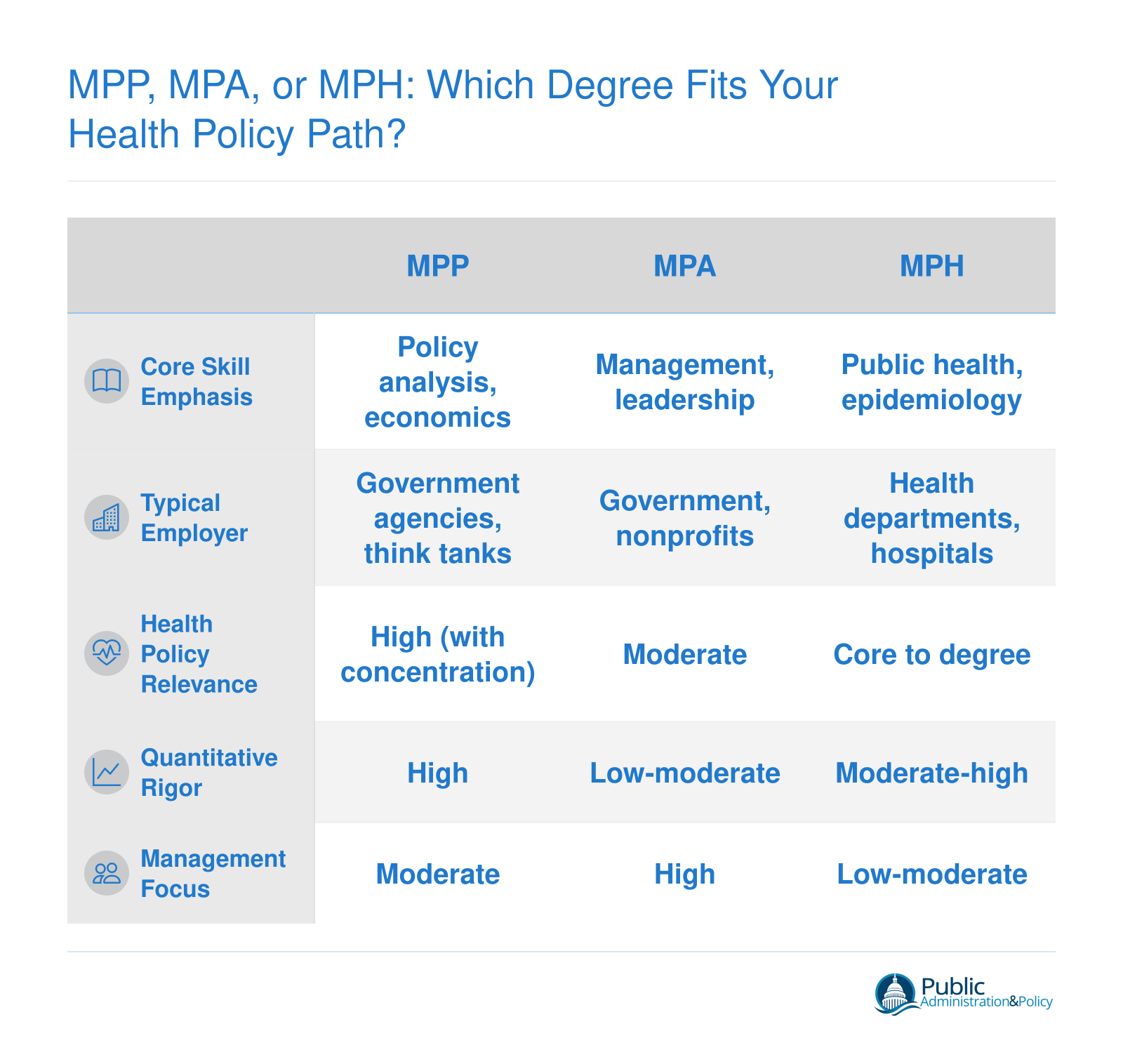
MPP, MPA, or MPH: Which Degree Fits Your Health Policy Path?
Choosing the right graduate degree shapes your trajectory into health and human services policy. Here’s how MPP, MPA, and MPH programs stack up on key dimensions.
Career Path and Salary Expectations by Experience Level and Sector
State-level advisory roles offer an insider track to shaping health and human services policy, often at the expense of a lower salary ceiling. Federal and consulting positions pay more but can distance you from direct implementation. Understanding how career progression and compensation differ across sectors is essential for MPP and MPA graduates.
A Career Ladder in Health Policy Advising
Most health policy advisors follow a progressive path from analytical support to strategic leadership. The timeline below reflects common milestones within state government, though transitions between sectors can accelerate or extend each phase.
Entry-level (0, 3 years): Graduates typically start as policy analysts or research fellows, conducting legislative research, drafting briefs, and supporting senior staff. National data for health policy analysts with under one year of experience shows a median salary around $52,900 and a mean near $72,800.1 Policy analyst roles in related fields report a median of $60,900.2 These positions build foundational knowledge of Medicaid, SNAP, and regulatory processes.
Mid-career (4, 8 years): Professionals advance to senior analyst or advisor titles, where they manage portfolios, coordinate interagency workgroups, and testify before legislative committees. Compensation rises into the $79,000, $127,500 interquartile range, based on national health policy advisor salary distributions.3 The national mean for this title is approximately $104,800.3
Senior (9, 15+ years): Top-level roles, chief policy officer, deputy secretary, or agency director, command salaries reaching $144,000 or more (90th percentile).3 The Bureau of Labor Statistics (BLS) reports that political scientists, a proxy occupation for senior policy experts, earn a median of $139,380, with top earners exceeding $172,050. These positions influence multi-billion-dollar budgets and statewide reform.
Salary Progression by Experience Level
Actual earnings depend heavily on sector, education, and location, but benchmarks from compensation databases help calibrate expectations. For a broader view of how these figures compare across the field, the public administration salary guide provides useful context.
0, 3 years: $50,000, $70,000, with higher starts in federal and consulting tracks.
4, 8 years: $80,000, $115,000; state advisors often land at the lower end, while federal and private-sector peers push toward the upper bound.
9, 15+ years: $120,000, $175,000; senior federal executives (SES) and consulting principals sit at the top.
These ranges are derived from PayScale and ZipRecruiter self-reported data for policy analysts, health policy advisors, and related titles, anchored to BLS occupational wage estimates for context.
Sector-by-Sector Compensation Comparison
Each sector trades off salary, influence, and lifestyle differently.
State government: Salaries are typically lower, but defined-benefit pensions, job security, and direct access to the governor's administration make it the highest-impact track. Work-life balance is often better than consulting.
Federal agencies (HHS, CMS, OMB): Pay scales follow the General Schedule; mid-career GS-13/14 roles range $90,000, $130,000 depending on locality. Prestige and national scope balance bureaucratic constraints.
Think tanks and nonprofits: Senior analysts earn $70,000, $110,000; mission alignment attracts many MPP/MPA graduates, though funding volatility can limit advancement. The think tank analyst career path offers a closer look at how this sector operates.
Consulting firms: Compensation peaks here, with senior advisors billing above $150,000, but hours are long and travel frequent. The work is project-based and output-driven. Professionals considering this route may also find the public policy consultant career guide useful for comparing entry points and advancement timelines.
Job Outlook and Demand
The BLS projects employment of political scientists will grow about 6% from 2024 to 2034, roughly as fast as the average for all occupations. However, the broader policy landscape shows stronger momentum. Medical and health services managers, a field that depends on many of the same regulatory skills, is projected to grow 32%, creating over 51,000 annual openings.4 State and federal agencies will continue hiring policy advisors to implement complex legislation like H.R. 1, which devolves major health program changes to the state level. The National Governors Association's 2026 Health and Human Services Policy Advisors Institute, which drew participants from 34 states, underscores the sustained need for professionals who can translate federal law into operational reality.
For MPP and MPA graduates, the career ladder is steep but navigable, with ample opportunity to move between sectors as expertise deepens.
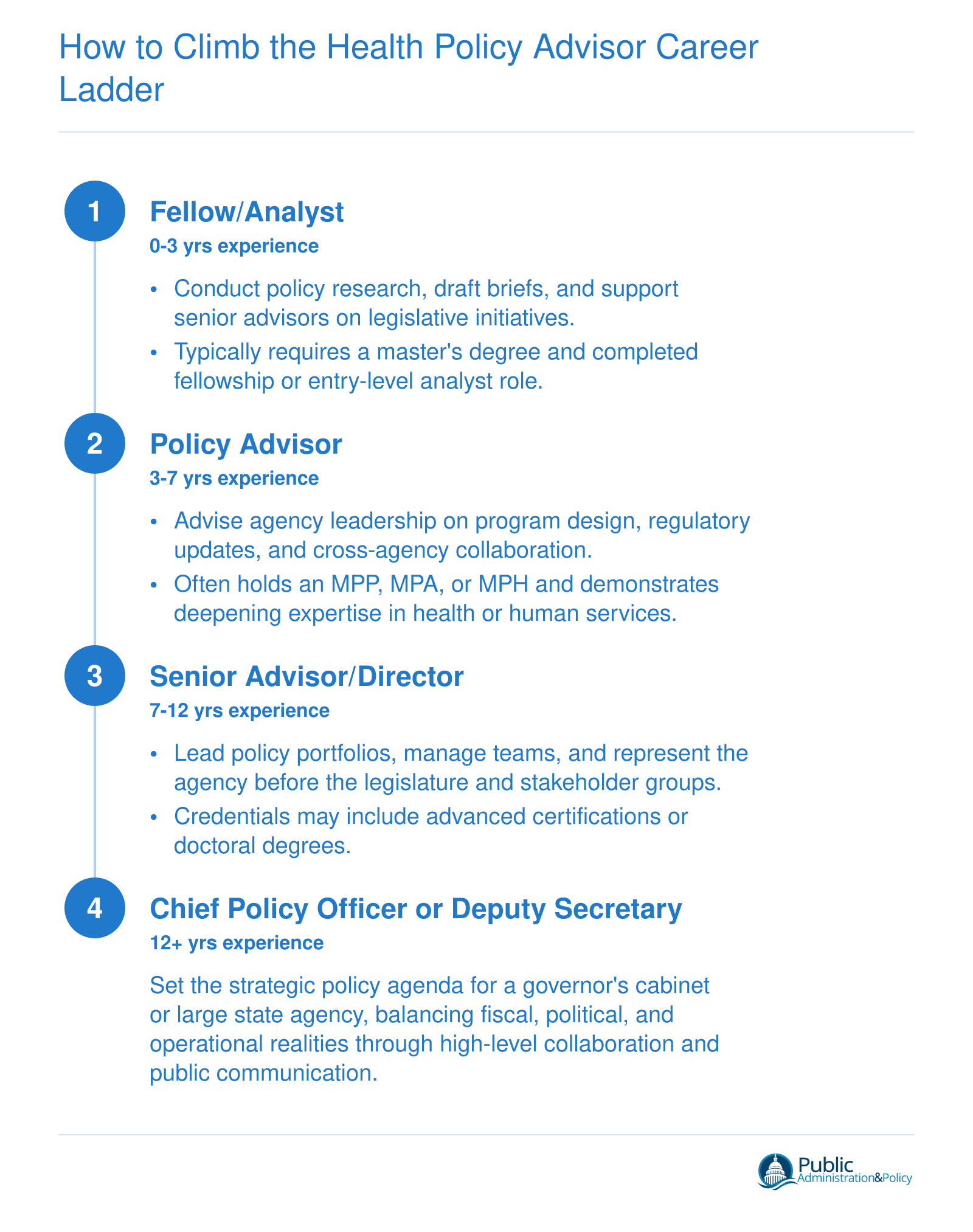
How to Climb the Health Policy Advisor Career Ladder
Health policy advising follows a structured climb from entry-level analysis to senior strategic roles. Most professionals spend 10-15 years progressing through four key stages, expanding their scope of influence from program support to shaping statewide policy.
Top Employers and Geographic Hubs for Health Policy Advisors
Health policy advisors often work in roles classified under political scientists or community and social service specialists. The Bureau of Labor Statistics provides metropolitan-level data for these occupations. The table below highlights key metropolitan areas for political scientists, a closely related profession, ranked by total employment.
Metropolitan Area
Total Employment
Mean Annual Wage
Median Annual Wage
25th Percentile Wage
75th Percentile Wage
Washington-Arlington-Alexandria, DC-VA-MD-WV
3,910
$153,650
$153,340
$128,940
$181,210
Seattle-Tacoma-Bellevue, WA
100
$129,840
$140,970
$91,150
$163,020
Chicago-Naperville-Elgin, IL-IN
90
$101,230
$98,300
$81,900
$98,300
Ann Arbor, MI
80
$117,700
$105,300
$81,620
$131,050
Miami-Fort Lauderdale-West Palm Beach, FL
60
$92,230
$76,780
$76,770
$120,010
Atlanta-Sandy Springs-Roswell, GA
30
$81,840
$80,000
$66,710
$95,000
Philadelphia-Camden-Wilmington, PA-NJ-DE-MD
30
$123,320
$104,990
$65,590
$164,630
Phoenix-Mesa-Chandler, AZ
30
$106,920
$104,640
$82,970
$112,340
Washington, D.C. dominates federal and think-tank advisory roles, yet state capitals, particularly in California, Texas, New York, and Illinois, offer robust opportunities. They feature lower cost of living and more direct policy impact, allowing advisors to see outcomes more immediately. While D.C. offers access to national agendas, state-level roles immerse advisors in community-specific challenges and tangible reforms.
Essential Skills and Competencies for Health Policy Advisors
Health policy advisors operate at the intersection of technical expertise and political acumen. The role demands a unique blend of hard and soft skills that go beyond what is typically required of a policy analyst. Below are the essential competencies for success in state-level health and human services advising.
Technical Skills for Policy Impact
Policy advisors need a strong command of the technical machinery that turns ideas into action. Core competencies include:
Legislative drafting: Crafting statutory and regulatory language that balances legal precision with political feasibility.
Fiscal and cost modeling: Estimating the budgetary impact of proposed policies, including state-federal matching requirements for Medicaid and SNAP.
Program knowledge: Deep familiarity with the operational details of Medicaid, SNAP, TANF, and other health and human services programs.
Data visualization for executive audiences: Translating complex analytics into one-page memos or dashboards that governors and senior staff can absorb in minutes.
Regulatory analysis: Interpreting federal rules, waiver processes, and state plan amendments to identify feasible policy options.
The Soft Skills That Set Advisors Apart
Technical ability alone rarely suffices. Health policy advisors work in politically charged environments where relationships and communication drive results. Essential soft skills include:
Coalition building across partisan lines: Finding common ground with legislators, agency heads, and external stakeholders who hold differing views.
Stakeholder engagement: Managing relationships with providers, patient advocates, industry groups, and community organizations to align interests behind policy goals.
Executive communication: Mastering the one-page brief and the five-minute elevator pitch to convey urgent recommendations to busy principals.
Crisis communication: Reacting swiftly and clearly when a public health emergency or program failure demands immediate, poised messaging.
Advisor vs. Analyst: Distinct Competencies
While policy analysts excel at rigorous research and option development, advisors carry additional responsibilities that blur the line between analysis and decision-making. The distinction hinges on political judgment and relationship management. Analysts can remain neutral, laying out multiple scenarios; advisors, however, must discern when to push a specific recommendation and when to present options neutrally, based on the administration's priorities and the political landscape. This requires a nuanced understanding of the governor's agenda, the legislative calendar, and the electoral implications of any move. Building and maintaining trust with elected officials, career staff, and external influencers is paramount, skills an analyst can often deprioritize.
Emerging Competencies for the Next Decade
The health policy landscape is evolving quickly, and advisors must stay ahead of new tools and frameworks. Leadership skills for healthcare administrators are increasingly relevant here, as advisors are expected to guide agency heads through organizational and cultural shifts alongside technical ones.
AI-assisted policy analysis: Leveraging machine learning to simulate the effects of policy changes or detect anomalies in program utilization.
Health equity frameworks: Applying structured assessments to ensure policies do not perpetuate disparities and instead close gaps in access and outcomes.
Cross-sector data integration: Linking SNAP enrollment data to health outcomes or housing stability to demonstrate the interconnectedness of human services and inform holistic policy design.
Entry Pathways: Fellowships, Internships, and Mid-Career Transitions
How can I break into health policy advising without prior government experience?
Federal Fellowships: The Presidential Management Fellowship
The Presidential Management Fellowship (PMF) is the premier federal entry point for graduate-degree holders, offering a structured 24-month pathway into HHS agencies such as CMS, SAMHSA, and the Office of the Assistant Secretary for Health.1 Eligibility requires U.S. citizenship and that you are in your final year of a qualifying graduate program, or within two years of graduation, during the application window, which typically runs from September to October. Finalists are announced in late winter or early spring, with agency placements occurring in spring and summer. PMF alumni often rotate through policy offices where they draft regulations, analyze legislation, and brief senior leadership, building the core competencies for a permanent advisory role.
Health-Focused Fellowships with Federal and State Placements
Several competitive fellowships place candidates directly into health policy advisor settings. The David A. Winston Health Policy Fellowship is a 12-month, Washington, DC-based program for U.S. citizens who are graduate students in their second semester of a first-year program or the next-to-last year of longer programs.2 Applications close October 17, 2025. Fellows work in congressional offices or federal health policy organizations, gaining legislative and analytical experience. The Robert Wood Johnson Foundation (RWJF) Health Policy Fellows Program targets mid-career professionals; its 12-month residential fellowship places participants in Congress, executive agencies, or other federal offices, followed by up to 12 months of continued health policy work.3 Applications open in early August and close in early November 2025. The Health and Aging Policy Fellows Program, with an April 15, 2025 application deadline, offers a 12-month experience that can include placements at federal, state, or local levels, blending onsite policy work with academic training to address aging-related challenges.4
State-Specific Pathways and Policy Academies
State government advisory roles are reachable through programs like the National Academy of Medicine's State Health Policy Fellowship, which embeds early-career professionals in state agencies to tackle localized delivery and financing issues.5 While many state-level fellowships have variable timelines, they consistently seek candidates with strong analytic and writing skills. The NGA Policy Academies, including the Strengthen SNAP E&T Delivery Academy, provide intensive, peer-learning experiences for state officials; involvement can open doors for aspiring advisors by demonstrating expertise in a specific policy area. Monitor NASHP and individual state government careers in public policy boards for announcements.
Mid-Career Transitions: From Practice to Policy
Clinicians, social workers, and nonprofit managers possess deep domain knowledge that translates well to policy advising. Their firsthand understanding of service delivery gaps and patient needs is invaluable in crafting operational policy. However, gaps often include budget analysis, legislative process navigation, and cost-effectiveness evaluation. An MPP or MPA fills these skill gaps with coursework in public finance, program evaluation, and policy analysis, while also providing the professional network and internship opportunities essential for a career pivot. The degree signals to hiring managers a commitment to public service and mastery of the public administration and policy tools of the trade.
Professional Networks to Accelerate Your Path
AcademyHealth: Connects researchers and policy professionals through conferences and interest groups on delivery system reform.
NASHP: Offers peer-learning calls, policy academies, and job boards tailored to state health policy advisors.
APPAM: Hosts an annual conference with a health policy track and fosters connections between academics and practitioners.
NGA Alumni Networks: Informal groups gather former institute participants, providing ongoing access to state policy advisors and chief policy officers.
Common Questions About Health Policy Advisor Careers
Here are answers to the most frequently asked questions about building a career as a health and human services policy advisor. These insights reflect the real-world dynamics highlighted by the National Governors Association and the career pathways open to MPP and MPA graduates.
How do I become a health policy advisor?
Start with a master's degree in public policy (MPP), public administration (MPA), or public health (MPH). Gain experience through internships or fellowships in government agencies or policy organizations. Develop expertise in health and human services programs, then transition into advisory roles that directly support elected or appointed officials in crafting and implementing policy.
What is the difference between a health policy advisor and a health policy analyst?
Advisors directly counsel decision-makers, translating analysis into actionable recommendations and navigating political and operational constraints. Analysts focus on research, data modeling, and program evaluation to inform policy options. While analysts provide the evidence base, advisors synthesize that information and guide strategic implementation, often working closely with leadership in real time.
Can I be a policy analyst with an MPA?
Yes. An MPA equips you with skills in program evaluation, budgeting, and public management that are highly valued in analyst roles. Many MPA graduates work as health policy analysts, examining program effectiveness or financial sustainability. This degree is especially relevant for state-level positions where implementation and administrative feasibility are as critical as pure research.
What careers can you get with an MPP?
An MPP leads to roles such as health policy advisor, legislative analyst, program evaluator, or budget examiner. Graduates work in governors' offices, state health departments, federal agencies like HHS, think tanks, and advocacy organizations. The degree's quantitative and analytical training prepares you to shape policy at every level of government.
What is the salary range for health policy advisors at the state and federal level?
Salaries vary widely. Entry-level state advisors often start around $55,000 to $70,000, while senior state advisors can earn $90,000 to $120,000. Federal roles, such as at HHS or the White House, typically range from $80,000 for early-career positions to over $150,000 for senior advisors. Location and agency budget levels influence compensation significantly.
What does a health and human services policy advisor do on a daily basis?
Daily work blends research, stakeholder meetings, and rapid response. Advisors brief governors or agency heads on emerging issues, draft policy memos, coordinate with Medicaid and SNAP program leads, and troubleshoot implementation challenges like those discussed at the NGA institute. They constantly translate complex federal requirements into actionable state strategies.
From the theoretical policy exercises of graduate school to the high-stakes briefing rooms where HHS decisions affect millions, MPP and MPA graduates discover where their training unlocks real change.
States now shoulder greater HHS implementation burdens after H.R. 1, making the advisor role both demanding and high-impact. The 2026 NGA Institute convening of 34 states exemplifies the collaborative, hands-on nature of this work, drawing on the full range of public administration careers and policy competencies explored throughout this guide.
You can begin now: bookmark the Presidential Management Fellowship and your state's capital fellowship program, join the American Society for Public Administration, and register for an upcoming state-level health policy summit within the next 12 months.
That room in New Orleans was filled with people whose degrees are shaping public health and human services. Yours can, too.