What you’ll learn in this article…
- SUNY's 64 campuses must adopt local AI policies by Dec 31, 2026.
- The policy mandates bias mitigation for high-risk AI systems.
- Starting Fall 2026, all undergrads encounter AI literacy in Gen Ed.
Your guide to SUNY's AI governance model, key requirements, and lessons for other public universities.
In April 2026, the State University of New York adopted a systemwide AI policy that applies to all 64 campuses.
This move responds to a landscape where generative AI tools are reshaping admissions, advising, and academic integrity without consistent safeguards. Public university systems face a stark tension: deploying automation to improve efficiency while upholding the equity and privacy mandates at the core of public education.
SUNY's framework, with its seven mandatory minimums and risk-based oversight, signals that ad hoc experimentation is giving way to coordinated governance in higher education.
The State University of New York (SUNY) faced a rapidly evolving technological landscape where generative AI tools were reshaping teaching, research, and campus operations. Without a unified framework, its 64 campuses risked inconsistent standards, privacy vulnerabilities, and missed opportunities to harness AI responsibly. The driving force behind the systemwide AI policy was twofold: to protect students, faculty, and institutional data, and to position SUNY as a leader in ethical AI adoption within public higher education. The initiative also responded to calls from faculty and administrators for clear guardrails as AI became embedded in everyday academic and administrative work.
On April 30, 2026, the SUNY Board of Trustees executive committee unanimously adopted the systemwide AI policy.1 The policy applies to all 64 SUNY campuses, requiring each institution to develop its own campus-specific AI policy by December 31, 2026, with the possibility of a two-month extension.1 Chancellor John B. King Jr. championed the policy as a foundational step in preparing students for an AI-augmented workforce while safeguarding academic integrity. The mandatory minimums that each campus policy must address include clarifying roles and responsibilities, embedding safeguards in procurement, distinguishing between teaching, research, and administrative uses, providing training, evaluating AI tools for bias, imposing greater oversight for high-risk AI systems, and committing to regular review and updates.3 These requirements reflect a governance and transparency philosophy grounded in best practice of public administration.
The SUNY policy does not exist in isolation. It aligns with the New York State Office of Information Technology Services Acceptable Use of AI Technologies policy (NYS-P24-001) and connects to broader state-level investments in AI education and ethics.5 The SUNY INSPIRE Center supports AI curriculum development and industry engagement, while the system's STRIVE Plan calls for the creation of Departments, Centers, and Institutes of AI and Society to explore the societal implications of artificial intelligence. Additionally, the Standardized Fundamental Ethics (SAFE) Initiative works to embed ethical reasoning into AI applications.6 By harmonizing its internal policy with these state initiatives, SUNY is building a comprehensive ecosystem where governance, workforce development, and ethical inquiry reinforce one another.
SUNY's AI governance follows a risk-based model with clear lines of authority from the system level to individual campuses. The structure ensures consistent policy enforcement while allowing campus-level adaptation.
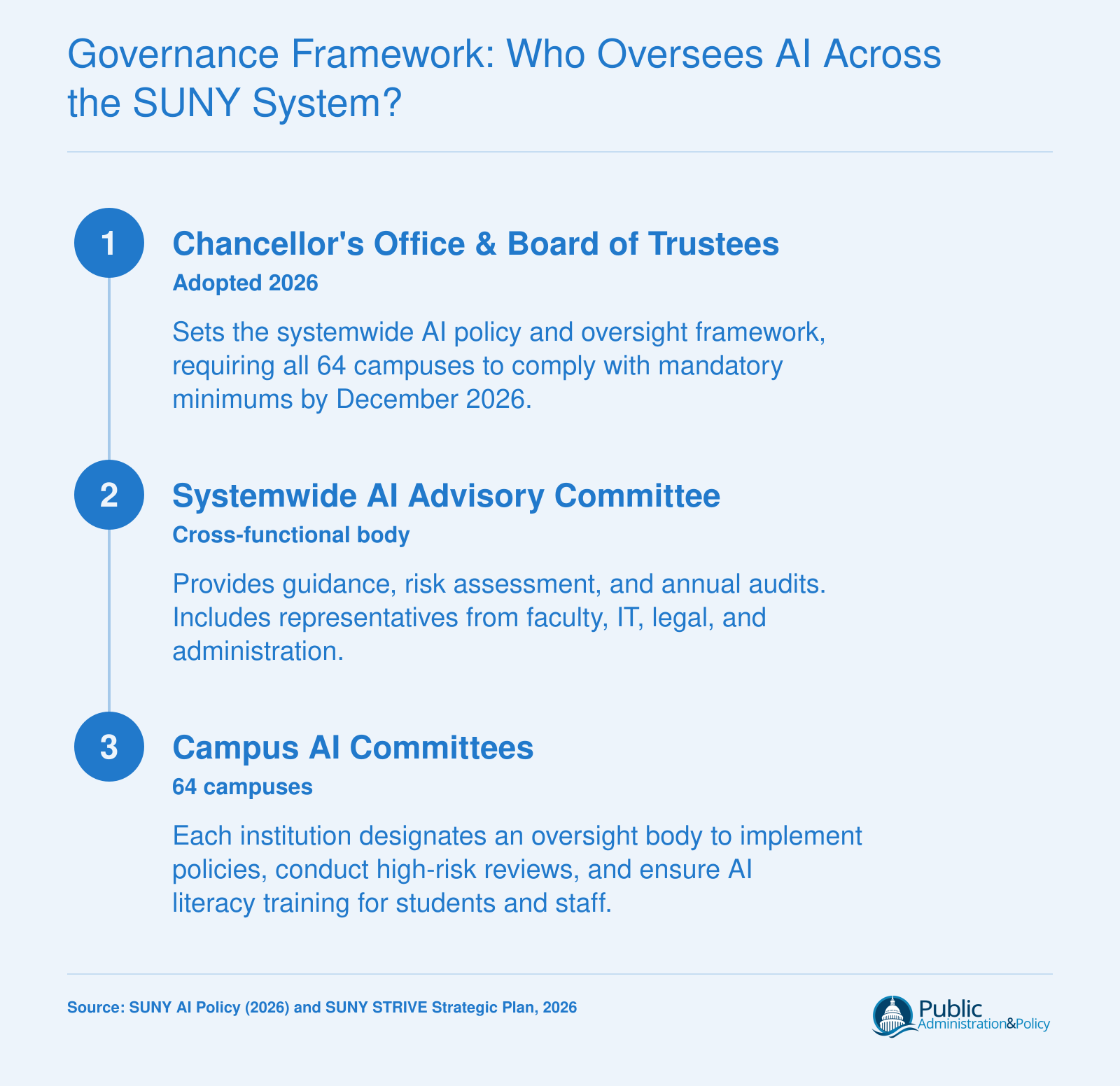
Every SUNY campus must build its local AI policy around seven core requirements, spelled out directly in the systemwide mandate. These mandatory minimums ensure that each institution addresses governance, risk, and literacy in a consistent way while leaving room for campus-specific needs. Campuses have until December 31, 2026, to publish their policies online1 (with a one-time, two-month extension available, making February 28, 2027, the latest compliance date2). Oversight committees and periodic audits will verify that the policies meet the required standards.
The policy lists each requirement in clear, actionable language. Below are the exact phrases from the mandate, followed by a plain-English explanation of what each means in practice.1
SUNY has published clarifying guidance alongside the mandate to help campuses interpret each requirement. While the guidance does not prescribe exact wording, it emphasizes transparency and accountability. For instance, the procurement safeguards must include data privacy checks, and the bias evaluations should be documented. The systemwide approach gives campuses a shared framework while acknowledging that a community college and a research university may implement training or high-risk oversight differently.
The efficiency that artificial intelligence promises in student services, enrollment management, and campus safety carries a direct tradeoff: automated speed can entrench the very inequities public universities are charged with dismantling. SUNY’s policy tackles that tension head-on by defining high-risk AI systems and mandating strict bias evaluation before deployment.
A system is high-risk if it makes decisions or informs outcomes that significantly affect an individual’s educational access, financial standing, or civil rights. Concrete examples include:
Low-risk systems, by contrast, are those with minimal potential for harm, such as a virtual assistant that answers routine campus hours questions or an automated parking permit tool. The distinction matters because high-risk designation triggers a cascade of required safeguards.
Before any high-risk AI tool is deployed, each SUNY campus must complete a multi-step evaluation:
Because the policy classifies tools upfront, procurement officers and IT teams must now filter vendor products through a high-risk lens. A proposed tool that ticks high-risk boxes cannot be purchased simply because it meets a functional spec; it must pass the bias evaluation protocol first. This shifts the buying process from a purely technical checklist to one that weighs equity, fairness, and institutional values in public administration and policy. Practically, it means some vendors will be disqualified if their models are opaque or cannot be tested, and campuses may opt for simpler, lower-risk alternatives where possible, an approach that reflects prudent public policy making.
What procurement safeguards and data privacy protections does SUNY's AI policy require when campuses acquire AI tools?
The systemwide policy establishes a structured vendor evaluation checklist that must be embedded in all AI-related requests for proposals (RFPs) and contracts. Each procurement now requires an assessment of three core areas: bias evaluation, data protection capabilities, and provisions for meaningful human oversight.1 This framework ensures that no AI system enters a campus workflow without a documented review of how it handles sensitive information and impacts decision-making.
Vendors must demonstrate compliance with stringent data handling protocols, including FERPA alignment for student records and HIPAA requirements where health information is involved. The New York State Contract Reporter opportunity #26-180 exemplifies this shift: it mandates adherence to the SUNY AI governance framework and HIPAA compliance as baseline criteria.2 Additionally, vendors are expected to provide sufficient algorithmic transparency so that campus officials can audit outputs and maintain human decision-making authority.1 Contracts now routinely prohibit the use of AI tools for marketing purposes and forbid any automated decision-making without human oversight.3
The policy strengthens data protection by requiring prior written consent before student or employee data can be used for AI training.3 Notably, even anonymized student data cannot be utilized for system improvement without explicit permission, as demonstrated by SUNY Fredonia’s model RFP language.3 These safeguards extend to banning the repurposing of AI tools for unaudited uses once deployed. Campuses must also ensure that all AI systems operate under the principle that human judgment remains paramount, preserving an appeal pathway when automated decisions affect individuals.1
With a December 31, 2026 deadline for local guidelines, each of SUNY’s 64 campuses is integrating these procurement checklists and contractual terms into their purchasing processes. Regular compliance reviews will verify that vendors meet ongoing data privacy standards, keeping institutional practices aligned with the systemwide governance model.1
The State University of New York (SUNY) system has set a clear timeline for implementing its systemwide AI policy, ensuring all 64 campuses adopt consistent governance standards. Key milestones and ongoing enforcement mechanisms are outlined below.
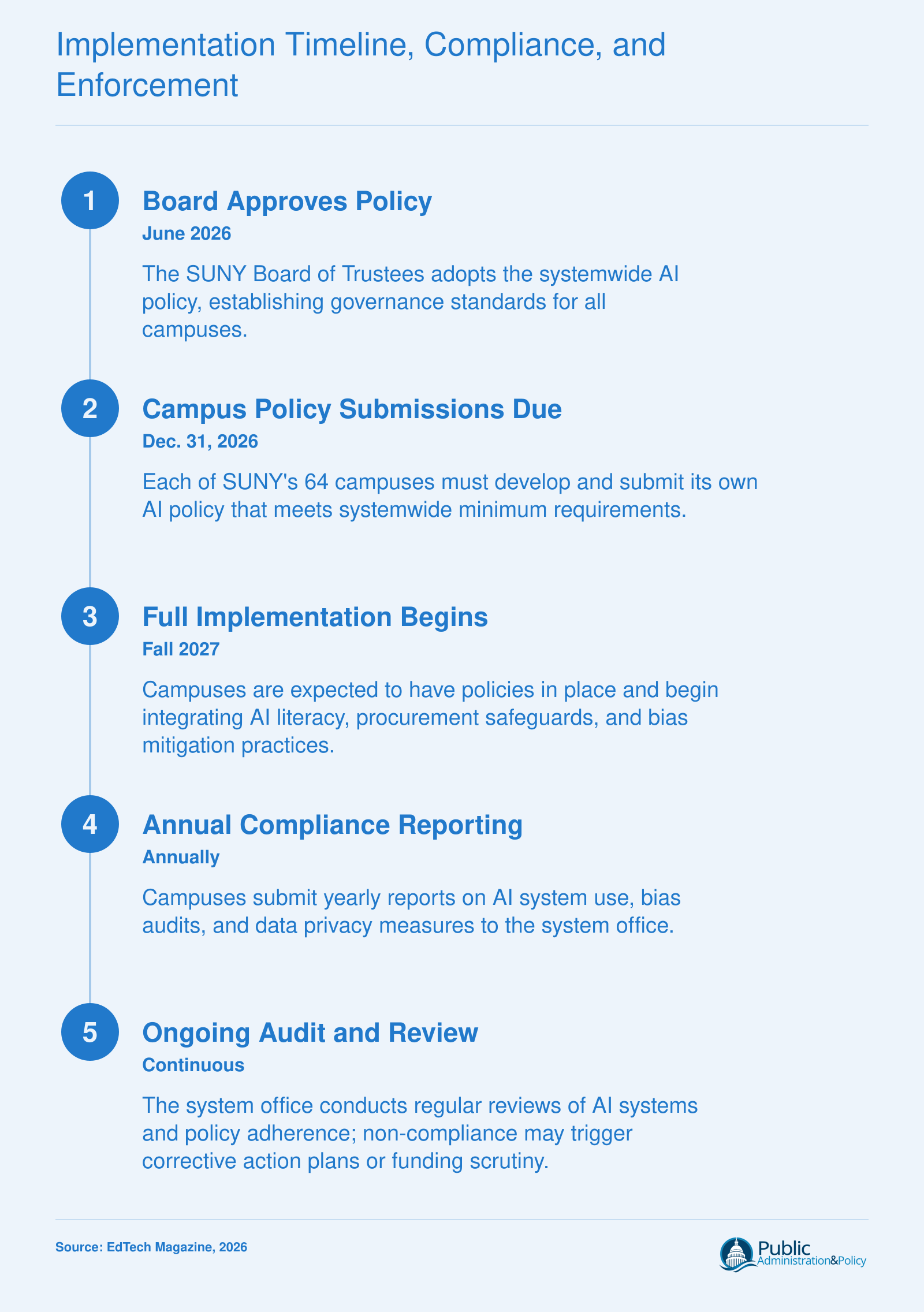
Beginning in Fall 2026, all SUNY undergraduates will encounter AI literacy embedded within the system's existing 30-credit General Education Framework3. The Board of Trustees approved the revision in December 20243, adding AI to the Information Literacy Core Competency without expanding credit requirements. Rather than a standalone course, campuses must integrate AI concepts into the required information literacy coursework, often a single course that every student takes, ensuring that every graduate develops critical skills without delaying degree completion. This approach reflects a deliberate choice to treat AI as a fundamental component of modern information fluency, not an elective topic.
To facilitate this curricular shift, SUNY has launched several professional development for public administration and policy initiatives. The Center for Professional Development offers a six-week training course, Introduction to Artificial Intelligence for Higher Education, designed in small cohorts of twenty participants to foster deep engagement5. Additionally, the Academic Affairs Fellows Programs have hosted webinars such as Back to Fundamentals: Using, Creating, and Sharing Information Ethically in the Age of AI, held in Spring 20266. The systemwide AI policy further mandates that all faculty, staff, and students receive training to use AI tools safely, ethically, and effectively. Beyond formal courses, the AI for the Public Good Fellows program, with twenty fellows for the 2025-2026 academic year, supports broader capacity building and peer-to-peer learning.
The revised information literacy competency now includes two explicit AI-related outcomes. Students will be expected to "evaluate information from a variety of sources with awareness of authority, validity, bias, and origin, including from AI,"3 and to "demonstrate understanding of ethical dimensions of information use, creation, and dissemination from traditional sources or emerging technologies such as AI."4 A pilot course, Introduction to Artificial Intelligence Literacy in Education, ran online from January 6-20, 20268, modeling how these outcomes can be met in a condensed format and providing a template for campus-level adaptations.
While specific assessment instruments are still under development, the SUNY policy deadline of December 31, 2026, requires each campus to have its own AI policy in place, including mechanisms for evaluating AI literacy. Faculty are likely to align existing information literacy assignments, such as source evaluation essays or research projects, with the new outcomes. As the Fall 2026 rollout approaches, campuses are sharing rubrics and example prompts through systemwide networks, with the pilot programs informing best practices for measuring both critical evaluation and ethical reasoning skills.
System-wide mandate or campus-by-campus autonomy? SUNY's 2026 AI policy takes the former route, contrasting sharply with the more decentralized paths that many peer public university systems have followed. Understanding these differences reveals how governance philosophy, risk tolerance, and institutional scale shape technology oversight in higher education.
SUNY's AI policy imposes a single framework across all 64 institutions, with a binding compliance deadline of December 31, 2026.1 This stands in contrast to the University of California, where individual campuses have traditionally developed their own AI guidelines, creating a more varied landscape. The California State University system has leaned toward recommendations rather than mandates, leaving substantial room for local decision-making. The University of Texas system sits between these extremes, offering system-level principles while allowing each campus to craft its own implementation plan. SUNY's approach centralizes authority to ensure equity and consistency, but it does so while preserving shared governance through campus oversight committees.
SUNY defines high-risk AI as any system that affects students' academic progress, access to resources, or well-being, a classification that triggers additional review. Many other large public systems have yet to formally codify such risk tiers, instead relying on broad ethical principles or general IT governance. The UC system, for example, has championed ethical AI use but has not prescribed operational risk thresholds. SUNY's risk-based model is more prescriptive, requiring dedicated committees to evaluate AI tools against clear criteria, a structure that could serve as a template for other systems seeking greater accountability.
Two areas where SUNY diverges most visibly from its peers are procurement and literacy. The system's AI-specific procurement safeguards, demanding bias mitigation, transparency, privacy protection, and human decision-making authority, are unusually detailed for a public university system, reflecting SUNY's AI education mandate. Most counterparts have not embedded such checks into their purchasing workflows. SUNY's AI literacy overhaul is equally distinctive: by embedding AI into general education and requiring training for all faculty, staff, and students, it goes beyond the typical exhortations to explore generative AI. While other systems promote digital fluency, few have tied it so directly to governance and graduation requirements.
Adopted in 2026, SUNY's policy arrives early in the lifecycle of higher education AI governance. Many large systems are still operating pilot programs or working groups. This gives SUNY a first-mover advantage, but the true test will be how its 64 campuses translate the framework into practice. If successful, the model could accelerate similar efforts across the country, demonstrating that a risk-based, system-wide approach can balance innovation with protection.
Each SUNY campus must translate the systemwide AI policy into localized guidelines tailored to its academic culture, administrative processes, and student body. While the December 31, 2026 deadline ensures baseline consistency1, the system intentionally allows institutions to shape their approaches. This produces a rich mosaic of implementations, from research-heavy universities to community colleges.
At University at Buffalo (UB), the policy emphasizes decentralized faculty discretion.4 Individual instructors determine if and how generative AI may be used in their courses, with a requirement that UB's graduate AI policy be publicly posted by Fall 2026. This puts the academic integrity conversation at the course level, supported by campus-wide guidance from the Office of Academic Integrity.
Stony Brook University takes a more centralized academic integrity approach. It explicitly defines AI misuse as "representing work generated by artificial intelligence as one’s own work" and enforces violations through existing academic integrity mechanisms. Both campuses demonstrate how large research institutions focus on scholarly integrity and instructor autonomy rather than micromanaging every classroom use.
SUNY Suffolk County Community College shapes its policy around the classroom contract. The college defines AI misconduct as "using material generated by artificial intelligence tools for an assignment without instructor authorization", placing the control point squarely at the course level. This empowers faculty to set clear expectations, particularly in introductory and career-focused programs where foundational skill-building is critical. It reflects a practical, teaching-first mindset common among two-year institutions.
Several campuses have adopted resource-driven, faculty-facing models. SUNY Binghamton provides template syllabus statements that faculty can adapt, creating consistency without sacrificing choice. SUNY Oneonta offers syllabus policy examples and guidance for instructors. SUNY Geneseo frames the conversation through academic misconduct, declaring that work created in whole or in part by generative AI is considered plagiarism. These variations highlight how the systemwide mandate supports local innovation: each campus identifies its most pressing AI challenges and crafts a response that aligns with its mission, while still meeting the seven mandatory minimum requirements for accountability.3
SUNY's systemwide AI policy, adopted in April 2026, marks a significant step in public university governance. Below are answers to key questions about the policy's requirements, implementation, and impact.