Your Complete Guide to an MPP in Environmental Policy

Explore curriculum, career paths, salary expectations, and how an MPP prepares you to shape environmental policy at every level of government.

By Carrie HirschReviewed by PAP Editoral TeamUpdated May 19, 202625+ min read

What you’ll learn in this article…

  • MPP programs emphasize policy design and quantitative analysis, while MPAs focus on management and MS degrees stress technical research.
  • Most MPP environmental concentrations require about 48 credits over two years, blending economics, statistics, and environmental governance coursework.
  • Graduates work across government, nonprofits, consulting, and international organizations, with private sector roles often offering the highest base salaries.
  • EPA staffing cuts are shifting environmental policy jobs toward state agencies, nonprofits, and the private sector, expanding demand for MPP holders.

The Bureau of Labor Statistics projects 8 percent job growth for political scientists and 6 percent growth for environmental scientists through 2032, yet the graduate degrees that feed those roles differ sharply in what they teach. A Master of Public Policy with an environmental policy concentration is a quantitative, analysis-driven credential built around econometrics, cost-benefit analysis, and regulatory design, distinguishing it from broader MPA management degrees and technically oriented MS programs in environmental science.

If you are weighing graduate programs to work on climate regulation, water policy, land-use planning, or environmental justice, the choice of degree shapes both the skills you develop and the roles available to you. For a closer look at how those skills translate into practice, explore the environmental policy advisor career path. Employers in federal agencies, state environmental offices, and consultancies increasingly expect policy analysts to pair subject-matter expertise with statistical fluency, a combination the MPP is specifically structured to deliver.

MPP vs. MPA vs. MS: Which Environmental Policy Degree Fits You?

Three graduate degrees dominate the environmental policy landscape, and choosing the right one depends on whether you want to design policy, manage programs, or conduct technical research. The comparison below breaks down the Master of Public Policy (MPP), Master of Public Administration (MPA), and Master of Science (MS) in Environmental Science across the dimensions that matter most for your career trajectory. Use it as a decision heuristic: if you picture yourself running regression models on cap and trade proposals, the MPP is your lane; if you see yourself directing a regional sustainability office, lean toward the MPA; and if fieldwork and lab research excite you most, the MS is likely the best fit.

DimensionMPP (Environmental Concentration)MPA (Environmental Concentration)MS in Environmental Science
Analytical EmphasisHeavy focus on econometrics, cost-benefit analysis, and statistical modeling to evaluate policy alternativesEmphasizes organizational analysis, program evaluation, and performance measurement in public agenciesCenters on scientific methodology, data collection in field and lab settings, and peer-reviewed research design
Curriculum BalanceRoughly 60% quantitative methods and economics, 40% policy electives including environmental regulation and climate economicsRoughly 50% management and budgeting, 50% policy electives covering areas like environmental governance and stakeholder engagementRoughly 80% natural science coursework (ecology, hydrology, atmospheric science) with limited policy or management electives
Quantitative RigorHigh. Expect multiple semesters of statistics, microeconomics, and regression analysis applied to environmental outcomesModerate. Coursework includes public budgeting, financial management, and introductory statistics, but less advanced econometric trainingHigh, but science-oriented. Quantitative training centers on experimental design, GIS, and environmental modeling rather than economic analysis
Career FitBest for roles in policy design, legislative analysis, and think tank research where you craft and evaluate environmental regulationsBest for roles managing environmental programs, leading nonprofit operations, or overseeing compliance within government agenciesBest for technical and research positions such as environmental scientist, ecological consultant, or laboratory director
Typical EmployersFederal agencies (EPA, DOE), policy think tanks, consulting firms, international organizations like the World BankState and local government agencies, environmental nonprofits, utility authorities, and public affairs officesResearch universities, federal science agencies (USGS, NOAA), environmental engineering firms, and private sector R&D labs
Decision HeuristicChoose this if you want to design, model, and recommend environmental policies using economic and statistical evidenceChoose this if you want to lead teams, manage budgets, and implement environmental programs within organizationsChoose this if you want to generate the scientific data and technical analyses that inform policy decisions

Core Curriculum and Environmental Coursework in an MPP

An MPP with an environmental policy concentration blends a rigorous analytical foundation with specialized knowledge in environmental governance, economics, and science-informed decision-making. Most programs require around 48 credits completed over 24 months, with six to eight core courses, three to six concentration electives, and a capstone project.1 Understanding how these pieces fit together will help you evaluate whether a program's curriculum matches your career goals.

The MPP Core and Why It Matters for Environmental Work

Regardless of concentration, every MPP student moves through a core sequence designed to build fluency in the language of policy design and evaluation.1 Expect courses in:

  • Microeconomics for Public Policy: Teaches cost-benefit reasoning, market failures, and externalities, concepts that sit at the heart of pollution regulation and climate mitigation.
  • Quantitative Methods and Statistics: Equips you to analyze emissions data, model policy impacts, and evaluate program effectiveness using regression, causal inference, and forecasting.
  • Policy Analysis and Decision-Making: Develops your ability to frame problems, weigh trade-offs, and present actionable recommendations to decision-makers, skills you will use whether you work at a federal agency or a conservation nonprofit.
  • Political Institutions and the Policy Process: Clarifies how legislation, executive orders, and administrative rulemaking shape environmental outcomes across federal, state, and local levels.
  • Public Finance: Covers taxation, budgeting, and the economics of public goods, directly relevant when designing cap-and-trade systems, green subsidies, or infrastructure investments.
  • Ethics and Professional Skills: Grounds your technical work in questions of equity, accountability, and stakeholder engagement.

Each of these disciplines feeds directly into real environmental challenges. You cannot design an effective carbon pricing mechanism without understanding microeconomics, nor can you defend a regulation in a public hearing without grasping political institutions.

Environmental Concentration Electives

Once you have completed the core, concentration electives let you go deep. Programs commonly offer courses such as climate change economics and policy, regulatory design, environmental justice, natural resource management, international environmental policy, sustainable development, and global environmental health.2 At Duke's Sanford School, for example, the Environment and Energy Policy concentration emphasizes statistical tools, efficiency and equity analysis, decision-making under uncertainty, and the valuation of non-market resources like clean air and biodiversity.

The number of concentration courses typically ranges from three to six, so look closely at how much flexibility a program offers.2 Some schools provide a tightly sequenced track while others let you assemble a more customized elective portfolio.

Capstone and Experiential Learning

Nearly every MPP program requires a capstone, and environmental concentrations often connect this requirement to live policy questions. Duke's MPP capstone, for instance, is a team-based policy analysis project that spans two semesters and pairs students with real clients.1 Across the field, common capstone partners include EPA regional offices, state environmental agencies, municipal sustainability departments, and national or international NGOs. Some programs also incorporate required internships or spring practicums during the first year, giving you hands-on experience before the capstone begins.3

These experiential components are not optional extras. They produce portfolio-ready work products and professional relationships that often lead directly to post-graduation employment. If you are drawn to this kind of applied work, you may also want to explore the environmental policy advisor career path to see how capstone experience translates into professional roles.

Elective Flexibility and Secondary Focuses

Credit requirements vary by program, generally falling between 48 and 60 credits. Programs on the higher end of that range tend to offer more elective space, which can be strategically valuable. Many schools allow students to pair an environmental concentration with a secondary focus such as data analytics, international development, or energy policy. If you are interested in cross-cutting work, such as using geospatial analysis to map environmental justice disparities, look for programs that explicitly support dual concentrations or certificate add-ons. Dual MPP/MEM or MPP/MF degrees typically require about 36 months and provide the deepest immersion, though they demand a larger time and financial commitment.4

As you compare curricula, pay attention not just to course titles but to the balance between required and elective credits. A program that locks in most of your schedule may offer less room to tailor your expertise, while one with generous elective space lets you respond to emerging policy areas like environmental AI applications or climate adaptation finance.

Questions to Ask Yourself

An MPP emphasizes analytical frameworks, econometrics, and legislative design. If you see yourself running programs on the ground or managing agency operations, an MPA with an environmental focus may be a stronger fit.

MPP programs typically require statistics, cost-benefit analysis, and regression modeling. If math-intensive methods feel like a barrier rather than a strength, look for programs that balance quant work with qualitative policy analysis electives.

Your target sector shapes which program networks, internship pipelines, and alumni connections matter most. Programs near Washington, D.C. or state capitals often have stronger government placement, while others excel in nonprofit or consulting pathways.

Full-time cohort programs offer deeper peer networks and on-campus research opportunities, but part-time and hybrid formats let you keep earning while you study. Weigh lost income against the immersive experience before committing.

Admissions Requirements and What Competitive Applicants Look Like

MPP admissions committees look for candidates who combine analytical aptitude with a genuine commitment to policy impact. Understanding what programs expect, and what sets the strongest applicants apart, will help you build a more strategic application.

GPA, Test Scores, and Experience Benchmarks

Most competitive MPP programs admit students with cumulative GPAs in the 3.2 to 3.5 range, though top-tier schools often see median GPAs closer to 3.5 or above. A lower GPA is not automatically disqualifying if the rest of the application is strong, but it does raise the bar for other components.

The GRE landscape has shifted considerably since 2020. Many programs now operate on a test-optional or test-flexible basis, and some have dropped the requirement entirely. Check each school's current policy before investing in test preparation; if you do submit scores, strong quantitative results reinforce the analytical profile admissions teams want to see.

Work experience expectations vary. Most programs prefer one to three years of professional or research experience, yet many also welcome exceptional candidates straight from undergraduate study. Quality matters more than duration: a year spent conducting field research on water policy or managing grants at an environmental nonprofit typically carries more weight than three years in an unrelated industry.

Standard Application Components

Expect to submit the following materials:

  • Statement of purpose: This is the single most important narrative element. Frame your environmental policy interest around a specific problem you want to help solve, the skills you need to get there, and why that particular program is the right fit.
  • Resume or CV: Highlight policy-relevant roles, research projects, and any quantitative or analytical work.
  • Letters of recommendation: Two to three letters, ideally from supervisors, professors, or collaborators who can speak to your analytical thinking and policy engagement.
  • Writing sample: Some programs request a sample demonstrating your ability to construct a clear, evidence-based argument. A policy memo or research paper works well here.

Quantitative Readiness

MPP programs are data-intensive by design. Admissions committees want evidence that you can handle graduate-level statistics, microeconomics, and cost-benefit analysis. Completing at least one course in statistics or economics at the undergraduate level is strongly recommended. If your transcript lacks this preparation, look for programs that offer pre-enrollment math bootcamps or bridge modules; several leading schools run these in the summer before orientation to help incoming students build a solid quantitative foundation.

Making Environmental Experience Count

Relevant, hands-on experience in environmental work strengthens an application considerably more than generic professional tenure. Roles or volunteer work at environmental nonprofits, government agencies like the EPA or state-level departments, conservation organizations, or university research labs all signal that your interest in environmental policy is rooted in real engagement rather than abstract ambition. A summer internship with a regional planning commission, for instance, could eventually lead to a career as an urban policy planner, and admissions readers recognize that kind of trajectory-building initiative. Even short-term positions, such as a semester assisting with climate data collection, can illustrate subject-matter familiarity that committees value highly.

Notable MPP Programs with Environmental Policy Concentrations

Several well-regarded schools offer MPP programs with dedicated environmental policy concentrations or tracks. The programs below represent a cross-section of options, but they are not the only choices available. Always verify details directly with each school, since concentration names, credit requirements, and delivery formats can change from year to year.

Programs Worth Exploring

The following schools have historically offered environmental policy pathways within their MPP curricula:

  • Duke University, Sanford School of Public Policy: The MPP at Duke allows students to specialize in energy and environmental policy, drawing on the university's broader strengths in environmental science and the Nicholas School of the Environment. The on-campus program in Durham, North Carolina, integrates analytical methods with policy design.
  • University of Michigan, Gerald R. Ford School of Public Policy: Ford School MPP students can focus on environmental policy, with coursework that connects to the School for Environment and Sustainability. This on-campus program is known for its interdisciplinary approach and strong quantitative training.
  • Indiana University, O'Neill School of Public and Environmental Affairs: O'Neill is one of the few schools that explicitly combines public affairs and environmental affairs in its mission. The MPP offers an environmental policy concentration with a wide selection of electives and access to a large alumni network in both government and nonprofit sectors.
  • Arizona State University, Watts College of Public Service and Community Solutions: ASU offers flexibility through both on-campus and online delivery formats. The program emphasizes sustainability and urban environmental challenges, reflecting the university's broader institutional commitment to sustainability research.
  • UC Berkeley, Goldman School of Public Policy: Goldman's MPP enables students to concentrate in energy and environmental policy within a rigorous analytical framework. The Bay Area location provides proximity to state and federal environmental agencies as well as a thriving nonprofit ecosystem.
  • University of Oregon: The MPP program here offers environmental policy coursework that taps into Oregon's reputation for progressive environmental governance. The on-campus program in Eugene provides access to both state policy institutions and community-based organizations.
  • University of Minnesota, Humphrey School of Public Affairs: Humphrey's MPP includes an environmental and energy policy concentration, with particular strengths in natural resource governance and climate adaptation. The Twin Cities location connects students to regional policy networks.

How to Dig Deeper Before Committing

A program listing only tells part of the story. Take these additional steps before narrowing your shortlist:

  • Visit each school's official website to confirm the exact concentration name, total credit requirements, and whether the program is offered on campus, online, or in a hybrid format. Program structures evolve, and third-party sources sometimes lag behind.
  • Use BLS.gov to research demand and projected growth for roles in environmental policy analysis, regulatory affairs, and sustainability planning. Understanding where jobs are growing can help you prioritize programs that align with high-demand career paths.
  • Review resources from professional associations such as APPAM (Association for Public Policy Analysis and Management) and NASPAA (Network of Schools of Public Policy, Affairs, and Administration). Both organizations offer program directories, rankings, and alumni perspectives that add context beyond what marketing materials provide.
  • Contact admissions offices directly. Ask about capstone project opportunities, faculty research areas in environmental policy, practicum placements with government agencies or advocacy organizations, and any distinctive features that may not appear on the website. Admissions staff can also clarify whether certain electives are offered every year or rotate on a less predictable schedule.

A Note on Rankings and Fit

Rankings from NASPAA, U.S. News, or similar outlets can be useful starting points, but they rarely capture everything that matters for environmental policy students specifically. A program ranked lower overall might have stronger faculty expertise in climate governance, deeper ties to a state environmental agency, or better financial aid packages. Prioritize alignment between your career goals and each program's concrete offerings over prestige alone. publicadministrationpolicy.org provides additional guidance on evaluating program fit across the broader landscape of public policy graduate education.

Career Paths: What Can You Do with an MPP in Environmental Policy?

An MPP with an environmental policy concentration opens doors across government, the nonprofit sector, private industry, and international organizations. The degree equips you with quantitative analysis, stakeholder engagement, and policy design skills that translate into specific, high-impact roles. Below is a sector-by-sector map of where graduates land and what the day-to-day work actually looks like.

Government Roles

  • Policy Analyst (Federal or State Agency): You spend your days building cost-benefit models, drafting regulatory impact assessments, and writing policy memos that inform agency decisions on issues like air quality standards or water infrastructure funding.
  • Environmental Planner (Local or Regional Government): You review land-use proposals against environmental regulations, coordinate with community groups during public comment periods, and develop long-range sustainability plans for municipalities or metropolitan planning organizations.
  • Legislative Aide (Congress or State Legislature): You brief elected officials on pending environmental bills, synthesize testimony from hearings, and negotiate policy language with advocacy groups and committee staff to move legislation forward.

Nonprofit and Research Roles

  • Program Manager (Environmental Nonprofit): You oversee grant-funded conservation or climate adaptation initiatives from budget to impact report, coordinating field teams, managing timelines, and presenting outcomes to funders and board members.

MPP graduates also find homes at research institutions such as Resources for the Future or the World Resources Institute, where they design studies that shape national and global policy debates. International organizations, including the World Bank and the UN Environment Programme, recruit MPP holders for roles in climate finance, environmental governance, and sustainable development programming.

Private Sector and Consulting Roles

  • Sustainability Director (Corporate): You set company-wide emissions reduction targets, manage ESG reporting frameworks, and work with operations teams to integrate sustainability metrics into supply chain decisions.
  • Regulatory Affairs Specialist (Consulting): You help clients navigate federal and state environmental permitting processes, track evolving regulations, and prepare compliance strategies that keep projects on schedule and within legal requirements.

A Note on the MPP vs. JD Question

Prospective students sometimes wonder whether they need a law degree instead. For the vast majority of environmental policy careers listed above, an MPP is the more direct and cost-effective path. It typically takes two years rather than three, and tuition is often lower than at comparable law schools. Most policy analyst roles, planner positions, and program management jobs do not require bar admission. That said, if your career goals center on environmental litigation, judicial review of agency rulemaking, or drafting statutory language at a high level, a JD or a JD/MPP dual degree becomes a serious asset. The dual degree is particularly powerful for professionals who want to move fluidly between legal strategy and policy design, though it does add time and expense.

Expanding Your Reach Internationally

The analytical toolkit you build in an MPP program, including econometrics, program evaluation, and stakeholder analysis, is valued well beyond domestic policy circles. Graduates regularly transition into roles at multilateral development banks and UN agencies, where they shape climate adaptation funding, negotiate international environmental agreements, and evaluate the effectiveness of conservation programs across multiple countries. Those drawn to this path may want to explore what an international policy specialist does day to day. For students motivated by global impact, an MPP in environmental policy offers a credible and versatile launching point, and our broader careers in public administration guide maps additional options across the field.

MPP Environmental Policy Salary Ranges by Role and Sector

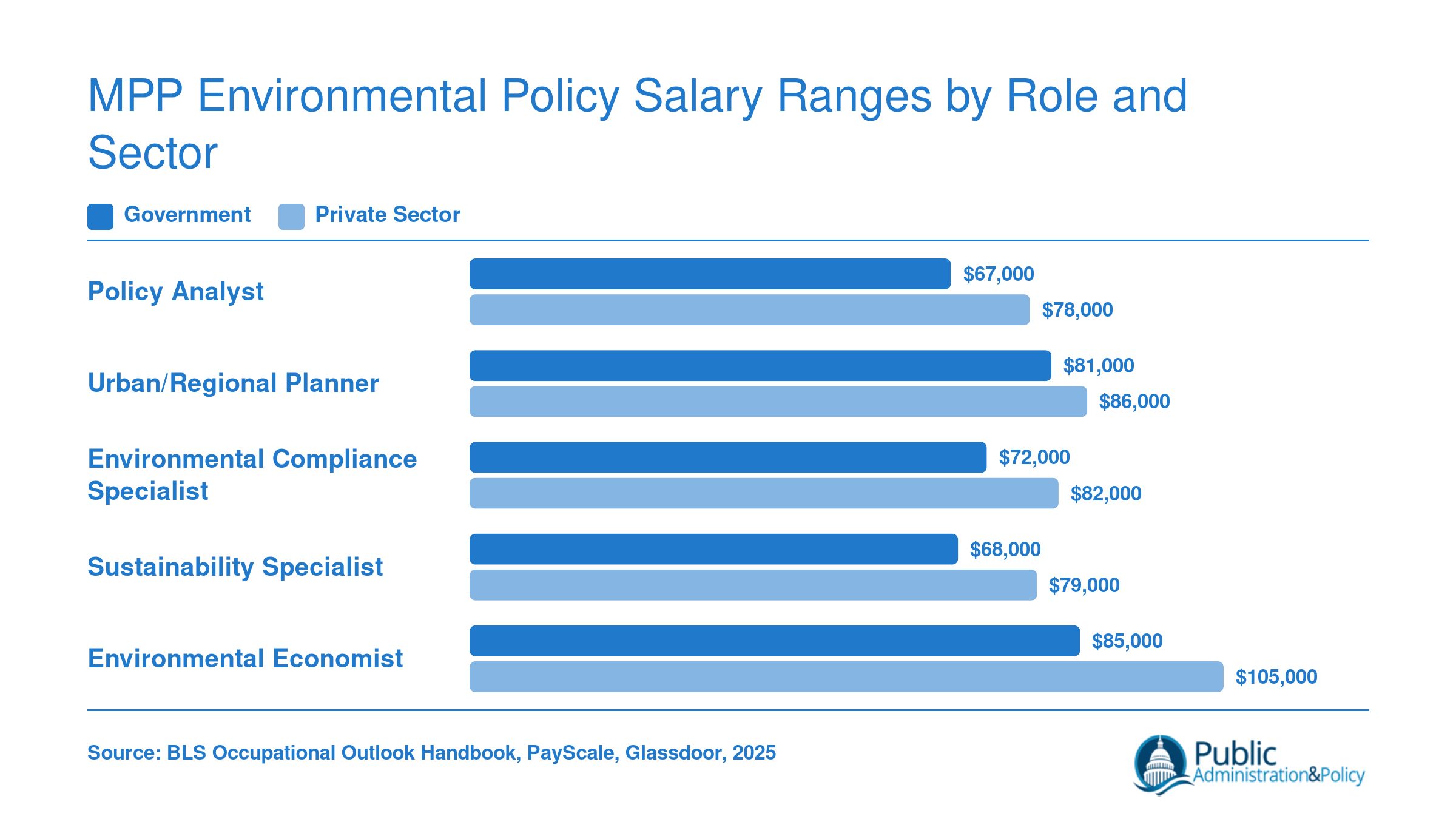
Salary expectations for MPP graduates in environmental policy vary significantly by role and sector. Government positions tend to offer stable compensation with strong benefits, while private-sector and consulting roles often come with higher base pay. The figures below reflect median annual salaries drawn from federal labor data and professional salary surveys, giving you a realistic snapshot of earning potential across common career paths.

Grouped bar chart comparing government and private-sector median salaries for five environmental policy roles, ranging from $67,000 to $105,000

The U.S. Environmental Protection Agency's FY 2026 budget funds roughly 12,856 full-time equivalent positions, a reduction of about 1,274 FTE from prior levels according to the FY 2026 EPA Budget in Brief. That shrinking federal footprint is pushing more environmental policy work to state and local agencies, creating new demand for MPP graduates who can design and implement climate and sustainability programs closer to the communities they serve.

Online and Hybrid MPP Programs with Environmental Concentrations

Not everyone can relocate to a policy hub for two years. Online and hybrid MPP programs make it possible to build expertise in environmental policy while staying in your current role or community. Several well-regarded schools now deliver their environmental policy coursework in flexible formats, though the experience differs from a traditional on-campus cohort in important ways.

Programs Worth Exploring

A handful of institutions stand out for combining online delivery with meaningful environmental policy content.

  • Arizona State University (ASU): ASU's online MPP allows students to select coursework in sustainability and environmental policy, drawing on the university's broader strength in sustainability science. The program is fully online with optional on-campus immersion experiences.
  • Indiana University O'Neill School: O'Neill offers an online MPA with an environmental policy concentration. While technically an MPA rather than an MPP, the program includes policy analysis coursework and is one of the most established online options in this space.
  • University of Southern California (USC) Price School: USC's online MPP provides access to policy electives that touch on environmental governance, though students should confirm the availability of specific environmental courses in the online format each semester.
  • Oregon State University: Oregon State delivers a hybrid Master of Public Policy with coursework that leverages the state's strong environmental and natural resource policy landscape.

Some of these programs require short on-campus residencies, capstone intensives, or practicum components that involve in-person engagement. Check each school's current requirements before assuming a program is entirely remote.

Trade-offs to Weigh

Online study offers clear advantages: lower living costs, the ability to keep working, and scheduling flexibility that accommodates professionals with families or geographic constraints. These benefits are real and increasingly valued by employers who care more about the credential and your skill set than the delivery format.

That said, reduced access to in-person networking is a genuine limitation. Policy careers are relationship-driven, and students on campus near Washington, D.C., state capitals, or regional EPA offices benefit from proximity to internships, guest speakers, and informal mentorship. Online students can partially offset this gap through virtual networking events, professional associations, and self-directed informational interviews, but it requires deliberate effort.

Verify Before You Commit

One of the most common surprises for online MPP students is discovering that not every concentration, elective, or faculty seminar available on campus is offered in the online format. Some schools limit their environmental policy electives to on-campus cohorts due to enrollment minimums or lab components. Many programs also waive standardized test requirements, so prospective students may want to explore best no-GRE MPA programs as part of their search. Before applying, take these steps:

  • Request a list of environmental policy courses that have actually been offered online in the past two academic years, not just those listed in the catalog.
  • Ask whether online students have the same faculty advisors and capstone project options as on-campus peers.
  • Confirm whether the diploma and transcript distinguish between online and on-campus completion. Most accredited programs do not make this distinction, but it is worth verifying.

The right online or hybrid MPP can deliver the same analytical toolkit as an in-person program. The key is choosing one where environmental policy is a genuine curricular strength, not an afterthought tucked into a general policy degree.

How to Choose the Right MPP Program for Environmental Policy

Selecting the right MPP program is less about prestige and more about strategic fit. A program that aligns with your environmental interests, connects you to the right employers, and leaves you financially positioned to pursue public service will outperform a higher-ranked alternative that checks none of those boxes. Use the five-factor framework below to evaluate each program on your list.

Five Weighted Factors for Your Decision

  • Issue-area alignment: Environmental policy is broad. Some programs emphasize climate and energy policy, others focus on water resource management, and still others center environmental justice or land use. Review course catalogs, capstone project archives, and faculty publications to confirm that a program matches the slice of environmental policy you care about most.
  • Faculty research strengths: The professors who lead environmental policy coursework shape the quality of your analytical training and often serve as professional references. Look for faculty who are actively publishing, advising government agencies, or leading policy labs. Their networks become your networks.
  • Geographic proximity to policy hubs: Programs located near Washington, D.C., state capitals, or regional EPA offices tend to offer stronger internship pipelines and practitioner guest lectures. A program in a state capital with an active environmental regulatory agency can provide semester-long placements that rural campuses struggle to replicate.
  • Total cost and funding packages: Compare net cost, not sticker price. Factor in merit scholarships, graduate assistantships, and cost of living. A fully funded seat at a mid-ranked program often delivers a better return than paying full tuition at a top-ten school, especially if you plan to work in the public or nonprofit sector.
  • Career placement rates and employer connections: Ask admissions offices for data on where recent graduates landed. Programs that maintain formal partnerships with agencies such as the EPA, state environmental departments, or organizations like the Environmental Defense Fund give students a measurable hiring advantage.

Go Beyond the Rankings

Published rankings from outlets like U.S. News capture broad program reputation, but they rarely account for the strength of a specific concentration. A program ranked twentieth overall may house one of the strongest environmental policy faculties in the country, while a top-five program may treat environmental coursework as an afterthought. The most reliable intelligence comes from people who have lived the experience. Reach out to current students and recent alumni. Ask them pointed questions: How competitive were capstone clients? What percentage of students secured environmental policy internships through the program? Were career services proactive in connecting students with environmental employers? These conversations reveal truths that glossy brochures and ranking tables cannot.

Your Concrete Next Step

Narrow your options to a shortlist of three to five programs that score well across the five factors above. Attend at least one virtual information session for each. During or after those sessions, request a brief conversation with the faculty member who leads the environmental policy concentration. Ask about upcoming research projects, capstone partnerships, and how the program is adapting its curriculum to emerging issues like climate adaptation finance or environmental data science. That single conversation will tell you more about fit than any ranking ever could. If you are still weighing whether an MPP or MPA best suits your goals, exploring an environmental policy advisor career path can help clarify which degree aligns with the roles you want to hold.

Frequently Asked Questions About MPP Environmental Policy Programs

Choosing the right environmental policy graduate degree raises plenty of practical questions, from curriculum details to earning potential. Below, we answer the most common questions prospective students ask about MPP programs with an environmental policy concentration.

An MPA (Master of Public Administration) emphasizes organizational management, budgeting, and the implementation of environmental programs within agencies. An MPP (Master of Public Policy) focuses on policy analysis, quantitative methods, and designing evidence-based environmental regulations. If you want to analyze and shape policy, the MPP is typically the stronger fit. If you prefer managing teams and programs, consider the MPA.

Salaries vary by role, sector, and experience level. Entry-level policy analysts in government often start in the $55,000 to $70,000 range, while mid-career professionals in federal agencies or consulting firms can earn $85,000 to $120,000 or more. Nonprofit roles tend to fall on the lower end, and senior positions in international organizations or the private sector can push well above six figures.

Yes. A growing number of accredited universities offer online or hybrid MPP programs that include environmental policy coursework. These formats are designed for working professionals and typically feature asynchronous lectures alongside periodic in-person residencies or capstone intensives. Check whether the program holds NASPAA accreditation, which signals quality standards recognized across the public policy field.

It depends on your goals. A J.D. prepares you for litigation, regulatory compliance, and legal advocacy. An MPP equips you with quantitative analysis, program evaluation, and policy design skills. Many environmental policy leaders hold both degrees. If you want to draft, analyze, or evaluate policy rather than litigate, an MPP is generally more direct and takes less time to complete.

Core MPP courses typically include microeconomics for policy, statistical methods, cost-benefit analysis, and policy process. Environmental concentrations add specialized coursework such as environmental economics, climate policy, energy regulation, natural resource management, and environmental justice. Most programs also require a capstone project or policy analysis exercise focused on a real-world environmental challenge.

Full-time MPP programs generally take two years. Some accelerated options can be completed in 12 to 18 months, while part-time and online formats may extend to three years. Dual-degree combinations (for example, MPP/J.D. or MPP/MS) typically require three to four years. Review each program's structure carefully to match your timeline and professional commitments.

Policies vary by school. Many MPP programs still accept or require GRE scores, but a growing number have adopted test-optional or test-flexible admissions, especially since 2020. Some programs waive the GRE for applicants with significant professional experience or strong academic records. Check admissions pages for the most current requirements, as policies continue to evolve heading into the 2026 to 2027 cycle.

Recent Articles