Everything federal professionals need to know about earning, maintaining, and advancing through FAC-P/PM certification levels.
By Max SheltonReviewed by PAP Editoral TeamUpdated August 2, 202625+ min read
What you’ll learn in this article…
FAC-P/PM has three core levels plus an IT specialization, each tied to increasing program size, risk, and complexity.
Seven competencies defined by the Federal Acquisition Institute form the knowledge framework every certified federal program manager must demonstrate.
FAC-P/PM and PMP complement each other: one is a mandatory federal workforce credential, the other validates broad industry project management expertise.
Continuous learning requirements keep your certification active, reflecting the federal government's treatment of program management as a living discipline.
The Federal Acquisition Certification for Program and Project Managers, known as FAC-P/PM, is the credential the Office of Federal Procurement Policy requires for civilian executive agency personnel who manage or oversee acquisition programs and projects. That scope is broader than many people expect: it covers not just contracting officers but any federal employee directing cost, schedule, and performance on an acquisition effort.
A common source of confusion is the certification's relationship to commercial credentials like the PMP. FAC-P/PM is not a substitute and not a competitor. It is a workforce mandate tied to specific federal roles, with three progressive levels calibrated to program dollar value, risk, and complexity. Agencies cannot waive it indefinitely, and letting it lapse can limit your assignment eligibility. For non-DoD federal professionals in careers in public administration, few credentials carry more practical weight.
FAC-P/PM Certification Levels Explained
The FAC-P/PM framework uses a tiered structure that scales with the size, risk, and complexity of the programs you manage. Three core levels form the backbone of the certification, and a specialized add-on exists for IT program managers.1 Understanding where you fit helps you chart the right development path and avoid wasting time on training that does not match your current responsibilities.
Entry Level (Level I)
Level I is designed for professionals who are relatively new to federal program management. It requires at least 1 year of project or program management experience within the past 5 years, along with completion of the FPM 120A/120B/121 or FPM 131-134 course tracks.2 Positions typically align with the GS-5 through GS-9 range, though your agency may map it differently. At this stage, you would serve as a project team member or junior project manager, contributing to planning, tracking milestones, or supporting a more experienced lead.
A concrete example: think of a junior project analyst supporting a facilities renovation contract at a regional GSA office. You are learning the acquisition lifecycle firsthand, gathering performance data, and coordinating with contracting officers, all under close supervision.
Mid Level (Level II)
Level II targets professionals who can independently manage projects of low to moderate risk and complexity. You need at least 2 years of experience within the past 5 years and must complete the FPM 231-234 course series.2 Positions at this level generally correspond to the GS-9 through GS-13 range. You are no longer shadowing a senior lead; instead, you own the project schedule, budget, and stakeholder communications with minimal oversight.
Picture a project manager at an agency like the Department of the Interior running a multi-year environmental remediation effort with a budget in the tens of millions. The stakes are higher, multiple contractors are involved, and you are the single point of accountability for delivering results on time and within scope.
Senior Level (Level III)
Senior-level certification is reserved for seasoned professionals who manage moderate to high risk programs and serve as agency-level experts. It requires 4 years of program or project management experience within the past 10 years, including at least 1 year of federal experience, plus completion of FPM 331-334.2 This tier aligns most closely with GS-13 through GS-15 positions, and at this level you are often responsible for enterprise-wide portfolios or programs that cut across organizational boundaries.
A representative role: a program manager at the Department of Homeland Security overseeing a multi-billion-dollar IT modernization initiative that spans several component agencies, involves dozens of contracts, and carries significant congressional visibility. Strategic leadership, risk governance, and executive communication are daily demands.
IT Core-Plus Specialization
The IT Core-Plus designation is not a standalone level. It is an add-on available to professionals who already hold a Mid-level or Senior-level FAC-P/PM certification. The specialization requires completion of the FPM 511-513 training series and equips program managers to lead major IT investments in accordance with OMB Circular A-130 and the responsibilities outlined under FITARA (the Federal Information Technology Acquisition Reform Act).
If your portfolio includes IT capital planning, enterprise architecture decisions, or cybersecurity investment oversight, this specialization signals that you have the targeted competencies agencies increasingly demand for technology-driven programs.
A Note on Agency Discretion
While the Office of Federal Procurement Policy sets the overall framework, individual agencies retain some discretion in mapping specific positions to certification levels. Two agencies may classify what appears to be the same role at different tiers based on internal risk assessments, organizational structure, or mission requirements. If you are weighing FAC-P/PM alongside other public administration certifications, confirm with your agency's acquisition career manager or human capital office which level your current or target position requires before you begin. This step can save you months of misdirected effort and ensure the training you complete actually counts toward the certification your agency expects you to hold.
Certification Requirements by Level
Each FAC-P/PM level builds on the one before it, raising the bar for both formal training and hands-on project management experience. Understanding these requirements side by side helps you map a realistic timeline from your current qualifications to the credential you need.
Training Hours Across All Levels
One detail that surprises many candidates is that the required training hours are consistent across Entry, Mid, and Senior levels. Each of the three core tiers calls for roughly 80 to 120 hours of approved coursework covering the FAC-P/PM competency areas.1 The range depends on the specific courses your agency directs you to complete and whether you pursue elective modules. FAI.gov maintains the official course catalog, and it is the definitive source for which offerings satisfy each competency requirement.
The IT Core-Plus specialization, by contrast, requires a smaller supplement of 24 to 40 additional training hours focused on IT program and project management topics.2 Because it is an add-on rather than a standalone credential, those hours sit on top of whatever you completed at the Mid or Senior level.
Experience Requirements
Experience is where the tiers diverge most clearly:
Entry Level: At least 1 year of project or program management experience within the past 5 years. Your agency validates this experience; there is no separate examination.1
Mid Level: At least 2 years of experience (inclusive of your Entry-level time) within the past 5 years. You must demonstrate that you have managed projects rated low to moderate risk.1
Senior Level: At least 4 years of experience within the past 10 years, with responsibility for moderate-to-high-risk, complex programs. The longer recency window at this tier acknowledges that senior professionals may have rotated through leadership or policy roles before returning to direct program oversight.1
IT Core-Plus: Requires existing Mid or Senior certification plus documented IT project management experience. The specialization does not specify a standalone year count but expects verifiable work in IT acquisition environments.2
Competency-Based and Experiential Alternatives
OFPP guidance now permits agencies to accept competency-based demonstrations as alternatives to completing every prescribed course. In practice, this means that if you can document equivalent knowledge gained through prior professional experience, graduate-level coursework, or industry credentials, your agency's Chief Learning Officer (CLO) can approve an equivalency determination. This flexibility is especially valuable for mid-career professionals transitioning into government program manager roles who may already hold recognized certifications or advanced degrees in public administration, business, or engineering.
Keep in mind that equivalency decisions rest with your individual agency. Documentation standards vary, so consult your CLO early in the process rather than assuming a blanket waiver. The FAC-P/PM certification overview on FAI.gov provides guidance on how agencies should evaluate equivalency requests, giving you a useful reference point when making your case.
Putting It All Together
The table-like symmetry across training hours can be deceptive. The real differentiator between levels is the depth of experience and the complexity of the programs you have led. As you plan your path, focus not only on accumulating hours in the classroom but also on seeking assignments that expose you to progressively higher-risk projects, because that portfolio of work is what your agency will scrutinize most closely during validation.
Questions to Ask Yourself
Are you currently managing discrete tasks, full projects, or multi-project programs?
Your day-to-day scope determines whether you should pursue Entry, Mid, or Senior level certification. Misaligning the level with your actual responsibilities can delay your application or leave you underprepared for your role.
Does your position involve major IT acquisitions that would call for the IT Core-Plus specialization?
Agencies overseeing large IT investments often require the additional IT Core-Plus credential on top of the standard FAC-P/PM level. Identifying this early lets you plan for the extra training hours before they become a bottleneck.
Have you contacted your agency's Acquisition Career Manager to confirm which certification level your position is mapped to?
Each federal position is mapped to a specific FAC-P/PM level in your agency's records. Confirming this upfront prevents wasted effort pursuing the wrong tier and ensures your training plan aligns with your official career path.
The FAC-P/PM Competency Model: Seven Core Competencies
The FAC-P/PM competency model, developed by the Federal Acquisition Institute and the Office of Federal Procurement Policy (OFPP), defines the knowledge and skills that federal program and project managers need to deliver results within the government acquisition environment.1 Unlike generic project management frameworks, these seven competencies are built around the realities of federal procurement law, appropriations constraints, and interagency collaboration. Understanding each one is essential for anyone pursuing or maintaining FAC-P/PM certification.
The Seven Competencies at a Glance
Requirements Development and Management Processes: Covers the ability to define, document, validate, and manage program requirements throughout the acquisition lifecycle. This includes translating mission needs into actionable specifications and keeping requirements aligned as conditions evolve.1
System Engineering: Focuses on applying a disciplined, interdisciplinary approach to translate stakeholder needs into integrated solutions. In a federal context, this means coordinating technical baselines, managing interfaces, and ensuring that delivered systems meet operational requirements.
Test and Evaluation: Addresses the planning and execution of testing strategies that verify whether a system or service meets its stated requirements before full deployment. Competence here reduces costly rework and schedule delays.
Life Cycle Logistics: Encompasses sustainment planning, supply chain management, and maintenance strategies that keep programs operational after initial delivery. Federal managers must plan for long lifecycle horizons and evolving support structures.
Contracting: Requires familiarity with the Federal Acquisition Regulation (FAR), contract types, source selection, and the collaborative relationship between program managers and contracting officers. This competency is a key differentiator from civilian project management credentials.
Business, Cost Estimating, and Financial Management: Covers budgeting, cost analysis, earned value management, and financial reporting within the federal appropriations framework. Program managers must justify expenditures and forecast costs with a level of rigor unique to public sector oversight.
Leadership: Emphasizes stakeholder communication, team development, strategic thinking, and ethical decision-making. Federal program leaders must navigate complex organizational hierarchies, congressional oversight, and public accountability.
Progressive Proficiency, Not Pass/Fail
Each competency is assessed across progressive proficiency levels that correspond to the Entry, Mid, and Senior certification tiers. At the Entry level, you demonstrate foundational awareness and the ability to apply concepts under supervision. Mid-level professionals are expected to analyze situations independently and adapt competency knowledge to complex scenarios. Senior-level practitioners must be able to evaluate enterprise-wide implications and mentor others.
This graduated structure means your development path is continuous rather than binary. There is no single exam to pass or fail. Instead, you demonstrate growing mastery through a combination of training, experience, and supervisory validation at each tier.
Why These Competencies Set FAC-P/PM Apart
If you compare this framework to credentials like the PMP, the distinction becomes clear. Competencies such as Contracting and Life Cycle Logistics have no direct equivalent in private-sector project management standards. They exist because federal program managers operate under statutory procurement rules, congressional budget cycles, and oversight mechanisms that commercial project managers rarely encounter. Mastering these areas signals to hiring officials that you can manage programs within the unique constraints of civilian agency work. For a broader look at how government-specific credentials compare to other options, see our guide to best certifications for government jobs.
Identifying Your Training Priorities
Before diving into coursework, take time to assess where you stand. The Federal Acquisition Institute offers a competency gap-analysis tool on FAI.gov that lets you rate your current proficiency against each of the seven competencies.1 The tool highlights specific areas where additional training or experience is needed, helping you build a targeted development plan rather than enrolling in courses at random. Those interested in learning more about the how to become a government program manager career path will find that this self-assessment step can save months of effort and ensure your training investments directly support your certification goals.
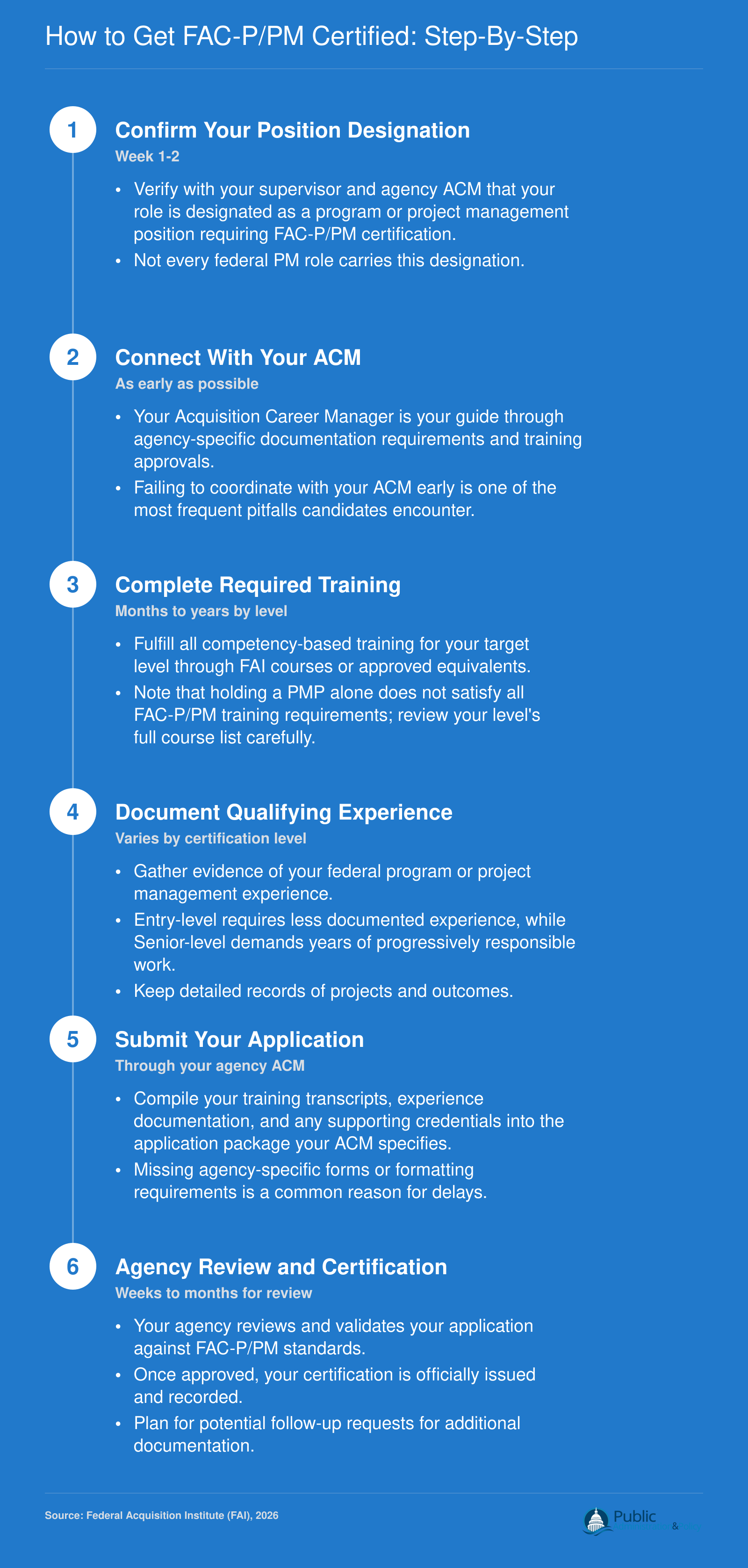
How to Get FAC-P/PM Certified: Step-By-Step
Earning your FAC-P/PM certification follows a structured federal process, but realistic timelines vary widely by level. Entry-level candidates may complete the process in a few months, while Senior-level certification can take years as you accumulate the required experience. One of the most common mistakes is waiting too long to engage your Acquisition Career Manager (ACM), so start that conversation early.
Navigating the Application Process: Tips and Common Pitfalls
One of the most common misconceptions about the FAC-P/PM certification is that you can apply for it independently through a centralized government website. In reality, the process routes entirely through your employing agency. Your agency's Acquisition Career Manager (ACM) or Chief Learning Officer (CLO) serves as the gatekeeper who reviews, validates, and ultimately approves your certification. Understanding this chain of authority early will save you significant time and frustration.
Assembling Your Documentation Package
Before you reach out to your ACM, gather a complete documentation package. The core elements typically include:
Training transcripts: Most agencies pull these from the Federal Acquisition Institute's learning management system (Cornerstone OnDemand). Log in and verify that every completed course appears on your transcript before you submit. Missing records are one of the top reasons applications stall.
Experience narratives: You will generally need to document relevant program or project management experience in a structured narrative format. Some agencies accept a resume-style summary; others require a specific template. Ask your ACM which format they expect.
Supervisor endorsements: A current or recent supervisor typically must sign off on your claimed experience. Coordinate early, because supervisors often need a week or more to review your narrative and provide their verification.
Equivalency requests: If you hold credentials like the PMP or have qualifying experience from outside the federal government, you may request equivalency credit for certain training or experience requirements. These requests require additional documentation and can add processing time, so submit them as a separate, clearly labeled component of your package.
Watch for Agency-Specific Nuances
Not every agency handles FAC-P/PM applications the same way. Some departments layer on additional internal reviews or require supplementary documentation for Core-Plus specializations, particularly in IT program management. At the Senior level, certain agencies convene a review panel or conduct an interview before granting certification. Check your agency's acquisition career management policy or intranet site for any local requirements that go beyond the government-wide baseline. Skipping this step is a common pitfall that can send your application back to square one.
Setting Realistic Timeline Expectations
Plan for a processing window of two to four weeks after you submit a complete application. That estimate assumes your documentation is thorough and your ACM office is operating at normal capacity. At fiscal-year-end (late August through September), ACM offices often face a surge in certification requests, contract closeouts, and workforce reporting deadlines. Applications submitted during that period may take considerably longer. If you need your certification by a specific date, perhaps because a position announcement requires it, build in a buffer of at least six weeks from the time you begin assembling your materials.
Practical Tips to Avoid Delays
The FAC-P/PM certification is one of several best certifications for government jobs worth pursuing, but earning it efficiently depends on how well you manage the application logistics.
Download and review your training transcript well before you intend to apply. If a course is missing, contact the Federal Acquisition Institute to resolve the discrepancy.
Use your agency's preferred application template rather than a generic format. Small formatting mismatches can trigger requests for resubmission.
Keep a personal copy of every document you submit. If your ACM office experiences staff turnover or system migration, having your own records ensures continuity.
Follow up politely but consistently. A brief email to your ACM two weeks after submission is reasonable and shows professional diligence without being burdensome.
Approaching the application process with organized documentation and an awareness of your agency's specific procedures will position you to earn your FAC-P/PM certification as efficiently as possible. For those pursuing broader career growth, the credential pairs well with roles in government program manager pathways across the federal workforce.
Applying Using the Short Form Application
What is the Short Form Application?
The FAC-P/PM Short Form Application is a streamlined pathway for experienced program and project management professionals to obtain their federal certification.1 Instead of submitting a full career resume and detailed training records, candidates provide a concise short form template that highlights their credentials. This expedited process is designed for individuals who already hold a current, accredited project management certification, most commonly the Project Management Professional (PMP) credential, and who have completed the required Federal Acquisition Institute (FAI) training. The short form replaces the need for a traditional resume, simplifying the application while still ensuring that all competency requirements are met.1
Eligibility Criteria
To use the short form, you must be a civilian employee of an executive agency.1 The FAI guidance on certification requirements specifies that only candidates who hold an active, recognized certification (such as the PMP or other FAI-accepted equivalents from recognized organizations) qualify for this route. Additionally, you must have completed the FAI-catalog training courses mapped to the desired FAC-P/PM level, and your training must be verifiable via your FAI-CSOD transcript. The short form does not waive the underlying experience requirements; you must still meet the prescribed years of project or program management experience within the applicable lookback window (e.g., one year within five years for Entry-Level, two years within five for Mid-Level, and four years within ten for Senior-Level, with at least one year of federal experience for the Senior level).2 However, your certification serves as evidence of competency, reducing the need for extensive documentation.
Reduced Documentation Requirements
The most significant advantage of the short form is its reduced administrative burden. In lieu of transcripts for every training course, your FAI-CSOD transcript serves as the single training record. Most importantly, proof of your current qualifying certification (such as a PMP certificate) substitutes for lengthy competency narratives or a detailed resume. This means you do not need to prepare and submit a traditional resume at all. The short form itself captures the essential information. The form requests basic information about your certification, experience summary, and agency details, but it is far simpler than assembling a complete career portfolio.
Submission Steps
Even with the short form, agency oversight is mandatory. Begin by downloading the official FAC-P/PM Short Form Application template from the FAI website. Complete all fields, attaching a copy of your certification and ensuring that your FAI-CSOD transcript is up-to-date and accessible. Submit the package to your Agency Acquisition Career Manager (ACM) for review. The ACM verifies your eligibility, confirms that your certification meets FAI's equivalency standards, and approves the application before forwarding it for final processing. According to the VA Acquisition Academy, approval typically takes 2-4 weeks from submission, though timelines vary by agency.
Tips for a Smooth Short Form Application
Verify equivalency early: Before beginning, confirm with your ACM that your specific certification is accepted under current FAI guidelines. Policies can update, so early verification prevents delays.
Keep transcripts current: Ensure your FAI-CSOD transcript reflects all completed FAI training, as any discrepancy can stall processing.
Double-check lookback windows: Since experience requirements are strict, count your qualifying years carefully against the applicable lookback period for your target level.
Use the correct template: Only use the official short form template; a standard application or resume will be rejected.
Engage your ACM proactively: Maintain open communication with your acquisition career manager throughout the process to address any questions promptly.
By following these steps, experienced professionals can leverage their existing credentials to earn FAC-P/PM certification efficiently.
FAC-P/PM vs PMP vs FAC-COR: Which Do You Need?
Federal professionals pursuing project management or acquisition roles often encounter three credentials that seem to overlap: FAC-P/PM, PMP, and FAC-COR. While all three touch on managing work within structured frameworks, they serve fundamentally different purposes, audiences, and career tracks. Understanding where each credential fits will save you time and help you invest in the right professional development.
Quick Comparison at a Glance
Issuing body: FAC-P/PM and FAC-COR are issued through the Federal Acquisition Institute (FAI) under the Office of Management and Budget. PMP is issued by the Project Management Institute (PMI), a private professional association.1
Target audience: FAC-P/PM is designed for federal civilian program and project managers in designated acquisition positions. PMP targets project managers across every industry, public and private.1 FAC-COR is specifically for contracting officer's representatives who oversee contractor performance on behalf of contracting officers.
Scope of practice: FAC-P/PM covers the full lifecycle of federal programs and projects, including acquisition planning and federal regulatory compliance. PMP focuses on universal project management methodologies. FAC-COR concentrates on contract surveillance, acceptance, and documentation.
Levels: FAC-P/PM has three tiers (Entry, Mid, and Senior). FAC-COR also has three levels (I, II, and III) based on contract complexity. PMP is a single-level credential.1
Cost: The PMP exam costs $405 for PMI members or $555 for non-members.1 FAC-P/PM and FAC-COR certifications are administered through agency training programs and carry no separate exam fee for federal employees.
Renewal: PMP requires 60 Professional Development Units every three years.1 FAC-P/PM and FAC-COR each require 80 Continuous Learning Points every two years.
Portability: PMP is recognized globally across private and public sectors. FAC-P/PM and FAC-COR are recognized within the federal government and carry limited formal weight outside that context.
Where PMP and FAC-P/PM Overlap
Holding a current PMP can satisfy a portion of the training requirements for FAC-P/PM, since the competencies in areas like schedule management, risk management, and stakeholder engagement align. However, a PMP does not replace the FAC-P/PM certification itself. If you hold a designated government program manager position, you are required to earn FAC-P/PM regardless of whether you already carry a PMP. Think of the PMP as a strong complement, not a substitute. The PMP prerequisites (35 hours of project management education and at least three years of experience leading projects) can help you demonstrate readiness for FAC-P/PM, but you will still need to complete the federal-specific coursework and apply through your agency.1
FAC-COR: A Different Role Entirely
FAC-COR is not a project management credential. It certifies professionals to serve as the government's eyes and ears on a contract, ensuring that contractors deliver what they promised, on time and within scope. If your role involves monitoring contractor performance rather than managing a broader program or project, FAC-COR is likely the credential your agency requires. Some professionals hold both FAC-P/PM and FAC-COR when their roles blend program oversight with direct contract surveillance, but the two certifications address distinct competency areas.
Deciding Which Credential to Pursue
Start by looking at your position description. If it is coded as a federal program or project management position, FAC-P/PM is mandatory. If you also want a credential that travels with you into the private sector or onto international assignments, adding a PMP strengthens your resume significantly. If your duties center on contract administration, FAC-COR is the appropriate path. Many mid-career federal professionals find that pursuing FAC-P/PM first and then layering on a PMP gives them the widest range of opportunities, both within government and beyond. For a broader look at credentials that can advance a public sector career, explore our guide to best certifications for government jobs.
FAC-P/PM and PMP are complementary credentials, not competing ones. PMP validates broad project management expertise recognized across industries, while FAC-P/PM is a mandatory federal workforce certification tied to specific agency roles and federal acquisition requirements. Holding both positions you as a well-rounded federal program manager with the strongest possible professional foundation.
Maintaining Your Certification: Continuous Learning Requirements
Earning your FAC-P/PM credential is a significant milestone, but it is not a one-and-done achievement. The federal government treats program and project management as a living discipline, and your certification reflects that philosophy through mandatory continuous learning requirements. Letting those requirements lapse can have real consequences for your career trajectory in acquisition-coded positions.
CLP Hour Requirements
Under longstanding Office of Federal Procurement Policy (OFPP) guidance, FAC-P/PM holders must earn 80 Continuous Learning Points (CLPs) every two years to keep their certification active. As of 2026, this 80-CLP-per-cycle standard remains in effect, though OFPP periodically updates its memoranda, so it is wise to confirm the latest cycle requirements through your agency's Acquisition Career Manager (ACM). One CLP generally equates to one hour of qualifying professional development activity.
What Counts Toward CLPs
The definition of qualifying activities is broader than many certificate holders realize. You can accumulate CLPs through a variety of channels:
Formal training courses: Instructor-led or online courses offered through the Federal Acquisition Institute (FAI), the Defense Acquisition University (DAU), or accredited external providers.
Conferences and seminars: Attendance at professional conferences, workshops, or government-sponsored symposia related to acquisition, program management, or leadership.
On-the-job developmental assignments: Rotational assignments, stretch projects, or cross-functional team participation that builds acquisition or project management competencies.
Professional association activities: Active roles in organizations such as the Project Management Institute (PMI) or similar bodies, including committee service and chapter leadership.
Publications and research: Authoring or co-authoring articles, white papers, or case studies in program management, acquisition, or related fields.
Teaching and mentoring: Serving as a guest lecturer, course instructor, or formal mentor within an acquisition workforce development program.
Document each activity carefully at the time you complete it. Retroactively reconstructing a two-year learning record is far more difficult than logging activities as they happen.
How CLPs Are Tracked
Most agencies require you to log CLPs in the FAI Cornerstone OnDemand (CSOD) platform, the government's centralized learning management system for the acquisition workforce. Your ACM reviews these records to verify compliance at the end of each cycle. Some agencies supplement CSOD with internal tracking tools, so check your organization's specific process early in your certification cycle rather than scrambling at the deadline.
Consequences of Lapsing
If you fail to complete the required CLPs within your two-year window, your FAC-P/PM certification lapses. The practical impact can be significant: you may lose eligibility for positions coded to require the credential, and reinstatement could require you to re-complete portions of the training curriculum rather than simply making up the missing hours. For professionals in mid-career roles managing complex federal programs, an unexpected certification gap can disrupt assignments and limit promotion opportunities.
A Note on PMP PDUs and Cross-Credit
Many FAC-P/PM holders also maintain the Project Management Professional (PMP) credential through PMI, which requires its own Professional Development Units (PDUs). Some agencies will accept PMP-qualifying PDUs as CLPs, recognizing the overlap in subject matter. However, this cross-credit arrangement is agency-discretionary, not automatic. Do not assume that your PMP maintenance activities will satisfy FAC-P/PM requirements until you have confirmed the policy with your ACM in writing. Where cross-credit is accepted, it can meaningfully reduce the administrative burden of maintaining dual credentials, so the conversation is well worth having early in your cycle.
The FAC-P/PM is just one of several best certifications for government jobs worth maintaining over the course of a career. Staying current with your CLPs is more than a bureaucratic checkbox. It signals to hiring managers and program sponsors that you remain engaged with evolving best practices in federal program and project management, a distinction that compounds over time and positions you well if you are working toward becoming a government program manager.
Career Paths and Advancement for FAC-P/PM Holders
FAC-P/PM certification does more than satisfy a compliance requirement. It maps directly to a federal career ladder, giving you a clear line of sight from entry-level project work to executive program oversight. Understanding how each certification level aligns with General Schedule grades and leadership responsibilities can help you plan your next move with precision.
Entry Level: Building Your Foundation (GS-7 to GS-9)
Earning the Entry-level FAC-P/PM credential qualifies you for junior project management positions, typically slotted at GS-7 through GS-9. In these roles you support senior program managers, track deliverables, assist with scheduling, and learn how federal acquisition and budgeting cycles work in practice. Think of this stage as your apprenticeship: you are absorbing institutional knowledge while building the documented experience hours you will need for higher certification tiers.
Mid Level: Leading Teams and Managing Branches (GS-11 to GS-13)
At the Mid level you transition from supporting projects to owning them. GS-11 through GS-13 positions often carry titles such as team lead, branch-level project manager, or integrated product team lead. At this tier, government and public administration salary becomes notably competitive. A GS-13 Step 5 in the Washington, D.C. locality area currently pays roughly $120,000 or more, and similar locality adjustments boost compensation in other high-cost metros. Mid-level certification signals to hiring managers that you can independently plan, execute, and close projects while managing cross-functional stakeholders.
Senior Level: Executive Oversight and SES Pipeline (GS-14 to GS-15)
Senior FAC-P/PM certification opens the door to executive-level program oversight at GS-14 and GS-15, where salaries in high-cost localities can approach $180,000 or more. These positions frequently serve as feeder roles for the Senior Executive Service (SES). At this stage, you are not merely running projects; you are shaping portfolios, directing multi-year acquisition strategies, and advising agency leadership on resource allocation. This is also where an MPA or MPP degree becomes a powerful complement to certification. Graduate coursework in policy analysis, organizational leadership, and public finance equips you with the strategic thinking frameworks that distinguish a competent manager from a transformational program leader.
Hybrid Roles and IT Core-Plus Opportunities
Federal agencies are increasingly seeking professionals who can operate at the intersection of IT modernization, acquisition, and program management. The IT Core-Plus specialization within FAC-P/PM is designed precisely for these hybrid positions. Agencies rolling out cloud migrations, cybersecurity overhauls, or enterprise software deployments need program managers who understand both the technical landscape and the federal procurement lifecycle. If you hold FAC-P/PM with the IT Core-Plus designation, you become eligible for a growing category of roles that blend traditional program management with technology governance, a combination that is in high demand across civilian and defense agencies alike.
Charting Your Trajectory
Whether you are just entering federal service or repositioning mid-career, consider these steps to accelerate advancement:
Start with intentional assignments: Seek rotational details or developmental assignments that expose you to different acquisition and program environments early on.
Pair certification with education: An MPA or MPP strengthens your candidacy for Senior-level roles and SES consideration by grounding your management skills in policy context.
Pursue IT Core-Plus if your agency is technology-driven: This specialization differentiates you in a competitive hiring landscape shaped by digital transformation mandates.
Track your continuous learning hours proactively: Maintaining certification without gaps signals reliability and commitment to hiring panels reviewing your qualifications.
FAC-P/PM is not a static credential. Treated strategically, it becomes a career engine that propels you from project support through portfolio leadership, with compensation and influence growing at every stage. For a broader view of where these skills fit within careers in public administration, explore the full range of roles open to credentialed professionals in this space.
Frequently Asked Questions About FAC-P/PM Certification
Below are answers to the most common questions about the Federal Acquisition Certification for Program and Project Managers. Whether you are just exploring this credential or actively preparing your application, these concise responses should help you move forward with confidence.
What is FAC-P/PM certification?
FAC-P/PM stands for Federal Acquisition Certification for Program and Project Managers. It is a government-wide credential that validates a federal civilian employee's competence in managing acquisition programs and projects. Established by the Office of Federal Procurement Policy, the certification ensures that program and project managers across agencies meet consistent standards of education, training, and experience before leading taxpayer-funded initiatives.
How long does it take to get FAC-P/PM certification?
Timelines vary by level. Entry-level certification can often be completed within a few months if you already hold a relevant degree and have some project experience. Mid-level typically requires one to two years of documented experience, while senior-level demands significant leadership tenure, often four or more years. Factor in time for completing required training courses and gathering supervisory endorsements when building your personal timeline.
What is the difference between FAC-P/PM and PMP?
FAC-P/PM is a federal government certification tied to acquisition program management competencies specific to the public sector. PMP (Project Management Professional), issued by the Project Management Institute, is an industry-neutral credential recognized globally. FAC-P/PM emphasizes federal acquisition regulations, stakeholder accountability, and lifecycle management within government frameworks, while PMP focuses on broadly applicable project management methodologies. Many federal professionals hold both.
Do I need FAC-P/PM if I already have PMP?
In most cases, yes. Federal agencies require FAC-P/PM for employees serving in designated program and project management roles within the acquisition workforce. A PMP credential may satisfy some training requirements or count toward continuous learning, but it does not replace the federal certification. Check your agency's specific policy, because some agencies grant partial credit for PMP coursework when you apply for FAC-P/PM.
Can contractors get FAC-P/PM certification?
No. FAC-P/PM is reserved for federal civilian employees who are members of the acquisition workforce. Government contractors and their staff are not eligible. Contractors who support federal programs often pursue PMP or other commercially recognized credentials instead. If you are a contractor considering a transition into federal service, earning FAC-P/PM would become an option once you are appointed to a qualifying government position.
Does FAC-P/PM apply to Department of Defense employees?
The Department of Defense operates its own certification framework called Defense Acquisition Workforce Improvement Act (DAWIA) credentials, which serve a parallel purpose. DoD civilian employees generally pursue DAWIA certifications rather than FAC-P/PM. However, reciprocity agreements exist in some functional areas, so a DoD employee transferring to a civilian agency, or vice versa, should consult their new agency's acquisition career manager to determine which certifications carry over.