What U.S. Public Administrators Can Learn from Morocco's Climate Governance Model
How a flexible inter-ministerial Climate Unit links national climate commitments to budgets, procurement, and sovereign bonds
By Holly AbramsonReviewed by PAP Editoral TeamUpdated July 21, 202625+ min read
What you’ll learn in this article…
Morocco’s Climate Unit sits inside the Ministry of Economy and Finance, breaking environment-ministry silos.
The 2026 Finance Law became the first to tag public financing for climate NDCs covering 2026-2028.
A green procurement manual and climate-tagged e-procurement portal now steer government spending toward sustainability.
Clean energy investments could yield 28,000 net jobs per year, but equity hinges on reaching rural communities.
In the 2026 Climate Performance Index, Morocco, an emerging economy with severe water stress, ranked 6th globally, ahead of Germany, the United Kingdom, and every G7 nation except France. The ranking captures institutional muscle: Morocco embedded a whole-of-government climate unit inside its Ministry of Economy and Finance, breaking traditional environmental silos.
Morocco's model ties Nationally Determined Contributions to budget cycle tagging, green procurement, and sovereign bond frameworks, all while addressing rural poverty where 79% of the poor live.1 For U.S. public administrators navigating fragmented federal and state authority, the coordination mechanics, budget alignment, and political economy analysis offer a direct template for translating climate pledges into executable fiscal policy.
Why Morocco's Climate Governance Matters for Public Administration
Public administrators are rapidly moving from policy design to fiscal execution on climate change, and Morocco's recent governance reforms offer a practical template for how to do it.
Climate Vulnerability and Economic Exposure
Morocco's urgency is rooted in stark physical and economic realities. Consecutive droughts between 2018 and 2023 drained water reserves, reduced agricultural output, and strained public budgets. According to the World Bank's Country Climate and Development Report, 79% of the country's poor live in rural areas, where agriculture employs over 80% of the workforce and roughly 30% of the national labor force. When crop yields collapse, the effects ripple across household incomes, food prices, and migration patterns. For public administrators, this means climate adaptation is inseparable from poverty reduction, rural development, and fiscal stability. The question is no longer whether line ministries should cooperate but how to build the institutional plumbing that makes coordination automatic.
A Whole-of-Government Approach in Practice
For MPA and MPP audiences, a "whole-of-government" approach refers to public policy making that moves beyond stand-alone environmental mandates and embeds climate objectives into the core machinery of finance, procurement, planning, and oversight. Morocco's model, as documented in a World Bank Arab Voices case study, does exactly that. In early 2025, the Ministry of Economy and Finance established a Climate Unit that operates as a flexible, rotating committee with representatives from multiple ministries. Its mandate is not to write another climate strategy but to align budget cycles, procurement rules, and reporting frameworks with the country's Nationally Determined Contributions. This is governance innovation that turns ambition into administrative routine, and it offers transferable lessons for sub-national and federal systems grappling with similar silo challenges.
Why the 2026 CPI Ranking Signals Governance Strength
Morocco's sixth-place ranking in the 2026 Climate Change Performance Index reflects more than emissions trajectories.1 The CCPI methodology evaluates 14 indicators across four categories: greenhouse gas emissions (weighted at 40%), renewable energy (20%), energy use (20%), and climate policy (20%). Morocco earned "high" ratings in three categories (emissions, energy use, and climate policy), offsetting a "low" score in renewable energy.3 That mix tells a governance story: institutional capacity to set and coordinate policy is strong, even as the energy transition still demands investment. A two-position jump from the previous index reinforces that the improvement is not a one-off policy win but a signal of deepening administrative capacity. For public administrators, this underscores that CCPI rankings reward the machinery of government (budget tagging, procurement greening, and cross-ministerial committees) just as much as wind turbines and solar panels. The World Bank case study notes that the 2026 Finance Law, for the first time, disclosed public financing for NDC implementation, linking climate targets directly to expenditure. Such transparency is a governance milestone that any jurisdiction can aim for, regardless of geography.
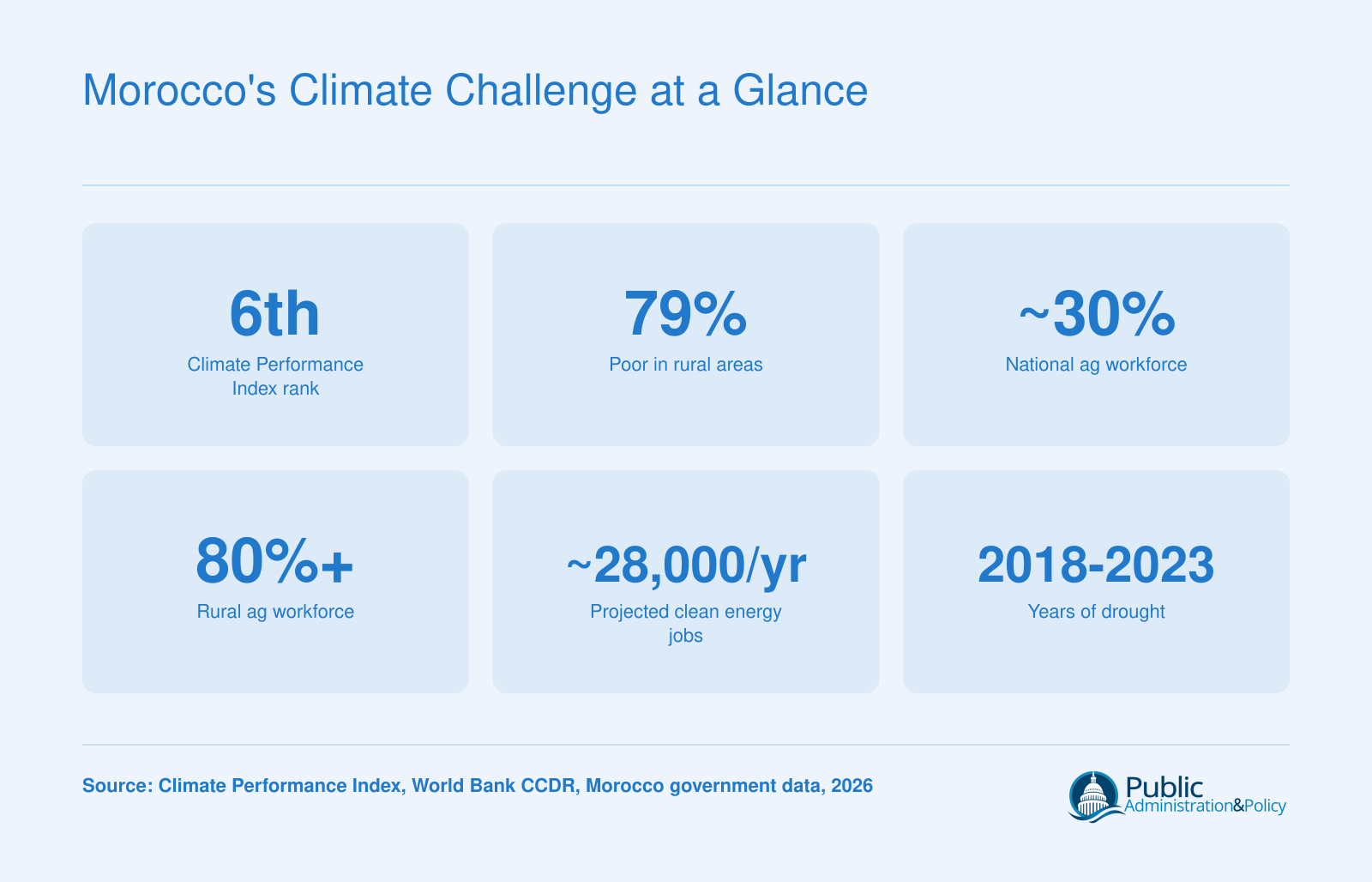
Morocco's Climate Challenge at a Glance
Morocco's vulnerability to climate extremes collides with a deeply agricultural economy. These six figures crystallize the urgency behind the country's push for whole-of-government climate governance.
How the MEF Climate Unit Works: Structure, Mandate, and Coordination Mechanics
Traditional climate governance often concentrates authority in an environment ministry, creating a single-issue silo with limited influence over budgets and sectoral priorities. Morocco took a different institutional path in early 2025, embedding a Climate Unit inside the Ministry of Economy and Finance (MEF). The design aims to make climate policy a central function of public administration and policy, not a peripheral environmental concern.
A Flexible Committee, Not a New Bureaucracy
The Climate Unit is deliberately structured as a cross-departmental committee, not a standalone agency. It draws members from existing MEF directorates including budget, treasury, debt management, and public procurement, along with rotating representatives from line ministries. This architecture avoids the cost and inertia of building a new administrative layer. The unit has no permanent staff beyond a small secretariat; its power comes from convening authority and access to budget decision-making. By repurposing existing structures, Morocco sidesteps lengthy legislative processes and cumbersome recruitment cycles. The committee model also makes it easier to adapt membership as climate priorities shift, ensuring expertise flows in from the ministries most relevant to the current policy cycle.
Rotating Leadership and Monthly Coordination: Breaking Silos
One of the unit's most innovative features is a rotating chair, which cycles among participating ministries. In one quarter, the environment ministry might lead; in another, the agriculture or energy ministry takes the helm. This mechanical rotation forces each ministry to take ownership of cross-cutting climate goals and discourages the turf wars that plague static inter-agency bodies. Monthly coordination meetings, mandated by an MEF circular, create a steady drumbeat of collaboration. The rhythm is intensive enough to build trust and institutional memory but not so frequent as to overwhelm already-stretched officials. Agenda items are deliberately cross-functional: a session might address how procurement rules affect renewable energy investment, or how budget classification codes block climate-tagged spending. By rotating leadership and locking in a monthly cadence, the unit converts climate coordination from an episodic political gesture into a routine administrative practice.
The MEF Advantage: Budget Authority That Environment Ministries Lack
Housing climate coordination inside the finance ministry changes the power dynamics entirely. Unlike an environmental agency that can only advocate, the MEF controls the budget formulation calendar, spending ceilings, and public investment review. When a climate unit sits inside that apparatus, it can embed climate criteria into budget call circulars, negotiate sectoral allocations before they reach cabinet, and link NDC targets directly to multi-year expenditure frameworks. The 2026 Finance Law, which for the first time includes public financing information for NDCs across 2026-2028, is a direct outcome of this positioning.1 A traditional environment ministry might publish a climate plan; the MEF can fund it, tag it in the budget system, and track it through the treasury. For public administrators elsewhere, that distinction is the core lesson: climate ambition without fiscal teeth remains aspirational.
Low Overhead, High Transferability
What makes the Moroccan model particularly replicable is its minimal institutional footprint. The Climate Unit requires no new legislation, no constitutional reform, and no large payroll. It leverages existing budget officers, existing IT systems for expenditure tracking, and existing inter-ministerial coordination norms. For U.S. public administrators working in state governments, city finance departments, or federal budget offices, the pattern is recognizable: an executive-level mandate, a small coordinating secretariat, and a process redesign that rewires routine budget decisions around climate outcomes. The impact is not in the name or the org chart, but in the mundane mechanics of meeting schedules, budget classification codes, and procurement circulars that steadily shift a government's default behavior toward low-carbon, climate-resilient spending.
Questions to Ask Yourself
Does your agency's climate mandate reside in an environmental office with no budget authority?
Climate goals need fiscal teeth. Embedding the mandate in finance or planning turns commitments into funded action.
Which department should lead a new climate committee to survive a change in administration?
Central agencies like finance provide institutional continuity and keep climate on the agenda through political shifts.
Could a rotating-chair model distribute climate ownership across your agencies?
Morocco’s rotating leadership builds shared accountability and prevents any one department from dominating.
Linking NDCs to Budgets: Morocco's Climate Budget Tagging and the 2026 Finance Law
One of the most persistent gaps in climate governance is the disconnect between the emissions reductions and adaptation targets that governments announce in their Nationally Determined Contributions (NDCs) and the actual financial resources they allocate to achieve them. Climate budget tagging (CBT) has emerged as the premier public financial management tool to bridge that gap, coding every budget line according to its climate relevance and making climate-related spending visible, trackable, and accountable.
What is Climate Budget Tagging?
CBT systematically classifies expenditures and, in some cases, revenues based on whether they contribute to climate mitigation, adaptation, or both. It often uses graduated scoring, for example high, medium, or low climate relevance, to avoid binary distinctions that obscure co-benefits. By 2023, at least 23 countries had adopted some form of climate budget tagging, deploying at least 18 distinct methodologies.1 Early movers such as Bangladesh, Indonesia, Nepal, and the Philippines grounded their approaches in UNDP's Climate Public Expenditure and Institutional Review (CPEIR) framework, while others, including France and Italy, aligned with the OECD's Rio markers.2 The core best practices that have emerged from these experiments include a clear definition of "climate" spending, full integration with the public financial management system, graduated scoring, institutional roles for line ministries and finance authorities, and transparent public reporting.3
Morocco's Landmark 2026 Finance Law
Against this backdrop, Morocco's 2026 Finance Law marks a watershed moment. For the first time, the law includes explicit public financing information for the country's climate NDCs covering the period 2026, 2028. This move transforms NDC commitments from aspirational policy documents into legally anchored, multi-year fiscal pledges. By embedding climate costs directly in the budget law, the Ministry of Economy and Finance enables parliament, the national audit office, and civil society to ask a simple, powerful question: Are the promised climate investments actually flowing into government programs? This innovation builds on Morocco's earlier work to climate-tag its e-procurement portal, ensuring that the greening of public procurement is not a standalone initiative but part of a coherent budgetary chain.
International Practice and OECD Guidance
Morocco's approach aligns closely with OECD guidance on green budget tagging, which recommends a three-step sequence: define what "green" means for the jurisdiction, identify policies and budget lines that meet that definition, and embed tags into the day-to-day budget cycle.3 Indonesia offers a notable parallel: its climate budget tagging, launched in 2014, has since been extended to subnational governments and linked to the issuance of green sovereign sukuk. Nepal has mandated climate classification for all development projects, using a three-category scoring system.1 Bangladesh, using a UNDP-inspired CPEIR methodology, was an early adopter.2 These examples highlight a lesson Morocco has clearly taken to heart: tagging must be mandatory, applied across all relevant spending, and consistently scored to allow year-on-year comparison. Common pitfalls include methodological ambiguity when distinguishing climate-specific spending from broader development co-benefits, a challenge Morocco is addressing by grounding its definitions in its NDC priorities.5
Accountability Mechanisms
When climate commitments are tagged to budget lines, they become subject to the full suite of legislative and audit scrutiny. Lawmakers can query underperforming programs during budget hearings, and supreme audit institutions can verify whether tagged expenditures actually delivered the expected climate outcomes. This transparency loop is the real engine of administrative accountability. Environmental policy advisors working at any level of government will recognize this logic: without a traceable fiscal signal, high-level climate pledges remain difficult to enforce. For Morocco, the 2026 Finance Law means that the Climate Unit inside the Ministry of Economy and Finance, itself a flexible, inter-ministerial mechanism, can monitor progress against NDC targets not through ad hoc reports, but through the state's own budget execution data. It is a model that public administration and policy practitioners elsewhere, including in the United States, can study as they wrestle with how to make their own climate pledges fiscally credible.
Greening Public Procurement and Sovereign Bond Frameworks
Greening public procurement means embedding environmental and climate criteria into the ordinary purchasing decisions that government agencies make every day, from office supplies to infrastructure contracts. Morocco has turned this concept into an actionable lever by finalizing a manual to "green" public procurement and adding a dedicated climate tag to its national e-procurement portal. These tools allow contracting officers to identify, screen, and prioritize bids that align with the country's climate commitments, transforming procurement from a passive administrative function into an active driver of NDC implementation.
Embedding Climate in Government Purchasing: The Procurement Manual and E-tagging
In early 2026, the Ministry of Economy and Finance released a standardized green procurement manual that spells out environmental specifications for common categories of goods and services. Simultaneously, a climate-tagging feature was integrated into the national e-procurement system, enabling every tender to be classified according to its climate relevance. This means that a municipal road project, for example, can be evaluated not only on cost and quality but also on its carbon footprint and resilience attributes. The system is designed to be practical: procurers receive step-by-step guidance, and the tags feed into a central database that monitors the share of procurement aligned with climate objectives. By embedding climate filters directly into the platform, Morocco avoids the common pitfall of aspirational guidance that gets ignored in daily operations.
Tapping Capital Markets for Climate Goals: Morocco's Green Sovereign Bond Framework
Beyond procurement, Morocco is moving to channel private capital toward climate investments through a sovereign green bond framework. A draft framework has been prepared, outlining how proceeds would be managed, reported, and linked to eligible projects drawn from the NDC investment pipeline. Although the first sovereign issuance is still pending, Morocco's track record in green debt is strong: the Moroccan Agency for Sustainable Energy (MASEN) issued the country's first green bond in 2016,1 and in 2026 the Casablanca-Settat region floated a green bond, signalling that green instrument markets are deepening beyond the central government.2 The sovereign framework references the ICMA Green Bond Principles and the Climate Bonds Initiative taxonomy, ensuring that proceeds meet international standards for use-of-proceeds clarity, sector mapping, screening, and impact reporting. Once launched, these bonds will enable Morocco to tap institutional investors seeking Paris-aligned assets while directly linking capital market flows to the budget's climate expenditure lines.
Extending Climate Accountability: ESG Reporting for State-Owned Enterprises
Morocco is also pushing climate accountability beyond core ministries by drafting an Environmental, Social, and Governance (ESG) reporting framework for state-owned enterprises (SOEs). SOEs control significant infrastructure, energy, and transport assets, so requiring them to disclose climate risks, emissions, and mitigation plans extends the whole-of-government approach into the business sphere. The draft framework draws on international reporting norms and would apply to major public entities, creating a consistent, auditable trail of climate performance. This complements the procurement and bond initiatives: green purchasing shapes immediate spending, green bonds fund transformative projects, and ESG reporting ensures that large public enterprises sustain climate discipline over time.
How Morocco's Green Bond Framework Compares with Peers
In the landscape of emerging-economy green bonds, Morocco occupies a growing niche. As of 2026, Indonesia and Chile have the most developed sovereign green bond programs, with multiple issuances and deep investor bases. Egypt and Nigeria, by contrast, have executed only limited sovereign green offerings. Morocco has not yet matched the scale of Indonesia or Chile, but it has distinguished itself by building a broader issuer base: MASEN and regional authorities like Casablanca-Settat have already accessed the market, and the Autorité Marocaine du Marché des Capitaux (AMMC) issued green bond guidelines with support from the International Finance Corporation. This foundation has helped Morocco become a regional green-bond hub in Africa,5 offering a practical template for other countries seeking to align public finance with climate goals. By drafting a sovereign framework, Morocco is following the trajectory of more established issuers while leveraging its own institutional innovations to accelerate NDC-aligned investment.
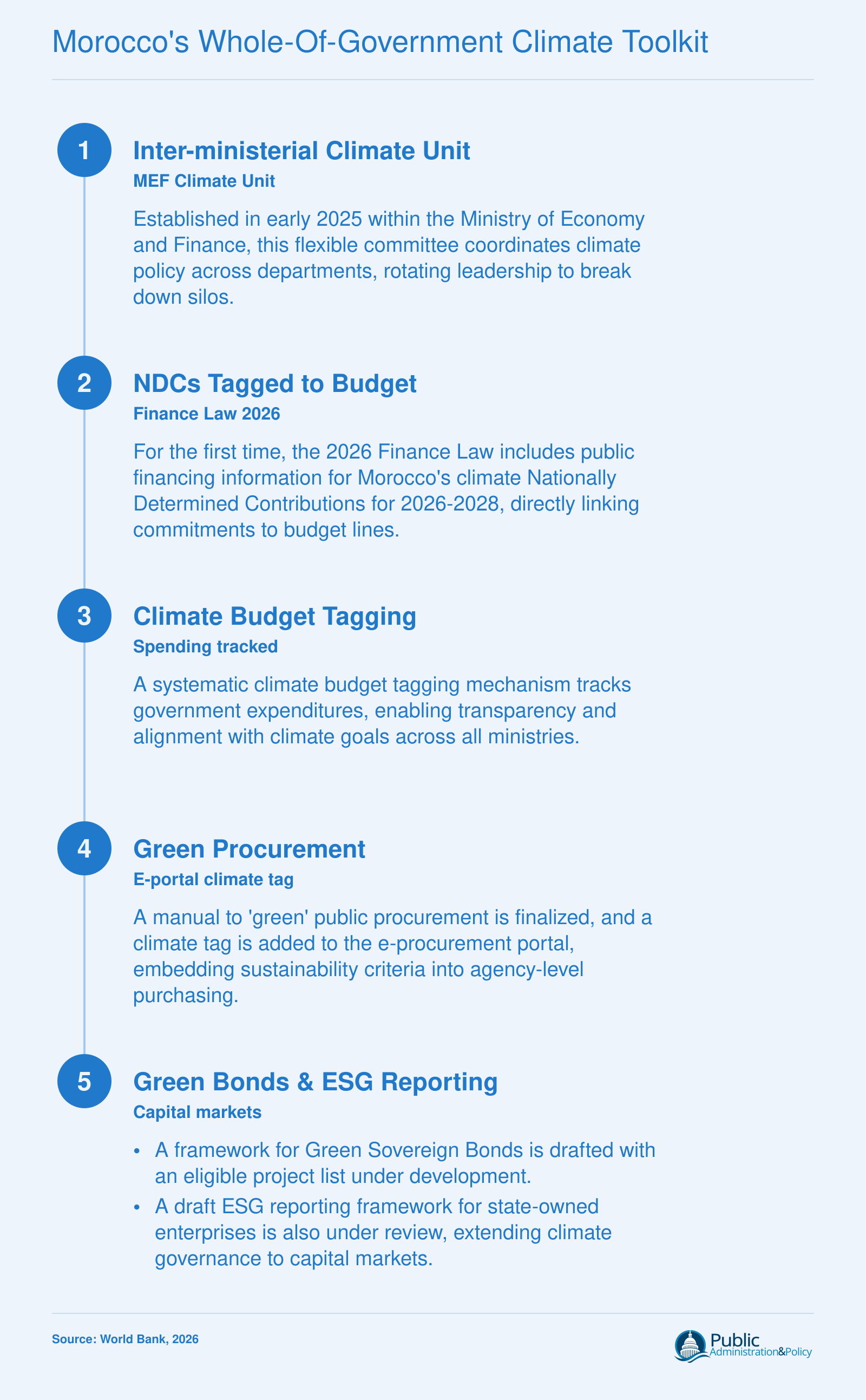
Morocco's Whole-Of-Government Climate Toolkit
Morocco's whole-of-government climate toolkit turns policy ambition into executable reforms. Here's how the sequence of institutional innovations works end-to-end, from inter-ministerial coordination to capital market instruments.
Transferable Lessons: What U.S. Public Administrators Can Apply
Applying Whole-of-Government Principles in the U.S. Context
The United States has already taken foundational steps toward cross-agency climate coordination that public administrators can observe and build upon. The White House National Climate Task Force, launched in January 2021 at the cabinet level, facilitates planning and implementation of federal climate action by bringing together leaders from key departments.1 The Department of Defense's 2024 Climate Adaptation Plan exemplifies how a single large agency translates those directives into concrete strategic objectives and performance goals.2 For administrators, the first practical step is to study these existing mechanisms by visiting agency websites for meeting summaries, strategic plans, and public reports. The Eno Center for Transportation provides clear analysis of how federal coordination orders are implemented across infrastructure sectors. Examining these documents reveals the formal architecture of U.S. climate governance and helps you identify where your own department or program fits.
Building Administrative Capacity Through Research and Professional Development
To move from observing to leading, you need to know where to find reliable information on roles, skills, and career pathways. The Bureau of Labor Statistics (BLS) website is the authoritative source for government salary data, occupational outlooks, and employment projections, including emerging specialties in climate policy analysis and resilience planning. Pair this with MPA and MPP program websites; many now offer concentrations in environmental or climate policy and publish detailed curricula, internship pipelines, and alumni employment data. For those considering an environmental policy advisor career path, professional associations such as the American Society for Public Administration (ASPA) and the National Academy of Public Administration provide white papers, mentorship directories, and specialty networks that connect you to practitioners already navigating interagency teams. Attending association webinars or annual conferences lets you learn directly from state-level leaders who have piloted cross-cutting climate initiatives in places like California or New York.
Lessons from Morocco's Institutional Flexibility
Morocco's Ministry of Economy and Finance Climate Unit demonstrates how a deliberately flexible structure, a rotating leadership committee rather than a new permanent bureaucracy, can overcome long-standing silos. U.S. administrators can test this idea by proposing similar temporary, cross-agency task forces for discrete climate challenges, such as aligning adaptation plans between the EPA, FEMA, and HUD. Study how Morocco sequenced its reforms: first establishing the committee, then rolling out climate budget tagging, and later greening procurement. Administrators with a background in MPA finance and budgeting will recognize how this sequencing mirrors sound public financial management principles. World Bank publications and international case studies detail these mechanics without requiring deep technical finance knowledge. When you encounter a coordination gap in your own work, consider drafting a short memo that adapts the Moroccan committee model to your agency's context; even informal interdepartmental check-ins can evolve into formalized collaboration.
Where to Find Climate Governance Data and Training
Actionable data for applying these lessons comes from multiple, authoritative sources. The U.S. Climate Resilience Toolkit aggregates federal agency tools and science, while state government portals for California, Colorado, or Washington often publish annual reports on their own interagency climate bodies. For career-focused research, cross-reference BLS occupational data with salary surveys from ASPA or the International City/County Management Association to understand compensation trends. When evaluating graduate programs, look beyond glossy brochures: compare course syllabi for climate finance or green budgeting modules, and reach out to faculty to ask about their policy work. Many universities also offer abbreviated online certificates; these are often listed on the school's continuing education website. Finally, monitor the Office of Management and Budget's annual budget guidance for climate-related reporting requirements, which signal emerging demand for administrators skilled in performance tracking and budget alignment.
U.S. Vs. Morocco Climate Governance: A Side-By-Side Comparison
Morocco's rise to 6th place in the 2026 Climate Change Performance Index1, compared to the United States' 65th1, is not primarily a story of renewable investment levels. It is a story of institutional architecture. The governance dimension reveals a whole-of-government model in Morocco versus fragmentation in the U.S., and that difference shapes how effectively policy translates into budgets, procurement, and verifiable outcomes.
Coordinating Mechanism
Morocco's Ministry of Economy and Finance established a flexible Climate Unit in early 2025, tasked with coordinating climate action across ministries through inter-departmental committees and rotating leadership.3 This unit directly links high-level commitments to operational decisions. In the United States, no single agency or permanent interagency body holds an equivalent mandate. Climate coordination remains dispersed among the Environmental Protection Agency, Department of Energy, Department of Interior, and others, often without a unified budget authority.
Budget Integration and Climate Tagging
For the first time, Morocco's 2026 Finance Law includes public financing information for climate-related NDC activities, embedding climate budget tagging into the fiscal cycle.3 The U.S. federal budget does not systematically tag climate expenditures, making it difficult to track alignment with NDC goals. While executive orders have required climate-related fiscal disclosures, no statutory mechanism links NDC pledges to line-item appropriations in the same transparent manner. Students pursuing online MPP programs focused on climate finance will find this contrast particularly instructive as a case in institutional design.
Green Procurement and Bond Frameworks
Morocco has finalized a manual to green public procurement and added a climate tag to its e-procurement portal, allowing contracting officers to screen bids for climate impact.3 A Green Sovereign Bond framework has also been drafted. By contrast, U.S. green public procurement remains governed by broad sustainability requirements within the Federal Acquisition Regulation; there is no climate-specific procurement tag. And while municipal green bonds are common, a federal green sovereign bond instrument does not exist.
Monitoring and Verification Maturity
Morocco is actively building its MRV system to track emissions and policy effectiveness, integrated with the Climate Unit's coordination. The U.S. maintains a robust greenhouse gas inventory through the EPA, but its connection to budget preparation and interagency policy review is weaker. The CCPI governance rating reflects this gap: Morocco earns a "good" overall rating and is deemed 1.5°C-compatible2, while the U.S. rates "very low" and remains off-track.1
These comparisons do not suggest that Morocco's approach is flawless or that the U.S. lacks ambition. They spotlight actionable design choices, including a central climate unit, budget tagging, procurement filters, and sovereign green bonds, that could strengthen U.S. climate governance at both federal and state levels.
Political Economy and Equity: Managing Reform Winners and Losers
The political economy of climate reform is not just about designing efficient instruments: it is about managing the uneven costs they impose on different groups. Morocco's whole-of-government climate push demonstrates that success hinges on intentional equity safeguards, from the fuel subsidy phaseout of the last decade to the green job promises of this one.
The Distributional Stakes in Morocco
With 79 percent of the country's poor living in rural areas and agriculture employing roughly 30 percent of the national workforce and over 80 percent of the rural population, climate policies that raise energy or water costs risk deepening spatial inequality. Morocco's recent droughts and climate shocks already strain these communities, so reform design must counteract, not amplify, existing vulnerabilities. Without deliberate social protection, even economically sound climate measures can become politically unsustainable.
Sequencing Subsidy Reform with Social Safety Nets
Morocco's largest equity stress test came between 2013 and 2015, when it phased out subsidies on gasoline, diesel, and industrial fuel oil.1 Pre-reform subsidy spending had reached 56.6 billion dirhams in 2012; the savings from reform were substantial, totaling 32.7 billion dirhams in 2014 alone, followed by 12.25 billion in 2015 and 10.7 billion in 2016, freeing fiscal space for cleaner investments.2 Planners understood that unscheduled price liberalizations would hit lower-income households the hardest, so they layered in compensatory social programs: the RAMED health coverage scheme, the Tayssir conditional cash transfer for education, and direct cash transfers.1 According to a World Bank distributional assessment, this sequencing produced "a good mix from welfare, poverty, and distributional perspectives" and reduced the regressive transfer embedded in the old subsidy regime.3
Crucially, the government deliberately kept LPG (butane) subsidies in place, recognizing that their removal would place a disproportionate burden on poor and rural families who rely on bottled gas for cooking.2 An electricity tariff increase followed in 2015, but by 2016 electricity still consumed 4.6 percent of income for the poorest 40 percent of households, signaling the limits of affordability even after reform.2 Morocco's willingness to phase out the most distorting subsidies while preserving a lifeline for the poorest offers a practical template for managing political backlash and equity concerns together.
Where Will the 28,000 Green Jobs Go?
The World Bank estimates that clean energy investments through 2030 could create roughly 28,000 net jobs per year across the Moroccan economy. The number is impressive, but its distributional meaning depends entirely on governance. Are these jobs concentrated in urban industrial zones, or do they reach the arid interior where youth unemployment is highest? What retraining pipelines exist for agricultural workers or fossil fuel employees? So far, Morocco has not published detailed spatial or demographic breakdowns of projected green employment, and the newly created Climate Unit at the Ministry of Economy and Finance will need to embed just-transition planning into budget allocation and public investment screening to answer these questions. public policy boost hiring research from the U.S. context underscores the same point: job creation numbers mean little without governance structures that direct opportunities to workers most exposed to transition costs.
Parallels for U.S. Public Administrators
American equity debates follow a similar logic, even if the administrative machinery differs. The Inflation Reduction Act includes community benefit provisions and bonus credits for projects in energy communities, while the Justice40 initiative directs 40 percent of certain federal spending benefits toward disadvantaged communities. Both frameworks grapple with the same political economy puzzle: how to compensate fossil fuel workers and low-income households while accelerating the transition. Morocco's experience, blending subsidy gradualism, cash transfers, and careful targeting of which subsidies to keep, shows that equity instruments must be designed concurrently with climate policy, not retrofitted once political resistance hardens.
The clean energy transition could create 28,000 net jobs annually by 2030, but whether they reach rural areas with 79% of Morocco's poor is the governance question that matters most.
Monitoring, Reporting, and Verification: Tracking Climate Progress
Two visions of accountability frame climate governance: performative reporting where budget tags and committee meetings create an illusion of action, versus a functional MRV system that traces public spending to measurable emissions reductions and adaptation outcomes. Morocco's whole-of-government experiment will succeed or fail on its ability to build the second.
Why MRV Keeps Whole-of-Government Honest
Without robust monitoring, reporting, and verification, inter-ministerial coordination and climate budget tagging risk becoming performative. A climate unit can coordinate spending, but if outcomes are not tracked, if no one measures whether tagged investments actually reduce vulnerability or emissions, the whole architecture collapses into a bureaucratic exercise. For public administrators, MRV provides the feedback loop that turns commitments into evidence-based adjustments. This is precisely where the work of a skilled environmental policy consultant intersects with public financial management reform.
Morocco's Current MRV Gaps
Morocco faces three interlocking challenges. First, data remain fragmented across line ministries, with no integrated platform linking expenditure to emissions baselines or climate impact indicators. Second, subnational reporting capacity is thin; regions that implement much of the adaptation work often lack the skills and systems to report results upward. Third, the gap between tagging spending and measuring outcomes remains unbridged. The 2026 Finance Law discloses climate-related allocations1, but performance indicators tied to NDC targets are still under development. Until these gaps close, the climate tag tells us only that money was spent, not that it worked.
What Good MRV Looks Like
Effective MRV architectures draw on international frameworks. The Enhanced Transparency Framework under the Paris Agreement requires countries to report on emissions, progress toward NDCs, and support received. The OECD's green budgeting standards emphasize independent verification of climate expenditure tags and outcome-based indicators. For Morocco, a mature MRV system would connect its climate budget tagging to verifiable emission trajectories and locally reported adaptation results, creating a single source of truth for the Climate Unit and the public. Policy analysts who specialize in climate governance increasingly view this kind of integrated data architecture as a prerequisite for credible NDC implementation.
A Weak Link Everywhere
MRV remains the weakest link in most developing-country climate governance and, as U.S. practitioners know, in many state and local systems where climate spending is siloed and unmeasured. Morocco's willingness to surface these gaps and to start building the data infrastructure makes its model instructive, even before it succeeds.
Key Takeaways for MPA and MPP Students and Practitioners
Morocco's pioneering whole-of-government climate model offers concrete lessons for public administrators seeking to translate climate commitments into measurable outcomes. Below, we answer key questions about how this approach works and what it means for governance reform in the United States.
What is a whole-of-government approach to climate change?
A whole-of-government approach coordinates climate action across all ministries and levels of government, breaking down silos to integrate climate goals into every policy and budget decision. It moves beyond an environment ministry’s sole responsibility to embed climate considerations in finance, infrastructure, agriculture, procurement, and more, ensuring cohesive, economy-wide implementation.
How does Morocco implement climate policy across government ministries?
Morocco established a Climate Unit within the Ministry of Economy and Finance in early 2025, a flexible committee with rotating leadership that convenes representatives from key ministries. This unit drives inter-ministerial coordination, aligns climate initiatives with fiscal policy, and oversees the integration of climate objectives into national planning, budgeting, and public investment.
What is climate budget tagging and how does Morocco use it?
Climate budget tagging is a tool that tracks and classifies public expenditures according to their climate relevance. Morocco applies it through its 2026 Finance Law, which for the first time includes public financing information for NDC implementation. This allows officials to measure how much of the national budget supports climate mitigation and adaptation, improving accountability and resource allocation.
What can U.S. public administrators learn from Morocco's climate governance?
U.S. public administrators can learn to institutionalize cross-agency climate coordination by creating a dedicated, flexible body similar to Morocco's Climate Unit. They can adopt budget tagging to make climate spending visible, mainstream green public procurement, and issue green bonds. The Moroccan example shows how a developing country can operationalize whole-of-government climate governance with pragmatic tools.
How does Morocco align its NDC targets with national budgets?
Morocco aligns its Nationally Determined Contribution (NDC) targets with national budgets by explicitly linking climate goals to the Finance Law. The 2026 Finance Law provides multi-year climate finance data (2026-2028), enabling line ministries to budget for climate projects. Climate budget tagging further ensures that expenditures are mapped to NDC priorities, transforming pledges into funded programs.
What are the biggest barriers to replicating Morocco's model in the United States?
The biggest barriers include the fragmented U.S. federal structure, where climate authority is split across many agencies and levels of government, and political polarization around climate policy. Additionally, the U.S. lacks a unified climate budget tagging system and has slower procurement reform processes. Overcoming these requires strong executive leadership and building bipartisan coalitions around the economic benefits of climate action.