Best Online Master of Public Administration Programs in West Virginia
Compare costs, accreditation, and career outcomes for every WV-based online MPA option
By Holly AbramsonReviewed by PAP Editoral TeamUpdated August 7, 202624 min read
What you’ll learn in this article…
West Virginia offers two in-state online MPA options, but only West Virginia University holds NASPAA accreditation.
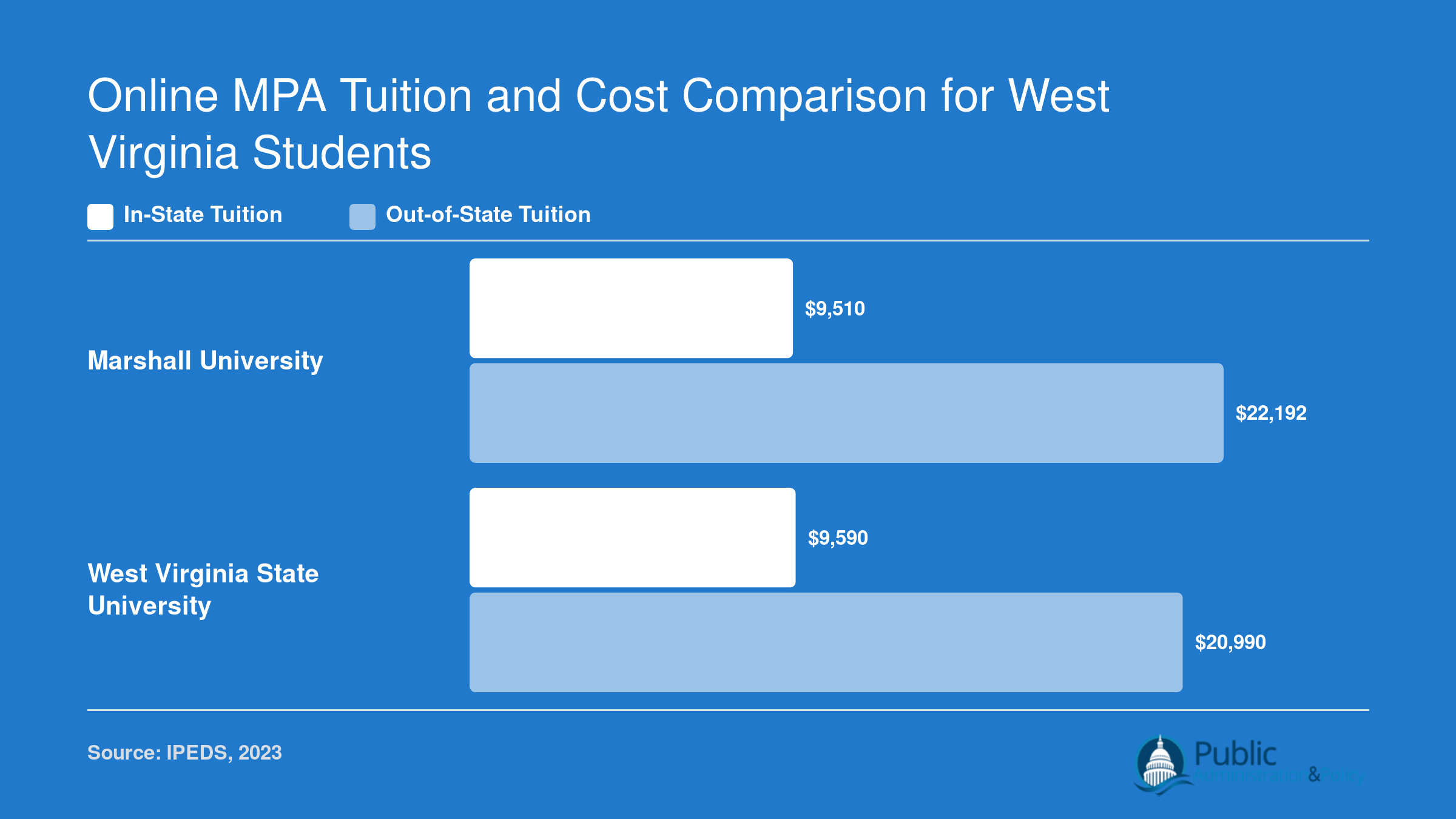
In-state tuition is comparable at both programs, while out-of-state rates diverge by more than $1,000.
Most WV online MPA students work full time, and programs deliver coursework through evening and asynchronous formats.
MPA graduates in West Virginia can pursue management roles in government, nonprofit, and healthcare sectors statewide.
West Virginia's public sector workforce depends heavily on professionals trained in budgeting, policy analysis, and organizational leadership, yet the state offers just two online MPA programs: Marshall University and West Virginia State University. Both charge in-state graduate tuition near $9,500 per year, but they differ in accreditation status, concentration options, and delivery structure. For residents working in state agencies, county offices, or Appalachian community development nonprofits, those differences matter more than they might appear at first glance.
The small program pool creates a practical tension. A limited in-state market means WV residents must weigh whether a nearby, affordable option meets their career goals or whether casting a wider net for a NASPAA-accredited program out of state justifies the higher cost. Students in similar rural states face the same calculus when evaluating affordable online mpa programs beyond their borders. In a state where the median salary for public administration managers sits well below the national average, the return on every tuition dollar deserves careful scrutiny.
Best Online MPA Programs in West Virginia: 2026 Rankings
The following 2026 rankings list online-delivery-eligible Master of Public Administration programs at West Virginia institutions, ordered by a composite quality score that weights online availability alongside institutional metrics such as graduation rates, tuition affordability, and student outcomes. West Virginia currently has two universities offering fully online or online-hybrid MPA degrees, and both serve distinct student populations across the state.
Factors considered
Online delivery availability
Institutional graduation and retention rates
Tuition and net price affordability
Program breadth and concentrations
Graduate earnings outcomes
Data sources
NCES-IPEDS federal institutional data — nces.ed.gov
Best for: Career changers seeking multiple concentration options
Marshall University's fully online MPA is the most comprehensive option in West Virginia, offering four distinct areas of emphasis within a 36-credit-hour framework built around ethical leadership, policy analysis, and public finance. In-state tuition sits at roughly $9,510, with an effective net price of $7,502 after aid, and the institution reports a 51.2% graduation rate (institution-wide). The program's coursework is designed around Appalachian and rural governance challenges, and its portfolio-based capstone gives graduates a practical career marketing tool aligned with West Virginia's public and nonprofit employers.
View program
Master of Public Administration, Nonprofit Leadership & Management — Online
36 credit hours at $534.75 per credit hour
Fully online format with two-year average completion
Concentration in Nonprofit Leadership & Management available
Concentration in Business & Government Relations available
Concentration in Cybersecurity & Policy Management available
Concentration in Planning & Economic Development available
No entrance exam required for admission
Portfolio-based capstone tied to core competencies
Best for: Mid-career state government professionals near Charleston
West Virginia State University, a historically Black university located minutes from the State Capitol in Charleston, delivers its MPA through a cohort model combining evening and online coursework. In-state tuition is approximately $9,590, with a net price of $11,139 and an institution-wide graduation rate of 39.2%. The program offers two track lengths (36 credits for experienced professionals, 42 credits for pre-service students) and leans heavily on its proximity to state government agencies for networking, guest speakers, and applied learning opportunities.
View program
Master of Public Administration — Online
Cohort model with evening and online class formats
36-credit track for experienced public sector professionals
42-credit track for pre-professional students
Test score waiver for 3.0 GPA or managerial experience
Conditional admission pathway for nontraditional applicants
Located near WV State Capitol for networking access
Prepares for city manager, budget analyst, and planner roles
NASPAA Accreditation in West Virginia: Which Programs Have It and Why It Matters
Not all MPA programs are created equal, and in West Virginia the accreditation landscape makes that especially clear. Understanding which programs hold NASPAA (Network of Schools of Public Affairs and Administration) accreditation, and which rely solely on regional institutional accreditation, is one of the most important distinctions you can make before committing your time and tuition dollars.
The Accreditation Landscape in West Virginia
As of the 2024-2025 academic year, West Virginia University is the only institution in the state whose MPA program holds NASPAA accreditation.1 WVU's program has maintained this distinction since the late 1970s and was most recently reaccredited in January 2023, reflecting decades of sustained conformance with NASPAA's rigorous standards.2
Several other institutions in the state offer MPA or closely related degrees, including Marshall University, West Virginia State University, American Public University System, and Strayer University's West Virginia operations. None of these programs currently hold NASPAA accreditation.1 They do hold regional institutional accreditation, which means the universities themselves meet broad academic quality thresholds, but their public administration curricula have not undergone the specialized peer review that NASPAA requires.
This is a critical distinction that many program comparison sites overlook entirely.
What NASPAA Accreditation Actually Requires
NASPAA accreditation signals that a program demonstrates substantial conformance with NASPAA Standards designed specifically for graduate education in public service.3 In practical terms, this means:
Curriculum alignment: Coursework must cover defined competency domains, including leading and managing in public governance, participating in the policy process, and applying analytical tools.
Peer review: Faculty, curriculum, and student outcomes are evaluated by a panel of public affairs scholars and practitioners, not just general academic reviewers.
Mission-driven assessment: Programs must show evidence that graduates achieve learning outcomes tied to the program's public service mission.
Continuous improvement: Accredited programs submit periodic reports and undergo full reaccreditation reviews, typically on a seven-year cycle.
These requirements go well beyond what regional accreditation evaluates, which tends to focus on institutional governance, financial stability, and general educational quality rather than discipline-specific rigor.
Career Implications: When Accreditation Matters Most
The weight NASPAA accreditation carries depends significantly on your career goals. For certain pathways, it can be a decisive factor.
Federal agencies, particularly those hiring through competitive management fellowship programs like the Presidential Management Fellows (PMF) program, often list graduation from a NASPAA-accredited program as a preferred or required qualification. Senior public-sector roles in policy analysis, budget management, and intergovernmental relations frequently reference NASPAA accreditation in job postings as well. If your ambition is to build a career in federal service or high-level state government, attending a NASPAA-accredited program positions you more competitively. Students in states with limited NASPAA-accredited options, such as those exploring naspaa accredited online mpa programs nationally, often face this same calculus.
When It May Matter Less
If your career trajectory points toward nonprofit management, community development, local government administration, or general organizational leadership, the absence of NASPAA accreditation is less likely to be a barrier. Employers in these sectors tend to weigh relevant experience, professional networks, and demonstrated skills alongside the degree itself. A regionally accredited MPA from a reputable institution can still serve you well in these contexts, particularly if the program offers strong practitioner faculty and applied capstone experiences.
Guidance for Prospective Students
Before enrolling in any West Virginia MPA program, ask yourself where you see your career in five to ten years. If the answer involves federal policy work, government fellowships, or senior-level public management, WVU's NASPAA-accredited program deserves serious consideration. If your goals are more localized or nonprofit-oriented, weigh accreditation status alongside other factors like cost, flexibility, and faculty expertise. Either way, go in with your eyes open. Knowing the difference between NASPAA accreditation and regional accreditation alone gives you a sharper lens for evaluating any program on your shortlist.
Questions to Ask Yourself
Are you targeting a federal management career where NASPAA accreditation is expected, or a state or local role where hands-on experience may carry more weight?
Federal agencies and some national nonprofits treat NASPAA accreditation as a baseline credential during hiring. If your career path stays within West Virginia's state or local government, relevant professional experience and networking often matter just as much as the accrediting body behind your degree.
Will you need evening and weekend flexibility, or can you attend synchronous sessions during standard business hours?
Some online MPA programs in West Virginia require real-time virtual classes on weekday afternoons. If you work a full-time government or nonprofit schedule, confirm that a program offers asynchronous or evening options before you apply.
Is staying under $25,000 in total tuition a hard limit, or does your employer offer tuition reimbursement that expands your budget?
West Virginia public employers and several federal agencies provide tuition assistance that can offset a higher-cost program. Knowing your actual out-of-pocket ceiling before you compare schools helps you avoid ruling out strong programs prematurely or taking on unnecessary debt.
Online MPA Tuition and Cost Comparison for West Virginia Students
West Virginia's two online MPA programs offer comparable in-state tuition, but out-of-state rates diverge by more than $1,000. Keep in mind that the institution-wide net price (approximately $7,502 at Marshall University and $11,139 at West Virginia State University) reflects average aid across all students and is not a guaranteed quote for every MPA student. Program-level debt and repayment figures are not yet available for either school, so prospective students should contact financial aid offices directly for graduate-specific estimates.
In-State Vs. Out-Of-State: Should WV Residents Look Beyond State Lines?
West Virginia residents have a genuine advantage when it comes to affordable online MPA programs, but the national online market is broad enough to deserve a serious look. The right choice depends on how you weigh cost, accreditation, and the professional network you want to build after graduation.
How WV In-State Tuition Stacks Up
Both of West Virginia's online MPA options keep total costs relatively low for state residents. Marshall University charges roughly $535 per credit hour for its 36-credit program, putting the estimated total around $19,250. West Virginia State University offers a comparable per-credit rate for its 36- to 42-credit MPA, with annual graduate tuition near $9,590 for in-state students. Out-of-state rates at both schools climb significantly, with Marshall's out-of-state graduate tuition exceeding $22,000 per year, making the in-state discount meaningful.
National online programs span a huge range. At the budget end, American Public University (APUS) charges approximately $425 to $470 per credit, with a total program cost near $16,200 for 36 credits, regardless of where you live.1 At the premium end, the University of Southern California's online MPA runs roughly $80,000 to $82,000 for 40 to 41 credits, while Indiana University's O'Neill School falls in between at approximately $63,000 to $64,000 for 48 credits.1
The Accreditation Tradeoff
Price alone does not tell the full story. NASPAA accreditation is widely considered the gold standard for public administration programs, and it can influence hiring decisions at federal agencies and some state governments. USC and Indiana University O'Neill both carry NASPAA accreditation. APUS, despite its lower price tag, does not.1 Neither Marshall University nor West Virginia State University currently holds NASPAA accreditation for their MPA programs, which puts them in the same category as APUS on that specific credential.
If NASPAA recognition matters for your career goals, you may need to look out of state, and the cost premium can be substantial. Students in neighboring states face a similar calculus; those exploring online MPA programs in Ohio will find NASPAA-accredited options that may also extend regional tuition benefits. If accreditation is less relevant to your target employers, the savings from an in-state or budget-friendly national program are hard to ignore.
Networking and Regional Connections
This is where WV-based programs hold an edge that spreadsheets cannot capture. Marshall University and West Virginia State University maintain direct ties to Charleston-area government agencies, county offices, and regional nonprofits. West Virginia State University, located minutes from the State Capitol, is particularly well positioned for students who plan to build careers in West Virginia's public sector. Faculty relationships with state legislators, department heads, and municipal leaders translate into internship pipelines and hiring connections that a national online program simply cannot replicate for WV-focused careers.
National programs like USC or Indiana O'Neill offer broader alumni networks and stronger name recognition outside the region. For graduates planning to work in federal agencies, international organizations, or public sectors in other states, that wider reach may justify the higher cost.
A Quick Comparison
Marshall University (in-state): Roughly $19,250 total for 36 credits; strong WV government and nonprofit connections; not NASPAA-accredited.
West Virginia State University (in-state): Annual tuition near $9,590; proximity to State Capitol; cohort model; not NASPAA-accredited.
American Public University: Approximately $16,200 total for 36 credits; flat-rate tuition for all students; not NASPAA-accredited.1
Indiana University O'Neill (online): Approximately $63,000 to $64,000 for 48 credits; NASPAA-accredited; nationally recognized.1
USC (online): Approximately $80,000 to $82,000 for 40 to 41 credits; NASPAA-accredited; elite reputation.1
For working professionals who intend to stay in West Virginia and serve state or local government, the combination of affordable in-state tuition and localized networking makes a compelling case for staying close to home. If your career trajectory points toward federal service or out-of-state opportunities and you can absorb the higher tuition, a NASPAA-accredited national program may deliver returns that outpace the upfront investment.
Online Vs. Hybrid: How WV MPA Programs Actually Deliver Courses
One of the most frustrating aspects of researching online MPA programs in West Virginia is that program websites and third-party listings often blur the line between "online," "hybrid," and "online-friendly." Here is a clear breakdown of how each in-state option actually delivers its coursework as of 2025, so you can plan around your job, family, and location.
Fully Online Options
Marshall University offers a fully online MPA that requires 36 credits and does not mandate campus visits, residencies, or proctored exams at a testing center. Courses are delivered primarily through asynchronous modules, meaning you complete readings, discussions, and assignments on your own schedule each week rather than logging in at a fixed time. This makes Marshall's program especially practical for working professionals juggling shift schedules or living outside Huntington.
American Public University, headquartered in Charles Town, also delivers its MPA entirely online with asynchronous coursework. Because it was built from the ground up for remote learners, including active military and government employees, there are no in-person requirements.
Hybrid and Campus-Based Programs
West Virginia State University takes a hybrid approach, combining evening on-campus sessions with online components.2 The program requires 36 to 42 credits depending on whether you need the internship component (pre-service students complete a required six-credit internship). If you live near the Institute, WV, campus, the evening schedule can work well alongside a day job, but this is not a program you can finish from across the state without some commuting.
West Virginia University's NASPAA-accredited MPA was historically campus-based.3 However, WVU has entered a teach-out phase for this program, meaning it is no longer admitting new students.4 Current enrollees are completing their degrees, but prospective applicants should not plan on WVU as a future option.
Completion Timelines for Working Professionals
Most part-time MPA students in West Virginia finish in roughly 24 to 36 months, while full-time students can compress their timeline to as few as 18 months depending on the program. Marshall's 36-credit structure, for example, fits neatly into a two-year part-time track if you take two courses per semester including summers. If you are comparing timelines across states, the online MPA programs for Montana students page offers a useful benchmark for similar rural-state programs.
Capstones and Practical Experience for Remote Learners
A common concern for fully online students is how programs handle the applied, hands-on components that make an MPA degree valuable. Marshall addresses this through a portfolio-based capstone course (PADM 616) rather than a traditional thesis or mandatory internship. Students compile and reflect on work completed throughout their program, which can be done entirely remotely.
At West Virginia State University, pre-service students who lack substantial public sector experience must complete a six-credit internship.2 This can often be arranged with a local government agency or nonprofit near the student's home, but you should confirm placement logistics with the program coordinator before enrolling.
The bottom line: if you need a program you can complete without ever setting foot on a campus, Marshall University and American Public University are your primary in-state options. If you are near the Charleston metro area and prefer some face-to-face interaction, West Virginia State University's evening hybrid model is worth a close look.
Admissions Requirements and GRE Policies for WV Online MPA Programs
If you are weighing your options for an online MPA in West Virginia, understanding each program's admissions requirements early can save you time and money. The two primary in-state options, West Virginia University and West Virginia State University, take notably different approaches to standardized testing, GPA thresholds, and application materials.
GPA Minimums and Prerequisite Degrees
Both programs require a completed bachelor's degree from a regionally accredited institution, but their GPA floors differ slightly:
WVU Online MPA: Minimum cumulative GPA of 2.75 on a 4.0 scale.1
WVSU MPA: Minimum cumulative GPA of 2.70 on a 4.0 scale.2
Neither program restricts applicants to a specific undergraduate major, so candidates from political science, business, social work, criminal justice, and other fields are all eligible. If your GPA falls just below the threshold, some programs may consider strong professional experience or supplementary materials on a case-by-case basis.
Do WV MPA Programs Require the GRE?
This is one of the most common questions prospective students ask, and the answer depends entirely on which school you choose.
West Virginia State University requires a qualifying score on the GRE, GMAT, LSAT, or MAT as part of its admissions package.2 Applicants should check directly with the WVSU admissions office for current score benchmarks and any waiver provisions that may apply.
West Virginia University's online MPA program does not list a standardized test as a universal requirement for admission.1 During and after the COVID era, many graduate programs across the country adopted test-optional or GRE-waiver policies, and WVU's current application cycle reflects that broader shift. Prospective students should still verify the latest policy on WVU's graduate application portal, since requirements can change from one admissions cycle to the next.
Other Application Components
Beyond GPA and test scores, expect to prepare the following materials for most WV MPA applications:
Letters of recommendation: Typically two or three, preferably from supervisors or faculty who can speak to your analytical and leadership abilities.
Personal statement or statement of purpose: Programs want to understand your public service goals and how the degree fits your career trajectory.
Resume or CV: Relevant professional experience in government, nonprofit, or community organizations strengthens your application, though neither WVU nor WVSU publishes a strict minimum work experience requirement.
If you are a working professional with several years of public sector experience but a slightly lower GPA, highlight that background in your personal statement. Prospective students in neighboring states exploring similar options, such as online MPA programs in North Carolina, will find that holistic review processes are increasingly common. Admissions committees at both West Virginia institutions recognize the value of real-world public administration experience when evaluating candidates.
Most online MPA students in West Virginia are already working full time in state agencies, local government, or nonprofits. Programs in the region are built around that reality, offering evening and asynchronous coursework, cohort models, and applied capstone projects that let students put new skills to work in their current roles from day one.
Career Outcomes and Salary Expectations for WV MPA Graduates
An MPA opens doors to management and leadership roles across government, nonprofit, and healthcare sectors in West Virginia. Understanding what those roles actually pay, and how they compare to the cost of your degree, is essential before you commit.
What MPA Graduates Earn in West Virginia
Program-level earnings data for the online MPA programs at Marshall University and West Virginia State University are not yet available through federal reporting. That means we cannot trace a precise salary trajectory from graduation through the first four years specifically for these programs. However, Bureau of Labor Statistics data for West Virginia provides a strong picture of the occupations MPA holders typically enter. For a broader look at compensation benchmarks across the field, see our public administration salary guide:
Administrative Services Managers: Median annual wage of approximately $88,190 in West Virginia, with these roles spanning state agencies, hospital systems, and large nonprofits.
Social and Community Service Managers: Median annual wage near $64,850, reflecting leadership positions in behavioral health, housing, and community development organizations.
Budget Analysts: Median annual wage around $63,500, a role concentrated in state and county government finance offices.
General and Operations Managers: Median annual wage of roughly $82,600, encompassing the broadest range of public and private sector leadership posts.
For context, workers in West Virginia with only a bachelor's degree in similar fields typically earn median wages in the $45,000 to $55,000 range. The salary premium for a master's-level credential in public administration is real and measurable, particularly in management tracks.
Major Employers Hiring MPA Graduates in WV
West Virginia's public sector is a significant driver of employment for MPA holders. Graduates pursuing public administration jobs will find opportunities with a range of organizations, including:
West Virginia state government departments, including the Department of Health and Human Resources, the Department of Administration, and the Division of Homeland Security and Emergency Management.
County and municipal governments, particularly in Charleston, Huntington, Morgantown, and Wheeling, which employ city managers, budget directors, and planning coordinators.
The Appalachian Regional Commission and related federally funded development organizations that manage economic revitalization programs across the state's rural communities.
Major healthcare systems such as WVU Medicine and Cabell Huntington Hospital, which employ administrators with policy and management training.
Statewide nonprofits focused on workforce development, substance abuse prevention, and housing access.
Is the MPA Worth It in West Virginia?
While program-specific debt and post-graduation employment metrics are not yet published for these two West Virginia MPA programs, we can work with what is available. Marshall University's total estimated in-state tuition for the 36-credit MPA comes to approximately $19,251 (at about $534.75 per credit hour). West Virginia State University's program costs are similarly modest, with in-state graduate tuition rates that keep total degree costs well under $25,000.
Compare those figures to the BLS wage data above. Even at the lower end of typical MPA occupations, a social and community service manager earning around $64,850 recoups the full cost of tuition within the first year of post-degree employment. Budget analysts and administrative services managers can expect returns that are even more favorable.
The calculus becomes clearer when you consider that many MPA students in West Virginia are working professionals who continue earning a salary throughout the program. Neither Marshall nor WVSU requires students to leave the workforce, meaning the opportunity cost is significantly lower than it would be for a full-time, on-campus degree.
West Virginia's cost of living, while lower than the national average, still demands competitive salaries for professionals managing public resources. An MPA positions you for the supervisory and director-level roles where that compensation materializes. For residents who plan to build careers serving their communities locally, the degree's return on investment is strong, particularly when you factor in affordable in-state tuition rates and the state's steady demand for qualified public administrators.
Common Questions About Online MPA Programs in West Virginia
Prospective MPA students in West Virginia tend to ask similar questions about cost, accreditation, and career payoff. Below are straightforward answers drawn from program data, admissions information, and labor market research to help you make a confident decision.
Is an MPA degree worth it in West Virginia?
For most public service professionals, yes. The Bureau of Labor Statistics reports that management and policy roles in state and local government typically pay well above the state median wage, and an MPA opens doors to leadership positions that often require a graduate credential. West Virginia's large public sector, including state agencies, healthcare systems, and nonprofit organizations, creates steady demand for qualified administrators.
Which MPA programs in West Virginia are NASPAA accredited?
West Virginia University (WVU) holds NASPAA accreditation for its Master of Public Administration program, making it the primary NASPAA accredited option based in the state. NASPAA accreditation signals that a program meets rigorous standards for curriculum, faculty qualifications, and student outcomes. Students considering out of state online programs should verify NASPAA status directly through the NASPAA website before enrolling.
How much does an online MPA cost in West Virginia?
Total tuition varies by institution and residency status. At WVU, in state graduate tuition runs roughly $9,000 to $11,000 per year, putting total program costs for a 42 credit MPA in the range of approximately $27,000 to $33,000 for residents. Out of state online students may face higher rates, though some programs offer flat rate online tuition regardless of residency. Always confirm current rates with the university's bursar office.
Can you complete an MPA fully online from a West Virginia university?
WVU offers coursework in formats that accommodate distance learners, but prospective students should confirm whether the current program structure is fully online or hybrid, as delivery models can shift between academic years. Several NASPAA accredited programs at universities outside West Virginia offer fully online MPA degrees accessible to WV residents, which we cover elsewhere in this article.
What jobs can you get with an MPA in West Virginia?
Common career paths include city or county manager, budget analyst, program director for state agencies, healthcare administrator, and nonprofit executive director. West Virginia's state government, federal offices located in the state (such as FEMA and the VA), and regional nonprofits are major employers. According to BLS data, roles like administrative services managers and social and community services managers earn median salaries that can exceed $70,000 annually in the broader region.
Do West Virginia MPA programs require the GRE?
Policies vary. WVU's MPA program has historically required GRE scores, though waivers may be available for applicants with significant professional experience or strong undergraduate GPAs. Many online MPA programs offered by out of state universities have moved to GRE optional or GRE waiver policies, particularly for working professionals. Check each program's current admissions page for the most up to date requirements.
How long does it take to complete an online MPA in West Virginia part-time?
Most MPA programs require around 36 to 42 credit hours. Full time students typically finish in two years, while part time students enrolling in two courses per semester can expect to complete the degree in approximately three to four years. Some programs offer accelerated schedules or summer terms that can shorten the timeline. Working professionals should look for programs with flexible pacing designed for those balancing careers and coursework.
West Virginia's online MPA landscape is small, which actually simplifies your decision. The key factors come down to NASPAA accreditation, total cost (with in-state tuition offering a genuine edge), delivery flexibility for working professionals, and whether the program connects you to the state's government and nonprofit hiring pipelines. As the career and salary data above show, an MPA can meaningfully boost your earning potential in roles across state agencies, local government, and the healthcare sector.
If neither in-state option aligns with your specialization goals or budget, out-of-state online programs deserve a serious look. Students exploring best online mpa programs nationally will find a wide range of accredited options at varying price points. Your concrete next step: compare the ranked programs above, check current admissions windows for fall 2026, and request program-specific information directly from each school.