Compare Alaska's MPA options side by side — tuition, format, admissions, and career outcomes for public service professionals.
By Max SheltonReviewed by PAP Editoral TeamUpdated August 14, 202623 min read
What you’ll learn in this article…
The University of Alaska Southeast offers the state's only fully online MPA, designed for remote and working professionals.
Neither UAS nor UAA currently requires GRE scores for MPA admission, lowering a common barrier for applicants.
WRGP eligibility lets students from participating western states pay in-state tuition rates at Alaska MPA programs.
Alaska MPA curricula uniquely cover tribal sovereignty, subsistence resource management, and rural governance found nowhere else.
Alaska's state and local governments employ roughly 50,000 workers across a territory larger than Texas, California, and Montana combined, yet only two universities within the state offer a master of public administration. That scarcity creates a real tension for working professionals: the programs are highly specialized around tribal governance, subsistence resource policy, and remote community management, but the limited options mean fit matters enormously.
The University of Alaska Southeast delivers a fully online MPA accessible statewide, while the University of Alaska Anchorage offers a separate pathway with a different curricular emphasis. Neither requires the GRE, and tuition varies sharply based on residency and regional exchange eligibility. For professionals already embedded in Alaska's public administration sector, choosing the right program often comes down to accreditation status, scheduling flexibility, and whether the coursework aligns with the specific policy challenges they face daily.
Best Online MPA Programs in Alaska: Rankings Overview
Alaska's online MPA landscape is intentionally focused. Rather than a crowded marketplace, the state offers a single dedicated online Master of Public Administration program built around the realities of governing in remote, resource-rich communities. Below is a curated look at Alaska's online MPA option, ranked by a quality composite that factors in online delivery format, institutional outcomes, and program relevance. Because only one fully online MPA currently operates in Alaska, we present it honestly as the state's standout choice rather than padding the list with programs that do not meet our online-delivery criteria.
NCES-IPEDS federal institutional data — nces.ed.gov
Independent program research
Internal program database
#1
University of Alaska Southeast
Juneau, AK · $12,000/yr (net price)
Best for: Alaska public sector professionals seeking advancement
The University of Alaska Southeast, based in Juneau, is Alaska's sole provider of a fully online Master of Public Administration. With a 9:1 student-to-faculty ratio and a curriculum shaped around Alaska and Yukon governance challenges, the program is designed specifically for working professionals in rural, tribal, and resource-dependent communities. UAS participates in the Western Regional Graduate Program (WRGP), which extends reduced tuition to qualified students from participating Western states, making it a cost-effective option well beyond Alaska's borders. The institution-wide average net price is $12,357, and median graduate debt sits at $19,111, though program-specific earnings data for this MPA are not yet available.
View program
Master of Public Administration — Online
36-credit fully online program with no GRE or GMAT required
Concentrations in Rural Development and Higher Education
Synchronous and asynchronous classes scheduled on Alaska Time
Capstone project requiring a minimum grade of B
Curriculum covers policy analysis, financial management, and ethics
Open to Alaska, Yukon, and WRGP-eligible Western state residents
Designed for full-time employees in government and nonprofits
$60 application fee with resume and three recommendation letters
Alaska offers two university-system MPA pathways, and choosing between them depends on your location, budget, and career focus. The University of Alaska Southeast (UAS) delivers a fully online MPA built for remote learners statewide and beyond, while the University of Alaska Anchorage (UAA) has historically served professionals in the Anchorage metro area with a more campus-oriented model. Below is a side-by-side breakdown across the dimensions that matter most. Note that UAA program details should be confirmed directly with the university, as publicly available information for its MPA offering is limited compared to the well-documented UAS program.
Dimension
University of Alaska Southeast (UAS)
University of Alaska Anchorage (UAA)
Delivery Format
Fully online, synchronous sessions allow real-time interaction from anywhere in Alaska or out of state
Primarily campus-based or hybrid; best suited for students who can attend classes in person in Anchorage (confirm current online availability with UAA directly)
Total Credits Required
36 credits
Approximately 36 to 42 credits (verify with UAA's graduate catalog for the most current requirement)
Graduate Tuition (2025-2026, Approximate)
Around $12,033 in-state or $23,919 out-of-state per year, based on institutional figures
Tuition rates vary; UAA's graduate tuition is generally comparable within the UA system, but students should check current per-credit rates with UAA's Office of Financial Aid
Concentrations or Specializations
Higher Education and Rural Development, plus 12 credits of advisor-approved electives for customization
UAA has offered focus areas aligned with public management and health administration in the past; confirm current specialization options with the program office
NASPAA Accreditation
Not currently NASPAA-accredited (students should weigh this against other program strengths)
Not currently listed as NASPAA-accredited; verify the latest status on the NASPAA directory
Entrance Exam Requirement
No GRE or GMAT required
GRE requirements have varied; contact UAA admissions for the most up-to-date policy
Minimum GPA for Admission
3.0 cumulative undergraduate GPA
Typically requires a 3.0 GPA (confirm with UAA graduate admissions)
Application Fee
$60
Application fees within the UA system are generally similar; verify the current amount on UAA's application portal
Capstone or Thesis
Capstone course required (minimum grade of B to pass)
A capstone, thesis, or applied project is typically required; check UAA's catalog for specific options
Student-to-Faculty Ratio (Institutional)
9:1, supporting close mentorship in a smaller program
UAA's ratio is larger given its broader student body; program-level class sizes may differ
Best Fit
Fully remote students anywhere in Alaska or the Lower 48 who want flexibility, a no-GRE pathway, and rural governance expertise
Anchorage-area professionals who prefer in-person networking, local government internship access, and proximity to state agencies in Southcentral Alaska
Questions to Ask Yourself
Are you based in Alaska or studying from out of state?
Residency status directly affects tuition rates, and some Alaska MPA programs extend regional discounts through Western Interstate Commission for Higher Education (WICHE) agreements. Knowing your location helps you estimate true cost and eligibility for in-state pricing.
Do you need a fully asynchronous format, or can you join scheduled live sessions?
Alaska MPA programs differ in delivery: one may lean on asynchronous coursework while another blends synchronous seminars. If you work irregular hours or live in a different time zone, a fully asynchronous option reduces scheduling conflicts.
Is NASPAA accreditation a requirement for your target employer or career path?
Federal agencies and many state governments prefer or require a NASPAA-accredited MPA. Not every Alaska program holds this credential, so confirming your employer's expectations now can prevent a costly mismatch later.
Are you drawn to concentrations in tribal governance, rural public management, or natural resource policy?
Alaska's MPA curricula reflect the state's unique policy landscape. If your career goals center on Indigenous self-governance or resource management, choosing the program with the stronger concentration in that area gives you a more relevant credential and professional network.
Online Format & Flexibility: What to Expect From Alaska MPA Programs
One of the most common questions prospective students ask about the University of Alaska Southeast MPA is whether classes meet at set times or can be completed on a student's own schedule. The short answer: both. UAS uses a hybrid delivery model that blends synchronous (live) sessions with asynchronous coursework, giving students real-time interaction with faculty and peers while still offering the flexibility that working professionals need.1
Synchronous and Asynchronous Components
Synchronous sessions typically involve live virtual discussions, guest speakers, or collaborative exercises scheduled at specific times. Asynchronous components include recorded lectures, discussion boards, readings, and written assignments that students can complete when their schedule allows. This combination means you get the community feel of a live classroom without being locked into rigid weekly time blocks for every course activity.
For out-of-state students, the time-zone question matters. Alaska operates on Alaska Standard Time (UTC minus 9), which can place live sessions in the late morning or early afternoon for students on the West Coast and in the mid-afternoon for those on the East Coast. Because much of the coursework is asynchronous, students in the Lower 48 or beyond generally find the format manageable. Recorded materials from synchronous sessions can also help bridge scheduling gaps, though students should confirm specific course expectations each semester.
No Mandatory On-Campus Residency
Unlike some online MPA programs that require a capstone weekend or immersion experience on campus, UAS does not mandate any on-campus residency or in-person immersion. The entire degree can be completed remotely, a significant advantage for professionals who cannot easily travel to Juneau.
Time Commitment and Completion Timeline
The program is designed with working professionals in mind.3 Most part-time students should expect to dedicate roughly 15 to 20 hours per week to coursework, depending on the number of credits taken per semester and the intensity of individual courses. Students enrolled part-time typically complete the degree in approximately three years, while those who can carry a heavier course load may finish in about two years. If you are weighing this master of public administration against other graduate options, the fully remote format and flexible pacing set it apart.
Key takeaways for prospective distance learners:
Live sessions: Synchronous meetings provide faculty interaction, but asynchronous options keep the schedule flexible.
Time zones: Alaska's UTC minus 9 offset can work in your favor if you are on the West Coast; East Coast students should plan around afternoon live sessions.
Residency: No travel to campus is required at any point in the program.
Weekly hours: Plan for 15 to 20 hours per week at a part-time pace, with a typical completion window of two to three years.
This format makes the UAS MPA one of the more accessible options for students balancing careers in public administration, family responsibilities, or geographic distance from Alaska.
Accreditation: NASPAA Status for Alaska MPA Programs
Accreditation is one of the most consequential factors in choosing an master of public administration program, yet it is also one of the most confusing. Competing websites frequently publish contradictory information about which Alaska programs hold NASPAA accreditation. Here is what the official record shows as of the 2025-2026 accreditation roster.
Both Alaska MPA Programs Hold NASPAA Accreditation
The University of Alaska Southeast (UAS) MPA and the University of Alaska Anchorage (UAA) MPA are both accredited by the Network of Schools of Public Policy, Affairs, and Administration.1 Alaska is one of few states where every in-state MPA option carries this credential. The UAS program has maintained continuous NASPAA accreditation since 1983, giving it one of the longest track records among online MPA programs nationwide.2 UAA's program likewise appears on the current NASPAA roster effective September 1, 2025.3
If you have encountered claims that one program is accredited and the other is not, those sources are out of date or inaccurate. Always verify against the official NASPAA roster of accredited programs before making enrollment decisions.
Why NASPAA Accreditation Matters in Practice
NASPAA accreditation is not just a prestige marker. It has direct, practical implications for your career and academic mobility.
Federal hiring preference: Many federal agencies, including OPM-classified public administration positions, recognize NASPAA accreditation as evidence that a degree meets professional competency standards. Graduating from a non-accredited program can limit eligibility for certain GS-level roles.
Employer recognition: State and tribal employers across Alaska increasingly list NASPAA-accredited degrees in preferred qualifications, particularly for senior management and policy analyst positions.
Credit transferability: Credits earned at a NASPAA-accredited institution transfer more predictably to other accredited MPA or doctoral programs, which matters if you plan to pursue additional graduate study later.
Regional Accreditation Provides the Foundation
Both UAS and UAA are regionally accredited by the Northwest Commission on Colleges and Universities (NWCCU). UAS operates on a seven-year NWCCU review cycle.2 Regional accreditation is the baseline credential that ensures your degree is recognized by other universities, federal student aid programs, and licensing bodies. It covers the institution as a whole, while NASPAA accreditation specifically validates the MPA curriculum, faculty qualifications, and student learning outcomes.
How This Should Shape Your Decision
Because both Alaska MPA programs hold NASPAA accreditation, accreditation status alone does not tip the scale toward one program over the other. That is actually good news for prospective students: you can focus your comparison on curriculum fit, delivery format, cost, and career alignment without worrying that one program will put you at a professional disadvantage. If you were considering an out-of-state alternative that lacks NASPAA accreditation, weigh that gap carefully against any other advantages it may offer.
Admissions Requirements & No-GRE Options
One of the most common questions prospective students ask is whether Alaska MPA programs require the GRE. The short answer: neither the University of Alaska Southeast (UAS) nor the University of Alaska Anchorage (UAA) currently requires standardized test scores for admission to their MPA programs. This places both squarely among the growing number of No-GRE MPA programs nationwide, making them particularly attractive for working professionals who may have been out of school for years and prefer to let their professional track record speak for itself.
GPA Expectations and Application Materials
Most applicants should aim for a cumulative undergraduate GPA of 3.0 or higher, which is the standard benchmark across both programs. A complete application typically includes:
Personal statement: A clear narrative explaining your interest in public administration, career goals, and how the program fits your trajectory.
Letters of recommendation: Two to three letters, ideally from supervisors, professors, or colleagues who can speak to your analytical ability and leadership potential.
Current resume or CV: Demonstrating relevant professional or community experience.
Official transcripts: From all previously attended institutions.
Some applicants also benefit from submitting a writing sample, especially if their undergraduate record does not fully reflect their current capabilities.
Holistic Review and Professional Experience
Both Alaska programs employ a holistic review process, meaning admissions committees evaluate the full picture rather than relying on a single metric. Candidates with substantial public sector, nonprofit, or tribal governance experience may find that their professional background carries significant weight, even if their GPA falls slightly below the 3.0 threshold. Programs in the University of Alaska system recognize that many applicants are mid-career professionals balancing work, family, and community responsibilities, and the review process reflects that reality. Those interested in nonprofit leadership, for example, may highlight experience that aligns with roles such as an executive director of a nonprofit.
Conditional Admission Pathways
If your undergraduate GPA falls below the preferred minimum, conditional or provisional admission may still be available. Under this pathway, students are typically admitted on a probationary basis and must maintain a specified GPA (often 3.0 or higher) during their first nine to twelve credits of graduate coursework. Successfully completing these initial courses at the required level converts your status to full admission. This option ensures that students who may have struggled as undergraduates, or whose academic record is dated, still have a clear route into the program without needing to retake standardized tests.
For the most current admission requirements, contact the program offices directly or check the University of Alaska system's graduate admissions pages, as policies can shift from year to year.
Tuition, Financial Aid & Regional Discounts for Alaska MPA Students
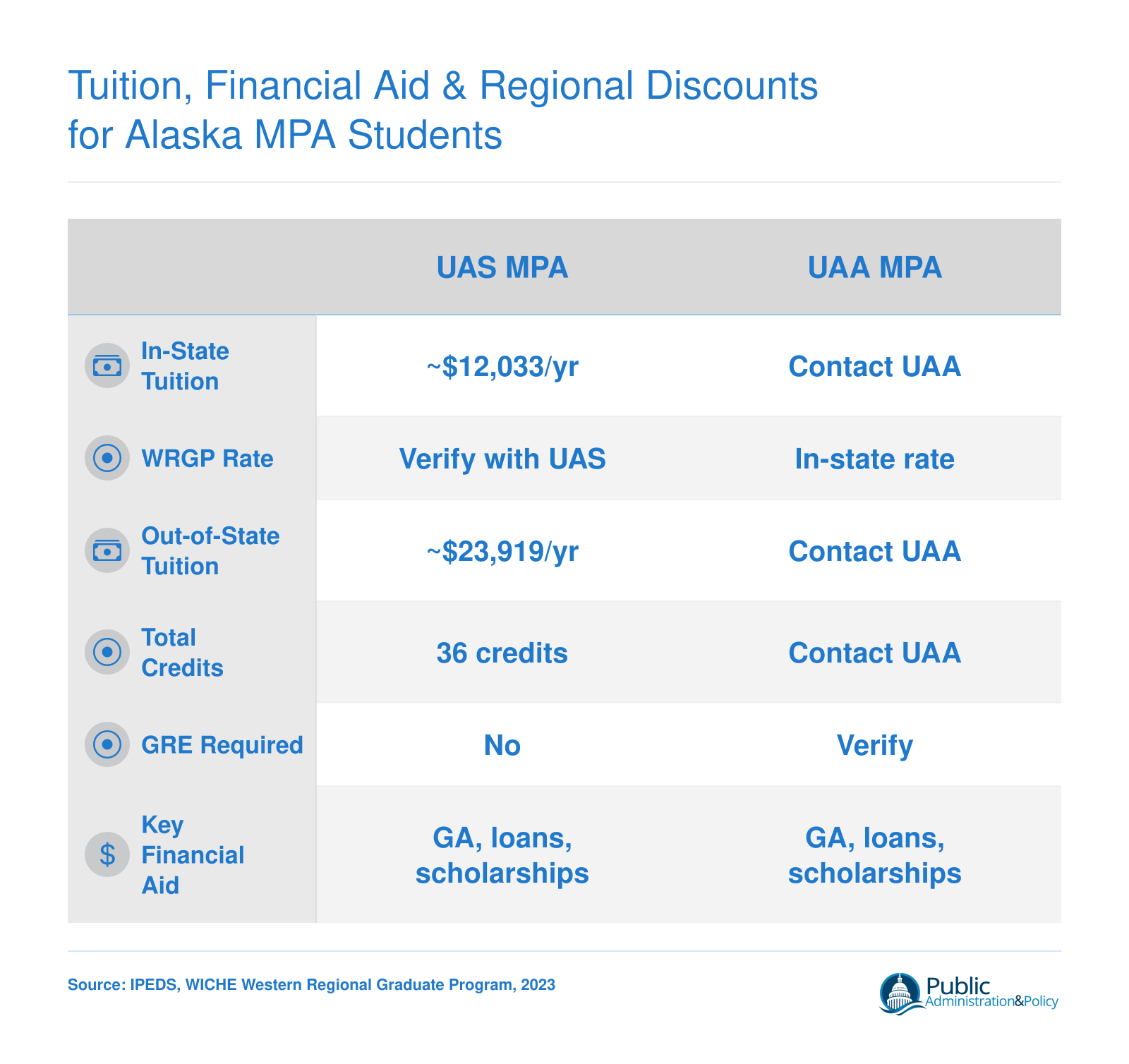
Tuition for Alaska's MPA programs varies significantly depending on residency status and eligibility for regional exchange discounts. The Western Regional Graduate Program (WRGP), administered by WICHE, allows graduate students from participating western states to pay in-state tuition at member institutions. Note that WRGP is distinct from WUE, which applies only to undergraduates and does not reduce MPA tuition. UAA's MPA participates in WRGP and generally extends the benefit to online students, while UAS participation should be confirmed directly with the university. The institution-wide average net price after aid, roughly $12,357 at UAS, offers a useful benchmark but does not reflect the exact cost of a graduate MPA program. Students should also explore graduate assistantships, university scholarships, employer tuition reimbursement programs, and federal student loans to further offset costs.
One of the strongest reasons to pursue an MPA through an Alaska-based program rather than a generic national alternative is the curriculum itself. Alaska's public administration landscape is unlike any other state's, and the coursework offered by its universities reflects the realities of governing across vast, remote regions with significant indigenous populations and resource-dependent economies.
Rural Public Management
Managing public services in Alaska means contending with geography, climate, and logistics that most mainland programs never address. The University of Alaska Southeast (UAS) MPA program includes coursework in rural public management that prepares students to oversee service delivery in communities reachable only by boat or small aircraft. Topics such as intergovernmental coordination across boroughs, emergency management in isolated villages, and budgeting for high-cost infrastructure are woven into core and elective courses. This focus gives graduates practical skills for roles in borough governments, regional health corporations, and state agencies that serve bush Alaska.
Natural Resource Policy
Alaska's economy and governance are tightly linked to natural resources, from oil and gas revenues to fisheries management and federal land stewardship. MPA students at Alaska institutions encounter public policy making not as an abstract elective but as a central theme. Coursework may cover topics like the Alaska Permanent Fund, subsistence resource management, and the interplay between state, federal, and tribal authority over land use. These courses prepare graduates for positions with agencies such as the Alaska Department of Natural Resources, the U.S. Fish and Wildlife Service, and regional Native corporations.
Indigenous Governance and Tribal Policy
Alaska is home to 229 federally recognized tribes, more than any other state. Programs like the UAS MPA integrate tribal governance into their curriculum, addressing sovereignty, self-determination, and the unique legal frameworks that define Alaska Native governance structures. Students explore topics including tribal consultation processes, Indian Self-Determination and Education Assistance Act compliance, and the administration of tribal health and social service programs. This specialized knowledge is difficult to find in MPA programs outside the state.
Capstone and Practicum Opportunities
Both UAS and the University of Alaska Anchorage (UAA) connect MPA students with practicum and capstone projects rooted in Alaska's public sector. Students may complete applied projects with:
State agencies: Such as the Alaska Department of Health or the Division of Community and Regional Affairs.
Tribal organizations: Including regional tribal consortiums and Alaska Native nonprofits.
Borough and municipal governments: Particularly in smaller jurisdictions where students can contribute meaningfully to policy development or program evaluation.
These experiential components ensure that graduates leave with not only academic preparation but also professional networks and demonstrated competence in the specific governance challenges Alaska presents. For anyone planning a career in public policy within Alaska, or in similarly remote and indigenous-centered policy environments elsewhere, this curriculum offers preparation that a standard national MPA simply cannot replicate.
Careers & Top Employers for Alaska MPA Graduates
Alaska's public sector job market offers MPA graduates a distinctive advantage: the state's relatively small population (roughly 733,000 residents) paired with an outsized government footprint means qualified professionals move into leadership positions faster than they might in larger states. If you earn your MPA from an Alaska-based program, you graduate with a network already embedded in the communities you aim to serve.
State of Alaska agencies: Departments such as Health, Natural Resources, Transportation, and Administration routinely hire policy analysts, budget analysts, and program directors. Juneau, as the state capital, concentrates many of these roles.
Borough and municipal governments: Anchorage, Fairbanks North Star Borough, and Matanuska-Susitna Borough need city managers, finance directors, and planning coordinators who can navigate complex local governance structures.
Tribal organizations: Entities like the Tlingit and Haida Central Council and the Alaska Native Tribal Health Consortium (ANTHC) employ tribal administrators, program directors, and grants managers across dozens of communities.
Federal agencies with large Alaska footprints: The Bureau of Land Management (BLM), National Park Service (NPS), and Bureau of Indian Affairs (BIA) maintain significant operations in the state, offering roles in resource management, community development, and intergovernmental affairs.
Common Job Titles
MPA holders in Alaska fill roles that carry real decision-making authority, often earlier in their careers than peers in the Lower 48. Typical titles include city manager, policy analyst, tribal administrator, program director, public budget analyst, and grants coordinator. In smaller boroughs and rural communities, a single MPA-trained professional may oversee budgeting, personnel, and community engagement simultaneously, making the degree's breadth particularly valuable.
Salary Landscape and Cost-of-Living Context
Program-level earnings data for Alaska MPA graduates are not yet available through federal reporting. However, broader labor market figures provide useful context. According to the Alaska Department of Labor and Workforce Development, public administration and management occupations in the Anchorage metro area carry median annual wages that generally range from the mid-$60,000s to the low-$80,000s, depending on the specific role and seniority. Comparable positions in Juneau tend to fall in a similar band, though senior leadership roles in state government can push well above $90,000. For broader national benchmarks, consult our public administration salary guide.
Keep in mind that Alaska's cost of living, particularly for housing, groceries, and energy, runs higher than the national average. The state's lack of a personal income tax and its Permanent Fund Dividend partially offset those costs, but candidates should weigh total compensation, including retirement benefits and geographic pay differentials offered by many state and federal employers, when evaluating offers.
Rapid Advancement in a Small Talent Pool
Alaska's compact professional community creates opportunities that are hard to replicate elsewhere. MPA graduates frequently report that networking circles overlap, mentors are accessible, and lateral moves across agencies are common. It is not unusual for a mid-career professional with an MPA to advance from program coordinator to department director within five to seven years, especially in rural municipalities or tribal organizations where leadership vacancies arise regularly. If you are drawn to meaningful, high-impact work in public service, Alaska's career landscape rewards initiative and preparation in equal measure.
Frequently Asked Questions About Online MPA Programs in Alaska
Below are answers to the most common questions prospective students ask about pursuing an online Master of Public Administration in Alaska. Each response draws on the program details, accreditation information, and career data covered earlier in this article.
Are there fully online MPA programs in Alaska?
Yes. The University of Alaska Southeast (UAS) offers a fully online MPA that is accessible to students anywhere in the state or beyond. The University of Alaska Anchorage (UAA) also delivers public administration coursework, though its format has historically blended online and in-person elements. For students who need complete flexibility, the UAS program is the most established fully online option within the University of Alaska system.
Is the University of Alaska Southeast MPA program NASPAA accredited?
As of 2026, the UAS MPA program is not accredited by the Network of Schools of Public Policy, Affairs, and Administration (NASPAA). While NASPAA accreditation is a valuable credential, the UAS program is regionally accredited through the Northwest Commission on Colleges and Universities, and its curriculum aligns with many NASPAA competency areas. Prospective students should weigh accreditation status against the program's Alaska-specific strengths discussed earlier in this article.
Do Alaska MPA programs require the GRE?
The UAS MPA program does not require GRE scores for admission, making it an attractive option for working professionals who prefer not to take a standardized exam. Admissions decisions rely on factors such as undergraduate GPA, professional experience, and a personal statement. If you are considering UAA, check directly with the department for the latest admissions requirements, as policies can change from year to year.
Can out-of-state students get in-state tuition for the UAS online MPA?
Out-of-state students enrolled in the UAS online MPA may qualify for reduced tuition through regional exchange agreements such as the Western Regional Graduate Program (WRGP), which allows residents of participating western states to pay in-state or near in-state rates. Additionally, some online programs within the University of Alaska system offer a single tuition rate regardless of residency. Contact UAS financial services to confirm current pricing for your state.
How do UAA and UAS MPA programs compare in cost and format?
UAS delivers a fully online MPA designed for remote learners and working professionals, with a curriculum emphasizing rural governance and Alaska Native policy. UAA's public administration offerings tend to serve Anchorage-area students and may include in-person components. Tuition at both institutions falls below the national average for public MPA programs. The detailed cost and format comparison earlier in this article can help you weigh each option side by side.
What jobs can you get with an MPA in Alaska?
MPA graduates in Alaska find roles across state and local government, tribal organizations, federal agencies such as the Bureau of Land Management and the National Park Service, and nonprofit organizations focused on natural resources, healthcare, and community development. Common titles include city manager, policy analyst, program director, and tribal administrator. Alaska's vast public sector and unique governance landscape create steady demand for trained public administration professionals.
How long does it take to complete an online MPA in Alaska part-time?
Part-time students in the UAS online MPA typically finish in about three years, though timelines vary based on course load each semester. Full-time students can often complete the degree in approximately two years. The program's asynchronous online format allows working professionals to set a pace that fits their schedule, and academic advisors can help you map out a realistic completion plan based on your personal and professional commitments.