The Schedule Policy/Career List: What It Means for MPA & MPP Graduates
How federal reclassification reshapes public administration careers — and what current and aspiring civil servants should do now
By Max SheltonReviewed by PAP Editoral TeamUpdated July 24, 202624 min read
What you’ll learn in this article…
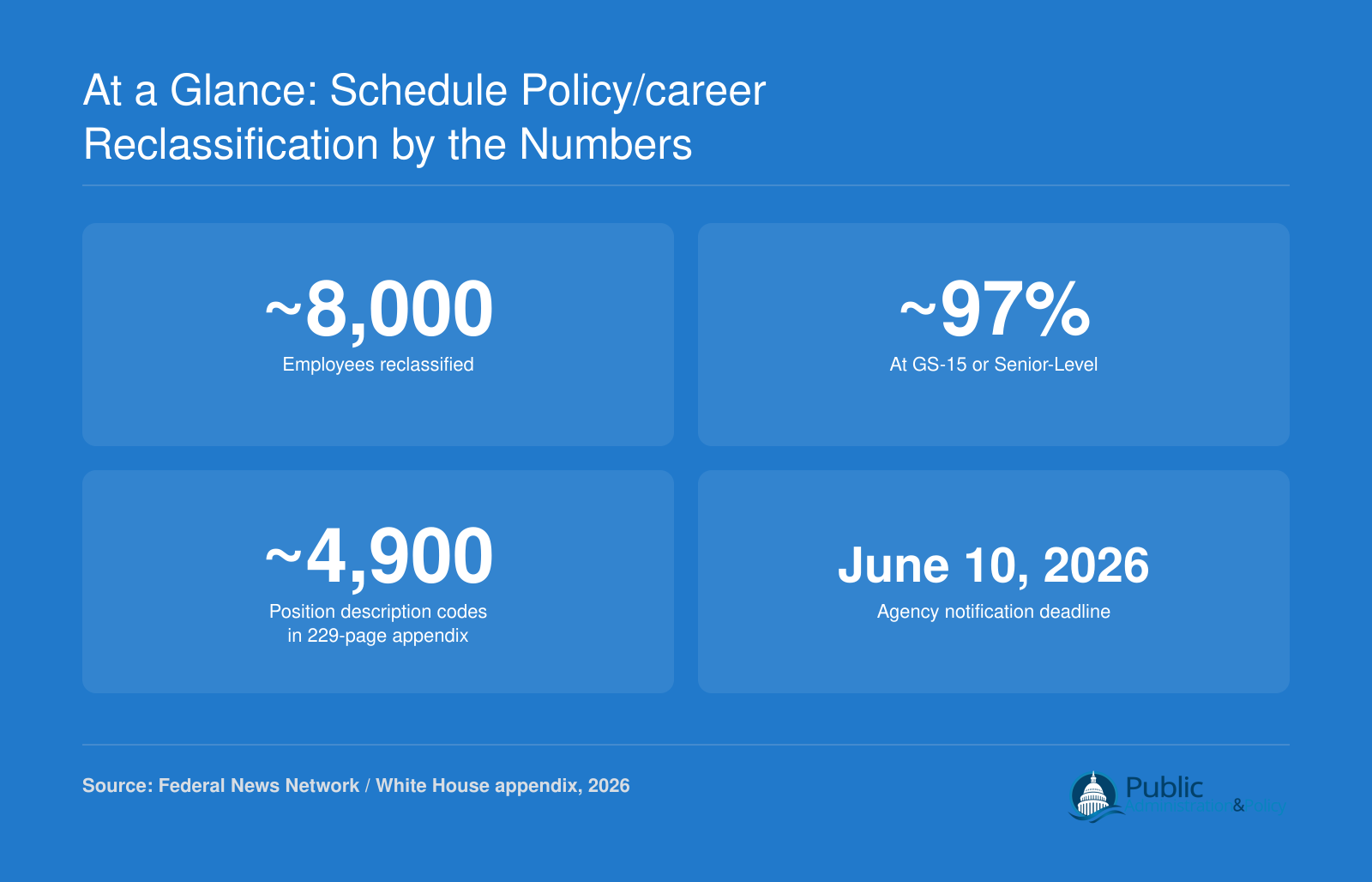
Close to 8,000 federal employees face reclassification under Schedule Policy/Career, with a June 10 notification deadline.
The White House appendix lists 4,900 position codes but omits how many people hold each role.
Roughly 97% of reclassified positions are at the GS-15 or Senior Level, reshaping senior career paths.
Multiple lawsuits and potential congressional action may yet reverse or modify the reclassification.
What does the Schedule Policy/Career list mean for MPA and MPP graduates? On June 10, 2026, agencies began notifying nearly 8,000 federal employees that their policy-influencing positions will lose traditional civil-service protections. The 229-page appendix lists just under 4,900 position description codes but does not reveal how many workers are affected per role.
For public administration and policy careers, this is the most consequential personnel change in decades. About 97% of reclassified slots are GS-15 or Senior Level, the tier MPA and MPP graduates aim for after years of service. The opacity leaves applicants guessing which federal jobs still offer the merit-based stability that once defined a career in public service.
What Is the Schedule Policy/career List?
For MPA and MPP graduates weighing a career in federal service, the traditional tradeoff has been clear: accept a government salary in exchange for job stability and merit-based advancement, insulated from political winds. The new Schedule Policy/Career list challenges that calculus, creating a category where policy-influencing roles can shift from career positions to at-will appointments. This section explains what the list is, how it came to be, and why it matters for your career planning.
A New Employment Category for Policy-Influencing Roles
Schedule Policy/Career is a reclassification that moves career civil servants out of the competitive service and into a newly defined excepted service schedule. Unlike competitive service positions, which carry robust protections against politically motivated dismissals, employees in this schedule lack standard due process safeguards. The White House published a 229-page appendix listing agencies, position titles, and description codes subject to the change, and senior officials confirmed that close to 8,000 employees have been reclassified so far, according to Federal News Network.1
The move effectively redefines which federal roles are deemed "policy-influencing," placing them outside the normal merit system. For MPA and MPP careers in federal civil service, this means jobs in human capital, procurement, financial management, communications, and public affairs are now more vulnerable to turnover with each administration.
From Schedule F to Policy/Career: A Regulatory Timeline
The concept originated with Executive Order 13957, signed in October 2020, which created "Schedule F" in the excepted service.2 That order was rescinded by President Biden on January 22, 2021, before any agencies fully implemented it.3
The current administration reinstated and expanded the policy with Executive Order 14171 on January 20, 2025, renaming it Schedule Policy/Career.2 The Office of Personnel Management issued its final rule on February 5, 2026, with a 30-day effective delay, citing authority under 5 U.S.C. §§ 3301 and 3302.4 By June 2026, agencies faced a deadline to notify affected employees.
This timeline underscores how civil service reform has become a pendulum swinging with each presidency, directly affecting the career stability of policy professionals.
Targeting the Most Experienced Career Staff
The reclassification is not a broad sweep: approximately 97 percent of reclassified employees hold GS-15 or Senior-Level (SL) positions, the highest grades before the Senior Executive Service.1 This means the list disproportionately targets the most seasoned policy analysts, government program managers, and advisors, people who often lead teams and shape agency direction.
For MPA and MPP graduates, these are the roles many aspire to after years of federal service. The practical effect is stark: reclassified employees can be dismissed more easily and lack the appeal rights of competitive service members. While proponents argue this enhances accountability, critics see it as a threat to neutral competence and institutional memory.
Understanding this landscape is essential for anyone considering a long-term federal career, as the traditional protections of civil service can no longer be taken for granted in policy-oriented roles.
Which Federal Positions Are on the List?
Just under 4,900 position description codes fill the White House's 229-page appendix, mapping a sweeping reclassification across dozens of agencies. A Leadership Connect analysis identifies the most frequently listed titles: program managers, attorney advisors, program analysts, and human resources specialists. These roles span core administrative functions that keep federal operations running.
Functional Areas in the Crosshairs
The reclassification cuts across six major functional domains: human capital, procurement, financial management, federal grants, communications, and public affairs. For public administration graduates, these are not abstract categories , they map directly to MPA and MPP career paths. Budget analysts, policy analysts, program evaluators, and grants managers now operate in positions that may shift from competitive service to Schedule Policy/Career, fundamentally altering hiring processes and job protections.
The GS-15 and Senior-Level Concentration
About 97% of reclassified positions sit at GS-15 or Senior-Level (SL) grades.1 This means entry-level MPA and MPP jobs, typically GS-9 through GS-12, are not immediately on the list. However, the career ladder into senior policy roles has been redrawn. A program analyst today may aspire to a government program manager role tomorrow, but that promotion now leads into Schedule Policy/Career territory, where the merit system principles that once governed advancement may no longer apply in the same way.
What This Means for Your Career Trajectory
If you plan a federal career in policy analysis, human resources, or grants management, you will likely encounter this reclassification at mid-career. The traditional path from entry-level specialist to senior advisor is now clouded by uncertainty about due process protections and the boundary between career and political appointments. Many of the position titles on the list, particularly program managers and program analysts, are classic landing spots for MPA and MPP degree holders. Understanding which roles are reclassified becomes essential for long-term career planning.
At a Glance: Schedule Policy/career Reclassification by the Numbers
The 2026 Schedule Policy/Career reclassification marks one of the most significant changes to the federal hiring landscape in decades. The following figures capture the immediate scope of the initiative.
Transparency Gaps: What We Still Don't Know About the List
The White House's Schedule Policy/Career appendix raises more questions than it answers for the federal workforce. Despite releasing a 229-page document with agency names, position titles, and codes, the administration has left both the public and the affected employees in the dark about critical details.
Missing Data Undermines Public Accountability
Protect Democracy's analysis of the appendix found no total count of affected positions, no breakdown of employees per position, no seniority levels, and no occupational series. As Jules Torti, a policy analyst at the organization, stated, "There's a lot of guesswork that the public has to do... about exactly who is being moved." This absence of aggregate data makes it impossible for outside observers, academics, and policy professionals to assess the scale or scope of the reclassification's impact on agency operations and merit system integrity.
Workers Cannot Verify Their Own Status
The opacity hits hardest among the civil servants themselves. The appendix identifies positions only by obscure position description (PD) codes, which are internal agency identifiers that are not standardized government-wide.1 Torti added, "We're hearing from civil servants that they don't know their position description number." A PD code is a document number or billet identifier maintained in agency HR records, not a label an employee typically carries around.2 It is not stored in the electronic Official Personnel Folder (eOPF). To find your PD code, you must ask your supervisor or HR office directly.3 Many employees learned of their reclassification only after the seven-day notification window began.4 Without knowing the PD code, individuals cannot cross-reference the appendix to confirm whether they are now in the excepted service. The administration's guidance states that later renumbering or reorganization does not alter one's placement,4 but that is cold comfort when you cannot even make the initial match.
Agency Silence Compounds Uncertainty
The federal civil service process for classification relies on OPM guidance covering pay plan, series, title, grade, and qualification requirements, yet OPM and the Office of Management and Budget did not respond to requests for comment on these transparency gaps.3 Their silence leaves frontline employees without clear, official channels for information. Agency HR offices, which maintain PD libraries,2 become the bottleneck, and not all have been equipped to handle the influx of inquiries. For MPA and MPP graduates eyeing federal careers, this episode underscores a foundational lesson in implementation: a policy's success depends not just on its intent but on the operational clarity it provides to those it governs.
Questions to Ask Yourself
Are the federal policy analysis, program management, or grants administration roles you are targeting now classified as Schedule Policy/Career?
If reclassified, these positions lose competitive service protections, shifting from merit-based to at-will employment. Verify the list to avoid unexpected career risks before you invest in an application.
Have you consulted your graduate program's career services about how Schedule Policy/Career is reshaping federal placement advice?
Career offices may not yet have updated guidance. Proactively asking ensures you receive accurate, current strategies for navigating this evolving hiring landscape.
If you are already a federal employee, can you locate your position description code today?
Knowing your code is essential to understand whether you might be affected. Many employees are unaware, and agency communication has been inconsistent.
Impact on Merit System Principles and Due Process
The Schedule Policy/Career reclassification strikes at the heart of the federal merit system, which for over a century has mandated that hiring, promotion, and retention decisions be based on competence, not political allegiance. By reclassifying thousands of career positions into the excepted service, the administration has created a category of federal employment where employees serve at will and can be removed for subjective reasons, including, as the executive order states, "subversion of presidential directives."1 This shift fundamentally challenges the principle that career public servants should be insulated from political pressure, raising profound concerns for MPA and MPP graduates aiming for federal careers.
Understanding the Merit System Principles
Civil service reforms codified in law since the Pendleton Act of 1883 aim to ensure a professional, nonpartisan career workforce. Employees are hired through competitive examination, demonstrate their qualifications, and earn job protections that prevent arbitrary dismissal. These protections include the right to appeal adverse actions to the Merit Systems Protection Board (MSPB), a safeguard that helps maintain a workforce focused on public interest rather than political loyalty. However, under the Schedule Policy/Career classification, such due process rights are sharply limited.2 Reclassified employees face at-will employment status, with reduced MSPB appeal rights. The initiative designates positions as "confidential, policy-determining, policy-making, or policy-advocating," categories historically reserved for political appointees, not career staff.3
The Blurred Line Between Career and Political Roles
Traditionally, there is a clear divide between career civil servants and political appointees. Career staff are selected through merit-based competition and are expected to serve administrations of either party with equal professionalism. Political appointees, by contrast, are chosen by the president to carry out the administration's agenda and serve at the president's pleasure; they typically lack the same job protections. By moving nearly 8,000 positions, roughly 97% of which are at the GS-15 or Senior-Level (SL) grade, into a new at-will category, the reclassification blurs this line.2 Now, seasoned program managers, attorney advisors, and public affairs specialists who previously enjoyed merit-based protections can be dismissed for failing to align with presidential directives, effectively treating them as political proxies.
Threat to Neutral Competence
The concept of "neutral competence" holds that career civil servants deliver objective analysis and expert implementation without partisan bias. This neutrality is essential for evidence-based public policy making and agency operations. When career positions become subject to political loyalty tests, the incentive to provide frank, unvarnished advice diminishes. MPA and MPP graduates who intend to build careers in federal service must now consider how this environment could stifle analytical independence. A policy analyst who fears reprisal for data that contradicts a political narrative may self-censor, undermining the very purpose of a professional public service.
Legal and Congressional Challenges
As of June 2026, the reclassification faces active legal challenges. A coalition lawsuit, PEER et al. v. OPM, was filed on March 4, 2026, by Public Employees for Environmental Responsibility (PEER) and a group of unions including the American Federation of Government Employees (AFGE) and the National Treasury Employees Union (NTEU). The plaintiffs seek to vacate the final rule and obtain injunctive relief, arguing that the reclassification violates merit system statutes. Although the suit is pending, no nationwide injunction has been issued, and the administration continues to implement the changes. Executive Order 14410, signed on June 3, has been incorporated into the existing litigation. Meanwhile, congressional oversight committees are actively examining the initiative, and several members have proposed legislation to block or modify the reclassification, though no specific bill numbers have been identified as of this writing.5 The outcome of these legal and legislative battles will significantly shape the future of federal hiring and the nature of the civil service.
Salary and Career Outlook for Affected Federal Roles
The Schedule Policy/Career reclassification primarily affects senior federal positions, including GS-15 and equivalent roles. For context, the table below shows national employment and wage data for selected occupations from the Bureau of Labor Statistics that broadly correspond to policy-influencing and management functions. While federal General Schedule pay for GS-15 steps ranges from approximately $110,000 to over $145,000 depending on locality, private-sector and other government earnings for similar functions can vary significantly.
Occupation
Total Employment (2024)
Median Annual Wage
25th Percentile
75th Percentile
Chief Executives
211,850
$206,420
$126,080
N/A
General and Operations Managers
3,584,420
$102,950
$67,160
$164,130
Legislators
26,510
$44,810
$29,120
$80,350
Highest-Paying States for Senior Policy and Management Roles
The table below highlights the states with the highest median wages for Chief Executives and General and Operations Managers, roles that align with the GS-15 and Senior-Level positions now being reclassified. While these private-sector figures serve as a benchmark, actual federal compensation is determined by locality pay adjustments, which are highest in the Washington, D.C. metropolitan area, where most affected positions are headquartered.
State
Occupation
Median Annual Wage
California
Chief Executives
$220,600
Pennsylvania
Chief Executives
$220,510
New York
Chief Executives
$219,320
Michigan
Chief Executives
$219,230
Rhode Island
Chief Executives
$211,810
Georgia
General and Operations Managers
$99,800
Michigan
General and Operations Managers
$99,660
South Carolina
General and Operations Managers
$99,340
North Carolina
General and Operations Managers
$99,190
Oregon
General and Operations Managers
$98,580
Roughly 97% of reclassified positions sit at the GS-15 or Senior Level, the exact tier MPA and MPP graduates aim for after a decade in federal service. This reclassification does not just affect current senior staff; it reshapes the career ceiling for every new hire with policy ambitions, making it critical to factor potential political alignment into career planning.
MPA Vs. MPP: How Each Degree Prepares You for This Landscape
Public administration and public policy degrees take different routes to the same destination: impactful public service. While an MPA trains you to run government and nonprofit organizations, an MPP sharpens your ability to design and evaluate the policies those organizations implement. Both degrees are gateways into the federal workforce, but the Schedule Policy/Career reclassification adds new weight to how each one aligns with roles now deemed policy-influencing.
Core Differences Between MPA and MPP Programs
The difference between public administration and public policy runs deeper than a curriculum catalog. An MPA centers on management: budgeting, human resources, organizational behavior, and program evaluation. It prepares you to lead agencies, oversee public funds, and ensure operational efficiency. An MPP, by contrast, delves into economics, quantitative analysis, and policy design, equipping graduates to craft legislation, model impacts, and advise decision-makers. Most programs share a foundation in ethics, public values, and analytic methods, but the emphasis diverges.
Typical Career Paths by Degree
MPA graduates often enter federal, state, or local government in roles like program manager, budget analyst, human capital specialist, or city manager. Many also pursue nonprofit leadership or private-sector consulting focused on public-sector clients.
MPP graduates tend toward policy analyst, legislative aide, research associate, or program evaluator positions. They are heavily represented in think tanks, advocacy organizations, and legislative offices.
Both paths are visible in the Schedule Policy/Career appendix, where program managers, attorney advisors, program analysts, and human resources specialists dominate. The blend reflects the administration's broad definition of policy-influencing work.
Relevance to the Schedule Policy/Career Shift
Understanding where your degree fits into a politicized hiring landscape matters more than ever. MPA holders may find their operational roles newly classified as policy-career if they involve budget formulation, procurement strategy, or agency communications. MPP graduates, already accustomed to policy design, may see the line between career and political appointment blur further. The lack of transparent classification criteria means you cannot assume a job title tells the full story. Review online public administration degree programs carefully alongside position descriptions to see how curricula align with the roles agencies are reclassifying, and track how agencies interpret the new rules.
How to Research Your Own Path
Consult the Bureau of Labor Statistics for occupation-level growth projections and typical education requirements for public administration and policy roles.
Review alumni career outcome reports from leading MPA and MPP programs, which often list common job titles and sector breakdowns.
Visit professional associations like NASPAA and APPAM for accreditation data and occasional placement surveys.
Search LinkedIn or school job portals to see where recent graduates with each degree are landing.
These sources, while not exhaustive, offer a starting point for mapping your degree to federal or public-sector opportunities in a changing civil service environment.
What MPA and MPP Graduates Should Know Before Applying to Federal Jobs
Two paths lie before MPA and MPP graduates eyeing federal service: applying directly to policy-influencing positions that may now be reclassified under Schedule Policy/Career, or pursuing roles that offer greater insulation from political turnover and personnel changes. The choice matters more than ever, and a few practical moves before you accept an offer can protect your career trajectory.
Verify the Position Description Code
The White House's 229-page appendix lists position description (PD) codes for all reclassified roles. Before you sign an offer, ask the HR contact or hiring manager for the PD number tied to the vacancy. Once you have it, cross-reference the appendix. A match means the job is Schedule Policy/Career , at-will employment with reduced civil service protections and no appeal rights for removals. If the agency is reluctant to share the PD code during the hiring process, treat that as a red flag; full transparency is a reasonable expectation.
Questions to Raise in the Interview
During your interview, frame two questions as professional due diligence: "Is this position classified under Schedule Policy/Career?" and "What protections does this position carry under the current classification?" Many current civil servants don't know their own PD numbers, so hiring panels may not have immediate answers , but posing the question signals you understand the landscape and need clarity before committing. The answers you get, or the inability to get them, will tell you a great deal about how the agency is handling the transition.
Career Progression into Reclassified Territory
Entry-level positions at GS-7 through GS-12 are largely unaffected right now. The risk emerges when you climb the ladder: roughly 97% of reclassified employees are GS-15 or Senior-Level (SL) staff, and typical career paths from GS-12 into GS-13-15 policy analyst roles, program manager, or attorney advisor positions lead straight into Schedule Policy/Career territory. Map your promotion potential early. If you intend to stay in the civil service for a decade, consider whether that terminal GS-14 policy role is worth the loss of due process protections.
Alternative Federal Roles with Greater Stability
Not all federal careers lead to the reclassified list. Technical positions in data science, IT, cybersecurity, and STEM-coded specialties are harder to label as "policy-influencing" and remain largely untouched. MPA and MPP graduates who have built quantitative and analytical skills can pivot into these mission-critical fields, often at similar pay grades, while staying outside the reclassification zone. Agencies need evaluators, data stewards, and systems architects just as much as they need policy advisors.
Looking Beyond the Federal Government
Parallel policy careers exist outside the federal system, completely free of Schedule Policy/Career risk. State and local government agencies, policy nonprofits, and think tanks offer robust public service paths where MPA and MPP credentials carry significant weight. These sectors are actively hiring for program evaluation, public budget analyst roles, legislative affairs, and community engagement, all of which leverage the same competencies. Broadening your search ensures you do not bet your entire career on a federal system in flux.
What Comes Next: Legal Challenges, Congressional Action, and Career Strategy
The Schedule Policy/Career reclassification is already moving forward, but its permanence hinges on an ongoing tangle of court challenges, congressional maneuvering, and the strategic decisions of public administration professionals themselves.
Legal Challenges Await Resolution
Multiple lawsuits are pending, yet no court has issued a nationwide injunction as of June 2026.1 The legal landscape is volatile: employees moved into Schedule Policy/Career (SP/C) lose most Merit Systems Protection Board (MSPB) appeal rights for both the reclassification itself and subsequent adverse actions, shifting review to internal agency procedures.1 The American Federation of Government Employees (AFGE) and the National Treasury Employees Union (NTEU) have vigorously opposed the changes, backing litigation that argues violations of due process and merit system principles.1 While no final ruling has been handed down, the White House continues to implement the policy, having already relocated an initial 8,000 positions and signaling an estimated total of 50,000 roles could eventually be affected.2
Congressional Dynamics and the Legislative Front
On Capitol Hill, no statute has yet blocked or repealed SP/C, but pressure is mounting.1 Lawmakers have introduced bills aimed at codifying civil service protections for policy-adjacent roles, though partisan disagreements have stalled passage. Committee hearings have spotlighted transparency gaps and the speed of implementation: agencies had just seven days to move identified positions and update personnel records.2 For now, employees and applicants must navigate a system where the rules can change with little notice.
Career Strategy for Uncertain Times
For MPA and MPP graduates, this moment demands a deliberate approach to federal workforce career planning. Consider these tactics:
Diversify your skills portfolio: beyond pure policy analysis, build expertise in financial management, procurement, data analytics, or human capital , fields that remain essential across administrations and classification schemes.
Deepen private-sector experience: even short-term roles outside government can provide transferable competencies and a professional safety net should federal pathways narrow.
Document your competitive service status: if you hold a position at risk of reclassification, keep meticulous records of appointments, classification decisions, and agency communications. This paper trail could prove critical in future appeals or legislative remedies.1
Monitor OPM and professional associations: subscribe to Federal Register updates from the Office of Personnel Management and follow analysis from groups like the American Society for Public Administration (ASPA) and the Association for Public Policy Analysis and Management (APPAM). They offer timely guidance as policies evolve.
Preparing for Future Policy Shifts
Regardless of how current lawsuits or bills fare, the precedent set by SP/C is profound. Future administrations of any party may attempt similar large-scale reclassifications. Career resilience now requires not just technical public policy knowledge, but an active plan for adaptability: staying current on personnel law, cultivating a wide professional network, and always keeping one eye on the broader labor market. The civil service you enter today may look very different in a decade, so plan accordingly.
Frequently Asked Questions About Schedule Policy/career and MPA/MPP Careers
The Schedule Policy/Career reclassification is raising critical questions for MPA and MPP graduates considering federal careers. Below, we answer the most pressing FAQs about what this change means for public administration professionals.
What is the final rule of the OPM Schedule F?
The final rule for Schedule F, originally issued in 2020 under an executive order, aimed to strip civil service protections from employees in "policy-determining, policy-influencing, or policy-advocating" roles. It was revoked in 2021. The current Schedule Policy/Career list represents a similar effort to reclassify positions, effectively bypassing traditional merit system protections and making those jobs easier to fill with political appointees.
Which federal positions are on the Schedule Policy/Career list?
The list includes positions primarily in human capital, procurement, financial management, federal grants, communications, and public affairs. The most frequent titles are program managers, attorney advisors, program analysts, and human resources specialists. Nearly 97% of reclassified employees are at the GS-15 or Senior-Level (SL) grade, indicating a focus on senior policy and management roles.
How does the Schedule Policy/Career reclassification affect federal hiring?
It blurs the line between career civil servants and political appointees, potentially reducing job security and merit-based competition. Hiring for these roles may shift toward political loyalty, discouraging qualified, nonpartisan applicants. The lack of transparency in which positions are deemed "policy-influencing" also creates uncertainty for candidates, possibly delaying recruitment and undermining morale within agencies.
What is the difference between career civil service and political appointee positions?
Career civil service positions are filled based on merit through competitive exams and are protected from arbitrary dismissal, ensuring neutral competence. Political appointees serve at the pleasure of the administration and can be hired or removed without cause. The Schedule Policy/Career reclassification effectively moves formerly protected career roles into a category that resembles political appointments despite their policy-influencing nature.
How can federal employees find their position description code?
Employees can locate their position description (PD) number on their official SF-50 Notification of Personnel Action or by reviewing their PD document with HR. However, the current reclassification process has caused confusion: civil servants report not knowing their PD number, and agencies have struggled to notify affected employees by the June 10 deadline. Directly consulting agency HR is the best step.
What should MPA graduates know about federal job reclassification before applying?
MPA graduates should understand that the reclassification introduces heightened political considerations into public service careers. They must analyze job announcements carefully for reclassified status, weigh the trade-offs between policy influence and job stability, and stay informed about legal challenges. Training in public personnel administration and policy analysis equips them to navigate these shifting dynamics effectively.
Are entry-level federal jobs affected by Schedule Policy/Career?
Currently, entry-level federal jobs are largely unaffected, as about 97% of reclassified positions are GS-15 or equivalent senior levels. The list targets senior policy and management roles. However, if the reclassification expands, it could eventually impact lower-graded positions. MPA graduates seeking entry-level U.S. federal jobs should monitor developments but need not fear immediate displacement.