Public Policy-Making: What It Is, How It Works & Why It Matters
A structured overview of the policy-making process, key stakeholders, and career pathways in public policy.
By Max SheltonReviewed by PAP Editoral TeamUpdated August 11, 202625+ min read
What you’ll learn in this article…
Public policy is a system of laws, regulations, and government decisions designed to solve societal problems or achieve collective goals.
Policy making follows a five stage cycle: agenda setting, formulation, adoption, implementation, and evaluation that continuously repeats.
Governments address policy across three core areas: social welfare, national defense and security, and economic management.
Degrees such as the MPA or MPP provide structured career pathways into public policy roles across government, nonprofits, and research.
In 2025, a single update to Medicaid eligibility thresholds affected coverage for more than 20 million Americans overnight, altering access to prescriptions, mental health services, and prenatal care across every state. That is public policy at work.
Policy decisions shape the fluoride concentration in your tap water, the emissions standards on your commute, and the interest rate on a federal student loan. The reach is constant, even when the mechanisms are invisible.
For students and professionals entering public administration, the core challenge is not awareness but literacy: understanding how policies are defined, how the five-stage process actually operates, who holds leverage at each stage, and where career entry points exist. That literacy increasingly separates effective practitioners from well-meaning observers.
What Is Public Policy? Definition and Core Concepts
At its simplest, defining public policy starts with a system of laws, regulations, courses of action, and government decisions designed to address societal problems or achieve collective goals. When a government decides how to handle climate change, manage public health, or regulate financial markets, it is engaging in policy making. The concept of public policy spans everything from a federal statute signed into law to a local ordinance governing zoning.
Understanding this definition is the first step, but the concept has layers that are worth unpacking, especially because newcomers to the field often confuse public policy with related ideas.
Public Policy vs. Private Policy vs. Public Administration
These three terms overlap in everyday conversation, yet they describe distinct things.
Public policy: The decisions, plans, and actions a government pursues on behalf of the public. It answers the question, "What should government do?"
Private policy: Rules and strategies adopted by corporations, nonprofits, or other non-governmental organizations. A company's data-privacy guidelines are private policy; they bind employees and customers, not citizens at large.
Public administration: The machinery that carries out public policy. If policy is the "what," administration is the "how." Public administrators implement budgets, manage agencies, and deliver services that policymakers have authorized.
Recognizing these distinctions matters for anyone exploring a career in public policy. A public policy analyst might draft recommendations for new legislation, while a public administrator manages the agency responsible for enforcing that legislation once it passes.
Four Main Types of Public Policy
Political scientists commonly classify public policy into four categories, each serving a different function.
Regulatory policy: Sets rules that constrain or direct individual and corporate behavior. The Environmental Protection Agency's emission standards for power plants are a classic example.
Distributive policy: Allocates government resources or services broadly across the population. Federal funding for interstate highway construction benefits communities nationwide, regardless of income level.
Redistributive policy: Shifts resources from one group to another to promote equity. Progressive income tax structures, where higher earners pay a larger percentage, fund social safety-net programs for lower-income households.
Constituent policy: Establishes or reorganizes government institutions and processes. The creation of the Department of Homeland Security in 2002 consolidated multiple agencies under a single umbrella to improve national security coordination.
These categories are not always rigid. A single piece of legislation can contain elements of more than one type, and policies evolve over time as political conditions shift.
Formal and Informal Policy
One nuance that many introductory resources overlook is the distinction between formal and informal policy. Formal policy takes the shape of statutes, executive orders, court rulings, and official regulations published in government registers. These carry the force of law and are enforceable through legal mechanisms.
Informal policy, on the other hand, operates through executive guidance documents, agency memoranda, unwritten norms, and institutional practices. A federal agency might issue non-binding guidance that effectively shapes how companies in a regulated industry behave, even though no statute mandates those specific actions. During the ongoing regulatory debates of 2025 and 2026, informal guidance has played an increasingly prominent role in areas such as artificial intelligence oversight and public health preparedness.
Both forms matter. Legislation grabs headlines, but informal policy often fills the gaps between what lawmakers enact and what agencies actually do on a daily basis. For students and professionals studying policy decision-making, paying attention to informal channels is essential to understanding how governance truly works in practice.
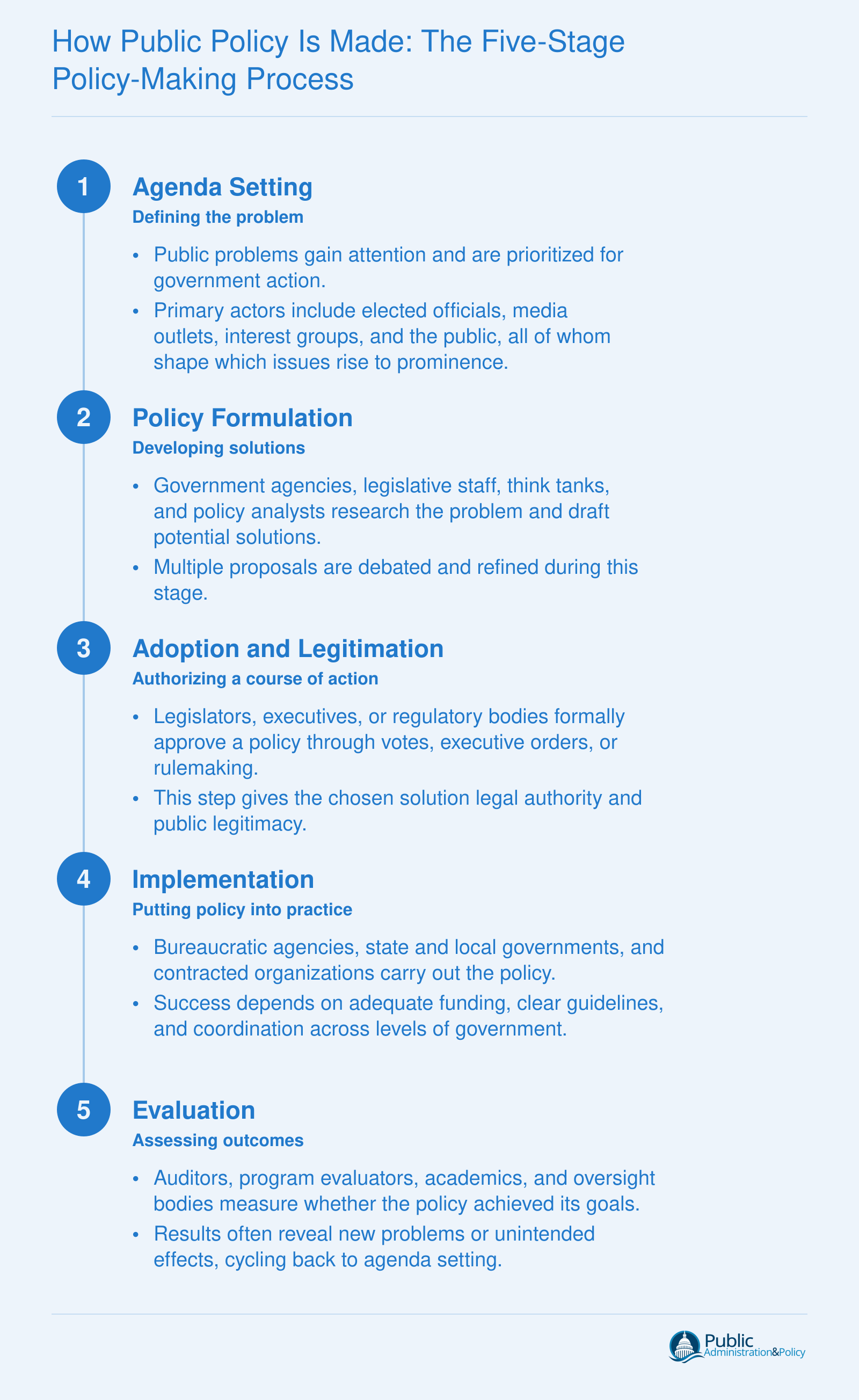
How Public Policy Is Made: The Five-Stage Policy-Making Process
Public policy making follows a well-established cycle of five interconnected stages. While presented as a sequence, the process is inherently cyclical: findings from evaluation regularly loop back to reshape the agenda, restarting the cycle with fresh evidence and priorities.
The Policy-Making Process in Action: Real-World Examples
Abstract frameworks become far more useful once you can see them at work. The examples below, drawn from 2024 through 2026, trace how three different policies moved (or stalled) through the five-stage process: agenda setting, formulation, adoption, implementation, and evaluation. Importantly, each operates at a different level of government, illustrating how the same basic cycle adapts to very different institutional contexts.
Federal Climate and Education Policy: The U.S. Department of Education Climate Adaptation Plan
Years of extreme weather events damaging school buildings and disrupting learning placed climate resilience on the federal education agenda. In 2024, the U.S. Department of Education released its 2024 to 2027 Climate Adaptation Plan, formulated through interagency coordination and stakeholder consultation.1 The plan was adopted as formal departmental policy guidance and includes an Infrastructure and Sustainability Initiative designed to help schools upgrade facilities and reduce climate-related disruptions.
As of 2026, the plan is in its capacity-building and technical-assistance phase, with programs like SASI and NCSI working to equip districts with the expertise they need to apply for funding and redesign infrastructure.1 Evaluation is ongoing, as the department tracks which districts are engaging with its resources and how effectively schools are integrating sustainability measures. This example shows that even after adoption, a policy can take years to reach the communities it is meant to serve.
Federal Health Policy Meets Political Headwinds: The HHS Climate Adaptation Plan
The U.S. Department of Health and Human Services followed a parallel path in 2024, publishing its own Climate Adaptation Plan to address heat-related illness, air quality, and climate-driven disease patterns.2 The plan moved through agenda setting and formulation alongside broader federal climate strategy, and it was formally adopted as departmental guidance. Professionals interested in this intersection of climate science and governance may want to explore a career as an environmental policy advisor.
However, this example highlights a reality the textbook model often glosses over: implementation can be reversed. By 2026, the Office of Climate Change and Health Equity, the unit responsible for driving much of the plan's work, had been eliminated.3 Core implementing capacity was significantly weakened, leaving the formal document in place but its practical machinery largely dismantled. This case is a powerful reminder that adoption does not guarantee lasting impact, and that the evaluation stage sometimes reveals political, rather than technical, failures.
State-Level Clean Energy Laws: A 2026 Wave of Climate Action
While federal efforts faced disruption, a wave of state-level climate and clean energy legislation advanced in 2026.4 Multiple states adopted laws designed to accelerate the build-out of renewable energy and storage, improve energy affordability, and strengthen community resilience against extreme weather.
At the state level, the policy-making process looks different in important ways. Agenda setting is often driven by governors, state legislators, and local advocacy organizations rather than by federal agencies. Formulation involves utility commissions, state environmental agencies, and industry stakeholders whose influence can vary dramatically from one state to the next. As of mid-2026, these laws are in their earliest implementation stages: rulemaking proceedings are underway, utility commissions are developing compliance frameworks, and initial funding rounds are being distributed.4 Formal evaluation will follow as states track emissions reductions, energy costs, and infrastructure deployment over the coming years.
Why These Examples Matter for You
Taken together, these three cases reveal several truths about how public policy actually works.
Scale shapes the process: Federal policies rely on large bureaucracies and interagency coordination, while state and local efforts can move more nimbly and respond to regional priorities.
Implementation is never automatic: Even well-designed plans require sustained funding, institutional support, and political commitment to translate from paper into practice.
Setbacks are part of the cycle: The elimination of implementing offices at the federal level shows that policies can be weakened or reversed, making ongoing civic engagement essential.
Evaluation drives the next round: When a policy falls short, whether through design flaws or political interference, the evaluation stage feeds new issues back onto the agenda, restarting the cycle.
Understanding this process equips you to do more than observe from the sidelines. Whether you are writing public comments during a rulemaking period, advocating at a state legislative hearing, or analyzing policy outcomes in a Master of Public Policy program, knowledge of how policies actually move through these stages makes your participation far more effective. The process is rarely as linear as a diagram suggests, but that is precisely why studying it matters.
Questions to Ask Yourself
Can you identify a public policy that directly affects your daily life, and do you know which stage of the policy process it is currently in?
Pinpointing where a policy sits, whether in agenda setting, formulation, adoption, implementation, or evaluation, helps you determine the most effective moment to voice your opinion or push for change.
If you wanted to influence a policy in your community, which stakeholders would you need to engage first?
Elected officials, advocacy groups, media outlets, and agency administrators each hold different levers of power. Knowing who controls what lets you build coalitions strategically rather than spending energy in the wrong places.
Do you tend to evaluate policies by their stated goals or by the outcomes they actually produce?
This distinction matters because well-intentioned policies sometimes create unintended consequences. Training yourself to assess real-world results, not just rhetoric, is a foundational skill in public policy analysis.
What tradeoffs are you willing to accept when a policy benefits one group but imposes costs on another?
Nearly every policy decision involves distributing limited resources. Reflecting on your own priorities around equity, efficiency, and liberty clarifies the lens you bring to policy debates and career decisions alike.
Key Stakeholders and Actors in Policy-Making
Public policy making is rarely a solo act. Instead, it emerges from ongoing negotiation, collaboration, and competition among diverse groups, each bringing distinct resources, perspectives, and leverage to the table. Understanding who these actors are and how they exert influence is essential for anyone studying or working in public policy, because the interplay among stakeholders ultimately shapes which issues reach the agenda, how solutions are designed, and whether policies succeed or fail in practice. The table below organizes the major categories of policy actors you will encounter throughout the process.
Stakeholder Group
Role in Policy-Making
Primary Influence Mechanism
Elected Officials (legislators, executives, governors)
Draft, debate, and vote on legislation; set broad policy priorities and allocate public budgets
Legislative authority, executive orders, veto power, and control over government spending
Bureaucrats and Civil Servants
Implement and administer policies on a day-to-day basis; draft detailed regulations that give laws practical effect
Administrative rulemaking, discretionary decision-making during implementation, and specialized expertise
Interest Groups and Lobbyists
Advocate for specific policy outcomes on behalf of industries, professions, or cause-based constituencies
Lobbying campaigns, political donations, coalition building, and providing research or testimony to lawmakers
Media (traditional and digital)
Shape public discourse by selecting which issues receive attention and how they are framed for audiences
Agenda-setting through coverage choices, investigative reporting, editorial commentary, and amplification via social platforms
Citizens and Voters
Express preferences through elections, public comment periods, protests, and civic engagement activities
Voting, petition drives, grassroots organizing, public opinion polling, and direct participation in town halls or hearings
Think Tanks and Academic Researchers
Generate evidence-based analysis, policy briefs, and program evaluations that inform debate and design
Publishing research, briefing policymakers, providing expert testimony, and training future policy professionals
Judiciary (courts and judges)
Interpret laws, resolve disputes over constitutionality, and set legal precedents that constrain or expand policy options
Judicial review, court rulings, injunctions, and constitutional interpretation that can uphold, modify, or strike down policies
Three Main Areas Governments Address Through Public Policy
Governments create public policy to address issues in three main areas: social welfare, national defense and security, and economic management. Understanding these categories is essential for anyone studying public policy making, because they represent the core responsibilities that define government action at every level. Below is a closer look at each area, along with concrete examples that illustrate how policy translates into real-world impact.
Social Welfare
Social welfare policy aims to protect and improve the well-being of individuals and communities, particularly those who are vulnerable or underserved. These policies address basic human needs such as healthcare, income security, education, and housing.
Social Security: This federal program provides retirement, disability, and survivor benefits to tens of millions of Americans, serving as a financial safety net for aging and disabled populations.
Medicaid and Medicare: These healthcare programs ensure that low-income individuals, seniors, and people with disabilities have access to essential medical services.
Public education funding: Federal and state policies that allocate resources to K-12 schools and higher education institutions shape opportunity and social mobility for entire generations.
National Defense and Security
Defense and security policy protects a nation's sovereignty, citizens, and interests from external and internal threats. This area has expanded significantly in the 21st century to include digital and non-traditional domains, and professionals who pursue an MPA in Homeland & National Security are well positioned to lead in this space.
Military spending: Annual defense budgets fund armed forces, weapons systems, and global military operations that maintain national security.
Cybersecurity initiatives: As of 2026, federal cybersecurity policy is a top priority, with agencies coordinating to protect critical infrastructure, government systems, and private sector networks from sophisticated digital threats.
Homeland security and immigration enforcement: Policies governing border protection, counterterrorism, and immigration shape how governments manage safety within their borders.
Economic Management
Economic policy guides how governments regulate markets, manage fiscal resources, and promote growth. These decisions affect employment, trade, inflation, and the financial health of households. Graduates who specialize in Economic Development through advanced degree programs often play a direct role in shaping these policies.
Tax policy: Decisions about tax rates, credits, and deductions influence consumer spending, business investment, and government revenue.
Trade agreements: International accords such as the United States-Mexico-Canada Agreement (USMCA) set the terms for cross-border commerce, affecting industries and workers across multiple countries.
Federal Reserve monetary policy: Interest rate decisions and other monetary tools help manage inflation and stabilize the broader economy.
Where These Areas Overlap
It is worth noting that many of the most pressing policy challenges in 2026 do not fit neatly into a single category. Climate policy is a prime example: it touches economic management through energy regulation and carbon pricing, social welfare through public health protections and environmental justice, and national security through resource competition and disaster preparedness. Immigration policy similarly spans all three areas, involving defense considerations, labor market effects, and social service demands.
Recognizing this overlap is important context for students and professionals exploring the field. The concept of public policy is inherently interdisciplinary, and those interested in careers in public policy will find that effective policy decision-making requires the ability to see connections across domains rather than treating each area in isolation.
Why Public Policy Matters: The Importance of Studying Policy
A 1936 observation by political scientist Harold D. Lasswell remains the sharpest definition of the field: "The study of public policy is the study of who gets what, when, and how."1 That insight is not merely academic; it captures why understanding the policy-making process is essential for anyone who wants to influence how resources, rights, and responsibilities are distributed in society.
Policy Literacy as a Civic Necessity
Policy literacy transforms passive residents into active citizens. When you understand how a bill becomes a regulation, how agency rule-making works, or how a budget is allocated, you gain the ability to vote with precision, advocate effectively, and hold elected officials accountable for the promises they make. Without that literacy, citizens are left reacting to headlines rather than shaping the decisions that affect their daily lives. An inclusive, transparent policy process ensures that governments retain the public's trust, because people can see how decisions are made and who influenced them.
How Policy Decisions Shape Society
Policy decisions are not abstract exercises. They drive measurable outcomes that touch every aspect of life. Reports from the CDC and the Census Bureau consistently show that changes in health policy, housing regulations, and education funding move the needle on life expectancy, income inequality, and educational attainment. When policy-making is informed by rigorous evidence gathering and genuine stakeholder input, the resulting laws are not only more effective but also more durable over time. The Association for Public Policy Analysis & Management (APPAM) regularly documents how robust policy processes lead to sustainable solutions in areas ranging from environmental quality to criminal justice reform.
Career Relevance Beyond Government
Policy skills are increasingly valued far outside the traditional public sector. The Bureau of Labor Statistics projects faster-than-average growth for policy analyst and program management roles across government, technology, healthcare, and finance. Private-sector firms need people who can navigate regulatory landscapes, forecast policy impacts, and design internal governance structures that align with public values. University public policy programs have responded by building curricula that blend data analysis, economics, and stakeholder negotiation with domain-specific tracks in tech policy, health policy, and financial regulation. Graduates with these competencies are finding opportunities not just as civil servants but as trust and safety leads, public affairs directors, and compliance strategists in major corporations.
Transparency and Inclusive Processes Build Legitimacy
Trust in government depends heavily on whether citizens believe the policy-making process is fair and open. When rule-making includes public comment periods, advisory committees that reflect diverse viewpoints, and transparent cost-benefit analyses, the resulting policies are more likely to be accepted and obeyed. Robust processes that deliberately seek out stakeholder input from communities, businesses, and non-profits reduce the risk of unintended consequences and legal challenges. Ultimately, studying how policy is made gives people the tools to participate in those processes meaningfully, strengthening democratic accountability and ensuring that a wider range of voices are heard.
Challenges and Emerging Trends in Public Policy-Making
The policy landscape in 2026 is shifting faster than at any point in recent memory. For students and professionals entering the field, the challenges below represent both obstacles and opportunities. These are the frontiers where the next generation of policy professionals will have the most impact.
Political Polarization and Legislative Gridlock
Deep partisan divides continue to slow legislative action across democracies. When polarization hardens, even policies with broad public support can stall for years. This dynamic pushes more consequential decisions toward executive orders, agency rulemaking, and state or local governments, reshaping where policy professionals need to focus their energy. Understanding how to build coalitions across ideological lines is becoming one of the most sought-after skills in public service, and aspiring professionals can explore a policy analyst career to learn how analytical skills translate into real legislative influence.
The Push for Evidence-Based Policy
Governments are increasingly expected to justify policy decisions with rigorous data rather than ideology alone. The New South Wales Government's Spatial Digital Twin offers a compelling example: by integrating over 1,000 datasets, the platform supports infrastructure planning, land-use decisions, and emergency response. Officials report that the tool has reduced planning cycle times by roughly 90 percent and cut costs by a factor of ten, while also improving cross-agency coordination.1 Initiatives like these illustrate how evidence-driven tools can make governance more efficient, though policymakers must remain cautious about data quality and the assumptions built into any model.
Artificial Intelligence and Technology in Governance
AI is rapidly moving from pilot projects to core government operations, a shift that Deloitte's Government Trends 2026 report describes as "cognitive government accelerated." The United Kingdom's Algorithmic Transparency Recording Standard, implemented across departments including the Department for Work and Pensions and HM Revenue and Customs during 2024 and 2025, shows how governments are trying to harness AI responsibly.1 That initiative increased public visibility into how automated tools affected decisions, and in some cases led departments to redesign or retire tools that did not meet transparency expectations. Meanwhile, several jurisdictions now require equity impact assessments before deploying AI in high-stakes areas like benefits eligibility and criminal justice risk scoring.3
Equity and Inclusion in Policy Design
Policymakers face growing pressure to ensure that new programs do not deepen existing disparities. Digital participation tools, such as virtual town halls, interactive dashboards, and secure digital voting platforms, have shown promise in reaching younger and lower-income populations who historically have lower engagement rates.4 The challenge is ensuring that digital-first approaches do not inadvertently exclude communities with limited internet access or digital literacy. Designing for equity from the outset, rather than retrofitting inclusion after the fact, is emerging as a core competency for policy professionals.
Social Media's Influence on Agenda Setting
Social media platforms now play a powerful role in determining which issues reach the public agenda. A viral post can elevate a local concern to national prominence within hours, compressing the timeline that policymakers have to respond. Open data frameworks that give journalists and nonprofit organizations access to government information have amplified this effect, enabling rapid public scrutiny of spending and program outcomes. For aspiring public policy consultant professionals, media literacy and strategic communication are no longer optional skills; they are essential to effective governance.
Each of these trends points toward a clear conclusion: the policy professionals who will thrive are those who combine analytical rigor with adaptability, technological fluency, and a genuine commitment to inclusive governance. The next section explores the education and career pathways that can prepare you to meet these challenges head-on.
How to Get Into Public Policy: Education and Career Pathways
A career in public policy is one of the most direct ways to translate academic knowledge into meaningful societal impact. Whether you are an undergraduate weighing majors or a working professional considering a pivot, the field offers structured educational pathways and a range of roles that match different interests, from hands-on legislative work to rigorous program evaluation.
Educational Pathways: From Bachelor's to PhD
Most policy careers begin with a bachelor's degree in political science, public administration, economics, or a related social science. Pursuing an online bachelor of public policy degree builds the analytical reasoning and institutional knowledge that employers expect at the entry level.
For those seeking leadership or specialized analyst positions, a graduate degree is often the next step. Two credentials dominate the field:
Master of Public Policy (MPP): Focuses on quantitative analysis, cost-benefit evaluation, and evidence-based decision-making. Ideal for aspiring policy analysts and researchers.
Master of Public Administration (MPA): Emphasizes organizational management, budgeting, and public leadership. Well suited for those who want to run programs or manage agencies.
A PhD in public policy, political science, or a related discipline is typically reserved for candidates who want to conduct original research or pursue tenure-track academic positions. While not required for most practitioner roles, doctoral training can open doors at elite think tanks and federal research agencies.
Common Job Titles and What They Involve
The public policy workforce spans legislative offices, executive agencies, nonprofits, and private consulting firms. Exploring careers in public administration reveals how broad the opportunities truly are. Four roles illustrate this range:
Policy Analyst: Researches issues, models potential outcomes, and drafts recommendations that inform decision-makers. Strong quantitative and writing skills are essential.
Legislative Aide: Supports elected officials by tracking bills, summarizing constituent concerns, and coordinating with stakeholders. This role is a common entry point on Capitol Hill and in state legislatures.
Program Evaluator: Assesses whether government programs achieve their intended outcomes. The work relies heavily on data collection, statistical analysis, and performance measurement.
Public Affairs Specialist: Manages communication between a government agency and the public, crafting press releases, coordinating outreach campaigns, and responding to media inquiries.
Career Outlook: What the Data Shows
Compensation in policy-adjacent roles can be quite competitive. According to the Bureau of Labor Statistics, political scientists earned a median annual wage of $139,380 as of 2024, with those at the 75th percentile earning approximately $167,650.12 Total employment in the political scientist category stood at about 6,500, with roughly 500 annual openings projected through 2034.1 It is worth noting that overall employment in this narrow occupational classification is projected to decline by about 3 percent over the decade, largely because of its small base. However, this figure does not capture the broader policy workforce. Roles such as program evaluator, policy analyst, and public affairs specialist are often classified under different occupational categories, and demand for these positions continues to grow across federal, state, and local governments as agencies prioritize data-driven governance.
Transferable Skills That Set You Apart
Regardless of your specific role, employers in the policy space consistently value a core skill set:
Data analysis: Proficiency in statistical software, spreadsheet modeling, or geographic information systems gives candidates a measurable edge.
Stakeholder communication: The ability to translate complex findings for elected officials, community groups, and the media is indispensable.
Policy brief writing: Clear, concise written analysis remains the primary currency of the field.
Program evaluation: Understanding how to design evaluations, select appropriate methodologies, and interpret results is increasingly expected even outside dedicated evaluator roles.
Actionable First Steps
If you are ready to explore this path, start with practical exposure before committing to a graduate program. Internships with government agencies at any level (city council offices, state departments, federal bureaus) provide firsthand insight into how policy is developed and implemented. Think tanks and research institutes offer experience on the analytical side, while advocacy organizations let you see how outside groups influence the policy agenda.
Look for internship listings through your university career center, through programs like the Presidential Management Fellows pipeline, or through nonprofit job boards. Many of these experiences are paid or carry academic credit. Even a single semester working in a policy environment can clarify which corner of the field suits you best, and it signals to graduate admissions committees and future employers that your interest is grounded in real-world experience.
For more guidance on matching master of public administration programs to specific career goals, explore the resources available on this site.
Frequently Asked Questions About Public Policy-Making
Below are answers to the most common questions students and early-career professionals ask about public policy making. Each response is designed to give you a concise, actionable understanding of the field and how to pursue it further.
What is the difference between public policy and public administration?
Public policy focuses on the substance of government decisions: what problems to address, which solutions to adopt, and how to evaluate outcomes. Public administration, by contrast, centers on the management and implementation of those decisions. Think of policy as the 'what and why' and administration as the 'how.' Both fields overlap significantly, and professionals often move between them throughout their careers.
What are the five stages of the policy-making process?
The five stages are agenda setting, policy formulation, policy adoption, policy implementation, and policy evaluation. Agenda setting identifies the problem. Formulation develops possible solutions. Adoption selects and authorizes an approach. Implementation puts the chosen policy into practice. Evaluation assesses whether the policy achieved its goals, often cycling back to earlier stages for refinement.
What are the three main areas governments address through public policy?
Governments generally address three broad areas: regulatory policy, which sets rules and standards for behavior; distributive policy, which allocates resources such as infrastructure funding or education grants; and redistributive policy, which shifts resources from one group to another, including programs like progressive taxation and social safety nets. Together, these categories cover most government action.
Why is studying public policy important?
Studying public policy equips you to understand how societal problems are identified, debated, and resolved through government action. It builds critical thinking, data analysis, and communication skills that are valuable in government, nonprofit, and private sector roles alike. As policy challenges grow more complex in areas like technology, climate, and public health, trained policy professionals are increasingly essential.
What degree do you need for a career in public policy?
A bachelor's degree in political science, economics, or a related social science is a common starting point. For advancement, many professionals pursue a Master of Public Policy (MPP) or Master of Public Administration (MPA). Some roles in research or academia may require a doctoral degree. Explore program options and career pathways on publicadministrationpolicy.org to find the right fit for your goals.
How do citizens influence public policy?
Citizens shape public policy through voting, contacting elected officials, participating in public comment periods, joining advocacy organizations, and engaging in community organizing. Social media and digital petitions have expanded these channels considerably. Citizen input is especially impactful during the agenda setting and policy adoption stages, when decision makers are weighing public priorities and gauging support for proposed solutions.