Best Online MPA Programs for Maryland Students (2026)
Compare top-ranked online MPA degrees by cost, accreditation, and career outcomes available to Maryland residents.
By Max SheltonReviewed by PAP Editoral TeamUpdated August 14, 202625+ min read
What you’ll learn in this article…
No Maryland university currently offers a fully online NASPAA-accredited MPA, but nationally available programs accept Maryland students.
Maryland residents can lower out-of-state tuition through flat-rate online pricing, employer reimbursement, and state workforce development benefits.
Proximity to Washington, D.C. and Baltimore gives Maryland MPA graduates access to one of the densest public-sector job markets nationwide.
NASPAA accreditation remains the gold standard for MPA programs and is preferred by many federal and state employers in the region.
Federal agencies headquartered in the Baltimore-Washington corridor, from NIH and the Social Security Administration to dozens of nonprofit policy shops, employ thousands of MPA-credentialed professionals at GS-11 through GS-15 pay grades. That concentration of public-sector demand makes Maryland one of the strongest labor markets in the country for public administration graduates. Yet no Maryland institution currently offers a fully online MPA with NASPAA accreditation.
The gap matters less than it appears. Top-ranked best online MPA programs at schools like Florida State University, Ohio State University, and Cornell University enroll students nationwide, often at flat-rate or competitive out-of-state tuition. Several charge Maryland residents under $20,000 for the full degree. For working professionals already embedded in state or federal agencies, an online format eliminates relocation while preserving access to rigorous, accredited coursework that aligns directly with mid-Atlantic hiring expectations.
Top Online MPA Programs for Maryland Students
No Maryland-based university currently offers a fully online Master of Public Administration that meets our quality threshold, but that is not a barrier. The programs below are nationally available online (or hybrid) options that accept students from any state, meaning you can complete your MPA from Baltimore, Bethesda, or anywhere else in Maryland without relocating. Each program is ranked using a quality composite that weighs institutional strength, program design, and accessibility for distance learners rather than simply sorting by cost or earnings.
Factors considered
Institutional graduation and retention rates
Online delivery and flexibility
Net price and affordability
Program breadth and concentrations
Graduate earnings potential
Sources
Internal program database
NCES-IPEDS federal institutional data — nces.ed.gov
Best for: Government professionals seeking emergency management skills
Florida State University delivers a fully online MPA through its Graduate School, with concentrations in Local Government Management and Emergency Management that are especially relevant for Maryland professionals eyeing municipal leadership or FEMA-adjacent roles in the D.C. corridor. The university posts an 85.6% institution-wide graduation rate and a 96% retention rate, signaling strong student support even at a distance. Out-of-state tuition is listed at approximately $26,707 per year, with an effective net price of $11,297, making it one of the more cost-efficient options from a nationally recognized public research university.
View program
Master of Public Administration — Online
Fully online format with flexibility for working professionals
No specific concentration required; tailor electives to your goals
Core coursework in policy analysis, public management, and leadership
Admissions typically require transcripts, recommendations, and GRE or GMAT
Military-friendly institution with veteran support services
Graduates prepared for policy analysis and civic leadership roles
Best for: Globally focused leaders wanting an Ivy League credential
The University of Pennsylvania's Global MPA is an Ivy League credential delivered almost entirely online, with 10 asynchronous courses, weekly synchronous advising, and optional in-person sessions in Philadelphia. The program can be completed in one year full-time or up to three years part-time, and it emphasizes comparative public administration, global leadership, and public-private problem solving. Penn also offers a hybrid Executive MPA through the Fels Institute of Government for professionals with at least five years of experience. The institution's median ten-year earnings of $111,371 and a 96.5% graduation rate underscore the long-term value of a Penn degree, though the effective net price of $28,699 reflects the premium of private-university tuition.
View 2 programs
Global Master of Public Administration — Online
10 asynchronous online courses with weekly synchronous advising
Completable in one year full-time or three years part-time
Requires proficiency in English and at least one other language
Capstone project integrates coursework into real-world application
Curriculum covers governance, management, and economic reasoning
Interdisciplinary, case-based, and skills-focused learning approach
Best for: Mid-career nonprofit and strategy professionals
Ohio State University's John Glenn College of Public Affairs provides multiple pathways: a 52-credit hybrid MPA (with an in-person, online, or D.C.-track option) and a streamlined 32-credit online Master of Public Administration and Leadership designed for mid-career professionals. The online MPL concentrations in Strategic Management and Nonprofit Management and Governance can be completed in five part-time semesters, making them practical choices for Maryland-based professionals balancing full-time work. No GRE is required for any track, and the institution's 87.7% graduation rate reflects broad academic quality.
View 2 programs
Master of Public Administration — Hybrid
52 credit hours covering public policy, economics, and data analysis
Available in-person, online, or via a hybrid D.C. option
Full-time and part-time plans with scholarship opportunities
No GRE required; 3.0 undergraduate GPA expected
Capstone course integrates analytical and managerial skills
Accredited program emphasizing public service leadership
The University of Georgia's School of Public and International Affairs offers a hybrid MPA that blends online coursework with on-campus experiences in Athens, Georgia. Ranked among the top ten nationally, the program uses a cohort model with small class sizes, hands-on projects, and internship opportunities. At $11,002 in-state tuition (approximately $29,774 for out-of-state students) and an effective net price of $13,936, UGA delivers strong value, especially given the institution's 89.7% graduation rate and median ten-year earnings of $68,726.
View program
Master of Public Administration (MPA) — Hybrid
Cohort-based hybrid format with small class sizes
Specialized tracks and diverse elective options
Open to students without prior public service experience
Scholarships and funding options available
Internship and alumni networking opportunities
Faculty are active scholars and public service practitioners
Part of the School of Public and International Affairs
Cornell University's Executive MPA through the Brooks School of Public Policy is a hybrid Ivy League program built for working professionals. The curriculum blends synchronous and asynchronous online coursework with campus intensives in Ithaca, New York, and international field treks. A concentration in Public and Nonprofit Management covers corporate responsibility, strategic management, and public-private partnerships. No GRE is required, and admissions prioritize professional experience over test scores. The institution's median ten-year earnings of $104,043 highlight the caliber of Cornell's graduate network.
View program
Executive Master of Public Administration (EMPA), Public and Nonprofit Management — Hybrid
Hybrid Ivy League program with campus intensives in Ithaca, NY
Concentration in Public and Nonprofit Management
Synchronous and asynchronous online coursework for flexibility
International field treks integrated into curriculum
No GRE required; admissions prioritize professional experience
California State University, San Bernardino offers a hybrid MPA with three concentration options: Leadership, Public Financial Management, and Nonprofit Management. With an out-of-state tuition of approximately $19,692 and an effective net price of $4,564, CSUSB stands out as one of the most affordable options on this list. The program emphasizes strategic leadership, ethical governance, and budgeting skills valued by public agencies. Maryland students should note that the hybrid format includes some in-person components.
View program
Master of Public Administration, Leadership — Hybrid
Concentration in strategic leadership for public service executives
Hybrid format blending online and in-person instruction
Curriculum covers efficiency, transparency, and due process
Select concentration during application via CSU Apply
Faculty mentorship from experienced public administration scholars
Prepares graduates for agency management and executive roles
CUNY City College's MPA, housed in the Colin Powell School at the Moynihan Center in New York City, is a hybrid program that emphasizes strategic management, data-driven decision-making, and leadership for government and nonprofit careers. In-state tuition is approximately $11,402 (about $20,832 for out-of-state), but the effective net price of $3,776 makes it one of the lowest-cost options on this list. The program serves a diverse student body, including first-generation graduates and mid-career professionals, and requires relevant work experience for admission.
View program
Master in Public Administration (MPA) — Hybrid
Hybrid program based at the Moynihan Center in New York City
Emphasis on strategic management and data-driven decision-making
Capstone project completed with community partners
Relevant work experience required for admission
No GRE or GMAT required
Professional development workshops and career-building exercises
Part of the Colin Powell School at CUNY City College
The University of Texas Rio Grande Valley offers a fully online, accelerated Master of Public Affairs with a Public Administration concentration that can be completed in about 12 months. At $444.44 per credit hour and a total program cost of approximately $16,000 for 36 credits, UTRGV is among the most budget-friendly options available to Maryland students. Coursework covers public budgeting, policy analysis, and grant writing, and admission requires a 3.0 GPA with no application fee and no entrance exam.
View program
Master of Public Affairs, Public Administration — Online
100% online accelerated format completable in about 12 months
36 credit hours at $444.44 per credit (approximately $16,000 total)
Courses delivered in 7-week sessions
Curriculum covers public budgeting, policy analysis, and grant writing
Admissions require 3.0 GPA, transcripts, and three references
Clemson University's online MPA is notable for charging the same tuition rate regardless of residency, which eliminates the out-of-state premium that Maryland students would face at many public universities. The 39 to 42 credit program features live evening Zoom sessions that fit around a full-time work schedule, with concentrations in Local and State Government and Regional Sustainability. No GRE is required, and students can finish with either a capstone project or comprehensive exam. Clemson's 86.6% graduation rate and median ten-year earnings of $71,513 reflect solid institutional outcomes.
View program
Master of Public Administration (MPA) — Online
Same tuition rate for in-state and out-of-state online students
39 to 42 credit hours with live evening Zoom sessions
Core courses in public policy, research methods, and financial management
No GRE required; admits in spring, summer, and fall
Comprehensive exam or capstone project to complete the degree
Non-degree certificate option with transferable credits
California State University, Fresno offers a hybrid MPA requiring a minimum of 36 units, with 21 core units spanning administration, quantitative methods, human resources, budgeting, and policy. The GRE is no longer required, and students can choose among a comprehensive exam, capstone class, or thesis to complete the degree. Out-of-state tuition is approximately $18,945, though the effective net price of $7,000 keeps it competitive. Maryland students should verify which course components can be completed remotely, as the hybrid format may include on-campus elements.
View program
Master of Public Administration (MPA) — Hybrid
Minimum 36 units with 21 core units in administration and policy
GRE not required for admission
Three completion options: comprehensive exam, capstone, or thesis
Core courses cover quantitative methods, HR, and budgeting
Electives chosen with advisor approval for flexible specialization
Hybrid format; confirm remote availability for out-of-state students
Focus on ethical administration and public governance
Naspaa-Accredited Vs. Non-Accredited Online MPA Options
The Network of Schools of Public Policy, Affairs, and Administration (NASPAA) is the global accrediting body for graduate programs in public administration and public policy.1 Unlike regional accreditation, which evaluates an entire institution, NASPAA accreditation is program-level: it certifies that a specific MPA curriculum meets rigorous standards for faculty qualifications, student competencies, and mission-driven public service outcomes. For Maryland students weighing online options, understanding this distinction can shape both your career trajectory and your return on investment.
Why NASPAA Accreditation Matters
NASPAA accreditation is not just an academic badge. It carries real weight in the job market, especially in government.
Federal hiring: Many federal agencies and GS-scale positions treat a NASPAA-accredited degree as a preferred or qualifying credential. While it is rarely a hard legal requirement, hiring panels and HR specialists routinely use accreditation status as a screening signal.
State and local government: Maryland state agencies and municipalities in the Baltimore-Washington corridor recognize NASPAA accreditation when evaluating candidates for management-track positions.
Professional credibility: If you plan to pursue the Certified Public Manager (CPM) designation or similar credentials, a NASPAA-accredited degree provides a stronger foundation and is often viewed favorably by credentialing bodies.
Which Programs on Our Ranked List Hold NASPAA Accreditation?
One important nuance: NASPAA accredits programs rather than delivery modes.1 The accrediting body does not issue separate seals for online versus on-campus versions of the same degree. If a university's master of public administration program appears on the NASPAA annual roster, students in both the online and in-person tracks benefit from that accreditation.
Among the programs ranked on this page that are available to Maryland students, several hold current NASPAA accreditation, including Florida State University, Ohio State University, the University of Georgia, Clemson University, and California State University, Fresno. You can verify any program's status on the NASPAA roster of accredited programs, which is updated annually.
Maryland does have one in-state NASPAA-accredited online option worth noting. The University of Baltimore's online MPA was the first program in the state to earn NASPAA accreditation, and it remains a strong choice for residents who want a local institutional connection while studying remotely.2 It is discussed further in other sections of this guide.
The Trade-Offs of Non-Accredited Programs
Non-accredited programs are not inherently low quality, but they do come with practical limitations.
Lower cost or faster completion: Some non-accredited options, such as the University of Texas Rio Grande Valley's Master of Public Affairs, offer accelerated timelines and lower tuition, which can appeal to budget-conscious students.
Career mobility risk: If you plan to move between agencies, apply for federal positions, or work in jurisdictions that value NASPAA accreditation, a non-accredited degree may narrow your options down the road.
Employer perception: In the D.C.-Maryland-Virginia region, where competition for public sector roles is fierce, accreditation status can be a tiebreaker between equally qualified candidates.
MPA vs. MPM vs. MPS: Degree Label Differences
Not every graduate program in this field carries the "Master of Public Administration" title, and the label matters more than you might expect. If you are still exploring the broader landscape of public administration degrees, degree naming conventions are an important factor to keep in mind.
MPA (Master of Public Administration): The standard professional degree for public and nonprofit management. This is the credential most employers and NASPAA recognize.
MPM (Master of Public Management): Functionally similar to an MPA but sometimes housed in a business school or focused more narrowly on organizational leadership. Fewer MPM programs hold NASPAA accreditation.
MPS or MPA in Public Affairs: Programs like UTRGV's Master of Public Affairs blend policy analysis with administration. They can be excellent preparation, but verify whether the specific degree title aligns with the job classifications you are targeting.
When in doubt, check whether the program title matches a NASPAA-accredited listing and whether the degree language matches what your target employers specify in their job postings.3 For Maryland students pursuing careers in the federal government or state agencies, an MPA from a NASPAA-accredited program remains the safest and most versatile choice.
Online MPA Tuition and Cost Comparison
For Maryland students evaluating online MPA programs, tuition is only one piece of the puzzle. Because most of these schools are public universities in other states, you will likely pay the out-of-state rate unless the program offers a flat online tuition rate or participates in a regional exchange agreement. The table below is sorted from lowest to highest estimated net price so you can quickly compare options. Keep in mind that the net price shown is an institution-wide average that reflects undergraduate and graduate aid combined, so treat it as a directional guide rather than a precise MPA cost estimate. Maryland residents should also check whether a program participates in the Academic Common Market or another reciprocity agreement, which could significantly reduce the out-of-state premium.
School
State
Graduate Tuition (In-State)
Graduate Tuition (Out-of-State)
Avg. Institutional Net Price
Flat Online Rate?
Texas A&M International University
TX
$6,650
$15,490
$3,637
No
CUNY City College
NY
$11,402
$20,832
$3,776
No
California State University, San Bernardino
CA
$9,612
$19,692
$4,564
No
University of Texas Rio Grande Valley
TX
$8,589
$15,971
$4,831
Yes (flat $444/credit)
California State University, Stanislaus
CA
$9,766
$19,846
$6,067
No
California State University, Fresno
CA
$8,865
$18,945
$7,000
No
California State University, East Bay
CA
$9,107
$19,187
$9,320
No
University of Texas at El Paso
TX
$7,166
$16,621
$9,403
No
Florida State University
FL
$10,553
$26,707
$11,297
No
University of Colorado Denver
CO
$9,298
$27,154
$11,900
No (WRGP discount available)
Maryland Tuition Benefits and Discounts for Online Graduate Students
One of the smartest moves you can make before enrolling in an online MPA program is to explore every tuition discount and reimbursement option available to you as a Maryland resident. Even though your program may be housed at an out-of-state university, several mechanisms exist that can bring the cost significantly closer to in-state rates, or in some cases, eliminate tuition costs entirely.
Explore the SREB Academic Common Market
Maryland participates in the SREB Academic Common Market, a tuition reduction program spanning 15 states.1 Through this agreement, Maryland residents can enroll in select out-of-state online graduate programs and pay the institution's in-state tuition rate rather than the higher out-of-state rate. To qualify, you must have been a Maryland resident for at least six months.2
Not every program at every participating institution is eligible, so verification is essential. Applications are submitted through the Maryland OneStop portal, and you should plan ahead: processing times typically run eight to 12 weeks.3 Start this process well before your intended enrollment term to avoid delays. Keep in mind that participation varies by school and program. Some institutions periodically add or discontinue their Academic Common Market offerings, so confirm current availability directly with both MHEC and the university you are considering.
Tuition Reimbursement for Maryland State Employees
If you currently work for the State of Maryland, you may be eligible for tuition reimbursement or waiver benefits. The Office of Personnel Services and Benefits administers these programs, and eligibility typically depends on factors like your length of employment and whether the coursework has been approved by your agency. For employees pursuing an MPA to advance within state or local government, this benefit can cover a substantial portion of graduate tuition costs. Review the specific policies on the Maryland Department of Budget and Management website and speak with your agency's human resources office to understand the approval process and any caps on reimbursement amounts.
Check University Financial Aid Pages Directly
Many universities that offer best online public administration degree programs maintain dedicated pages listing the tuition exchange consortia and employee benefit programs they accept. Before assuming your target school participates in the Academic Common Market or honors Maryland state employee benefits, visit the institution's graduate admissions or financial aid page to confirm. Schools sometimes offer their own institutional discounts for online learners, military-connected students, or public sector employees that are not part of any statewide program.
Verify Eligibility with the Program Coordinator
Tuition discount eligibility can hinge on program-specific details that are not always obvious from a university's main website. Contact the MPA program coordinator or the school's registrar directly to verify that your specific online program qualifies for any Maryland-related discounts or waivers. This step is especially important for the Academic Common Market, where eligibility is determined at the program level rather than the university level. A quick email or phone call can save you from discovering mid-semester that a discount you were counting on does not apply to your chosen concentration or delivery format.
Questions to Ask Yourself
Do you need NASPAA accreditation for the career you are targeting, or will a regionally accredited MPA meet the requirement?
Some federal agencies, state HR offices, and competitive fellowships specifically look for NASPAA accreditation. If your target role does not require it, a regionally accredited program may offer lower tuition and more scheduling options.
Can you handle a full-time course load of 18 to 24 months, or do you need part-time flexibility around a government or nonprofit work schedule?
Full-time cohorts move faster but demand 15 to 20 hours a week of coursework. If you are balancing a public sector job, choosing a self-paced or part-time track can prevent burnout and protect your GPA.
Does your employer offer tuition reimbursement that could offset out-of-state online tuition rates?
Many Maryland state agencies and large nonprofits provide annual tuition assistance that can close the gap between in-state and out-of-state pricing. Confirming this before you enroll could save thousands of dollars over the life of the program.
Which concentration aligns with the policy area or management function you want to move into next?
Programs differ widely in specialization options, from nonprofit management to homeland security to budgeting and finance. Picking a concentration that matches your career goal lets you build a portfolio of relevant coursework rather than a generic credential.
Are you prepared to complete synchronous sessions at set times, or do you need a fully asynchronous format?
Some online MPA programs require live virtual classes on weekday evenings in Eastern or Central time zones. If your schedule is unpredictable, confirm that the program offers recorded lectures and flexible deadlines before committing.
Admissions Requirements for Online MPA Programs
Getting into an online MPA program is more accessible than many graduate applicants expect, but requirements do vary. Understanding what admissions committees look for will help you build a stronger application and identify programs that align with your academic and professional profile.
GPA Expectations
Most online MPA programs set minimum GPA thresholds between 2.7 and 3.0 on a 4.0 scale, though the exact floor depends on the institution.1 Purdue University, for example, accepts applicants with a cumulative GPA as low as 2.5, while the University of Delaware and Seton Hall both require a 3.0. The University of North Dakota sets its bar slightly higher at 3.25.1 If your undergraduate GPA falls below a program's stated minimum, do not assume the door is closed. Many schools consider the strength of your professional experience and other application materials holistically.
GRE Waivers and Test Policies
One of the most common questions Maryland students ask is whether online MPA programs require the GRE for admission. The short answer: most do not, or they make it easy to qualify for a waiver. Programs at the University of Delaware, the University of North Dakota, and LSU either waive the GRE entirely or offer waivers for applicants who bring three or more years of professional experience or already hold a graduate degree. This trend has accelerated in recent years, and as of 2026, the majority of online MPA programs either have no standardized test requirement or provide a clear path to a waiver.
Work Experience and Supplemental Materials
Professional experience carries real weight in MPA admissions. Many programs expect between one and three years of relevant work, and some, like the University of Delaware, specifically require three years. Even when it is not a formal requirement, a strong professional background can compensate for a lower GPA or help secure a GRE waiver.
Beyond transcripts and test scores, plan to prepare these supplemental materials:
Personal statement: A narrative explaining your goals in public service and why the MPA fits your career trajectory.
Letters of recommendation: Most programs ask for two to three letters, ideally from supervisors or professors who can speak to your leadership and analytical abilities.1
Current resume: Highlighting professional experience, community involvement, and any public sector or nonprofit roles.
Time to Completion
Online MPA programs typically require 36 to 42 credit hours, though a few fall slightly outside that range.1 Full-time students can generally finish in 18 to 24 months. Part-time pacing, which is the more popular option among working professionals in Maryland, stretches the timeline to roughly three to five years depending on course load and program structure. Some schools offer accelerated terms or allow students to shift between full-time and part-time enrollment as their schedules change, so it is worth asking about flexibility before you commit.
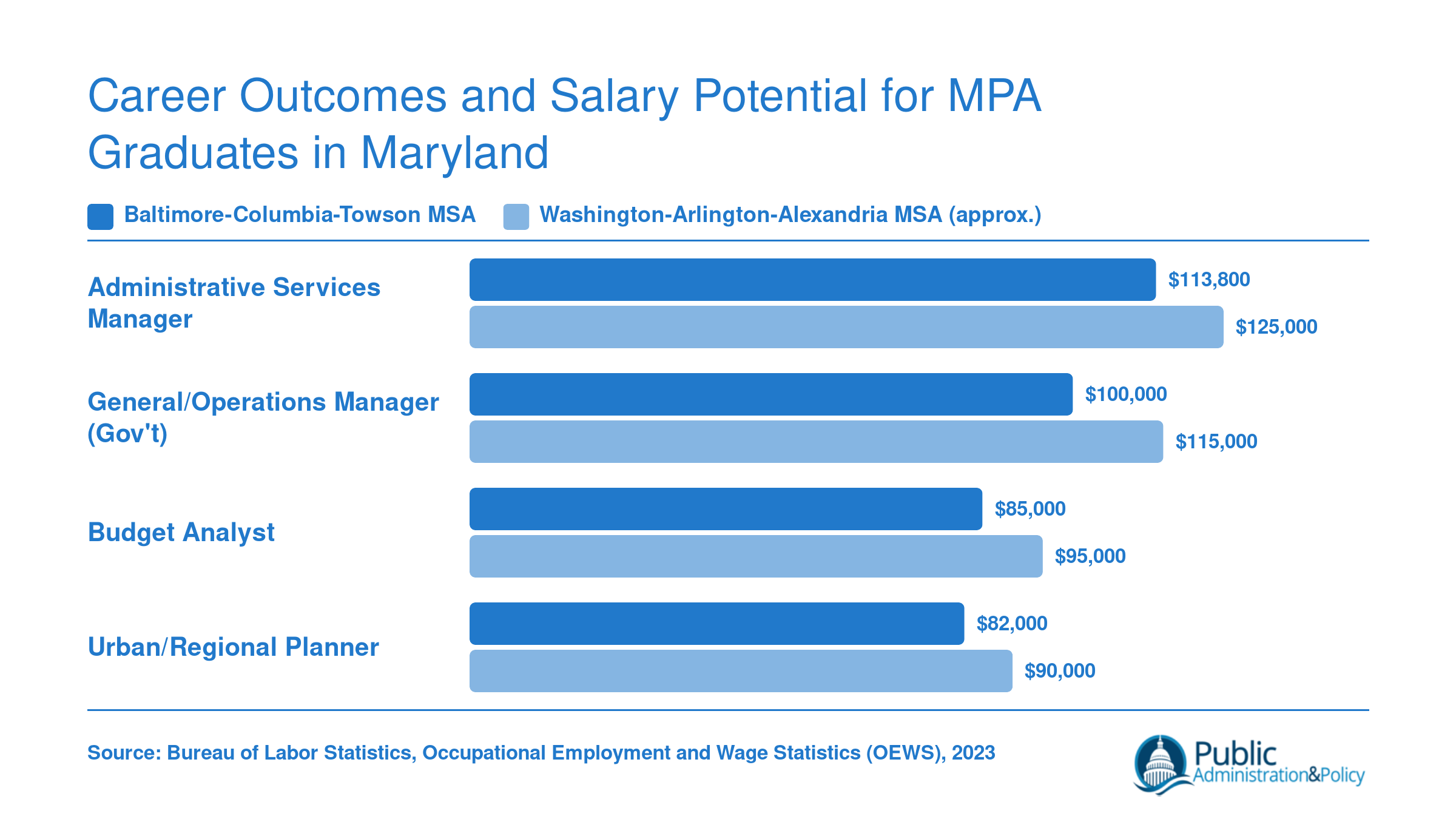
Career Outcomes and Salary Potential for MPA Graduates in Maryland
Maryland's location between Baltimore and Washington, D.C. gives MPA graduates access to one of the country's densest public-sector job markets. Major employers include federal agencies headquartered in the region (such as the Social Security Administration, NIH, and FDA), Maryland state government, Baltimore City government, and large nonprofits like the Annie E. Casey Foundation and Johns Hopkins health system affiliates. Program-level post-graduation earnings are not yet available for most online MPA programs, so the figures below draw on Bureau of Labor Statistics occupation data for the two metro areas where most Maryland MPA holders work.
Concentrations and Specializations Available Online
Choosing the right MPA concentration can shape your entire career trajectory, especially in a state like Maryland where proximity to Washington, D.C. creates unusually strong demand in specific policy areas. Health policy and administration concentrations align well with employers such as NIH and HHS in Bethesda, while emergency management and homeland security tracks pair naturally with DHS and NSA positions at Fort Meade. Nonprofit management is another high-value focus given the density of advocacy organizations across the D.C. corridor. The table below maps which ranked online MPA programs offer named concentrations so Maryland students can quickly identify the best fit.
School
Nonprofit Management
Public Finance / Budgeting
Emergency Management
Urban Affairs / Local Government
Public and Nonprofit Leadership
Regional Sustainability
Arizona State University
Yes
Yes
Yes
Yes
N/A
N/A
Florida State University
N/A
N/A
Yes
Yes (Local Government Management)
N/A
N/A
Ohio State University
Yes (Nonprofit Management and Governance)
N/A
N/A
N/A
Yes (Strategic Management)
N/A
Cornell University
Yes (Public and Nonprofit Management)
N/A
N/A
N/A
N/A
N/A
CSU San Bernardino
Yes
Yes (Public Financial Management)
N/A
N/A
Yes (Leadership)
N/A
Clemson University
N/A
N/A
N/A
Yes (Local and State Government)
N/A
Yes
UT Rio Grande Valley
N/A
Yes (Public Budgeting coursework)
N/A
N/A
N/A
N/A
University of Georgia
Specialized tracks available
Specialized tracks available
N/A
N/A
N/A
N/A
University of Pennsylvania
N/A
N/A
N/A
N/A
Global leadership focus
N/A
UT Arlington
N/A
N/A
N/A
N/A
General MPA (no named concentrations listed)
N/A
How to Choose the Right Online MPA Program From Maryland
Choosing an online MPA program from Maryland means weighing several variables at once, and the right fit depends on your career goals, budget, and schedule. Rather than comparing dozens of programs at random, use a structured decision framework to narrow the field quickly and confidently.
Four Factors That Should Drive Your Decision
Every program you consider should be evaluated against these core criteria:
Accreditation status: NASPAA accreditation is the gold standard for public administration programs. It signals that a program meets rigorous peer-reviewed standards for curriculum, faculty qualifications, and student outcomes. If you plan to pursue senior government roles or competitive fellowships, a NASPAA-accredited degree carries more weight.
Total cost: Look beyond per-credit tuition. Factor in fees, technology charges, and any required travel. Check whether you qualify for tuition discounts through regional compacts or state agreements before assuming you will pay full out-of-state rates.
Concentration fit: Make sure the program offers a specialization aligned with your career trajectory, whether that is nonprofit management, healthcare administration, urban policy, or public finance. A generic MPA is still valuable, but the right concentration can sharpen your resume.
Format: Not all online programs operate the same way. Synchronous formats require you to log in at set times, while asynchronous programs let you complete coursework on your own schedule. Either can work well, but one may suit your lifestyle far better than the other.
Verify That "Online" Really Means Online
Some programs marketed as fully online still include hybrid components such as in-person residencies, on-campus orientation weekends, or capstone presentations that require travel. Before you commit, ask the admissions office directly whether you can complete the entire degree remotely from Maryland. This is especially important if you are balancing a full-time public sector job or family responsibilities.
Ask About Maryland-Specific Tuition Agreements
Maryland residents may qualify for reduced tuition at out-of-state institutions through agreements like the Academic Common Market or individual university partnerships. These arrangements can save thousands of dollars over the life of a degree. Do not assume you will pay published out-of-state rates. Contact the program's admissions or financial aid office and specifically ask about any reciprocity agreements or discounts available to Maryland students.
Your Concrete Next Step
Narrow your list to two or three programs that score well across all four factors. If you are still exploring the broader landscape of online MPA programs, requesting detailed information from multiple schools, including a full cost breakdown and available financial aid, is the fastest way to make meaningful comparisons. Then compare aid packages side by side, accounting for scholarships, employer tuition reimbursement, and any state-level discounts. This apples-to-apples comparison is the single most effective way to make a decision you will feel good about for years to come.
Frequently Asked Questions About Online MPA Programs for Maryland Students
Maryland students considering an online Master of Public Administration often share similar questions about accreditation, cost, and program logistics. Below are answers to the most common questions we receive, drawn from current program data and admissions guidance for 2026.
Which online MPA programs are NASPAA accredited for Maryland students?
Several nationally ranked online MPA programs hold NASPAA accreditation and accept Maryland residents. Examples include Indiana University Bloomington, the University of North Carolina at Chapel Hill, and Syracuse University. Because NASPAA accreditation is tied to the program rather than student location, Maryland students can enroll in any accredited online MPA nationwide. Always verify a program's current accreditation status on the NASPAA website before applying.
How much does an online MPA cost for Maryland residents?
Total tuition for an online MPA typically ranges from about $20,000 at more affordable public institutions to over $60,000 at private universities. Many programs charge a flat online rate regardless of state residency, which can benefit Maryland students. Some schools also participate in regional tuition agreements or offer military and government employee discounts that further reduce costs for Maryland residents.
How long does it take to complete an online MPA program?
Most online MPA programs require 36 to 42 credit hours and can be completed in about two years of full-time study. Part-time students typically finish in three to four years. Accelerated options at some schools allow completion in as few as 18 months. The timeline depends on course load, transfer credits, and whether the program follows a cohort or self-paced format.
What is the difference between an MPA and an MPM degree?
An MPA (Master of Public Administration) focuses on managing government agencies and nonprofit organizations, with coursework in budgeting, policy analysis, and organizational leadership. An MPM (Master of Public Management) is narrower, concentrating on operational management and performance within public sector organizations. The MPA is more widely recognized and versatile, while the MPM suits professionals seeking management-specific skills without the broader policy curriculum.
Do online MPA programs require the GRE for admission?
Many online MPA programs have moved to GRE-optional or GRE-waiver policies, especially for applicants with significant professional experience or strong undergraduate GPAs. Schools such as the University of Southern California and Syracuse University offer conditional waivers. Check each program's admissions page for current requirements, as policies can vary by cohort and may change from year to year.
Can I work full-time while completing an online MPA?
Yes. Online MPA programs are specifically designed for working professionals. Most offer asynchronous coursework, meaning you can complete lectures and assignments on your own schedule. Part-time enrollment options let you take one or two courses per term, making it manageable alongside a full-time career. Some programs also incorporate weekend or evening synchronous sessions to accommodate work schedules.
Does the University of Maryland offer an online MPA?
As of 2026, the University of Maryland College Park does not offer a fully online MPA degree. The university does provide related graduate programs in public policy through the School of Public Policy, but these are primarily campus-based. Maryland students seeking a fully online MPA should explore accredited programs at out-of-state institutions, many of which charge competitive flat-rate tuition for online learners.
More Online MPA Programs Available to Maryland Students
The programs below are additional online MPA options available to Maryland students. While they did not rank among our top 10, each offers a strong curriculum and flexible delivery. Use this directory to expand your search.
California State University-Stanislaus
Offers a NASPAA-accredited hybrid MPA with 36-39 semester units, covering public finance, ethics, and policy analysis. Designed for pre-service and in-service students in Northern and Central California.
Fully online MPA program with 42 credit hours and concentrations in emergency management, nonprofit administration, public finance, and urban management. No GRE required for admission.
Online MPA through the Baker School of Public Policy. Asynchronous 36-credit program with concentrations in policy analytics, emergency management, and nonprofit management.
Louisiana State University and Agricultural & Mechanical College
Online MPA from LSU's E.J. Ourso College of Business. 36 credits, NASPAA-accredited, no GRE needed. Core courses in data analytics, budgeting, and public administration theory.
Online MPA with a concentration in Public Financial Management. NASPAA-accredited, 40 credits, no GRE required. Asynchronous courses for working professionals.