Federal hiring averages roughly 100 days, nearly three times longer than the private sector's 36 day norm.
Merit based hiring, performance accountability, and digital transformation remain the three pillars driving civil service reforms in 2026.
Reform outcomes vary widely: some initiatives cut costs and improved retention, while others stalled due to political and bureaucratic resistance.
Civil service reform directly shapes career trajectories for roughly 2 million federal civilian employees and millions more at state and local levels.
The federal civilian workforce numbers roughly 2 million employees, yet the system governing how they are hired, paid, and held accountable still runs on frameworks designed decades ago. That gap between modern demands and legacy rules is now at the center of a fierce policy fight. On one side, calls for a more agile government workforce and faster hiring. On the other, deep concerns that proposals like the revival of Schedule F and DOGE-era restructuring efforts could erode merit protections and open the door to political loyalty tests.
Civil service reform is back in the headlines in 2026, drawing bipartisan attention for very different reasons. The stakes are not abstract. They determine whether the federal government can recruit top talent, deliver services competently, and maintain public trust in institutions that serve 330 million people. For students and professionals exploring public administration, understanding how these reforms reshape government careers is no longer optional; it is foundational.
What Is Civil Service Reform? Definition and Core Principles
Civil service reform refers to the deliberate restructuring of government employment systems to improve merit-based hiring, accountability, performance, and the quality of public service delivery. It encompasses changes to the rules, policies, and institutional frameworks that govern how government employees are recruited, evaluated, promoted, compensated, and, when necessary, removed from their positions.
If that sounds broad, it helps to draw a clear boundary. Civil service reform is not synonymous with public sector reform in general. Public sector reform can include everything from privatizing utilities to redesigning tax codes. Civil service reform is narrower in scope: it targets the workforce itself, specifically the civil service system that determines who gets hired, how their performance is judged, and what protections and obligations come with a government career.
Core Principles Behind Reform Efforts
While no two reform initiatives look identical, most share a common set of principles that have remained remarkably consistent since the late 19th century.
Merit over patronage: Government positions should be filled based on qualifications, skills, and demonstrated competence, not political connections or party loyalty.
Political neutrality of the career workforce: Career civil servants are expected to serve the public interest regardless of which party holds power, insulating day-to-day governance from electoral cycles.
Accountability to the public: Systems should include transparent mechanisms for measuring performance, addressing misconduct, and ensuring taxpayer dollars fund effective work.
Competitive compensation: Pay and benefits need to attract and retain talent capable of managing complex public programs, from cybersecurity to public health.
Adaptability to modern needs: Civil service rules written decades ago may not accommodate remote work, rapid technological change, or the specialized skill sets today's agencies require. Reform efforts increasingly prioritize flexibility without sacrificing the protections that make merit systems work.
Why Civil Service Reform Matters to Everyday Life
It is easy to treat civil service reform as an inside-the-beltway abstraction, but the quality of these systems shapes experiences that millions of people encounter directly. How quickly the Department of Veterans Affairs processes a disability claim, how accurately the IRS handles a tax return, how effectively FEMA coordinates disaster response: all of these outcomes depend on whether agencies can hire the right people, hold them to clear standards, and adapt their workforce to emerging challenges.
When civil service systems function well, government feels competent and responsive. When they do not, the consequences range from frustrating delays to genuine harm. For students and professionals considering careers in public policy or public administration, understanding what civil service reform actually entails is not just academic. It is the foundation for grasping how the institutions you may one day lead are structured, and why changing them is both necessary and genuinely difficult. Those interested in the broader distinction between implementation and public administration vs public policy will find that civil service reform sits squarely at the intersection of both disciplines.
A Brief History of Civil Service Reform in the United States
Understanding civil service reform requires a look at the forces that shaped it. The trajectory of reform in the United States follows a remarkably consistent pattern: crisis reveals weakness, reform follows, momentum fades, and eventually a new crisis restarts the cycle.
From Patronage to Merit: The Pendleton Act
For much of the 19th century, the federal workforce operated under the spoils system, where incoming presidents rewarded political allies with government jobs regardless of qualifications. The assassination of President James Garfield in 1881 by a disgruntled office-seeker shocked the nation into action, and Congress passed the Pendleton Civil Service Reform Act of 1883. The Pendleton Act established competitive examinations for federal positions and created the Civil Service Commission, marking the foundational shift from patronage to merit-based hiring.
Key 20th-Century Inflection Points
Several landmark reforms built on the Pendleton framework over the following century:
Classification Act of 1923: Standardized position classifications and pay grades, creating the structured pay system that still underpins federal compensation.
Hatch Act of 1939: Restricted partisan political activity by federal employees, reinforcing the principle that civil servants serve the public, not a political party.
Civil Service Reform Act of 1978: Arguably the most sweeping overhaul since the Pendleton Act. It abolished the Civil Service Commission and replaced it with the Office of Personnel Management (OPM), the Merit Systems Protection Board (MSPB), and the Senior Executive Service (SES), separating management functions from employee protections.
National Performance Review (1993): The Clinton-era initiative, led by Vice President Al Gore, pushed to streamline government operations, reduce bureaucratic layers, and adopt private-sector management practices. It resulted in a federal workforce reduction of roughly 300,000 positions.
21st-Century Acceleration
The pace of reform has quickened dramatically in recent decades. After the September 11 attacks, the newly created Department of Homeland Security experimented with workforce flexibility models that departed from traditional civil service rules. The Obama administration issued executive orders targeting federal hiring timelines and reducing reliance on lengthy knowledge-based examinations.
The reform debate intensified with the creation of Schedule F in 2020, which sought to reclassify tens of thousands of policy-influencing positions into a new category with fewer employment protections. That order was rescinded in 2024, but a successor framework emerged quickly. Executive Order 14171, signed on January 20, 2025, directed OPM to modernize policy-influencing positions and create Schedule Policy/Career.1 OPM finalized the rule in February 2026, with an effective date in March 2026.2 The rule reduces notice and appeal rights for covered employees while stating that it preserves merit-based hiring, veterans' preference, and whistleblower protections.3 Enforcement falls to employing agencies rather than the Office of Special Counsel.
Alongside this reclassification, the Department of Government Efficiency (DOGE) has served as a central implementation partner for workforce restructuring and hiring reform, including a target of reducing time-to-hire to 80 days.1 One analysis found that recent federal workforce changes have cost the economy more than $165.6 billion.4 In Congress, the Saving the Civil Service Act was introduced in 2026 to limit executive authority to reclassify civil service positions, signaling that the legislative branch is actively contesting the boundaries of reform.3
The Cyclical Takeaway
If you are studying public administration or considering a career in public policy, the historical pattern matters. Reform has never been a straight line. Each wave, from the Pendleton Act through Schedule Policy/Career, was triggered by a perceived dysfunction: corruption, inefficiency, unresponsiveness, or politicization. A burst of activity follows, then institutional inertia sets in until the next crisis demands attention. Recognizing this cycle helps you anticipate where reform is heading and, more importantly, equips you to participate in shaping it rather than simply reacting to it.
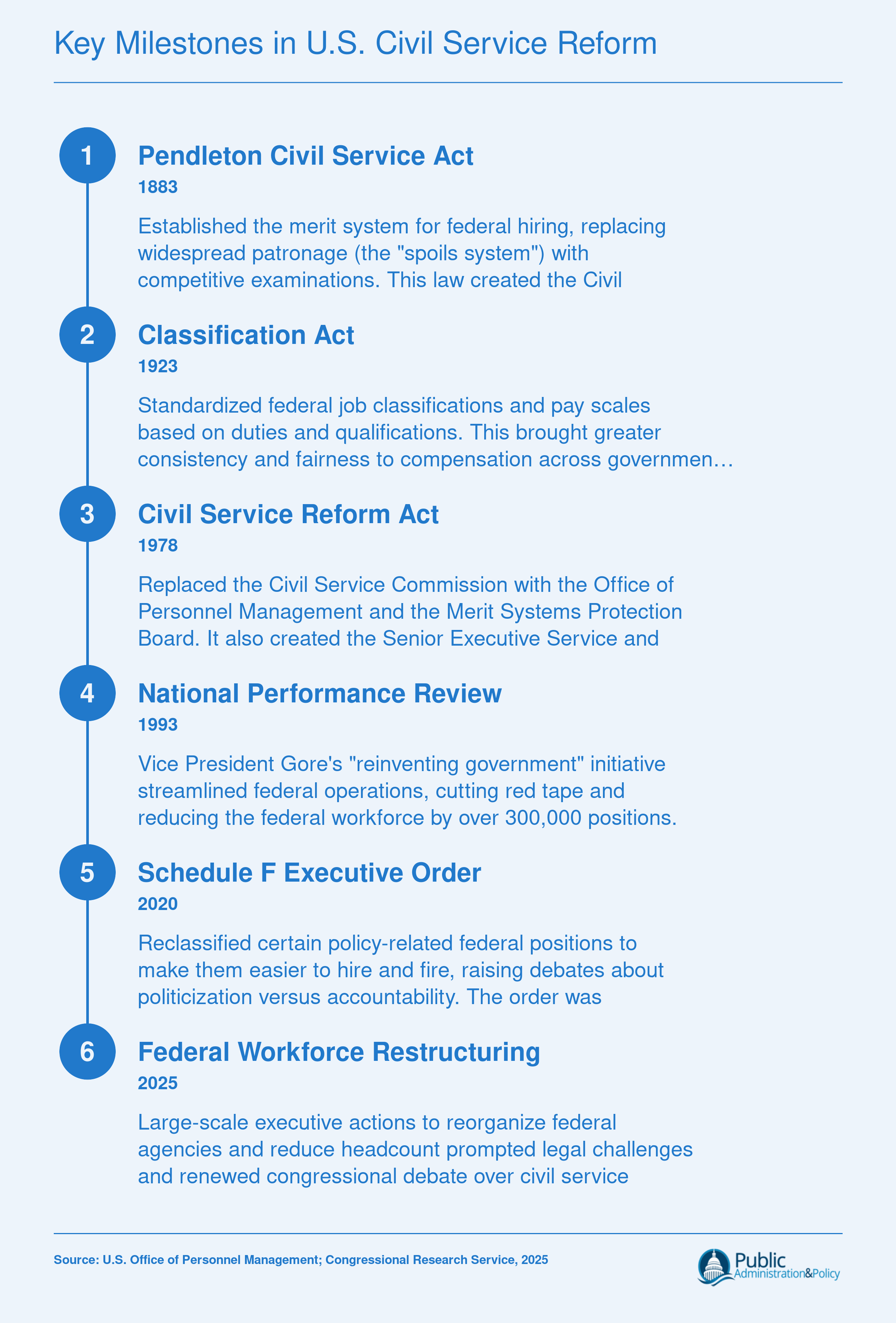
Key Milestones in U.S. Civil Service Reform
The evolution of U.S. civil service reform spans more than 140 years, with each milestone reshaping how the federal workforce is hired, managed, and held accountable. Understanding this timeline helps public administration students and professionals see how today's reform debates are rooted in longstanding tensions between political responsiveness and professional merit.
Key Challenges Facing Civil Service Reform Today
Reforming the civil service sounds straightforward in theory: modernize hiring, update pay structures, and build a more responsive government workforce. In practice, reformers run into overlapping obstacles that reinforce one another. Understanding these challenges in clear categories helps explain why progress has been so difficult, and where the real pressure points lie.
Political Obstacles: Partisanship and Shrinking Windows
Civil service reform rarely stays above the partisan fray. Proposals to restructure federal employment protections, adjust pay systems, or consolidate agencies quickly become proxies for larger ideological debates about the size and scope of government. When one party frames reform as "cutting bureaucracy" and the other frames it as "gutting worker protections," consensus collapses. These debates are ultimately rooted in competing visions of defining public policy and how government should serve the public.
History shows that bipartisan reform windows tend to open only during crisis moments. The federal reorganizations after September 11, 2001, and the emergency management overhauls following Hurricane Katrina are prime examples. Polarized political environments, by contrast, slam those windows shut. The structural mismatch is stark: meaningful civil service reform typically requires five to ten years of sustained implementation to show measurable results, yet political cycles turn over every two to four years. Incoming administrations often scrap or rebrand their predecessors' initiatives before those initiatives have had time to mature.
Structural Barriers: Outdated Classification and Pay Systems
The General Schedule pay scale, established in 1949, remains the backbone of federal compensation for most white-collar workers. While it has been adjusted periodically, it was never designed for a labor market in which government agencies compete directly with tech companies, consulting firms, and healthcare systems for data scientists, cybersecurity analysts, and project managers.
Rigid classification tiers: Positions are slotted into grades and steps that reward tenure over performance, making it difficult to offer competitive salaries for high-demand skills.
Slow hiring pipelines: The average federal hiring process stretches well beyond 100 days from posting to onboarding. Top candidates often accept private-sector offers long before a federal agency extends one.
Limited lateral mobility: Moving between agencies or between technical and managerial tracks requires navigating classification rules that predate the internet.
These structural rigidities do not just slow hiring. They shape who applies in the first place, filtering out candidates who cannot afford to wait months for an offer.
Cultural Resistance: Risk Aversion and Institutional Inertia
Inside many agencies, the prevailing culture rewards caution over innovation. Decades of oversight pressure, including inspector general audits, congressional inquiries, and media scrutiny of government mistakes, have created an environment where avoiding errors often matters more than pursuing improvement. Managers who take calculated risks on new processes or technologies receive little recognition if things go well but face serious consequences if things go wrong.
This risk aversion compounds over time. Veteran employees mentor newer staff in the existing way of doing things, and institutional memory becomes a force for continuity rather than adaptation. Reform proposals that require agencies to rethink workflows, adopt new evaluation criteria, or restructure teams often encounter passive resistance that is harder to overcome than outright opposition.
Technical Gaps: Legacy Systems and HR Technology
Many federal HR operations still run on technology platforms designed in the 1990s or earlier. Applicant tracking systems are clunky, data interoperability between agencies is limited, and workforce analytics capabilities lag far behind what private-sector employers use to forecast talent needs. Modernizing these systems is expensive and time-consuming, and agencies must maintain existing operations while transitioning, a challenge sometimes described as "rebuilding the plane while flying it."
The Demographic Tipping Point
Layered across all four categories is a workforce demographics challenge that adds both urgency and a measure of hope. As the last wave of Baby Boomers moves into retirement, agencies face significant knowledge loss in mission-critical areas. Institutional expertise built over decades of service walks out the door every month.
Yet this generational turnover also creates a rare opening. Agencies that act strategically can recruit a new cohort of public servants under modernized rules, build digital-first HR processes, and establish performance cultures from the ground up rather than retrofitting them. For students and early-career professionals considering a public administration & policy jobs path, this demographic shift represents genuine opportunity. The question is whether the political, structural, cultural, and technical barriers described above will allow agencies to seize that opportunity before it closes.
Consider this: the average federal hiring process takes roughly 100 days from job posting to start date, while private sector employers fill comparable roles in about 36 days. That gap of more than two months is not just an inconvenience. It drives top talent toward the private sector and stands as one of the clearest signals that the current civil service system needs structural change.
Which Civil Service Reforms Have Actually Worked?
Most discussions of civil service reform focus on proposals, frameworks, and aspirations. Far fewer bother to show what actually happened after a reform was implemented. This section delivers the receipts, examining concrete case studies where governments tried something different and where we can point to measurable results, both encouraging and cautionary.
Each case follows the same frame: what was tried, what outcome resulted, what conditions enabled success, and what limitations remain.
U.S. Federal Hiring Reform: Incremental Progress, Persistent Gaps
The Office of Personnel Management has pursued multiple rounds of hiring reform aimed at reducing the notoriously slow federal recruitment timeline. As of 2026, the average time to hire across the federal civil service sits at roughly 101 days, still above the agency's own target of 80 days.1 OPM's annual performance plan tracks metrics like selections per announcement (currently averaging about three) and merit hiring compliance rates (around 85 percent), signaling a shift toward data-driven accountability.1
These pilots have yielded modest improvements over the multi-year timelines that once characterized federal hiring. The conditions enabling progress include sustained attention from OPM leadership, standardized measurement across agencies, and phased rollout of new assessment tools.
The caveat is significant, however. In 2025, the federal workforce experienced a departure-to-hire ratio of roughly four departures for every new hire, a metric that underscores how hiring speed improvements can be overwhelmed by retention crises.2 Reform in recruitment alone, without addressing the broader talent pipeline, risks running in place.
Georgia's At-Will Experiment: Bold but Contested
In 1996, Georgia became the first U.S. state to move new state employees to at-will status, stripping traditional civil service protections in favor of managerial flexibility. The reform aimed to make government more responsive by letting agencies hire and terminate employees without the lengthy procedural requirements of merit system rules.
Research conducted in the years following the reform found that managers reported greater flexibility in personnel decisions and that hiring timelines shortened. Some agencies saw improved responsiveness to gubernatorial priorities.
However, studies also documented concerns. Employee morale surveys revealed anxiety about political interference, and turnover in some agencies increased. The reform worked best in agencies with strong internal management cultures that provided informal protections against arbitrary action. Where those cultures were weak, the removal of formal protections left employees vulnerable and recruitment of top talent more difficult. Georgia's experience demonstrates that structural deregulation without cultural guardrails can produce mixed results, a lesson especially relevant for students of public administration vs public policy who want to understand how institutional design shapes real-world outcomes.
United Kingdom: Fast Stream and the Civil Service Reform Plan
The UK's Civil Service Reform Plan, launched in 2012, set out to professionalize the senior civil service, improve digital capability, and reduce costs. One of its most visible components, the Fast Stream graduate program, has long served as a pipeline for high-caliber talent into government. The program consistently attracts tens of thousands of applicants for a few hundred positions, maintaining selectivity that rivals top private-sector graduate schemes.
Measurable outcomes from the broader reform plan included reductions in administrative costs, consolidation of back-office functions, and the creation of dedicated digital and project management professions within government. The UK Government Digital Service, born partly from this reform era, became an internationally recognized model for digital public services.
The enabling conditions were clear: sustained prime ministerial sponsorship, a dedicated implementation unit, and willingness to publish progress reports publicly. The limitation is equally clear. Many of the "cultural" goals of the reform plan, such as reducing risk aversion and encouraging innovation, proved far harder to measure and slower to materialize than structural changes.
Estonia's Digital Governance Model: Small Country, Big Lessons
Estonia is frequently cited by the OECD and World Bank as a standout example of digital civil service transformation. Beginning in the late 1990s, Estonia built a comprehensive digital identity and e-governance infrastructure that allows citizens to access virtually all government services online. Civil servants operate within interoperable digital systems that reduce paperwork, increase transparency, and compress decision timelines.
The results are tangible: Estonia estimates that its digital signature system alone saves the equivalent of an entire working week per citizen per year in administrative time. Government processes that once required days of in-person interaction can be completed in minutes.
The enabling conditions are distinctive and hard to replicate at scale. Estonia is small (roughly 1.3 million people), had the political will of a newly independent state building institutions from scratch, and invested heavily in digital literacy across the population. For larger, legacy-laden bureaucracies, Estonia's model offers inspiration but not a simple blueprint.
The Pattern: What Successful Reforms Share
Across these cases, a consistent pattern emerges. Reforms that produce measurable results tend to combine several ingredients:
Top-level political sponsorship: Without sustained leadership attention, reforms stall in implementation.
Clear, published metrics: Accountability requires transparent benchmarks, whether that means hiring timelines, cost savings, or citizen satisfaction.
Phased implementation: Wholesale overnight transformation almost always triggers backlash or unintended consequences. Incremental rollout allows course correction.
Protection against patronage backsliding: Flexibility without guardrails risks re-politicizing the civil service, as Georgia's experience illustrates.
No single reform model works everywhere. But understanding what conditions enabled past successes, and where even well-designed reforms fell short, gives students and practitioners a far more useful foundation than yet another list of aspirational proposals.
Comparing Reform Outcomes Across Systems
The table below distills findings from major civil service reform efforts at the federal, state, and international levels. Each initiative is measured against a concrete before and after metric, with an overall outcome verdict drawn from government reports, OECD data, and World Bank governance indicators. As you review the results, note that even reforms judged as 'mixed' often produced measurable improvements in specific areas while falling short of broader goals.
Jurisdiction
Reform Initiative
Period
Key Metric (Before → After)
Outcome
United States (Federal Government)
Civil Service Reform Act of 1978
1979 to mid-1980s
Average time to take disciplinary action: 1 to 2 years (mid-1970s) → 6 to 12 months (mid-1980s)
Mixed
United States (State of Georgia)
Georgia Civil Service Overhaul (1996)
1996 to early 2000s
Share of workforce under merit protections: approximately 100% (1996) → over 70% shifted to at-will status in some agencies (early to mid-2000s)
Mixed
Multiple OECD Member Countries
Civil service professionalization and open recruitment
Mid-1990s to 2010
Share of central government positions filled via open competition: below 50% in some countries (mid-1990s) → over 60 to 70% in leading countries (mid-2000s to 2010)
Successful
Multiple Low- and Middle-Income Countries
Civil service merit and public administration reform
Late 1990s to 2015
World Bank Government Effectiveness score: ranging from -1.0 to -0.5 (late 1990s/early 2000s) → improvement of +0.2 to +0.5 points (2010s)
Mixed
Questions to Ask Yourself
When you last renewed a passport or applied for government benefits, did the process feel like it was staffed by people rewarded for working efficiently?
Your firsthand experience is a real-world measure of whether merit-based performance standards have actually reached frontline service delivery. Gaps between policy goals and lived experience reveal where reform still has the farthest to travel.
What would change in your community if federal hiring moved at private-sector speed?
Government agencies often take months to fill critical roles, losing top candidates to faster-moving employers. Faster hiring could mean quicker responses to public health crises, shorter wait times at benefits offices, and stronger competition for skilled graduates.
Would you accept lower job security in a government role if it came with clearer paths for advancement and performance-based pay?
This tradeoff sits at the heart of civil service reform debates. Loosening traditional protections may attract ambitious talent but risks exposing employees to political pressure, so the balance you prefer says a lot about which reforms you would support.
If you were designing a civil service system from scratch, which would you prioritize: standardized fairness or managerial flexibility?
Rigid rules protect against favoritism but can slow agencies down. Greater flexibility lets managers hire and promote faster, yet it requires strong accountability safeguards. Choosing between them forces you to weigh equity against agility in public institutions.
How Civil Service Reforms Are Measured: Success Metrics and Benchmarks
Reforming a civil service system is only as meaningful as your ability to prove it worked. Several major frameworks exist to evaluate whether reforms are delivering results, but no single scorecard covers every dimension. Understanding these measurement tools, and their limitations, is essential for anyone studying or working in public administration.
The Major Measurement Frameworks
Four institutions anchor most reform measurement efforts at the federal and international levels:
OPM's Federal Employee Viewpoint Survey (FEVS): This annual survey captures the perspectives of hundreds of thousands of federal workers. In 2023, the employee engagement index scored in the 71 to 72 range on a 100-point scale, while the global satisfaction index landed between 65 and 67.1 Around 80 to 90 percent of respondents said their work relates to their agency's goals, a consistently strong result. However, performance management and recognition remain persistent pain points.1
GAO's High-Risk List: The Government Accountability Office has kept strategic human capital management on its High-Risk List since 2001. As of its 2023 assessment, federal agencies had only partially met criteria for leadership commitment, organizational capacity, action planning, and monitoring. Demonstrated progress was rated as limited.2 GAO has also flagged cybersecurity and IT as critical skills gap areas.2
OECD Government at a Glance: This recurring publication compares public workforce indicators across member countries, covering topics like compensation structures, workforce composition, and hiring practices.
World Bank Worldwide Governance Indicators: These provide cross-country benchmarks on government effectiveness, regulatory quality, and control of corruption, offering a macro-level lens on whether civil service systems are functioning well.
Three Buckets of Metrics
When evaluating reform, it helps to organize metrics into three categories:
Process metrics: Time-to-hire, classification accuracy, and vacancy fill rates. These reveal whether reforms are streamlining bureaucratic procedures.
Workforce metrics: Employee engagement scores, turnover and retention rates, and diversity representation. These capture whether reforms are improving the day-to-day experience of public servants and building a workforce that reflects the population it serves.
Outcome metrics: Citizen satisfaction, service delivery speed, and cost per transaction. These connect internal reforms to the external results that the public actually experiences.
Why Measurement Remains a Challenge
One of the most common pitfalls in reform evaluation is tracking inputs rather than outcomes.1 An agency might report the number of training hours completed or the volume of new hires processed without ever connecting those figures to improvements in service quality or mission delivery. The GAO's limited progress rating on strategic human capital management illustrates the gap: agencies can put structures in place and still fall short of demonstrable results.2
There is also no universally accepted reform scorecard. FEVS captures employee sentiment but not citizen outcomes. GAO's High-Risk List evaluates management practices but not frontline performance. International frameworks like the OECD's and the World Bank's provide useful cross-country comparisons but are too broad to diagnose specific agency-level issues. Each framework illuminates a piece of the puzzle, not the full picture.
A Practical Takeaway for Evaluating Any Reform
Whether you are reviewing a policy proposal, analyzing a case study, or advising a public agency, apply a simple test to any reform initiative: ask what metric will improve, by how much, and by when. If the proponents of a reform cannot answer those three questions with reasonable specificity, the reform itself is probably underdeveloped. Vague goals produce vague results. The most impactful civil service reforms in recent history have been those tied to concrete, measurable targets, tracked consistently over time, and adjusted when evidence shows they are falling short. For professionals pursuing roles such as government program manager, fluency in these measurement frameworks is a critical competency.
Technology, Digital Government, and the Future of Civil Service
Digital transformation is the single biggest accelerant of civil service reform in the 2020s, and simultaneously its most disruptive force. From AI-assisted hiring screening to cloud-based human resources platforms replacing decades-old mainframe systems, technology is reshaping how governments recruit, manage, and deploy their workforces. At the same time, digital service delivery is reducing headcount needs in some traditional functions while generating urgent demand for entirely new roles. If you are studying or working in public administration, understanding this shift is not optional.
Embedding Tech Talent in Government
Several models have emerged to bridge the gap between Silicon Valley speed and government-scale complexity. The U.S. Digital Service (USDS) and 18F, both launched in the mid-2010s, pioneered the approach of embedding technologists directly inside federal agencies to modernize legacy systems and redesign citizen-facing services. These teams demonstrated that government could attract top-tier tech talent on term-limited appointments, bypassing some of the slower hiring mechanics that often discourage private-sector candidates.
Internationally, Estonia's e-governance ecosystem remains a global benchmark. Estonian citizens can access nearly all public services digitally, from voting to filing taxes to managing health records, through a unified digital identity system. As of 2026, AI tools are also being piloted within the U.S. federal workforce for workforce planning, helping agencies forecast retirement waves, identify skills gaps, and model the effects of reorganizations before they happen.
The Tension: Speed vs. Safeguards
Digital tools can make the civil service faster and more transparent, but they also introduce serious questions that reform advocates cannot ignore:
Algorithmic bias in hiring: AI screening tools trained on historical data can replicate or amplify the very demographic biases that merit-based civil service systems were designed to eliminate.
Employee surveillance: Cloud-based productivity platforms give managers granular visibility into employee activity, raising concerns about privacy and trust within the federal workforce.
Digital divide in citizen access: As agencies shift services online, communities without reliable internet access or digital literacy risk being left behind, undermining the equity goals that public service reforms are meant to advance.
Balancing innovation with accountability requires deliberate governance frameworks, not just new software.
Reclassifying the Workforce for a Digital Era
Reform increasingly means reclassifying positions away from paper-processing and routine administrative roles toward data analysis, cybersecurity, user experience research, and human-centered design. The problem is that the General Schedule (GS) classification system, the backbone of federal pay and job grading, was not built for these kinds of roles. Position descriptions written around clerical tasks do not map cleanly onto work that involves machine learning pipelines or cloud infrastructure management.
This mismatch creates tangible consequences. Agencies struggle to offer competitive compensation for in-demand technical skills because GS pay bands do not reflect market rates for those positions. Some agencies have used excepted service hiring authorities or special pay rates to work around this limitation, but these are patchwork solutions rather than systemic reform. Professionals navigating this landscape may find that earning public administration certifications helps bridge credentialing gaps that traditional classification systems fail to address.
For students and early-career professionals considering public service, the takeaway is clear: the civil service of the near future will look fundamentally different from the one described in most textbooks. Fluency in digital tools, comfort with data, and an understanding of how technology governance intersects with civil service law will be among the most valuable assets you can bring to a public administration career.
Civil service reform is not just a policy debate. It directly shapes career pathways for roughly 2 million federal civilian employees and millions more at state and local levels. Whether you are a student considering public service or a mid-career professional navigating a transition, the rules being debated right now will define the job you walk into.
How Civil Service Reform Shapes Public Administration Careers
Civil service reform is not simply an abstract policy debate. It directly determines the day-to-day realities of working in government, from how much you earn to how quickly you advance, what skills you need on the job, and how secure your position actually is. If you are considering a public administration & policy jobs, understanding reform dynamics is one of the most practical investments you can make.
Reform Defines the Rules You Will Work Under
Every major reform wave redraws the employment landscape for public servants. Pay scales, promotion criteria, performance evaluation systems, and workforce protections all flow from the civil service framework in place at a given agency. The shift toward performance-oriented cultures at the federal and state levels means that seniority alone no longer guarantees advancement. Agencies increasingly tie raises and promotions to measurable outcomes, and hiring managers look for candidates who can demonstrate results, not just credentials. Understanding both the legacy merit system rules and the newer performance expectations gives job seekers a genuine edge in interviews, onboarding, and long-term career planning.
New Career Niches Created by Reform
Recent reform efforts have opened career paths that barely existed a decade ago. Digital services teams at agencies like the U.S. Digital Service and state-level equivalents need user experience designers, software engineers, and product managers comfortable working inside bureaucratic structures. Data analytics positions are expanding as agencies adopt evidence-based decision-making mandates. Human capital officers now serve as strategic advisors rather than paper-pushing administrators, helping agencies recruit and retain talent in competitive labor markets. Reform implementation specialists, professionals who can design, pilot, and scale new processes across large organizations, are among the most sought-after hires in government consulting and direct public employment alike.
Growth areas to watch include:
Digital government roles: Cloud migration, cybersecurity, and AI governance positions across federal and state agencies.
Data and evaluation analysts: Positions supporting program evaluation, performance dashboards, and evidence-based budgeting.
Human capital strategists: Officers who redesign classification systems, compensation models, and workforce development pipelines.
Change management professionals: Specialists who help agencies transition from legacy processes to reformed operating models.
The Educational Pipeline Is Catching Up
Master of Public Administration and Master of Public Policy programs have adapted their curricula to reflect the reform landscape. Courses in public human resource management, digital government, organizational change, and performance measurement are now common as core requirements or popular electives. Students who engage with these subjects graduate with a vocabulary and analytical toolkit that hiring managers recognize immediately. Programs that integrate capstone projects or practicums with government agencies offer even stronger preparation, giving students firsthand exposure to reform implementation. Supplementing coursework with relevant certifications for public service can further sharpen your competitive profile.
A Practical Career Takeaway
The professionals who command the highest value in public administration right now are those who can operate fluently across two worlds. They understand the statutory protections, classification systems, and procedural safeguards of the traditional merit system, and they can simultaneously champion accountability, agility, and innovation. This dual fluency is difficult to develop on the job alone. Building it through deliberate study, whether in a degree program, professional development courses, or self-directed reading, positions you as exactly the kind of hire agencies need as reform continues to accelerate through 2026 and beyond.
The Road Ahead: Reform Priorities and What to Watch
Civil service reform is not a destination. It is a continuous process of institutional adaptation, and the priorities shaping 2026 will determine whether the federal workforce can meet the demands of a rapidly changing world. Here are the five reform fronts that deserve your closest attention.
Resolving the Schedule F and At-Will Reclassification Debate
The question of whether tens of thousands of career civil servants in policy-influencing roles should be reclassifiable as at-will employees remains one of the most contentious issues in federal workforce policy. Supporters argue that at-will authority gives political leadership the flexibility to align agency staff with administration priorities. Critics warn it would gut merit protections and invite a return to patronage-era dysfunction. Success in the next two to three years would look like a durable legislative or regulatory framework that clarifies which roles carry political accountability without eroding protections for nonpartisan expertise. Congress, the Office of Personnel Management (OPM), and federal employee unions are the key players to watch.
Modernizing the GS Pay Scale
The General Schedule pay system, largely unchanged in structure since 1949, continues to lose ground against private-sector compensation, particularly for technology and cybersecurity talent. Locality pay adjustments help, but they have not closed the gap in high-cost markets. A meaningful reform would tie compensation more closely to labor-market benchmarks and skill-based classifications, enabling agencies to compete for specialized roles without relying solely on special hiring authorities. OPM and the Office of Management and Budget (OMB) have both signaled interest, though budget constraints and union negotiations will shape the pace of change.
Accelerating Time-to-Hire
The federal hiring process still averages well over 80 days for many positions, a timeline that drives top candidates toward faster-moving private employers. Reducing time-to-hire below 60 days, a target that has been discussed for over a decade, would require streamlining classification standards, expanding direct-hire authorities, and adopting modern applicant-tracking systems. Agencies that have piloted these approaches, including portions of the Department of Defense, have shown it is achievable. The challenge is scaling those successes government-wide.
Embedding AI Governance in Federal HR
As agencies adopt artificial intelligence tools for resume screening, workforce analytics, and performance management, they face growing pressure to establish governance frameworks that ensure fairness, transparency, and accountability. Without clear guardrails, algorithmic bias could undermine the very merit principles that civil service systems are designed to protect. Success here means developing enforceable standards for AI use in hiring and evaluation, backed by regular auditing. OPM and the Government Accountability Office (GAO) are both actively involved in shaping this space.
Addressing the Federal Retirement Wave
More than 30 percent of the federal workforce is currently eligible to retire or will become eligible within the next five years. This retirement wave threatens institutional knowledge and leadership continuity across virtually every agency. Effective succession planning, mentorship pipelines, and knowledge-transfer programs are essential. Agencies that invest now in building leadership benches and onboarding systems will weather the transition far better than those that treat it as a future problem.
What You Can Do Now
If you are studying public administration or building a career in public policy, these reform priorities are not abstract policy debates. They are the environment you will work in and, potentially, the challenges you will help solve. Understanding the importance of public policy making can sharpen your perspective on how these reforms take shape. To stay informed and position yourself as a reform-literate professional, consider these concrete steps:
Follow GAO's High-Risk List: Updated every two years, this list identifies federal programs and operations most vulnerable to waste, fraud, and mismanagement, including strategic human capital management.
Read the annual FEVS results: The Federal Employee Viewpoint Survey offers the most comprehensive look at workforce engagement, satisfaction, and perceptions of agency leadership.
Explore reform-focused roles: OPM, OMB, and state-level human resources agencies regularly hire analysts, policy specialists, and program managers who work directly on workforce modernization.
Engage with professional associations: Organizations like the American Society for Public Administration and the National Academy of Public Administration publish research and host events that connect emerging professionals with reform practitioners.
Civil service reform will never be "finished." The professionals who engage with it, who understand its history and wrestle with its tradeoffs, will define whether government institutions can attract talent, deliver results, and earn public trust in the decades ahead. Pursuing relevant Certifications for Public Service can give you a tangible edge as these reform priorities evolve. That work starts with the choices you make now about where to focus your education and your career.
Frequently Asked Questions About Civil Service Reform
Civil service reform is a broad and evolving topic that intersects with public administration careers, government efficiency, and democratic accountability. Below are concise answers to the questions students and professionals ask most often about the reform landscape as of 2026.
What is civil service reform and why does it matter?
Civil service reform refers to deliberate changes in how government recruits, manages, compensates, and holds accountable its workforce. It matters because a well functioning civil service delivers public services more efficiently, reduces corruption, and strengthens public trust in government. Reforms range from merit based hiring laws to digital modernization of human resources systems, and they directly shape the quality of governance citizens experience every day.
What are the main challenges of civil service reform?
The biggest obstacles include political resistance from elected officials and unions, outdated legal frameworks that make rapid change difficult, and talent shortages in specialized fields like data science and cybersecurity. Cultural inertia within agencies can slow adoption of new practices. Budget constraints also limit investments in training and technology. Balancing accountability with flexibility, so managers can act decisively without enabling favoritism, remains a persistent tension in every reform effort.
Which civil service reforms have been most successful?
Historically, the Pendleton Civil Service Reform Act of 1883 established merit based hiring and remains foundational. More recently, performance management overhauls at agencies like the Government Accountability Office and pay for performance pilots in select federal units have shown measurable gains. Internationally, New Zealand's public management reforms of the late 1980s and Singapore's competency based civil service model are frequently cited as benchmarks for effective, sustained reform.
How long does civil service reform typically take to implement?
Meaningful reform is rarely quick. Legislative changes can take one to three years to pass, and full implementation, including new hiring systems, training programs, and cultural shifts, often requires five to ten years or more. Incremental reforms, such as updating classification standards or digitizing applications, can yield results in one to two years. Sustained political will and consistent funding are critical to seeing reforms through to completion.
How does civil service reform affect public service delivery?
Effective reforms improve service delivery by attracting higher caliber talent, reducing bureaucratic delays, and aligning employee incentives with agency missions. When hiring is merit based and performance is regularly evaluated, agencies respond more quickly to citizen needs. Conversely, poorly designed reforms, such as those that cut staffing without streamlining processes, can degrade service quality. The net impact depends heavily on implementation details and ongoing leadership commitment.
What metrics are used to measure civil service reform progress?
Common metrics include employee engagement scores, time to hire, workforce diversity statistics, retention rates, and citizen satisfaction surveys. Agencies also track performance against strategic goals, cost per hire, and training completion rates. International organizations like the OECD use composite indices covering merit, accountability, and openness. No single metric captures the full picture, so analysts typically rely on dashboards combining quantitative benchmarks with qualitative assessments.
What is the difference between civil service reform and public sector reform?
Civil service reform focuses specifically on the government workforce: how employees are hired, promoted, compensated, and held accountable. Public sector reform is a broader concept that encompasses changes to government institutions, fiscal policy, regulatory frameworks, and service delivery models, including privatization and public private partnerships. Civil service reform is one component of public sector reform, but the two terms are not interchangeable.