How to Become a Policy Analyst: Your Step-by-Step Career Roadmap
From degree options to day-one skills — everything you need to launch and advance a career in policy analysis.
By Holly AbramsonReviewed by PAP Editoral TeamUpdated July 10, 202625+ min read
What you’ll learn in this article…
Most policy analyst roles require at least a bachelor's degree, but a master's in public policy accelerates advancement significantly.
The Bureau of Labor Statistics classifies the closest occupation under Political Scientists, with median pay well above the national average.
Hiring managers consistently value a portfolio of published policy briefs and applied research over institutional prestige alone.
Salaries range widely by sector: federal roles and consulting firms pay the most, while nonprofits typically offer the lowest starting wages.
Policy analysts work in federal agencies, state legislatures, think tanks, consulting firms, and nonprofits, and the demand for their skills is growing as data-driven governance becomes the norm rather than the exception. Median salaries for the closest federal occupational category fall roughly between $65,000 and $130,000, with wide variation by sector, geography, and experience level.
The practical challenge for aspiring analysts is sequencing: which degree to pursue, when to invest in graduate school, and how to build a portfolio of applied work that hiring managers actually value. This guide walks through each stage, from choosing the right undergraduate major to landing fellowships and climbing into senior roles across careers in public administration. Employers increasingly weigh demonstrated analytical output, such as published policy briefs or capstone projects, as heavily as the credential itself.
What Does a Policy Analyst Do?
A policy analyst sits at the intersection of research and governance. The core mission is straightforward: identify a public problem, gather evidence about its causes and scope, evaluate possible solutions, and translate that analysis into clear recommendations that decision-makers can act on. Unlike pure academic researchers, policy analysts work within tight timelines and political realities. Unlike lobbyists, they are expected to follow the evidence rather than advocate for a predetermined position. The role demands intellectual rigor paired with practical communication skills, because even the most sophisticated analysis is useless if it never reaches the people who set budgets and draft legislation. For a broader look at how governments create and implement these decisions, see our introduction to public policy.
Policy Analyst vs. Policy Advisor
The titles "policy analyst" and "policy advisor" are sometimes used interchangeably, but they describe different orientations within the policy process. Analysts focus on data collection, modeling, and evidence synthesis. Their value lies in producing objective, well-sourced analysis that can withstand scrutiny. Advisors, by contrast, focus on strategic counsel and stakeholder management. They interpret analytical findings through a political lens, helping elected officials or executives weigh trade-offs, build coalitions, and time decisions for maximum impact. In many organizations the advisor role is more senior or more explicitly political, drawing on years of experience navigating institutional dynamics. Think of the analyst as the person who builds the map and the advisor as the person who chooses the route.
Three Core Work Products
Regardless of employer, most policy analysts are responsible for a recurring set of deliverables:
Policy memos and briefs: Concise documents (typically two to ten pages) that frame a problem, summarize evidence, and present options with pros and cons. These are the bread and butter of the profession.
Quantitative impact analyses: Statistical models, cost-benefit calculations, or fiscal projections that estimate what will happen if a particular policy is adopted, modified, or repealed. Analysts may use spreadsheet tools, statistical software, or dedicated simulation platforms depending on the complexity of the question.
Stakeholder presentations: Slide decks, oral briefings, or testimony prepared for legislative committees, agency leadership, board members, or community groups. The ability to distill a 50-page report into a 15-minute presentation is a skill employers prize.
Where Policy Analysts Work
One of the role's defining features is its versatility. Policy analysts are employed across a wide range of sectors, and the day-to-day rhythm shifts accordingly:
Federal and state agencies: Analysts draft regulatory impact assessments, evaluate program performance, and support rulemaking processes.
State legislatures and congressional offices: Nonpartisan research staff and committee analysts provide lawmakers with objective briefings on pending bills.
Nonprofits and think tanks: Analysts produce original research intended to shape public debate, often with a specific policy lens (housing, education, criminal justice, and so on).
Consulting firms: Private-sector analysts serve government clients on contract, tackling discrete projects such as program evaluations or feasibility studies.
Healthcare systems and insurers: Analysts model the effects of payment reforms, coverage expansions, or public health interventions.
Because the role spans so many settings, two policy analysts with identical degrees can have very different daily routines, reporting structures, and career trajectories. Professionals interested in the nonprofit and research side of the field may want to explore the think tank analyst path, which shares many of the same core competencies. That flexibility is part of what makes the profession appealing to people who want to apply analytical thinking to real-world problems without being locked into a single industry.
A Day in the Life of a Policy Analyst
No two policy analyst positions look exactly alike, but the rhythm of the work shares a common pulse: gather evidence, interpret it, and translate it into recommendations that decision-makers can act on. Below is a realistic look at how that plays out across the three most common employment settings.
Government Policy Analyst
A typical morning in a federal or state agency begins with scanning overnight legislative updates, executive orders, and agency memoranda. By mid-morning, the analyst is pulling datasets from internal systems or public sources, running regression models or cost-benefit analyses to estimate the impact of a proposed rule change. After lunch, the focus shifts to writing: drafting a two-page policy brief that distills findings into plain language for a senior appointee who may have five minutes to read it. The afternoon often includes an interagency meeting where analysts from different departments compare notes, negotiate assumptions, and align on a joint recommendation before a congressional hearing or budget deadline.
Morning: Legislative scan, email triage, data pulls
Think tank analysts operate on longer research timelines but face different pressures. A morning might involve several hours of deep-dive literature review or interviewing subject-matter experts for a forthcoming report. The pace picks up when a publication deadline looms or when a breaking policy development requires a rapid-response commentary. Media engagement is part of the job description here: analysts may spend time preparing talking points for a podcast appearance, writing an op-ed, or coordinating logistics for a public panel event. The work is more public-facing, and the analyst's personal expertise often becomes the organization's brand.
Private-Sector and Consulting Analyst
In consulting firms and corporate government-affairs shops, the tempo is faster and directly tied to client deliverables. An analyst might spend the morning building a slide deck that quantifies regulatory risk for a Fortune 500 client, then pivot in the afternoon to a stakeholder mapping exercise for a different engagement. Timelines are tighter, sometimes measured in days rather than weeks, and the definition of success often connects to revenue or a client's bottom line rather than to the public interest alone.
The Common Thread
Regardless of setting, every policy analyst's core task is the same: converting complex, sometimes messy data into clear, actionable recommendations for audiences that are not technical specialists. Whether the reader is a cabinet secretary, a think tank donor, or a corporate board, the analyst serves as translator between evidence and action. If you thrive on research but also enjoy the challenge of making that research matter to people who set agendas, this career in public policy offers a deeply rewarding daily rhythm.
Questions to Ask Yourself
Do you enjoy turning complex data and research into clear, persuasive writing for non-expert audiences?
Policy analysts spend much of their time distilling technical findings into briefs, memos, and presentations for legislators or executives who lack subject-matter expertise. If translating numbers into narrative feels energizing rather than tedious, this core task will suit you.
Are you comfortable working on problems where no single correct answer exists?
Most policy questions involve competing values, incomplete evidence, and political constraints. Analysts who thrive in ambiguity, weighing tradeoffs rather than seeking certainty, tend to find the work intellectually rewarding instead of frustrating.
Can you find satisfaction in work that shapes decisions but rarely carries your name?
A policy analyst's strongest recommendations may become law or regulation, yet credit typically goes to elected officials or agency leaders. If influence matters more to you than visibility, the behind-the-scenes nature of the role is a feature, not a drawback.
Education Requirements: Degrees That Prepare You for Policy Analysis
One of the most common questions aspiring policy analysts ask is whether they need a graduate degree. The short answer: it depends on where you want to work and how quickly you want to advance. A bachelor's degree can open the door to entry-level roles, particularly in state government agencies, legislative offices, and nonprofits. But for mid-career positions at federal agencies, major think tanks, and consulting firms, a master's degree is the standard credential that hiring managers expect to see on your resume.
Best Undergraduate Majors for Policy Analysis
No single undergraduate major owns the pipeline to public policy making, but certain disciplines build the analytical foundation employers look for. The strongest options include:
Political science: Develops fluency in government institutions, legislative processes, and the political dynamics that shape policy adoption.
Economics: Builds the quantitative reasoning and cost-benefit thinking central to evaluating policy trade-offs.
Public health: Prepares you for health policy roles with training in epidemiology, program evaluation, and population-level data.
Statistics: Provides the data-analysis toolkit that modern policy shops increasingly require, from regression modeling to survey design.
Sociology: Cultivates skills in social research methods and an understanding of inequality, community dynamics, and institutional behavior.
Any of these majors can serve you well, especially if you supplement your coursework with electives in writing, research methods, or a policy-adjacent field that broadens your perspective.
Master's Degrees That Carry the Most Weight
When you are ready for graduate school, four master's degrees dominate the policy analyst job market:
Master of Public Policy (MPP): The flagship credential, designed specifically for policy analysis. Curricula center on microeconomics, statistical methods, program evaluation, and a capstone policy project.
Master of Public Administration (MPA): Broader in scope, the MPA emphasizes management, budgeting, and organizational leadership alongside policy coursework. It suits analysts who also see themselves moving into program management.
MA in Economics: Ideal if your interests lean toward fiscal policy, regulatory analysis, or international development. The heavier quantitative load can be an advantage in agencies that prize econometric rigor.
Master of Social Work (MSW): A strong fit for social policy roles in child welfare, housing, or behavioral health, where frontline practice knowledge informs better analysis.
Most competitive MPP and MPA programs take two years and include a summer internship or practicum that doubles as a hiring audition. When evaluating programs, look for strong alumni networks in the sector you want to enter and faculty who are active practitioners, not just theorists. If you are exploring online MPA options, prioritize programs with NASPAA accreditation and robust practicum partnerships.
When a PhD Makes Sense (and When It Doesn't)
A doctoral degree is the right move if you want to conduct original academic research, teach at the university level, or hold a senior research position at a major think tank where publishing peer-reviewed work is part of the job description. In those settings, a PhD in public policy, economics, or political science signals the deep methodological expertise that the role demands. Candidates drawn to this path can explore online phd in public policy programs that offer flexible scheduling for working professionals.
For most government and consulting positions, however, a PhD is not necessary and can actually slow your career trajectory. The four to seven years spent completing a dissertation could be spent building the practical experience and professional network that hiring managers in those sectors value more. If you are drawn to applied work rather than academic publishing, the master's degree is almost certainly the more efficient path.
Career Changers With Quantitative Backgrounds
Policy analysis is increasingly welcoming professionals who started in data science, engineering, finance, or other quantitative fields. If that describes you, the good news is that the technical skill gap most policy aspirants struggle to close is already behind you. Your primary task is filling the policy domain knowledge gap: learning how government institutions function, how legislation moves from proposal to law, and how programs are evaluated in real-world settings.
A targeted graduate certificate in public policy, a one-year accelerated MPP, or even a well-chosen set of continuing education courses can bridge that gap without requiring you to start a full degree from scratch. Agencies and research organizations are actively seeking analysts who can pair statistical fluency with substantive policy understanding, so the combination of a quantitative background and focused policy training can make you a highly competitive candidate.
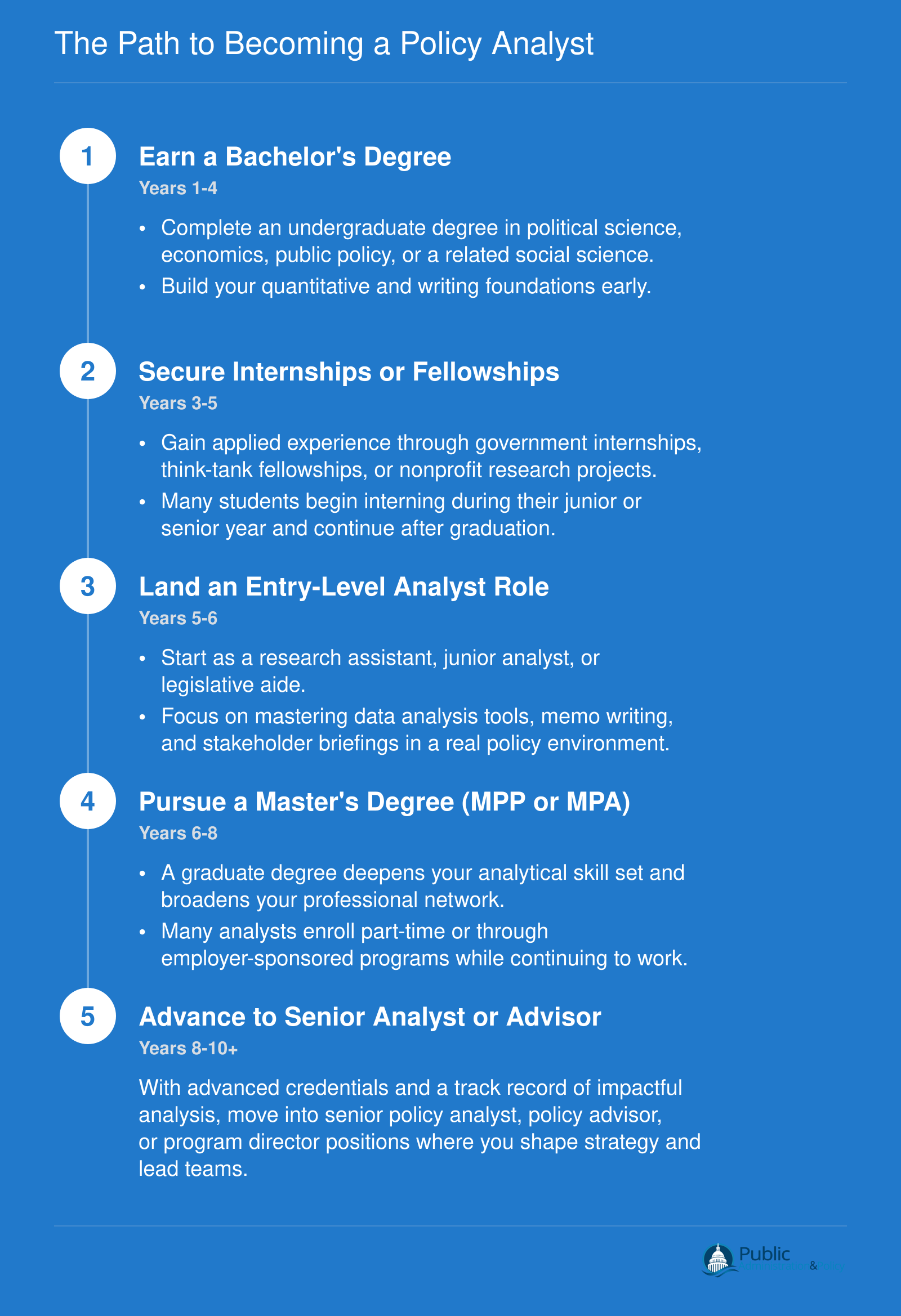
The Path to Becoming a Policy Analyst
Most policy analysts follow a five-stage trajectory that blends formal education with hands-on experience. The timeline below maps each milestone to a realistic window so you can plan your career runway from undergraduate study through senior leadership.
Essential Skills and Technical Tools Employers Expect
Policy analyst job postings paint a clear picture: employers want candidates who can crunch numbers, translate findings into plain language, and present recommendations to decision-makers who may have no statistical background.12 Building the right mix of technical proficiency and professional soft skills is what separates competitive applicants from the rest of the field. Below is a breakdown of what hiring managers across government, consulting, and the nonprofit sector are looking for.
Technical and Hard Skills
Spreadsheet fluency remains the universal baseline. Microsoft Excel appears in the vast majority of policy analyst postings, and comfort with pivot tables, VLOOKUP, and basic macros is treated as a given rather than a differentiator.1
Beyond Excel, the statistical tools that matter most depend on the sector you are targeting. Stata and R dominate postings from federal agencies and think tank analyst organizations, where reproducible research scripts and peer-reviewed methodologies carry weight. Python, meanwhile, is rising fast in consulting firms and tech-policy organizations that value automation, web scraping, and machine-learning applications. If you are unsure where to start, R offers the most transferable value across academic and government settings, while Python opens doors in the private sector.2
Data visualization tools are increasingly expected rather than optional. Tableau and Power BI show up with growing frequency, particularly in roles that involve briefing legislators, executives, or community stakeholders who need to absorb findings quickly.3
Here is a snapshot of common tools and how often they surface in current postings:
R: Common in government and research organizations.2
Python: Moderate overall but growing demand in consulting and tech policy.2
Tableau or Power BI: Moderate and rising, especially for stakeholder-facing roles.3
SQL: Moderate, valuable for roles involving large administrative datasets.4
Stata: Specialized, frequently listed in federal and academic research positions.
SPSS: Specialized, more common in social science and evaluation roles.
GIS (ArcGIS or QGIS): Specialized, important for urban planning and environmental policy.6
NVivo: Specialized, used in qualitative and mixed-methods research.
Soft and Professional Skills
Technical chops get your resume past the initial screen, but soft skills determine whether you thrive on the job. Three capabilities appear at the top of nearly every posting reviewed on USAJOBS and Indeed: written communication, stakeholder engagement, and critical thinking.62
Written communication is arguably the single most important skill in the profession. You will draft policy briefs, legislative summaries, and white papers, often under tight deadlines. Employers want evidence that you can distill complex analysis into concise, actionable prose. Those pursuing advanced credentials through a master of public administration program will find that coursework in policy writing and program evaluation builds this skill directly.
Stakeholder engagement matters because public policy making is inherently collaborative. You may coordinate with agency directors one morning and community advocates the next. The ability to listen actively, manage competing interests, and build consensus is essential.
Additional soft skills that appear regularly include:
Critical thinking: Evaluating evidence, identifying assumptions, and stress-testing policy options.6
Research design: Structuring literature reviews, surveys, or program evaluations.
Project management: Juggling multiple deliverables, timelines, and cross-functional teams.
Putting It All Together
The strongest candidates do not simply list tools on a resume. They demonstrate how those tools solved real problems. A portfolio project showing an R-based regression analysis paired with a Tableau dashboard and a one-page policy brief will communicate your readiness far more effectively than a string of software names. As you build your skill set, focus on pairing at least one statistical programming language with strong writing ability, and you will be well positioned for most entry-level and mid-career policy analyst openings.
How to Gain Experience: Internships, Fellowships, and Entry-Level Roles
Classroom knowledge in policy analysis only becomes career-ready when you pair it with hands-on experience. Employers across government, think tanks, and nonprofits consistently prioritize candidates who can demonstrate applied research skills, and the good news is that a well-established ecosystem of fellowships, internships, and entry-level pipelines exists to help you build that record. The challenge is finding these opportunities on time and positioning yourself competitively.
Flagship Fellowships Worth Tracking
Several high-profile programs recruit annually and often convert participants into full-time staff. The Presidential Management Fellows (PMF) Program remains one of the most prestigious entry points into the federal government for graduate students. It is a two-year, paid fellowship across dozens of agencies, and eligibility typically requires completion of an advanced degree within a defined window before the application cycle. Because deadlines, eligibility criteria, and program structures can shift from year to year, always verify current details at PMF.usajobs.gov.
Major research organizations run their own pipelines as well. The Brookings Institution offers research fellowships and internships that place emerging analysts alongside senior scholars working on domestic and international policy. RAND Corporation maintains internship and associate analyst programs that emphasize quantitative research in areas like defense, health, and education policy. The Congressional Budget Office hires analyst positions that function as intensive training grounds in fiscal and legislative analysis. Each of these organizations posts openings, eligibility requirements, and application windows on its own careers page (Brookings.edu/jobs, RAND.org/careers, and CBO.gov, respectively), and checking those pages directly is the most reliable way to get accurate, up-to-date information.
Building a Systematic Search Strategy
Policy fellowships and internships often have narrow application windows that open months before a start date, so a passive job search rarely works. Instead, adopt a proactive approach:
Bookmark recurring deadlines: Many programs, including the PMF and Brookings internships, follow a predictable annual cycle. Record these dates in a calendar and set reminders at least six weeks before each window opens.
Set USAJOBS alerts: Create a profile on USAJOBS and activate email notifications for the Pathways Programs, PMF postings, and GS-5 through GS-9 analyst roles, which represent common entry-level grades for policy positions in federal agencies.
Use fellowship aggregator sites: Platforms that compile fellowship listings across disciplines can surface opportunities you might otherwise miss. Subscribe to their newsletters so new postings arrive in your inbox rather than requiring manual searches.
Consult APPAM and NASPAA: Professional associations such as the Association for Public Policy Analysis and Management (APPAM) and the Network of Schools of Public Policy, Affairs, and Administration (NASPAA) maintain curated job and internship boards geared specifically toward policy careers.
Leveraging University Resources
Your campus career center is an underused asset. Career offices at schools with MPP or MPA programs often maintain employer partnership lists, host recruitment events with government agencies and think tanks, and track which fellowship programs have historically converted their graduates into full-time hires. Alumni networks are equally valuable. A quick informational interview with a graduate who completed a fellowship two or three years ago can reveal practical details about the application process, day-to-day responsibilities, and whether the program genuinely accelerates career progression.
For broader labor market context, including occupational outlook, typical entry-level pathways, and sector-level employment trends, BLS.gov remains the most authoritative public data source. Cross-referencing what you learn there with the specific opportunities listed above will help you target roles that align with both your skills and your long-term career goals.
Entry-Level Roles That Build Your Portfolio
Not every path runs through a formal fellowship. State legislative offices, municipal budget departments, and advocacy organizations regularly hire research assistants and junior analysts. Those interested in local governance may find that an urban policy planner role offers particularly relevant training. These positions may carry less name recognition, but they offer the same core benefit: a portfolio of memos, briefs, and data analyses that proves you can do the work. Treat every project, whether it is a semester-long capstone, a summer internship deliverable, or a volunteer research brief for a nonprofit, as a writing sample you might hand to a future hiring manager. In policy hiring, demonstrable output consistently outweighs credentials alone.
Hiring managers in policy consistently rank demonstrated analytical writing and a real portfolio of policy briefs above the name on your diploma. A strong capstone project, a published brief, or a well-documented internship deliverable can outweigh a prestigious MPP that lacks practical output. If you are building your candidacy, invest your energy in producing tangible work samples rather than chasing brand-name credentials alone.
Policy Analyst Salary by Experience, Sector, and Location
Compensation for policy analysts varies widely depending on where you work, who you work for, and how many years you have been in the field. The Bureau of Labor Statistics tracks Political Scientists (SOC 19-3094) as the closest standard occupational classification, and that category offers a useful, though imperfect, proxy for policy analyst earnings.1 The national median annual wage for political scientists was approximately $139,380 as of 2024.2 The broader range spans from roughly $72,470 at the 10th percentile to $183,500 at the 90th percentile.1 Keep in mind that many policy analyst roles, particularly those at nonprofit organizations, state agencies, and entry-level positions, fall below the median of this SOC code because the classification also captures senior researchers and academics with doctoral credentials.
Salary by Experience Level
While the BLS does not publish salary tiers by years of experience for this occupation, aggregated job-market data and salary surveys consistently show a steep earnings curve.
Entry-level (0 to 2 years): Analysts just starting out, especially those with only a bachelor of public administration, can expect salaries roughly in the $50,000 to $70,000 range, with federal positions generally paying toward the higher end of that band.
Mid-career (3 to 7 years): With a master's degree and a track record of published analyses or legislative support, salaries typically climb into the $80,000 to $120,000 range. Promotions to senior analyst or team lead roles often coincide with this stage.
Senior (8+ years): Experienced policy analysts who move into director-level roles, lead research divisions, or consult independently can earn $130,000 to $180,000 or more, particularly in the federal government or private consulting.
These ranges are approximate and should be treated as general guideposts rather than guarantees. Actual compensation depends on your employer, credentials, and the policy domain you specialize in.
Salary by Sector
The sector you choose has a dramatic impact on your paycheck. Using BLS industry wage data for political scientists as a reference point:1
Federal government (combined): Mean annual wage of roughly $142,390, reflecting the General Schedule pay scale and locality adjustments.
Scientific research and development: Approximately $135,620, driven by demand for quantitative rigor in defense, health, and environmental policy research.
Social advocacy and nonprofit organizations: Around $97,130, a figure that underscores the trade-off many analysts accept in exchange for mission-driven work.
State government: Roughly $78,340, often supplemented by strong pension and benefits packages that narrow the gap with higher-paying sectors.
Higher education: About $90,740, with the caveat that these roles frequently blend teaching duties with research.
Private consulting firms and government contractors can also pay competitively, though published data for those employers is less standardized.
Top-Paying Locations
Geography matters enormously in this field because policy work clusters around seats of government and major research hubs. The highest-paying states for political scientists, according to BLS data, include:1
District of Columbia: Mean annual wage of approximately $146,600, unsurprisingly the epicenter of federal policy work.
Virginia: Roughly $145,100, buoyed by the concentration of federal agencies and defense contractors in Northern Virginia.
Washington state: About $132,010, reflecting demand from state government agencies and a growing tech-policy intersection in the Seattle metro.
California: Approximately $127,460, with opportunities concentrated in Sacramento, Los Angeles, and the San Francisco Bay Area.
Illinois: Around $88,230, largely centered on Chicago-area think tanks and state legislative support roles.
Metro-level data for policy analysts specifically is limited in public datasets, but the Washington-Arlington-Alexandria metro area consistently ranks as the single highest-paying market in the country for this occupation. Other metros that tend to pay above the national average include the San Francisco, New York City, Boston, and Seattle metropolitan areas, though available data should be verified against current job postings and salary surveys before making relocation decisions.
What This Means for Your Career Planning
If maximizing salary is a priority, targeting federal roles in the D.C. metro area or pivoting into private-sector consulting after building public-sector expertise are well-established strategies. Professionals interested in related careers in public administration should note that total compensation in government often includes benefits, pension contributions, and loan-forgiveness eligibility that do not appear in base salary figures. Weigh those factors carefully when comparing offers across sectors. For the most current salary benchmarks, consult the BLS Occupational Employment and Wage Statistics and O*NET's summary report for Political Scientists.
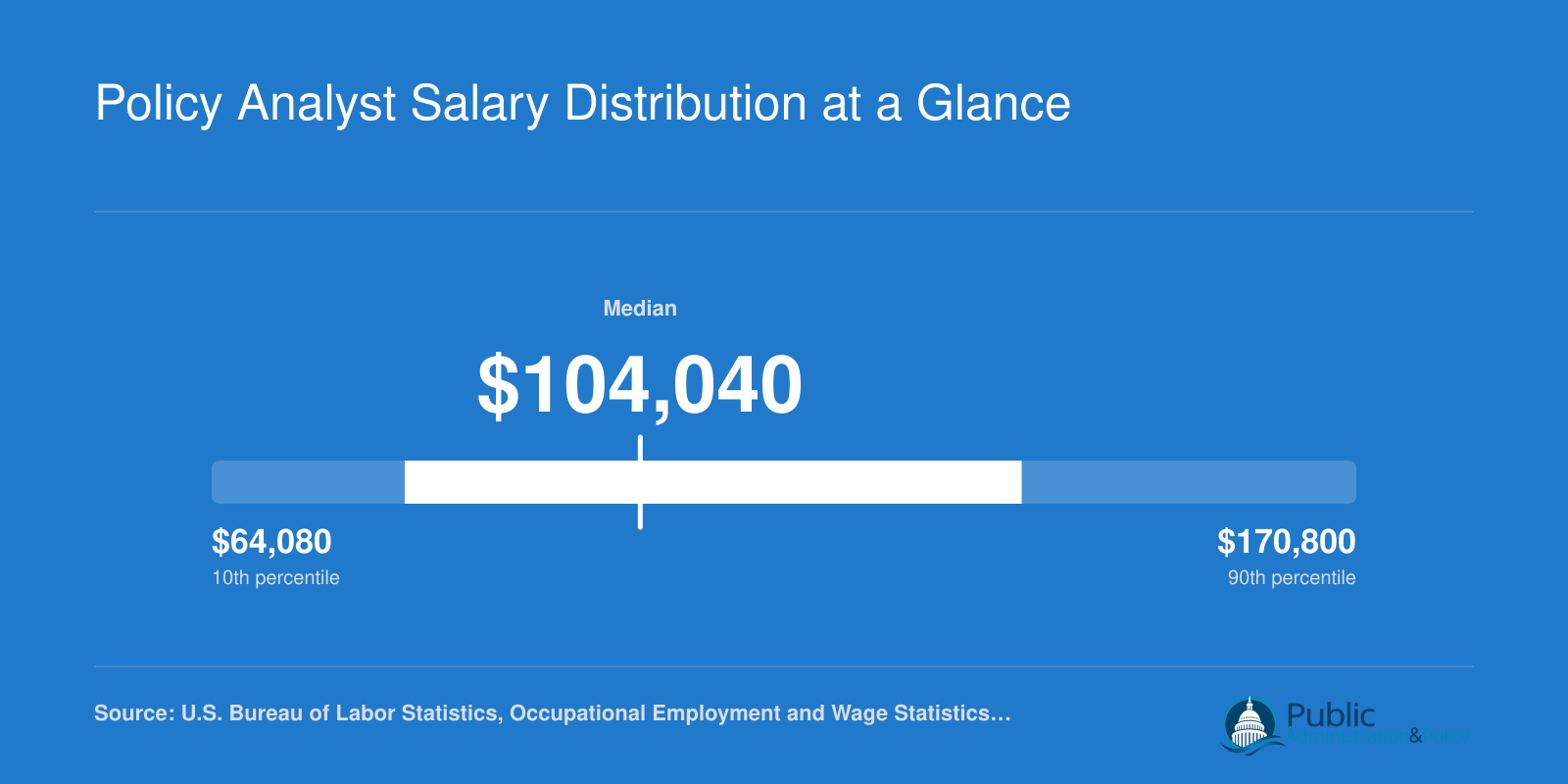
Policy Analyst Salary Distribution at a Glance
Policy analyst salaries vary widely depending on sector, experience, and geography. The gap between the lowest and highest earners reflects the significant difference between nonprofit entry-level positions and senior federal or consulting roles. The figures below represent annual wages for political scientists, the closest BLS occupational category encompassing policy analysts.
Where Policy Analysts Work: Sectors and Top Employers
Policy analysts are employed across a wide spectrum of organizations, and the sector you choose will shape your daily work, compensation, and long-term trajectory in meaningful ways. Each sector offers a distinct blend of stability, earning potential, intellectual latitude, and pace of advancement. Understanding these trade-offs early helps you target your job search more effectively.
Federal Government
Federal roles offer the strongest benefits packages and job security of any sector. Agencies such as the Government Accountability Office (GAO), the Congressional Budget Office (CBO), the Office of Management and Budget (OMB), the Department of Health and Human Services, and the Environmental Protection Agency regularly hire policy analysts under titles like Program Analyst, Management and Program Analyst, and Social Science Analyst.1 Salary ranges typically follow the General Schedule pay scale, placing most mid-career analysts between roughly $70,000 and $120,000 depending on grade and locality. Advancement can be methodical, often tied to time-in-grade requirements, but the trade-off is predictable career progression, generous retirement benefits, and expanding remote and direct-hire options. Between 2024 and 2026, federal listings have grown notably in climate and energy policy, artificial intelligence governance, and health policy.
Typical salary range: $60,000 to $130,000
Work-life balance: Strong, with telework increasingly common
Job stability: Very high
Advancement speed: Moderate, structured by pay grade
Example employers: GAO, CBO, OMB
State and Local Government
State and local agencies are an often-overlooked entry point with real policy influence. Governor's offices, legislative research agencies, and state departments of health, education, and environmental protection all employ analysts under titles such as Policy Analyst, Legislative Analyst, and Research Analyst. Salaries tend to be lower than federal equivalents, but cost-of-living adjustments can narrow the gap in many regions. Hybrid work arrangements have become more common since 2024, and states have expanded roles in Medicaid administration, climate resilience, and workforce development, creating new openings for data-oriented analysts. Those interested in planning-focused roles at this level may also consider becoming an urban policy planner.
Typical salary range: $45,000 to $100,000
Work-life balance: Generally good, varies by agency
Job stability: High
Advancement speed: Moderate, with smaller hierarchies offering faster visibility
Example employers: State legislative research offices, governor's policy teams, state health departments
Nonprofit Organizations and Think Tanks
If intellectual freedom and mission-driven work appeal to you, think tanks and policy nonprofits deserve serious consideration. Organizations like the Brookings Institution, the RAND Corporation, and the Urban Institute are among the most respected employers in this space. Others, including the Heritage Foundation, the Center for American Progress, and New America, offer ideologically diverse environments where analysts publish original research and brief policymakers directly. Salaries generally fall below consulting and sometimes below federal pay, but the ability to choose your research questions and build a public body of work is a powerful draw. Demand for quantitative skills has risen steadily, and advanced degrees are strongly preferred. For a deeper look at this pathway, explore our guide on how to become a think tank analyst.
Typical salary range: $50,000 to $110,000
Work-life balance: Moderate, with periodic deadline intensity around legislative cycles
Job stability: Moderate, often grant-dependent
Advancement speed: Variable, tied to publication record and funding
Example employers: Brookings Institution, RAND Corporation, Urban Institute
Private Consulting
Consulting firms represent the highest earning ceiling for policy analysts, particularly at the senior level. Major employers include McKinsey and Company, Deloitte, Booz Allen Hamilton, Guidehouse, and ICF, all of which maintain dedicated public-sector practices.1 Analysts in these firms may carry titles like Public Sector Consultant, Business Analyst, or Implementation Consultant. The work tends to be project-based and fast-paced, with frequent travel, though hybrid arrangements have become standard. Health, technology, and climate policy consulting have seen the fastest growth from 2024 through 2026. While job stability is lower than government employment and hours can be demanding, the compensation and speed of promotion are hard to match elsewhere. A Public Budget Sector Analyst background can be especially valuable for consultants advising agencies on fiscal strategy.
Typical salary range: $65,000 to $160,000 or more
Work-life balance: Lower, especially at top-tier strategy firms
Job stability: Moderate, contract-driven
Advancement speed: Fast, performance-based
Example employers: McKinsey and Company, Deloitte, Booz Allen Hamilton
No single sector is objectively best. Federal service rewards patience with unmatched stability. Think tanks reward curiosity with intellectual autonomy. Consulting rewards ambition with rapid advancement and top-tier pay. Many successful policy analysts move between sectors over the course of a career, and that cross-sector fluency often becomes one of their greatest professional assets.
Career Advancement and Related Roles
Policy analysis is not a dead-end specialty. With deliberate skill-building and the right moves, an entry-level position can evolve into senior leadership over the course of a career. Understanding the typical trajectory, the roles that border policy analysis, and the lateral pivots available to you will help you plan several steps ahead.
Typical Promotion Timeline
While timelines vary by sector and employer, most policy careers follow a recognizable arc:
Junior/Associate Policy Analyst (1 to 3 years): You support senior colleagues by gathering data, drafting background memos, and summarizing stakeholder input. Expect close supervision and a steep learning curve in your organization's policy domain.
Policy Analyst (3 to 6 years): You own discrete research projects, present findings to decision-makers, and begin building relationships with external partners. At this stage, employers look for independent judgment and the ability to translate evidence into actionable recommendations.
Senior Analyst or Team Lead (6 to 10 years): You manage small teams, set research agendas, and serve as a subject-matter authority. Mentoring junior staff and coordinating across departments become core parts of the role.
Director of Policy or Chief Policy Officer (10-plus years): You shape organizational strategy, represent your institution in public forums, and advise executives or elected officials. Hiring, budgeting, and coalition-building dominate your calendar.
One pattern worth noting: analysts who focus exclusively on technical skills sometimes plateau at the mid-career level. Advancing into management almost always requires strong communication abilities, political awareness, and the capacity to navigate competing stakeholder interests. If you want to reach director-level roles, invest early in public speaking, negotiation, and cross-functional collaboration.
How Policy Analyst Differs From Similar Titles
Three roles are routinely confused with policy analyst, but the day-to-day work is quite different.
A legislative aide supports an elected official by managing constituent services, tracking bills through committee, and handling procedural logistics. The focus is on legislative process rather than independent research and evidence-based recommendations.
A program evaluator enters the picture after a policy has been implemented. Their core task is assessing whether a program achieved its intended outcomes, using evaluation frameworks and performance metrics. Policy analysts, by contrast, typically work upstream, shaping proposals before they become programs.
A research or data analyst builds and maintains data pipelines, runs statistical models, and produces dashboards. While policy analysts rely on many of the same quantitative tools, their distinguishing responsibility is framing findings within a public policy context, weighing trade-offs, and recommending a course of action.
Lateral Moves and Career Pivots
Policy analysts develop a versatile skill set that transfers well across sectors. Common lateral moves include:
Government affairs and lobbying: Your ability to read regulatory landscapes and synthesize research translates directly into advocacy work for corporations, nonprofits, or trade associations.
Strategic consulting: Firms value analysts who can diagnose complex problems, model scenarios, and present recommendations to senior clients.
Political campaigns: Campaign strategists need people who can analyze polling data, craft policy platforms, and communicate positions clearly to diverse audiences.
Academic research: Analysts with graduate degrees sometimes transition into university research centers or think tanks, where they pursue longer-term studies on policy questions.
Journalism and media: Policy expertise combined with strong writing skills opens doors to investigative reporting, editorial boards, and policy-focused media outlets.
Each of these paths rewards the same core competency: the ability to translate complex evidence into clear narratives that move people to action. Whether you climb the traditional ladder or pivot into an adjacent field, the analytical foundation you build early in your career will remain one of your most marketable assets.
Frequently Asked Questions About Becoming a Policy Analyst
Below are answers to the most common questions prospective policy analysts ask. Each response draws on the salary benchmarks, education pathways, and skill requirements covered earlier in this guide.
What degree do you need to become a policy analyst?
Most policy analysts hold at least a bachelor's degree in political science, economics, public administration, or a related social science. A master's degree, particularly a Master of Public Policy (MPP) or Master of Public Administration (MPA), is the most common credential for mid-level and senior roles. Some analysts enter the field with graduate training in economics, data science, or law.
Can you become a policy analyst with just a bachelor's degree?
Yes. Entry-level research assistant and junior analyst positions are accessible with a bachelor's degree, especially if you supplement coursework with internships or fellowship experience. Many employers in think tanks, advocacy organizations, and local government hire bachelor's-level candidates. However, advancing into senior analyst or advisory roles typically requires a graduate degree or several years of demonstrated expertise.
How much do policy analysts make?
Policy analyst salaries vary by experience, sector, and location. As outlined earlier in this guide, entry-level analysts can expect salaries in the mid $50,000s to low $60,000s, while mid-career professionals often earn between $70,000 and $90,000. Senior analysts and those in high-cost metro areas or federal agencies can surpass $100,000. Private sector consulting roles tend to offer the highest compensation.
What is the difference between a policy analyst and a policy advisor?
A policy analyst focuses on research, data collection, and evidence-based evaluation of policy options. A policy advisor leans more heavily on strategic counsel, stakeholder communication, and political context. In practice the roles overlap considerably. Analysts tend to produce the written briefs and quantitative models, while advisors translate those findings into recommendations for elected officials or executives.
What skills do you need to be a policy analyst?
Employers expect a blend of quantitative and communication skills. Strong statistical analysis, proficiency in tools like Stata, R, or Python, and the ability to interpret complex datasets are essential on the technical side. Equally important are clear writing, persuasive presentation, and the capacity to distill research into actionable policy briefs. Critical thinking and stakeholder engagement round out the skill set.
Is policy analysis a good career for career changers?
Absolutely. Professionals transitioning from law, journalism, data analytics, social work, or military service bring transferable skills that policy employers value. A graduate certificate or MPP program can bridge knowledge gaps efficiently. As noted earlier in this guide, demonstrated experience through fellowships or project-based work often carries as much weight as formal credentials during the hiring process.
What certifications help policy analysts advance?
While no single certification is required, credentials such as the Certified Analytics Professional (CAP) designation, project management certifications like the PMP, or specialized training in geographic information systems (GIS) can strengthen your profile. Graduate certificates in program evaluation or public financial management also signal advanced competence. Employers increasingly value demonstrated proficiency in data visualization platforms like Tableau or Power BI.