How to Become a Grant Administrator: Your Complete Career Path

Education requirements, certifications, salary expectations, and step-by-step guidance for launching a career in grant administration.

By Max SheltonReviewed by PAP Editoral TeamUpdated June 19, 202625+ min read

What you’ll learn in this article…

  • Most grant administrator roles require a bachelor's degree, though a master's degree is increasingly expected for senior positions.
  • The federal government awarded roughly 1.22 trillion dollars in grants in fiscal year 2025, driving strong demand for qualified administrators.
  • Certifications such as the CGMS and GPC can accelerate promotions and justify higher compensation across government and nonprofit sectors.
  • Federal grant administrators typically earn the highest salaries, while nonprofit roles fall at the lower end of the pay spectrum.

More than 1.2 trillion dollars in federal grants flowed through U.S. organizations in fiscal year 2025, and that figure does not account for the billions distributed by private foundations and state agencies each year. Every one of those awards requires someone to manage compliance, track expenditures, reconcile budgets, and ensure that reporting deadlines are met. That someone is a grant administrator.

Grant administration sits at the intersection of finance, regulation, and public administration jobs. The role demands fluency in cost principles like 2 CFR 200, proficiency with grants management software, and the organizational rigor to steward funds across multi-year award periods. Employers increasingly expect a bachelor's degree at minimum, with a growing share of senior positions requiring a master's or a professional credential such as the Certified Grants Management Specialist (CGMS). This guide walks you through the education, certifications, skills, and career steps you need to enter and advance in the field.

What Is a Grant Administrator?

A grant administrator is the professional responsible for managing the financial, regulatory, and administrative lifecycle of awarded grants, from initial budget setup through final closeout. While grant writers focus on securing funding and government program managers oversee the activities that grants support, the grant administrator occupies the critical space between finance and compliance. This role ensures that every dollar is tracked, every deadline is met, and every federal, state, or private funder requirement is satisfied.

If you have ever wondered what a grant administrator actually does on a day-to-day basis, the simplest answer is this: they keep grants running smoothly so that the people doing the work can focus on outcomes rather than paperwork.

The Three Phases of Grant Administration

Grant administration is typically organized into three overlapping phases, each with distinct responsibilities.

  • Pre-award: During this phase, administrators assist with budget development, cost analysis, and proposal preparation. They review funding opportunity announcements, ensure institutional compliance with sponsor guidelines, and help principal investigators (PIs) or project directors assemble competitive submissions.
  • Award: Once a grant is funded, the administrator sets up financial accounts, establishes internal tracking systems, and ensures that award terms and conditions are clearly communicated to all stakeholders. Compliance monitoring begins here and continues throughout the life of the grant.
  • Post-award: This phase involves financial reporting, expenditure monitoring, effort certification, audit preparation, and formal closeout. Administrators reconcile budgets, submit required progress and financial reports to funders, and resolve any outstanding compliance issues before the grant record is officially closed.

Titles Vary, but the Core Work Overlaps

One aspect that can confuse newcomers is the wide variety of job titles attached to what is essentially the same set of responsibilities. At universities and research institutions, the role often appears as "sponsored programs administrator" or "research administrator." In government agencies, the title might be "grants management specialist" or "grants compliance officer." Nonprofit organizations may simply use "grants coordinator" or "grants administrator." Despite the naming differences, the core duties of managing budgets, ensuring compliance, and facilitating communication among stakeholders remain remarkably consistent across sectors.

A Role That Blends Precision with People Skills

Grant administration is not purely a numbers job. While the role demands meticulous attention to detail, particularly around federal regulations like the Uniform Guidance (2 CFR 200), it also requires strong interpersonal and communication skills. Grant administrators serve as a bridge between PIs who are focused on research or program delivery, finance offices that manage institutional funds, and external funders who set the rules. The ability to translate complex regulatory language into practical guidance, negotiate timelines, and build trust with diverse stakeholders is just as important as knowing how to read a budget spreadsheet. Professionals who enjoy this blend of analytical and financial work may also find related opportunities as a public budget analyst.

For professionals drawn to work that combines analytical rigor with collaborative problem-solving, grant administration offers a career path with real impact across public administration, higher education, healthcare, and beyond.

Grant Administrator vs. Grant Manager: Key Differences

The titles "grant administrator" and "grant manager" are sometimes used interchangeably, but they describe distinct roles in most mid-size and large organizations. Understanding the differences can help you target the right position as you plan your career. In smaller nonprofits or local government offices, a single professional often fills both functions, while universities, federal agencies, and large foundations tend to separate them clearly.

DimensionGrant AdministratorGrant Manager
Primary FocusOperational: handles day-to-day compliance, financial tracking, and reporting deadlinesStrategic: oversees grant portfolios, sets funding priorities, and aligns awards with organizational goals
Typical Seniority LevelEntry-level to mid-level; often reports to a grants manager or finance directorMid-level to senior; may supervise grant administrators and coordinate across departments
Core ResponsibilitiesProcessing invoices, monitoring expenditures against budgets, preparing progress reports, ensuring regulatory complianceDeveloping funding strategies, managing relationships with funders, reviewing proposals for alignment, evaluating program outcomes
Decision-Making AuthorityExecutes policies and procedures established by leadership; flags compliance issues for reviewShapes grant policies, approves budget modifications, and makes portfolio-level funding decisions
Typical Employer SizeFound across all sizes, but the role is most clearly defined in large institutions such as research universities and federal agenciesMore common in organizations large enough to maintain multiple active grants or a dedicated grants office
Key Skills EmphasizedAttention to detail, regulatory knowledge, financial reconciliation, database managementLeadership, stakeholder communication, strategic planning, risk assessment
Common Employer TypesUniversities, state and local government agencies, community nonprofits, healthcare systemsFederal agencies, large foundations, research institutions, international development organizations

Questions to Ask Yourself

Your answer reveals whether you lean toward an administrator role, focused on compliance and documentation, or a manager role, centered on strategic direction. This distinction shapes day-to-day work and long-term career trajectory.

Grant administrators spend much of their time in these activities. If meticulous data tracking and deadline management feel satisfying rather than exhausting, the role is likely a strong fit for your working style.

Administrators typically operate in a support and oversight capacity, while proposal-facing roles involve more relationship building with funders. Knowing which setting suits you helps you choose the right entry point into the grants field.

Grant Administrator Job Description and Core Responsibilities

Grant administration spans the entire lifecycle of a funded award, from the earliest stages of proposal development through final closeout. Understanding how responsibilities shift across each phase helps clarify what this role demands on a daily basis and why employers value professionals who can manage complexity across multiple simultaneous awards.

Pre-Award Responsibilities

Before a grant is even submitted, administrators play a critical support role. They assist principal investigators and program directors in building proposal budgets that align with sponsor guidelines, institutional policies, and applicable cost principles. Pre-award duties typically include:

  • Budget development: Translating project narratives into line-item budgets, calculating fringe benefit rates, and applying correct indirect cost rates.
  • Compliance review: Confirming that proposals meet sponsor eligibility criteria, formatting requirements, and submission deadlines.
  • Institutional approvals: Routing proposals through internal review chains and collecting required certifications before submission.

This phase demands careful reading of solicitation documents, because even a minor oversight in allowable costs or page limits can disqualify a proposal.

Award and Negotiation Phase

Once a sponsor issues a notice of award, the grant administrator shifts into setup mode. Tasks at this stage include establishing project accounts in the institution's financial system, reviewing and negotiating award terms, and processing any subaward agreements with partner organizations. Administrators also verify that budgets match the final award amount and confirm that all special conditions (such as prior-approval requirements for equipment purchases) are clearly documented for the project team.

Post-Award Management

The longest and most detail-intensive phase is post-award. Grant administrators monitor expenditures against approved budgets, flag potential overruns or underspending, prepare and submit financial reports on sponsor-required schedules, and coordinate audit responses. At the end of a project period, they manage grant closeout, which involves reconciling final expenses, submitting terminal financial reports, and ensuring record retention requirements are met. Professionals who enjoy this kind of financial stewardship may also find overlapping skill sets in roles like budget officer job description positions.

Sector-Specific Nuances

The core lifecycle is consistent, but day-to-day emphasis varies by employer. In higher education, administrators frequently manage effort reporting and cost-sharing commitments tied to faculty time. Nonprofit organizations often expect grant administrators to handle donor reporting alongside funder compliance, blending stewardship and financial oversight. Government agencies place heavy emphasis on enforcing the OMB Uniform Guidance (2 CFR 200), which governs allowable costs, procurement standards, and audit thresholds for federal funds. In larger federal agencies, grant administrators often collaborate closely with federal program management teams to align funding decisions with broader programmatic goals.

Skills and Tools Employers Expect

Job postings for grant administrators consistently highlight a mix of technical and interpersonal competencies. On the soft-skills side, cross-functional communication tops the list because administrators serve as the bridge between investigators, finance offices, and sponsors. Attention to detail, the ability to interpret dense regulatory language, and comfort working through ambiguity in sponsor rules are also cited frequently.

On the technical side, most positions require proficiency in at least one grant management system, such as Cayuse, Workday Grants, or SAP, along with Excel-level data skills for budget modeling, reconciliation, and ad hoc reporting. Employers increasingly look for candidates who can pull and analyze financial data independently rather than relying on institutional reports alone.

Taken together, these responsibilities make grant administration a role that rewards people who are both process-oriented and adaptable. No two sponsors structure their requirements identically, so the ability to learn new guidelines quickly and apply them accurately is just as important as mastering the technical tools of the trade. For those drawn to the broader landscape of public administration jobs, grant administration offers a highly specialized entry point with clear pathways for advancement.
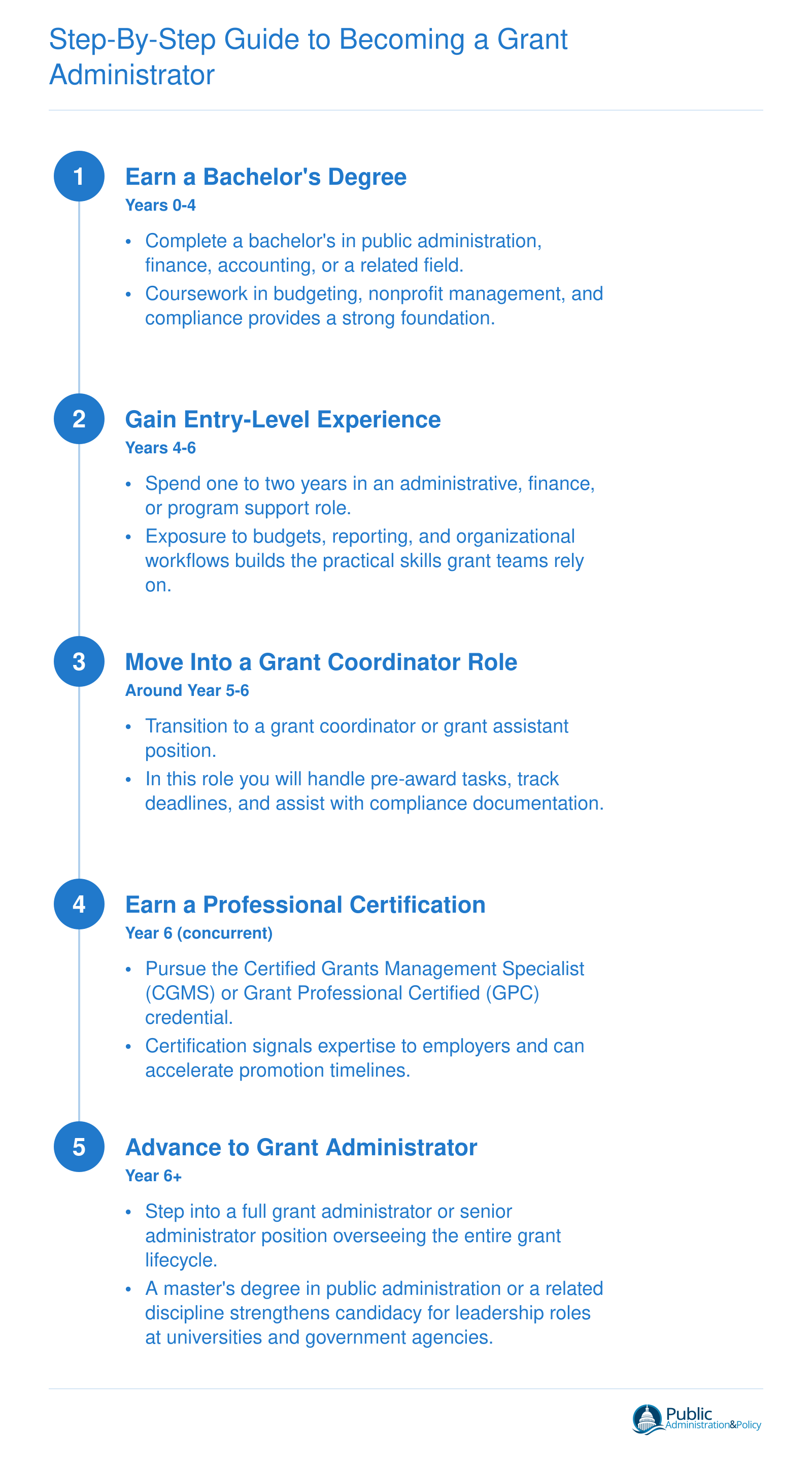
Step-by-Step Guide to Becoming a Grant Administrator

The path to becoming a grant administrator typically spans six or more years, combining formal education with progressive professional experience. A master's degree can compress this timeline and is increasingly expected for senior roles in higher education and government settings.

Five-step career ladder from bachelor's degree through senior grant administrator, spanning approximately six or more years

Most grant administrator positions require at least a bachelor's degree, and the field of study matters more than you might expect. Employers consistently look for candidates whose academic background reflects the financial, regulatory, and organizational skills that grant administration demands daily. Choosing the right degree path, and supplementing it with targeted coursework, can significantly shorten the time between graduation and your first role.

Bachelor's Degree: The Standard Baseline

A four-year degree is the entry point for the majority of grant administrator openings across government, higher education, and the nonprofit sector. The most commonly sought majors include:

  • Public administration: Builds a foundation in government operations, policy analysis, and public finance.
  • Business administration: Covers organizational management, budgeting, and strategic planning.
  • Accounting or finance: Develops the quantitative and compliance skills central to grant oversight.
  • Nonprofit management: Focuses on fundraising, program evaluation, and mission-driven leadership.

Any of these paths will position you well, though candidates from other disciplines (political science, social work, health administration) can also be competitive if they pair their degree with relevant experience.

When a Master's Degree Is Expected

Senior grant administration roles, particularly at R1 research universities and large federal agencies, often prefer or explicitly require a graduate degree. A Master of Public Administration (MPA) is one of the most directly aligned options, blending public finance, organizational theory, and policy implementation. Prospective students can explore best online public administration degree programs to find accredited MPA options that fit their schedule. A Master of Business Administration (MBA) appeals to employers in the private and nonprofit sectors, while an MA in nonprofit management is well suited for foundation and NGO settings. If you aspire to direct a grants office or oversee multimillion-dollar portfolios, plan on pursuing one of these credentials.

Entry-Level Flexibility for Smaller Organizations

Some entry-level positions, especially within smaller nonprofits and local government offices, accept an associate degree combined with relevant work experience. Roles like grants assistant or grants coordinator can serve as stepping stones, giving you hands-on exposure while you complete a bachelor's degree part time or online.

Coursework That Sets You Apart

Regardless of major, look for classes that cover federal regulations (particularly the Uniform Guidance, 2 CFR Part 200), budgeting and cost accounting, research compliance, and data management. Programs that include a practicum or capstone involving real grant proposals add practical credibility to your resume. If your degree program does not offer these courses directly, consider electives through a public administration certificate programs track or an accounting department to fill the gaps. Hiring managers notice when a transcript aligns with the daily realities of grant oversight, and targeted coursework signals that you understand what the work actually entails.

Certifications for Grant Administrators: CGMS, GPC, and More

Professional certification signals to employers that you understand the regulatory frameworks, compliance standards, and lifecycle processes central to grant administration. While not always required, a credential can accelerate promotions, justify higher pay, and open doors in competitive government and nonprofit hiring pools. Below is a side-by-side look at the most relevant options as of 2026.

Certified Grants Management Specialist (CGMS)

Issued by the National Grants Management Association (NGMA), the CGMS is widely regarded as the gold standard for post-award grants management and compliance work.1 It is especially valued in federal agencies, state grant offices, and pass-through entities that must adhere to Uniform Guidance (2 CFR 200).

  • Eligibility: Experience-based. Candidates must demonstrate hands-on grants management work before sitting for the exam.1
  • Exam format: 150 multiple-choice questions delivered via a computer-based testing platform.2
  • Cost: Approximately $500 for NGMA members or $674 for non-members (2025 fees). A free practice test is included with membership; non-members pay $50. Retake fees run $175 (members) or $250 (non-members).2
  • Renewal cycle: Every three years, requiring 60 continuing professional education (CPE) credits. Recertification fees are $299 for members and $473 for non-members.3

Grant Professional Certified (GPC)

The Grant Professionals Association awards the GPC to individuals who demonstrate competency across the full grants lifecycle, including pre-award research, proposal development, and budget justification. While the CGMS leans post-award, the GPC covers the entire spectrum, making it popular among grant writers and coordinators in nonprofits, universities, and local governments. Eligibility typically requires a combination of education and professional experience in grant-related roles, and the exam tests knowledge across the Grant Professionals Association's competencies and skills standards.

Other Credentials Worth Knowing

Depending on your career focus, a few adjacent certifications may strengthen your profile:

  • Certified Government Financial Manager (CGFM): Offered by the Association of Government Accountants (AGA), this credential covers government accounting, auditing, and financial reporting.4 It pairs well with the CGMS for administrators who handle fiscal reconciliation on federal grants.
  • NCMA Contract Management Certifications (CPCM, CFCM, CCCM): The National Contract Management Association issues these credentials for professionals managing contracts rather than grants.5 If your role sits at the intersection of procurement and grant-funded agreements, one of these may add value.

Is the CFRE Relevant for Grant Administrators?

The Certified Fund Raising Executive (CFRE) credential is designed for development officers and fundraisers who cultivate donor relationships, run capital campaigns, and manage annual giving programs. Although fundraising and grant seeking both generate revenue for organizations, the skill sets diverge sharply once funds are secured. Grant administrators focus on compliance, reporting, and financial stewardship rather than donor engagement. In most cases, the CFRE is better suited for advancement professionals, not grant administrators. If your role is purely post-award or compliance-oriented, investing in the CGMS or GPC will yield a far stronger return.

Choosing the Right Certification

Start by mapping your daily responsibilities. If you spend most of your time monitoring sub-recipients, tracking expenditures, and preparing federal reports, the CGMS aligns directly with that work. If your role spans the full lifecycle from prospect research through closeout, the GPC offers broader coverage. Professionals who manage grant-funded contracts may also benefit from pairing a grants credential with a CGFM or NCMA certification. Those interested in the broader landscape of how to become a public administrator will find that a grants credential also strengthens candidacy for senior roles across the public sector. Whichever path you choose, budgeting for both the exam fee and ongoing CPE requirements ensures you maintain your credential without surprises at renewal time.

In fiscal year 2025, the U.S. federal government awarded roughly 1.22 trillion dollars in grants, underscoring the enormous scale of funding that grant administrators help manage. That volume of spending means qualified professionals who can ensure compliance, track deliverables, and steward taxpayer dollars remain in consistently high demand across every level of government.

Grant Administrator Salary by Experience, Sector, and Location

Grant administration does not have a single dedicated occupational classification in federal labor data, so salary estimates draw on the closest related categories alongside aggregated figures from employer surveys. The ranges below should be treated as reliable approximations rather than pinpoint figures, and actual compensation will depend heavily on your employer, the size of the grants portfolio you manage, and where you live.

Salary Ranges by Experience Level

Using Bureau of Labor Statistics wage data for Business Operations Specialists, All Other (SOC 13-1199) and related manager roles, combined with market surveys, a general salary picture emerges:1

  • Entry-level (0 to 2 years): Approximately $44,000 to $60,000. Professionals in this range typically hold a bachelor's degree and handle compliance tracking, data entry, and basic reporting under supervision.
  • Mid-career (3 to 7 years): Roughly $65,000 to $90,000. At this stage, administrators often manage full grant life cycles, lead audits, and mentor junior staff.
  • Senior level (8 or more years): Ranges from about $100,000 to $140,000 and above. Senior administrators, directors of sponsored programs, or those overseeing multimillion-dollar portfolios can reach the upper end of this spectrum, particularly in large institutions or federal agencies.

BLS data for Business Operations Specialists reports a median annual wage of $79,590 and a 75th-percentile wage of $106,300, which aligns with what mid-career and senior grant administrators typically earn.1

How Sector Affects Pay

Not all employers compensate equally. Government agencies and large research universities generally offer the most competitive base salaries for grant administrators, while small nonprofits tend to fall at the lower end. Those interested in comparing adjacent careers in public administration will notice similar sector-driven pay patterns.

  • Federal, state, and local government: Mean wages for related operations roles in government averaged roughly $99,640 in the most recent BLS data, and federal positions often include generous retirement contributions and locality pay adjustments.1
  • Higher education: Universities with large sponsored-research offices frequently peg salaries at or above the mid-career range, especially for administrators managing federally funded research portfolios.
  • Healthcare systems: Hospitals and health networks that rely on NIH, HRSA, or CDC grants generally pay in line with higher-education rates, sometimes slightly above due to the complexity of clinical trial compliance.
  • Nonprofit organizations: Smaller nonprofits may offer entry-level salaries in the mid-$40,000s. Larger national or international nonprofits can be more competitive, but budget constraints keep many positions below the government average.

Top-Paying Locations

Geography plays a significant role. According to BLS figures, the Washington-Arlington-Alexandria, DC-VA-MD-WV metro area consistently leads for operations and management roles connected to grant work, with mean annual wages for the Managers, All Other category exceeding $161,300.2 The District of Columbia itself averaged roughly $168,180 for the broader manager category.2 Other high-paying areas tend to include major research corridors such as the Boston, San Francisco, and New York metro regions, where the concentration of federal agency offices, research universities, and large foundations drives up demand and compensation.

Beyond Base Salary: Total Compensation

Base pay tells only part of the story. When evaluating offers, consider the full compensation package:

  • Government pension plans: Federal employees and many state workers participate in defined-benefit retirement systems that can add substantial long-term value compared to a private-sector 401(k) match alone.
  • Tuition benefits: University employers commonly offer tuition remission or reimbursement, a meaningful perk if you plan to pursue a master's degree or professional certification while working.
  • Work-life balance and mission alignment: Nonprofit and public-sector employers may offer more flexible schedules, generous leave policies, or the intangible benefit of work that directly supports community health, education, or scientific discovery.

Job growth in related business operations and administrative management occupations is projected at roughly 4 to 7 percent through the early 2030s, suggesting steady demand for qualified grant administrators across all sectors.3 As federal and state grant funding continues to expand, professionals who pair strong compliance skills with sector expertise should find competitive opportunities, particularly in government and higher education settings.

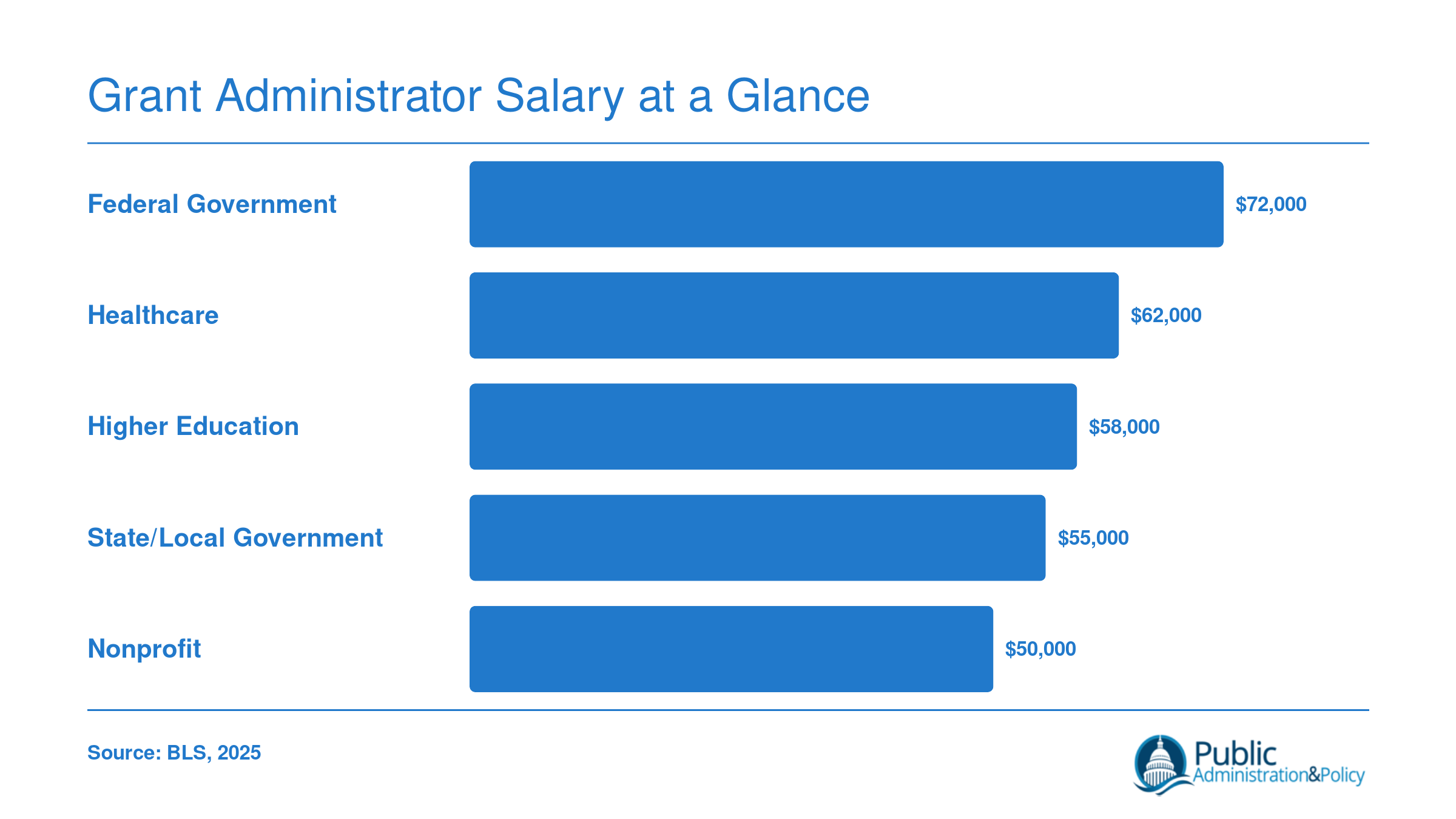
Grant Administrator Salary at a Glance

Grant administrator salaries vary significantly depending on the sector. Federal roles tend to offer the highest compensation, while nonprofit organizations typically fall at the lower end of the pay spectrum. The figures below reflect median annual salaries across five common employment sectors for grant administrators.

Median grant administrator salaries compared across five sectors: federal government, healthcare, higher education, state and local government, and nonprofit organizations

Where Grant Administrators Work: Key Sectors and Employers

Grant administrators are in demand across a broad range of organizations, and the sector you choose shapes your daily work, the scale of funding you manage, and the compliance frameworks you navigate. Four primary sectors employ the majority of grant administrators in the United States, though the boundaries between them are more porous than many early-career professionals realize.

Higher Education

Colleges and universities employ grant administrators within sponsored programs offices, research administration units, and individual academic departments. In these roles you oversee the full lifecycle of externally funded research, from proposal submission through closeout. Large research universities may manage hundreds of active awards simultaneously, making this sector one of the most complex environments for grant administration.

Federal and State Government

Government agencies on both the federal and state levels hire grant administrators to manage the distribution and oversight of public funds. Agencies such as the National Institutes of Health, the Department of Energy, and state housing authorities all maintain dedicated grants management teams. Working on the funder side offers a different vantage point, focusing on monitoring sub-recipients, reviewing compliance reports, and developing programmatic guidance. Professionals in these settings often collaborate closely with colleagues in federal program management roles.

Healthcare Systems and Research Hospitals

Academic medical centers and large healthcare networks fund clinical trials, community health programs, and translational research through federal and private grants. Administrators in this sector must understand institutional review board requirements and clinical trial regulations alongside standard financial compliance rules.

Nonprofit Organizations

Nonprofits of all sizes rely on grant administrators to secure and manage foundation, corporate, and government funding. Smaller organizations may combine grant writing with post-award management, while large national nonprofits maintain specialized teams focused solely on compliance and reporting.

Skills That Travel Across Sectors

One of the most valuable aspects of a grant administration career is the transferability of core competencies. Knowledge of OMB Uniform Guidance (2 CFR 200), for example, applies everywhere federal dollars flow, whether that is a university lab, a state environmental policy advisor office, or a community health center. Financial reporting, budget reconciliation, and audit preparation skills are equally universal. Starting in one sector does not lock you in. Many administrators move between higher education and government mid-career, or shift from nonprofits into healthcare systems, bringing cross-sector perspective that employers prize.

Emerging Demand Areas

Several trends are expanding the job market for grant administrators in 2026. Climate and clean energy programs continue to generate new federal funding streams, while post-pandemic public health investments sustain demand in healthcare and state agencies. CHIPS Act implementation and broader infrastructure legislation have created a wave of federally funded projects that require skilled administrators to ensure compliance and accountability. Professionals who position themselves in these growing areas may find especially strong hiring prospects and opportunities for advancement.

Essential Software and Tools for Grant Administrators

Technology is central to modern grant administration. Whether you are tracking compliance deadlines, reconciling budgets, or submitting federal reports, the platforms you use every day will shape your efficiency and accuracy. Familiarizing yourself with the tools below before you apply for roles gives you a tangible advantage over candidates who have only worked with spreadsheets.

Grant Management Platforms

Grant management software (GMS) handles the full lifecycle of a grant, from application intake through reporting and closeout.1 The platforms you encounter will depend on your sector.

  • Fluxx: Widely adopted by large foundations, corporate funders, and universities. It offers configurable workflows for both grantmakers and grantees.1
  • Submittable: Popular among nonprofits, foundations, CSR programs, and local governments. Its intuitive interface makes it a common choice for organizations that manage high volumes of applications.1
  • Cayuse: The dominant platform in higher education and research hospitals, built specifically around sponsored research and federal compliance requirements.1
  • Workday Grants Management: Used by universities, research institutions, and large nonprofits that already run Workday as their enterprise resource planning system.1
  • SmartSimple and Foundant GLM: Frequently seen at community foundations, family foundations, and large corporate grantmakers.1
  • eCivis: Tailored to state and local government grant teams that need to track multiple federal and state funding streams simultaneously.1

Newer entrants such as Instrumentl, Temelio, and GrantOps are gaining traction as well, offering AI-driven prospecting and streamlined end-to-end workflows that appeal to lean teams.234

Federal Systems You Must Know

Any grant administrator who touches federal funding needs hands-on comfort with a core set of government portals.

  • Grants.gov: The single access point for finding and applying to more than 1,000 federal grant programs.
  • SAM.gov: The System for Award Management, where organizations register as eligible recipients and where you verify entity status, exclusion records, and wage determinations.
  • Federal Audit Clearinghouse: The repository for single audit reports required under the Uniform Guidance. You will reference it regularly during subrecipient monitoring.
  • GrantSolutions: A federal shared-service platform used by multiple U.S. agencies and pass-through entities to manage awards post-obligation.1

Spending time navigating these portals, even just creating a test profile on SAM.gov or browsing funding opportunities on Grants.gov, demonstrates practical readiness that hiring managers value.

Supporting Productivity Tools

Beyond dedicated grant platforms, day-to-day administration relies on general productivity software. Professionals who also hold financial analyst skills will find that strong spreadsheet proficiency translates directly into grant budget work.

  • Excel and Google Sheets: Still the backbone of budget tracking, cost allocation schedules, and ad hoc financial analysis. Strong formula and pivot table skills are expected.
  • Project management tools (Asana, Monday.com): Useful for mapping deliverable timelines, assigning tasks across departments, and keeping multi-year awards on schedule.
  • E-signature platforms (DocuSign, Adobe Sign): Increasingly standard for executing subaward agreements, memoranda of understanding, and vendor contracts without paper delays.

Getting Started Before You Apply

If you are still building experience, aim to gain hands-on proficiency with at least one GMS and the federal portal ecosystem. Many platforms offer free demos, sandbox environments, or training webinars.5 Cayuse and Submittable, for example, publish help-center documentation that lets you study workflows before you ever log in on the job. Pairing that familiarity with strong spreadsheet skills and a working knowledge of Grants.gov positions you as a candidate who can contribute from day one.

Frequently Asked Questions About Grant Administration Careers

Grant administration is a rewarding career path that blends financial oversight, regulatory compliance, and public service. Below are answers to the questions prospective grant administrators ask most often.

A grant administrator reviews budgets, tracks expenditures against award terms, ensures regulatory compliance, and prepares financial and progress reports for funders. Day to day, the role involves coordinating with program staff, responding to auditor inquiries, monitoring submission deadlines, and maintaining documentation in grants management software. The work demands attention to detail and strong organizational skills.

Most employers require at least a bachelor's degree in public administration, business administration, finance, accounting, or a related field. A master's degree in public administration (MPA) or nonprofit management can strengthen your candidacy for senior roles, though it is not always mandatory for entry level positions.

Salaries vary by experience, sector, and location. As of 2026, entry level grant administrators typically earn in the range of $45,000 to $55,000 per year, while mid career professionals often earn between $60,000 and $75,000. Senior grant administrators at large universities or federal agencies can exceed $85,000 annually. Government and higher education employers generally offer competitive benefits alongside base pay.

Grant administrators focus primarily on the financial and compliance side of awards, handling budgets, reporting, and regulatory requirements. Grant managers typically oversee the broader lifecycle of a grant, including program strategy, stakeholder engagement, and outcome evaluation. In smaller organizations the two roles may overlap, but in larger institutions they are distinct positions with different reporting lines.

Yes. Grant funding continues to grow across government, healthcare, and nonprofit sectors, which sustains steady demand for qualified administrators. The role offers a clear path into leadership positions, competitive salaries, and the satisfaction of supporting programs that drive meaningful societal change. Professionals who enjoy structured, detail oriented work often find it highly rewarding.

The most recognized credentials include the Certified Grants Management Specialist (CGMS) offered by the National Grants Management Association and the Grant Professional Certified (GPC) credential from the Grant Professionals Certification Institute. Other options include certificates in federal grants management from organizations such as Management Concepts. Earning a certification signals expertise and can improve advancement prospects.

Absolutely. Many grant administrators enter the field with a bachelor's degree and build expertise through on the job experience, professional development workshops, and certifications like the CGMS or GPC. Gaining practical experience in budgeting, compliance, or nonprofit finance can compensate for the absence of a graduate degree, especially when paired with a recognized credential.

Recent Articles