How to Become a Public Budget Analyst: Your Step-by-Step Career Path
Navigate education, certifications, and government hiring to launch a rewarding public budgeting career
By Holly AbramsonReviewed by PAP Editoral TeamUpdated August 2, 202625+ min read
What you’ll learn in this article…
A bachelor's degree is the typical entry point, but a Master of Public Administration accelerates advancement to senior roles.
Federal budget analysts help allocate over $6 trillion annually and earn a notable salary premium over state and local peers.
Three credentials, the CGFM, CBA, and CPA, appear most often in public budgeting job postings and can fast-track promotions.
Climbing from entry-level analyst to budget director typically takes 15 to 25 years depending on agency size and credentials earned.
Federal budget analysts help allocate more than $6 trillion in annual spending, while their state and local counterparts manage budgets that routinely reach tens of billions. The role sits at the intersection of finance, policy analysis, and public accountability, making it one of the most practical career in public policy options for professionals motivated by mission over margin.
Breaking in, however, requires deliberate preparation. Entry-level federal positions typically start at GS-7 or GS-9, and the hiring process on USAJOBS follows conventions that trip up even experienced applicants. A bachelor's degree is the baseline, but the right major, targeted certifications like the CGFM or CBA, and fluency in tools such as MAX or SAP can separate competitive candidates from the rest. Demand remains steady: BLS projections show roughly 4,700 budget analyst openings annually through the late 2020s, yet the applicant pool for government roles skews smaller than in the private sector, rewarding those who understand how public hiring actually works.
What Does a Public Budget Analyst Do?
A public budget analyst serves as the financial steward behind government programs, ensuring that every dollar of taxpayer money is allocated wisely, spent legally, and aligned with policy goals. Unlike their private-sector counterparts, public budget analysts operate within a framework of legislative oversight, fund accounting rules, and public accountability that shapes every recommendation they make.
At its core, the role involves reviewing agency budget requests, building cost projections, preparing budget justifications for legislative committees, and monitoring how funds are actually spent once appropriated. If a state health department wants to expand a vaccination outreach program, a budget analyst evaluates the cost estimates, compares them against competing priorities, flags risks, and writes the justification that lawmakers will rely on during deliberations.
The Rhythm of the Budget Cycle
Public budget work is distinctly seasonal. During budget formulation season, typically a three-to-four-month stretch of intensive deadline-driven work, analysts prepare agency submissions, build crosswalk tables that reconcile prior-year spending with new requests, and support hearings where agency leaders defend their proposals. At the federal level, this period culminates in the Office of Management and Budget (OMB) passback, when agencies receive their approved or revised funding levels and must respond quickly.
Outside that peak window, the pace shifts but the work remains substantial. Off-cycle responsibilities include mid-year budget reviews, program performance evaluations, audit support, obligation tracking, and cleaning up data systems so the next cycle runs more smoothly. Analysts also respond to ad hoc requests from legislators, inspectors general, and department heads who need quick spending analyses.
Job Titles You Will Encounter
One confusing aspect of this career is that the same work goes by different names depending on jurisdiction and agency:
Budget analyst: The most common title at the federal level and in many state governments.
Budget officer: Often used in smaller agencies or municipalities where one person manages the entire budget function.
Fiscal analyst: Favored by state legislative research offices and some county governments.
Program budget analyst: Indicates a focus on a specific program portfolio rather than agency-wide finances.
Management analyst (budget track): A broader federal classification (often GS-0343) that includes budget-focused positions.
Titles vary because each jurisdiction structures its civil service classification system independently. When searching for openings, casting a wide net across these titles will surface far more opportunities.
Where Public Budget Analysts Work
The employer landscape is broader than many candidates realize. Major federal employers include the Office of Management and Budget, the Department of Defense, and the Department of Health and Human Services, but nearly every cabinet-level department and independent agency hires budget staff. At the state level, central budget offices (sometimes called divisions of budget and management) coordinate the governor's spending plan. Counties and cities rely on finance departments to manage general fund and special fund budgets. School districts, public universities, and quasi-governmental nonprofits such as transit authorities and public hospital systems also employ analysts who perform essentially the same work within their own governance structures.
The role shares analytical DNA with a policy analyst, but the focus here is squarely on dollars and compliance rather than broad program design. Regardless of the specific employer, the unifying thread is public trust. Every analysis a public budget analyst produces could end up in a legislative hearing, an inspector general report, or a Freedom of Information Act release. That level of transparency demands precision, integrity, and a deep understanding of how public policy translates into spending decisions.
Public Budget Analyst Vs. Private Sector Budget Analyst
Public and private budget analysts share core analytical competencies, but the environments they operate in differ in fundamental ways. Public budget analysts work within appropriations law and must balance the demands of elected officials, oversight bodies, and the general public, making political navigation a daily reality rather than an occasional concern. Private sector analysts, by contrast, optimize for profitability and shareholder returns, which shapes everything from their reporting standards to their career trajectories. Understanding these differences will help you decide which path aligns with your professional goals.
Dimension
Public Budget Analyst
Private Sector Budget Analyst
Accountability Structure
Accountable to legislators, oversight agencies, and the public through transparency requirements such as open budget hearings and freedom of information laws
Accountable to a board of directors, shareholders, or private owners with less public disclosure required outside of publicly traded companies
Budget Cycle Timing
Follows a fixed fiscal year cycle (October 1 for federal; July 1 for most states) driven by legislative calendars, with multi-year appropriations and continuing resolutions common
Operates on the company's fiscal calendar with more flexibility to adjust budgets mid-cycle based on market conditions or executive decisions
Accounting Framework
Uses fund accounting and governmental accounting standards (GASB) to track restricted and unrestricted funds across multiple program areas
Primarily follows Generally Accepted Accounting Principles (GAAP) or IFRS, with a focus on profit and loss, cost centers, and return on investment
Job Security and Benefits
Strong civil service protections, defined benefit pension plans, generous health insurance, and predictable pay increases through step and grade systems
Employment is at will in most cases, with benefits varying widely by employer; retirement plans are typically 401(k) with employer match rather than pensions
Salary Range (2025 BLS Data)
Median annual salary of approximately $84,940 for federal budget analysts, with state and local roles often ranging from $55,000 to $80,000 depending on jurisdiction
Median salaries in the private sector range from $70,000 to over $110,000 depending on industry, with finance and tech sectors at the higher end
Career Mobility and Software Tools
Promotion follows structured GS grade or equivalent systems, which can be slower but predictable; tools often include federal systems such as MAX, SAP, and agency-specific platforms
Faster promotion timelines in many firms, with exposure to a wider variety of software including Oracle, Adaptive Insights, Anaplan, and advanced BI tools such as Tableau and Power BI
Questions to Ask Yourself
Do you find satisfaction in improving how public dollars are allocated rather than maximizing profit?
Public budget analysts serve taxpayers, not shareholders. Your recommendations shape funding for schools, infrastructure, and social services, so the motivation must come from public impact rather than bottom-line growth.
Are you comfortable working within rigid timelines, legislative calendars, and political dynamics?
Government budgets follow strict fiscal-year cycles and require coordination with elected officials. Deadlines are often set by law, not by management discretion, which means flexibility on timing is limited.
Do you enjoy translating complex financial data into clear recommendations for non-financial decision-makers?
Budget analysts routinely brief legislators, city managers, and agency directors who may lack financial training. Success depends on your ability to distill spreadsheets into concise, actionable narratives that drive policy decisions.
Education Requirements: Best Degrees for Public Budget Analysts
The Bureau of Labor Statistics lists a bachelor's degree as the typical entry-level requirement for budget analysts, and that holds true across most federal, state, and local government postings. Choosing the right major, and knowing when a graduate degree pays off, can shape both how quickly you land your first role and how far you advance.
Bachelor's Degrees That Open the Door
Several undergraduate majors prepare you well for a public budget analyst position. The most common include:
Public administration: Gives you direct exposure to government operations, policy processes, and public finance frameworks.
Accounting: Builds the technical foundation in financial reporting and auditing that budget work demands.
Finance: Emphasizes forecasting, capital planning, and quantitative analysis.
Economics: Develops the analytical reasoning behind resource allocation and fiscal policy.
Political science: Provides context on legislative processes and policy environments, though you will likely need to supplement with quantitative coursework.
Any of these can qualify you for entry-level roles, especially at the GS-7 or GS-9 level in federal agencies. What matters most is that your transcript demonstrates comfort with numbers and familiarity with the public sector. Candidates interested in a bachelor of public administration will find that degree particularly well-aligned with government budget work.
Graduate Degrees: MPA, MBA, or a Specialized Master's?
A graduate degree is not always required, but it accelerates promotion and is expected at many senior budget officer positions. The three most relevant options serve different goals.
The Master of Public Administration sends the strongest signal to public-sector hiring managers. MPA programs typically include dedicated coursework in public budgeting, intergovernmental finance, and policy analysis, making graduates immediately applicable to government roles. If your long-term goal is a budget director or chief financial officer position in a public agency, the MPA is usually the most strategic investment.
An MBA offers broader management training and is a smart choice if you want flexibility to move between government and the private sector. However, it rarely covers governmental accounting standards or legislative appropriations processes in depth.
A master's in public finance or accounting occupies a middle ground: technically rigorous and well-regarded for roles that emphasize compliance, auditing, or capital budgeting. Consider this path if you want deep specialization without the broader policy curriculum of an MPA.
Non-Traditional Entry Paths
Candidates from sociology, social work, or liberal arts backgrounds can absolutely transition into public budget analysis. The key is filling quantitative gaps. Adding courses in statistics, managerial accounting, and public finance, whether through a community college, a university extension program, or an online public administration certificate programs, demonstrates the technical competence hiring panels require. Several universities now offer graduate certificates in public budgeting and financial management that can be completed in two to three semesters without committing to a full master's program.
Coursework Hiring Managers Actually Look For
Regardless of your degree title, certain courses carry outsized weight on a resume for public budget roles:
Governmental accounting: Covers fund accounting, GASB standards, and the reporting frameworks unique to public entities.
Public finance: Explores revenue systems, tax policy, debt management, and intergovernmental fiscal relations.
Cost-benefit analysis: Teaches you to evaluate program effectiveness in dollar terms, a skill budget offices use daily.
Statistics: Provides the foundation for forecasting, trend analysis, and performance measurement.
Public policy analysis: Develops your ability to connect fiscal decisions to policy outcomes, which is ultimately what separates a budget analyst from a bookkeeper.
If your program did not include these courses, seek them out as electives or through continuing education. A transcript that checks these boxes tells a hiring manager you are ready to contribute from day one.
How to Get Hired: USAJOBS, GS Grades, and Government Entry-Level Strategies
Landing a government budget analyst position requires a different approach than applying for private-sector jobs. The federal hiring process has its own classification system, application platform, and resume conventions. Understanding each element before you apply will save you time and dramatically improve your odds.
Understanding the 0560 Budget Analysis Series
The Office of Personnel Management classifies federal budget analyst positions under the 0560 Budget Analysis occupational series, a two-grade interval administrative series.1 There are no individual occupational requirements beyond the general qualification standards, which means any bachelor's degree can qualify you for entry-level roles.2 Here is how education and experience map to starting grades:
GS-5: A bachelor's degree in any field, or three years of progressively responsible general work experience.1
GS-7: One year of graduate-level education, or a bachelor's degree with Superior Academic Achievement (a cumulative GPA of 3.0 or higher on a 4.0 scale, or top-third class standing, or membership in a recognized honor society).2
GS-9: A master's degree or two full years of graduate education in a related field.1
GS-11: A doctoral degree or three years of graduate education.1
GS-12 and above: Education alone cannot substitute for specialized experience at these levels.1
Because it is a two-grade interval series, promotions typically follow the GS-5, GS-7, GS-9 ladder, with each step representing roughly one year of satisfactory performance when you are hired under a career-ladder announcement.
Navigating the USAJOBS Application Process
Every federal budget analyst vacancy is posted on USAJOBS.3 The application process differs substantially from sending a PDF resume through a corporate portal.
Create your account: You will need a Login.gov account with multi-factor authentication to access USAJOBS. Set up your profile, upload documents, and save job searches with email alerts for the 0560 series.3
Build a federal resume: Federal resumes are far more detailed than private-sector versions. For every position you have held, include your job title, employer name and address, start and end dates (month and year), hours worked per week, supervisor contact information, and a thorough description of duties and accomplishments. A two-page corporate resume will not suffice; four to six pages is common.3
Complete assessment questionnaires: Most 0560 vacancy announcements include a self-rating questionnaire asking you to evaluate your proficiency on specific tasks. Some agencies also require USA Hire assessments, which are timed online tests measuring competencies like critical thinking and written communication. Rate yourself honestly but do not undersell your experience, because low self-ratings can screen you out before a human ever reads your resume.
Track your status: After the announcement closes, your application will be marked "Received," then either "Referred" (your materials were forwarded to the hiring manager) or "Not Referred" (you did not meet the cutoff). Being referred does not guarantee an interview, but not being referred means your application is out of consideration for that announcement.
Alternative Entry Routes
The standard USAJOBS process is not the only path into government budgeting.
Presidential Management Fellows (PMF) Program: If you are completing or have recently completed a graduate degree, the PMF program is one of the most competitive and rewarding entry points. Fellows are placed at the GS-9 level (or equivalent) and receive rotational assignments, mentoring, and a pathway to a permanent position upon successful completion of the two-year fellowship.
Pathways Internships: The Pathways Program offers internships for current students and recent graduates. These positions can convert to permanent roles without a new competitive application, giving you a significant advantage.
Agency-specific fellowships: Programs like the Department of Defense SMART Scholarship or FEMA Corps provide funding, training, and a service commitment that leads directly to a government career.
State and local civil service exams: Many state and municipal governments require candidates to pass a civil service examination before being considered for budget analyst roles. Check your state or city human resources website for exam schedules and study guides.
Practical Tips to Strengthen Your Candidacy
Apply broadly. Budget analysts work in nearly every federal department, from the Department of Education to the Department of Veterans Affairs. Smaller agencies like the General Services Administration or the National Science Foundation often receive fewer applications, which improves your chances. If you are exploring other careers in public administration, the skills you build preparing a federal application transfer across the entire public sector.
Tailor your resume keywords to each vacancy announcement. Pull specific language from the "Duties" and "Qualifications" sections of the posting and mirror that language in your experience descriptions. Federal HR specialists often screen for exact terminology.
If you qualify for veterans' preference or Schedule A hiring authority (available to individuals with certain disabilities), note that clearly in your application. These designations can elevate your standing in the referral process. Starting at a lower GS grade or at a less prominent agency is a perfectly sound strategy; once you are inside the federal system, transferring and promoting becomes considerably easier.
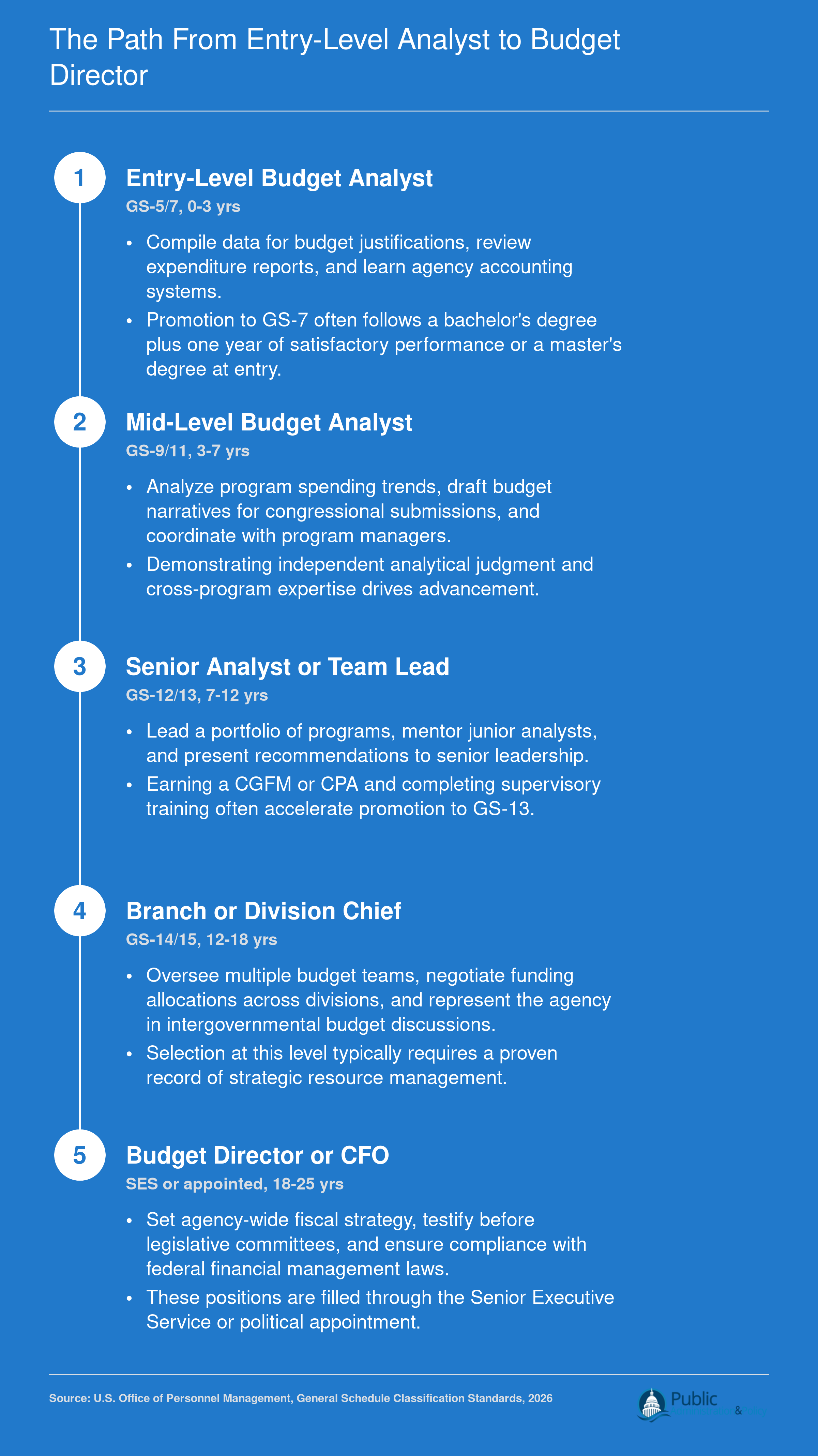
The Path From Entry-Level Analyst to Budget Director
Climbing the public budgeting career ladder typically takes 15 to 25 years, depending on agency size, performance, and whether you pursue advanced credentials. Each rung brings broader fiscal responsibility and greater influence over how public dollars are allocated.
Essential Skills and Tools for Public Budget Analysts
Success as a public budget analyst depends on a blend of analytical depth, technical fluency, and the interpersonal skills needed to guide fiscal decisions through complex political environments. Whether you are preparing for your first role or sharpening your profile for a promotion, the skill categories below will shape your competitiveness.
Core Analytical Skills
Public budgeting requires a distinct analytical toolkit. You will need proficiency in budget formulation and execution, understanding how appropriations move from proposal through obligation and expenditure. Cost-benefit analysis and cost-effectiveness analysis are daily staples, especially when agencies must justify competing spending priorities to oversight bodies.
Forecasting and trend analysis allow you to project revenues, expenditures, and caseloads across multi-year planning horizons. Equally important is a solid grounding in fund accounting principles. Unlike accrual-basis accounting common in the private sector, government accounting tracks resources by fund (general, special revenue, capital projects, and others) to ensure legal compliance with how taxpayer dollars are spent. Understanding this distinction is essential for anyone transitioning from corporate finance into a public budgeting career path.
Technical and Software Skills
Government agencies rely on specialized platforms that differ significantly from private-sector tools.
Advanced Excel: Spreadsheet modeling remains the backbone of budget analysis, from pivot-table summaries for leadership to multi-tab scenario models.
Government ERP systems: SAP Public Sector, Oracle Federal Financials, and CGI Advantage are among the most widely deployed enterprise platforms you will encounter.
Budget-specific applications: Tools such as Hyperion/PBCS, IBM Cognos, and GFMS handle planning, consolidation, and reporting across large agencies.
Data visualization: Tableau and Power BI are increasingly used to present budget data to elected officials and the public in accessible, interactive formats.
At the federal level, SQL and basic data analysis skills using Python are emerging as meaningful differentiators. Analysts who can query large appropriations datasets directly, rather than waiting for IT-generated reports, add speed and precision to the budget cycle.
Communication and Collaboration
Technical ability alone will not carry your career. Public budget analysts must translate complex financial data into clear narratives for non-financial stakeholders, including elected officials, agency heads, and community advocates. Written communication is especially critical: budget justifications, issue papers, and fiscal impact statements must be concise, accurate, and persuasive under tight deadlines. Professionals who enjoy this blend of quantitative reasoning and public policy making often find budget analysis deeply rewarding.
Negotiation skills surface during budget hearings and markup sessions, where you may need to defend an agency request or mediate between programs competing for limited funds. The ability to work across agencies with different missions and priorities, maintaining objectivity while building trust, separates competent analysts from those who advance into senior leadership.
Building a Competitive Edge
If you are early in your career, focus first on mastering fund accounting and at least one major ERP platform. Add data visualization and SQL capabilities as soon as practical. Earning a graduate certificate in public administration can help you build these competencies in a focused, accelerated format. These combined skills position you well for roles at any level of government and make you a stronger candidate on federal and state merit-system postings alike.
According to the Government Finance Officers Association, public budget analysts at the federal level help oversee the allocation of more than $6 trillion in annual spending. The Bureau of Labor Statistics reports roughly 50,000 budget analysts work across all levels of government, meaning each one plays an outsized role in shaping how public dollars translate into policy outcomes.
Certifications That Advance Your Public Budgeting Career: CGFM, CBA, and CPA
Earning a professional credential signals specialized competence and can accelerate your move from analyst to senior budget officer or director. Three certifications surface most often in public budgeting job postings, but they differ sharply in focus, recognition, and investment. For a broader look at credentials across the field, see our guide to certifications for public service. Below is a side-by-side look at each one so you can decide which fits your career stage and goals.
Certified Government Financial Manager (CGFM)
Issued by the Association of Government Accountants (AGA), the CGFM is widely regarded as the gold standard for professionals working in federal, state, or local government finance.1 Eligibility requires a bachelor's degree, at least two years of experience in U.S. government financial management, and agreement to the AGA Code of Ethics.2
Candidates must pass three exams covering distinct domains:
Exam 1: Governmental Environment
Exam 2: Governmental Accounting, Financial Reporting, and Budgeting
Exam 3: Governmental Financial Management and Control1
The application fee is approximately $90, with each exam priced at roughly $150 as of 2025-2026.2 Once certified, you must complete 80 hours of continuing professional education (CPE) every two years, including at least 4 hours of ethics content, with a cap of 20 hours in taxation topics.3
The CGFM is most valuable for mid-career professionals who already work inside government and want to formalize their expertise. If you are aiming for a supervisory budget role at a federal agency or a state budget office, this credential carries significant weight with hiring managers.
Certified Budget Analyst (CBA)
Offered by the American Institute of Budget Management (AIBM), the CBA is a newer and more narrowly targeted credential designed specifically for budget practitioners. The certification covers budget formulation, execution, forecasting, and performance measurement. Because it is less established than the CGFM or CPA, the CBA is not yet as widely recognized among federal HR panels, though it is gaining traction among state and local agencies that value specialized budget training.
The CBA can be a smart early-career move if you want a focused credential before committing to the broader scope of the CGFM or CPA. Prospective candidates should verify current exam fees and eligibility requirements directly with AIBM, as these details have been updated periodically.
Certified Public Accountant (CPA)
The CPA is issued by individual State Boards of Accountancy and is the most universally recognized accounting credential in the United States.1 Candidates typically need 150 semester hours of education and must pass the Uniform CPA Exam, which covers auditing, financial accounting, regulation, and business concepts. Work experience requirements and CPE obligations vary by state.
For public budget analysts, a CPA adds credibility in roles that touch financial reporting, audit oversight, grant compliance, fund accounting, or budget-to-actual variance analysis. It is particularly useful if your career path may cross into audit or inspector general functions. The investment is substantial in both exam preparation time and fees, so the CPA tends to benefit analysts who want maximum career flexibility across public and private sectors.
Choosing the Right Credential
If your goal is to build a long career inside government budget offices, the CGFM should be your first priority. Its exam content maps directly to the work you will perform daily, and federal and state agencies recognize it as a mark of genuine government finance expertise. A CPA makes strategic sense if you anticipate audit-adjacent responsibilities or want to keep private-sector doors open. The CBA fills a useful niche for early-career analysts seeking a budget-specific credential, though its market recognition is still growing. You can pursue more than one over time, and many senior budget directors hold both the CGFM and CPA to cover the full spectrum of government financial management. Pairing any of these credentials with an online MPA can position you competitively for leadership roles across all levels of government.
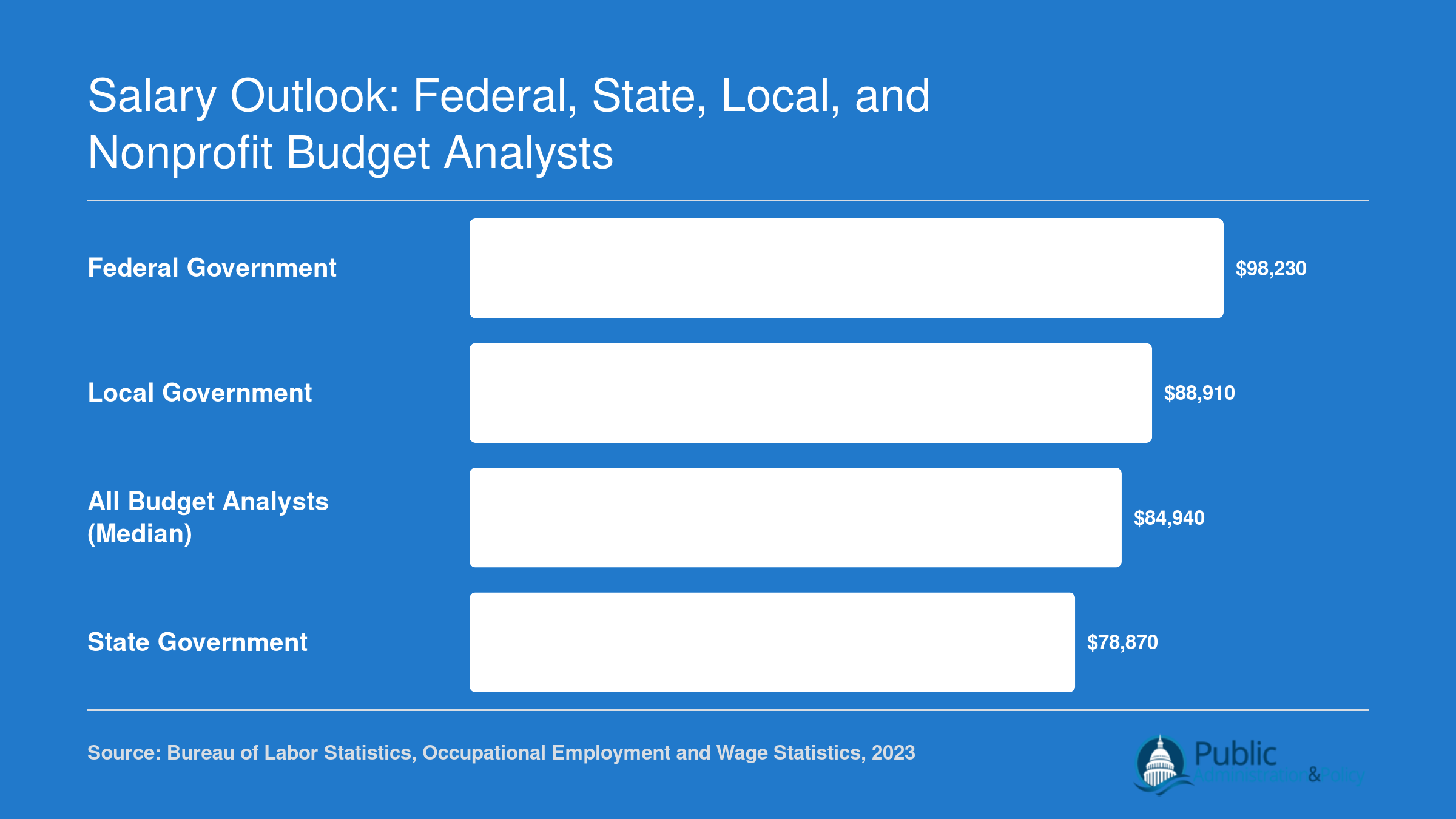
Salary Outlook: Federal, State, Local, and Nonprofit Budget Analysts
Government budget analysts earn competitive salaries, though compensation varies significantly by employer type. Federal budget analysts enjoy a notable premium over their state government counterparts, while local government roles often fall between the two. Nonprofit and quasi-governmental salary data is not consistently reported by BLS, so those figures are not included here.
When comparing federal budget analyst salaries to private sector figures, remember that base pay tells only part of the story. The Federal Employees Retirement System pension, Thrift Savings Plan matching contributions, generous annual and sick leave accrual, and subsidized health insurance together add roughly 30 to 40 percent on top of base salary in total compensation value.
Professional Associations and Networking for Public Budget Analysts
Career advancement in public budgeting depends as much on who you know as on what you know. Many government budget positions circulate informally through professional networks well before they appear on USAJOBS or state job boards. Joining the right organizations, and actively participating in them, gives you a meaningful edge at every stage of your career.
Four Organizations Every Public Budget Analyst Should Know
AGA (Association of Government Accountants): Offers the Certified Government Financial Manager (CGFM) credential and hosts an annual Professional Development Training (PDT) conference. AGA chapters exist in most metropolitan areas and provide a natural entry point for local networking.
GFOA (Government Finance Officers Association): Sets best practices for government finance nationwide and administers the Certified Public Finance Officer (CPFO) program. Its annual conference is one of the largest gatherings of state and local budget professionals in the country.
ASPA (American Society for Public Administration): Takes a broader public administration focus, but its budget and finance sections are directly relevant. ASPA is especially useful if your interests span policy analysis and fiscal management.
NASBO (National Association of State Budget Officers): An essential resource if you work at or aspire to work at the state level. NASBO publishes widely referenced fiscal survey reports and connects analysts across all 50 state budget offices.
A Practical Networking Strategy
Start by joining a local AGA or GFOA chapter. Attend monthly meetings, introduce yourself to seasoned professionals, and volunteer for a committee. Committee work, even something as simple as helping organize a training event, signals initiative and puts your name in front of hiring managers. Make attending the annual GFOA conference a goal within your first two years; this is where cross-jurisdictional connections form that can follow you throughout your career. Ask experienced members to serve as mentors. Many budget directors remember what it was like to break in and are willing to offer guidance. If your interests extend beyond fiscal management into broader policy analyst roles, the connections you build through these organizations will serve you in those transitions as well.
Low-Cost Entry Points
You do not need a large professional development budget to get started. Most of these organizations offer discounted student memberships, sometimes for as little as $25 to $50 per year. AGA and GFOA both host free or low-cost webinars on topics ranging from performance budgeting to federal grant compliance. Regional training events, often organized by local chapters, provide quality professional development without the travel costs of a national conference. Students currently enrolled in an online MPA program often find that chapter membership complements their coursework by connecting academic concepts to real-world budget practice.
Digital Networking Spaces
Beyond in-person events, LinkedIn hosts several active groups focused on government finance and public budgeting. Search for groups affiliated with GFOA, AGA, or broader government finance topics and contribute thoughtfully to discussions. GovLoop is another digital community worth joining; it functions as a social network specifically for government professionals and regularly features content on budget and finance career paths. These platforms are especially helpful for connecting with professionals in jurisdictions outside your own region, broadening your visibility when you are ready to pursue your next opportunity.
Frequently Asked Questions About Becoming a Public Budget Analyst
Below are answers to the most common questions prospective budget analysts ask when exploring this career path. Each response draws on the education, hiring, certification, and compensation details covered throughout this guide.
What degree do you need to become a budget analyst?
Most government budget analyst positions require at least a bachelor's degree in public administration, finance, accounting, economics, or a related field. A Master of Public Administration (MPA) or Master of Public Policy (MPP) is increasingly preferred for mid-level and senior roles, especially at the federal level. Coursework in public budgeting, statistics, and financial management strengthens your candidacy significantly.
How do I get a government budget analyst job through USAJOBS?
Start by creating a USAJOBS profile and uploading a federal-format resume that highlights relevant education, budget experience, and quantifiable accomplishments. Search for the Budget Analyst series (GS-0560) and filter by grade level. Entry-level positions typically fall at GS-7 or GS-9. Tailor each application to the specific vacancy announcement, use keywords from the posting, and complete all required questionnaires to avoid automatic disqualification.
What certifications do government budget analysts need?
Certifications are not always mandatory, but they can accelerate promotions and demonstrate expertise. The Certified Government Financial Manager (CGFM) credential from AGA is widely respected in public sector roles. The Certified Budget Analyst (CBA) designation is another strong option. A CPA license can also be valuable, particularly for analysts who oversee audit compliance or financial reporting within government agencies.
What is the difference between a public budget analyst and a private sector budget analyst?
Public budget analysts work within government agencies or nonprofits, managing taxpayer-funded budgets that must comply with legislative mandates, appropriations cycles, and public transparency requirements. Private sector analysts focus on corporate profitability, cost optimization, and shareholder returns. Public analysts typically enjoy stronger job security and benefits, while private sector roles may offer higher base salaries and performance bonuses.
How much do public sector budget analysts make at the federal, state, and local levels?
According to the Bureau of Labor Statistics, the median annual salary for budget analysts was approximately $84,940 as of the most recent reporting period. Federal budget analysts generally earn the highest salaries due to the General Schedule (GS) pay scale and locality adjustments, often exceeding $90,000 at mid-career. State and local analysts typically earn somewhat less, though total compensation packages including pensions and health benefits can close the gap.
Can I become a budget analyst with a political science or public policy degree?
Yes. A political science or public policy degree provides a strong foundation in government operations, legislative processes, and policy analysis. To strengthen your competitiveness, supplement your degree with coursework or electives in accounting, public finance, and data analysis. Many successful budget analysts entered the field through these programs, especially when paired with internships at government agencies or policy research organizations.
What software do government budget analysts use?
Government budget analysts regularly use Microsoft Excel for financial modeling, forecasting, and data analysis. Many federal agencies also rely on enterprise systems such as SAP, Oracle Federal Financials, or agency-specific budget formulation tools. Familiarity with data visualization platforms like Tableau or Power BI is increasingly valued. At the federal level, analysts may also work with MAX Budget, the OMB's primary budget data system.
You now have a clear roadmap. Three first moves will generate the most momentum: choose a degree path that aligns with public budgeting (an MPA or a bachelor's in public administration, finance, or a related field), create a USAJOBS profile and begin targeting Pathways programs or entry-level 0560 budget analyst postings, and join a professional community like AGA or GFOA to access credentials such as the CGFM and build the network that surfaces opportunities before they hit job boards.
If your background is outside finance, that is not a disqualifier. As earlier sections of this guide detail, supplemental coursework in public budgeting, accounting, or statistics, paired with the right certification, can bridge the gap. Exploring best online public administration degree programs is one practical way to build those competencies on your own schedule. Public budgeting is one of the few career paths where analytical rigor translates directly into how communities are served and how trillions of dollars shape public outcomes. The work matters, and the field needs sharp, mission-driven analysts ready to step in.