How to Become a City or County Manager: A Complete Career Roadmap
From education requirements to hiring timelines — the practical steps to lead a local government
By Max SheltonReviewed by PAP Editoral TeamUpdated July 31, 202625+ min read
What you’ll learn in this article…
Most city and county managers hold a master's degree in public administration or a related field and spend 10 to 20 years gaining progressive government experience before their first appointment.
Earning the ICMA Credentialed Manager designation, while voluntary, signals ethical and professional competence that sets candidates apart in a politically driven hiring process.
The median annual wage for chief executives in local government was $189,520 as of May 2023, with pay varying widely by community size and region.
The hiring process is uniquely political: council priorities, community dynamics, and professional recruiters shape selections as much as qualifications do.
More than 3,500 U.S. municipalities operate under the council-manager form of government, making the city or county manager one of the most consequential appointed positions in local public service. These executives oversee multimillion-dollar budgets, direct hundreds or even thousands of employees, and keep essential services running, from police and fire protection to water systems and land-use planning.
The role demands a specific combination of graduate education, progressive government experience, and political acumen that takes most professionals 10 to 20 years to build. Median pay for chief executives in local government topped $189,500 as of the latest federal data, yet compensation swings dramatically with jurisdiction size. Perhaps the sharpest tension in the profession: the manager serves at the pleasure of an elected body, so career stability depends as much on political fit as on operational competence. This guide breaks down every step of the journey, from choosing the right degree in public administration to navigating the executive search process and building a sustainable career in local government leadership.
What Does a City or County Manager Do?
Think of a city or county manager as the chief executive officer of a local government. Elected councils and boards set public policy priorities, approve budgets, and represent constituents. The manager translates all of that into reality. They run daily operations, prepare the annual budget, hire and supervise department heads, negotiate contracts, and coordinate long-range planning. The distinction is critical: the manager does not set policy. They execute it, advise on it, and are ultimately accountable to the elected body that hired them.
Across the United States, roughly half of all municipalities with populations of 2,500 or more use the council-manager form of government.1 By recent estimates, more than 3,500 cities and about 370 counties operate under this structure, collectively serving approximately 92 million people.1 Among larger cities with populations above 100,000, the share is even higher, with about 58 percent relying on an appointed professional manager.1 The model continues to be the dominant governance structure in American local government.
A Week in the Life
The breadth of a city or county manager's responsibilities becomes clearer when you look at a typical week. Consider a Monday morning spent reviewing quarterly revenue projections with the finance director, followed by a Tuesday afternoon preparing briefing materials for a council work session on zoning amendments. Wednesday might bring an evening community meeting where residents voice concerns about a failing stormwater system. Thursday could involve a sensitive human resources conversation with the police chief about a personnel complaint, and Friday might close with a regional planning authority meeting where the manager coordinates with neighboring jurisdictions on transportation funding.
No two days look the same, and no single technical skill covers the range. Managers need fluency in public finance, human resources, infrastructure planning, intergovernmental relations, and community engagement, often within the same 48 hours.
Council-Manager vs. Mayor-Council: Why the Structure Matters
Not every local government gives its top appointed professional the same authority. In a council-manager city or county, the manager holds broad operational control. They can hire and fire department heads, reorganize agencies, and present the budget with a high degree of independence. In contrast, mayor-council cities sometimes employ a chief administrative officer who fills a similar coordinating role but often with more limited authority. The mayor retains executive power, and the CAO serves at the mayor's discretion rather than the council's. Research comparing the two forms has found that council-manager cities tend to spend more per capita ($1,037 versus $944 in mayor-council cities), reflecting the broader operational mandate these managers carry.2
This distinction directly affects job security and professional autonomy. A council-manager arrangement gives the manager a clear mandate to run the organization, but it also means they can be dismissed by a simple council majority. Understanding which governance form a community uses is essential before you apply for a position.
Scale Changes Everything
The size of the community dramatically shapes what the job looks like day to day. In a town of 10,000 residents, the manager may personally handle human resources disputes, draft press releases, and inspect a water main break, essentially serving as the de facto HR director, public affairs specialist, and emergency coordinator rolled into one. With a lean staff of perhaps 50 employees, the manager is deeply hands-on.
Contrast that with a city of 200,000, where the manager oversees 2,000 or more employees through a team of assistant city managers, each responsible for a portfolio of departments. At this scale, the work shifts toward strategic leadership, intergovernmental negotiation, and managing the politics of a large, complex bureaucracy. Both roles carry the same title, but they demand different skill sets and temperaments. As you explore this career in public policy, understanding where you thrive on that spectrum will help you target the right opportunities.
City Manager Vs. County Manager: Key Differences
Although city managers and county managers share nearly identical educational backgrounds and core competencies, the structural and political environments they operate in differ significantly. Understanding these distinctions can help you decide which path aligns with your career goals. Below is a side-by-side comparison across the dimensions that matter most.
Dimension
City Manager
County Manager
Governing Body
Appointed by and reports to a city council, typically consisting of 5 to 9 elected council members
Appointed by and reports to a board of county commissioners or board of supervisors, which may range from 3 to 7 or more members depending on state law
Jurisdiction Type
Manages an incorporated municipality operating under a city or municipal charter that grants significant local autonomy
Oversees services across a county, including unincorporated areas and sometimes coordinating with multiple incorporated cities within the county's boundaries
Typical Service Scope
Focuses on municipal services such as water and sewer utilities, local zoning and land use, parks and recreation, police, fire, and public works
Responsible for a broader, often state-mandated portfolio including courts, jails and corrections, elections administration, public health departments, and social services
Discretion and Mandates
Operates with relatively high discretion under the municipal charter; the city council sets local priorities and the manager implements them with considerable flexibility
Often has less discretion because many core services (courts, elections, social services) are mandated by state law, leaving the manager to administer programs with strict regulatory requirements
Political Dynamics
Works within a council-manager form of government where political relationships are concentrated among a smaller group of council members and local stakeholders
Navigates a more complex political landscape that may include state agencies, judges, constitutional officers (sheriff, clerk of court, tax assessor), and multiple municipalities within the county
Availability of Positions
More plentiful nationwide because the council-manager form of government is widely adopted across thousands of municipalities in the United States
Less common because many counties still operate under an elected executive model or a commission-only structure without a professional appointed manager
Educational and Skill Requirements
Typically requires a Master of Public Administration (MPA) or related graduate degree, plus progressive local government experience and strong budgeting, leadership, and communication skills
Requires essentially the same credentials: an MPA or similar degree, progressive government experience, and competency in finance, human resources, and intergovernmental relations
Questions to Ask Yourself
Are you comfortable holding a position where a single council vote can end your tenure, sometimes for purely political reasons unrelated to your job performance?
City and county managers serve at the pleasure of elected councils. Terminations driven by shifting political alliances, not performance shortfalls, are a well-documented reality of the profession. Financial security and emotional resilience under that uncertainty are non-negotiable.
Are you willing to relocate multiple times over the course of your career?
Most local government managers change communities every five to seven years, whether by choice or necessity. Career advancement often means moving to a larger jurisdiction in a different region, which affects family stability, homeownership, and community roots.
Can you translate between the technical language of professional staff and the political priorities of elected officials without alienating either side?
You effectively serve two bosses: department heads who rely on data and best practices, and council members who answer to voters. Succeeding requires fluency in both worlds and the diplomacy to reconcile competing agendas under public scrutiny.
Do you find satisfaction in behind-the-scenes operational leadership rather than public-facing political recognition?
Elected officials typically receive credit for policy wins, while the manager handles day-to-day execution. If you need visible public recognition to stay motivated, the council-manager structure may feel frustrating over time.
Step 1: Earn a Relevant Degree
Education is the foundation of a career in city or county management, and choosing the right degree path matters more here than in many other public sector roles. While a bachelor's degree is the minimum qualification, the master's degree has become the de facto industry standard for anyone serious about leading a local government.
Start With a Strong Undergraduate Foundation
Most aspiring city and county managers begin with a bachelor of public administration, political science, urban planning, or business administration degree. Any of these fields will give you useful exposure to government structures, budgeting, and policy analysis. That said, your undergraduate major is less important than what comes next: the vast majority of managers in cities with populations over 25,000 hold a graduate degree, and job postings for mid-size and large jurisdictions almost universally list one as a requirement or strong preference.
MPA vs. MBA vs. MPP: Which Master's Degree Fits?
Three graduate credentials show up most often in this profession, but they serve different purposes.
Master of Public Administration (MPA): This is the most common degree among practicing city and county managers. MPA programs are built around the operational realities of government: budgeting, human resources management, intergovernmental relations, and organizational leadership. If your goal is to run a municipality, the MPA is the most direct path.
Master of Business Administration (MBA): An MBA carries weight in larger cities where financial complexity rivals that of private-sector organizations. It signals strength in fiscal management, strategic planning, and data-driven decision making. Some managers combine an MPA with MBA-level coursework, or choose an MBA with a public management concentration.
Master of Public Policy (MPP): The MPP skews more toward policy analysis, program evaluation, and research methodology than toward day-to-day operations. It is a strong credential for roles in policy development or legislative analysis but is less commonly held by managers who oversee service delivery and departmental operations.
If you are targeting a career as a practicing local government manager, the master of public administration should be your default choice. Consider the MBA if you plan to work in a large or financially complex jurisdiction. Reserve the MPP for a career that blends management with heavy policy work.
Do You Actually Need a Master's Degree?
Technically, no. Smaller communities sometimes hire managers who hold only a bachelor's degree, particularly if the candidate brings decades of progressive government experience. In practice, however, skipping the graduate degree limits your competitiveness significantly. ICMA survey data consistently shows that the overwhelming majority of appointed managers and administrators hold at least a master's degree. For cities above 25,000 residents, it is nearly universal. If you intend to advance beyond small-town administration, plan on earning one.
Look for NASPAA Accreditation
When evaluating MPA programs, prioritize those accredited by the Network of Schools of Public Policy, Affairs, and Administration (NASPAA). NASPAA accreditation is the gold standard for public affairs graduate education. It ensures the curriculum meets rigorous peer-reviewed benchmarks in areas such as public management, policy analysis, and ethical leadership. Many NASPAA-accredited programs now offer fully online or executive-format options designed for working professionals, making it possible to earn your degree while gaining the government experience that hiring councils also expect. You can explore best online public administration degree programs to compare accredited options by format, cost, and specialization.
Step 2: Build Progressive Government Experience
Earning a degree opens the door, but the path to a city or county manager appointment runs through years of hands-on government work. Hiring panels consistently look for one phrase on your resume: progressive responsibility. That means a track record of taking on broader, more complex leadership roles over time, not just logging years in a single department.
A Realistic Career Ladder
While every career unfolds differently, a common trajectory looks roughly like this:
Management analyst or budget analyst (years 1 to 3): You learn the nuts and bolts of municipal operations, from revenue forecasting and capital budgets to council agenda preparation. These roles build analytical credibility and let you observe how decisions move through an organization.
Assistant to the city manager (years 3 to 6): This staff-level position gives you direct exposure to the chief executive's office. You draft policy memos, coordinate across departments, and begin interacting with elected officials, all without yet carrying line authority.
Assistant city manager or department director (years 6 to 12): Now you manage people, budgets, and programs. Whether you oversee public works, community development, or administrative services, the goal is demonstrating that you can run a sizable operation and navigate the political dynamics that come with it.
First city or county manager appointment (years 10 to 15 from career start): Most professionals land their first top appointment after a decade or more of cumulative experience, often in a small or mid-size community where the governing board values breadth over big-city pedigree.
Why Cross-Departmental Exposure Matters
Deep specialization in finance or planning is valuable, but it can actually work against you in a manager search. Governing boards want someone who can credibly oversee every function, from HR and IT to parks and utilities. Seek rotational assignments, volunteer for interdepartmental task forces, and take on special projects outside your home department. The wider your exposure to finance, human resources, public works, and community development, the stronger your candidacy will be when the time comes. Professionals who have worked in policy analyst roles, for instance, often bring sharp analytical instincts that translate well into broader executive leadership.
Starting Small to Move Up
Communities with populations between 5,000 and 50,000 are often the best launching pads. In a smaller jurisdiction, an assistant city manager might handle everything from labor negotiations to emergency management in the same week. That breadth is hard to replicate in a large city where roles are more compartmentalized. Many successful managers of major metropolitan communities began their careers in towns most people have never heard of, using that broad foundation to compete for progressively larger appointments.
Lateral Entry From Other Sectors
Former military officers, nonprofit executives, and state agency managers do cross into local government management, and some bring highly transferable leadership skills. However, lateral entrants should expect to serve as an assistant or deputy manager before being considered for the top job. Municipal governance has unique mechanics, including council-manager dynamics, public meeting laws, intergovernmental funding streams, and civil service rules, that require firsthand experience. A stint in a deputy role allows you to learn those systems while demonstrating to future hiring panels that you understand how local government actually operates day to day.
Regardless of which path you follow, treat every role as a chance to broaden your portfolio. The managers who rise fastest are the ones who consistently seek out unfamiliar challenges rather than staying comfortable in a single lane.
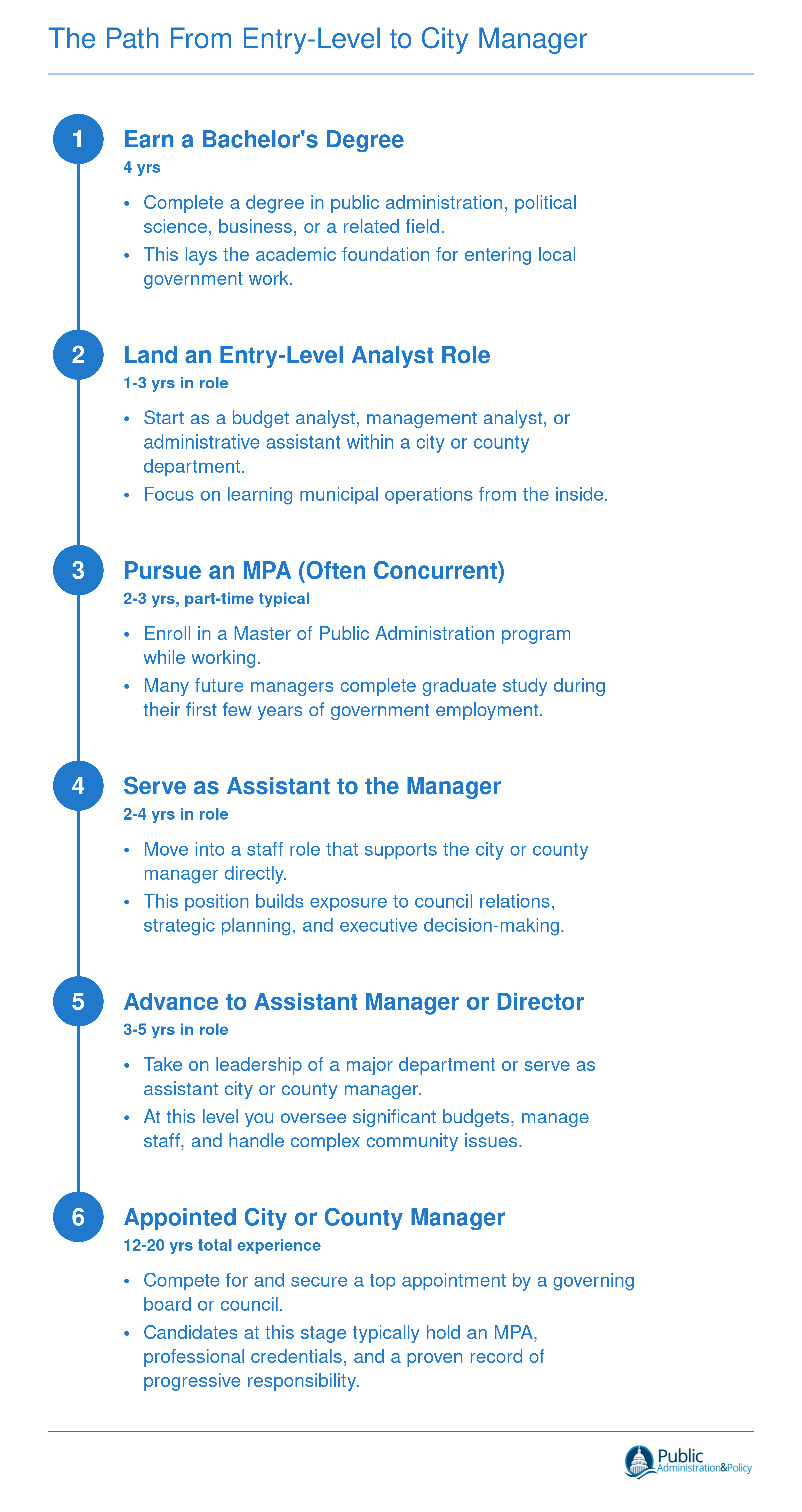
The Path From Entry-Level to City Manager
Most city and county managers spend 10 to 20 years climbing from their first government post to the top appointed role. The timeline below maps the typical career sequence and realistic timeframes at each stage, so you can plan accordingly.
Step 3: Pursue Professional Certifications, the ICMA Credentialed Manager
While no license is required to serve as a city or county manager, a voluntary professional credential can distinguish you from other candidates and signal to elected officials that you operate at the highest standard of ethical, competent management. The most recognized designation in the field is the ICMA Voluntary Credentialing Program, formally known as the ICMA Credentialed Manager (ICMA-CM), awarded by the International City/County Management Association.
What the ICMA-CM Designation Means
The ICMA Credentialed Manager credential is not a one-time test you pass and forget. It is an ongoing commitment to professional ethics, continuous learning, and peer accountability.1 Holding the credential tells hiring authorities that you have been vetted against the ICMA Code of Ethics and that you maintain your skills through structured professional development. For communities searching for their next top administrator, that assurance carries real weight.
Eligibility and Application Process
Earning the ICMA-CM requires a meaningful track record in local government leadership. Key requirements include:
Role: You must be serving, or have served, as a chief administrative officer (CAO) or assistant CAO of a local government.2
Experience: A minimum of seven years of qualifying service is required.2
Assessment: Applicants must complete the ICMA Management Assessment, which evaluates competencies across areas such as financial management, community engagement, and strategic leadership.3
Ethics commitment: You must demonstrate adherence to the ICMA Code of Ethics, a foundational document that governs professional conduct in the field.
Applications are submitted online through your ICMA account, and the association accepts them on quarterly deadlines throughout the year.3 Once credentialed, you are required to complete 40 hours of continuing education annually4 and undergo a multi-rater assessment (a 360-degree feedback tool completed by colleagues, elected officials, and direct reports) every five years.5 These renewal requirements ensure that the credential remains a living standard rather than a static line on a resume.
Does the Credential Affect Career Outcomes?
ICMA does not publish a precise salary premium tied to the credential, and the data on competitive advantage is not as granular as many candidates would like. That said, anecdotal evidence and hiring trends suggest that credentialed managers are more likely to be considered for positions in larger jurisdictions where councils actively seek candidates with demonstrated commitment to professional development. Some executive search firms note the ICMA-CM as a preferred or recommended qualification in their postings, particularly for communities with populations above 25,000. If you aspire to manage increasingly complex organizations, pursuing this credential is a strategic investment.
Other Credentials Worth Considering
The ICMA-CM is the gold standard for local government management, but it is not the only credential that can strengthen your candidacy. Professionals earlier in their careers in public administration may benefit from stacking complementary certifications as they build experience:
Certified Public Manager (CPM): Offered through state-level programs (often in partnership with universities), the CPM focuses broadly on public sector management competencies and is especially valuable early in your career before you meet the ICMA-CM's seven-year threshold.
Project Management Professional (PMP): Demonstrates your ability to manage complex initiatives on time and on budget, a skill elected officials deeply appreciate.
Financial certifications: Credentials such as the Certified Government Financial Manager (CGFM) show that you can navigate the nuances of public budgeting, auditing, and financial reporting.
None of these replace the ICMA-CM, but stacking complementary certifications throughout your career creates a portfolio that communicates both depth and range. Start with the credentials that match your current career stage, and plan your path toward ICMA credentialing once you have accumulated the required experience.
Step 4: Navigate the Hiring Process
Landing a city or county manager position is unlike applying for most government jobs. The process is highly structured, politically sensitive, and often mediated by professional recruiters who specialize in local government leadership placements. Understanding how the system works gives you a meaningful advantage over candidates who simply submit a resume and wait.
How Executive Search Firms Shape the Process
Most cities and counties with populations above 25,000 hire an executive search firm to manage their recruitment. Firms such as SGR, GovHR USA, Slavin Management Consultants, and Baker Tilly (which recently handled the City of Golden's manager search2) dominate this space. ICMA maintains a resource directory for executive searches to help communities and candidates identify reputable recruiters.
These firms do far more than post a job listing. They actively recruit passive candidates, conduct preliminary background reviews, and present a curated shortlist to the governing body. When screening applicants, recruiters evaluate three things above all else:
Progressive responsibility: A clear trajectory from analyst or department head roles into assistant manager or deputy positions.
Community fit: Whether your management style, policy philosophy, and communication approach align with the community's culture and priorities.
Absence of red flags: Any history of ethical complaints, contentious departures, litigation, or public controversies will surface during their vetting. Recruiters routinely contact references you did not provide.
If you are preparing for your first manager search, building a relationship with recruiters before you are ready to apply is a smart move. Attending ICMA conferences and state association meetings puts you on their radar.
Typical Interview Stages
The hiring process generally unfolds in four phases and can stretch from three to six months:
Recruiter screening: A phone or video interview with the search firm to assess qualifications, salary expectations, and interest level.
Semifinalist panel interview: A more formal session, often with council members, senior staff, and sometimes community stakeholders. Expect scenario-based questions about budgets, labor negotiations, and crisis management.
Finalist public forum: Many communities require finalists to participate in a public meet-and-greet or community forum where residents can ask questions directly. This stage tests your communication skills and comfort with transparency.
Final council vote: The governing board deliberates and votes, sometimes in a public meeting. The decision is inherently political, and factors beyond your resume, such as interpersonal chemistry with elected officials, often tip the balance.
Patience is essential. Timelines slip regularly due to scheduling conflicts, council turnover, or unexpected political dynamics.
Negotiating Your Contract
Once selected, you will negotiate a written employment agreement. A formal contract is standard practice in the profession, and ICMA's ethics code encourages managers to insist on one.3 Typical contract provisions include:
Initial term: Most agreements cover two to three years, with automatic renewal for one-year periods unless either party provides notice.3
Severance protection: Contracts commonly guarantee six to 12 months of salary upon termination without cause, though some jurisdictions offer up to 18 months. This clause is not a luxury; it reflects the political vulnerability of the role.3
Resignation notice: Managers are generally required to give 30 to 60 days written notice before departing voluntarily.3
Additional benefits: Relocation allowances, vehicle stipends, enhanced retirement contributions, and professional development budgets (covering ICMA membership, conferences, and continuing education) are all negotiable and widely offered.
Annual evaluation: Contracts typically require a formal performance review at least once per year, conducted by the governing body.3
Indemnification: Most agreements include a clause requiring the jurisdiction to cover legal costs if you are sued for actions taken in your official capacity.3
Termination, when it happens, must occur through a public meeting and vote, reinforcing how visible this position is.3
Understanding Tenure and Career Mobility
Nationally, city and county managers remain in their current position for roughly six to eight years on average, though annual turnover rates range from 10 to 20 percent across the profession.3 First-time managers appointed in smaller communities often serve three to four years before pursuing opportunities in larger jurisdictions with bigger budgets and more complex operations. This stepping-stone pattern is well established and expected within the field, much like progression across other careers in public administration.
Knowing these norms helps you plan realistically. Your first appointment is unlikely to be your last, and each role builds the track record that search firms and councils evaluate for the next opportunity.
Even the most qualified candidate can lose a city manager appointment to someone who better fits a council's political moment. A community recovering from scandal may prioritize ethics and transparency credentials, while a fast-growing suburb may seek a development-oriented operator. Tailor every application to the community's current story, not just your resume.
City and County Manager Salary and Job Outlook
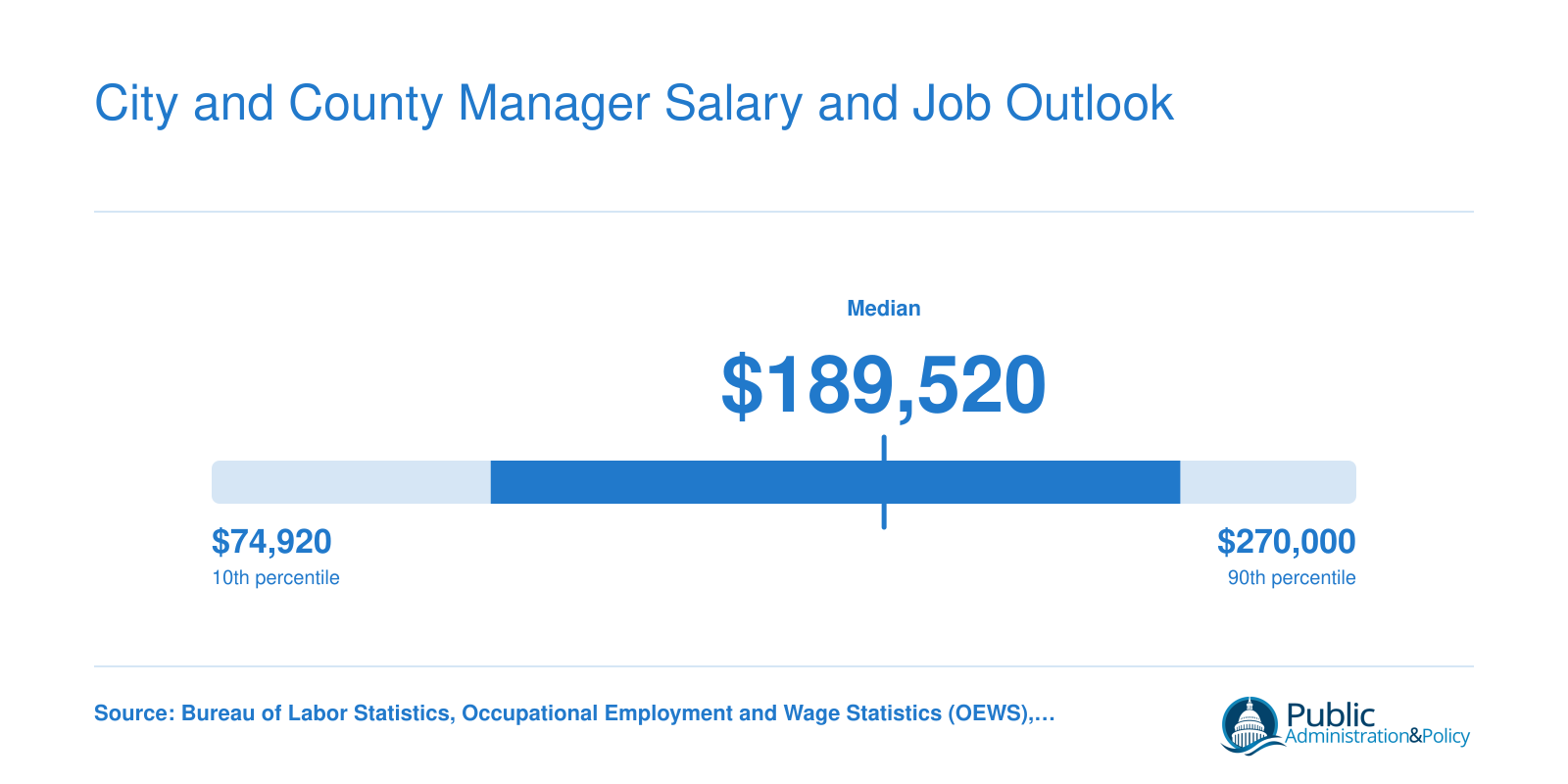
The Bureau of Labor Statistics groups city and county managers under the Chief Executives category (SOC 11-1011). The median annual wage was $189,520 as of May 2023, but pay varies widely by community size: managers in small towns under 10,000 residents often earn closer to the lower percentiles, while those leading large metros can exceed $200,000. Total compensation frequently adds 20-30% on top of base salary through benefits such as vehicle allowances, housing stipends, deferred compensation plans, and retirement contributions. Job growth for this category is projected at about 4%, roughly in line with the average for all occupations.
Challenges, Realities, and Career Growth
City and county management is one of the most rewarding career paths in public service, but it demands a level of personal sacrifice that candidates should weigh carefully before committing. The profession carries structural risks that no amount of talent or preparation can fully eliminate.
Political Risk and Job Security
City and county managers serve at the pleasure of the elected council or board of commissioners. A single election cycle that shifts the political majority can end your tenure, regardless of your performance record, budget discipline, or community satisfaction. Involuntary terminations are not uncommon in the profession. Some managers negotiate severance clauses into their employment agreements precisely because turnover driven by political realignment is a known occupational hazard rather than an exception. You can run an objectively well-managed government and still lose your position because new council members want "their own person" in the role.
Work-Life Balance
Expect to work 50 to 60 hours in a typical week, and more during crises. Council meetings regularly extend into late evenings, sometimes past 10 p.m. Community emergencies like flooding, infrastructure failures, or public safety incidents have no regard for weekends or holidays. In smaller jurisdictions, you are also a highly visible public figure. Your neighbors know where you live, your dining choices become small talk, and your family's daily life receives a level of scrutiny that most private-sector professionals never encounter. The boundary between professional and personal identity can feel razor-thin, especially in communities under 50,000 residents.
Relocation Frequency
Most managers move three to five times over the course of a career, often across state lines. Each move disrupts a spouse's or partner's employment, uproots children from schools, and severs the community connections you have spent years building. This pattern of relocation is one of the leading reasons professionals leave the field. Dual-career households face particular strain, and candidates should discuss this reality with their families well before accepting a first appointment.
Career Paths Beyond the Manager's Office
The skills you develop in city or county management translate to a wide range of second-act careers. Common trajectories include:
Consulting: Many former managers become advisors through ICMA or join executive search firms that recruit local government leaders.
Academia: Retired managers frequently teach as adjunct or full-time faculty in Master of Public Administration programs, bringing invaluable practitioner perspective to the classroom.
State and federal government: Senior roles in intergovernmental affairs, emergency management, or state municipal leagues draw heavily from former local government managers.
Private sector: Utility companies, real estate development firms, and engineering consultancies value the regulatory knowledge and stakeholder management expertise that managers bring.
None of these transitions are automatic, but the breadth of competencies you build, from finance and labor relations to crisis communication, positions you as a versatile executive in almost any organizational setting. Former managers who pivot into policy consulting find that their experience navigating elected boards and public budgets gives them an immediate credibility advantage. Understanding these exit ramps early in your career can reduce the anxiety that comes with the profession's inherent political volatility.
Frequently Asked Questions About Becoming a City or County Manager
Aspiring local government managers often have practical questions about timelines, qualifications, and career stability. Below are concise answers to the questions we hear most often from students and mid-career professionals considering this path.
How long does it take to become a city manager?
Most city managers reach the role after 10 to 15 years of combined education and professional experience. A typical timeline includes four years for a bachelor's degree, two years for a master's degree in public administration or a related field, and five to ten years of progressive local government work. Smaller municipalities sometimes appoint managers with fewer years of experience, while larger cities generally expect a longer track record.
Do you need a master's degree to be a city manager?
A master's degree is not legally required in most jurisdictions, but it is strongly preferred. The majority of job postings for city and county manager positions list a Master of Public Administration (MPA) or a related graduate degree as a preferred or required qualification. Candidates without a master's degree can sometimes compensate with extensive management experience, yet the credential significantly strengthens competitiveness in the hiring process.
What is an ICMA Credentialed Manager?
The ICMA Credentialed Manager designation is a voluntary professional credential awarded by the International City/County Management Association. It recognizes local government managers who meet standards for education, experience, and adherence to a professional code of ethics. Earning the credential involves documenting at least a certain level of executive experience, completing ongoing professional development, and demonstrating ethical leadership. It signals a commitment to excellence in public management.
What is the difference between a city manager and a city administrator?
The titles are often used interchangeably, but they can carry different levels of authority depending on the municipality. A city manager typically serves as the chief executive under a council-manager form of government, with broad authority over operations and staffing. A city administrator usually works under a mayor-council system with more limited executive powers, functioning in an advisory or coordinating role rather than as the top decision-maker.
Can you become a city manager without government experience?
It is rare but not impossible. A small number of municipalities have hired managers from the nonprofit or private sector, especially when candidates bring transferable skills in budgeting, operations, or organizational leadership. However, most appointing councils strongly favor candidates with direct local government experience because the role demands familiarity with public finance, intergovernmental relations, and the political dynamics unique to municipal governance.
How stable is a city manager's job?
City and county managers serve at the pleasure of their governing boards, which means they can be dismissed without cause. The average tenure for a city manager is roughly seven years, according to industry surveys, though turnover can be faster in politically volatile communities. Employment contracts with severance provisions help offset this risk. Building strong relationships with elected officials and maintaining transparent communication are the most effective strategies for long-term job stability.
The path is straightforward, even if it is not quick: earn a relevant degree (ideally a NASPAA-accredited MPA), accumulate 10 to 15 years of progressive local government experience, pursue ICMA credentialing, and stay open to relocating for the right opportunity.
If you are ready to start, take three concrete steps now. Explore accredited online MPA programs that align with your schedule and budget. Join ICMA as a student or early-career member to access mentorship and job boards. And apply for a management analyst or budget analyst role in a city or county department to begin building the operational track record hiring panels expect. Few careers in public administration let you directly shape the quality of life for an entire community. City and county management is one of them.
City Manager Qualifications
The path to becoming a city or county manager is neither accidental nor rapid; it is built on a deliberate accumulation of credentials, experience, and trust. Municipalities and counties hire for this role with clear expectations: a master's degree, more than a decade of progressively responsible government work, and a demonstrated capacity to lead across departments and political environments.
Educational Foundation
A bachelor's degree is the non-negotiable starting point. Common majors include public administration, political science, urban planning, and business.2 These fields provide grounding in public policy, organizational behavior, and fiscal analysis. For towns and small counties, a bachelor's may be sufficient when paired with deep local experience, but nearly three out of five city managers hold a graduate degree. According to the most recent State of the Profession data from the International City/County Management Association, 59 percent of local government managers have a master's.1
The Master of Public Administration (MPA) is the most direct and widely respected credential. Other strong options include the Master of Public Policy (MPP) and the Master of Business Administration (MBA), particularly when the program includes coursework in public budgeting, intergovernmental relations, and ethics. Large jurisdictions and county governments with multimillion-dollar budgets consistently prefer candidates with an MPA or equivalent.
Professional Experience
The resume of a competitive city manager candidate typically shows 8 to 15 years of progressively responsible local government experience.2 Entry points often begin in analytical roles: budget analyst, management analyst, or policy associate. From there, professionals move into department head positions (parks and recreation, public works, community development) or into an assistant city manager role, where they directly support the manager and gain cross-departmental exposure.
Council-manager systems expect candidates to have hands-on experience with public budgets, union negotiations, and long-range planning. A career that includes both operational management and policy advising signals readiness for the top job. Those who have served as an assistant city manager for several years, particularly in a larger jurisdiction, are often shortlisted when a manager position opens in a mid-sized city or county.
ICMA Credentialed Manager Designation
The International City/County Management Association (ICMA) offers the Credentialed Manager (CM) designation, a voluntary public administration certification that is increasingly valued by hiring bodies.1 Earning the CM credential signifies a commitment to the ICMA Code of Ethics and a mastery of defined competencies in leadership, service delivery, and personnel management. While not a legal requirement anywhere in the United States, the designation can differentiate a candidate in a competitive search.1 It requires a combination of education, significant professional experience, and ongoing professional development, reinforcing the same qualifications already essential for the role.
Critical Skills
Technical ability alone does not secure a city manager position. Councils look for sophisticated budget management, nuanced policy analysis, and clear, honest communication. A city manager must translate complex financial data into accessible briefings, facilitate public meetings with composure, and negotiate with labor unions while maintaining community trust. Strategic planning, crisis management, and emotional intelligence complete the skill set. These abilities are honed over years, not months, and are tested repeatedly during the interview process and in the first few months on the job.1