Best Online Master of Public Policy Programs for Wyoming Students
Ranked online MPP degrees accessible from Wyoming — with cost, career outcomes, and accreditation compared side by side.
By Max SheltonReviewed by PAP Editoral TeamUpdated July 16, 202625+ min read
What you’ll learn in this article…
Wyoming has no in-state online MPP program, so all options are out-of-state or national online degrees.
NASPAA-accredited online MPP programs from Johns Hopkins, USC Price, and American University accept Wyoming residents.
Most public universities charge flat online tuition rates or honor WICHE agreements, keeping costs competitive for Wyoming students.
MPP graduates in Wyoming find policy roles in energy, land management, and state government with strong earning potential.
No Wyoming institution currently offers an online Master of Public Policy degree. That gap matters less than it sounds. Top nationally ranked programs from Johns Hopkins, USC, American University, and others enroll Wyoming residents at flat online tuition rates, often comparable to what in-state students pay elsewhere.
Wyoming's state and local government sector employs roughly one in five workers, and with a population under 600,000, individual policy analysts here shape legislation and budgets in ways that would take a decade to achieve in larger states. An MPP sharpens the quantitative and analytical skills that those roles demand.
The practical tension for Wyoming applicants is cost. Without a home-state program, tuition can range from roughly $20,000 to over $100,000 depending on the school, and regional tuition-exchange agreements like WICHE do not always extend to online formats. NASPAA accreditation further narrows the field of programs worth serious consideration. Students in neighboring states face similar dynamics; those researching online MPP programs Montana or best online MPP programs for South Dakota students will find comparable tradeoffs when shopping a national marketplace.
Top Online MPP Programs Available to Wyoming Students
Wyoming has no in-state Master of Public Policy program, but that does not limit your options. The online-first programs below are ordered by a mixed quality composite that weighs institutional graduation rates, net price after aid, and program outcomes. All accept students from Wyoming and can be completed remotely, with several offering flat-rate online tuition or government-employee discounts that make them especially practical for working professionals in the Equality State. Note that the net price and graduation rate shown for each school are institution-wide averages drawn from federal data, not program-specific figures.
NCES-IPEDS federal institutional data — nces.ed.gov
Independent program research
#1
University of Pittsburgh-Pittsburgh
Pittsburgh, PA · $30,000/yr
Best for: Mid-career government employees seeking tuition savings
The University of Pittsburgh's Graduate School of Public and International Affairs offers a Master of Public Policy and Management (MPPM) built for mid-career professionals with at least five years of experience. What sets this program apart for Wyoming residents is that all online students pay in-state tuition regardless of where they live, and full-time government employees receive an additional 20 percent tuition discount. The 30-credit curriculum can be completed in 20 months through a fully online track, making it one of the most accessible options for state and local government workers across Wyoming.
View program
Master of Public Policy and Management — Online
30 credit hours: 4 required courses plus 6 electives
Fully online track completable in 20 months
In-state tuition for all online students regardless of residency
20% tuition discount for full-time government employees
No entrance exam required for admission
Flexible delivery: online, on-campus, or hybrid formats
Emphasis on real-world problem solving for public service roles
Best for: Energy and natural-resource policy professionals
The University of Tennessee-Knoxville's Baker School delivers a fully online MPP with seven concentration tracks that align closely with Wyoming's economy, including Energy Policy, Agricultural and Environmental Policy, and National Security. The 36-credit program is NC-SARA eligible, so Wyoming residents can enroll without regulatory hurdles. With no thesis required and a capstone master class that emphasizes applied analysis, the program is designed for professionals who want to stay in the workforce while earning their degree.
View program
Master of Public Policy — Online
36 credit hours with no thesis required
Fully online delivery via NC-SARA authorization
Seven 9-credit concentration options including Energy Policy
Capstone master class replaces traditional thesis
GRE required only for applicants with non-U.S. degrees
Internship component builds hands-on experience
Concentrations in agriculture, health, and national security
Best for: Professionals needing a fast, asynchronous format
Binghamton University offers one of the few entirely asynchronous online MPP programs in the country, allowing Wyoming students to complete coursework on their own schedule across fall, spring, and summer terms. The curriculum emphasizes data analysis, policy modeling, and global perspectives, and can be finished in as little as one year of full-time study. As a SUNY institution, Binghamton charges a dedicated online graduate tuition rate that is typically lower than standard non-resident pricing, making it a cost-effective choice for out-of-state learners.
View program
Master of Public Policy — Online
100% online with fully asynchronous course delivery
Can be completed in one year of full-time study
Dedicated online tuition rate lower than non-resident campus rate
Applied policy laboratory for real-world project experience
Focus on data analysis, policy modeling, and global perspectives
Military-friendly program with flexible scheduling
Prepares graduates for government, nonprofit, and private sectors
Oregon State University's NASPAA-accredited MPP is available through its Ecampus platform in a hybrid or fully online format, with flat tuition for all distance students regardless of state of residence. Wyoming students studying energy, environmental, or rural policy will find especially relevant concentrations here. The 54-quarter-credit curriculum includes an 11-week capstone policy lab in which student teams conduct research for real clients.
View program
Master of Public Policy, energy policy — Hybrid
NASPAA-accredited with 54 quarter credit hours required
Flat Ecampus tuition: no out-of-state surcharge for online students
Seven concentrations plus a self-designed option
Energy, Environmental, and Rural Policy tracks suit Wyoming needs
11-week capstone policy lab with real client partnerships
Military-friendly program with interdisciplinary faculty
Duke University's Sanford School of Public Policy offers a Master of Public Policy through a hybrid model blending online and on-campus learning over 24 months. With eight policy-area concentrations, including Development Policy and Energy and Environment Policy, the program emphasizes evidence-based analysis and inclusive leadership. Duke boasts a 96.8 percent institutional graduation rate and provides fellowship and financial aid opportunities, though Wyoming students should note that the program requires periodic campus visits to Durham, North Carolina.
View 2 programs
Master of Public Policy — Hybrid
24-month hybrid program with online and on-campus components
Eight policy-area concentrations available
51 credit hours including core courses and capstone project
Dual degree options with other Duke graduate programs
GRE is optional for admission
Financial aid and fellowship opportunities available
Summer internship required for hands-on experience
George Mason University's Schar School of Policy and Government delivers its MPP in a hybrid format with evening classes and a substantial online component, leveraging its proximity to Washington, D.C. The program connects students with practitioners at agencies and organizations such as the World Bank, USAID, and leading consulting firms. George Mason is NC-SARA eligible, so Wyoming residents can take its online coursework without additional authorization, though some on-campus attendance may be expected.
View program
Master of Public Policy — Hybrid
Hybrid format with evening classes near Washington, D.C.
NC-SARA eligible for Wyoming online enrollment
Merit scholarships and military tuition assistance accepted
80+ faculty members with practitioner experience
Focus on policy analysis, technology modeling, and global issues
Dedicated career development advisors for each student
The University of Houston's Hobby School of Public Affairs houses a NASPAA-accredited MPP that blends online and on-campus instruction in a 39-credit-hour format. The interdisciplinary curriculum spans economics, politics, ethics, and quantitative analysis, and includes both an internship and a capstone project. UH is an NC-SARA institution, allowing Wyoming residents to participate in online coursework, though some in-person engagement may be part of the program structure.
View program
Master of Public Policy — Hybrid
NASPAA-accredited 39-credit-hour program
Hybrid delivery with online and on-campus coursework
Internship and capstone project required
Interdisciplinary curriculum: economics, politics, ethics, data
NC-SARA participant for out-of-state online students
Virtual information sessions and application fee waivers available
Ranked among top public affairs programs nationally
Ohio State University's Glenn College offers a Master of Arts in Public Policy and Management designed for in-career professionals with at least three years of administrative or analytical experience. The 38-credit hybrid program features evening classes and can be completed in five semesters. While it is primarily oriented around the Columbus campus, its hybrid delivery and no-GRE admission policy make it accessible to motivated Wyoming students willing to balance some travel with remote coursework.
View program
Master of Arts in Public Policy and Management — Hybrid
38-credit hybrid program with evening classes
Designed for professionals with 3+ years of experience
No GRE required for admission
Core coursework in policy, economics, and management
Capstone course and elective customization available
Most students complete the degree in five semesters
Application fee waivers available for qualified applicants
Rutgers University's Edward J. Bloustein School offers a 48-credit MPP with 14 concentrations, or students can design a custom track. The hybrid program blends in-person and synchronous remote courses, and a unique cross-registration agreement with Princeton's School of Public and International Affairs expands elective possibilities. A 300-hour internship and a group policy research practicum round out the applied learning experience. Wyoming students should be aware that some on-campus attendance in New Jersey is typically expected.
View program
Master of Public Policy (MPP) — Hybrid
48-credit, two-year hybrid curriculum
14 concentration options or a custom-designed track
Cross-registration with Princeton for expanded coursework
300-hour internship and group policy research practicum
Synchronous remote courses provide some distance flexibility
No entrance exam required for admission
Concentrations include health, environment, and urban policy
The University of Washington-Bothell offers a Master of Arts in Policy Studies through an interdisciplinary, cohort-based model with evening classes held after 5 p.m. two to three times per week. The program emphasizes evidence-based policy analysis and community partner projects. While UW participates in the Western Interstate Commission for Higher Education (WICHE), this degree is not currently listed under the Western Regional Graduate Program for Wyoming residents, so standard non-resident tuition applies. The program is primarily on-campus, which limits its practicality for students who need to remain in Wyoming.
View program
Master of Arts in Policy Studies — Hybrid
Interdisciplinary cohort-based program structure
Evening classes after 5 p.m., two to three nights per week
Community partner projects for applied learning
Focus on evidence-based policy analysis and social change
Designed for working professionals and non-traditional students
Not currently eligible for WICHE/WRGP Wyoming tuition discount
Neither the University of Wyoming nor any of the state's community colleges currently offer a Master of Public Policy program, whether online or on campus. That is not a barrier. Online MPP programs exist precisely for working professionals in states without a local option, giving Wyoming residents access to the same NASPAA accredited curricula, faculty, and career networks available to students anywhere in the country.
MPA Vs. MPP: Which Degree Is Right for Wyoming Students?
If you have been searching for graduate programs in public service, you have probably noticed that most results point to Master of Public Administration (MPA) programs rather than Master of Public Policy (MPP) options. That is not an accident: MPA programs far outnumber MPP programs nationwide, and many competitor guides treat the two degrees as interchangeable. They are not. Understanding the distinction matters, because the degree you choose shapes the skills you develop, the roles you qualify for, and how you spend your career. Below is a side by side breakdown across five key dimensions to help you decide which path fits your goals.
Dimension
Master of Public Administration (MPA)
Master of Public Policy (MPP)
Core Curriculum Focus
Organizational management, budgeting, human resources, leadership, and administrative law. Emphasizes how to run public organizations effectively.
Quantitative analysis, microeconomics, statistics, program evaluation, and cost benefit analysis. Emphasizes how to design, evaluate, and improve public policies.
Quantitative Rigor
Moderate. Students take foundational courses in budgeting and data, but the curriculum leans toward qualitative leadership skills.
High. Expect multiple courses in econometrics, regression analysis, and research methods. Students build technical fluency with data.
Policy vs. Administration Emphasis
Administration first. You learn to implement, manage, and oversee programs and agencies that carry out policy decisions.
Policy first. You learn to analyze problems, model outcomes, and recommend evidence based solutions before implementation begins.
Typical Career Paths
City or county manager, nonprofit executive director, agency administrator, budget director, human resources manager in government.
Policy analyst, legislative researcher, program evaluator, regulatory analyst, think tank researcher, data strategist for government or advocacy organizations.
Best Fit For
Professionals who want to lead teams, manage operations, and oversee the day to day delivery of public services. If you want to run a government agency or nonprofit, start here.
Professionals drawn to research, analysis, and strategic design. If you want to study why a policy works (or does not), craft alternatives, and advise decision makers, the MPP is your degree.
NASPAA Accreditation Note
Many NASPAA accredited MPA programs now offer policy analysis concentrations that closely mirror MPP coursework, which can blur the line between the two degrees.
Fewer NASPAA accredited programs carry the MPP title specifically, but those that do meet the same rigorous standards. Some programs use hybrid titles or allow deep policy specialization within an MPA framework.
How Much Does an Online MPP Cost for Wyoming Residents?
Because Wyoming has no in-state online MPP program, students must look to out-of-state options. Most public universities charge non-resident tuition unless they offer a flat online rate or participate in regional tuition-exchange agreements such as WICHE. The table below sorts programs by out-of-state tuition (the rate most Wyoming residents will pay) and includes median graduate debt to help you estimate your total financial commitment. Note that the institution-wide net price figures shown are approximate averages across all students and degree levels; contact each program directly for a graduate-specific cost estimate.
School
State
In-State Tuition
Out-of-State Tuition
Flat Online Rate?
Approx. Net Price (Institution-Wide)
Median Graduate Debt
Worcester State University
MA
$6,813
$6,813
Yes (same rate for all students)
$13,381
$19,500
North Dakota State University
ND
$8,786
$12,578
No (but narrow in-state/out-of-state gap)
$15,543
$23,199
Texas A&M University, Central Texas
TX
$6,242
$13,586
No
$1,300
$17,750
University of Illinois Springfield
IL
$11,938
$19,515
No
$9,833
$19,128
University of Houston
TX
$10,051
$19,231
No
$14,276
$18,194
California State University, Sacramento
CA
$9,542
$19,622
No
$9,338
$15,000
University of Southern Maine
ME
$9,918
$26,676
No (reduced out-of-state rate advertised)
$13,596
$19,060
University of Colorado Denver
CO
$9,298
$27,154
No (discount for Western state residents noted)
$11,900
$20,500
Florida Gulf Coast University
FL
$8,961
$31,216
No
$12,568
$17,622
University of Washington, Bothell
WA
$18,738
$32,757
No
$12,319
$14,615
Naspaa-Accredited Online MPP Options for Wyoming Students
NASPAA accreditation, administered by the Network of Schools of Public Policy, Affairs, and Administration, is widely regarded as the gold standard for graduate programs in public policy and public administration. For Wyoming students shopping for an online MPP, understanding what this accreditation signals can sharpen your search considerably.
What NASPAA Accreditation Means for You
A NASPAA-accredited program has undergone rigorous peer review of its curriculum, faculty qualifications, student learning outcomes, and mission alignment. Think of it as a quality seal that tells employers, particularly in the federal government and many state agencies, that your degree meets a recognized professional benchmark. Some federal hiring pathways and OPM classification standards give explicit preference to graduates of NASPAA-accredited programs, so the credential can directly affect your competitiveness in public sector job markets.
NASPAA-Accredited Programs on Our List
Among the top online MPP programs available to Wyoming residents, two carry current NASPAA accreditation:
University of Houston (Hobby School of Public Affairs): This 39-credit-hour hybrid MPP includes an internship, capstone project, and interdisciplinary coursework in economics, quantitative analysis, and ethics. Its NASPAA status reinforces a curriculum built around evidence-based policy analysis.
Oregon State University (School of Public Policy): Oregon State's 54-quarter-credit hybrid MPP features seven established concentrations, including Energy Policy, Environmental Policy, and Rural Policy, along with a self-designed option. Its 11-week capstone policy lab pairs student teams with real-world clients, and the program's NASPAA accreditation confirms that the entire structure meets national standards.
Both programs accept students from Wyoming and can be completed primarily online, making them practical choices for working professionals across the state.
Strong Programs Without NASPAA Accreditation
Not every high-quality MPP carries the NASPAA seal. Several other programs in our ranking, including those at Duke University, Binghamton University, the University of Tennessee-Knoxville, and the University of Pittsburgh, hold strong regional accreditation and deliver rigorous policy curricula. These degrees are well-respected in many nonprofit, private sector, and state-level government roles. If you are weighing a related degree, you may also want to explore online MPA programs Wyoming to compare options in public administration. If your career goals center on federal employment or positions where NASPAA accreditation is explicitly preferred, however, prioritize the accredited options above.
Verify Before You Apply
Accreditation status is not permanent. Programs can gain, lose, or be in the process of renewing their NASPAA designation in any given review cycle. Before submitting an application, visit the official NASPAA website and search for the specific program you are considering. Confirm that the accreditation is current and covers the degree format (online, hybrid, or on-campus) you plan to pursue. Taking this small step protects you from surprises and ensures your investment aligns with your professional goals.
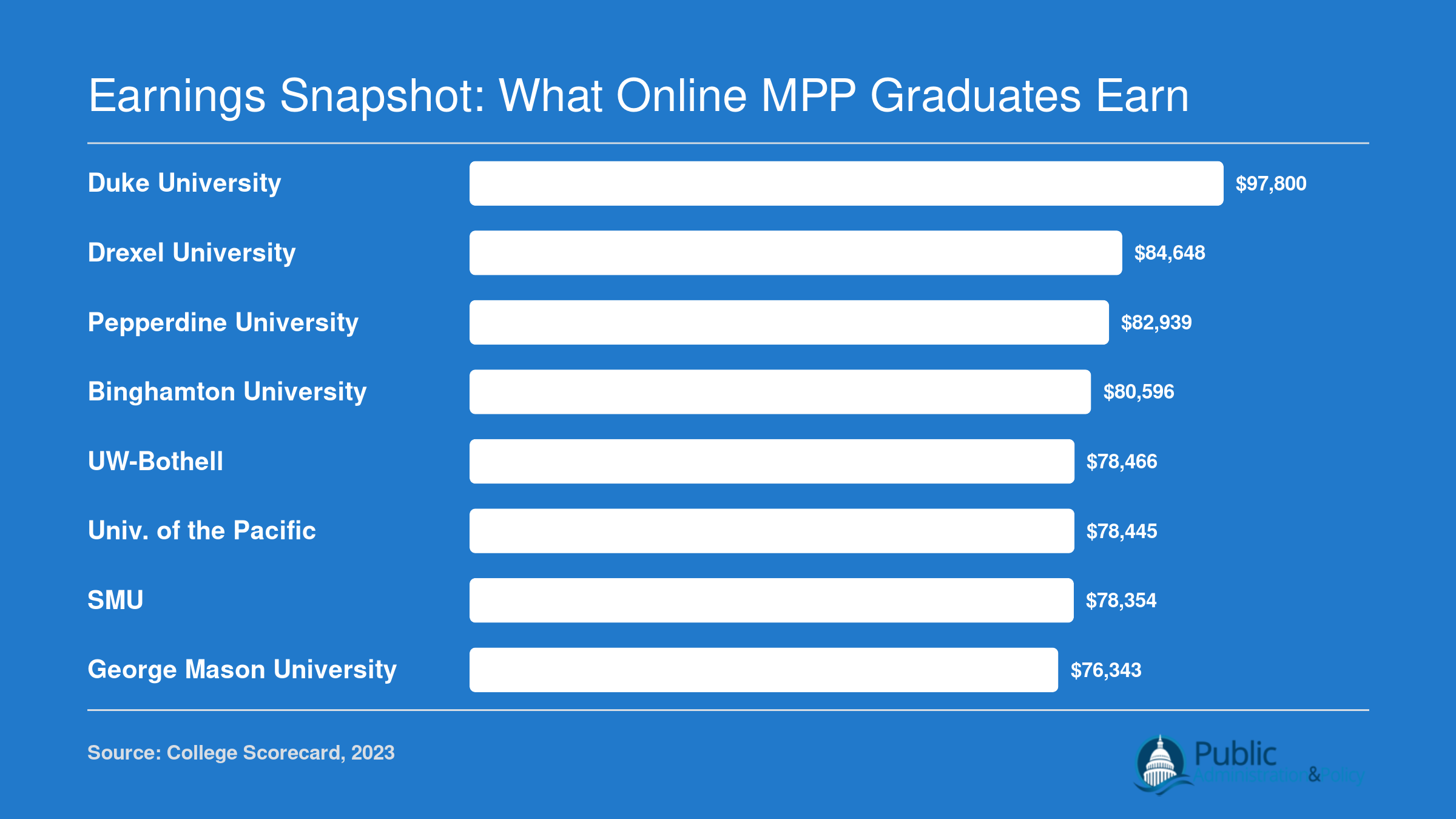
Earnings Snapshot: What Online MPP Graduates Earn
Program-level earnings data at one year and four years after completion are not yet published by the College Scorecard for these MPP programs. The institution-level median earnings shown below, measured ten years after enrollment, offer a useful benchmark for comparing long-term earning potential across schools. Keep in mind that Wyoming-specific public-sector roles, which are covered in the next section, may pay differently than these national medians. Individual outcomes vary by prior experience, employer, and sector.
Career Outcomes and Earnings After an Online MPP in Wyoming
Wyoming's job market for policy professionals looks different from what you will find in more populous states, but the opportunities are real and, in some cases, surprisingly well compensated. Understanding what MPP holders actually earn in the state, and where the jobs are, can help you build a realistic return-on-investment picture before you enroll.
What Policy-Related Roles Pay in Wyoming
Bureau of Labor Statistics wage estimates for Wyoming offer a useful baseline. According to the most recent data (May 2023), urban and regional planners in the state earned a median hourly wage of about $31.32, translating to a median annual salary in the mid-$60,000 range, with mean annual wages reaching roughly $72,860 across approximately 80 positions statewide.2 Social scientists and related workers, a broader category that captures many policy analyst and political scientist roles, earned a median hourly wage of approximately $39.86, with mean annual wages near $86,790. Total employment in that category was small, around 50 positions, reflecting Wyoming's compact workforce.1
Political scientist positions are not separately reported by the BLS in Wyoming due to the limited number of workers in that specific classification.3 That does not mean the work disappears. It means those roles tend to be folded into broader social science or management analyst titles within state agencies and federal offices.
Where the Jobs Are
Cheyenne, as the state capital, concentrates the largest share of state government positions in policy making, budgeting, and legislative analysis. Beyond the capitol complex, Wyoming's vast federal lands create a distinctive cluster of policy roles with agencies such as the Bureau of Land Management, the U.S. Forest Service, and the National Park Service. Energy policy is another major draw. Wyoming leads the nation in coal production and has a growing wind energy sector, meaning regulatory analysis and environmental policy positions remain in steady demand. Tribal governance roles on the Wind River Reservation also represent a meaningful, if often overlooked, career in public policy for MPP graduates with an interest in sovereignty issues, natural resource management, and community development.
Fewer Openings, Less Competition
Wyoming's population of under 600,000 means total job openings in any single policy field will be modest. The flip side is that competition for those openings is considerably lighter than in metro-heavy states. Candidates with a graduate-level policy credential stand out quickly, especially in state agencies where advanced degrees are less common than in Washington, D.C., or major urban centers.
Many MPP holders based in Wyoming also leverage remote work. National consulting firms, think tank analyst organizations, and advocacy groups increasingly hire analysts regardless of location, so living in Casper or Laramie does not prevent you from serving clients or projects across the country.
Building an ROI Narrative
Program-level earnings data for online MPP graduates are not yet available for most of the programs listed on this site, so a direct comparison between what a specific program's alumni earn and what Wyoming employers pay is not possible at this time. What the BLS figures do confirm is that policy-relevant roles in the state can reach the $70,000 to $87,000 range, which compares favorably to total program costs at several of the more affordable online MPP options, some of which carry total tuition below $30,000 for out-of-state students. That ratio suggests a reasonable payback window for graduates who secure full-time policy positions in Wyoming or combine in-state work with remote consulting engagements.
The bottom line: Wyoming rewards MPP holders who are strategic about where they apply and willing to think creatively about combining local public-sector roles with remote policy work.
Questions to Ask Yourself
Do I want to analyze and design policy, or manage public organizations?
An MPP focuses on quantitative analysis, program evaluation, and policy design. An MPA emphasizes leadership and organizational management. Choosing the wrong degree can leave you without the specific skills your target role requires.
Can I realistically commit to two or three years of part-time online coursework while working full time in Wyoming?
Most online MPP programs expect 15 to 20 hours per week of study alongside synchronous sessions that may fall during Mountain Time work hours. Map your current obligations before enrolling so you can finish without burnout.
Is NASPAA accreditation a must for my target employer, or is regional accreditation sufficient?
Federal agencies and some state offices prefer NASPAA-accredited graduates. If your career goals center on nonprofit or private-sector policy roles, a regionally accredited program may serve you just as well at a lower cost.
Will the program require on-campus residencies, and how does travel from Wyoming factor into my total budget?
Some online MPP programs include mandatory immersions or capstone residencies. Flying from Cheyenne, Casper, or other Wyoming cities to a campus out of state can add thousands of dollars in airfare, lodging, and lost work time over the life of the degree.
Admissions Requirements Compared: What Online MPP Programs Expect
Admissions standards across top online MPP programs share a common framework, but the details vary enough that checking each school's official admissions page is essential. Programs at Johns Hopkins, USC Price, American University, Georgia Tech, Oregon State, and the University of Michigan all publish their expectations under dedicated "Admissions" or "How to Apply" sections. Here is what to look for and how to navigate the process from Wyoming.
GPA and GRE Expectations
Most competitive online MPP programs expect a minimum undergraduate GPA in the range of 3.0 on a 4.0 scale, though some will consider applicants with lower GPAs who demonstrate strong professional accomplishments. GRE requirements have shifted considerably in recent years. Several programs, including those at Johns Hopkins and American University, have adopted GRE-optional or GRE-waiver policies. Common criteria for a waiver include five or more years of relevant professional experience, a previously earned graduate degree, or a high undergraduate GPA (often 3.3 or above). If you think you qualify, look for a "Waiver Request" or "Test Score Exemptions" page on the program's site. Some schools require you to submit a waiver request before your application is reviewed, so confirm the timeline early.
Work Experience and Residency
Online MPP programs generally prefer applicants with some professional experience, though few set a rigid minimum. Programs oriented toward mid-career professionals, such as the University of Michigan's Ford School offering, tend to favor candidates with three to five years in policy, government, or nonprofit roles. Residency requirements also differ. Some programs are fully online with no campus visits, while others incorporate a brief immersion or capstone residency of a few days. Wyoming students should verify whether travel is expected and factor that into cost and scheduling. Students weighing the differences between an MPP and a management-focused degree may also want to explore public administration vs public policy to clarify which path fits their goals.
How to Confirm Current Requirements
Program websites are the most reliable starting point, but they do not always reflect the latest policy changes. Take these additional steps to get a clear picture:
Check official rankings lists: Resources like U.S. News online MPP rankings can help you identify strong programs, and each listing typically links to the school's admissions page.
Cross-reference with NASPAA: The Network of Schools of Public Policy, Affairs, and Administration maintains a searchable directory. Accredited programs tend to meet baseline admissions standards that are transparent and well-documented.
Contact admissions advisors directly: If a website lacks clarity on GRE waivers, GPA flexibility, or residency expectations, reach out by email or phone. Many programs also host monthly virtual information sessions where staff address these questions in real time.
Ask about conditional admission: Some schools offer conditional or provisional admission for applicants who fall just below a GPA threshold, requiring successful completion of early coursework to continue.
Taking 30 minutes to compare admissions pages side by side can save weeks of confusion later. Wyoming residents face no geographic disadvantage here. Every program listed above accepts students nationwide, and none impose state-based admissions restrictions. Neighboring-state students in similar situations, such as those researching online mpp programs for Kansas students, will find the same open-enrollment policies.
How to Choose the Right Online MPP Program From Wyoming
Choosing an online Master of Public Policy program from Wyoming means weighing several factors that go beyond simple rankings. Because no in-state university currently offers an online MPP, you have the advantage of shopping a national marketplace. That breadth can be overwhelming without a clear decision framework, so start by browsing best online public administration degree programs to see the full landscape before narrowing your focus.
Five Factors That Should Drive Your Decision
Organize your research around these core criteria:
Accreditation status: NASPAA accreditation is the gold standard for public policy and administration programs. If your career path points toward federal agencies, many hiring managers and fellowship committees treat NASPAA accreditation as a baseline expectation. Prioritize it.
Cost and financial aid: Tuition for online MPP programs ranges widely. Compare net cost after scholarships, employer tuition assistance, and any state authorization discounts. Ask each program specifically whether Wyoming residents qualify for reduced rates through reciprocity agreements or institutional policies.
Specializations aligned to career goals: Not every MPP curriculum covers the same ground. If you plan to work in Wyoming state government or with tribal nations, look for concentrations in public management, environmental policy, or Indigenous governance. If your sights are set on think tanks or federal policy shops, programs with strong quantitative methods or economic policy tracks will serve you better.
Program format and flexibility: Some programs use a cohort model with set weekly meeting times, while others are fully self-paced. Both structures have tradeoffs. Cohort models build stronger peer networks and keep you on schedule; self-paced formats accommodate irregular work hours common in fields like emergency management, seasonal resource work, or legislative staffing.
Career services and alumni networks: Investigate whether a program's career office actively helps online students, not just on-campus learners. Ask where alumni are working. A program with graduates placed across federal agencies, state capitals, and nonprofit leadership roles gives you a wider set of professional connections to draw on.
Tailoring the Search to Wyoming Priorities
Wyoming's policy landscape is shaped by natural resource management, public lands governance, and the needs of sovereign tribal nations. If these are your areas of interest, ask admissions counselors whether the curriculum addresses energy policy, rural governance, or federal-tribal relations. Programs that incorporate case studies or capstone projects relevant to Western states will translate more directly to your career.
For those targeting federal service, a NASPAA-accredited program paired with a concentration in policy analysis or program evaluation positions you well for roles with agencies that have a significant Wyoming presence, such as the Bureau of Land Management, Forest Service, or Department of the Interior. Students eyeing the D.C. policy arena specifically may also benefit from reviewing online MPP programs D.C. for programs with strong federal placement records.
Your Concrete Next Step
Request informational interviews with admissions counselors at your top candidates. These conversations reveal details that websites often leave out, from cohort culture to how capstone projects are structured for distance learners. Then narrow your list to three programs and compare them side by side on accreditation, total cost, and specialization fit. Before you submit any application, attend at least one virtual information session for each finalist. That firsthand exposure to faculty and current students will clarify which program feels like the right match for your goals and your schedule.
Frequently Asked Questions About Online MPP Programs for Wyoming Students
Wyoming students considering an online Master of Public Policy often have practical questions about availability, cost, and career outcomes. Below are answers to the most common questions we hear from prospective MPP students in the state.
Does Wyoming offer any online Master of Public Policy degree?
No. As of 2026, no Wyoming college or university offers an online Master of Public Policy. The University of Wyoming has an MPA program but does not confer an MPP. Wyoming residents can, however, enroll in accredited online MPP programs offered by universities in other states, many of which charge competitive out-of-state tuition rates for distance learners.
What is the difference between an MPA and an MPP?
An MPA (Master of Public Administration) focuses on managing organizations in the public and nonprofit sectors, emphasizing leadership, budgeting, and operations. An MPP (Master of Public Policy) centers on analyzing and designing public policy through quantitative methods, economics, and program evaluation. Both degrees lead to public service careers, but the MPP is a stronger fit if you want to specialize in policy research or legislative analysis.
Which online MPP programs are NASPAA accredited?
Several universities hold NASPAA (Network of Schools of Public Affairs and Administration) accreditation for their online MPP programs. Notable options include the University of Southern California, the University of Michigan, American University, and the University of Chicago. NASPAA accreditation signals that a program meets rigorous standards for curriculum, faculty, and student outcomes. Always verify a program's current accreditation status on the NASPAA website before applying.
How much does an online MPP cost for Wyoming residents?
Total tuition for an online MPP typically ranges from roughly $30,000 at more affordable public universities to over $100,000 at elite private institutions. Some programs offer flat per-credit rates regardless of residency, which benefits Wyoming students. Look for programs that participate in regional tuition agreements or offer scholarships for out-of-state online learners to reduce costs.
Can you complete an online MPP without visiting campus?
Many online MPP programs are designed to be completed entirely remotely, which is ideal for Wyoming students who may live far from the host campus. However, some programs require brief on-campus residencies, orientations, or capstone presentations. Before enrolling, confirm whether the program includes any in-person components and factor travel costs into your budget.
What jobs can you get with an MPP degree in Wyoming?
MPP graduates in Wyoming find roles in state and local government, tribal governance, energy and natural resources policy, healthcare administration, and nonprofit leadership. Common titles include policy analyst, legislative aide, program evaluator, and government affairs director. Federal agencies with a Wyoming presence, such as the Bureau of Land Management and the National Park Service, also hire MPP holders for planning and analysis positions.
Is the GRE required for online MPP programs?
Requirements vary by program. A growing number of online MPP programs have dropped the GRE requirement or made it optional, especially since 2020. Schools such as American University and several state flagship universities now offer GRE-waiver pathways based on professional experience or undergraduate GPA. Check each program's current admissions page, as testing policies can change from year to year.
More Online MPP Programs to Consider From Wyoming
Beyond the top-ranked options, many other accredited online MPP programs welcome Wyoming students. This directory lists additional schools offering fully online or hybrid formats, giving you more choices to find the best fit for your career goals and budget. Program fit often matters more than exact rank, so explore these options alongside our featured picks.
University of Northern Iowa
Offers an online Master of Public Policy (MPP) with synchronous Zoom sessions on Tuesday evenings, following a cohort model for two-year completion. Tuition is $586 per graduate credit for 2025-26.
Online Master of Public Policy (MPP) part-time program focusing on technical skills in policy analysis, research, and data-driven evaluation. Includes virtual live lectures, project-based assignments, and two on-campus immersions.
Online Master of Public Policy and Administration (MPPA) with three concentrations: Public Management, Public Policy, and International Policy and Management. Interdisciplinary curriculum with real-world experience.
Hybrid Master of Public Policy (MPP) combining online coursework with in-person Saturday sessions in Sacramento. Offers concentrations in Environmental and Water Policy, Public Policy Advocacy, Non-Profit and Social Capacity Management, and Local Government.
Hybrid Master of Public Administration & Policy (MPAP) blending online and on-campus courses. 36-credit program with core courses in policy analysis, public budgeting, and organizational theory, plus a capstone fieldwork component.
Hybrid Master of Public Policy (MPP) with both online and on-campus options. Features a Graduate Public Service Internship program with paid work in government agencies and potential tuition waivers.
Hybrid Master of Public Policy with case study research focus. Offers full-time or part-time study, year-round admissions, and the ability to customize through certificate programs or graduate minors.
Hybrid Master of Public Policy (MPP) allowing in-person or remote real-time attendance. 36-credit program completable in two years, with an accelerated five-year option for undergraduates.
Hybrid Master of Public Administration (MPA) designed for professionals in government, non-profits, and public sector management. 36-credit curriculum with flexible delivery, military-friendly policies.
Hybrid Master of Public Policy (MPP) blending online and in-person classes at the Malibu campus with a Washington, DC track option. 48-unit program with five specializations; over 95% of students receive scholarships.
University of Colorado Denver/Anschutz Medical Campus
Hybrid Master of Public Policy (MPP) with core courses in research methods, economics, and policy design. Optional concentrations include Education Policy, Environmental Policy, Policy Analysis & Methods, and Policy Entrepreneurship & Advocacy.
Fully online Master of Public Policy and Administration (MPPA) with concentrations in Urban Planning, Nonprofit Leadership, and Local Government. 36-credit program with core courses and electives, completable in as few as two years.
Hybrid Master of Public Policy and Management (MPPM) offering concentrations in Community Planning and Sustainable Development or Public Policy and Public/Nonprofit Management. Reduced tuition for out-of-state students.
Hybrid Master of Public Policy & Administration (MPPA) combining policy analysis with public management. 56-credit program with flexible formats including online, in-person, and hybrid. No standardized tests required.
Hybrid Master of Science in Public and Urban Policy with a focus on social inclusion and equity. Features the Urban Policy Lab with team-based research and client projects for government, nonprofit, and private sector clients.