Best Online MPP Programs for Oklahoma Students (2026)
Compare top-ranked online MPP degrees by cost, flexibility, and career outcomes available to Oklahoma residents.
By Max SheltonReviewed by PAP Editoral TeamUpdated August 14, 202625+ min read
What you’ll learn in this article…
No Oklahoma university currently offers a fully online Master of Public Policy degree as of 2026.
Several affordable, NASPAA accredited online MPP programs at public universities accept Oklahoma residents at competitive tuition rates.
Oklahoma employers in state agencies, nonprofits, and tribal governance value NASPAA accreditation over a program's physical location.
Policy careers in Oklahoma span health care, energy, tribal governance, and legislative analysis, all accessible with an online MPP.
Oklahoma's tribal governance systems, energy-sector regulations, and rural health disparities create steady demand for policy professionals, yet no university in the state currently offers a fully online Master of Public Policy degree. That gap forces Oklahoma residents to look nationally, where roughly a dozen NASPAA-accredited online MPP programs accept out-of-state students at tuition rates that often rival in-state pricing at Oklahoma's own public universities.
The practical tension is real: you need a credential recognized by state agencies, tribal nations, and nonprofits, but the program has to fit around a career and a life rooted in Oklahoma. If you are weighing an best online MPA Oklahoma track against an MPP, the distinction matters more than you might expect. Fortunately, several top-ranked institutions now deliver rigorous, asynchronous MPP curricula with no relocation required. For Oklahoma students, the differentiator is less about geography and more about cost structure, specialization fit, and whether a program carries NASPAA accreditation.
Top Online MPP Programs Available to Oklahoma Students
Because no Oklahoma university currently offers a fully online Master of Public Policy, students in the state need to look nationally. The programs below accept applicants from Oklahoma and can be completed remotely or through hybrid formats that minimize travel. We ranked them using a composite that weighs academic quality, online accessibility, and affordability, then layered in program-specific research on how well each option serves Oklahoma residents.
Factors considered
Institution-wide graduation and retention rates
Online delivery accessibility
Tuition and net price
Faculty to student ratio
Program depth and concentration options
Sources
NCES-IPEDS federal institutional data — nces.ed.gov
Best for: Working professionals seeking fast online completion
Binghamton University delivers a fully online, asynchronous MPP that can be finished in as little as one year of full-time study. The curriculum stresses data analysis, policy modeling, and global perspectives, while a hands-on policy laboratory lets students apply skills to real scenarios. As a SUNY institution, Binghamton keeps tuition comparatively low, and its online format makes it one of the most accessible options for Oklahoma professionals who need maximum scheduling flexibility.
View program
Master of Public Policy — Online
100% online with asynchronous delivery
Can be completed in one year full-time
In-state tuition: $13,950; out-of-state: $27,140
Policy laboratory for applied project work
Emphasis on data analysis and policy modeling
Prepares for government, nonprofit, and private sectors
Best for: Oklahoma energy and agriculture policy careers
The University of Tennessee, Knoxville offers a fully online MPP through its Howard H. Baker Jr. Center that is explicitly authorized for distance learners in Oklahoma. The 36-credit program features seven concentration tracks, several of which align with Oklahoma's most pressing policy domains: energy, agriculture, economic development, and health. No thesis is required, and most domestic applicants do not need to submit GRE scores.
View program
Master of Public Policy — Online
Fully online, authorized for Oklahoma enrollment
36 credit hours with no thesis requirement
In-state tuition: $15,972; out-of-state: $34,760
Seven concentration options including Energy Policy
Agricultural and Environmental Policy track available
Best for: Mid-career government employees saving on tuition
The University of Pittsburgh's online MPPM is designed for mid-career professionals with at least five years of experience. A standout feature for Oklahoma residents: all online students pay in-state tuition rates regardless of where they live, effectively eliminating the out-of-state premium. Full-time government employees also receive a 20% tuition discount. The 30-credit curriculum emphasizes real-world problem solving across four required courses and six electives.
View program
Master of Public Policy and Management — Online
Fully online with in-state tuition for all students
Oregon State University's NASPAA-accredited MPP is available fully online through its Ecampus platform, which charges a single tuition rate that often works out favorably for out-of-state students, including those in Oklahoma. With seven established concentrations plus a self-designed option, students can tailor studies to energy, environmental, or rural policy areas that mirror Oklahoma's core challenges. An 11-week capstone policy lab pairs student teams with real clients.
Duke University's Sanford School of Public Policy offers a highly regarded MPP in a hybrid format that blends online coursework with on-campus residencies. The 24-month, 51-credit program provides eight policy concentrations, including Development Policy and Energy and Environment Policy. With a 96.8% institution-wide graduation rate and a 5:1 student-to-faculty ratio, Duke delivers intensive mentorship, though its tuition and hybrid structure require more investment of time and travel than fully online alternatives.
View 2 programs
Master of Public Policy — Hybrid
Hybrid format with online and on-campus components
24-month program totaling 51 credit hours
Tuition: $66,523 (same for in-state and out-of-state)
Ohio State's John Glenn College of Public Affairs offers a Master of Arts in Public Policy and Management built for in-career professionals with at least three years of experience. The 38-credit hybrid program features evening classes and can be finished in five semesters. Its core spans economics, management, and decision-support systems, making it a strong fit for Oklahoma professionals who can occasionally travel to Columbus or participate in intensive sessions.
View program
Master of Arts in Public Policy and Management — Hybrid
Hybrid delivery with evening class schedule
38 credit hours, completable in five semesters
In-state tuition: $13,901; out-of-state: $42,740
No GRE required for admission
Minimum three years of professional experience
Core in economics, management, and decision systems
Rutgers University's Edward J. Bloustein School offers a 48-credit MPP with 14 concentrations spanning health, environment, budget and finance, social justice, and urban policy. The program blends in-person classes with synchronous remote sessions, and a unique cross-registration agreement with Princeton's School of Public and International Affairs broadens course options. A 300-hour internship and group policy research practicum deliver hands-on experience, though the hybrid model may require periodic trips to New Jersey.
George Mason University's Schar School of Policy and Government delivers its MPP in a hybrid format near Washington, D.C., giving students direct access to federal agencies, think tanks, and international organizations. The curriculum emphasizes analytic modeling, technology, and global policy perspectives. Evening courses and some online options accommodate working schedules, and merit scholarships and military tuition assistance help offset costs for Oklahoma students willing to engage with periodic D.C.-area residencies.
View program
Master of Public Policy — Hybrid
Hybrid format with evening classes near D.C.
In-state tuition: $17,964; out-of-state: $40,308
Net price: $17,915 after institutional aid
Merit scholarships and military tuition assistance
80+ faculty with policy practitioner backgrounds
Graduates hired by agencies such as the World Bank
The University of Houston's Hobby School of Public Affairs offers a NASPAA-accredited, 39-credit MPP that combines online and on-campus learning in one of the nation's most diverse metropolitan areas. The interdisciplinary curriculum covers economics, politics, ethics, and quantitative analysis, and it includes an internship and capstone project. While the program is not fully online, its hybrid structure and relatively low tuition make it an option worth exploring for Oklahoma students who can periodically travel to Houston.
View program
Master of Public Policy — Hybrid
NASPAA-accredited 39-credit-hour program
In-state tuition: $10,051; out-of-state: $19,231
Hybrid delivery with on-campus components
Internship and capstone project required
Interdisciplinary coursework in economics and politics
Virtual information sessions available to prospective students
The University of Washington, Bothell offers a Master of Arts in Policy Studies through an interdisciplinary, cohort-based model. Evening classes held after 5 p.m. suit working professionals, and community partner projects provide applied experience. The curriculum centers on evidence-based analysis, social theory, and evaluation methods. However, the program is primarily in-person in the Seattle-area campus, so Oklahoma residents should verify current online availability before applying.
View program
Master of Arts in Policy Studies — Hybrid
Hybrid cohort model with evening classes after 5 p.m.
In-state tuition: $18,738; out-of-state: $32,757
Net price: $12,319 after institutional aid
Emphasis on evidence-based policy analysis
Community partner projects for applied experience
Prepares for government, nonprofit, and private sectors
Why Oklahoma Lacks In-State Online MPP Programs, and What to Do About It
If you have searched for online MPP programs in Oklahoma, you have probably noticed something frustrating: no Oklahoma university currently offers a fully online Master of Public Policy degree. The state's public universities provide several strong policy-adjacent programs, but none of them deliver a dedicated MPP in a completely remote format. Understanding what is available locally, and why national online programs fill the gap, is essential for making a smart decision.
What Oklahoma Universities Offer Instead
Oklahoma's flagship institutions do have graduate programs that touch on public policy, though they are structured differently from a traditional MPP.
University of Oklahoma MPA with Public Policy Concentration: This 36-credit Master of Public Administration program includes a 9-credit public policy concentration alongside 15 core credits and 12 elective credits.1 It is delivered in a hybrid format with classes offered evenings, weekends, online, and during the day across the Norman and Tulsa campuses.2 However, the degree cannot be completed fully online.3
Oklahoma State University MA in Political Science: OSU offers a Master of Arts in Political Science that can include a politics and policy focus, but this is an academic political science degree rather than a professional policy degree. Its availability in a fully online format has been limited.
University of Central Oklahoma MPA: UCO's Master of Public Administration is geared toward public management rather than policy analysis, and it has not been consistently available in a fully online delivery mode.
MPA vs. MPP: Why the Distinction Matters
The difference between an MPA and an MPP is not just semantic. An MPA emphasizes organizational management, budgeting, and the administrative side of government operations. An MPP, by contrast, focuses on policy analysis, program evaluation, economic reasoning, and the use of quantitative methods to assess and design public interventions. If your career goals center on analyzing legislation, evaluating social programs, or advising elected officials on evidence-based solutions, an MPP is the more targeted credential. States like Nebraska face a similar gap, which is why many students there also turn to best online MPP programs for Nebraska students. Oklahoma's in-state options lean heavily toward the MPA model.
National Online MPP Programs Are the Practical Solution
The good news is that a growing number of nationally recognized universities offer fully online MPP degrees that Oklahoma residents can complete without relocating. Many of these programs hold NASPAA accreditation, which is the same professional standard applied to top on-campus programs. Key advantages for Oklahoma students include:
Asynchronous coursework that accommodates full-time professionals in Oklahoma City, Tulsa, or rural communities
No residency requirements, meaning you can remain in your current role while earning the degree
Access to specializations in areas directly relevant to Oklahoma, such as energy policy, health policy, and economic development
The same career outcomes and employer recognition as traditional on-campus formats
So, are there online MPP programs in Oklahoma? Not from in-state institutions as of 2026. But that should not limit your options. Enrolling in a reputable national online MPP program lets you build the analytical skill set Oklahoma's policy sector demands, all without leaving the state.
Questions to Ask Yourself
Do you want to design policy or manage public organizations?
An MPP focuses on policy analysis, research methods, and program evaluation, while an MPA emphasizes leadership and organizational management. Choosing the wrong degree can leave you without the specific skills Oklahoma employers expect for your target role.
Are you drawn to Oklahoma issues like tribal governance, energy regulation, or rural health?
Not every online MPP offers concentrations relevant to Oklahoma's policy landscape. Programs with coursework in Indigenous policy, natural resource economics, or rural health systems will give you a sharper competitive edge in the state's public sector.
Do you need fully asynchronous coursework to fit around a full-time Oklahoma job?
Some programs require live virtual sessions on weekday evenings, which may conflict with shift work or time zone differences. Confirming asynchronous flexibility before you apply prevents schedule conflicts that lead to unnecessary withdrawals.
Is NASPAA accreditation a priority for your career goals?
Many state and federal agencies in Oklahoma prefer or require degrees from NASPAA-accredited programs. If you plan to pursue senior government roles, filtering for accreditation early narrows your list to programs that carry the most professional weight.
What is your realistic budget, and does the program offer in-state or flat-rate tuition for online students?
Out-of-state online tuition varies widely, and some universities charge Oklahoma residents the same rate as all distance learners. Comparing total program cost, not just per-credit pricing, helps you avoid unexpected expenses over two or three years.
Most Affordable Online MPP Programs for Oklahoma Residents
Because Oklahoma does not currently offer an in-state online Master of Public Policy, students in the state should look to affordable out-of-state options. The good news: every school on this list is a public university, and many public institutions now charge a flat online tuition rate regardless of residency, which can significantly reduce costs for Oklahoma students. Net price figures below are institution-level estimates (not program-specific) and reflect average costs after financial aid, so your actual expense may vary based on aid eligibility and credit load.
School
State
Type
In-State Tuition
Out-of-State Tuition
Approx. Net Price
Median Graduate Debt
Texas A&M University-Central Texas
TX
Public
$6,242
$13,586
$1,300
$17,750
California State University-Sacramento
CA
Public
$9,542
$19,622
$9,338
$15,000
University of Illinois Springfield
IL
Public
$11,938
$19,515
$9,833
$19,128
University of Colorado Denver/Anschutz Medical Campus
Admissions Requirements and How to Apply to Online MPP Programs
Applying to an online Master of Public Policy program does not have to be intimidating, but it helps to know what admissions committees expect. Because Oklahoma lacks in-state online MPP options, you will likely be applying to nationally recognized programs that draw candidates from across the country. Understanding typical requirements, and how they differ from MPA admissions, gives you a real advantage.
GPA Expectations
Most online MPP programs set a minimum undergraduate GPA between 2.75 and 3.0. The University of Northern Iowa, for example, lists a 2.75 minimum for its MPP program.2 That said, competitive applicants at top-tier programs such as the University of Michigan Ford School or USC Price often present GPAs in the 3.3 to 3.7 range. If your GPA falls below the stated minimum, strong professional experience or a well-crafted personal statement can sometimes offset that gap.
Do Online MPP Programs Require the GRE?
This is one of the most common questions prospective students ask, and the answer has shifted significantly. As of the 2025-2026 admissions cycle, many leading online MPP programs either waive the GRE entirely or make it optional. American University, USC Price, Pepperdine, and the University of Michigan Ford School all offer GRE waivers or test-optional policies. The trend toward dropping standardized test requirements has accelerated in recent years, so Oklahoma students should not assume the GRE is a barrier. Always check each program's current admissions page, because policies can change from one cycle to the next.
Application Components and How MPP Differs from MPA
A typical online MPP application includes:
Personal statement: Most programs want to see a clear connection between your policy interests and career goals. MPP statements tend to focus more on analytical thinking and quantitative aptitude than MPA statements, which often emphasize management and leadership experience.
Letters of recommendation: Expect to submit two to three letters. Academic references carry weight for recent graduates, while professional references matter more for mid-career applicants.
Resume or CV: Programs generally prefer one to three years of professional or policy-related experience, though some accept strong candidates directly out of undergraduate programs.
Writing sample: This requirement is more common in MPP admissions than in MPA programs. A policy memo, research paper, or analytical writing sample helps committees gauge your ability to engage with evidence-based arguments.
Some elite programs have additional requirements. Princeton's School of Public and International Affairs, for instance, targets candidates with roughly seven years of professional experience for its mid-career MPP track.5 Most online programs, however, are designed for early-to-mid-career professionals and set a lower bar for work history.
Rolling Admissions Give Oklahoma Students Flexibility
One practical advantage of applying to online MPP programs is that many use rolling or multiple-deadline admissions rather than a single fixed cutoff. This means you can apply when you are ready, whether that is summer, fall, or spring, without waiting for a narrow application window. For Oklahoma students balancing full-time work or state government roles, this flexibility is especially valuable. Just keep in mind that applying earlier in a cycle often improves your chances of receiving financial aid or assistantship offers, since those funds are allocated on a first-come basis at many institutions. Graduates who pursue careers in urban policy planning will find that strong application materials translate directly into professional credibility.
Take time to research each program's specific admissions criteria before you apply. Requirements vary, and tailoring your materials to reflect each school's values and policy focus areas will strengthen your candidacy considerably.
Curriculum, Specializations, and Oklahoma-Relevant Policy Areas
Online Master of Public Policy programs follow a structured curriculum designed to build analytical, quantitative, and leadership skills. While individual programs vary, the core coursework is remarkably consistent across NASPAA-accredited options, making it straightforward to compare what you will learn regardless of which out-of-state program you choose.
Core Curriculum You Can Expect
Most MPP programs require a foundation of courses that prepare you to analyze, design, and evaluate public policy. Core classes typically include:
Quantitative Methods and Statistics: Courses in applied statistics, data analysis, and research design that equip you to work with the numbers behind policy decisions.
Microeconomics for Policy: An examination of how economic principles shape government intervention, market regulation, and resource allocation.
Policy Analysis: Frameworks for evaluating the costs, benefits, and trade-offs of proposed and existing policies.
Program Evaluation: Methods for assessing whether government programs and nonprofit initiatives achieve their intended outcomes.
Capstone or Practicum: A culminating project, often client-based, that lets you apply classroom knowledge to a real policy challenge.
These courses typically account for roughly half of a program's total credit hours, with the remainder devoted to electives and a chosen concentration.
Specializations That Align with Oklahoma's Workforce
Oklahoma's economy and governance landscape create distinct demand for policy professionals in several areas. If you are weighing a best online MPA Oklahoma track against an MPP, keep in mind that the MPP leans more heavily into analytical and research-driven coursework. When selecting an online MPP program, look for concentrations that map onto these needs:
Energy Policy: Oklahoma remains one of the nation's top oil and natural gas producers. Concentrations in energy policy or environmental regulation prepare graduates for roles at agencies like the Oklahoma Corporation Commission or within the private energy sector.
Health Policy: Rural health access is a persistent challenge across much of the state. A health policy concentration positions you to work on Medicaid expansion implementation, hospital sustainability in rural counties, or behavioral health initiatives.
Tribal Governance: With 39 federally recognized tribes headquartered in Oklahoma, tribal governance and federal Indian policy represent a meaningful and growing career path. Some programs offer specific coursework in Indigenous policy or intergovernmental relations.
Education Policy: School funding formulas, teacher retention, and workforce readiness remain top legislative priorities. An education policy focus is well suited for careers at the Oklahoma State Department of Education or advocacy organizations.
Environmental and Sustainability Policy: Water rights, drought management, and land use planning are increasingly urgent issues in the state, making this concentration highly relevant.
Completing Your Practicum Locally in Oklahoma
One of the biggest advantages of an online MPP is that practicum and capstone requirements can almost always be fulfilled where you live and work. Most programs allow students to arrange placements with local organizations, and Oklahoma offers a strong set of options. State agencies such as the Oklahoma Policy Institute, tribal government offices, county health departments, and nonprofits focused on criminal justice reform or economic development can all serve as practicum hosts. Before enrolling, confirm with your chosen program that locally arranged placements are accepted and discuss any approval timelines.
Program Length and Credit Requirements
Online MPP programs generally require between 36 and 48 credit hours. Full-time students can typically finish in 18 to 24 months, while part-time students, a common path for working professionals in state government or tribal organizations, should plan for two to three years. Some programs offer accelerated tracks or allow transfer credits that can shorten the timeline. If you are balancing a career in Oklahoma's public sector while pursuing your degree, part-time enrollment with asynchronous coursework tends to offer the most flexibility.
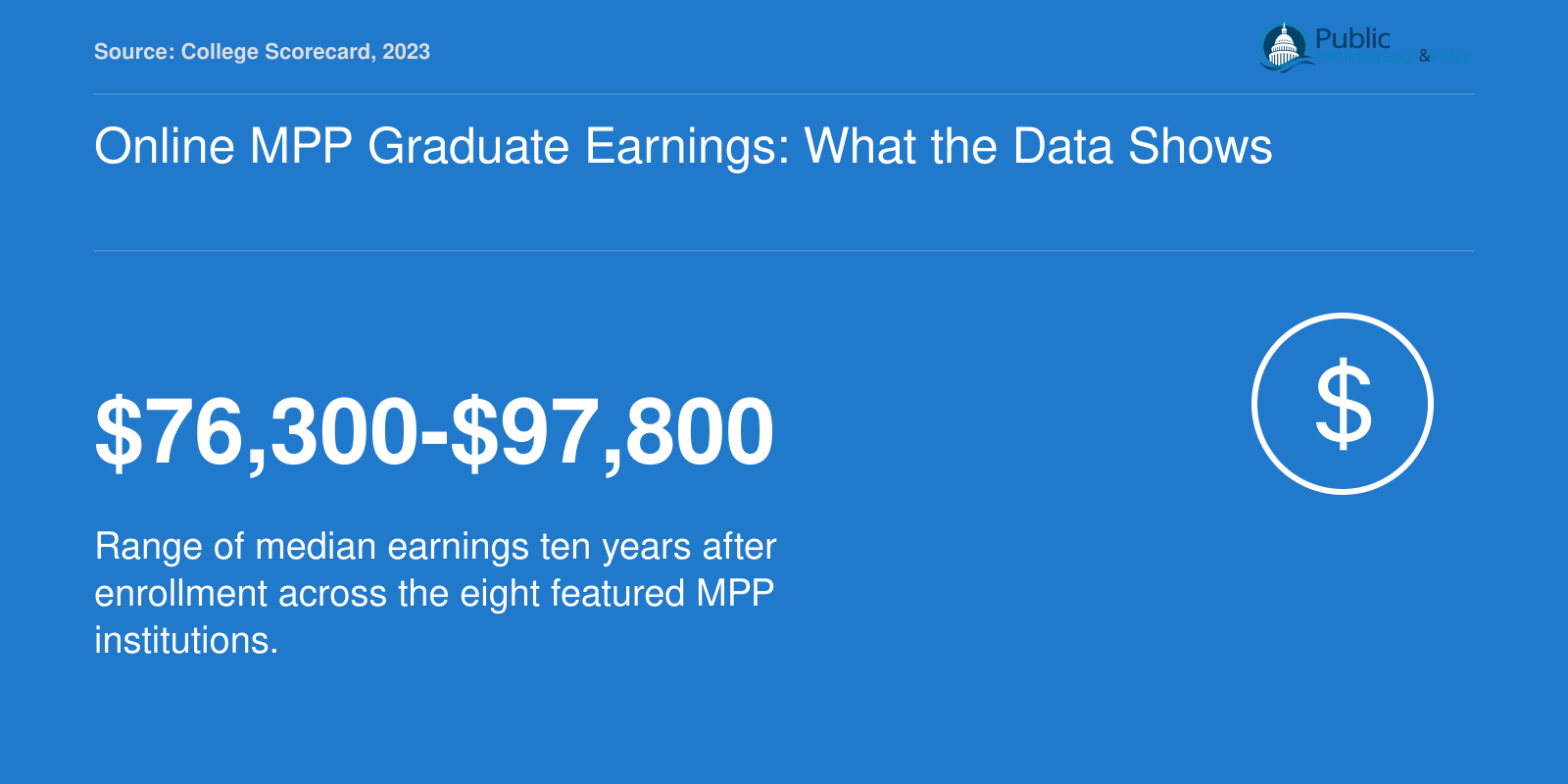
Online MPP Graduate Earnings: What the Data Shows
Program-level earnings data (such as median salary one year or four years after graduation) is not yet published for the public policy master's programs featured in this guide. However, institution-wide median earnings ten years after enrollment provide a useful benchmark. These are national figures reflecting all graduates at each university, so Oklahoma-based graduates may see different outcomes depending on local cost of living, employer type, and sector.
Career Outcomes and Salaries for Public Policy Graduates in Oklahoma
An online Master of Public Policy opens doors to a wide range of careers in public policy across government, tribal governance, and the nonprofit sector in Oklahoma. Whether you plan to shape health care legislation at the state capitol or manage federal grant programs for a tribal nation, the MPP credential positions you for roles that carry real influence and above-average compensation in the Oklahoma labor market.
What Careers Can You Pursue with an MPP Degree in Oklahoma?
MPP graduates are equipped for analytical and leadership roles that span the public and nonprofit sectors. Common job titles for MPP holders working in Oklahoma include:
Policy Analyst: Research and evaluate proposed legislation or regulatory changes for state agencies, advocacy groups, or think tanks.
Legislative Aide: Support Oklahoma state legislators by drafting policy briefs, tracking bills, and liaising with constituents.
Program Evaluator: Assess the effectiveness of government or nonprofit programs using quantitative and qualitative methods.
Grants Manager: Oversee federal, state, and foundation funding cycles for agencies and community organizations.
Government Affairs Director: Lead external advocacy strategies for corporations, health systems, or industry associations operating in the state.
These roles exist across every level of government and in many private-sector organizations that interact with regulators or depend on public funding.
Salary Expectations for Policy-Related Occupations in Oklahoma
Bureau of Labor Statistics data offers useful benchmarks for MPP-relevant occupations in Oklahoma, though not every role maps neatly to a single occupational code.
Social and community service managers in Oklahoma earned a median hourly wage of roughly $30.18 and a mean annual wage of about $67,150 as of the most recent BLS Occupational Employment and Wage Statistics release (May 2023 data).1 Management analysts, another common landing spot for MPP graduates, and political scientists are also tracked by BLS, though detailed Oklahoma-specific median figures for those categories were not fully published in the dataset available at the time of writing.2 Nationally, management analysts tend to earn above the median for social and community service managers, so Oklahoma MPP graduates moving into consulting or operational-improvement roles may see higher ceilings.
For context, the U.S. Census Bureau has estimated Oklahoma's median household income at approximately $61,000 to $65,000 in recent years. A single earner in a social and community service management role already meets or exceeds that threshold, and more senior policy positions, particularly in federal offices or tribal government, often surpass it by a considerable margin. For a broader look at compensation benchmarks, see our public administration salary guide. Metro areas like Oklahoma City and Tulsa generally offer higher pay than rural parts of the state, reflecting both cost-of-living differences and the concentration of government and nonprofit employers.
Major Oklahoma Employers for MPP Graduates
Oklahoma's policy ecosystem is broader than many prospective students realize. Key employers to keep on your radar include:
Oklahoma Health Care Authority: The state's Medicaid agency, which regularly hires policy analysts and program evaluators.
Office of Management and Enterprise Services (OMES): Oklahoma's central administrative agency, overseeing budgeting, human resources, and interagency coordination.
Oklahoma Corporation Commission: Regulates utilities, oil and gas, and transportation, creating demand for analysts who understand regulatory policy.
Cherokee Nation, Chickasaw Nation, and Choctaw Nation policy offices: Tribal governments in Oklahoma employ policy professionals across health, education, housing, and economic development. These are some of the largest employers in the state.
Oklahoma Policy Institute: A nonpartisan research organization focused on state budget, tax, and social policy.
Community Action agencies: A statewide network of nonprofits administering anti-poverty programs, often funded through federal and state grants.
Federal agency field offices: The Department of Health and Human Services, FEMA, and the Department of the Interior all maintain Oklahoma offices that hire policy-trained professionals.
The Value Proposition of an MPP in Oklahoma
Compared to the state's overall median household income, MPP-level salaries represent a meaningful step up, especially as graduates advance into director-level or senior analyst positions. Oklahoma's relatively low cost of living also means that these salaries stretch further than equivalent pay in coastal metro areas. With tribal governments expanding their policy infrastructure and state agencies facing persistent demand for data-driven decision-making, the employment outlook for MPP holders in Oklahoma remains favorable heading into 2026 and beyond.
Online Vs. Hybrid MPP Programs: What Oklahoma Students Should Know
Choosing the right program format is just as important as choosing the right school. For Oklahoma students pursuing an out-of-state online MPP, the distinction between fully online, synchronous online, and hybrid delivery can affect everything from your weekly schedule to your travel budget. Working professionals in Oklahoma should strongly consider asynchronous or evening synchronous formats, which allow you to maintain a full-time career while completing coursework on your own timeline.
Dimension
Fully Online (Asynchronous)
Online with Synchronous Sessions
Hybrid (Online Plus On-Campus)
Flexibility
Highest: complete coursework on your own schedule, any time of day
Moderate: lectures are live but often held in the evening to accommodate working students
Lowest: requires planning around scheduled campus visits, which may occur on weekdays
Residency or Travel Requirements
None: all coursework and exams are completed remotely
None or minimal: some programs require a brief orientation, but most do not
Significant: typically requires multiple campus visits per year, a major consideration for Oklahoma students attending programs in other states
Networking Opportunities
Virtual networking through discussion boards, group projects, and online events; may feel less personal
Stronger peer connections through real-time class discussions and live group work
Strongest: in-person residencies create deeper relationships with faculty and classmates, plus access to local policy networks
Weekly Time Commitment
Typically 15 to 20 hours per week, self-paced within weekly deadlines
Similar total hours (15 to 20), but 3 to 6 of those hours are at fixed meeting times each week
Similar academic hours plus travel time and on-campus days, which can add several days per term
Technology and Format
Relies on learning management systems, recorded lectures, and asynchronous discussion tools
Uses live video platforms (Zoom, Teams) for class meetings alongside recorded content
Combines online platforms with traditional in-person classroom sessions and face-to-face collaboration tools
Frequently Asked Questions About Online MPP Programs for Oklahoma Students
Oklahoma students considering an online Master of Public Policy often have practical questions about availability, cost, and career outcomes. Below are answers to the most common questions, drawing on the information covered throughout this guide.
Are there any online MPP programs in Oklahoma?
As of 2026, no Oklahoma-based university offers a fully online Master of Public Policy degree. However, several nationally recognized programs from institutions in other states are available entirely online and accept Oklahoma residents, often at competitive tuition rates. Some Oklahoma schools do offer related degrees, such as the MPA or the MPH in Health Administration and Policy, which may overlap with your policy interests.
What is the cheapest online Master of Public Policy program for Oklahoma students?
Among the programs highlighted in our affordability table, options from schools like the University of Arkansas and Arizona State University tend to offer lower per-credit rates that are accessible to out-of-state students. Some programs also extend flat-rate online tuition regardless of residency. Always confirm current tuition with the school directly, and factor in any fees, to get a true cost comparison.
Is an MPP or MPA better for a career in public policy in Oklahoma?
It depends on your goals. An MPP emphasizes policy analysis, quantitative methods, and program evaluation, making it ideal for roles in research, legislative analysis, or think tanks. An MPA leans more toward organizational management and public administration. In Oklahoma's policy landscape, both degrees open doors in state government and nonprofits, but an MPP may give you an edge in analytical or advisory positions.
Do online MPP programs require a GRE for admission?
Many online MPP programs have moved to GRE-optional or GRE-waiver policies, particularly for applicants with professional experience or strong undergraduate GPAs. Programs at schools such as the University of Southern California and American University offer test-optional pathways. Check each program's current admissions page, as policies can shift from year to year.
How long does it take to complete an online MPP program?
Most online MPP programs require around 36 to 48 credit hours and can be completed in two years of full-time study. Part-time students typically finish in three to four years. Some programs offer accelerated tracks that compress the timeline. The flexibility of online coursework allows Oklahoma students to maintain employment while completing their degree at a pace that fits their schedule.
What careers can you pursue with an MPP degree in Oklahoma?
An MPP opens pathways to roles such as policy analyst, program evaluator, legislative aide, government affairs director, and nonprofit program manager. In Oklahoma, key employers include state agencies, tribal governments, energy sector regulatory bodies, and healthcare organizations. As discussed in the career outcomes section, graduates may also pursue federal roles or consulting positions that allow remote work from within the state.
Are online MPP degrees respected by Oklahoma employers?
Yes. Oklahoma employers in government, nonprofits, and the private sector increasingly recognize online degrees, especially those from regionally accredited and NASPAA-accredited institutions. What matters most is the program's accreditation, curriculum rigor, and your ability to demonstrate relevant skills. Completing a capstone project or practicum focused on Oklahoma policy issues can further strengthen your candidacy with local employers.
Additional Online MPP Programs for Oklahoma Students to Consider
Beyond the top-ranked programs, Oklahoma students have access to a wide range of other quality online Master of Public Policy (MPP) degrees. These schools offer flexible, remote options that allow you to earn your degree from anywhere. We encourage you to verify application deadlines and Oklahoma-specific financial aid eligibility before applying.
University of Northern Iowa
This 36-credit online MPP program uses synchronous Zoom sessions on Tuesday evenings and follows a cohort model with two-year completion. Tuition is $586 per graduate credit for 2025-26, with scholarship opportunities available.
SMU's online MPP is a part-time program focusing on technical skills in policy analysis, research, and data-driven evaluation. It features virtual live lectures, project-based assignments, and a real-world capstone project with two on-campus immersions.
This online Master of Public Policy and Administration offers interdisciplinary study with concentrations in Public Management, Public Policy, and International Policy and Management. The program is military-friendly and offers an accelerated option.
Offering a hybrid MPP through McGeorge School of Law, this 39-unit program combines online coursework with in-person Saturday sessions. Concentrations include Environmental and Water Policy, Public Policy Advocacy, and more.
This 36-credit hybrid Master of Public Administration and Policy blends online and on-campus courses, designed for working professionals. The curriculum includes policy analysis, public budgeting, and a capstone fieldwork component.
The MPP at UIS offers both online and on-campus options with a focus on analytical skills and decision-making frameworks. Graduate Public Service Internships provide paid government work and tuition waivers.
This hybrid Master of Public Policy features a case study-driven curriculum with opportunities to specialize through certificates or graduate minors. The program can be completed in 18-24 months with year-round admissions.
NDSU's hybrid MPP allows in-person or remote real-time attendance. This 36-credit program focuses on policy design and evaluation, with an accelerated five-year option for undergraduates.
This hybrid Master of Public Administration is designed for public service leadership, with a 36-credit curriculum covering policy analysis, budgeting, and ethical decision-making. It is military-friendly and flexible for working professionals.
Pepperdine's hybrid MPP blends online flexibility with in-person classes in Malibu and a Washington, DC track. Over 95% of admitted students receive scholarships covering an average of 70% of tuition. No GRE required.
University of Colorado Denver/Anschutz Medical Campus
This hybrid MPP requires 36 credits with optional concentrations in Education Policy, Environmental Policy, and more. Tuition discounts are available for Western state residents, and no entrance exam is required.
This fully online Master of Public Policy and Administration offers concentrations in Urban Planning, Nonprofit Leadership, and Local Government. The 36-credit program can be completed in two years.
The hybrid Master of Public Policy and Management offers concentrations in Community Planning and Sustainable Development or Public Policy and Public/Nonprofit Management. Out-of-state students receive reduced tuition.
This hybrid Master of Public Policy & Administration combines policy analysis with public management skills. The 56-credit program features 8-week courses, cohort-based learning, and no standardized test requirements.
This hybrid Master of Science in Public and Urban Policy prepares change-makers with a focus on social inclusion and equity. The Urban Policy Lab offers hands-on client projects with government and nonprofit organizations.