Best Online Master of Public Policy Programs for Nebraska Students

Accredited online MPP programs ranked by cost, outcomes, and flexibility for Nebraska residents pursuing public policy careers.

By Carrie HirschReviewed by PAP Editoral TeamUpdated May 16, 202610+ min read

Key Points

  • No Nebraska university currently offers an online Master of Public Policy, so residents must choose from strong out-of-state programs.
  • MPP graduates from the top-ranked programs out-earn the median Nebraska household income within ten years of enrollment.
  • Management analyst roles, a common MPP career path, are projected to grow 10 percent nationally through 2032.
  • Specializations in agricultural policy, water resources, and rural development align directly with Nebraska's most pressing challenges.

No Nebraska university currently offers a Master of Public Policy, but the 10 online and hybrid MPP programs ranked here accept Nebraska residents and can be completed without relocating. Tuition for out-of-state online students ranges from roughly $19,000 to over $66,000 per year, and some programs, like the University of Pittsburgh's, charge in-state rates regardless of where you live.

The practical challenge for Nebraska students is sorting through national programs to find one that aligns with state-relevant policy needs, from water management and agricultural economics to rural health care. Nebraska's unicameral legislature and lean state agencies mean MPP graduates often wear multiple hats, making the analytical depth of an MPP, rather than the administrative focus of an MPA, a meaningful distinction worth understanding before you apply. For a broader comparison of online public administration degree options alongside MPP programs, our national rankings can help you benchmark both credential types.

Top Online MPP Programs for Nebraska Students

Because no Nebraska institution currently offers an in-state Master of Public Policy, the programs below represent the strongest online and hybrid MPP options available to Nebraska residents in 2026. Each accepts out-of-state students, and most can be completed largely or entirely from home. Programs are ordered by a mixed quality composite that weighs graduation outcomes, affordability, program-level features, and online-delivery accessibility rather than any single metric. Graduation rates listed are institution-wide figures, and net price is an average that may vary by student.

Factors considered
  • Online delivery accessibility
  • Institutional graduation outcomes
  • Net price and affordability
  • Program concentrations and depth
  • Relevance to Nebraska policy needs
Data sources

The University of Tennessee-Knoxville

#1

Knoxville, TN · ~$19,000/yr (est.)

Best for: Nebraska professionals seeking agriculture-aligned concentrations

The University of Tennessee, Knoxville delivers a fully online MPP through its Baker School that is purpose-built for working professionals nationwide. With concentrations in Agricultural and Environmental Policy, Energy Policy, Economic and Community Development, Health Policy, National Security, Nuclear Security, and Public Management, the program maps closely to Nebraska's dominant policy challenges. At 36 credit hours with no thesis requirement, it is one of the more streamlined options on this list, and NC-SARA membership ensures Nebraska students can enroll without additional authorization hurdles.

  • 36 credit hours, completable fully online
  • Seven concentration tracks including ag, energy, and health
  • Internship and capstone master class required
  • No thesis required for graduation
  • GRE waived for applicants with a U.S. degree
  • Net price avg. $18,976; inst. grad rate 73.9%
  • Emphasizes data-driven analysis and ethical leadership

Binghamton University

#2

Vestal, NY · $20,000 – $25,000/yr

Best for: Working professionals wanting one-year completion

Binghamton University's fully online, asynchronous MPP is one of the few programs on this list that Nebraska residents can complete without a single campus visit. The curriculum emphasizes data analysis, policy modeling, and global perspectives, and its policy laboratory component lets students tackle applied projects remotely. Full-time students can finish in as little as one year, making it an efficient option for mid-career Nebraskans who need a credential quickly. The institution posts an 81.6% graduation rate and an average net price of $21,620.

  • 100% online with asynchronous delivery
  • Can be completed in one year full-time
  • Emphasis on data analysis and policy modeling
  • Applied projects through a remote policy laboratory
  • Fall, spring, and summer start terms available
  • Military-friendly program designation
  • Inst. grad rate 81.6%; avg. net price $21,620

Oregon State University

#3

Corvallis, OR · $15,000 – $20,000/yr

Best for: Students focused on rural and environmental policy

Oregon State University's NASPAA-accredited MPP blends online and on-campus delivery, with an expanding slate of Ecampus courses that let Nebraska residents complete most or all coursework remotely. Seven established concentrations, including Energy Policy, Environmental Policy, and Rural Policy, align directly with Nebraska's agricultural, natural-resource, and community-development priorities. The 54-quarter-credit curriculum includes an 11-week online capstone policy lab in which student teams conduct research for real clients, a feature that can be directed toward Nebraska organizations with faculty approval.

  • 54 quarter credits (34 core, 20 concentration)
  • Seven concentrations plus a self-designed option
  • 11-week online capstone with real-world clients
  • NASPAA-accredited and military-friendly
  • Ecampus pricing applies equally to all states
  • Avg. net price $19,604; inst. grad rate 70.1%
  • Graduate certificate stacking available
  • 54 quarter credits (34 core, 20 concentration)
  • Seven concentrations plus a self-designed option
  • 11-week online capstone with real-world clients
  • NASPAA-accredited and military-friendly
  • Ecampus pricing applies equally to all states
  • Avg. net price $19,604; inst. grad rate 70.1%
  • Graduate certificate stacking available
  • 54 quarter credits (34 core, 20 concentration)
  • Seven concentrations plus a self-designed option
  • 11-week online capstone with real-world clients
  • NASPAA-accredited and military-friendly
  • Ecampus pricing applies equally to all states
  • Avg. net price $19,604; inst. grad rate 70.1%
  • Graduate certificate stacking available

University of Pittsburgh-Pittsburgh

#4

Pittsburgh, PA · $30,000/yr

The University of Pittsburgh's Master of Public Policy and Management targets mid-career professionals with at least five years of experience and offers a fully online track that can be finished in 20 months. Notably, online students pay in-state tuition regardless of where they live, and full-time government employees receive a 20% tuition discount. The streamlined 30-credit curriculum blends four required courses with six electives, giving Nebraska public servants ample room to customize.

  • 30 credit hours: 4 required courses, 6 electives
  • Fully online track completable in 20 months
  • Online students pay in-state tuition rate
  • 20% tuition discount for government employees
  • Requires minimum five years professional experience
  • No entrance exam required for admission
  • Inst. grad rate 85.5%; avg. net price $30,434

Duke University

#5

Durham, NC · ~$30,000/yr (est.)

Duke University's Sanford School offers a prestigious 24-month MPP with concentrations in Development Policy, Energy and Environment Policy, and six additional tracks. The program emphasizes evidence-based analysis, inclusive leadership, and a required summer internship and capstone. However, it is fundamentally a residential program in Durham, NC, with hybrid elements rather than a fully online degree, so Nebraska students should plan for relocation. Financial aid, fellowships, and dual-degree options help offset a higher price point (average net price $29,612). The institution's 96.8% graduation rate and 5:1 student-faculty ratio underscore its academic intensity.

  • 24-month hybrid program with residential core
  • 51 credit hours; GRE optional for admission
  • Eight policy-area concentrations available
  • Required summer internship and capstone project
  • Dual degree options across Duke schools
  • Fellowship and financial aid opportunities
  • Inst. grad rate 96.8%; avg. net price $29,612
  • 24-month hybrid program with residential core
  • 51 credit hours; GRE optional for admission
  • Eight policy-area concentrations available
  • Required summer internship and capstone project
  • Dual degree options across Duke schools
  • Fellowship and financial aid opportunities
  • Inst. grad rate 96.8%; avg. net price $29,612
  • 24-month hybrid program with residential core
  • 51 credit hours; GRE optional for admission
  • Eight policy-area concentrations available
  • Required summer internship and capstone project
  • Dual degree options across Duke schools
  • Fellowship and financial aid opportunities
  • Inst. grad rate 96.8%; avg. net price $29,612

Rutgers University

#6

New Brunswick, NJ · $24,000/yr (net price)

Rutgers University's 48-credit MPP at the Bloustein School blends in-person instruction with synchronous remote courses. Students choose from 14 concentrations, including Budget and Finance and Health, or design a custom track, and they can cross-register at Princeton's School of Public and International Affairs. A 300-hour internship and group policy research practicum ensure applied learning. While remote course options add flexibility, the program is not designed as a fully online degree, so Nebraska residents should verify how much coursework can be completed from a distance.

  • 48 credits over two years with hybrid delivery
  • 14 concentrations or custom-designed track
  • Cross-registration with Princeton available
  • 300-hour internship and group research practicum
  • No thesis required; no entrance exam needed
  • Inst. grad rate 83.6%; avg. net price $24,406
  • 48 credits over two years with hybrid delivery
  • 14 concentrations or custom-designed track
  • Cross-registration with Princeton available
  • 300-hour internship and group research practicum
  • No thesis required; no entrance exam needed
  • Inst. grad rate 83.6%; avg. net price $24,406
  • 48 credits over two years with hybrid delivery
  • 14 concentrations or custom-designed track
  • Cross-registration with Princeton available
  • 300-hour internship and group research practicum
  • No thesis required; no entrance exam needed
  • Inst. grad rate 83.6%; avg. net price $24,406

George Mason University

#7

Fairfax, VA · $15,000 – $20,000/yr

George Mason University's Schar School MPP leverages its proximity to Washington, D.C., connecting students with policy practitioners at agencies like USAID and consulting firms such as Accenture. The curriculum covers policy analysis, technology modeling, and global perspectives, with evening classes that accommodate working professionals. Merit scholarships and military tuition assistance are available. The program uses a hybrid format; Nebraska students should confirm the extent of online coursework before committing, as on-campus presence may be expected.

  • Hybrid format with evening classes near D.C.
  • Curriculum spans policy analysis and tech modeling
  • Merit scholarships and military tuition assistance
  • Access to 80+ faculty and D.C. policy networks
  • No entrance exam explicitly required
  • Inst. grad rate 67.8%; avg. net price $17,915
  • Dedicated career development advisors provided

Ohio State University

#8

Columbus, OH · $17,000/yr (net price)

Ohio State University's MA in Public Policy and Management is a 38-credit hybrid program built for in-career professionals with at least three years of experience. Evening classes in Columbus and a capstone course anchor the curriculum, which spans economics, management, and decision support systems. Most students finish in five semesters, and no GRE is required. Because the program relies heavily on in-person evening sessions, Nebraska residents should assess whether travel to Columbus is feasible.

  • 38 credit hours with hybrid evening delivery
  • Designed for professionals with 3+ years experience
  • Core spans economics, management, decision support
  • Most students complete in five semesters
  • No GRE required; minimum 3.0 GPA
  • Inst. grad rate 87.7%; avg. net price $17,339

University of Houston

#9

Houston, TX · $10,000 – $23,000/yr

The University of Houston's Hobby School of Public Affairs offers a 39-hour, NASPAA-accredited MPP featuring interdisciplinary coursework in economics, politics, ethics, and quantitative analysis. An internship, capstone project, and electives allow specialization. The program is primarily hybrid in Houston, so Nebraska students should verify online availability. With an average net price of $14,276, it is among the most affordable options on this list.

  • 39 credit hours; NASPAA-accredited
  • Internship and capstone project required
  • Electives allow career-specific specialization
  • Interdisciplinary: economics, politics, ethics, quant
  • Priority and final application deadlines each cycle
  • Inst. grad rate 64.6%; avg. net price $14,276

University of Washington-Bothell Campus

#10

Bothell, WA · $12,000/yr

The University of Washington, Bothell offers an MA in Policy Studies with an interdisciplinary focus on evidence-based analysis and social change. The cohort-based program features evening classes held two to three times per week and community partner projects that ground coursework in practice. This format is designed for Seattle-area working professionals, so Nebraska students should note that significant in-person attendance in Bothell is expected. The institution reports an average net price of $12,319.

  • Interdisciplinary curriculum: social theory and data analysis
  • Cohort model with community partner projects
  • Evening classes after 5 p.m., two to three times weekly
  • Focused on evidence-based policy and social change
  • Designed for working professionals and nontraditional students
  • Inst. grad rate 65.3%; avg. net price $12,319

Why Nebraska Lacks In-State MPP Programs, and What to Do About It

If you have searched for an online Master of Public Policy program housed within a Nebraska university, you have likely come up empty. That is not a gap in your research; it reflects a structural reality of how smaller state university systems build their graduate portfolios. Understanding why the gap exists, and how to work around it, puts you in a much stronger position as an applicant.

Why MPA but Not MPP?

Nebraska institutions offer Master of Public Administration degrees, but none currently grant a standalone MPP. The reason is straightforward: smaller state systems tend to consolidate their public-service graduate offerings around the MPA, which blends management, budgeting, and organizational leadership into a single credential. The MPP, with its heavier emphasis on quantitative policy analysis, econometrics, and program evaluation, is more commonly found at large research universities with the faculty depth and enrollment base to sustain a separate degree track. Nebraska's universities have chosen to serve students through MPA programs rather than split demand across two closely related degrees. Students in other states with thin in-state MPP options, such as best online MPP programs for Idaho students, face the same dynamic.

Online MPP Credentials Carry the Same Weight

The good news is that earning your MPP online from an accredited out-of-state institution does not diminish the credential. Regionally accredited universities deliver the same curriculum, the same faculty, and the same degree title whether you attend on campus or online. Employers and licensing bodies in Nebraska treat these degrees identically, so an online MPP from a respected program stands on equal footing with one earned in a traditional classroom.

Navigating Tuition as an Out-of-State Student

Nebraska has participated in the State Authorization Reciprocity Agreement since 2014, with the Nebraska Coordinating Commission for Postsecondary Education (CCPE) serving as the portal agency under the Midwestern Higher Education Compact's M-SARA program.1 SARA simplifies the legal authorization process, meaning accredited out-of-state programs can enroll Nebraska residents without additional state-level hurdles.2 However, SARA governs authorization, not tuition. Most public universities still charge nonresident rates to out-of-state online students, and Nebraska does not maintain a broad statewide graduate tuition reciprocity compact with neighboring states.4 The Midwest Student Exchange Program exists but primarily covers undergraduate programs, with graduate coverage varying by institution.

That said, a growing number of universities set a single flat tuition rate for all online graduate students regardless of where they live. These programs effectively eliminate the resident vs. nonresident distinction, which can save Nebraska students thousands of dollars per year.

Your Concrete Next Step

Focus your search on NASPAA-accredited online MPP programs that advertise a flat or universal tuition rate for distance learners. NASPAA accreditation signals that a program meets rigorous peer-reviewed standards in curriculum, faculty qualifications, and student outcomes. Combining that quality marker with a tuition model that does not penalize you for living in Nebraska gives you the strongest combination of credential value and affordability. When you contact admissions offices, ask two direct questions:

  • Tuition structure: Does the program charge the same per-credit rate for all online students, or does residency status affect cost?
  • NASPAA status: Is the program currently accredited by NASPAA, or is it a candidate for accreditation?

Those two data points will quickly narrow your list to programs worth a full application.

Questions to Ask Yourself

An MPP trains you in quantitative analysis, program evaluation, and policy design, while an MPA emphasizes leadership, budgeting, and organizational management. Your answer shapes which degree aligns with the day-to-day work you actually want to do.

Some online MPP programs include live virtual seminars or group projects with set meeting times. If you are balancing a full-time role in state government or a nonprofit, confirm that the program's format fits your weekly obligations before you apply.

Whether you plan to work in the Nebraska Legislature, Omaha-area nonprofits, or federal agencies with regional offices, a program whose graduates already hold those positions can open doors that coursework alone cannot.

Because no Nebraska institution currently offers an online MPP, you will pay out-of-state tuition unless the school participates in a reciprocity agreement or offers flat-rate online pricing. Comparing net cost across programs can save thousands of dollars.

MPP vs. MPA: Which Degree Fits Nebraska Policy Careers?

Nebraska students face a unique decision when choosing between a Master of Public Policy (MPP) and a Master of Public Administration (MPA). The state is home to several respected MPA programs, including the one at the University of Nebraska Omaha, but no in-state institution currently offers a dedicated MPP degree. That gap makes understanding the differences between these two degrees especially important: choosing the right one could mean the difference between studying locally and enrolling in an online program from an out-of-state university.

Dimension

Analytical Focus Typical Coursework Career Tracks Availability in Nebraska Ideal Candidate Profile Skills Emphasis

Master of Public Policy (MPP)

Quantitative policy analysis, causal inference, and data-driven evaluation of government programs and proposed legislation Econometrics, cost-benefit analysis, statistical methods, program evaluation, microeconomics for policy, and research design Policy analyst, legislative analyst, think tank researcher, program evaluator, government affairs consultant No in-state MPP programs are currently offered; Nebraska students must enroll in accredited online programs from out-of-state universities Students who enjoy working with data, want to shape legislation or evaluate program outcomes, and are comfortable with advanced quantitative methods Regression analysis, data visualization, evidence-based policy design, and written policy briefs for decision-makers

Public Policy Careers in Nebraska: Salary and Job Outlook

Nebraska's policy landscape offers a distinctive mix of opportunities for MPP graduates, driven by the state's agricultural economy, growing urban centers, and persistent rural challenges. While the state may not have the volume of policy positions found in Washington, D.C. or major coastal metros, the demand for analytical talent in government and nonprofit sectors is real and, in many cases, underserved.

Salary Benchmarks for Policy-Relevant Roles

Bureau of Labor Statistics wage data for Nebraska (2024) provides useful reference points for occupations commonly pursued by MPP holders:1

  • Management Analysts: Median annual wage of approximately $75,000 to $80,000, with mean wages reaching $84,000 to $86,000.
  • Urban and Regional Planners: Median annual wage in the range of $75,000 to $78,000, with mean wages between $78,000 and $82,000.
  • Social and Community Service Managers: Median annual wage of roughly $60,000 to $65,000, with mean wages of $65,000 to $70,000.
  • Political Scientists: State-level wage data for this occupation is suppressed in Nebraska due to limited employment numbers, which itself signals an analytical gap that MPP graduates are well positioned to fill.

These figures reflect base compensation. Benefits packages in state and local government roles often add meaningful value through retirement plans, health coverage, and tuition reimbursement.

Where the Jobs Are

Nebraska's top employers for policy professionals span the public and nonprofit sectors. The Nebraska Legislature and state executive agencies (including the Department of Health and Human Services and the Department of Natural Resources) regularly hire analysts, program evaluators, and policy advisors. City and county governments in Omaha and Lincoln employ planners, public budget analysts, and community development managers. On the nonprofit side, organizations like Nebraska Appleseed focus on poverty, immigration, and health care policy, while agricultural policy organizations address issues central to the state's economy. For a broader look at the field, our careers in public policy overview outlines where MPP holders find the strongest demand nationwide.

Nebraska-Specific Policy Demand

Several policy areas create sustained demand for trained analysts in the state:

  • Rural development planning, including broadband access and workforce retention strategies for smaller communities.
  • Water resource management and agricultural policy, both critical to a state where farming and ranching anchor the economy.
  • Medicaid expansion implementation, which continues to require program design, evaluation, and stakeholder engagement.
  • Tribal governance and sovereignty issues, particularly for professionals working with or within Nebraska's Native nations.

These are complex, data-intensive challenges. Yet many of the roles addressing them are filled by professionals who lack formal policy analysis training. An MPP equips graduates with quantitative methods, cost-benefit analysis, and program evaluation skills that remain relatively scarce in Nebraska's current workforce. Professionals interested in urban policy planning will find that Nebraska's growing cities offer expanding opportunities. For those willing to work at the intersection of research and public decision-making, the state presents a landscape where advanced training translates directly into influence and career advancement.

Specializations Relevant to Nebraska Policy Issues

Nebraska faces a distinctive set of policy challenges, from sustaining rural communities to managing the Ogallala Aquifer. Choosing an MPP concentration that aligns with those realities can make your degree immediately applicable when you return to (or remain in) the state workforce. Below are five specialization areas available through top-ranked online programs that map directly onto Nebraska's most pressing needs.

Rural Development and Community Economics

Nebraska has lost population in dozens of rural counties over the past decade, straining schools, broadband access, and local tax bases. The University of Tennessee-Knoxville's online MPP offers an Economic and Community Development concentration, and Oregon State University lists a dedicated Rural Policy concentration. Both tracks equip graduates to design incentive programs, analyze workforce retention strategies, and evaluate infrastructure investments that keep small communities viable. Graduates of these tracks often pursue roles as a community development specialist in state or regional agencies.

Agricultural and Environmental Policy

Agriculture accounts for a major share of Nebraska's economic output, and the state sits atop one of the world's largest freshwater reserves, the Ogallala Aquifer. Groundwater depletion, nitrate contamination, and federal farm-program reform are ongoing concerns. The University of Tennessee-Knoxville offers an Agricultural and Environmental Policy concentration, while Oregon State University provides an Environmental Policy track focused on natural resource management and environmental justice. Either path prepares graduates to work with Nebraska's Natural Resources Districts or state agencies on water allocation and conservation policy. Students drawn to this area may also want to explore the environmental policy advisor career path in greater detail.

Energy Policy

Nebraska is the only state with an entirely publicly owned electric utility system, and it is rapidly expanding wind-energy capacity. Oregon State University's Energy Policy concentration and Duke University's Energy and Environment Policy track both address energy markets, climate regulation, and sustainability, topics that are central to the state's transition planning and rural economic diversification.

Nonprofit Management and Public Management

Rural hospital closures and gaps in social services across western Nebraska depend heavily on nonprofit organizations filling roles that government agencies cannot. The University of Tennessee-Knoxville's Public Management concentration and the University of Pittsburgh's elective-driven Master of Public Policy and Management both prepare students for leadership in nonprofits and local government offices that manage healthcare, housing, and human services delivery. Understanding the broader relationship between public administration vs public policy can help you decide which degree track best fits your goals.

State and Local Government Focus

Nebraska's unique unicameral legislature, combined with home-rule cities and a patchwork of county governance structures, creates a policy environment unlike any other state. Programs such as Ohio State University's Master of Arts in Public Policy and Management, which emphasizes decision support systems and public management, provide a strong foundation for professionals navigating that landscape. Rutgers University also offers 14 concentration options, giving students flexibility to build a custom track around state and local fiscal policy or urban planning.

Tribal Governance: An Emerging Area

Nebraska is home to the Omaha, Winnebago, Ponca, and Santee Sioux nations, among others. Tribal governance intersects with federal trust responsibilities, public health disparities, and land-use planning. While few MPP programs offer a standalone tribal governance concentration, students at Oregon State and other programs with self-designed concentration options can tailor coursework around Indigenous policy issues. This is a growing area where trained policy analysts are in short supply, and Nebraska students with cultural knowledge and community ties are well positioned to fill that gap.
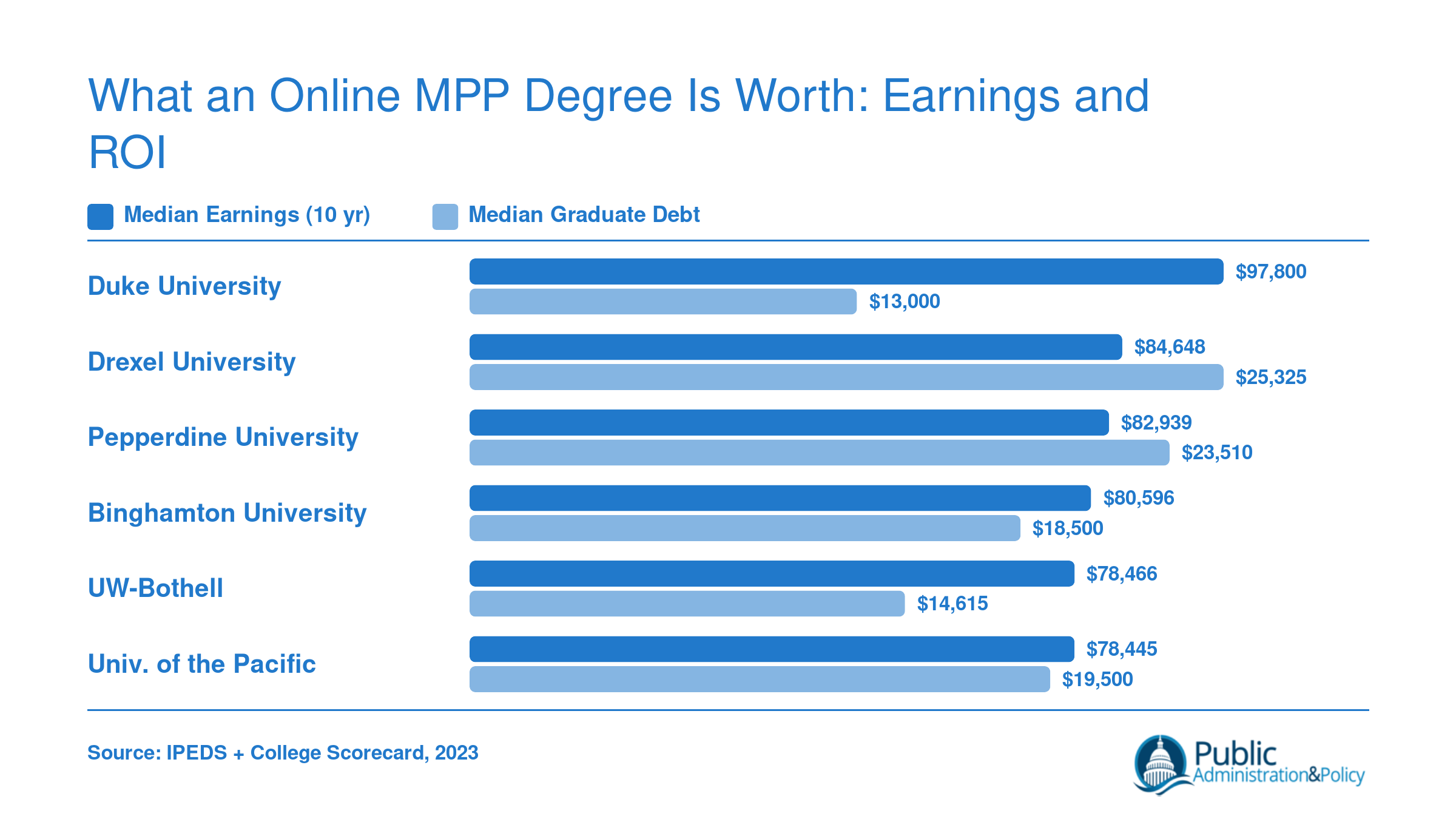

The U.S. Bureau of Labor Statistics projects employment for management analysts, a common role for MPP graduates, will grow 10 percent from 2022 to 2032, significantly faster than the average for all occupations. This rising demand, paired with expanding online offerings across NASPAA accredited programs, makes earning an MPP online increasingly accessible for Nebraska students.

Admissions Requirements and How to Apply to Online MPP Programs

Applying to an online Master of Public Policy program is more straightforward than many Nebraska professionals expect, especially if you already have relevant work experience in government, nonprofits, or community organizations. Here is what you need to know about typical requirements and how to put together a competitive application.

Academic Standards and GPA Expectations

Most NASPAA-accredited online MPP programs set a minimum GPA requirement between 2.7 and 3.0 on a 4.0 scale, though competitive applicants typically hold a 3.0 to 3.25 or higher.1 If your undergraduate GPA falls slightly below the threshold, strong professional experience or solid performance in prerequisite coursework can offset that gap. Common prerequisite courses include statistics, economics, and American government.1 If your undergraduate transcript lacks these, many programs allow you to complete them before or during your first semester.

GRE Policies: Often Optional or Waived

The GRE requirement has been eliminated by a growing number of online MPP programs as of 2026.1 Many programs that still accept scores offer waivers for applicants who hold a GPA of 3.0 or above, or who bring significant professional experience. This shift is good news for Nebraska working professionals who may be years removed from standardized testing. Check each program's current policy, but do not let GRE anxiety delay your application.

Application Components

Expect to submit the following materials with your application:2

  • Transcripts: Official records from all post-secondary institutions attended.
  • Statement of purpose: A concise essay explaining your policy interests, career goals, and why you are drawn to this particular program.
  • Resume or CV: Emphasizing relevant professional, volunteer, or civic experience.
  • Letters of recommendation: Typically two to three, from supervisors, professors, or professional colleagues who can speak to your analytical skills and leadership potential.
  • Writing sample: Some programs request an analytical or policy-related writing sample to gauge your ability to construct evidence-based arguments.
  • English proficiency scores: Required for applicants whose first language is not English.

Work Experience: Required or Preferred?

Most online MPP programs welcome applicants straight from undergraduate programs through pre-service tracks that do not require professional experience. Mid-career tracks, on the other hand, typically require a minimum of three years of relevant work.1 If you fall somewhere in between, highlight any exposure to Nebraska state or local government, legislative internships, nonprofit leadership, or community organizing. Neighboring-state applicants exploring similar options, such as those considering online MPP Iowa programs, will find comparable admissions structures.

Rolling Admissions and Flexible Deadlines

A practical advantage for Nebraska students is that many online MPP programs use rolling admissions or offer multiple start dates throughout the year. This flexibility means you do not have to wait for a single fall deadline. If you decide in March that you want to pursue a degree, you may be able to start that summer or the following term, which is especially helpful for professionals balancing work schedules.

Strengthening Your Application Without a Policy Background

If your undergraduate degree was not in political science, economics, or a related field, you can still build a strong application. Emphasize any hands-on experience with Nebraska policy issues, whether that is coordinating services at a rural nonprofit, managing budgets for a city department, or volunteering on a local campaign. Admissions committees at NASPAA-accredited programs value diverse perspectives and real-world problem solving. A compelling statement of purpose that connects your professional experiences in Nebraska to specific policy challenges you want to address can distinguish your application from candidates with more traditional academic backgrounds. If you are still building foundational knowledge, completing a graduate certificate in public administration can strengthen your transcript before applying.

How to Choose the Right Online MPP Program

Selecting an online Master of Public Policy program is a decision that will shape your career trajectory, your finances, and your day-to-day schedule for the next two years. Because Nebraska does not currently offer an in-state online MPP, you are choosing from a national pool of programs, which makes a structured evaluation framework even more important. The following factors should guide your search.

NASPAA Accreditation

The Commission on Peer Review and Accreditation, housed within NASPAA (Network of Schools of Public Policy, Affairs, and Administration), is the recognized quality standard for graduate programs in public policy and administration. Earning your MPP from a NASPAA-accredited program signals to employers that your coursework met rigorous competency benchmarks in policy analysis, quantitative methods, and public management. This matters most in public-sector hiring: many federal agencies and state civil service systems give preference, or even require, degrees from accredited programs when screening applicants. If you plan to compete for positions with agencies like the U.S. Government Accountability Office, the Congressional Budget Office, or Nebraska state government, NASPAA accreditation removes a potential barrier.

Delivery Format: Synchronous vs. Asynchronous

Online MPP programs vary widely in how they deliver instruction. Some hold live sessions at set times each week (synchronous), while others let you complete coursework on your own schedule (asynchronous). A few blend both approaches. Nebraska students working full time in government or nonprofit roles should weigh this carefully. Synchronous sessions can foster stronger peer interaction but may conflict with work hours. Asynchronous formats offer flexibility but demand more self-discipline. Check whether the program records live lectures for later viewing, as that hybrid approach often gives you the best of both worlds.

Tuition Structure and Residency Policies

Tuition models differ in ways that directly affect total cost.

  • Flat-rate tuition: Some programs charge one per-credit rate regardless of where you live, which is often the most transparent option for out-of-state students.
  • Residency-based tuition: Other schools apply in-state and out-of-state rates even to online learners, potentially doubling your bill.
  • In-person residencies: A handful of programs require one or more on-campus intensives. For Nebraska students, this means airfare, lodging, and time away from work. Always confirm residency requirements before you apply.

Capstone, Practicum, and Time to Completion

Most online MPP programs can be completed in 18 to 24 months of full-time study. However, many also offer part-time tracks that stretch the timeline to roughly three years, an ideal arrangement if you are already working in Nebraska state government, a municipal planning office, or a nonprofit and cannot step away from your role. Pay attention to capstone or practicum requirements as well. Some programs require a client-based policy project, which you may be able to complete with a Nebraska organization, while others substitute a comprehensive exam. A practicum grounded in a local issue, such as water policy, rural healthcare access, or agricultural regulation, can double as a professional networking opportunity.

Pulling It All Together

Before committing, create a simple comparison grid with columns for accreditation status, format, per-credit cost, residency requirements, and completion timeline. Our broader guide to best online public administration degree programs can help you benchmark MPP offerings against related MPA options. Reach out to admissions offices and ask specific questions: Can I use a Nebraska-based organization for my capstone? Are there tuition agreements for online learners? Is financial aid available for part-time enrollment? You can also explore how neighboring states handle similar decisions by reviewing online MPP programs Maine, where students face the same challenge of evaluating national programs without an in-state option. A methodical approach at this stage saves you from costly surprises later and ensures the program you choose aligns with both your career goals and your life in Nebraska.

Frequently Asked Questions About Online MPP Programs for Nebraska Students

Choosing the right online Master of Public Policy program raises practical questions, especially for Nebraska students who may not find an in-state option. Below are answers to the most common concerns prospective MPP students in Nebraska bring to us in 2026.

As of 2026, no Nebraska university offers a dedicated Master of Public Policy degree, whether on campus or online. The University of Nebraska Omaha provides a well-regarded Master of Public Administration, but it is not the same credential. Nebraska students seeking an MPP typically enroll in accredited online programs from out-of-state institutions such as the University of Michigan, American University, or the University of Southern California, many of which welcome students nationwide.

An MPP focuses on policy analysis, quantitative research methods, and evidence-based evaluation of public programs. An MPA emphasizes organizational management, budgeting, and leadership within government agencies or nonprofits. In practical terms, MPP graduates tend to work in policy design, legislative analysis, and think tanks, while MPA graduates often manage agencies and public programs. Many careers in Nebraska benefit from either degree, so your choice should reflect whether you prefer analysis or administration.

For most professionals, yes. An online MPP can lead to higher earning potential in policy analysis, government affairs, and consulting roles. Nationally, mid-career professionals with a master's in public policy report median salaries well above those with only a bachelor's degree. The online format also lets Nebraska students keep working while studying, which preserves income and builds experience simultaneously. Accreditation from NASPAA or a recognized regional body is the key quality indicator to verify before enrolling.

Most online MPP programs require 36 to 48 credit hours and take about two years of full-time study to complete. Part-time students commonly finish in three to four years. Some programs offer accelerated tracks that compress coursework into 18 months. If you are balancing a full-time job in Lincoln or Omaha, a part-time schedule with asynchronous courses tends to be the most manageable path.

It depends on the institution. Some universities participating in the Midwest Student Exchange Program or similar regional agreements offer reduced tuition for Nebraska residents. Others set a flat online tuition rate regardless of where you live. A growing number of schools, including several ranked programs, now charge a single per-credit rate for all online students. Always confirm the exact tuition structure with the admissions office before applying, because savings can be significant.

Nebraska MPP graduates pursue roles such as policy analyst, legislative aide, program evaluator, and research director in state government, agricultural policy organizations, health systems, and nonprofit advocacy groups. Omaha and Lincoln house several federal and state agencies, as well as philanthropic foundations, that regularly hire policy professionals. The degree also positions you for consulting work or roles with national organizations that focus on rural development, education policy, or healthcare access.

More Online MPP Programs Available to Nebraska Students

In addition to our top 10 rankings, Nebraska students have many other quality online MPP programs to consider. The following programs are worth exploring for their unique strengths, flexibility, and affordability.

University of Northern Iowa
The University of Northern Iowa offers an online Master of Public Policy (MPP) designed for public service professionals with synchronous Zoom sessions on Tuesday evenings and a cohort model for two-year completion.
Southern Methodist University
Southern Methodist University offers an online Master of Public Policy for working professionals, focusing on policy analysis, research, and data-driven evaluation with two on-campus immersions.
Colorado State University-Fort Collins
Colorado State University-Fort Collins offers an online Master of Public Policy and Administration with concentrations in public management, public policy, and international policy and management.
University of the Pacific
University of the Pacific offers a hybrid Master of Public Policy with concentrations in environmental and water policy, public policy advocacy, non-profit management, and local government.
Worcester State University
Worcester State University offers a hybrid Master of Public Administration and Policy with a capstone fieldwork component for real-world application.
University of Illinois Springfield
University of Illinois Springfield offers a hybrid Master of Public Policy with Graduate Public Service Internships providing paid government work and tuition waivers.
Drexel University
Drexel University offers a hybrid Master of Public Policy with a case study-driven curriculum and flexible full-time or part-time options for completion in 18-24 months.
North Dakota State University
North Dakota State University offers a hybrid Master of Public Policy with a 36-credit curriculum and an accelerated option for undergraduate students to earn both degrees in five years.
Texas A&M University-Central Texas
Texas A&M University-Central Texas offers a hybrid Master of Public Administration focusing on leadership roles in government, non-profits, and public sector management.
Pepperdine University
Pepperdine University offers a hybrid Master of Public Policy with a Washington, DC track option, five specializations, and no GRE required for admission.
University of Colorado Denver/Anschutz Medical Campus
University of Colorado Denver offers a hybrid Master of Public Policy with concentrations in education, environmental, and policy analysis, plus a capstone or thesis option.
York College of Pennsylvania
York College of Pennsylvania offers a fully online Master of Public Policy and Administration with concentrations in urban planning, nonprofit leadership, and local government.
University of Southern Maine
University of Southern Maine offers a hybrid Master of Public Policy and Management with concentrations in community planning and sustainable development or public policy and nonprofit management.
University of Redlands
University of Redlands offers a hybrid Master of Public Policy and Administration with 8-week courses and cohort-based learning, emphasizing policy analysis and public management.
The New School
The New School offers a hybrid Master of Science in Public and Urban Policy with an Urban Policy Lab for hands-on client projects addressing urban challenges.

Recent Articles