Best Online MPP Programs for Alaska Students (2026)
Compare accredited online MPP degrees by cost, completion time, and career outcomes available to Alaska residents.
By Holly AbramsonReviewed by PAP Editoral TeamUpdated August 14, 202625+ min read
What you’ll learn in this article…
Alaska has no in-state online MPP program, so residents must choose from nationally accredited out-of-state options.
Several NASPAA-accredited online MPP programs accept Alaska students, and many now waive the GRE requirement.
With 229 federally recognized tribes, Alaska offers unique policy careers in Indigenous governance and natural resource management.
Affordable online MPP tuition varies widely, making net price comparisons essential for out-of-state Alaska learners.
No Alaska institution currently offers an online Master of Public Policy, yet the state's policy workforce needs are anything but small. With 229 federally recognized tribes, billions in Permanent Fund revenue, and rural health systems stretching across 665,000 square miles, Alaska demands graduates who can analyze complex trade-offs across resource management, Indigenous governance, and federal-state relations.
The constraint for Alaska residents is geographic, not academic. Several NASPAA-accredited programs enroll students remotely, with total tuition ranging from roughly $20,000 to over $70,000 depending on the institution. Some waive the GRE; others offer flat-rate or reduced out-of-state pricing. The University of Alaska system does provide a related online MPA programs Alaska track, but students seeking the policy-analysis focus of an MPP need to look beyond state borders. Cost variation at that scale makes program selection a financial decision as much as an academic one, especially for mid-career professionals already working in state or tribal agencies.
Top Online MPP Programs for Alaska Students
Alaska has no in-state Master of Public Policy program offered entirely online, which means residents need to look beyond state borders. The good news: several nationally respected universities deliver online or hybrid MPP programs that Alaska students can complete remotely. The programs below are ordered by a quality composite that weighs institutional graduation rates, retention, net price, and program-level factors such as delivery format, concentration options, and experiential requirements. Program-level earnings data is not yet available for these MPP programs, so institution-wide outcomes are noted where useful.
Factors considered
Online delivery eligibility
Institutional graduation and retention
Net price and affordability
Program concentrations and format
Experiential learning components
Sources
Internal program database
Independent program research
NCES-IPEDS federal institutional data — nces.ed.gov
Best for: Early-career professionals seeking elite credentials
Duke University's Sanford School of Public Policy offers a 24-month, 51-credit-hour MPP with a hybrid format that blends online coursework with on-campus residencies. The program features eight concentration tracks, including Development Policy and Energy and Environment Policy, and allows dual-degree pairings. With a 96.8% overall graduation rate and a 5-to-1 student-faculty ratio, Duke delivers an exceptionally supportive academic environment, though its net price of $29,612 places it at the higher end of this list. Fellowship opportunities and financial aid help offset costs, and the GRE is optional for admission.
View 2 programs
Master of Public Policy — Hybrid
Hybrid format: online coursework plus campus residencies
Best for: Remote learners needing asynchronous flexibility
Binghamton University delivers one of the few fully online, asynchronous MPP programs in the country, making it especially practical for Alaska residents who need maximum scheduling flexibility. The curriculum emphasizes data analysis, policy modeling, and global perspectives, with applied projects completed through a dedicated policy laboratory. Full-time students can finish in as little as one year, and the net price of $21,620 keeps costs competitive among public research universities. The school's overall graduation rate stands at 81.6%.
View program
Master of Public Policy — Online
100% online with asynchronous course delivery
Can be completed in one year full-time
Applied policy laboratory for hands-on projects
Strong focus on data analysis and policy modeling
Military-friendly program designation
Fall, spring, and summer start terms available
Affordable tuition at a public research university
Best for: Mid-career professionals with management experience
Ohio State University's Glenn College offers a Master of Arts in Public Policy and Management built specifically for working professionals who already have at least three years of administrative or analytical experience. The 38-credit hybrid program features evening classes and can be completed in five semesters, with no GRE required. At a net price of $17,339 and an overall graduation rate of 87.7%, Ohio State balances affordability with strong institutional outcomes. Core coursework spans public policy, economics, management, and decision support systems.
View program
Master of Arts in Public Policy and Management — Hybrid
38 credit hours with hybrid evening delivery
Designed for professionals with 3+ years of experience
Rutgers University's Bloustein School pairs hybrid in-person classes with synchronous remote sessions across a rigorous 48-credit, two-year MPP. Students choose from 14 concentrations, including health, environment, social justice, and urban policy, or design a custom track. A standout feature is the ability to cross-register at Princeton's School of Public and International Affairs. The 300-hour internship and group policy research practicum give graduates substantial real-world experience. The school's overall graduation rate is 83.6%, and net price comes in at $24,406.
View program
Master of Public Policy (MPP) — Hybrid
48 credits completed over two years
14 concentration options or custom-designed track
Cross-registration with Princeton available
300-hour applied field experience internship
Group policy research practicum with real agencies
The University of Washington Bothell offers a Master of Arts in Policy Studies with a hybrid format that combines online coursework and evening classes held after 5 p.m. Its Pacific Northwest location makes it geographically closer to Alaska than most programs on this list, and the cohort model fosters collaborative learning through community partner projects. At a net price of $12,319, it is the most affordable option in this ranking. The school's overall graduation rate is 65.3%, but its interdisciplinary, evidence-based curriculum and focus on social change make it a strong fit for Alaska students interested in state and local governance.
View program
Master of Arts in Policy Studies — Hybrid
Hybrid format with evening classes after 5 p.m.
Cohort model with community partner projects
Interdisciplinary curriculum in policy and social theory
Emphasis on evidence-based analysis and evaluation
George Mason University's Schar School of Policy and Government delivers an MPP in hybrid and fully online formats, with evening classes designed for working professionals. Proximity to Washington, D.C. gives students access to federal agencies, NGOs, and international organizations, and graduates have been hired by employers such as the CIA, Accenture, and the World Bank. Merit scholarships and military tuition assistance are available, and the program's net price of $17,915 keeps it competitive among public universities. George Mason's overall graduation rate is 67.8%.
View program
Master of Public Policy — Hybrid
Hybrid or fully online format with evening classes
Located near D.C. for federal networking access
Merit scholarships and military tuition assistance offered
Curriculum covers technology modeling and global policy
80+ faculty members across policy disciplines
Dedicated career development advisors assigned
Graduates placed at CIA, World Bank, USAID, and more
The University of Houston's Hobby School of Public Affairs offers a NASPAA-accredited, 39-credit-hour MPP in a hybrid format that blends online learning with on-campus components. The curriculum spans economics, politics, ethics, and quantitative analysis, and includes an internship plus a capstone project. At a net price of $14,276, it is one of the most affordable options on this list. The school's overall graduation rate is 64.6%, and its location in one of the country's most diverse metro areas enriches the experiential learning dimension of the program.
View program
Master of Public Policy — Hybrid
39 credit hours with hybrid delivery
NASPAA-accredited program
Internship and capstone project required
Interdisciplinary core in economics, politics, and ethics
Virtual information sessions and fee waivers available
The University of Tennessee Knoxville's Baker School provides a fully online, 36-credit MPP with seven concentration options that include Energy Policy, Health Policy, and National Security. Alaska students interested in natural resource governance will find the Agricultural and Environmental Policy track particularly relevant. The program does not require a GRE for domestic applicants and can be completed without a thesis. Net price is $18,976, and the school's overall graduation rate is 73.9%.
View program
Master of Public Policy — Online
Fully online, 36-credit-hour program
Seven concentrations including Energy and Health Policy
Oregon State University's NASPAA-accredited MPP requires 54 quarter credits and offers seven established concentrations, including Energy Policy, Environmental Policy, and Rural Policy, plus a self-designed option. The hybrid format lets students complete coursework online while participating in an 11-week capstone policy lab where teams conduct research for real clients. At a net price of $19,604, the program is moderately priced, and the school's overall graduation rate is 70.1%. Its Pacific Northwest location and rural-policy expertise align well with many Alaska policy priorities.
View program
Master of Public Policy, energy policy — Hybrid
54 quarter credits: 34 core plus 20 concentration
NASPAA-accredited hybrid program
11-week online capstone with real-world clients
Energy Policy focus on production and sustainability
The University of Pittsburgh's Master of Public Policy and Management targets seasoned professionals with at least five years of post-entry-level experience. Its 30-credit curriculum, consisting of four required courses and six electives, is among the most compact on this list and can be completed online in 20 months. A major perk for Alaska residents: online students pay in-state tuition regardless of where they live. Full-time government employees also qualify for a 20% tuition discount. The school's overall graduation rate is 85.5%, and net price is $30,434 at the institutional level, though the in-state online rate effectively lowers costs for distance learners.
View program
Master of Public Policy and Management — Online
30 credit hours across 10 courses
Online students pay in-state tuition from any state
Why Alaska Doesn't Have Local MPP Programs, and Why That's OK
Alaska is home to roughly 730,000 residents, making it one of the least populated states in the country. That small population base directly shapes the graduate education landscape. The University of Alaska system, the state's primary public university network, offers related coursework through its master of public administration Alaska program, but no institution in the state awards a dedicated Master of Public Policy degree. For students who want the policy-analysis focus that distinguishes an MPP from an MPA, looking beyond state borders is the only path.
The good news: that path has never been easier to walk.
Online Programs Erase the Distance Problem
A decade ago, Alaska students interested in a policy-focused graduate degree would have faced a stark choice: relocate to the Lower 48 or settle for a different program. Today, nationally ranked universities deliver full MPP curricula online with the same faculty, the same degree title, and the same accreditation as their on-campus counterparts. Many of these programs charge a flat tuition rate regardless of where you live, so Alaska residents pay the same per-credit cost as students in the program's home state. That pricing model removes one of the biggest financial barriers that once penalized students in remote areas.
Financial Aid Options Alaska Students Should Know
Being out of state does not mean being out of options when it comes to paying for your degree. Alaska students can leverage several funding channels:
Federal financial aid: FAFSA eligibility is tied to you, not your school's location. Stafford loans, Pell Grants (for those who qualify), and graduate PLUS loans all apply to regionally accredited online programs.
Employer tuition reimbursement: Alaska state agencies, tribal governments, and many nonprofits operating in the state offer education benefits. If you already work in the public or tribal sector, check whether your employer covers part or all of graduate tuition.
WICHE reciprocity: The Western Interstate Commission for Higher Education operates exchange programs that can reduce tuition at participating institutions across the western United States. Not every online MPP participates, but it is worth confirming eligibility before you enroll.
Turn a Limitation Into a Strategic Advantage
The absence of a local MPP program actually frees Alaska students to be selective. Instead of defaulting to the nearest option, you can shop the entire national market for the program that best fits your career goals, whether that means a concentration in environmental policy, Indigenous governance, health systems, or economic development. You can prioritize NASPAA accreditation, seek out programs with no GRE requirement, or filter by cost. The result is a degree tailored to your ambitions rather than your zip code, and you never have to leave the communities you aim to serve.
Most Affordable Online MPP Programs for Alaska Residents
Because Alaska has no in-state MPP programs, every option on this list is out-of-state, which makes cost comparison especially important. The table below is sorted by net price, an institution-wide average that reflects what students typically pay after grants and scholarships. Net price is not a guaranteed quote for any individual student or program; it can vary significantly based on your financial profile, enrollment status, and the aid package you receive. Always contact each school's financial aid office for a personalized estimate. Program-level debt repayment figures are not yet available for these programs, so we have included the institution-wide median graduate debt to help you gauge overall borrowing patterns.
School
State
Program Offered
Out-of-State Tuition
Net Price (Avg. After Aid)
Median Graduate Debt
Texas A&M University-Central Texas
TX
Master of Public Administration
$13,586
$1,300
$17,750
California State University-Sacramento
CA
Master of Public Policy and Administration
$19,622
$9,338
$15,000
University of Illinois Springfield
IL
Master of Public Policy
$19,515
$9,833
$19,128
University of Colorado Denver
CO
Master of Public Policy
$27,154
$11,900
$20,500
University of Washington-Bothell
WA
Master of Arts in Policy Studies
$32,757
$12,319
$14,615
Florida Gulf Coast University
FL
Master of Public Administration (MPA)
$31,216
$12,568
$17,622
Worcester State University
MA
Master of Public Administration and Policy
$6,813
$13,381
$19,500
University of Southern Maine
ME
Master of Public Policy and Management
$26,676
$13,596
$19,060
University of Houston
TX
Master of Public Policy
$19,231
$14,276
$18,194
North Dakota State University
ND
Master of Public Policy
$12,578
$15,543
$23,199
Questions to Ask Yourself
Are you drawn to quantitative policy analysis or community-based advocacy?
Programs emphasizing econometrics and data modeling differ sharply from those centered on stakeholder engagement and equity frameworks. Knowing your preferred toolkit helps you filter concentrations and match coursework to the policy work you actually want to do in Alaska.
Does your target employer require a NASPAA-accredited degree?
Many federal agencies, state departments, and tribal organizations treat NASPAA accreditation as a hiring benchmark. If your career goal depends on that credential, narrowing your list to accredited programs early saves time and tuition dollars.
Do you need part-time or asynchronous flexibility to keep working in Alaska?
Alaska's time zone and remote work conditions can clash with synchronous class schedules. Programs offering asynchronous coursework or evening sessions let you maintain your current role while completing the degree on a realistic timeline.
How much weight should cost carry relative to concentration fit and accreditation?
An affordable program that lacks your ideal specialization may cost more in the long run if you need additional credentials later. Before scrolling further, rank your priorities: tuition, program reputation, and the specific policy focus areas that align with your career path.
MPP Vs. MPA: Which Degree Fits Alaska Careers?
If you have searched for public policy or public administration degrees online, you have likely noticed that many program listings blur the line between the MPP and MPA. These are distinct degrees with different strengths, and choosing the right one depends on the kind of work you want to do in Alaska or beyond. Both fall under the NASPAA accreditation umbrella and are respected across public sector hiring, but their core training diverges in important ways. Here is a side-by-side breakdown across five key dimensions.
Dimension
Master of Public Policy (MPP)
Master of Public Administration (MPA)
Analytical Focus
Quantitative policy analysis, causal inference, and evidence-based decision making. The MPP trains you to evaluate whether a program or regulation achieves its intended outcomes.
Organizational management, leadership, and the day-to-day administration of public agencies. The MPA trains you to run programs effectively once policy decisions have been made.
Typical Coursework
Econometrics, statistics, cost-benefit analysis, program evaluation, microeconomics for policy, and research methods.
Public budgeting and finance, human resource management, organizational behavior, administrative law, and strategic planning.
Career Alignment
Legislative analysis, think-tank research, federal policy roles, program evaluation consulting, and data-driven advocacy positions.
Agency director and department head positions, city or borough management, nonprofit executive leadership, and public HR or budget officer roles.
Relevance to Alaska Public Sector Roles
Strong fit for roles analyzing resource policy, fisheries management regulations, federal land-use decisions, and tribal policy development at the research or advisory level. Particularly valuable for positions that interface with federal agencies.
Strong fit for managing Alaska state agencies, leading tribal governance organizations, directing rural nonprofits, and overseeing borough-level operations. Especially relevant for hands-on leadership in remote or underserved communities.
NASPAA Accreditation
NASPAA accredits qualifying MPP programs under the same standards applied to MPA programs. Accredited online MPP options are available to Alaska residents from institutions across the country.
NASPAA accredits qualifying MPA programs under identical standards. A wider selection of NASPAA-accredited online MPA programs exists compared to MPP programs, giving Alaska students more choices in administration-focused study.
Bottom Line for Alaska Students
Choose the MPP if you want to shape policy through research, analysis, and evaluation, especially at the state legislative, federal, or tribal policy level.
Choose the MPA if you want to lead teams, manage budgets, and direct operations within Alaska's state agencies, tribal organizations, or nonprofit sector.
Naspaa-Accredited Online MPP Options for Alaska Students
If you are evaluating online Master of Public Policy programs from Alaska, NASPAA accreditation should be one of the first things you check. The Network of Schools of Public Policy, Affairs, and Administration sets the gold standard for graduate programs in public affairs and policy, much like AACSB accreditation does for business schools. NASPAA accreditation signals that a program meets rigorous benchmarks for curriculum design, faculty qualifications, student learning outcomes, and mission-driven assessment. For Alaska students studying remotely, that external quality assurance carries real weight. Those exploring the broader landscape of online MPP programs will find that NASPAA status is consistently one of the most important differentiators.
Why NASPAA Accreditation Matters
NASPAA-accredited programs follow a peer-reviewed process that evaluates whether graduates are prepared for careers in policy analysis, public management, and related fields. This matters most in two practical ways:
Federal hiring preferences: Many federal agencies and some state positions give preference to candidates who hold degrees from NASPAA-accredited programs. If you plan to work for the federal government (a major employer in Alaska), this credential distinction can be meaningful.
Credential portability: A NASPAA-accredited degree is widely recognized across sectors and states, which protects your investment if you relocate or shift career paths.
Confirmed NASPAA-Accredited Online MPP Programs
According to NASPAA's 2025-2026 roster of accredited programs, several institutions offer online or hybrid MPP degrees that carry full NASPAA accreditation and accept students nationwide, including those based in Alaska:1
American University: Master of Public Policy (MPP), offered fully online.
Oregon State University: Master of Public Policy (MPP), available in a hybrid format with concentrations in energy, environmental, rural, and social policy.
University of Massachusetts Boston: Master of Public Policy (MPP), offered online and hybrid with a focus on urban and social policy.
University of Minnesota Twin Cities: Master of Public Policy (MPP), with an online emphasis and strengths in quantitative policy analysis.
Northwestern University: Master of Public Policy and Administration (MPPA), delivered online.
Each of these programs appears on NASPAA's official accredited list for the current cycle, but Alaska students should verify status directly at naspaa.org before applying.1 Accreditation applies to specific programs, not entire universities, so a school may hold NASPAA accreditation for its MPA but not its MPP, or vice versa. The online delivery modality may also differ from the campus-based version. Students interested in the MPA track specifically may want to explore naspaa accredited online mpa options in nearby states as well.
What About Non-NASPAA Programs?
Not every strong online MPP carries NASPAA accreditation. Programs at schools like Binghamton University, the University of Tennessee-Knoxville, and the University of Pittsburgh hold regional accreditation and produce competitive graduates in policy roles. Regional accreditation (from bodies like the Higher Learning Commission or Middle States) ensures institutional legitimacy and credit transferability. If a program you are considering lacks NASPAA credentials, look closely at its curriculum, career placement data, and faculty expertise before ruling it out.
The bottom line: NASPAA accreditation is a strong signal of program quality and can open specific doors, particularly in federal employment. But it is not the only measure of a worthwhile degree. Weigh accreditation alongside fit, cost, concentration options, and your own career goals.
Admissions Requirements and GRE Policies for Online MPP Programs
Applying to an online Master of Public Policy program is more straightforward than many Alaska-based professionals expect. While each university sets its own criteria, the core requirements are remarkably consistent across NASPAA-accredited and nationally ranked programs. Below is a practical breakdown of what you will need and how the GRE landscape has shifted in your favor.
Common Admissions Requirements
Most online MPP programs ask for a similar set of application materials. Here is what you should plan to prepare:
Bachelor's degree: A completed undergraduate degree from a regionally accredited institution. Your major does not need to be in political science or economics; programs welcome applicants from diverse academic backgrounds.
Minimum GPA: A cumulative GPA of 3.0 on a 4.0 scale is the standard threshold, though some programs consider applicants below that mark if professional experience is strong.
Letters of recommendation: Two to three letters, typically from academic references, supervisors, or colleagues who can speak to your analytical and leadership abilities.
Statement of purpose: A personal essay explaining your policy interests, career goals, and reasons for pursuing the degree.
Resume or CV: A current document highlighting relevant work, volunteer, and civic engagement experience.
Some programs also request a writing sample or short-answer responses, so read each school's checklist carefully before you begin.
The GRE Waiver Trend
The standardized testing landscape shifted dramatically during the pandemic, and many top programs have kept those relaxed policies in place. USC Price, for example, does not require a GRE or any entrance exam for its online Master of Public Administration program.1 Oregon State University offers conditional GRE waivers for qualified applicants, often based on a combination of GPA and professional background. Other well-known programs at universities such as American University and Johns Hopkins have adopted similar test-optional or waiver-based policies in recent admissions cycles, though you should verify each school's current stance for the 2026 admissions window.
This trend is especially good news for Alaska residents working in state or local government, tribal governance, or nonprofit organizations. Programs that offer experience-based waivers typically look for three to five years of relevant professional work, and the public service backgrounds common in Alaska communities often meet or exceed those benchmarks.
Typical Program Length and Credit Requirements
Online MPP programs generally range from 36 to 48 credits, though a few extend to 60 credits when they include a broader interdisciplinary curriculum. Full-time students can expect to finish in roughly 18 to 24 months. Part-time enrollment, which is the more common choice for working professionals in Alaska, typically stretches the timeline to two to three years. USC Price's online program requires 40 to 48 credits and is designed around a 24-month completion track.1 Oregon State's program spans 45 to 60 credits with an estimated 24-month full-time timeline, though part-time options are available.
Before applying, map out your personal timeline. Consider your current work obligations, whether your employer offers tuition assistance, and how quickly you want to transition into a policy-focused role. Most programs offer rolling or multiple admission cycles per year, giving you flexibility to start when the timing is right.
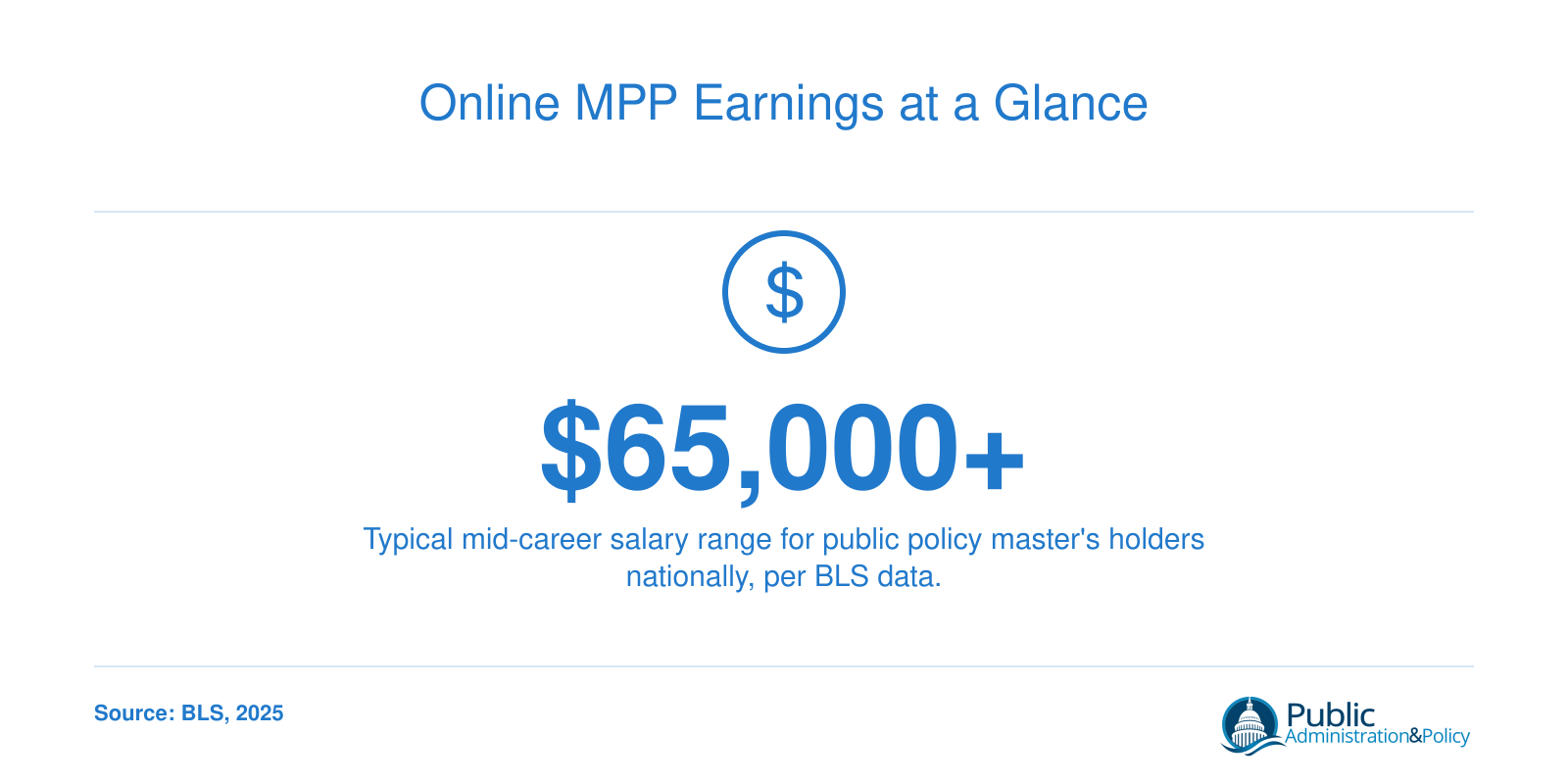
Online MPP Earnings at a Glance
Program-level earnings data for online Master of Public Policy programs are not yet available for the schools featured in this guide. The U.S. Department of Education's College Scorecard publishes median post-completion earnings on a rolling basis, but reporting thresholds mean many online MPP programs have not released figures. As new data becomes available, publicadministrationpolicy.org will update this section with a full program-by-program salary comparison for Alaska students.
Online MPP Curriculum and Concentrations Relevant to Alaska
Most online MPP programs share a common curricular backbone designed to turn students into skilled policy analysts. Understanding what that core looks like, and where you can specialize, helps you choose a program that aligns with Alaska's distinct policy landscape.
Core Curriculum You Can Expect
Regardless of which program you choose, the first year of coursework typically covers a set of foundational subjects:
Microeconomics for Policy: How markets work, why they fail, and when government intervention makes sense.
Statistics and Quantitative Methods: Tools for analyzing data, building models, and interpreting research that informs policy decisions.
Policy Analysis Frameworks: Structured approaches for evaluating policy alternatives, estimating costs and benefits, and presenting recommendations to decision-makers.
Political Institutions and the Policy Process: How legislation moves through government bodies, how bureaucracies implement policy, and how stakeholders influence outcomes.
Ethics in Public Policy: Navigating the moral dimensions of policy design, from equity considerations to transparency and accountability.
This core equips you with a versatile analytical toolkit, one that applies whether you end up working in Juneau, Washington, D.C., or a tribal council office in rural Alaska. For a broader look at how policies move from idea to implementation, our introduction to public policy guide covers the full lifecycle.
Concentrations That Matter for Alaska
Alaska's economy, geography, and demographics create policy challenges rarely found in other states. When evaluating programs, look for concentrations that speak directly to those challenges:
Environmental and Natural Resource Policy: Alaska manages vast public lands, fisheries, and wildlife populations. This track prepares you to navigate federal and state resource governance.
Energy Policy: With oil revenue shaping the state's fiscal structure and renewable energy gaining traction in remote communities, energy policy expertise is in high demand.
Health Policy: Rural health access remains one of Alaska's most pressing concerns. Programs with a health policy focus teach you to design solutions for underserved and geographically isolated populations.
Indigenous and Tribal Governance: Alaska is home to more than 200 federally recognized tribes. Concentrations in tribal governance address sovereignty, self-determination, and the intersection of tribal, state, and federal law.
Rural Development: Some programs offer coursework on economic development strategies tailored to low-density, resource-dependent communities.
If environmental and natural resource governance appeals to you, consider exploring the environmental policy advisor career path to see where that concentration can lead.
Capstones and Independent Study Projects
Nearly every accredited MPP program requires a capstone experience, often a professional policy memo or applied research project. This is where your Alaska-specific interests can take center stage. Many programs allow you to design a capstone around a real-world issue relevant to your career goals. Students from Alaska have explored topics such as subsistence resource management, Permanent Fund dividend policy, climate adaptation strategies for coastal villages, and rural broadband expansion.
Some programs also offer independent study courses where you can work one-on-one with a faculty advisor on a topic not covered in the standard curriculum. If a program does not list an Alaska-relevant concentration, ask the admissions office whether independent study or directed research options can fill that gap.
The capstone requirement is more than an academic exercise. It produces a polished writing sample and analytical showcase that employers in government agencies, nonprofits, and consulting firms expect to see from MPP graduates.
Career Outcomes and Salaries for Alaska Policy Graduates
Alaska's policy landscape is uniquely shaped by vast public lands, resource-dependent economies, and the strongest tradition of tribal sovereignty in any U.S. state. For MPP graduates, that translates into a surprisingly diverse set of career paths, even in a state with fewer than 750,000 residents.
Primary Career Paths in Alaska
MPP holders working in Alaska typically land in one of five sectors:
State government: Legislative staff roles, budget analysts, and policy analysts within agencies such as the Department of Health and Social Services, the Department of Natural Resources, and the Department of Environmental Conservation.1
Tribal governance and Alaska Native corporations: Policy staff who manage everything from land-use planning to health care delivery across more than 200 federally recognized tribes and a dozen regional Native corporations.
Federal agencies: Alaska hosts major operations for the Bureau of Land Management, the Environmental Protection Agency, the National Park Service, and the Bureau of Indian Affairs, all of which employ policy analysts at various GS levels.2
Nonprofit advocacy: Organizations focused on subsistence rights, energy policy, climate resilience, and public health regularly seek analysts who can translate research into legislative recommendations.
Consulting and research: A smaller but growing niche, particularly around natural resource management and environmental impact assessment.
What Alaska Policy Professionals Earn
Salary ranges reflect the state's higher cost of living and the premium placed on professionals willing to work in remote communities. Based on 2023 and 2024 workforce data:
Entry-level policy roles in state agencies generally fall between $55,000 and $80,000.1
Mid-career analysts and program managers typically earn $80,000 to $110,000, while senior policy directors and operations managers in state government average $95,000 to $120,000.2
Federal positions carry locality pay adjustments. A GS-9 policy role in Alaska pays roughly $65,000 to $89,000, a GS-11 role ranges from $85,000 to $105,000, and a GS-12 position reaches $100,000 to $125,000.2
Alaska Native corporation policy staff earn between $85,000 and $120,000, while tribal government policy roles range from $60,000 to $90,000.1
Program-level earnings data for the online MPP programs featured on this site are not yet available at the national level. However, the institutional median earnings ten years after enrollment at schools like Duke University and Binghamton University exceed $80,000, which provides a useful national baseline. Keep in mind that Alaska's cost of living, particularly for housing and food outside Anchorage, can be 30 to 50 percent above the national average, so raw salary figures need context.
Why Breadth Matters in a Small State
Alaska's compact policy community means professionals rarely occupy narrow, single-issue roles. A policy analyst at the Department of Natural Resources might draft subsistence regulations in January and pivot to oil revenue projections by March. An MPP curriculum built around quantitative analysis, program evaluation, and cross-sector leadership prepares graduates for exactly this kind of versatility. The Workplace Alaska Internship Program, which offers Graduate Intern I and II positions, gives current students a direct entry point into state government while completing an online degree from outside the state.
For Alaska students enrolled in online MPP programs at institutions like Binghamton University or the University of Washington-Bothell, remote coursework pairs naturally with local professional experience. Those interested in the quantitative side of government work can explore a career as a public budget analyst while building analytical skills through a program's policy laboratory or capstone project. Students considering a complementary credential may also benefit from reviewing online MPA programs Alaska offers through partner institutions. Either way, networking within Juneau, Anchorage, or Fairbanks agencies is where your next career move is likely to begin.
Alaska is home to 229 federally recognized tribes, more than any other state in the nation, according to the U.S. Bureau of Indian Affairs. That concentration of tribal governments creates exceptional demand for policy professionals trained in Indigenous governance, rural resource management, and intergovernmental relations.
Frequently Asked Questions About Online MPP Programs for Alaska Students
Alaska students considering an online Master of Public Policy have plenty of options, but sorting through program details can feel overwhelming. Below are answers to the most common questions we hear from prospective MPP students in the state.
Which online MPP programs are available to Alaska residents?
Several nationally recognized universities offer fully online MPP programs open to Alaska residents. Schools such as the University of Michigan, University of Southern California, and American University deliver online MPP curricula with no geographic restrictions. Because Alaska has no in-state MPP program, most students enroll in out-of-state online options. Check each program's state authorization page to confirm eligibility before applying.
What is the difference between an MPP and an MPA degree?
An MPP focuses on policy analysis, research methods, and evidence-based decision making, preparing graduates to design and evaluate public policies. An MPA emphasizes organizational management, budgeting, and leadership within government agencies and nonprofits. Both degrees can lead to public service careers, but if you want to shape policy through data and analysis rather than manage day-to-day operations, the MPP is typically the stronger fit.
Are there NASPAA-accredited online MPP programs that accept Alaska students?
Yes. The Network of Schools of Public Policy, Affairs, and Administration (NASPAA) accredits several online MPP programs that enroll students nationwide, including those in Alaska. NASPAA accreditation signals that a program meets rigorous standards for curriculum, faculty quality, and student outcomes. Always verify a program's current accreditation status on the NASPAA website before committing.
Do online MPP programs require the GRE?
Many online MPP programs have moved to GRE-optional or GRE-waiver policies, especially for applicants with professional experience or strong undergraduate GPAs. Some programs have dropped the GRE requirement entirely. If standardized testing is a concern, look for programs that explicitly list a no-GRE admissions path. Requirements can change from year to year, so confirm the current policy directly with each admissions office.
How long does it take to complete an online MPP program?
Most online MPP programs require around 42 to 48 credit hours and take approximately two years of full-time study to complete. Part-time students often finish in three to four years. Some programs offer accelerated options or allow you to transfer credits, which can shorten the timeline. Review each program's course sequencing to understand how quickly you can progress.
Do online MPP programs require campus visits or residencies?
It depends on the program. Many fully online MPP programs have no on-campus requirement at all, making them practical for Alaska students who live far from a university campus. However, some programs include optional or required short residencies, capstone presentations, or immersion weekends. If travel is a barrier, prioritize programs that are 100 percent online with no in-person component.
Can I work full-time while earning an online MPP?
Absolutely. Online MPP programs are designed with working professionals in mind. Most feature asynchronous coursework, recorded lectures, and flexible deadlines that let you study on your own schedule. Many students in Alaska's public and nonprofit sectors complete their MPP while maintaining full-time employment. Enrolling part-time can further ease the workload, though it will extend your time to degree completion.
More Online MPP Programs Available to Alaska Students
Beyond our top 10, here are additional online MPP programs worth exploring. These schools offer flexible formats and various concentrations that may align with your career goals. All accept Alaska students for remote completion.
University of Northern Iowa
The online MPP program features synchronous Zoom sessions on Tuesday evenings and a cohort model for full-time students. Tuition is $586 per graduate credit for 2025-26, with scholarships available.
The part-time online MPP emphasizes technical skills in policy analysis, research, and data-driven evaluation. Includes two on-campus immersions and a real-world capstone project.
The online MPPA program offers concentrations in Public Management, Public Policy, and International Policy and Management. It features an interdisciplinary curriculum and accelerated options.
The hybrid MPP at McGeorge School of Law includes online coursework and in-person Saturday sessions in Sacramento. Concentrations include Environmental and Water Policy and Public Policy Advocacy.
The hybrid MPAP program blends face-to-face and online courses for working professionals. Core courses cover policy analysis, public budgeting, and organizational theory, with a capstone fieldwork component.
This flexible hybrid MPP program offers online and on-campus courses. Graduate Public Service Internships provide paid government work and tuition waivers in Springfield or Chicago.
The hybrid MPP uses a case study approach and offers full-time or part-time study with completion in 18-24 months. Courses are available online and on-campus, with certificate and graduate minor options.
The hybrid MPP allows in-person or remote real-time attendance. The 36-credit program offers an accelerated five-year option for undergraduates and focuses on policy design and evaluation.
The hybrid MPA program combines online coursework with in-person sessions and emphasizes leadership in government and nonprofit sectors. It is military-friendly with a flexible curriculum.
The hybrid MPP offers five specializations and a Washington, DC track. Over 95% of admitted students receive scholarships averaging 70% of tuition. No GRE required.
University of Colorado Denver/Anschutz Medical Campus
The hybrid MPP offers concentrations in Education Policy, Environmental Policy, Policy Analysis & Methods, and Policy Entrepreneurship & Advocacy. Tuition discounts for Western state residents.
The fully online MPPA program features concentrations in Urban Planning, Nonprofit Leadership, and Local Government. Can be completed in two years with thesis and Scholar-in-Residence opportunities.
The hybrid MPPM offers concentrations in Community Planning and Sustainable Development or Public Policy and Public/Nonprofit Management. Accelerated pathway for undergraduates and reduced out-of-state tuition.
The hybrid MPPA program offers 8-week courses with cohort-based learning. Classes meet evenings and weekends. No standardized tests required; complete in 15 months.
The hybrid MS in Public and Urban Policy focuses on social inclusion and equity. Features the Urban Policy Lab for client projects in government, nonprofit, and private sectors.