Best Online Master of Public Policy Programs in Michigan for 2026
Compare Michigan's top online and hybrid MPP, MPA, and MPAP programs — with tuition, outcomes, and career data to guide your decision.
By Holly AbramsonReviewed by PAP Editoral TeamUpdated August 7, 202625+ min read
What you’ll learn in this article…
Fully online MPP degrees from Michigan universities remain scarce in 2026, but hybrid and online MPA or MPAP alternatives offer strong policy training.
The University of Michigan-Dearborn MPAP provides a policy concentration with in-state tuition significantly lower than the Ford School's residential programs.
NASPAA accreditation and rigorous quantitative coursework in statistics, microeconomics, and cost-benefit analysis distinguish top Michigan policy programs.
Michigan MPP graduates find strong career demand in state government, nonprofit advocacy, and health policy across the Great Lakes region.
Michigan employs roughly 14,000 state government policy analysts, program evaluators, and legislative staff in Lansing alone, with additional demand radiating from Detroit's metro governance agencies and a nonprofit sector that has expanded steadily since 2020. For professionals hoping to earn an online MPP in Michigan, though, the options are surprisingly limited. No Michigan university currently offers a fully online, standalone Master of Public Policy. The University of Michigan-Dearborn's hybrid Master of Public Administration and Policy, with its dedicated public policy concentration, is the closest fit for online learners who need scheduling flexibility around a full-time career.
That thin supply means prospective students must weigh related degrees, such as online MPA programs with policy tracks, against residential MPP options. For those exploring careers in public administration, understanding the real differences in curriculum, accreditation, cost, and career outcomes matters more here than in states with a crowded market.
Best Online MPP & Public Policy Programs in Michigan, Ranked
To build this ranking, we filtered Michigan graduate programs in public policy for online or hybrid delivery and ordered them using a quality composite that weighs institutional outcomes, affordability, and program design. The eligible universe is small: as of 2026, only one Michigan institution offers a graduate public policy degree with meaningful online or hybrid delivery. Rather than pad the list with unrelated programs, we present the single qualifying option with full transparency so you can evaluate it on its merits.
NCES-IPEDS federal institutional data — nces.ed.gov
Independent program research
Internal program database
#1
University of Michigan-Dearborn
Dearborn, MI · ~$9,000/yr (est.)
Best for: Working Michigan professionals in public service
The University of Michigan-Dearborn is the sole Michigan institution currently offering a graduate public policy degree in a hybrid format accessible to working professionals. Its Master of Public Administration and Policy (MPAP) integrates policy analysis into a traditional public administration framework, with evening and online course components designed around full-time work schedules in southeast Michigan. The program leverages deep partnerships with Detroit-area governments, nonprofits, and community organizations, giving students regionally relevant applied experience through capstones and practicum placements. Michigan residents benefit from significantly lower in-state tuition, and a 4+1 accelerated pathway is available for UM-Dearborn undergraduates.
View program
Master of Public Administration and Policy — Hybrid
36-credit hybrid curriculum with evening and online components
18 core credits covering public administration and policy analysis
15 elective credits for tailored specialization
3-credit capstone seminar with applied community projects
Concentrations in Public Policy, Human Resources, or Evaluation
4+1 accelerated option for UM-Dearborn undergraduates
Rolling admissions with bachelor's degree and statement of purpose
Designed for full-time employees in government and nonprofits
Online MPP Vs. MPA Vs. MPAP: Which Michigan Degree Is Right for You?
If you have been searching for online MPP programs in Michigan, you have probably noticed something frustrating: a true, fully online Master of Public Policy from a Michigan university is difficult to find. Both the University of Michigan's Ford School of Public Policy and Michigan State University offer highly regarded MPP programs, but as of 2026, neither delivers its MPP online.12 That does not mean you lack strong options. Michigan institutions offer closely related graduate degrees that can be completed online or in a hybrid format, and understanding the differences among them will help you choose the right fit.
Three Degrees, Three Emphases
Each degree occupies a distinct niche within the public service landscape:
MPP (Master of Public Policy): Centers on policy analysis, quantitative methods, and evidence-based decision-making. Coursework leans heavily on economics, statistics, and program evaluation. Capstones typically involve original policy analysis or research. In Michigan, the Ford School MPP and the MSU MPP are both on-campus programs only.12
MPA (Master of Public Administration): Emphasizes management, leadership, budgeting, and organizational behavior in the public and nonprofit sectors. Capstones tend to be applied projects or professional portfolios. The Ford School's Online Master of Public Affairs is a hybrid program requiring two on-campus residencies, while the University of Michigan-Flint offers its MPA fully online or in person.34
MPAP (Master of Public Administration and Policy): Blends the managerial focus of the MPA with the analytical rigor of the MPP. Programs under this label, such as the one historically offered at UM-Dearborn, aim to produce graduates comfortable with both organizational leadership and policy evaluation.
How They Compare Side by Side
Analytical vs. management focus: The MPP is the most analytically intensive. The MPA is the most management-oriented. The MPAP sits in between.
Quantitative rigor: Expect the heaviest statistical and econometric coursework in an MPP. MPA programs require budget analysis and data literacy but less formal quantitative training. MPAP programs vary.
Typical career paths: MPP graduates often enter policy analyst, legislative staff, or research roles. MPA graduates gravitate toward city management, nonprofit leadership, and agency administration. MPAP graduates can move in either direction.
Capstone type: MPP capstones usually involve empirical policy research. MPA capstones tend toward applied management projects or consulting engagements.
Fully online availability in Michigan: No Michigan MPP is available online. The UM-Flint MPA can be completed fully online.4 The Ford School Online Master of Public Affairs is hybrid with required residencies.3
So What Should You Do?
If your primary goal is a quantitatively rigorous policy degree and you need a fully online format, you may need to look beyond Michigan or consider the Ford School's hybrid program, which pairs online coursework with just two on-campus visits to Ann Arbor.3 That structure preserves much of the flexibility distance learners need while granting access to a program at one of the top public policy schools in the country.
If management and leadership matter more to you than econometric modeling, the UM-Flint MPA is a strong, fully online option rooted in public administration.4 For a deeper look at online MPA programs in Michigan, our dedicated guide breaks down admissions, costs, and career outcomes. And if you want a balance of both worlds, keep an eye on MPAP offerings and hybrid formats that may expand in coming years.
The key takeaway: the label on your degree matters less than the skills and network you build within it. Clarify whether your career calls for deep analytical capability, organizational leadership, or a blend of the two, and let that answer guide your choice.
Questions to Ask Yourself
Do you want to design policy or manage the organizations that implement it?
MPP programs focus on policy analysis, research methods, and program evaluation. MPA programs emphasize leadership, budgeting, and organizational management. Your answer shapes which degree delivers the skills you will actually use on the job.
Can you attend occasional in-person residencies, or do you need a fully online format?
Some Michigan programs require weekend or weeklong campus intensives for workshops, capstone presentations, or networking events. If travel is not feasible, confirm that your target program offers a 100% online path before you apply.
Are you targeting Michigan state or local government roles, or do you want a degree with national portability?
A program with strong ties to Lansing agencies and Michigan nonprofits can fast-track local career placement. If you plan to work outside the state, prioritize NASPAA accreditation and alumni networks that extend beyond Michigan's borders.
Tuition, ROI, and Financial Aid for Michigan Online Policy Programs
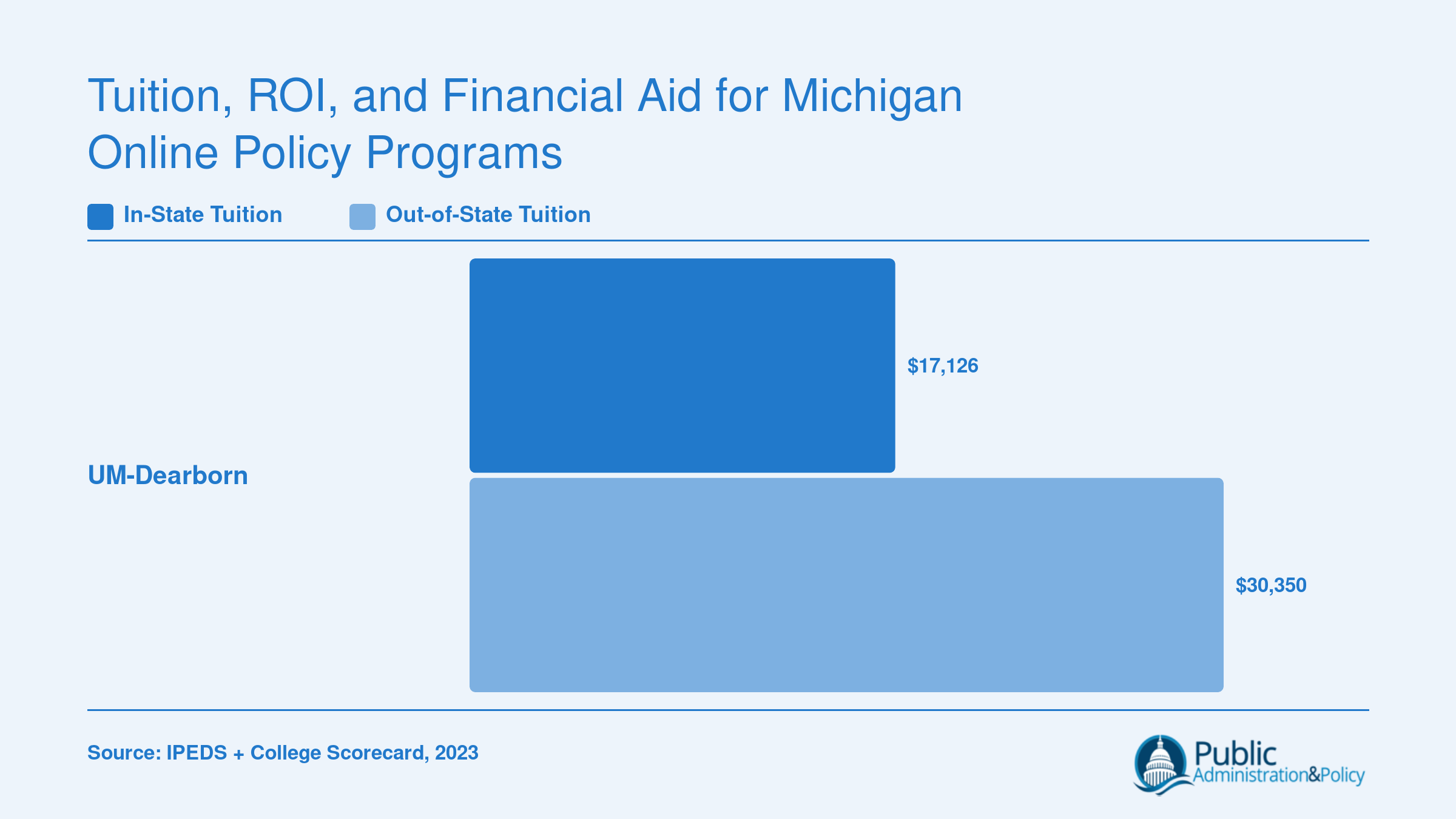
Understanding the gap between in-state and out-of-state tuition is critical when evaluating Michigan online policy programs. At the University of Michigan-Dearborn, which offers a Master of Public Administration and Policy with a public policy concentration, in-state graduate tuition runs roughly $17,126 per year while out-of-state students pay about $30,350. The institution-wide average net cost after aid is approximately $9,492 (note: this figure reflects undergraduate averages across the university, not program-specific graduate costs). Median debt at completion for UM-Dearborn graduates is $22,500, and median earnings ten years after enrollment reach $59,649. Program-level earnings shortly after graduation are not yet available for this degree. Common financial aid avenues for Michigan graduate students include graduate assistantships, employer tuition reimbursement programs, federal direct unsubsidized and Grad PLUS loans, and scholarship opportunities offered directly through the university.
Admissions Requirements and Application Deadlines for Michigan Online MPP Programs
Getting into an online public policy graduate program in Michigan is more accessible than many applicants expect, but each institution has its own requirements. Understanding what is expected before you apply will help you build a stronger application and avoid last-minute surprises.
Do Michigan MPP Programs Require the GRE?
This is one of the most common questions prospective students ask, and the answer in 2026 is reassuring: none of the major Michigan-based online policy programs currently require standardized test scores. The University of Michigan Ford School's online MPA does not require the GRE1, nor does the University of Michigan-Dearborn MPAP2, UM-Flint's MPA3, or Central Michigan University's MPA4. If you have been putting off applying because of test anxiety or cost, this barrier has largely been removed across the state's programs.
GPA, Work Experience, and Other Expectations
Most programs set a minimum undergraduate GPA of 3.0 for regular admission.3 Central Michigan University raises that threshold to 3.5 for applicants seeking entry into its accelerated track.4 The Ford School's online MPA stands apart by expecting approximately five years of professional work experience, reflecting the program's design for mid-career professionals.1 Other programs, such as UM-Dearborn's MPAP, welcome earlier-career applicants and do not impose a strict experience minimum, though relevant professional or volunteer engagement strengthens any application. If you are also exploring michigan mpa options, you will find similar GPA benchmarks across the state.
Common Application Components
Regardless of the specific school, expect to submit most or all of the following:
Statement of purpose: Articulates your career goals and why you are drawn to public policy.
Letters of recommendation: Typically two or three, ideally from professional supervisors or faculty who can speak to your analytical abilities.
Resume or CV: Should highlight relevant professional, civic, or research experience.
Writing sample: Some programs request this to gauge your ability to construct evidence-based arguments.
Transcripts: Official transcripts from all postsecondary institutions attended.
Tailor each component to the program. A statement aimed at the Ford School's mid-career cohort should read differently from one targeting UM-Dearborn's broader applicant pool.
Deadline Windows to Keep in Mind
Deadlines vary by institution and term. For fall 2026 entry, UM-Flint lists an early deadline of May 1 and a final deadline of August 1, with a December 1 deadline for winter enrollment.3 Eastern Michigan University's Public Policy Analysis Graduate Certificate uses rolling admissions, which provides more flexibility.5 Most other programs publish priority and final deadlines on their admissions pages each cycle, so always verify current dates directly with the program before finalizing your timeline.
Stackable Certificates as On-Ramps
If you are not ready to commit to a full master's degree, or if you want to test the waters first, several Michigan institutions offer graduate certificate in public administration options that can stack toward a master's. The Ford School's Science, Technology, and Public Policy (STPP) Graduate Certificate allows students to apply 9 to 12 credits toward the full degree.6 UM-Dearborn similarly permits 9 to 12 certificate credits to count toward its MPAP.2 Eastern Michigan University offers a Public Policy Analysis Graduate Certificate with a lower GPA threshold of 2.7, making it a practical entry point for students who want to demonstrate graduate-level readiness before pursuing a full program.5 These stackable pathways reduce financial risk and let you build momentum one course at a time.
Curriculum, Concentrations, and Online Learning Format
Whether you enroll in the University of Michigan Ford School's online MPA or the University of Michigan-Dearborn MPAP, you will encounter a policy curriculum built on a shared disciplinary spine. Understanding how that core translates into specialization options, delivery logistics, and support structures will help you choose the program that fits your professional life.
Core Curriculum Across Michigan Policy Programs
Most NASPAA-aligned programs in Michigan share a set of foundational courses that every student completes before moving into electives or applied work. Expect coursework in the following areas:
Policy analysis: Frameworks for evaluating public programs, regulatory proposals, and legislative alternatives.
Economics for policy: Microeconomic and macroeconomic principles applied to government decision-making, market failures, and cost-benefit analysis.
Statistics and quantitative methods: Regression analysis, data visualization, and program evaluation techniques that prepare you to work with real datasets.
Public management: Organizational behavior, budgeting, and leadership within public and nonprofit settings.
Ethics and public values: Competing normative frameworks, equity considerations, and accountability in democratic governance.
At the Ford School, these topics are woven into a 30-credit curriculum designed for mid-career professionals with five or more years of experience.12 The program culminates in an applied policy project rather than a traditional thesis, giving students a chance to tackle a real-world challenge for an external client or agency.3 No separate internship is required.3
UM-Dearborn's MPAP spans 36 credits, with 18 credits of core coursework, 15 credits of electives, and a 3-credit capstone seminar. The additional elective space creates room for deeper specialization.
Concentrations and Specialization Tracks
The Ford School online MPA does not offer formal concentrations.1 Instead, students tailor their experience through elective selection and the applied policy project.
UM-Dearborn, by contrast, provides three defined concentration tracks within its MPAP:
Public Policy: For students aiming at legislative analysis, advocacy, or government advisory roles.
Human Resources: Focused on workforce management within public agencies and nonprofits.
Evaluation and Assessment: Geared toward program evaluation, performance measurement, and data-driven accountability.
These tracks allow you to align coursework directly with the career path you want to pursue after graduation.
Online Delivery: Synchronous, Asynchronous, and Residency Details
The Ford School's online MPA uses a cohort-based model with synchronous components.43 Students progress through the program alongside the same group of peers over 30 to 48 months.2 Two multi-day, in-person residencies on the Ann Arbor campus are required, offering intensive workshops, networking sessions, and team-based learning experiences that are difficult to replicate in a virtual setting.5 The program launched its first cohort in January 2026.2
UM-Dearborn delivers its MPAP in a hybrid format, with courses scheduled to accommodate full-time working professionals. Rolling admissions give applicants flexibility in when they start, and the program also offers a 4+1 accelerated pathway for qualifying undergraduates.
Student Support Services for Online Learners
Both universities extend campus-level resources to their online students. At the Ford School, online MPA students receive dedicated academic advising, full access to the university library system, technology support for virtual coursework, and career services through the Ford School's professional development office. The cohort model also creates a built-in peer network that many graduates cite as one of the program's strongest assets. If you are comparing options across the state, our guide to Michigan MPA programs provides additional context on how these support structures vary.
UM-Dearborn provides similar support, including career counseling, internship placement assistance, and access to research programs and study abroad opportunities that can supplement the hybrid experience.
Dual-Degree Pathways
The Ford School's on-campus programs are known for offering joint degrees such as MPP/JD and MPP/MSW combinations. However, the online MPA does not currently advertise dual-degree options.6 If a joint degree is a priority, you may need to explore the residential Ford School programs or contact UM-Dearborn about combining the MPAP with other graduate credentials on that campus. This is an area worth discussing with admissions counselors early in the process, as policies can shift as online programs mature.
Do not underestimate the quantitative demands of an MPP curriculum. Regardless of your chosen concentration, expect rigorous coursework in microeconomics, applied statistics, cost-benefit analysis, and data visualization. This analytical emphasis is one of the clearest differences between MPP and MPA programs, so be honest about your comfort with numbers before you apply. If math feels rusty, consider a refresher course in statistics or economics first.
Career Outcomes and Salaries for Michigan MPP Graduates
An MPP from a Michigan institution positions you at the intersection of policy analysis, public management, and advocacy, and the state's unique political geography means graduates don't have to look far for meaningful work. Before you enroll, though, it helps to understand what the salary landscape actually looks like and where Michigan MPP holders tend to land.
What the Earnings Data Tells Us
Program-level earnings data for most Michigan public policy graduate programs is not yet published at the detail needed to trace a full salary trajectory from one year to four years after graduation. That means prospective students should rely on broader occupational wage benchmarks rather than program-specific figures when building financial expectations. For a wider look at compensation across the field, our public policy and administration salary guide offers additional context.
According to Bureau of Labor Statistics Occupational Employment and Wage Statistics from May 2023, political scientists in Michigan earned a mean annual wage of roughly $132,020 statewide.1 In the Ann Arbor metro area, that figure was approximately $87,070.2 These numbers reflect mean rather than median wages, and they capture a relatively small occupation, so individual outcomes can vary significantly.1 Still, the data signals that advanced policy research roles in Michigan can be quite lucrative, particularly in state-level or federally funded positions.
For the more common roles MPP graduates enter, management analysts across Michigan typically earn competitive salaries that track closely with national medians, and social and community service managers, a popular destination for graduates drawn to the nonprofit sector, also command solid mid-career wages. Exact metro-level figures for Detroit, Lansing, and Grand Rapids fluctuate year to year, so checking the latest BLS Occupational Employment and Wage Statistics release is a practical step during your decision-making process.
Common Career Paths
MPP graduates in Michigan tend to pursue roles that blend analytical rigor with public impact. The most frequently cited career paths include:
Policy analyst: Researching legislation and advising decision-makers in government agencies or think tanks.
Legislative aide: Supporting state legislators in Lansing with bill analysis, constituent communications, and committee work.
Program evaluator: Measuring the effectiveness of social programs for government or nonprofit clients.
Budget analyst: Developing fiscal plans and monitoring spending for public entities.
Nonprofit director: Leading organizations focused on housing, health equity, education, or economic development.
Government affairs specialist: Representing corporations or advocacy groups before policymakers.
If the policy analyst career path appeals to you, the quantitative and analytical training embedded in MPP curricula, from econometrics to cost-benefit analysis, makes graduates especially competitive for roles that require evidence-based recommendations.
Sector Placement and Michigan's Political Geography
Michigan offers a distinctive advantage that many states cannot match: three distinct employment hubs, each with its own policy ecosystem.
Lansing, as the state capital, is the natural home for careers in state government. Agencies covering environmental quality, health and human services, labor, and transportation all employ policy professionals. Legislative staff positions and roles within the governor's executive office are perennial pipelines for MPP holders.
Detroit's landscape is different but equally rich. The city's ongoing revitalization creates demand for municipal government professionals, urban planners with policy expertise, and nonprofit leaders tackling issues from affordable housing to public health. National foundations and federal grant programs also maintain a strong presence in the metro area, expanding options for program evaluation and grant management roles.
Grand Rapids and other mid-sized cities round out the picture, with growing nonprofit sectors and regional government agencies that value policy-trained professionals but often face less competition for talent than the state's larger metros.
Across all three regions, consulting firms that contract with state and local governments represent another employer category. These firms hire MPP graduates for engagements in performance management, regulatory compliance, and strategic planning. Those interested in the budget side of public service may also want to explore how to become a budget analyst for a deeper look at that career track.
Framing Your Return on Investment
Because detailed post-graduation employment shares and poverty-threshold benchmarks are not yet available at the program level for most Michigan public policy degrees, you should weigh salary expectations against concrete tuition figures. For instance, the University of Michigan-Dearborn's Master of Public Administration and Policy carries in-state tuition of approximately $17,126 per year, making it one of the more affordable graduate options in the region. When you pair that cost with the earning potential of management analyst or policy research roles in the Detroit metro area, the financial math can be quite favorable.
The bottom line: Michigan's combination of accessible tuition at several public universities and a diversified public-sector job market creates a strong value proposition for MPP graduates, provided you choose a program aligned with the sector and geography where you plan to build your career.
NASPAA Accreditation and How to Evaluate Program Quality
Choosing the right online Master of Public Policy program goes beyond tuition and convenience. Accreditation status and broader quality indicators should sit at the center of your decision. Here is what to look for and why it matters.
What NASPAA Accreditation Means
The Network of Schools of Public Policy, Affairs, and Administration (NASPAA) is the global standard for graduate education in public service fields. A NASPAA-accredited program has passed a rigorous peer-review process confirming that its curriculum meets competency-based standards in areas such as policy analysis, public management, quantitative methods, and ethical leadership. Accreditation also signals that the program undergoes periodic reaccreditation reviews, so quality is not a one-time achievement but a sustained commitment.
For employers in federal, state, and local government, NASPAA accreditation often serves as shorthand for credibility. Some federal positions and fellowship programs, including the Presidential Management Fellowship, require or strongly prefer candidates from NASPAA-accredited schools. If your career path runs through government, this credential can open doors that would otherwise stay closed.
Which Michigan Programs Hold NASPAA Accreditation?
In Michigan, the University of Michigan's Gerald R. Ford School of Public Policy holds NASPAA accreditation for its residential Master of Public Policy degree. Wayne State University and other institutions in the state also maintain NASPAA-accredited programs in public administration and related fields. However, dedicated fully online mpp programs with NASPAA accreditation remain uncommon across Michigan. Because the landscape evolves, prospective students should verify a program's current accreditation status directly through the NASPAA website before applying.
It is worth noting that some high-quality public policy programs operate outside NASPAA accreditation and still deliver excellent outcomes. Programs housed in economics departments or interdisciplinary schools may hold regional accreditation and maintain strong reputations without seeking the NASPAA designation. Accreditation matters most when your specific career goals demand it.
A Checklist for Evaluating Program Quality Beyond Accreditation
Accreditation is a necessary starting point, not the finish line. Use this checklist to dig deeper:
Faculty credentials: Look for instructors with doctoral degrees, peer-reviewed research, and real-world policy experience. Faculty who have served in government or led policy organizations bring practical insight that textbooks cannot replicate.
Alumni network strength: A well-connected alumni network in Michigan government, nonprofits, and think tanks can accelerate your job search. Ask admissions offices for data on where recent graduates work.
Career placement rates: Programs that track and publicly report employment outcomes within six to twelve months of graduation demonstrate confidence in their results. Ask for specifics rather than accepting vague claims.
Capstone and experiential rigor: A meaningful capstone project or professional consulting practicum, one where you solve a real problem for a real client, signals that the program prioritizes application over theory alone.
Student-to-faculty ratio: Smaller cohorts typically translate to more personalized feedback, stronger mentoring relationships, and more meaningful class discussions, all of which matter even more in online formats where passive learning can become a risk.
When Accreditation Is Less Critical
If your career plans center on the private sector, international development organizations, or research institutions, NASPAA accreditation may carry less weight than factors like faculty expertise, analytical rigor, and brand recognition. Many policy professionals working in policy consulting, data analytics, or advocacy built successful careers from programs that never sought NASPAA review. The key is to match the program's strengths to the career you actually want, not to chase a credential for its own sake.
Frequently Asked Questions About Online MPP Programs in Michigan
Below are the most common questions prospective students ask about pursuing an online Master of Public Policy in Michigan. Each answer draws on admissions data, tuition benchmarks, and career outcomes discussed throughout this guide. If you have additional questions, publicadministrationpolicy.org offers program comparison tools and career resources to help you decide.
Are there fully online MPP programs in Michigan?
Michigan offers a limited number of fully online or hybrid public policy graduate programs. The University of Michigan and several other state institutions provide policy-focused master's degrees with significant online components, though some may require occasional on-campus residencies or capstone experiences. If a 100% online format is essential, check each program's course delivery details carefully and consider NASPAA-accredited options from out-of-state schools that accept Michigan residents.
What is the difference between an MPP and an MPA degree?
An MPP (Master of Public Policy) emphasizes policy analysis, quantitative research methods, economics, and evidence-based decision making. An MPA (Master of Public Administration) focuses more on organizational management, budgeting, and leadership within public agencies. Both prepare graduates for public service careers, but MPP graduates typically gravitate toward research, legislative analysis, and program evaluation, while MPA holders often pursue administrative and managerial roles. As discussed in this guide, choosing between the two depends on whether your strengths lean analytical or managerial.
Is the University of Michigan MPP program available online?
The University of Michigan's Gerald R. Ford School of Public Policy offers one of the nation's top-ranked MPP programs, but it is primarily an in-person, residential program based in Ann Arbor. As of 2026, the Ford School does not offer a fully online MPP. Prospective students seeking Michigan's prestige in an online format may want to explore hybrid options or related online policy degrees offered by other universities in the state.
How much does an online MPP cost in Michigan?
Tuition for Michigan-based online policy master's programs generally ranges from roughly $30,000 to over $75,000 for the full degree, depending on the institution and residency status. In-state tuition at public universities tends to fall on the lower end of that range. As outlined in the tuition and financial aid section above, many programs offer graduate assistantships, merit scholarships, and employer tuition reimbursement options that can reduce out-of-pocket costs significantly.
Do Michigan MPP programs require the GRE?
GRE requirements vary by program. Some Michigan institutions have adopted GRE-optional or test-flexible admissions policies, a trend that accelerated in recent years. Others still require or strongly recommend the exam, especially for applicants without substantial professional experience. Check each program's current admissions page for 2026 requirements, and note that strong quantitative coursework or professional credentials can sometimes serve as an alternative to standardized test scores.
What careers can you pursue with a Master of Public Policy from Michigan?
Michigan MPP graduates pursue careers as policy analysts, legislative aides, program evaluators, budget analysts, nonprofit directors, and consultants. Common employers include state and federal government agencies, think tanks, advocacy organizations, and healthcare systems. As covered in the career outcomes section, mid-career MPP holders in Michigan often earn salaries well above the state median, with roles in data-driven policy analysis and management commanding some of the strongest compensation.
What is the difference between a NASPAA-accredited and non-accredited program?
NASPAA (Network of Schools of Public Policy, Affairs, and Administration) accreditation signals that a program meets rigorous standards for curriculum quality, faculty qualifications, and student outcomes. Accredited programs undergo regular peer review and must demonstrate continuous improvement. Non-accredited programs are not necessarily low quality, but they lack this independent verification. As discussed earlier in this guide, NASPAA accreditation can matter for federal hiring preferences and is a reliable quality benchmark when comparing online policy programs.