Best Online Master of Public Policy (MPP) Programs in Texas

Compare tuition, accreditation, outcomes, and flexibility for every Texas MPP program — updated for 2026.

By Holly AbramsonReviewed by PAP Editoral TeamUpdated May 16, 202610+ min read

Key Points

  • SMU, UTEP, and UH offer the leading online or hybrid MPP programs in Texas for 2026.
  • NASPAA accreditation remains the gold standard: always verify a program's status before enrolling.
  • Texas policy analysts, budget analysts, and legislative staff earn median salaries ranging from roughly $60,000 to over $90,000 depending on role and metro area.
  • MPP degrees emphasize quantitative analysis and economics, while MPA programs focus more on organizational management and administration.

Texas employs more than 1.7 million public-sector workers and sits at the center of national debates over energy regulation, border security, immigration policy, and rapid metropolitan growth. That combination makes the state a working laboratory for policy research, and it explains why several Texas universities now offer online MPP programs designed for professionals who cannot step away from full-time roles.

Only a small number of institutions currently deliver an MPP or a policy-focused MPA concentration in an online format, with in-state graduate tuition ranging from roughly $6,200 to over $37,000 depending on the school. NASPAA accreditation, which separates vetted programs from the rest, is held by only some of these options, so credential verification matters before you apply.

Best Online Master of Public Policy Programs in Texas: Rankings Overview

The following online and hybrid MPP programs in Texas are ranked using a composite score that weighs online accessibility alongside academic quality indicators such as graduation rates, student-to-faculty ratios, median earnings, and graduate debt levels. Because some Texas institutions house their public policy concentration within a Master of Public Administration degree, we include those programs when they offer a distinct public policy track delivered online or in a hybrid format. Program-level earnings data is not yet available for any of these programs, so the institution-wide median earnings figures from College Scorecard are provided for context. Graduation rates listed are also institution-wide, not specific to individual graduate programs.

Factors considered
  • Online and hybrid delivery access
  • Institution-wide graduation rates
  • Graduate median debt levels
  • Median earnings after graduation
  • Student-to-faculty ratio
Data sources

University of Houston

#1

Houston, TX · $10,000 – $23,000/yr

Best for: Houston-area professionals seeking hybrid flexibility

The University of Houston's Hobby School of Public Affairs delivers a NASPAA-accredited Master of Public Policy built around Gulf Coast and Texas-centric policy research. The 39-credit-hour hybrid program blends online coursework with in-person sessions designed for working professionals in the Houston metro, and faculty research centers focus on energy, elections, health equity, and urban development. As a Hispanic-Serving Institution with in-state tuition around $10,051 and institution-wide median earnings of $62,377 ten years after enrollment, UH pairs strong affordability with meaningful career outcomes.

  • 39-credit-hour NASPAA-accredited hybrid program
  • Interdisciplinary core in economics, politics, ethics, and quantitative methods
  • Required internship and capstone project with real-world sponsors
  • Electives allow specialization in energy, health, or urban policy
  • Faculty research tied to Texas and Gulf Coast policy issues
  • In-state tuition approximately $10,051; median graduate debt $18,194
  • Hybrid format supports commuting professionals across greater Houston
  • Regular practitioner talks featuring Texas officials and agency leaders

Southern Methodist University

#2

Dallas, TX · ~$41,000/yr (est.)

Best for: Part-time online learners in policy analysis

Southern Methodist University's fully online Master of Public Policy is a part-time program tailored to working professionals who want rigorous training in policy analysis, research methods, and data-driven evaluation without relocating. The program includes two on-campus immersions in Dallas that connect students with North Texas policymakers, the George W. Bush Presidential Center, and local government leaders. SMU posts the highest institution-wide median earnings in this group at $78,354, paired with an 84.3% graduation rate and an 11:1 student-to-faculty ratio.

  • Fully online, part-time format with virtual live lectures
  • Two required on-campus immersions in Dallas for networking
  • Coursework in policy analysis, statistics, and research methods
  • Real-world capstone projects often partnered with Dallas-area organizations
  • Tuition of $37,278 (same for in-state and out-of-state); median debt $19,500
  • Prepares graduates for roles as policy analysts, economists, and statisticians
  • Close ties to the George W. Bush Institute and North Texas policy ecosystem

Texas A&M University-Central Texas

#3

Killeen, TX · $0 – $5,000/yr

Best for: Military-affiliated students on tight budgets

Texas A&M University-Central Texas offers a 36-credit-hour hybrid Master of Public Administration with a curriculum that emphasizes policy analysis, public budgeting, and ethical decision-making for local government professionals. Located in Killeen near Fort Cavazos, the program draws heavily from military-affiliated and Central Texas public sector employees. As an HSI-designated institution with in-state tuition of just $6,242 and a median graduate debt of $17,750, A&M-Central Texas stands out as the most affordable entry point in this ranking.

  • 36-credit-hour hybrid program with growing online course options
  • Comprehensive training in policy analysis and organizational theory
  • Focus on ethical public service and critical leadership skills
  • In-state tuition approximately $6,242; out-of-state approximately $13,586
  • Median graduate debt of $17,750, lowest in this ranking
  • Strong ties to Central Texas municipalities and Fort Cavazos community
  • Open admissions policy broadens access for working professionals

The University of Texas at El Paso

#4

El Paso, TX · $5,000 – $10,000/yr

The University of Texas at El Paso offers two NASPAA-accredited online MPA pathways with a dedicated Public Policy and Management concentration that centers on U.S.-Mexico border and West Texas issues. The 36-credit-hour, 100% online program is explicitly designed for working professionals across rural and frontier communities who cannot relocate, and it features a partnership with the U.S. Army Sergeants Major Academy. UTEP is an HSI-designated institution with in-state tuition around $7,166 and institution-wide median earnings of $50,923, making it an accessible option for students committed to border-region policy careers.

  • 100% online, 36-credit-hour NASPAA-accredited program
  • Concentration in Public Policy and Management available
  • Curriculum covers policy analysis, public budgeting, and emergency management
  • In-state tuition approximately $7,166; out-of-state approximately $16,621
  • Capstone experience and optional internship for applied learning
  • Partnership with U.S. Army Sergeants Major Academy (USASMA)
  • Focus on border policy, immigration, binational health, and cross-border governance
  • Median graduate debt of $18,000; HSI-designated institution
  • 100% online, 36-credit-hour NASPAA-accredited program
  • Concentration in Public Policy and Management available
  • Curriculum covers policy analysis, public budgeting, and emergency management
  • In-state tuition approximately $7,166; out-of-state approximately $16,621
  • Capstone experience and optional internship for applied learning
  • Partnership with U.S. Army Sergeants Major Academy (USASMA)
  • Focus on border policy, immigration, binational health, and cross-border governance
  • Median graduate debt of $18,000; HSI-designated institution

What Is an MPP Degree and Who Is It For?

A Master of Public Policy, commonly known as an MPP, is a graduate degree built around policy analysis, quantitative methods, economics, and evidence-based decision-making. While it shares some DNA with the more broadly scoped Master of Public Administration, the MPP zeroes in on how policies are designed, evaluated, and refined using rigorous analytical tools. If the MPA trains managers to run public organizations effectively, the MPP trains analysts to figure out which policies those organizations should pursue in the first place.

Who Pursues an MPP?

The degree attracts a wide range of professionals and aspiring professionals, but a few profiles appear repeatedly across Texas programs:

  • Mid-career government employees: Analysts and program managers in state agencies or city departments who want to move into policy design roles.
  • Nonprofit managers: Leaders looking to strengthen their ability to measure program impact and advocate for evidence-backed funding.
  • Legislative and campaign staffers: Professionals in the political arena who need sharper analytical skills for drafting legislation or briefing elected officials.
  • Career-changers: People transitioning from fields like journalism, law, engineering, or healthcare who are drawn to policy research or advocacy and want a structured credential to make the leap.

Online MPP programs in Texas are especially well suited to these students because they allow continued employment while completing coursework, a practical consideration for anyone already embedded in a career.

Core Skill Set

Regardless of the institution, most MPP curricula converge around a set of analytical competencies that transfer across government, nonprofit, and private-sector consulting roles:

  • Cost-benefit analysis: Weighing the financial and social trade-offs of proposed policies so decision-makers can allocate limited resources wisely.
  • Statistical modeling: Using regression analysis, causal inference techniques, and data visualization to identify what works and what does not.
  • Program evaluation: Designing and executing assessments that determine whether a policy or initiative is achieving its intended outcomes.
  • Stakeholder analysis: Mapping the interests, power dynamics, and concerns of affected groups to anticipate political feasibility and build coalitions.

These skills make MPP graduates valuable well beyond traditional government settings. Consulting firms, think tanks, healthcare systems, and technology companies all hire policy consultants and analysts who can translate complex data into actionable recommendations. For a deeper look at how legislation and regulation take shape, our guide on public policy making covers the full lifecycle.

Why NASPAA Accreditation Matters

The Network of Schools of Public Policy, Affairs, and Administration (NASPAA) is the recognized accrediting body for MPP and MPA programs in the United States. When a Texas MPP program holds NASPAA accreditation, it signals that the curriculum, faculty qualifications, and student outcomes have been independently reviewed against national standards. For students, this matters in concrete ways: many federal and state hiring systems give preference to applicants who hold degrees from NASPAA-accredited programs, and some scholarship or fellowship opportunities list accreditation as an eligibility requirement. Before committing tuition dollars, confirming a program's NASPAA status is one of the most straightforward quality checks you can perform.

MPP vs MPA in Texas: Key Differences That Affect Your Career

If you are weighing graduate programs in public affairs at a Texas university, you have likely noticed that many departments house both a Master of Public Policy (MPP) and a Master of Public Administration (MPA), sometimes sharing the same faculty and NASPAA accreditation. The overlap is real, but the degrees prepare you for distinctly different roles. Understanding these differences will help you choose the path that aligns with your career goals, whether that means designing policy or leading the organizations that carry it out.

Dimension

Core Focus Typical Coursework Common Career Tracks Employer Perception NASPAA Accreditation Decision Shortcut

Master of Public Policy (MPP)

Analytical and research oriented: emphasizes evaluating problems, modeling outcomes, and recommending evidence based solutions Microeconomics, econometrics, statistical methods, cost benefit analysis, program evaluation, policy design Policy analyst, research associate, legislative staff, program evaluator, think tank researcher, data strategist Valued for quantitative rigor; employers hiring for research, analysis, or advisory roles often prefer MPP holders Available at qualifying Texas programs; signals adherence to national competency standards in public affairs education Best if you want to design, evaluate, or shape policy through data and analysis before decisions are made

Cost and ROI: Tuition, Debt, and Earnings Comparison

The table below compares tuition, median debt, and estimated return on investment for the three online MPP programs in Texas featured in our 2026 rankings. A few important notes: in-state and out-of-state tuition figures reflect graduate-level, degree-specific rates reported by each institution, while the net price column represents an institution-wide approximate figure that accounts for financial aid across all students. Program-level earnings after graduation are not yet available for these programs, so the median earnings shown reflect institution-wide outcomes ten years after enrollment. Among these three options, Southern Methodist University posts the strongest ROI ratio at roughly 4.0, driven by the highest median earnings despite its premium tuition. For students prioritizing the lowest debt burden, UTEP edges ahead with a median graduate debt of $18,000 and the most affordable in-state tuition at $7,166 per year, making it an especially strong value pick for Texas residents on a budget.

ProgramIn-State Tuition (Annual)Out-of-State Tuition (Annual)Approx. Net Price (Institution-Wide)Median Graduate DebtMedian Earnings (10 Yr, Institution-Wide)ROI Ratio
Southern Methodist University (SMU)$37,278$37,278$40,892$19,500$78,3544.02
University of Houston (UH)$10,051$19,231$14,276$18,194$62,3773.43
The University of Texas at El Paso (UTEP)$7,166$16,621$9,403$18,000$50,9232.83

Questions to Ask Yourself

Asynchronous online MPP programs let you watch lectures and complete coursework on your own schedule, while some Texas programs require live virtual sessions at set times. Knowing your weekly availability helps you filter programs that actually fit your life.

Some Texas MPP programs emphasize quantitative skills like econometrics and cost-benefit analysis, while others lean toward leadership, budgeting, and program implementation. Identifying your preference early points you toward the right curriculum track and career path.

Programs with capstone projects tied to Austin-based agencies offer strong local networks, but if you plan to work for federal agencies or consulting firms, a program with broader national alumni connections may serve you better.

Several NASPAA-accredited online MPP programs in Texas include real-time seminars, group policy exercises, or weekend residencies. If your work schedule is unpredictable, confirm whether mandatory live components conflict before you apply.

NASPAA Accreditation and Admissions Requirements for Texas MPP Programs

Accreditation by the Network of Schools of Public Policy, Affairs, and Administration (NASPAA) is the gold standard for graduate programs in public policy and public affairs. Before you invest time and tuition in any MPP, confirming accreditation status should be one of your first steps.

Which Texas Programs Hold NASPAA Accreditation?

As of the 2025-2026 academic year, Texas has a relatively small number of NASPAA-accredited programs that specifically award an MPP or closely related policy-focused degree.1 The University of Texas at Arlington offers a NASPAA-accredited Master of Public Policy (MPP), and Texas A&M University holds accreditation for its Master of Public Service and Administration (MPSA), which carries a strong policy analysis component despite its distinct title.

Several other Texas universities hold NASPAA accreditation for MPA (Master of Public Administration) programs, including the University of Houston, University of North Texas, Texas State University, Texas Tech University, and UT El Paso.1 While these are administration-focused degrees rather than policy degrees, some offer policy concentrations or elective tracks that overlap with MPP curricula. If your career goals sit at the intersection of policy and administration, these accredited MPA programs in Texas may also deserve a spot on your shortlist.

Accreditation status can change between review cycles, so always verify a program's current standing directly through the NASPAA accredited programs roster before submitting an application.

Why NASPAA Accreditation Matters

Choosing a NASPAA-accredited program is not just a prestige play. It carries practical implications that follow you well beyond graduation.

  • Employer recognition: Many government agencies and nonprofits specifically look for candidates who graduated from NASPAA-accredited programs, viewing accreditation as a quality benchmark.
  • Federal career pathways: Certain federal positions and fellowship programs, including the Presidential Management Fellows program, require or prefer degrees from accredited institutions.
  • Credit transferability: If you ever need to transfer credits or pursue a doctoral degree, accredited coursework is far more likely to be accepted.
  • Financial aid eligibility: Some scholarships and loan forgiveness programs, including Public Service Loan Forgiveness, pair more smoothly with accredited programs that meet recognized standards.

Typical Admissions Requirements

Admissions criteria vary by program, but most NASPAA-accredited MPP and related policy programs in Texas share common expectations.

  • GPA benchmarks: A minimum undergraduate GPA of 3.0 on a 4.0 scale is standard, though some programs consider applicants with lower GPAs if they demonstrate strong professional experience or submit competitive test scores.
  • GRE policies: The GRE landscape has shifted considerably. Several Texas programs now waive the GRE under specific conditions, such as holding an advanced degree, meeting a GPA threshold, or demonstrating substantial professional experience. UT Arlington and Texas A&M, for instance, have adopted more flexible testing policies in recent years. Always check the most current admissions page, as GRE requirements can change from one cycle to the next.
  • Work experience: While not universally required, many programs prefer applicants with at least one to three years of professional experience in government, nonprofit, or related sectors. Programs that serve working professionals often weight experience heavily in holistic review.
  • Personal statements and writing samples: Expect to submit a statement of purpose describing your policy interests and career goals. Some programs also request a professional writing sample or policy memo to assess analytical communication skills.
  • Letters of recommendation: Two to three letters from academic or professional references are standard.

A Word of Caution on Verification

Program websites do not always reflect real-time accreditation changes. A program might be in a reaffirmation review cycle, or its accreditation could lapse between directory updates. The most reliable source is the NASPAA accredited programs directory itself. Take five minutes to confirm status before you begin your application, especially if accreditation is a factor in your employer's tuition reimbursement policy or your long-term career plans in federal service.

Online vs On-Campus MPP Flexibility for Working Professionals

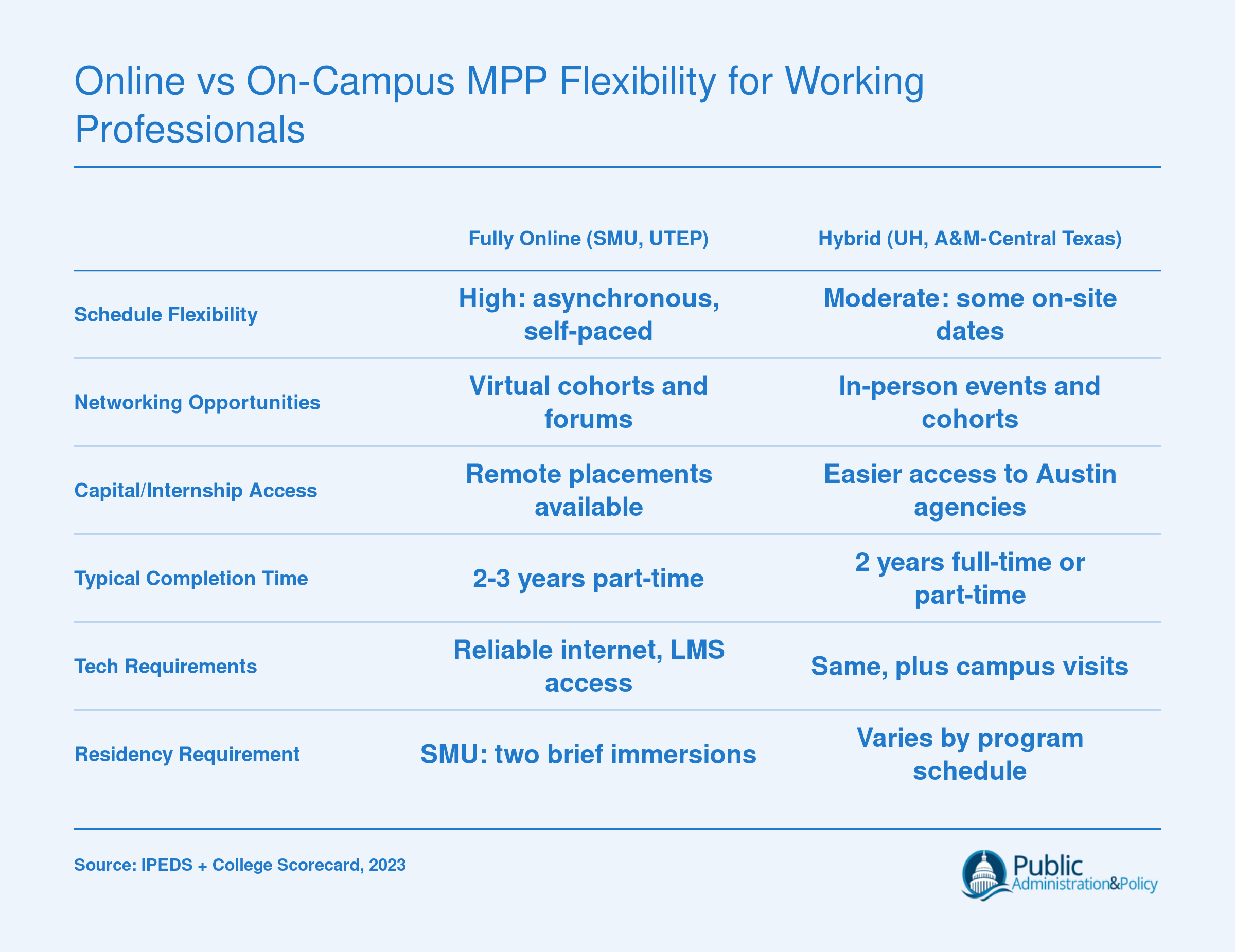
Texas MPP programs split between fully online and hybrid formats, each with trade-offs for working professionals. SMU and UTEP deliver their programs entirely online with asynchronous coursework, so students can complete readings and assignments on their own schedule. UH and Texas A&M-Central Texas use hybrid models that blend online sessions with periodic in-person requirements, giving students face-to-face networking and closer access to Austin's state capital for policy internships. Regardless of format, all four programs provide career services, capstone placements, and advising to online students.

Comparison of fully online versus hybrid MPP delivery in Texas across schedule flexibility, networking, internship access, completion time, and tech requirements

Curriculum, Specializations, and Dual-Degree Options at Texas MPP Programs

Texas is home to several well-regarded MPP programs, each with a distinct curricular focus shaped by the state's outsized role in energy policy, border affairs, healthcare, and economic development. Understanding what each program offers, and how to verify the latest details, can help you choose the path that aligns with your career ambitions.

Core Curriculum Across Texas MPP Programs

Most Texas MPP curricula share a common analytical foundation: quantitative methods, microeconomics for policy analysis, statistics, program evaluation, and a capstone or policy research project. Beyond that core, programs diverge. UT Austin's LBJ School, for example, emphasizes applied research and places students in real policy settings through its professional report requirement. Texas A&M's Bush School integrates leadership development and public management alongside policy analysis. Rice University's program at the Baker Institute leans into global affairs, energy, and health policy. UT Dallas and UNT each bring strengths in urban policy, data analytics, and local governance.

Because course offerings and elective tracks can shift from year to year, the most reliable way to confirm 2025-2026 curricula is to visit each program's official website directly.

Specializations That Reflect Texas Policy Priorities

Texas MPP programs often let students concentrate in areas that mirror the state's policy landscape:

  • Energy and environmental policy: Particularly prominent at Rice (Baker Institute) and UT Austin, reflecting the state's role in oil, gas, and renewables.
  • Health policy: Available at multiple programs, with growing relevance given Texas's uninsured population and Medicaid debates.
  • Immigration and border policy: A natural fit at institutions near the U.S.-Mexico corridor, especially the LBJ School.
  • Urban and regional planning: UT Dallas and UNT cater to students interested in the rapid growth of the Dallas-Fort Worth metroplex.
  • International affairs and security: The Bush School at Texas A&M pairs public policy training with global security and diplomacy coursework.

To see how these specializations align with job demand and salary expectations, the Bureau of Labor Statistics (BLS.gov) publishes detailed occupational outlooks for fields such as urban planning, public health analysis, and energy regulation.

Dual-Degree and Accelerated Track Options

Several Texas programs offer dual-degree pathways that let students earn two graduate credentials in less time than completing each separately. Students considering complementary credentials may also want to explore mpa programs in texas for a broader view of public service graduate options. Common combinations include:

  • JD/MPP: Pairs legal training with policy analysis, ideal for legislative affairs or regulatory law careers. UT Austin's LBJ School coordinates this track with the School of Law.
  • MPP/MBA: Blends business strategy with public sector problem-solving, available at programs such as Rice and UT Austin.
  • MPP/MSW: Combines social work practice with policy design, suited for students targeting child welfare, housing, or community development.

Some schools also offer accelerated or one-year MPP options for students who enter with substantial professional experience or relevant graduate coursework. These condensed tracks typically require a heavier course load and may limit elective choices, so weigh the trade-offs carefully.

Because dual-degree partnerships, credit-sharing agreements, and accelerated eligibility criteria often change between academic years, contact program admissions offices or academic advisors directly for the most current details. A quick phone call or email can save you from relying on outdated web pages.

Verify Before You Commit

Before finalizing your program choice, take these steps:

  • Check the Network of Schools of Public Policy, Affairs, and Administration (NASPAA) website to confirm each program's accreditation status and compare program features side by side.
  • Browse Texas-focused policy organizations such as Texas 2036 and the Baker Institute for Public Policy to understand which regional issues are shaping demand for specific specializations.
  • Review BLS.gov occupational data to ensure your chosen concentration leads to a career field with strong projected growth and competitive earnings.
  • Reach out to current students or alumni through program events or LinkedIn to get candid perspectives on curriculum quality and career preparation.

Taking the time to cross-reference official program pages, accreditation databases, and labor market data gives you a far clearer picture than any single source can provide. The Texas MPP landscape is rich with options, but the right fit depends on matching your professional goals with each program's particular strengths.

Public Policy Careers and Job Outlook in Texas

Texas is one of the largest and most economically diverse states in the country, which translates into a deep and varied labor market for MPP graduates. From the state capitol in Austin to the energy corridors of Houston, policy professionals find employment across government agencies, nonprofits, consulting firms, and the private sector. For a broader look at careers in public policy, the outlook in Texas is especially strong. Here is what the data tells us about earnings and opportunities.

What Texas MPP Graduates Earn

Program-level earnings data for Texas MPP programs are not yet available through federal reporting, so we cannot quote a single median salary tied specifically to these degrees. That said, Bureau of Labor Statistics wage estimates for closely related occupations paint a useful picture.

According to the most recent BLS Occupational Employment and Wage Statistics for Texas (2024 state-level data, supplemented by 2025 metro-area estimates), median annual wages for key policy occupations include:12

  • Political Scientists (SOC 19-3094): This is one of the highest-paying paths for policy graduates, though published employment estimates in several Texas metros are limited due to small sample sizes. Statewide, the occupation commands salaries well above the national median for social science roles.
  • Management Analysts (SOC 13-1111): The statewide median annual wage sits in the range of roughly $95,000 to $100,000 depending on the data year, with metros like Dallas-Fort Worth-Arlington and Houston-The Woodlands-Sugar Land tracking at or above that figure. Austin-Round Rock is similarly competitive.
  • Social and Community Service Managers (SOC 11-9151): These roles, common in health policy and nonprofit leadership, carry a statewide median closer to $72,000 to $78,000, with variation across metros. San Antonio-New Braunfels tends to fall slightly below the Austin and Houston metros.

Note that these figures reflect broad occupational categories, not MPP holders exclusively, and wages can vary significantly by employer type, years of experience, and specialization.

Top Employers and Sectors in Texas

Texas offers an unusually wide range of employers for policy professionals:

  • State Government: The Texas Legislature, the Governor's Office, and the Legislative Budget Board are high-profile employers for analysts and advisors. Session cycles create recurring demand for policy research staff.
  • Health and Human Services: Texas Health and Human Services Commission is one of the state's largest agencies and a major employer of program evaluators, budget analysts, and policy specialists.
  • Energy Sector Policy: Houston's concentration of energy companies and trade associations supports a niche but well-compensated market for regulatory analysts and environmental policy advisors.
  • Think Tanks and Research Organizations: Groups like the Texas Public Policy Foundation, the Bush Institute in Dallas, and university-based policy centers across the state hire MPP graduates for research and advocacy roles.
  • Consulting Firms: National and regional management consulting firms with Texas offices regularly recruit graduates with quantitative policy training for both public-sector and private-sector engagements.

Job Outlook Across Major Metros

Texas metro areas each offer a distinct mix of policy opportunities.3 Austin-Round Rock stands out for state government and tech-sector policy work. Dallas-Fort Worth is a hub for management consulting and corporate government affairs. Houston-The Woodlands-Sugar Land leads in energy, health care, and international trade policy. San Antonio-New Braunfels has a growing presence in military-affiliated policy and public health, partly driven by the city's large military installations.

The BLS projects continued growth nationally for management analysts and social service managers through the late 2020s, and Texas population growth only amplifies that demand locally. For MPP graduates willing to build quantitative and analytical skills, the state's job market is among the most promising in the country.

Frequently Asked Questions About MPP Programs in Texas

Choosing the right MPP program in Texas involves weighing factors like accreditation, cost, format, and career outcomes. Below, we answer the questions prospective students ask most often, drawing on the program details and labor market data covered throughout this guide.

A Master of Public Policy (MPP) focuses on policy analysis, quantitative research methods, and evidence based decision making. An MPA (Master of Public Administration) emphasizes organizational management, budgeting, and leadership within public agencies. In practice, MPP graduates often work in policy design and program evaluation, while MPA graduates tend to manage operations and personnel. Both degrees can lead to overlapping careers, but the analytical toolkit differs significantly.

Several Texas institutions hold NASPAA accreditation for their public policy or public affairs programs. Notable examples include the University of Texas at Austin (LBJ School of Public Affairs), Texas A&M University (Bush School of Government and Public Service), and the University of Texas at Dallas. NASPAA accreditation signals that a program meets rigorous quality standards for curriculum, faculty, and student outcomes, so it is an important factor when comparing options.

Yes. A growing number of Texas universities now offer fully online or hybrid MPP programs designed for working professionals. These programs typically deliver the same curriculum and faculty as their on campus counterparts, with asynchronous coursework, virtual seminars, and optional in person residencies. Prospective students should verify whether a specific program requires any campus visits, as policies vary by institution.

Tuition for MPP programs in Texas varies widely depending on the institution and residency status. In state students at public universities can expect total tuition roughly in the range of $25,000 to $50,000, while out of state or private university tuition may exceed $60,000. Many programs offer graduate assistantships, fellowships, and employer tuition reimbursement options that can substantially reduce net cost.

GRE requirements differ by program. Some Texas MPP programs still require or recommend GRE scores, while others have adopted test optional or test flexible admissions policies, a trend that accelerated after 2020. Programs may waive the GRE for applicants with significant professional experience or strong undergraduate GPAs. Always check the most current admissions page for each program you are considering.

MPP graduates in Texas pursue roles such as policy analyst, legislative aide, program evaluator, budget analyst, and research director. Employers range from state and local government agencies to nonprofits, consulting firms, and health care organizations. Texas's large and diverse public sector, combined with a growing presence of think tanks and advocacy groups in Austin, Dallas, and Houston, creates strong demand for policy trained professionals.

Most online MPP programs in Texas are designed to be completed in two years of full time study, typically requiring around 42 to 48 credit hours. Part time students who take one or two courses per semester often finish in three to four years. Accelerated options exist at some institutions, allowing motivated students to graduate in as few as 18 months, though availability depends on the specific program structure.

Recent Articles