Best Online MPP Programs for Vermont Students (2026)
Compare top-ranked online MPP degrees by cost, accreditation, and career outcomes for Vermont residents
By Carrie HirschReviewed by PAP Editoral TeamUpdated August 14, 202625+ min read
What you’ll learn in this article…
No Vermont institution offers an online MPP, but NASPAA accredited programs nationwide accept Vermont residents without residency restrictions.
Most online MPP programs require 36 to 48 credits and can be completed in roughly two years.
Vermont's small state governance structure lets MPP graduates shape policy across education, environment, and health sectors.
Worcester State and University of Southern Maine extend New England regional tuition rates to Vermont students, lowering costs significantly.
Vermont's policy workforce operates in one of the nation's smallest state governments, yet its professionals tackle outsized challenges: rural healthcare access, climate adaptation, and a housing market where median home prices have surged past $350,000. An online Master of Public Policy equips you with the quantitative and analytical tools those problems demand, drawing on the fundamentals of public policy making at every level of government. No Vermont institution currently offers the degree online, so residents must look to nationally accredited programs in other states, many of which charge between $18,000 and $55,000 in total tuition.
The practical tension is cost. Most public universities will bill you at out-of-state rates, though a handful of New England schools extend regional tuition discounts through the New England Board of Higher Education. NASPAA accreditation remains the clearest quality benchmark, and fewer than half of available online MPP programs hold it.
Top Online MPP Programs for Vermont Students
No Vermont-based institution currently offers an online Master of Public Policy, but that does not limit your options. The programs below are available fully online or in a hybrid format to Vermont residents and are ranked using a composite that weighs institutional quality, affordability, graduate outcomes, and program design. Program-level median earnings are not yet available for these degrees, so the institution-wide figures listed reflect each university's overall graduate earning power rather than MPP-specific outcomes.
Factors considered
Institutional graduation and retention rates
Tuition and net price affordability
Graduate earnings and debt levels
Program curriculum and concentrations
Online or hybrid delivery flexibility
Sources
Internal program database
NCES-IPEDS federal institutional data — nces.ed.gov
Best for: Early-career professionals seeking elite credentials
Duke University's Sanford School of Public Policy offers a rigorous 24-month MPP built around evidence-based analysis, ethical leadership, and customizable concentrations. As a private university, tuition is the same for all students at $66,523, but generous financial aid brings the effective net price down to roughly $29,612. Schools offering this program have an institution-wide graduation rate of 96.8%, and the 5:1 student-to-faculty ratio signals unusually close mentorship. While the program uses a hybrid model that blends online and on-campus components, dual-degree options and fellowship funding add further value.
View 2 programs
Master of Public Policy — Hybrid
24-month hybrid program with online coursework
51 credit hours including capstone and internship
Eight customizable policy concentrations available
GRE is optional for all applicants
Dual-degree options across Duke schools
Fellowship and financial aid packages offered
Core covers policy analysis, statistics, and ethics
Best for: Working professionals wanting a one-year degree
Binghamton University delivers a fully online, asynchronous MPP that can be completed in as little as one year of full-time study, making it one of the fastest paths to the degree. In-state tuition is $13,950 and out-of-state tuition is $27,140, with an effective net price near $21,620. The curriculum prioritizes data analysis, policy modeling, and global perspectives, and students gain hands-on experience through an applied policy laboratory. Schools offering this program have an institution-wide graduation rate of about 81.6%.
View program
Master of Public Policy — Online
100% online with asynchronous course delivery
Can be finished in one year full-time
Emphasizes data analysis and policy modeling
Applied projects through a policy laboratory
Courses available in fall, spring, and summer
Military-friendly program designation
Prepares graduates for government and nonprofit roles
Best for: Mid-career analysts seeking hybrid flexibility
Ohio State University's Glenn College offers a Master of Arts in Public Policy and Management designed specifically for in-career professionals with at least three years of experience. The 38-credit hybrid program features evening classes and can typically be completed in five semesters. Vermont students would pay the out-of-state rate of $42,740, though the institution-wide net price averages $17,339. No GRE is required, and schools offering this program boast an 87.7% graduation rate.
View program
Master of Arts in Public Policy and Management — Hybrid
38 credit hours with evening class schedule
Hybrid format blends online and on-campus learning
No GRE required for admission
Requires minimum three years of work experience
Capstone course plus elective customization
Core spans economics, management, and decision support
Rutgers University's 48-credit MPP through the Bloustein School features 14 concentration tracks, from health policy to social justice, or students can design their own. A 300-hour internship and group policy research practicum ensure real-world experience, and cross-registration with Princeton's School of Public and International Affairs is a standout perk. The hybrid format mixes in-person instruction with synchronous remote courses. Out-of-state tuition runs $37,689, and the effective net price is approximately $24,406. Schools offering this program have an institution-wide graduation rate of 83.6%.
View program
Master of Public Policy (MPP) — Hybrid
48 credits completed over two years
14 concentrations or custom-designed track
300-hour applied internship required
Group policy research practicum with real agencies
The University of Washington Bothell's Master of Arts in Policy Studies takes an interdisciplinary approach, weaving social theory, data analysis, and evaluation techniques into a cohort-based model. Evening classes held after 5 PM two to three times per week suit working professionals, and community partner projects ground coursework in applied settings. Out-of-state tuition is $32,757, while the effective net price sits at a competitive $12,319. The institution-wide graduation rate is 65.3%.
George Mason University's Schar School of Policy and Government sits near Washington, D.C., giving students direct access to federal agencies, consulting firms, and international organizations. The MPP is available in hybrid or fully online formats, with courses scheduled in late afternoons and evenings. Out-of-state tuition is $40,308, and the effective net price averages $17,915. Merit scholarships and military tuition assistance help offset costs. Schools offering this program have an institution-wide graduation rate of about 67.8%.
View program
Master of Public Policy — Hybrid
Hybrid or fully online delivery available
Late afternoon and evening class schedule
Proximity to D.C. policy employers and networks
Merit scholarships and military tuition assistance
Over 80 faculty members with practitioner experience
Curriculum covers policy analysis and global issues
The University of Houston's Hobby School of Public Affairs offers a NASPAA-accredited MPP that combines economics, politics, ethics, and quantitative analysis in a 39-credit-hour program. Students complete an internship and capstone project alongside elective specializations. Out-of-state tuition is $19,231, making it one of the more affordable options on this list, and the effective net price is approximately $14,276. Schools offering this program have an institution-wide graduation rate of 64.6%.
The University of Tennessee Knoxville's Baker School delivers its 36-credit MPP fully online, with seven concentration options ranging from Energy Policy to National Security. An internship and a capstone master class replace the traditional thesis. Out-of-state tuition is $34,760 and the effective net price is about $18,976. The GRE is waived for applicants holding U.S. degrees. Schools offering this program have an institution-wide graduation rate of 73.9%.
View program
Master of Public Policy — Online
36 credits delivered fully online
Seven concentration tracks including Health Policy
Internship and capstone master class required
No thesis required for graduation
GRE waived for U.S. degree holders
Emphasizes data-driven decision-making and ethics
Prepares for government, nonprofit, and private roles
Oregon State University's NASPAA-accredited MPP requires 54 quarter credits and features seven established concentrations, including Energy, Environmental, and International Policy, plus a self-designed option. A standout 11-week policy lab capstone pairs student teams with real-world clients. The hybrid format offers both Corvallis campus attendance and online participation. Out-of-state tuition is $33,351, with an effective net price of about $19,604. Schools offering this program have an institution-wide graduation rate of 70.1%.
View program
Master of Public Policy, energy policy — Hybrid
54 quarter credits: 34 core, 20 concentration
Energy Policy focus on production and sustainability
11-week capstone policy lab with real clients
NASPAA-accredited and military-friendly
Hybrid delivery: Corvallis campus or online
Interdisciplinary faculty from multiple departments
The University of Pittsburgh's Master of Public Policy and Management is tailored for mid-career professionals with at least five years of post-entry-level experience. The streamlined 30-credit program includes four required courses and six electives, and the online track can be finished in 20 months. Online students pay in-state tuition regardless of residency, a major benefit for Vermonters. Full-time government employees receive a 20% tuition discount. Schools offering this program have an institution-wide graduation rate of 85.5%.
View program
Master of Public Policy and Management — Online
30 credits: four required courses, six electives
Online students pay in-state tuition from any state
Completable in 20 months at two courses per term
20% tuition discount for government employees
No entrance exam mentioned for admission
Flexible online, on-campus, or hybrid delivery
Focus on real-world problem solving in public service
MPP vs MPA: Which Degree Fits Your Policy Career Goals?
Two graduate degrees dominate the public service landscape, and choosing between them can shape the trajectory of your career. The Master of Public Policy (MPP) and the Master of Public Administration (MPA) share common ground but differ in emphasis, methodology, and the professional roles they prepare you for. Understanding those differences will help you invest your time and tuition wisely. Worth noting: NASPAA accredits both degrees under the same quality standards, and some programs use the names almost interchangeably, so always look beyond the title to examine the actual curriculum.
Comparison Point
Master of Public Policy (MPP)
Master of Public Administration (MPA)
Core Focus
Analytical and quantitative; centers on how policies are designed, evaluated, and reformed
Managerial and organizational; centers on how public agencies and nonprofits are led and operated
Typical Coursework
Policy analysis, econometrics, statistical methods, program evaluation, cost benefit analysis, microeconomics for policy
Public management, organizational leadership, budgeting and financial management, human resources administration, ethics in governance
Ideal Candidate Profile
Candidates drawn to research, data driven decision making, and shaping legislation or regulatory frameworks
Candidates who want to manage teams, oversee budgets, and run day to day operations in government or nonprofit organizations
Common Career Outcomes
Policy analyst, legislative aide, program evaluator, research director, think tank fellow, regulatory analyst
City or county manager, nonprofit executive director, budget director, human services administrator, public affairs officer
Quantitative Rigor
Higher; expect multiple courses in statistics, regression analysis, and economic modeling
Moderate; quantitative content typically focuses on budgeting, performance measurement, and basic data analysis
Degree Length (Online)
Generally 36 to 48 credits, completable in about two years of full time study
Generally 36 to 42 credits, completable in about two years of full time study
Accreditation Body
NASPAA (same standards applied to both degrees)
NASPAA (same standards applied to both degrees)
Best Fit Summary
Choose the MPP if you want to design, analyze, or advocate for policy solutions using evidence and data
Choose the MPA if you want to lead organizations, manage public programs, or advance into executive roles in government or the nonprofit sector
What to Look for in an Online MPP Program
Choosing the right online Master of Public Policy program takes more than a quick tuition comparison. Because Vermont students will be shopping almost exclusively from out-of-state options, a few quality signals deserve extra attention before you apply.
Start with NASPAA Accreditation
The Network of Schools of Public Policy, Affairs, and Administration (NASPAA) is the gold-standard accreditor for public policy and public administration degree programs. A NASPAA-accredited program has been peer-reviewed for curriculum rigor, faculty qualifications, student outcomes, and mission alignment.1 Crucially, NASPAA accreditation applies to the degree program itself across all delivery formats, so an accredited on-campus program that also offers an online version carries that same credential for distance learners.1
Not every online MPP holds NASPAA accreditation, and the distinction matters. Many government agencies, nonprofits, and policy research organizations treat the credential as a hiring filter or a prerequisite for advancement. You can verify any program's status on the roster of accredited programs. Keep in mind that the roster does not include a separate filter for online-only delivery, so you will need to confirm the program's format directly with the school.2
Evaluate the Format and Structure
Online programs vary widely in how they deliver coursework, and the differences affect your day-to-day experience.
Synchronous vs. asynchronous: Synchronous classes meet at set times via video, which builds peer interaction but demands schedule flexibility. Asynchronous courses let you watch lectures and complete assignments on your own timeline.
Cohort vs. self-paced: Cohort models move a group through the curriculum together, fostering networking. Self-paced tracks offer more freedom but may feel isolating.
Capstone or practicum: Many programs require a capstone project or a field practicum. Ask whether the practicum can be completed at a Vermont-based organization, since placement logistics differ for distance students.
Look at Specializations and Faculty
If you already know you want to focus on health policy, environmental policy, social policy, or quantitative policy analysis, confirm that your target program offers relevant electives or formal concentrations. Some programs lock students into a general track with limited room to customize.
Faculty credentials are another quality signal. Look for professors who hold terminal degrees in their field and who bring professional experience in government or policy research. Also ask whether online students receive the same career services access as their on-campus peers, including resume coaching, job boards, and alumni networking events. Programs that treat distance learners as an afterthought in career support may leave you without the professional connections that make an mpp degree worthwhile.
Confirm State Authorization for Vermont
Vermont participates in the National Council for State Authorization Reciprocity Agreements (NC-SARA), which means most SARA-member institutions can legally enroll Vermont residents in their online programs without obtaining a separate state license.1 This opens the door to a broad range of accredited options. Still, a small number of schools operate outside the SARA framework, so it is worth verifying that any program you are considering is either SARA-approved or independently authorized to serve Vermont students. Your enrollment or financial aid eligibility could depend on it.
By prioritizing NASPAA accreditation, a format that fits your life, meaningful specialization options, strong faculty and career services, and proper state authorization, you set yourself up for a program that delivers real returns in Vermont's public policy job market.
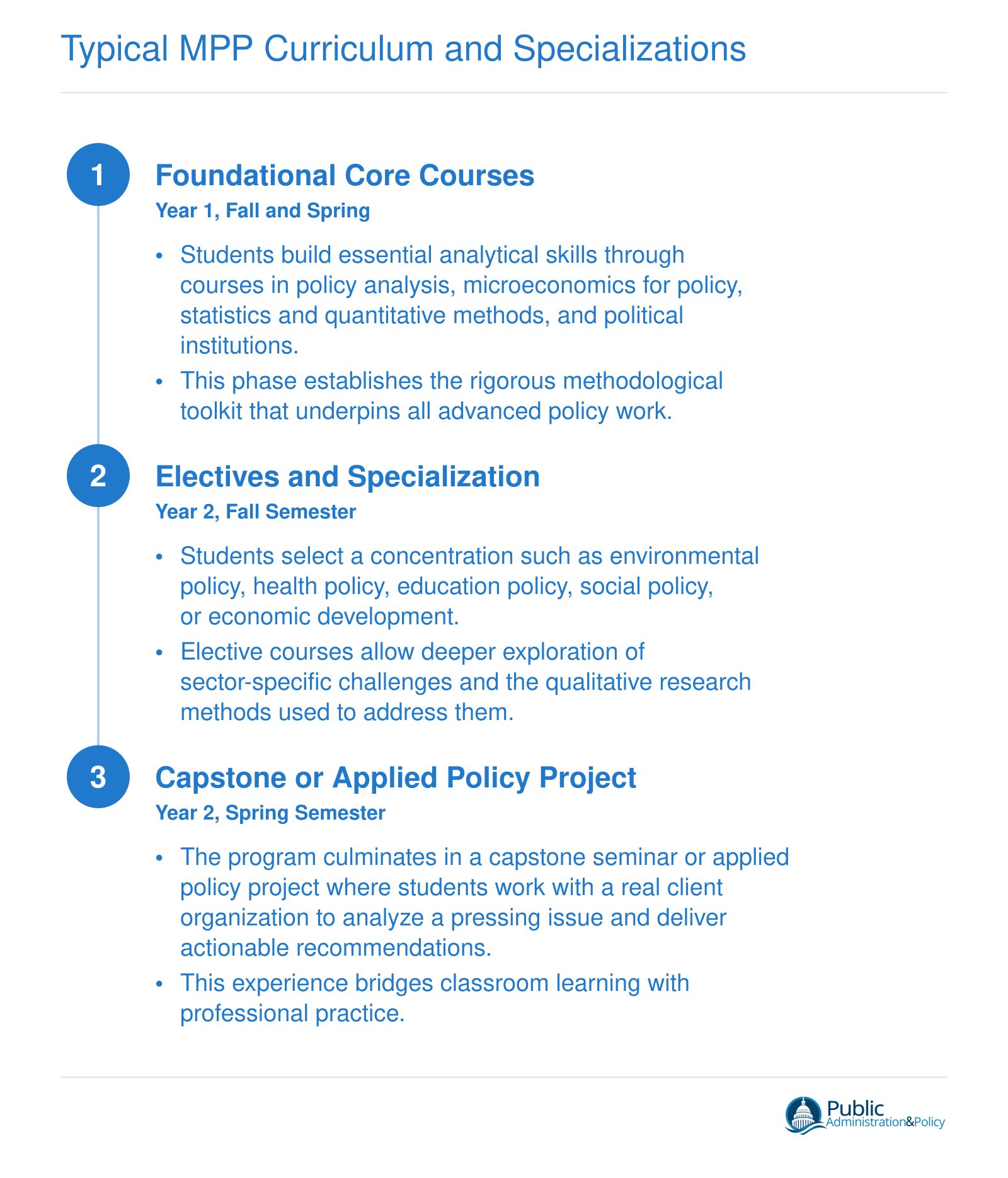
Most online MPP programs require 36 to 48 credits and are designed to blend quantitative methods with qualitative policy skills. The typical two-year progression moves from foundational coursework through tailored specializations to a culminating applied project. Common specialization tracks include environmental policy, health policy, education policy, social policy, and economic development.
Questions to Ask Yourself
Do you want to analyze and design policy, or manage existing programs and agencies?
An MPP focuses on policy analysis, quantitative methods, and program evaluation. If your goal is day-to-day organizational leadership, an MPA may be a better fit. Clarifying this distinction early prevents switching programs later.
Can you realistically commit 15 to 20 hours per week to coursework while working full-time?
Most online MPP programs expect this weekly investment across two to three years. If your current role involves unpredictable hours or seasonal surges, look for asynchronous formats with flexible deadlines rather than live-session models.
Are you drawn to a specific policy area, such as environmental, health, or education policy, that a concentration could deepen?
Not every program offers the same specializations. Vermont students interested in areas like climate resilience or rural health equity should verify that a program's elective tracks and faculty expertise align with those goals before applying.
Would Vermont-based fieldwork or a local practicum matter to your career, or are you comfortable completing a fully remote capstone?
Some employers in Montpelier and Burlington value candidates with hands-on experience in state or regional agencies. If local connections matter, prioritize programs that allow you to arrange a practicum with a Vermont organization rather than requiring an on-campus residency elsewhere.
Tuition, Financial Aid, and Cost Comparison for Vermont Students
Because no Vermont institution currently offers an online MPP, students in the Green Mountain State will pay out-of-state tuition at most public universities listed below. The good news: two New England schools (Worcester State University and University of Southern Maine) may qualify for the NEBHE Tuition Break, which caps tuition at the in-state rate plus 50 percent for residents of CT, ME, MA, NH, RI, and VT enrolled in programs not available in their home state. For the 2026-27 academic year, NEBHE confirms that online and hybrid delivery modes are eligible, though each program must be individually listed in the NEBHE directory. Vermont students should search the official program finder at nebhe.org or contact NEBHE directly ([email protected], 857-284-4879) to verify whether a specific MPP or MPA program qualifies. Note that the approximate net price column reflects institution-wide averages for undergraduate aid recipients and may not match your actual graduate costs. Always confirm program-specific tuition and fees with each school's admissions or bursar office. Beyond tuition reciprocity, Vermont students should file the FAFSA to access federal Stafford and Grad PLUS loans, explore employer tuition reimbursement programs (common among state agencies and large nonprofits), and ask each school about graduate assistantships or merit scholarships that can significantly reduce out-of-pocket expenses.
School
State
Program Offered
In-State Tuition
Out-of-State Tuition
Approx. Net Price (Institution-Wide)
NEBHE Tuition Break Possible
Texas A&M University-Central Texas
TX
Master of Public Administration
$6,242
$13,586
$1,300
No
Worcester State University
MA
Master of Public Administration & Policy
$6,813
$6,813
$13,381
Yes, if listed
Florida Gulf Coast University
FL
Master of Public Administration (MPA)
$8,961
$31,216
$12,568
No
University of Colorado Denver
CO
Master of Public Policy
$9,298
$27,154
$11,900
No
California State University-Sacramento
CA
Master of Public Policy and Administration
$9,542
$19,622
$9,338
No
University of Southern Maine
ME
Master of Public Policy and Management
$9,918
$26,676
$13,596
Yes, if listed
University of Illinois Springfield
IL
Master of Public Policy
$11,938
$19,515
$9,833
No
University of Washington-Bothell
WA
Master of Arts in Policy Studies
$18,738
$32,757
$12,319
No
Public Policy Career Paths in Vermont
Vermont's compact governance structure and deeply engaged civic culture create a distinctive environment for policy professionals. If you earn an online MPP, you will find that the Green Mountain State rewards versatility, and its small-state dynamics mean you can shape legislation, direct programs, and advise elected officials far earlier in your career than you might in a larger state.
State Government and Legislative Roles
Vermont state government is one of the largest employers of policy-trained professionals in the state. Key agencies that regularly hire MPP graduates include the Agency of Human Services, the Agency of Natural Resources, the Agency of Education, the Department of Public Service, and the Department of Financial Regulation.1 Common titles range from Policy Analyst and Program Analyst to Senior Policy Analyst and Director of Policy.
The Vermont Legislature also offers meaningful career tracks. The Joint Fiscal Office employs analysts who evaluate budget proposals and fiscal impacts, while Legislative Council attorneys and committee staff work directly on bill drafting and public policy making.1 The Governor's Office frequently seeks advisors with graduate-level policy training to coordinate cross-agency initiatives.
Because Vermont is one of the smallest states by population, policy professionals in state government often manage portfolios that would be split among several specialists elsewhere. That breadth of responsibility translates into outsized influence and accelerated professional growth.
Nonprofit and Advocacy Organizations
Vermont's nonprofit sector is a major force in the policy landscape. Environmental and climate organizations such as the Vermont Natural Resources Council, the Conservation Law Foundation, and 350Vermont actively shape energy, land use, and sustainability legislation. Health and human services advocates, including Voices for Vermont's Children, Vermont Care Partners, and Vermont Legal Aid, drive policy on rural health access, child welfare, and poverty reduction.2 Housing-focused groups like the Vermont Housing and Conservation Board and Champlain Housing Trust address affordability challenges that intersect with economic development policy. Civil rights and consumer advocacy organizations, among them the ACLU of Vermont and VPIRG, round out a sector where MPP skills in data analysis, stakeholder engagement, and program evaluation are consistently in demand.
Municipal and Regional Planning
Cities such as Burlington, Montpelier, South Burlington, and Brattleboro employ policy staff to manage everything from zoning reform to public health initiatives. Regional planning commissions, including the Chittenden County Regional Planning Commission and the Two Rivers-Ottauquechee Regional Planning Commission, hire analysts who can bridge local priorities with state and federal funding requirements.3 Professionals interested in the planning side of this work may also want to explore how to become an urban policy planner.
Vermont's High-Demand Policy Areas
The state's geography and economy create specialized niches where MPP graduates are especially valuable:
Rural health policy: Expanding access to care in communities without a nearby hospital remains a persistent challenge.
Environmental and climate policy: Vermont's ambitious climate action goals require analysts who can model emissions scenarios and evaluate regulatory frameworks.
Agricultural policy: With a strong farm-to-table economy, the state needs professionals who understand federal agricultural programs alongside local food system resilience.
Small-state governance: Policy generalists who can navigate multiple issue areas simultaneously thrive here.
Salary Expectations
Because Vermont's workforce is small, the Bureau of Labor Statistics sometimes suppresses state-level wage estimates for occupations like policy analyst and political scientist. Regional data for New England, however, provides a useful benchmark. Policy analysts in the broader New England region earn a median annual salary that generally tracks above the national median for the occupation, reflecting the region's higher cost of living and demand for graduate-educated professionals. Vermont salaries may be somewhat lower than those in Boston or Hartford, but the state's lower overall cost of living, particularly outside Chittenden County, helps offset the difference.
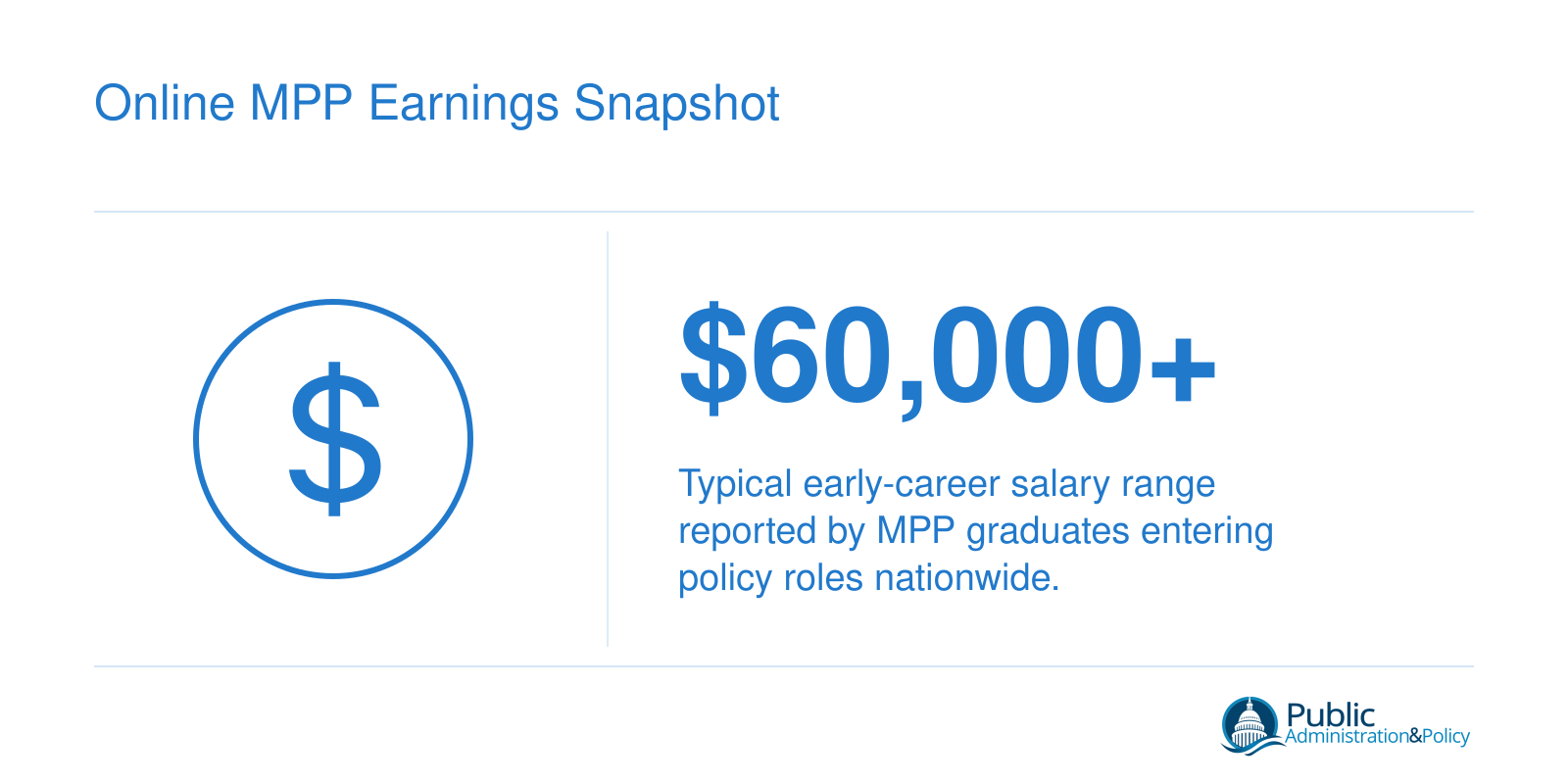
Program-level earnings data for the online MPP programs featured in this article are not yet available through federal reporting sources. Because the College Scorecard publishes earnings on a rolling schedule and many online MPP programs are relatively new additions to institutional reporting, early-career salary figures for these specific programs have not been released. We will update this section as new data becomes available.
Admissions Requirements and How Long an Online MPP Takes
Whether you are a recent graduate or a mid-career professional in Montpelier or Burlington, understanding what admissions committees expect and how long the degree takes will help you plan with confidence. The good news: most online MPP programs have streamlined their requirements in recent years, and flexible scheduling options make the degree more accessible than ever.
What You Will Need to Apply
Admissions criteria are fairly consistent across NASPAA-accredited online MPP programs, though individual schools may weigh components differently. Expect to prepare the following:
Bachelor's degree: A completed undergraduate degree from a regionally accredited institution is universally required. Your major does not need to be in political science or a related field; programs welcome applicants from diverse academic backgrounds.
Minimum GPA: Most programs set a floor of 3.0 on a 4.0 scale, though some will consider applicants slightly below this threshold if they present strong professional experience or compelling supplementary materials.
Statement of purpose: This essay is your chance to articulate your policy interests, career goals, and reasons for pursuing the degree. Tailor it to each program when possible.
Professional resume: Highlighting relevant work, internships, or volunteer experience in government, nonprofits, or advocacy strengthens your application considerably.
Letters of recommendation: Two to three letters from academic or professional references are standard.
GRE scores: A growing number of online MPP programs have permanently dropped the GRE requirement, and many others offer test-optional pathways. If standardized testing is a concern, you have plenty of strong programs to choose from that no longer require it.
How Long Does It Take to Finish?
Completion timelines vary depending on your enrollment status and life circumstances. Full-time students typically earn the degree in 18 to 24 months, covering roughly 40 to 48 credit hours across four to five semesters. Part-time students, particularly working professionals balancing careers and family, more commonly finish in two and a half to three and a half years.
Some programs offer accelerated tracks that compress coursework into shorter terms or year-round scheduling, shaving several months off the standard timeline. Others accept transfer credits from prior graduate coursework or grant credit for documented professional experience, which can also reduce the total credits required.
Timing Tips for Vermont Applicants
Because no Vermont-based institutions currently offer an online MPP, you will be applying to out-of-state programs, and that actually expands your options. Students in neighboring New Hampshire face a similar landscape, so if you are comparing notes with peers across the border, our guide to online MPP programs New Hampshire covers parallel considerations. Many nationally recognized online MPP programs feature rolling admissions rather than a single annual deadline, and several provide multiple start dates throughout the year (fall, spring, and sometimes summer). This means you do not have to wait months if you miss a traditional deadline.
Look for programs that clearly list their admissions calendar on their website and confirm whether they charge out-of-state tuition rates for online learners. Many do not, which is a significant cost advantage worth verifying before you apply. Starting your application materials early, even before a formal cycle opens, gives you time to secure strong recommendation letters and craft a polished statement of purpose without rushing.
Frequently Asked Questions About Online MPP Programs for Vermont Students
Vermont students considering an online Master of Public Policy often have questions about program options, costs, and career outcomes. Below are answers to the most common questions we hear from prospective MPP students in the Green Mountain State.
What is the best online MPP program for Vermont students?
The best program depends on your career goals, budget, and schedule. Top options frequently recommended on publicadministrationpolicy.org include NASPAA-accredited programs from schools such as the University of Michigan, American University, and the University of Southern California. Vermont students should prioritize accreditation, flexible scheduling, and whether the school charges in-state or flat-rate tuition for online learners.
Are there any NASPAA-accredited online MPP programs available to Vermont residents?
Yes. While no Vermont-based institution currently offers an online MPP, several NASPAA-accredited programs enroll students nationwide. Schools like American University, the University of Michigan, and George Washington University hold NASPAA accreditation and accept Vermont residents into their fully online MPP tracks. NASPAA accreditation signals that a program meets rigorous standards for public policy education.
How long does an online Master of Public Policy take to complete?
Most online MPP programs require 36 to 48 credit hours and take about two years of full-time study. Part-time students typically finish in three to four years. Some programs offer accelerated formats that can be completed in as few as 18 months. Check whether a program allows you to set your own pace, which is especially helpful for working professionals in Vermont's public sector.
What is the difference between an MPP and an MPA degree?
An MPP (Master of Public Policy) focuses on policy analysis, research methods, and quantitative evaluation, preparing graduates to design and assess public policies. An MPA (Master of Public Administration) emphasizes organizational management, budgeting, and leadership within government agencies. If you want to analyze and shape policy, the MPP is typically the stronger fit. If managing programs and leading teams appeals to you, consider an MPA.
What can you do with a Master of Public Policy in Vermont?
Vermont MPP graduates work in state government, nonprofit organizations, healthcare policy, environmental advocacy, and legislative analysis. Common roles include policy analyst, program evaluator, legislative aide, and nonprofit director. Vermont's focus on areas like environmental sustainability, rural health, and community development creates strong demand for policy professionals who can guide evidence-based decision making.
How much does an online MPP program cost?
Tuition for online MPP programs typically ranges from about $20,000 at public universities offering flat-rate or reduced online tuition to over $100,000 at selective private institutions. Many programs offer financial aid, graduate assistantships, or employer tuition reimbursement options. Vermont students should compare total program costs rather than per-credit rates, and ask whether out-of-state surcharges apply.
Does Vermont offer tuition reciprocity for online graduate programs?
Vermont participates in the New England Board of Higher Education (NEBHE) Regional Student Program, which can reduce tuition at certain public universities in other New England states. However, this benefit applies mainly to on-campus programs. For online programs, many schools already charge a flat tuition rate regardless of residency. Always confirm directly with the institution whether Vermont residents qualify for any regional discounts.
More Online MPP Programs Available to Vermont Students
In addition to the top-ranked programs, many other excellent online Master of Public Policy programs welcome Vermont students. These programs offer flexible formats and diverse specializations to help you advance your public policy career. Explore the full directory below to find additional options that fit your goals.
University of Northern Iowa
The University of Northern Iowa offers an online Master of Public Policy (MPP) program designed for public service professionals. This 36-credit program uses synchronous Zoom sessions on Tuesday evenings and follows a cohort model for two-year completion.
Southern Methodist University offers an online Master of Public Policy (MPP) program for working professionals, focusing on technical skills in policy analysis, research, and evaluation. The part-time program includes virtual live lectures and a real-world capstone project.
Colorado State University's online Master of Public Policy and Administration with a concentration in Public Management prepares professionals for leadership roles in public and nonprofit sectors. The interdisciplinary curriculum blends theory with practical experience.
The Master of Public Policy (MPP) at University of the Pacific's McGeorge School of Law offers a hybrid format combining online coursework with in-person Saturday sessions in Sacramento. The program includes concentrations in environmental policy, advocacy, and nonprofit management.
Worcester State University's Master of Public Administration and Policy (MPAP) uses a blended format to accommodate working professionals. The 36-credit curriculum covers policy analysis, public budgeting, and organizational theory, with a capstone fieldwork component.
The Master of Public Policy (MPP) at University of Illinois Springfield prepares students for careers analyzing complex social, political, and economic issues. The hybrid program offers both online and on-campus options, with paid Graduate Public Service Internships available.
Drexel University's Master of Public Policy program offers a flexible, innovative approach for careers in government, nonprofit, or private sectors. The hybrid curriculum emphasizes case study research and can be customized through certificates or graduate minors.
North Dakota State University's Master of Public Policy (MPP) program prepares students for policy design and evaluation roles. The hybrid format allows in-person or remote real-time attendance, and an accelerated option lets undergraduates earn both degrees in five years.
Texas A&M University-Central Texas offers a Master of Public Administration (MPA) designed for impactful public service careers. The hybrid program blends online coursework with in-person sessions, focusing on policy analysis, budgeting, and ethical decision-making.
Pepperdine University offers a Master of Public Policy (MPP) degree preparing students for leadership across sectors. The hybrid program features a Washington, DC track, five specializations, and no GRE requirement.
University of Colorado Denver/Anschutz Medical Campus
The Master of Public Policy at University of Colorado Denver provides tools for policy design, analysis, and advocacy. The hybrid program requires 36 credits with optional concentrations and a capstone or thesis.
York College of Pennsylvania offers a fully online Master of Public Policy and Administration (MPPA) degree. The 36-credit program includes concentrations in Urban Planning, Nonprofit Leadership, and Local Government, and can be completed in two years.
The Master of Public Policy and Management (MPPM) at the University of Southern Maine offers a multidisciplinary curriculum for public and nonprofit careers. The hybrid program features concentrations in Community Planning and Sustainable Development or Public Policy and Management.
The Master of Public Policy & Administration (MPPA) at University of Redlands combines policy analysis with public management skills. The hybrid program requires 56 credits and is taught by practitioner faculty, covering policy writing, grant writing, and program evaluation.
The Master of Science in Public and Urban Policy at The New School prepares change makers to tackle urban challenges with a focus on social inclusion and equity. The hybrid program includes an Urban Policy Lab with client projects for real-world experience.