Best Online Master of Public Policy Programs for Utah Students

Compare top-ranked online MPP degrees by cost, curriculum, and career outcomes for Utah residents

By Carrie HirschReviewed by PAP Editoral TeamUpdated May 16, 202610+ min read

Key Points

  • No Utah university currently offers a fully online MPP, but nationally available programs accept Utah applicants at flat tuition rates.
  • NASPAA accredited online MPP programs typically cost between roughly 500 and 1200 dollars per credit for out of state students.
  • An MPP emphasizes quantitative policy analysis while an MPA focuses on organizational management, so your career goals should guide the choice.
  • Utah policy roles in state agencies, nonprofits, and health systems align well with core MPP skills like program evaluation and data analysis.

Utah's legislative analyst office, county health departments, and a growing cluster of Wasatch Front nonprofits all compete for professionals who can design and evaluate policy, yet no university in the state offers a fully online Master of Public Policy. That gap sends Utah students to nationally available online MPP programs, many of which charge a flat per-credit rate that eliminates out-of-state tuition penalties.

The practical question is which of those programs delivers rigorous quantitative training, NASPAA-aligned curriculum, and scheduling flexibility that works around a Mountain Time career in public policy. Demand for policy analysts in Utah state government has risen steadily, but the credential market remains uneven in cost, specialization depth, and post-graduation outcomes.

Top-Ranked Online MPP Programs for Utah Students

Because no Utah-based university currently offers a fully online Master of Public Policy, Utah students can turn to nationally available online and hybrid MPP programs that accept applicants from every state. The 10 programs below are ordered by a composite quality score that factors in institutional strength and online-delivery accessibility. All graduation rates cited are institution-wide figures and do not reflect MPP-specific completion rates. Program-level earnings data are not yet available for these degrees, so we include institution-wide median earnings where reported.

Factors considered
  • Online delivery accessibility
  • Institutional graduation and retention rates
  • Graduate tuition and net price
  • Program breadth and concentrations
  • Institutional earning outcomes
Data sources

The University of Tennessee-Knoxville

#1

Knoxville, TN · ~$19,000/yr (est.)

Best for: Utah professionals seeking fully online flexibility

The University of Tennessee, Knoxville delivers its Baker School MPP entirely online, making it one of the most accessible options for Utah residents who need full schedule flexibility. The 36-credit program features seven concentration tracks, several of which align well with Utah's policy landscape, including Agricultural and Environmental Policy, Energy Policy, and Economic and Community Development. A capstone master class and internship replace a traditional thesis, and no GRE is required for applicants with a U.S. degree.

  • 36 credit hours with no thesis required
  • Delivered 100% online for students in any state
  • Seven concentration options including Energy and Health Policy
  • Internship and capstone master class included
  • GRE waived for applicants with a U.S. bachelor's degree
  • In-state tuition: $15,972; out-of-state: $34,760
  • Institution-wide graduation rate: 73.9%

Oregon State University

#2

Corvallis, OR · $15,000 – $20,000/yr

Best for: Western-region policy careers at equal tuition

Oregon State University's NASPAA-accredited MPP is available through its established Ecampus platform, where online students pay the same per-credit rate regardless of residency. That tuition structure is a meaningful advantage for Utah residents. Concentrations in Energy Policy, Environmental Policy, and Rural Policy mirror many of the Intermountain West's most pressing challenges, and an 11-week capstone policy lab pairs student teams with real-world clients.

  • 54 quarter credits: 34 core plus 20 in a concentration
  • NASPAA-accredited with seven concentration tracks
  • Online students pay the same rate as Oregon residents
  • 11-week capstone policy lab with real client projects
  • Concentrations include Energy, Environmental, and Rural Policy
  • Hybrid or fully online delivery through Ecampus
  • In-state tuition: $16,206; out-of-state: $33,351
  • Institution-wide graduation rate: 70.1%
  • 54 quarter credits: 34 core plus 20 in a concentration
  • NASPAA-accredited with seven concentration tracks
  • Online students pay the same rate as Oregon residents
  • 11-week capstone policy lab with real client projects
  • Concentrations include Energy, Environmental, and Rural Policy
  • Hybrid or fully online delivery through Ecampus
  • In-state tuition: $16,206; out-of-state: $33,351
  • Institution-wide graduation rate: 70.1%
  • 54 quarter credits: 34 core plus 20 in a concentration
  • NASPAA-accredited with seven concentration tracks
  • Online students pay the same rate as Oregon residents
  • 11-week capstone policy lab with real client projects
  • Concentrations include Energy, Environmental, and Rural Policy
  • Hybrid or fully online delivery through Ecampus
  • In-state tuition: $16,206; out-of-state: $33,351
  • Institution-wide graduation rate: 70.1%

University of Pittsburgh-Pittsburgh

#3

Pittsburgh, PA · $30,000/yr

Best for: Mid-career government employees saving on tuition

The University of Pittsburgh's Master of Public Policy and Management is built for mid-career professionals with at least five years of experience. Its fully online track charges in-state Pennsylvania tuition to all distance learners, regardless of where they live, giving Utah students a concrete cost advantage. The streamlined 30-credit curriculum (four required courses plus six electives) can be finished in about 20 months, and full-time government employees receive an additional 20% tuition discount.

  • 30 credits: 4 required courses and 6 electives
  • Online students pay in-state tuition ($27,580) from any state
  • Completable in approximately 20 months online
  • 20% tuition discount for full-time government employees
  • Requires five or more years of professional experience
  • No entrance exam mentioned for admission
  • Institution-wide graduation rate: 85.5%

Binghamton University

#4

Vestal, NY · $20,000 – $25,000/yr

Binghamton University's fully asynchronous online MPP is one of the few programs on this list that can be completed entirely without live class sessions or campus visits. Utah students benefit from a curriculum that emphasizes data analysis, policy modeling, and applied projects through a dedicated policy laboratory. Full-time students can finish in as little as one year, and graduate tuition at this SUNY institution remains competitive compared with many private alternatives.

  • Fully asynchronous online delivery from anywhere
  • Can be completed in one year full-time
  • Curriculum centers on data analysis and policy modeling
  • Applied projects through a policy laboratory
  • In-state tuition: $13,950; out-of-state: $27,140
  • Institution-wide graduation rate: 81.6%
  • Military-friendly program designation

Duke University

#5

Durham, NC · ~$30,000/yr (est.)

Duke University's Sanford School of Public Policy offers a highly regarded hybrid MPP that blends online learning with on-campus residencies in Durham, NC. The 24-month, 51-credit program provides eight concentration areas, including Development Policy and Energy and Environment Policy, along with dual-degree options. Financial aid and fellowship opportunities help offset its premium tuition. Utah students should note that periodic campus attendance is expected.

  • Development Policy concentration focuses on poverty reduction
  • Energy and Environment concentration covers climate and energy markets
  • Summer internship and capstone project required
  • Prerequisites: one course each in microeconomics and statistics
  • Cohort size typically 80 to 100 students
  • Career services tailored by career stage
  • Development Policy concentration focuses on poverty reduction
  • Energy and Environment concentration covers climate and energy markets
  • Summer internship and capstone project required
  • Prerequisites: one course each in microeconomics and statistics
  • Cohort size typically 80 to 100 students
  • Career services tailored by career stage
  • Development Policy concentration focuses on poverty reduction
  • Energy and Environment concentration covers climate and energy markets
  • Summer internship and capstone project required
  • Prerequisites: one course each in microeconomics and statistics
  • Cohort size typically 80 to 100 students
  • Career services tailored by career stage

George Mason University

#6

Fairfax, VA · $15,000 – $20,000/yr

George Mason University's Schar School of Policy and Government sits just outside Washington, D.C., giving students access to a dense network of federal agencies, NGOs, and international organizations. The MPP can be taken in a hybrid or fully online format with evening course times that work across time zones. Merit scholarships and military tuition assistance are available, and the faculty of more than 80 scholars brings practitioner-level expertise to the classroom.

  • Hybrid or fully online format with evening classes
  • Located near Washington, D.C. policy ecosystem
  • Merit scholarships and military tuition assistance offered
  • 80+ faculty members with practitioner backgrounds
  • In-state tuition: $17,964; out-of-state: $40,308
  • Institution-wide graduation rate: 67.8%
  • Graduates employed at agencies like USAID and the World Bank

Rutgers University

#7

New Brunswick, NJ · $24,000/yr (net price)

Rutgers University's 48-credit MPP combines in-person instruction with synchronous remote courses, providing some flexibility for distance learners. The program stands out for its 14 concentration tracks, including Health, Budget and Finance, Environment, and Urban Policy, plus the option to design a custom track. A distinctive feature is cross-registration at Princeton's School of Public and International Affairs. Utah students should weigh the synchronous scheduling and potential on-site requirements.

  • 48 credits over two years with hybrid delivery
  • 14 concentrations or design your own track
  • 300-hour internship and group policy research practicum
  • Cross-registration available at Princeton
  • No thesis required; no entrance exam for admission
  • In-state tuition: $23,241; out-of-state: $37,689
  • Institution-wide graduation rate: 83.6%
  • 48 credits over two years with hybrid delivery
  • 14 concentrations or design your own track
  • 300-hour internship and group policy research practicum
  • Cross-registration available at Princeton
  • No thesis required; no entrance exam for admission
  • In-state tuition: $23,241; out-of-state: $37,689
  • Institution-wide graduation rate: 83.6%
  • 48 credits over two years with hybrid delivery
  • 14 concentrations or design your own track
  • 300-hour internship and group policy research practicum
  • Cross-registration available at Princeton
  • No thesis required; no entrance exam for admission
  • In-state tuition: $23,241; out-of-state: $37,689
  • Institution-wide graduation rate: 83.6%

Ohio State University

#8

Columbus, OH · $17,000/yr (net price)

Ohio State University's Glenn College offers a Master of Arts in Public Policy and Management designed for in-career professionals with at least three years of experience. The 38-credit hybrid program uses evening classes and can be completed in about five semesters. Core coursework spans economics, management, public policy, and decision support systems. Because the hybrid model relies on Columbus-based evening sessions, Utah students should confirm current remote-participation options before applying.

  • 38 credit hours with evening hybrid delivery
  • Designed for professionals with 3+ years of experience
  • Core streams: economics, management, policy, decision support
  • No GRE required for admission
  • Capstone course and electives included
  • In-state tuition: $13,901; out-of-state: $42,740
  • Institution-wide graduation rate: 87.7%

University of Houston

#9

Houston, TX · $10,000 – $23,000/yr

The University of Houston's Hobby School of Public Affairs delivers a NASPAA-accredited, 39-hour hybrid MPP that blends online and on-campus elements. Interdisciplinary coursework covers economics, politics, ethics, and quantitative analysis, culminating in an internship and capstone project. Houston's diverse metropolitan setting provides rich experiential learning opportunities, though Utah-based students should confirm how much coursework can be completed remotely.

  • 39-hour NASPAA-accredited program
  • Hybrid format combining online and campus learning
  • Interdisciplinary core: economics, politics, quantitative analysis
  • Internship and capstone project required
  • In-state tuition: $10,051; out-of-state: $19,231
  • Institution-wide graduation rate: 64.6%
  • Virtual information sessions and fee waivers available

University of Washington-Bothell Campus

#10

Bothell, WA · $12,000/yr

The University of Washington, Bothell offers an interdisciplinary Master of Arts in Policy Studies that uses a cohort model and community partner projects to build evidence-based analysis skills. Classes meet after 5 p.m. two to three times per week in a hybrid format. As a Pacific Northwest institution, its policy focus on social change and regional governance may resonate with Utah students interested in western-state issues, though campus attendance in Bothell is generally expected.

  • Cohort-based interdisciplinary program
  • Hybrid delivery with evening classes after 5 p.m.
  • Focus on evidence-based policy analysis and social change
  • Community partner projects for hands-on experience
  • In-state tuition: $18,738; out-of-state: $32,757
  • Institution-wide graduation rate: 65.3%
  • Designed for working professionals and non-traditional students

Why No Utah-Based Online MPP Exists, and Why It Doesn't Matter

If you have been searching for a fully online Master of Public Policy from a Utah university, you have likely noticed a gap. No institution in the state currently offers a complete online MPP degree.1 That includes the University of Utah, the state's most prominent public policy program and the one that draws the most search interest from prospective students. Understanding what the U of U does provide, and why out-of-state online programs are a strong alternative, can save you months of uncertainty.

What the University of Utah Offers Today

The University of Utah houses an on-campus MPP that requires 40 credits and is well regarded within the region.2 However, a fully online version of the MPP is not advertised or scheduled for launch.3 If you want to study public policy at the U of U without relocating your life, you do have one meaningful option: the university offers a 15-credit online Graduate Certificate in Public Policy. With program manager approval, those certificate credits can count as an MPP emphasis area, which means the certificate could eventually feed into the full degree if you later enroll on campus.4

The university also maintains several joint and dual-degree tracks that appeal to students with interdisciplinary goals:

  • MPP/MCMP Dual Degree: Requires 61 credits, saving 27 credits compared to pursuing each degree separately.5
  • MPP/MPH Joint Degree: Allows up to 9 MPH credits toward the MPP and up to 12 MPP credits toward the MPH, saving roughly 21 credits overall.
  • JD/MPP Joint Degree: Typically completed in about four years, also saving 21 credits.7

These pathways are valuable, but they are campus-based programs. For working professionals in Utah who need fully online flexibility, the best online public administration degree programs ranked earlier in this article are the more practical route.

Geography Is Not a Barrier

Every program featured in our rankings above is fully online and open to Utah residents. You do not need to live near campus, travel for residencies (unless a specific program includes an optional immersion), or uproot your career. Admissions offices at these institutions are accustomed to enrolling students from across the country, and many have built their online programs specifically with working professionals in mind.

A Note on WICHE Tuition Reciprocity

Utah participates in the Western Interstate Commission for Higher Education (WICHE), which includes the Western Undergraduate Exchange (WUE) and the Western Regional Graduate Program (WRGP). These agreements can reduce tuition at participating schools in western states. However, WUE is designed for undergraduate students, not graduate students. The WRGP does cover certain graduate programs at reduced rates, but eligibility is program-specific, and most fully online graduate degrees do not qualify because tuition reciprocity agreements typically apply to on-campus or hybrid delivery. Before enrolling, contact both the program and your state's WICHE coordinator to confirm whether any discount applies. In practice, many online MPP programs set a single tuition rate for all students regardless of residency, which can work in your favor compared to traditional out-of-state pricing.

NASPAA Accreditation Holds Equal Weight Online

One concern prospective students sometimes raise is whether an online degree carries the same accreditation standing as its on-campus counterpart. With NASPAA (the Network of Schools of Public Policy, Affairs, and Administration), the answer is straightforward: accreditation applies to the degree program itself, not to the delivery format. A NASPAA-accredited online MPP meets the same curricular standards, competency requirements, and review processes as an accredited on-campus program at the same institution. Employers, government agencies, and doctoral admissions committees recognize this equivalence. When evaluating programs, look for NASPAA accreditation as your quality benchmark regardless of whether you attend in person or online.

The absence of a homegrown online MPP in Utah is a minor inconvenience, not a roadblock. Between the University of Utah's online graduate certificate and the nationally accessible online MPP programs ranked on this page, Utah students have clear, accredited pathways to a public policy career without compromising on quality or flexibility.
What Online MPP Programs Cost Utah Residents

Because no Utah-based university currently offers a fully online MPP, students in the state will enroll at an out-of-state institution. The good news: several programs charge a flat per-credit rate regardless of where you live, effectively eliminating the out-of-state premium. The table below is sorted by annual graduate tuition (in-state rate, lowest first) and includes the institution-wide average net price and median graduate debt. Note that the net price column reflects an institution-wide average across all programs and student profiles; your actual cost for an MPP may differ. Schools where in-state and out-of-state tuition are identical are flagged as especially cost-friendly for Utah residents. Utah students should also explore federal graduate loan options, employer tuition reimbursement (common among Utah state agencies), and WICHE's Western Regional Graduate Program, which can unlock reduced tuition at participating schools in neighboring states such as the University of Colorado Denver.

SchoolStateAnnual In-State TuitionAnnual Out-of-State TuitionSame Rate for All Students?Avg. Net Price (Institution-Wide)Median Graduate Debt
Texas A&M University-Central TexasTX$6,242$13,586No$1,300$17,750
Worcester State UniversityMA$6,813$6,813Yes$13,381$19,500
North Dakota State UniversityND$8,786$12,578No$15,543$23,199
Florida Gulf Coast UniversityFL$8,961$31,216No$12,568$17,622
University of Colorado DenverCO$9,298$27,154No$11,900$20,500
California State University-SacramentoCA$9,542$19,622No$9,338$15,000
University of Southern MaineME$9,918$26,676No$13,596$19,060
University of HoustonTX$10,051$19,231No$14,276$18,194
University of Illinois SpringfieldIL$11,938$19,515No$9,833$19,128
University of Washington-BothellWA$18,738$32,757No$12,319$14,615

Questions to Ask Yourself

An MPP centers on research, data analysis, and policy design, while an MPA focuses on organizational leadership and program management. Your answer here shapes which degree aligns with your career goals.

MPP curricula lean heavily on quantitative coursework. If you thrive on data-driven problem solving rather than qualitative management skills, the MPP's analytical rigor will feel like a natural fit.

MPP graduates often gravitate toward policy research organizations, legislative staff roles, and federal agencies where analysis drives decisions. If direct program administration appeals to you more, an MPA may be the stronger match.

MPP vs. MPA: Which Degree Fits Your Goals?

One of the most common questions Utah students ask is whether to pursue a Master of Public Policy (MPP) or a Master of Public Administration (MPA). Both degrees prepare you for meaningful public service careers, and both fall under the same NASPAA accreditation umbrella, so the distinction is about curricular emphasis rather than prestige. The right choice depends on whether you see yourself analyzing policy problems or managing the organizations that implement solutions.

Dimension

Analytical Focus Core Curriculum Typical Career Paths Utah Employer Preferences NASPAA Accreditation Best Fit For You

Master of Public Policy (MPP)

Quantitative policy analysis, econometrics, statistical modeling, and causal inference Microeconomics, program evaluation, cost benefit analysis, regression analysis, policy design Policy analyst, legislative research staff, program evaluator, think tank researcher, government affairs strategist Agencies like the Governor's Office of Planning and Budget (GOPB) and legislative research offices tend to value MPP style skills in quantitative analysis and evidence based evaluation Accredited programs are evaluated under the same NASPAA standards that apply to MPA programs, ensuring equivalent rigor Students drawn to research, data driven problem solving, and shaping policy through evidence and analysis

Admissions Requirements and How to Apply

Applying to an online Master of Public Policy program is more straightforward than many prospective students expect, but each school has its own nuances. Understanding the common requirements will help you build a stronger application and avoid surprises late in the process.

Academic Thresholds and Testing Policies

Most online MPP programs look for a minimum undergraduate GPA of 3.0, though a few schools set the bar slightly lower.1 The University of Northern Iowa Online MPP, for instance, requires a 2.75 GPA for admission.2 Applicants from any undergraduate major are eligible, so you do not need a prior degree in political science or public affairs to qualify.1

As of 2025-2026, the vast majority of top-ranked online MPP programs no longer require the GRE.1 Many have moved to permanently test-optional policies, while others offer GRE waivers for applicants whose undergraduate GPA meets or exceeds 3.25. If your GPA falls below a program's standard threshold but you have strong professional credentials, contacting the admissions office about alternative pathways is always worthwhile.

Common Application Components

While the exact checklist varies by school, you can expect most programs to require the following:

  • Statement of purpose: A narrative essay explaining your policy interests and career goals. This is universal across programs.1
  • Letters of recommendation: Typically two to three, from academic or professional references who can speak to your analytical skills and leadership potential.1
  • Resume or CV: Programs value professional experience, and most prefer applicants with one to five years of relevant work. This does not always mean government service; nonprofit, advocacy, consulting, and private-sector roles all count.
  • Writing sample: Required by some but not all programs. When requested, a research paper or policy memo from a previous academic or professional setting works well.
  • Transcripts: Official transcripts from all undergraduate and graduate institutions attended.

Prerequisite Coursework and Conditional Admission

Several programs expect incoming students to have foundational knowledge in microeconomics, statistics, or research methods.1 If your undergraduate transcript does not include these courses, do not count yourself out. Many schools offer provisional or conditional admission paired with bridge courses that let you build quantitative skills during your first semester. This option is especially common at programs that attract career-changers from fields like education, communications, or the humanities.

A Note for Utah Students on Residency Classification

Because no Utah-based university currently offers an online MPP, you will be applying to out-of-state institutions. If you are weighing related graduate options closer to home, you may also want to explore online MPA programs in Utah. Here is where a bit of research pays off: some online programs classify all distance learners as in-state students for tuition purposes, regardless of where they live. Others maintain separate out-of-state rates even for fully online students. Before you apply, check each program's residency classification policy for online learners. The difference can amount to thousands of dollars per year, so confirming your tuition tier early in the process is one of the most practical steps you can take.

Curriculum and Specializations in Online MPP Programs

Online MPP programs share a recognizable curricular backbone, but the details vary enough from school to school that choosing the right fit takes some legwork. Whether you are a Utah professional eyeing a career shift or a recent graduate ready to dive into policy analysis, understanding what these programs teach (and how they teach it) will help you make a confident decision.

Core Coursework and Credit Hours

Most online MPP curricula run between 36 and 48 credit hours and can be completed in two to three years of part-time study. The core sequence typically covers quantitative methods, microeconomics for policy, statistics, program evaluation, political institutions, and ethics in public policy. These foundational courses are designed to build analytical muscle, training you to dissect proposed legislation, model fiscal impacts, and weigh trade-offs using evidence rather than intuition.

Programs at institutions like Georgetown, USC, and UNC each publish detailed curriculum maps on their official websites. Reviewing these side by side is one of the most efficient ways to compare required coursework, elective flexibility, and the total credit load you would need to complete.

Specialization Tracks Worth Exploring

Specializations are where online MPP programs distinguish themselves from one another, and from the more management-focused MPA degree. Common concentration areas available in online formats include:

  • Data Analytics and Quantitative Policy Analysis: Emphasizes advanced statistics, data visualization, and programming skills increasingly sought by employers.
  • Health Policy: Covers healthcare economics, regulatory frameworks, and population health, a growing field in Utah given the state's expanding healthcare sector.
  • Education Policy: Focuses on K-12 and higher education funding models, equity, and institutional reform.
  • Environmental and Energy Policy: Addresses sustainability, climate regulation, and natural resource management.
  • Social Policy and Inequality: Examines poverty alleviation, housing, and workforce development.

The U.S. Bureau of Labor Statistics outlines the core competencies employers expect from policy analysts, including research design, statistical software proficiency, and written communication. Consulting BLS.gov before selecting a specialization can help you align your elective choices with labor market demand.

Capstone Projects and Experiential Learning

A defining feature of high-quality MPP programs is the capstone experience. Unlike a traditional thesis, most online MPP capstones are applied projects completed in partnership with a real government agency, nonprofit, or community organization. You might conduct a cost-benefit analysis for a municipal transit authority or evaluate the effectiveness of a statewide early childhood program.

Formats vary. Some programs pair students with a client organization and require a final policy memo and presentation. Others offer a portfolio-based capstone that showcases work completed throughout the program. Searching LinkedIn for alumni testimonials or contacting admissions offices directly can give you honest insight into how these capstone experiences work in practice and whether the program facilitates placements or expects students to find their own partners.

Ensuring Curriculum Quality Through Accreditation

Before committing to any program, verify its accreditation status through the Network of Schools of Public Policy, Affairs, and Administration (NASPAA). NASPAA-accredited programs meet rigorous standards for curriculum design, faculty qualifications, and student outcomes. The organization maintains a searchable database on its website, making it easy to confirm that a program's coursework meets the profession's benchmarks for quality and comparability. For Utah students evaluating online MPP programs from other states, NASPAA accreditation serves as a reliable equalizer, ensuring that what you learn in an online classroom from North Carolina or California holds the same weight as a degree earned on campus.

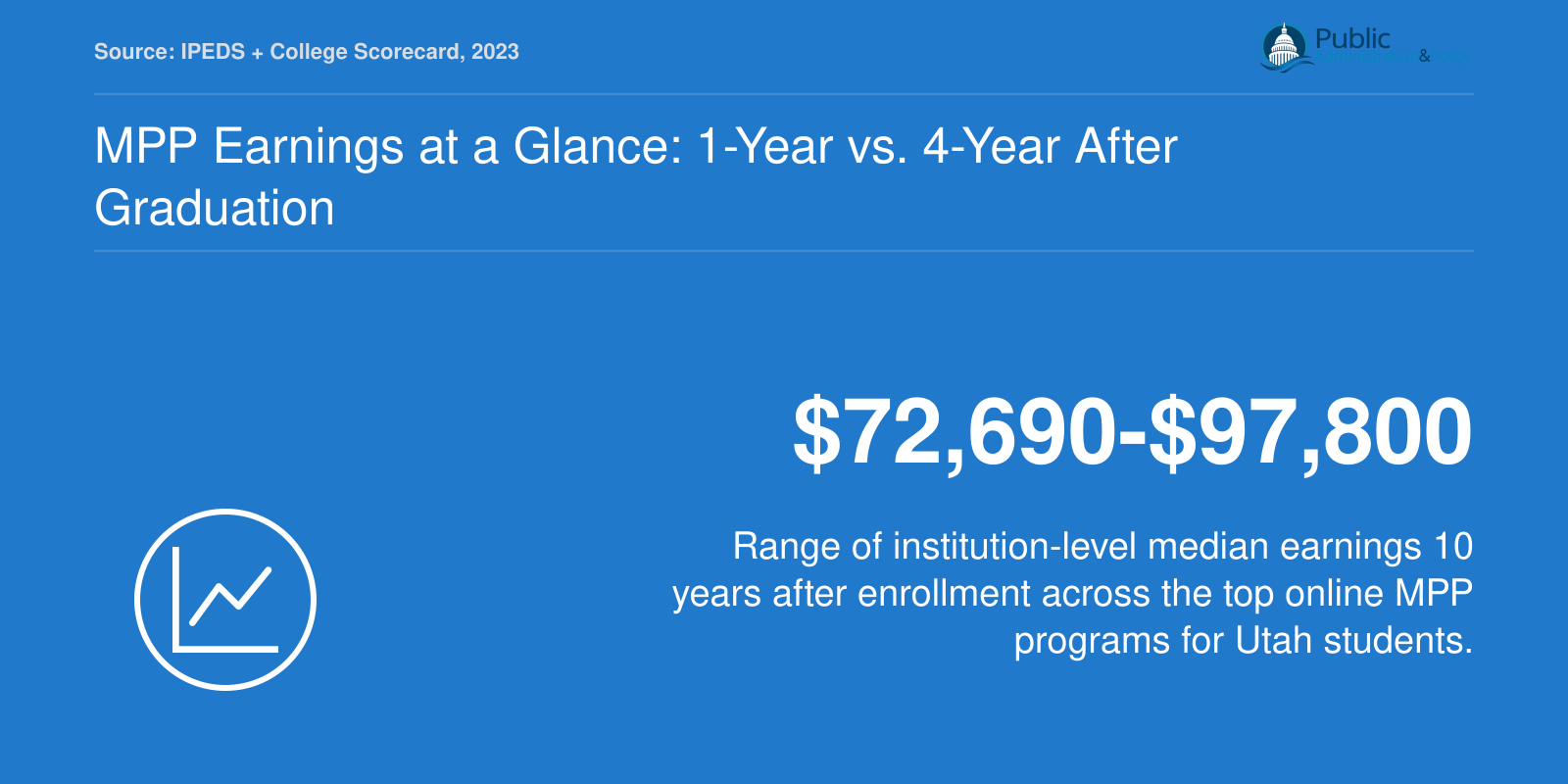
MPP Earnings at a Glance: 1-Year vs. 4-Year After Graduation

Program-level earnings data at the 1-year and 4-year marks after graduation are not yet available for the online MPP programs featured in this guide. The U.S. Department of Education's College Scorecard has not published these program-specific outcome figures for any of the top-ranked MPP programs listed here. Until those numbers are released, institution-wide median earnings 10 years after enrollment offer the best available proxy for long-term ROI.

Institution-level median earnings 10 years after enrollment range from $72,690 to $97,800 across top online MPP programs.

Career Outcomes and Salary Expectations in Utah

An online MPP equips you with quantitative analysis, program evaluation, and strategic communication skills that translate directly into policy roles across Utah and beyond. While program-level earnings data for most online MPP programs are not yet published at the granular level, national wage benchmarks and Utah-specific labor data paint an encouraging picture for graduates.

National Earnings for Policy Professionals

According to Bureau of Labor Statistics data from May 2023, political scientists nationally earn a median annual wage of roughly $132,350, with the 10th percentile starting around $72,470 and the 90th percentile reaching approximately $183,500.1 That range reflects wide variation depending on employer type, years of experience, and geography. Management analysts and other business operations specialists, occupations that commonly absorb MPP graduates, also report strong compensation nationally. Keep in mind that these figures capture the full profession, not just recent graduates, so early-career salaries will typically fall in the lower quartiles before climbing with experience.

What Utah's Job Market Looks Like

Utah's policy landscape is smaller than that of Washington, D.C. or New York, but it is growing steadily. The Salt Lake City metro area hosts a concentrated cluster of public-sector and research employers that actively recruit policy talent:

  • Governor's Office of Planning and Budget: Analyzes fiscal impacts of proposed legislation and develops long-range economic forecasts for the state.
  • Office of Legislative Research and General Counsel: Provides nonpartisan research and bill drafting for the Utah State Legislature.
  • Kem C. Gardner Policy Institute: Housed at the University of Utah, this institute produces widely cited demographic and economic research that shapes state and local decisions.
  • Intermountain Health: One of the largest healthcare systems in the Intermountain West, with growing demand for health policy analysts and outcomes researchers.
  • Federal agencies with Salt Lake offices: The Bureau of Land Management and EPA Region 8 both maintain operations in the area, offering federal policy and regulatory roles.

Utah-specific wage data for narrowly defined political scientist positions is limited due to relatively small employment counts in the state. However, management analysts and related operations specialists in the Salt Lake City metro generally earn competitive salaries that reflect the region's lower cost of living compared to coastal metros, meaning your purchasing power can stretch further than raw salary numbers suggest.

Beyond Government: Tech and Nonprofit Opportunities

Utah's booming technology sector, anchored along the Silicon Slopes corridor, is creating a new category of policy jobs that did not exist a decade ago. Companies dealing with data privacy, artificial intelligence regulation, and digital accessibility increasingly hire professionals who can interpret legislation and advise on compliance. If you are considering a policy analyst career, MPP graduates with strong data skills are well positioned for these roles.

Data-driven nonprofit organizations focused on housing, education equity, and public health are also expanding in the Wasatch Front. These employers value the program evaluation and cost-benefit analysis training that forms the backbone of most MPP curricula. Graduates interested in grassroots impact may also find rewarding paths as a community development specialist.

Putting It All Together

While early-career MPP salaries in Utah will vary based on sector and role, the combination of competitive public-sector pay, a growing tech economy, and a relatively affordable cost of living makes the state an attractive landing spot. Explore the full range of careers in public policy to see how an online MPP positions you to compete for these opportunities without relocating during your studies.

Frequently Asked Questions About Online MPP Programs for Utah Students

Choosing the right graduate program means sorting through a lot of details, from accreditation to cost to career outcomes. Below are answers to the questions Utah students ask most often about online Master of Public Policy programs, written for quick reference whether you are just beginning your research or already comparing offers.

An MPA (Master of Public Administration) focuses on managing public organizations, budgets, and operations. An MPP (Master of Public Policy) emphasizes research methods, data analysis, and policy design. Both prepare graduates for public service careers, but MPP students typically spend more time on program evaluation and quantitative analysis, while MPA students concentrate on leadership and organizational management. Your ideal choice depends on whether you prefer shaping policy or running the agencies that implement it.

As of 2026, the University of Utah does not offer a fully online MPP degree. The university's on-campus policy programs are well regarded, but students who need an online format will need to look at nationally available programs from other institutions. Many NASPAA-accredited schools enroll Utah residents and charge competitive tuition rates, so geography does not have to limit your options.

Yes, several online MPP programs hold accreditation from NASPAA (the Network of Schools of Public Policy, Affairs, and Administration). NASPAA is the recognized quality standard for public policy and administration graduate education. Not every online program has earned this designation, so verify accreditation status on the NASPAA website before applying. Programs with NASPAA accreditation meet rigorous benchmarks for curriculum, faculty qualifications, and student outcomes.

Most online MPP programs require 36 to 48 credit hours and can be completed in two to three years of part-time study. Students who take a heavier course load may finish in as few as 18 months. Programs designed for working professionals typically offer asynchronous coursework and evening sessions, letting you balance job responsibilities with academic deadlines. Check each school's maximum time-to-completion policy before enrolling.

MPP graduates in Utah work as policy analysts, legislative aides, program evaluators, nonprofit directors, and government affairs specialists. Employers include state agencies, local governments, healthcare systems, and organizations along the Wasatch Front. Federal agencies with Utah offices, such as the Department of the Interior, also hire policy professionals. The degree's quantitative training makes graduates competitive for data-focused roles in both the public and private sectors.

Yes. Several nationally available online MPP programs offer total tuition below $40,000, and some public universities extend in-state or flat-rate tuition to all online students regardless of where they live. Look for schools that participate in the Western Regional Graduate Program (WRGP), which can significantly reduce costs for Utah residents. Employer tuition assistance and federal financial aid can lower out-of-pocket expenses further.

Requirements vary by school. A growing number of online MPP programs have adopted GRE-optional or test-free admissions policies, especially for applicants with professional experience or strong undergraduate records. Some programs still require the GRE or accept alternative tests like the GMAT. Review each school's admissions page for current testing requirements, as policies have shifted frequently in recent years.

More Online MPP Programs Available to Utah Students

This directory includes additional online MPP and related programs that are available to Utah students. These programs offer flexibility for remote learning and are worth exploring if you're looking for more options beyond our top-ranked list.

University of Northern Iowa
Offers a 36-credit online MPP with synchronous Zoom sessions on Tuesday evenings, following a cohort model for two-year completion. Tuition is $586 per graduate credit for 2025-26.
Southern Methodist University
Part-time online MPP designed for working professionals, focusing on policy analysis, research, and data-driven evaluation. Includes two on-campus immersions and a capstone project.
Colorado State University-Fort Collins
Master of Public Policy and Administration offers online or on-campus formats with concentrations in Public Management, Public Policy, and International Policy and Management.
University of the Pacific
Hybrid MPP through McGeorge School of Law, combining online coursework with Saturday in-person sessions in Sacramento. Offers concentrations like Environmental and Water Policy.
Worcester State University
36-credit hybrid Master of Public Administration and Policy blending online and on-campus courses, with a capstone fieldwork component for real-world application.
University of Illinois Springfield
MPP available online or on-campus, focusing on analytical skills and economics for policy analysis. Graduate Public Service Internships provide paid government work.
Drexel University
Hybrid MPP emphasizing case study research, with online and on-campus options. Full-time or part-time study, completable in 18-24 months. No entrance exam required.
North Dakota State University
Hybrid MPP with 36 credits, offering in-person or remote real-time attendance. Focuses on policy design and evaluation, with an accelerated five-year option for undergraduates.
Texas A&M University-Central Texas
Hybrid Master of Public Administration (MPA) designed for leadership roles in government and non-profits, with a 36-credit curriculum integrating policy analysis and budgeting.
Pepperdine University
Hybrid MPP with in-person classes at Malibu and a Washington, DC track option. 48-unit, 20-month program with five specializations; no GRE required.
University of Colorado Denver/Anschutz Medical Campus
Hybrid MPP requiring 36 credits, with core courses in research methods and economics. Optional concentrations available, including Education and Environmental Policy.
York College of Pennsylvania
Fully online Master of Public Policy and Administration (MPPA) requiring 36 credits. Concentrations in Urban Planning, Nonprofit Leadership, and Local Government.
University of Southern Maine
Hybrid Master of Public Policy and Management (MPPM) with concentrations in Community Planning and Public Policy/Nonprofit Management. Offers an accelerated pathway for undergraduates.
University of Redlands
Hybrid MPPA blending policy analysis and public management. 56-credit program with 8-week courses, cohort-based learning, and no standardized test requirements.
The New School
Hybrid Master of Science in Public and Urban Policy focused on social inclusion and equity. Features an Urban Policy Lab with real-world client projects.

Recent Articles