Compare NASPAA-accredited policy programs, tuition costs, and career outcomes across Missouri's top schools.
By Max SheltonReviewed by PAP Editoral TeamUpdated July 25, 202624 min read
What you’ll learn in this article…
Missouri lacks a standalone online MPP, but NASPAA accredited MPA programs offer policy focused concentrations that fill the gap.
All major Missouri programs have dropped the GRE requirement, making admissions more accessible for working professionals.
Missouri policy graduates can expect median early career earnings that outpace average program costs within a few years of completion.
Choosing between an MPP and MPA depends on whether you prefer analyzing policy problems or managing public organizations.
Missouri's graduate policy landscape tilts heavily toward the Master of Public Administration and Master of Public Policy and Administration rather than a standalone MPP. No university in the state currently offers a fully online Master of Public Policy as a distinct degree, so prospective students need to identify MPA and MPPA programs with strong policy concentrations to get comparable analytical training. Program-level tuition for online-eligible options starts around $13,700 per year, though total cost varies widely by institution and format.
The practical tension is clear: students drawn to policy analysis, not organizational management, must evaluate curricula carefully to ensure the coursework matches their career goals. Neighboring states face similar constraints, and students willing to look beyond Missouri may find relevant online mpp programs illinois worth comparing. NASPAA accreditation remains the strongest quality signal in this space, yet not every Missouri program holds it. The sections below rank the state's best online-eligible options, break down tuition and credit requirements, and explain how to choose between an MPA and a policy-focused concentration.
Top Online Public Policy and Administration Programs in Missouri
The following ranking highlights online-delivery-eligible graduate programs in Missouri ordered by a mixed quality composite that weighs institutional outcomes, program features, and accessibility. It is important to note that Missouri does not currently offer a standalone online Master of Public Policy (MPP) degree. Instead, the state's policy-focused graduate options take the form of Master of Public Administration (MPA) programs with policy-oriented concentrations. Webster University's MPA, featured below, delivers two distinct emphasis areas that address contemporary public sector needs, and both can be completed fully online.
NCES-IPEDS federal institutional data — nces.ed.gov
#1
Webster University
Saint Louis, MO · $27,000/yr
Best for: Missouri professionals entering government or nonprofit leadership
Webster University, based in Saint Louis, offers an ACBSP-accredited Master of Public Administration that can be completed fully online in approximately two years. The program prepares working professionals for leadership in government agencies, nonprofits, and NGOs through coursework in fiscal management, ethical decision-making, and policy implementation. Webster's strong physical presence across Missouri, including partnerships with military installations and regional employers, creates networking opportunities that extend well beyond the virtual classroom. Two specialized emphasis areas, Cybersecurity and Digital Marketing Management, allow students to tailor the degree to high-demand niches in public service.
View program
Master of Public Administration, Cybersecurity — Hybrid
Fully online program designed for working professionals
Average completion time of approximately two years
ACBSP-accredited business school program
Cybersecurity emphasis for government IT and risk policy
Digital Marketing Management emphasis for public engagement
Curriculum covers fiscal management and policy implementation
Ethical decision-making and strategic leadership focus
Practitioner-led instruction with immediate job application
MPP Vs. MPA: Which Missouri Degree Is Right for You?
Choosing the right graduate degree starts with understanding what each credential is built to do. Both the Master of Public Policy (MPP) and the Master of Public Administration (MPA) prepare you for careers in the public and nonprofit sectors, but they emphasize different skill sets and career trajectories.
What Is an MPP Degree?
A Master of Public Policy is a research-oriented degree grounded in policy analysis, quantitative methods, and program evaluation. Students learn to frame public problems, model potential outcomes, and assess whether existing programs are achieving their goals. Core coursework typically includes statistics, econometrics, cost-benefit analysis, and policy design. If you picture yourself writing policy briefs, running program evaluations for a state agency, or advising legislators on evidence-based solutions, the MPP skill set is what you need.
An MPA, by contrast, focuses on management, budgeting, organizational leadership, and the day-to-day operations of government and nonprofit organizations. For a deeper look at how this field is structured, see our guide on public administration vs public policy. The MPA is the degree of choice for professionals who want to run agencies, lead teams, or oversee public budgets.
Missouri's Degree Landscape
Here is an important reality check: Missouri's graduate programs lean heavily toward the MPA and MPPA (Master of Public Policy and Administration). True standalone MPP programs are rare, or functionally nonexistent, among the state's online offerings. That does not mean Missouri students lack access to rigorous policy training. Several MPA and MPPA programs embed policy-analysis concentrations, elective tracks, or capstone options that mirror much of what a dedicated MPP would cover. When evaluating programs, look for course sequences in quantitative analysis, program evaluation, and policy research methods. Students in neighboring states face a similar landscape; those in Kansas, for example, can explore online MPP programs for Kansas students for additional options that accept out-of-state learners.
Decision Criteria to Guide Your Choice
Four questions can help you sort through the options:
Design and evaluate policy? Seek an MPP-style track or an MPA with a policy-analysis concentration. You will want courses in statistics, econometrics, and evaluation methodology.
Manage agencies or nonprofits? A traditional MPA, with its emphasis on budgeting, human resources, and organizational behavior, is likely the better fit.
Want maximum flexibility? An MPPA program blends both worlds, combining management coursework with policy analysis electives so you can pivot between roles as your career evolves.
Career stage matters too. Mid-career professionals already working in government management may benefit most from an MPA's leadership focus, while early-career analysts or researchers often gravitate toward the quantitative depth of an MPP track.
Accreditation Is Comparable Across Degree Titles
One concern prospective students raise is whether an MPA with a policy concentration carries the same weight as a standalone MPP. From an accreditation standpoint, the answer is reassuring. NASPAA (the Network of Schools of Public Policy, Affairs, and Administration) accredits both MPP and MPA programs under the same set of standards. A NASPAA-accredited MPA with a policy emphasis meets the same quality benchmarks as a NASPAA-accredited MPP. What matters most is the curriculum you complete and the competencies you build, not the three letters on the diploma.
The next section provides a side-by-side visual comparison to make these distinctions even clearer.
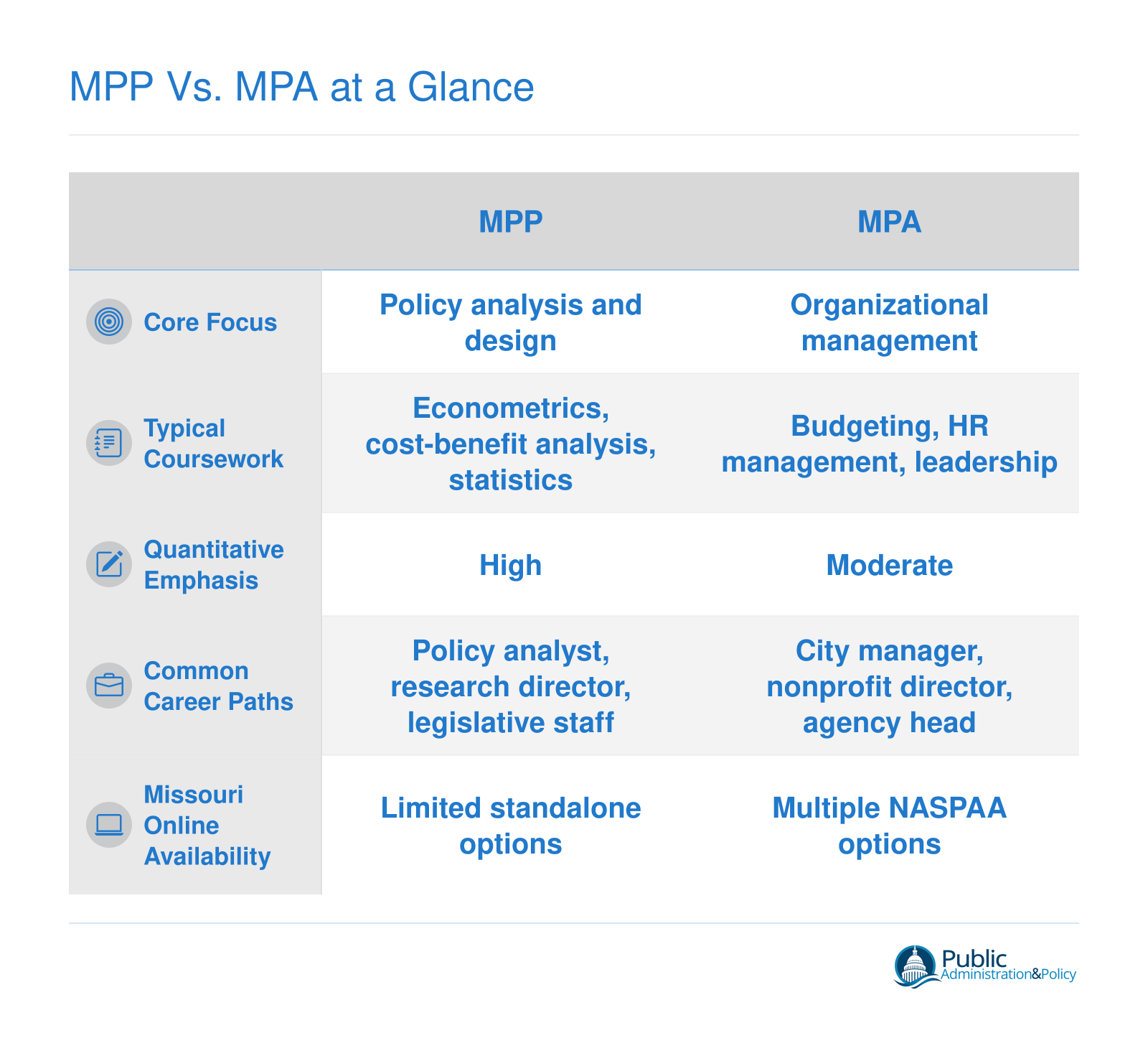
MPP Vs. MPA at a Glance
Choosing between a Master of Public Policy and a Master of Public Administration comes down to whether you prefer analyzing policy problems or managing public organizations. This quick comparison highlights the key distinctions across five attributes to help you decide which degree aligns with your career goals.
Missouri Program Comparison: Tuition, Credits, and Time to Completion
The table below compares key structural details for online and hybrid public policy and administration programs available to Missouri students in 2026. Tuition figures labeled as institution-wide averages reflect net price data across all programs at that school, not a per-student guarantee for your specific degree. Note that several Missouri public universities charge the same tuition rate for in-state and out-of-state online students, which can significantly reduce costs for learners outside Missouri.
University
Program
Total Credits
Est. Time to Completion
Delivery Format
Term Structure
In-State Tuition (Annual)
Out-of-State Tuition (Annual)
Avg. Net Price (Institution-Wide)
University of Missouri, Columbia
Master of Public Affairs (MPA)
36
24 months
Asynchronous
8-week sessions
Not separately listed
Not separately listed
N/A
University of Missouri, Kansas City
Master of Public Administration (MPA)
36
24 to 36 months
Hybrid
16-week semesters
Not separately listed
Not separately listed
N/A
Missouri State University
MPA, Public Safety Concentration
36
18 to 24 months
Asynchronous
16-week semesters with some 8-week blocks
Not separately listed
Not separately listed
N/A
Northwest Missouri State University
Master of Public Administration (MPA)
30
12 to 24 months
Asynchronous
7-week sessions, 6 terms per year
Not separately listed
Not separately listed
N/A
Webster University (St. Louis)
Master of Public Administration
N/A
Approximately 24 months
Hybrid
N/A
$13,736
$13,736
$27,047
Questions to Ask Yourself
Do you need asynchronous flexibility, or would scheduled live sessions help you stay on track?
Missouri's online MPP and MPA programs vary widely in delivery format. If you work full time or have caregiving responsibilities, asynchronous coursework offers the most flexibility, but synchronous cohort sessions can boost engagement and accountability.
Can you access in-state tuition as an online student, or should you prioritize programs with a flat online rate?
Some Missouri universities extend resident tuition to all online learners regardless of location, while others charge out-of-state rates. Clarifying this early can save thousands of dollars over two to three years of study.
Are you drawn to quantitative policy analysis, or is your career goal centered on managing public organizations?
This distinction often determines whether an MPP or an MPA is the better fit. If you want to design and evaluate policy using data, lean toward the MPP; if you see yourself leading agencies or nonprofits, the MPA's management focus may serve you better.
NASPAA Accreditation and What It Means for Your Degree
If you have ever seen the AACSB seal on a business school's website and understood it as a mark of quality, NASPAA accreditation plays an identical role for public administration degrees, public policy, and related graduate programs. The Network of Schools of Public Policy, Affairs, and Administration (NASPAA) is the global standard-setting body for this field, and its accreditation process evaluates whether a program meets rigorous benchmarks for curriculum design, faculty qualifications, student outcomes, and alignment with a public-service mission.1
What NASPAA Accreditation Actually Evaluates
One important distinction: NASPAA accredits individual graduate programs, not entire universities.1 A school may hold regional institutional accreditation while its MPA or MPP program has not undergone the separate NASPAA review. When a program earns the NASPAA seal, it signals that the degree meets profession-wide standards in several areas:
Curriculum rigor: Core competencies in policy analysis, public management, budgeting, and ethics are embedded in the coursework.
Faculty qualifications: Instructors hold terminal degrees and maintain active research or practitioner engagement in public affairs.
Mission alignment: The program demonstrates a clear commitment to preparing graduates for public-service leadership.
Continuous improvement: NASPAA-accredited programs undergo periodic peer review and must show evidence of ongoing assessment and refinement.
Which Missouri Programs Hold NASPAA Accreditation
As of the 2025-2026 academic year, three University of Missouri System programs carry NASPAA accreditation.2
University of Missouri, Columbia (Mizzou): The Master of Public Affairs program is NASPAA-accredited and offers a fully online option, making it the only NASPAA-accredited program in Missouri that distance learners can complete entirely online.3
University of Missouri, St. Louis (UMSL): The Master of Public Policy Administration (MPPA) is NASPAA-accredited but is primarily delivered on campus.4
University of Missouri, Kansas City (UMKC): The Master of Public Administration is NASPAA-accredited and includes some online course options, though it is not fully online.5
Neither Missouri State University nor Northwest Missouri State University holds NASPAA accreditation for a graduate program in public affairs or administration at this time.1
Why NASPAA Status Matters for Your Career
Accreditation is not just an academic badge. It carries practical weight in the job market. Some federal agencies and state government offices give hiring preference to candidates who hold degrees from NASPAA-accredited programs. Certain fellowship and scholarship programs, including prestigious national competitions, restrict eligibility to students enrolled in accredited programs.
Credential portability is another consideration. If you plan to work across state lines or at the federal level, a NASPAA-accredited degree is widely recognized regardless of where you earned it. For Missouri students considering best online MPA programs in Missouri, this recognition can streamline career transitions, whether you stay in-state or pursue federal service.
If completing your degree entirely online is a priority and NASPAA accreditation matters to you, the University of Missouri, Columbia's Master of Public Affairs program is currently the only Missouri option that checks both boxes.3 Students who are open to hybrid or on-campus formats have additional accredited choices through UMSL and UMKC.
Admissions Requirements and How to Apply
Getting into an online public policy or public administration program in Missouri is more accessible than many prospective students expect. Every major program in the state has dropped the GRE requirement, and most follow a straightforward application process. That said, each university has its own nuances, so knowing the details can save you time and help you put together a stronger application.
GPA Expectations Across Missouri Programs
Minimum GPA thresholds vary, but none are prohibitively high. The University of Missouri (Mizzou) and Columbia College both set their minimum at a 3.0 on a 4.0 scale.12 Southeast Missouri State University requires a 2.73, while Northwest Missouri State accepts applicants with a GPA as low as 2.50, with conditional admission possible for candidates in the 2.20 to 2.49 range.4 Missouri State University, UMKC, and UMSL each require a completed bachelor's degree but do not publicize a rigid GPA cutoff in the same way, which typically means a holistic review plays a larger role in their admissions decisions.567
If your undergraduate GPA falls below a program's stated minimum, do not count yourself out. Professional experience, strong recommendation letters, and a compelling personal statement can offset a lower number, especially at schools that review applications holistically.
The GRE Is Off the Table
As of 2026, none of the major online MPA or MPPA programs in Missouri require the GRE.14 Mizzou, UMSL, UMKC, Missouri State, Northwest Missouri State, Southeast Missouri State, and Columbia College have all eliminated the exam. This is a significant shift that lowers both the cost and the time investment of applying. You will not need to budget for test prep or worry about scheduling an exam date. If you are comparing options beyond Missouri, you will find a similar trend among best online MPA programs nationwide.
What You Will Need to Submit
While exact checklists differ by institution, most Missouri programs ask for a similar set of materials:
Completed application: Typically submitted through the university's graduate school portal.
Official transcripts: From every institution where you earned college credit.
Personal statement or statement of purpose: This is your opportunity to explain your interest in public policy or administration and outline your career goals.
Resume or CV: Programs want to see relevant work, internship, or volunteer experience, though entry directly from undergrad is common.
Letters of recommendation: Most schools request two or three, ideally from academic or professional references who can speak to your analytical skills and leadership potential.
Application Timelines and Start Terms
Missouri programs generally offer multiple start points throughout the year, with fall, spring, and sometimes summer entry available. Northwest Missouri State, for example, uses term-based deadlines tied to each start date.4 Several programs operate on a rolling admissions basis, meaning your application is reviewed as soon as it is complete rather than after a single cutoff date. Rolling admissions can work in your favor if you are applying late in a cycle, but submitting early is still wise since some cohort-based courses or financial aid pools may fill.
If a program does use fixed deadlines, plan to have all materials ready at least four to six weeks before the posted date. Ordering transcripts and securing recommendation letters are the steps most likely to cause delays.
Prerequisite Coursework to Keep in Mind
Most Missouri programs do not list formal prerequisite courses for admission. However, some curricula assume a baseline familiarity with introductory statistics or economics. If your undergraduate transcript does not include coursework in these areas, you may be asked to complete a bridge course or foundational module early in the program. Check with your target school's admissions office to confirm whether any preparatory work is expected, particularly if your bachelor's degree was in an unrelated field such as the humanities or fine arts.
Taking the time to understand each program's specific requirements will help you craft a polished application and avoid last-minute surprises. With no GRE to worry about and multiple entry points throughout the year, Missouri's online programs are designed to be approachable for working professionals and recent graduates alike.
Curriculum and Policy-Focused Concentrations
Missouri's online public policy and administration programs share a foundation of analytical coursework designed to prepare graduates for evidence-based decision-making. Even when the degree title reads MPA rather than MPP, the right concentration can deliver a deeply policy-oriented education. Knowing what to expect from the core curriculum, and how elective tracks diverge, will help you select a program that aligns with your career goals.
Core Coursework Across Programs
Regardless of concentration, most Missouri programs require a set of foundational courses that build the analytical toolkit policy professionals rely on daily. Expect to encounter the following in your first year:
Policy Analysis: Frameworks for evaluating proposed and existing policies, including cost-benefit analysis and stakeholder assessment.
Program Evaluation: Quantitative and qualitative methods for measuring whether public programs achieve their intended outcomes.
Research Methods: Applied statistics, survey design, and data interpretation tailored to public sector questions.
Public Budgeting and Finance: Revenue structures, budget cycles, and fiscal decision-making at the state and local level.
Economics for Policy: Microeconomic principles applied to market failures, regulation, and public goods, often with a focus on Missouri-relevant sectors like agriculture and health care.
These courses appear in both administration-focused and policy-focused tracks, but the depth of statistical training and the emphasis on analytical reasoning tend to be more pronounced in policy concentrations.
Policy-Heavy Concentrations and Elective Tracks
Several Missouri MPA programs offer concentrations or elective sequences that closely mirror an MPP experience. Common options include policy analysis tracks that emphasize quantitative modeling and legislative research, health policy concentrations covering Medicaid, public health systems, and health equity, and nonprofit policy tracks that examine advocacy strategy and grant-funded program design. Students interested in state and local governance may also find electives in education policy, environmental regulation, or criminal justice reform. Prospective students in neighboring states can explore similar offerings through online MPP programs for Arkansas students or online MPP Iowa guides.
These concentrations set a policy-focused student apart from peers on the general administration side. Where administration concentrations prioritize organizational management, human resources, and leadership, policy tracks keep the lens trained on how decisions are made, whom they affect, and what the data says about their effectiveness.
Capstone and Applied Project Requirements
Most Missouri programs cap the degree with a capstone experience that mirrors the work policy analysts perform in practice. Formats vary, but a typical capstone asks students to partner with a government agency or nonprofit, define a policy problem, gather and analyze data, and present actionable recommendations. Some programs offer a choice between a traditional research thesis and an applied consulting project. If your goal is to enter the workforce ready to contribute on day one, prioritize programs whose capstones involve real clients and real policy questions rather than purely academic exercises.
Choosing the Right Track
If you find yourself drawn to questions like "Does this program work?" or "What would happen if Missouri changed this law?" a policy analysis or health policy concentration is likely the better fit. If you are more energized by leading teams, managing budgets, and overseeing day-to-day operations in a public agency, a general administration or public management track will serve you well. Many students discover their preference during core coursework, so look for programs that allow you to declare or change your concentration after the first semester.
Career Outcomes and Salary Expectations for Missouri Policy Graduates
A graduate degree in public policy or public administration opens doors to leadership roles across government, nonprofits, and the private sector. Understanding what Missouri graduates actually earn, and how those earnings compare with program costs, can help you decide whether the investment makes sense for your career in public policy.
What Missouri Graduates Earn
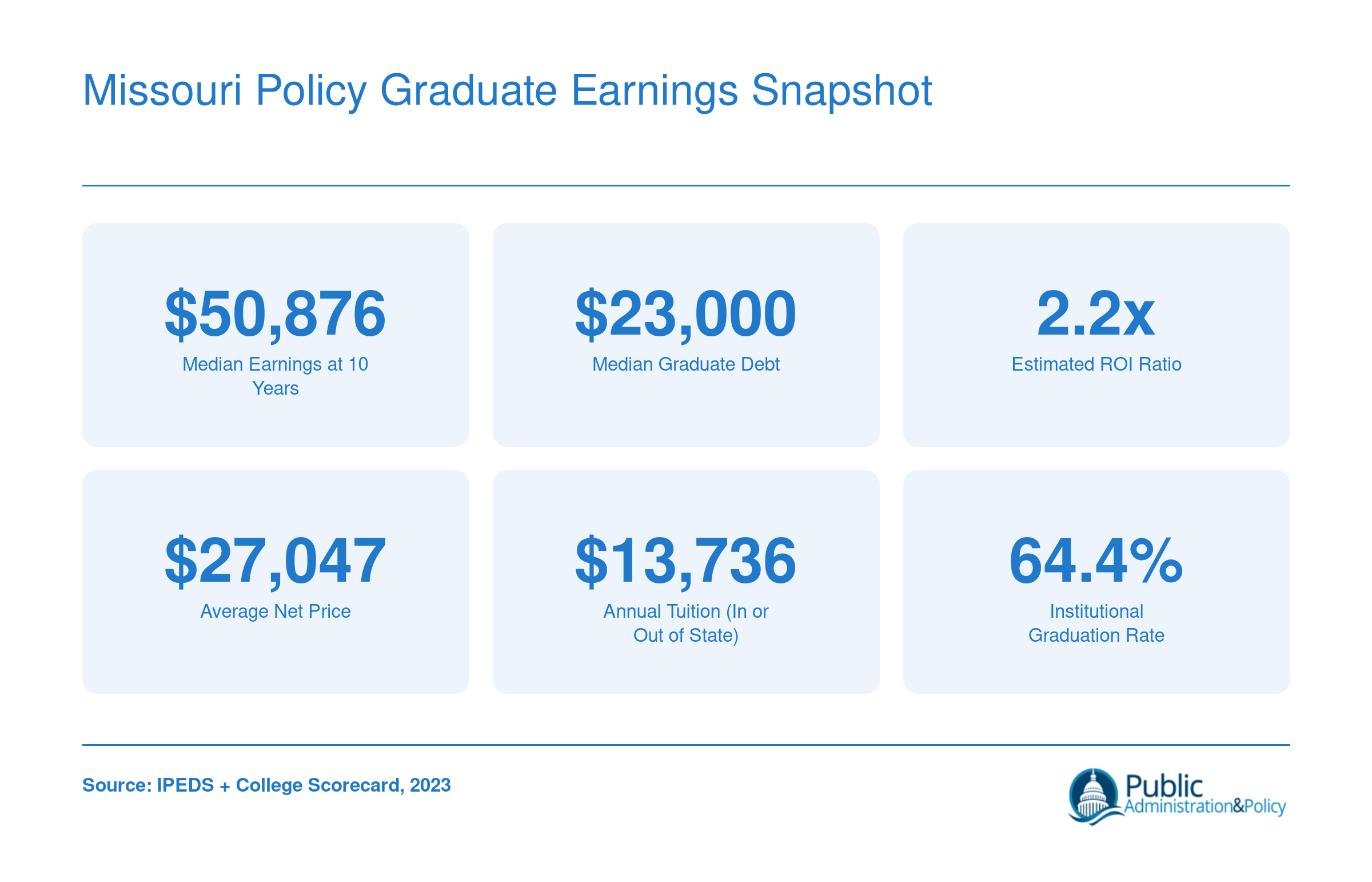
Program-level earnings data for Missouri's online public policy and administration programs are not yet available for most institutions, which means we cannot rank programs by graduate salary at this time. However, broader institutional data from Webster University, one of the state's featured programs, shows a median earnings figure of roughly $50,900 at ten years after enrollment for all graduates institution-wide. While that number reflects the full range of degree programs at the university rather than policy graduates specifically, it offers a useful baseline for setting expectations.
To fill the gap, job-market data provides a clearer picture. The Bureau of Labor Statistics classifies many policy-focused roles under Political Scientists (SOC 19-3094), though the occupation is heavily concentrated in Washington, D.C., and sample sizes in Missouri metros like Kansas City and St. Louis are too small for the BLS to publish reliable local wage estimates.1 Industry salary platforms such as Indeed estimate that policy analysts in Missouri earn in the range of $55,000 to $75,000 annually, with Kansas City salaries tracking close to the statewide median.2 For those who advance into senior management, BLS data for Chief Executives in Missouri shows substantially higher compensation, though median and percentile figures in both the Kansas City and St. Louis metro areas are partially suppressed for confidentiality reasons.3
Common Career Paths
Missouri policy graduates typically pursue roles such as:
Policy analyst: Researching and evaluating legislation, regulatory proposals, or organizational strategies for government agencies, think tanks, or advocacy groups.
Legislative aide: Supporting state or federal lawmakers with bill analysis, constituent relations, and committee preparation in Jefferson City or Washington, D.C.
Program evaluator: Assessing the effectiveness of public programs and recommending data-driven improvements for state departments or grant-funded initiatives.
City or county manager: Overseeing day-to-day operations of a municipality, managing budgets, coordinating departments, and implementing council directives.
Nonprofit director: Leading mission-driven organizations that shape public outcomes in areas such as housing, health care, or education.
Tuition for Missouri's online programs varies, but several options come in well under $15,000 for the full degree. Debt data at the program level is not yet published for most of these offerings, so a precise debt-to-earnings ratio is difficult to pin down. That said, if total borrowing stays near or below $25,000, which is consistent with broader graduate-level median debt at institutions like Webster University, early-career salaries in the mid-$50,000 to mid-$70,000 range suggest the degree can pay for itself within a few years of graduation.
The strongest ROI typically comes when you combine the credential with Missouri-specific professional networks, internships tied to state government in Jefferson City, or partnerships with regional nonprofits. Prospective students should ask each program about employer partnerships, career services support, and alumni placement rates before committing. For a side-by-side look at tuition and credit requirements, refer to the program comparison table elsewhere in this article.
Missouri Policy Graduate Earnings Snapshot
Before investing in a graduate policy degree, it helps to see the numbers side by side. This snapshot captures key financial benchmarks for Missouri policy graduates, giving you an at-a-glance picture of costs, debt, and earning potential after completing your degree.
Frequently Asked Questions About Online MPP Programs in Missouri
Below are answers to the most common questions prospective students ask about pursuing an online Master of Public Policy in Missouri. Where applicable, we reference earlier sections of this guide for deeper detail.
What is an MPP degree, and how is it different from an MPA?
A Master of Public Policy (MPP) focuses on policy analysis, research methods, and evidence-based decision making. A Master of Public Administration (MPA) emphasizes organizational management, budgeting, and leadership within public agencies. Both degrees prepare graduates for public service, but the MPP leans analytical while the MPA leans operational. See the MPP vs. MPA section above for a side-by-side comparison.
Are there any true online MPP programs based in Missouri?
As of 2026, Missouri institutions primarily offer online MPA programs rather than a standalone online MPP. However, several Missouri MPA programs include policy analysis concentrations that cover core MPP competencies. Students seeking a dedicated MPP label may also consider NASPAA-accredited online programs offered by out-of-state universities. Our ranking section above details the strongest Missouri-based options.
Is an MPP degree worth it for public policy careers?
Yes, for many professionals an MPP provides a strong return on investment. Graduates frequently move into roles such as policy analyst, legislative aide, or program evaluator in government, nonprofits, and consulting firms. Earning potential tends to increase meaningfully within a few years of graduation, and the analytical skills you gain are in high demand across sectors. Review our career outcomes section for Missouri-specific salary data.
Which Missouri public policy programs are NASPAA accredited?
NASPAA accreditation in Missouri applies to select MPA programs, including those at the University of Missouri and the University of Missouri, Kansas City. NASPAA accreditation signals that a program meets rigorous standards for curriculum, faculty qualifications, and student outcomes. Our accreditation section above explains why this credential matters and how to verify a program's current status.
How long does it take to complete an online public policy master's program?
Most online MPA and MPP programs require 36 to 42 credit hours and can be completed in about two years of full-time study. Part-time students typically finish in three to four years. Some Missouri programs offer accelerated tracks or allow transfer credits, which can shorten the timeline. Check the tuition and credits comparison table earlier in this article for program-specific details.
Do Missouri MPA or MPP programs require the GRE?
Requirements vary by institution. Several Missouri programs have moved to GRE-optional or GRE-waiver policies, particularly for applicants with significant professional experience or strong undergraduate GPAs. Others still require standardized test scores. Our admissions requirements section outlines each program's current testing policy so you can plan accordingly.
Can I get in-state tuition rates as an out-of-state online student in Missouri?
Some Missouri universities extend a flat online tuition rate to all students regardless of residency, effectively eliminating the in-state and out-of-state distinction for fully online learners. Others participate in the Midwest Student Exchange Program, which can reduce costs for residents of neighboring states. Contact your target program's enrollment office to confirm the rate structure that applies to online students.