Best Online MPP Programs for Montana Students (2026)
Ranked online MPP degrees with cost, career outcomes, and accreditation data to help Montana residents launch policy careers.
By Carrie HirschReviewed by PAP Editoral TeamUpdated August 14, 202625+ min read
What you’ll learn in this article…
No Montana university offers an MPP, but nationally available online programs accept Montana residents with no relocation required.
Online MPP tuition ranges from roughly $6,200 to over $32,700 per year, so comparing out-of-state rates is essential.
NASPAA accreditation is the gold standard for MPP programs; always verify a school's status before enrolling.
Montana's tribal nations and public lands make tribal governance and natural resources policy especially strong MPP career paths.
No Montana college or university currently awards a Master of Public Policy degree, yet the state's policy workforce needs are acute. Tribal governance across seven federally recognized nations, natural resource management on over 30 million acres of public land, and rural health systems serving some of the most remote communities in the lower 48 all demand analysts trained in rigorous public policy making methods.
The practical tension is real: Montana professionals must look out of state, which means weighing variable tuition rates (roughly $6,200 to over $32,700 per year), unfamiliar admissions processes, and whether a program carries NASPAA accreditation. The good news is that top-ranked online MPP programs enroll Montana residents at competitive rates, and several offer concentrations directly relevant to tribal policy, environmental management, and rural governance. Employer demand for MPP holders in state and federal agencies continues to outpace the local supply of graduates.
Top-Ranked Online MPP Programs for Montana Students
Montana has no in-state Master of Public Policy program, but that does not mean your options are limited. The online and hybrid MPP programs below are nationally available, accept Montana residents, and can be completed remotely or with minimal travel. We ranked them using a composite that weighs academic quality, institutional graduation rates, net price, program flexibility, and relevance to the policy challenges Montana professionals face, from natural-resource management to rural economic development. All graduation rates cited below are institution-wide figures, not specific to individual graduate programs.
Factors considered
Institutional graduation and retention rates
Net price and financial accessibility
Online or hybrid delivery flexibility
Program depth and concentration options
Relevance to Western and rural policy
Sources
Independent program research
NCES-IPEDS federal institutional data — nces.ed.gov
Best for: Rural and natural-resource policy professionals
Oregon State University's NASPAA-accredited MPP is one of the strongest fits for Montana students thanks to its fully online delivery through Ecampus, concentrations in Energy Policy, Environmental Policy, and Rural Policy, and faculty research closely mirroring Montana's public-lands and natural-resource challenges. The 54-quarter-credit program includes an 11-week online capstone where student teams conduct policy research for real clients. As a WICHE institution, Oregon State may offer reduced graduate tuition for Western-state residents, though Montana students should confirm eligibility directly with the Graduate School.
View program
Master of Public Policy, energy policy — Hybrid
54 quarter credits: 34 core, 20 in a concentration
Seven concentrations including Rural Policy and Energy Policy
Self-designed concentration and graduate certificate options
11-week online capstone with real-client research projects
NASPAA-accredited and military-friendly
Hybrid or fully online delivery through Ecampus
Environmental Policy track covers climate, wildfire, and water
Best for: Distance learners pursuing energy or ag policy
The University of Tennessee-Knoxville's Baker School offers a fully online, 36-credit MPP built for distance learners in SARA-member states like Montana. Its seven concentration tracks, including Agricultural and Environmental Policy, Energy Policy, and Economic and Community Development, draw heavily on rural and resource-dependent case studies that parallel Montana's policy landscape. No thesis is required; students instead complete an internship and a capstone master class focused on applied analysis.
View program
Master of Public Policy — Online
36 credit hours, fully online delivery
Seven 9-credit concentrations, including Energy and Health Policy
Internship and capstone master class replace a thesis
GRE generally not required for U.S. degree holders
Emphasizes data-driven decision-making and ethical leadership
SARA participation ensures Montana enrollment eligibility
Net price approximately $18,976 (institution-wide average)
Best for: Mid-career government employees seeking tuition savings
The University of Pittsburgh's online Master of Public Policy and Management is designed for mid-career professionals with at least five years of experience. A standout benefit for Montana residents: online students pay in-state tuition regardless of where they live, making it one of the most cost-equalized options on this list. The 30-credit curriculum blends four required courses with six electives, and the fully online track can be completed in 20 months. Full-time government employees receive an additional 20% tuition discount.
View program
Master of Public Policy and Management — Online
30 credits: 4 required courses plus 6 electives
Online students pay in-state tuition from any state
Completable in 20 months at two courses per term
20% tuition discount for full-time government employees
Online, on-campus, or hybrid delivery options
No entrance exam mentioned in admissions requirements
Binghamton University's 100% online, asynchronous MPP was explicitly designed for students in rural and underserved regions across the United States, making it a natural match for Montana professionals who need maximum scheduling flexibility. The curriculum emphasizes data analysis, policy modeling, and global perspectives, and can be completed in as little as one year of full-time study. Applied projects in a policy laboratory give students hands-on experience without leaving home.
View program
Master of Public Policy — Online
Fully online with asynchronous delivery
Can be completed in one year full-time
Focuses on data analysis and policy modeling
Applied policy laboratory projects included
Designed for students in rural and underserved areas
Institution-wide graduation rate of 81.6%
Net price approximately $21,620 (public university)
Duke University's Sanford School of Public Policy offers a highly selective, 24-month hybrid MPP with concentrations including Development Policy and Energy and Environment Policy, the latter addressing climate change, energy markets, and environmental regulation. The program requires 51 credit hours and includes a summer internship, capstone project, and dual-degree options. As a private university with a 96.8% institution-wide graduation rate and a 5:1 student-faculty ratio, Duke delivers an elite academic experience, though its hybrid format requires on-campus time in Durham, NC.
View 2 programs
Master of Public Policy — Hybrid
24-month hybrid program requiring 51 credit hours
Eight concentrations including Energy and Environment Policy
Dual-degree options and fellowship opportunities available
GRE is optional for master's applicants
Institution-wide graduation rate of 96.8%
Net price approximately $29,612 (private university)
Ohio State University's Glenn College offers a Master of Arts in Public Policy and Management tailored to working professionals with at least three years of experience. The 38-credit hybrid program features evening classes and core coursework spanning public policy, economics, management, and decision-support systems. Most students complete the degree in five semesters, and no GRE is required. The hybrid format does include on-campus components in Columbus, so Montana students should plan for periodic travel.
View program
Master of Arts in Public Policy and Management — Hybrid
38 credit hours with evening hybrid classes
Requires at least three years of professional experience
Rutgers University's 48-credit MPP stands out for its 14 concentration options, ranging from health and environment to social justice and urban policy, plus a custom-designed track. The program blends in-person classes with synchronous remote courses, and a unique cross-registration agreement with Princeton's School of Public and International Affairs expands elective access considerably. Students complete a 300-hour internship and a group policy research practicum. Some remote synchronous courses can be taken from out of state, though Montana students should confirm how much travel may be needed.
View program
Master of Public Policy (MPP) — Hybrid
48 credits over two years with 14 concentrations
Cross-registration with Princeton available
300-hour internship and group policy research practicum
Synchronous remote courses available for some offerings
No thesis required; no entrance exam for admission
Custom concentration option with faculty advising
Net price approximately $24,406 (public university)
The University of Washington-Bothell's Master of Arts in Policy Studies is an interdisciplinary hybrid program with a strong Pacific Northwest orientation. Evening classes held after 5 PM two to three times per week accommodate working professionals, and the cohort model pairs students with community partner projects focused on evidence-based social change. Its proximity to Montana and occasional focus on cross-border environmental and tribal policy make it regionally relevant, though the hybrid schedule is oriented toward the Seattle-area campus.
View program
Master of Arts in Policy Studies — Hybrid
Interdisciplinary hybrid program with a cohort model
Evening classes after 5 PM, two to three times weekly
Emphasis on evidence-based policy and social change
Community partner projects embedded in curriculum
Net price approximately $12,319 (lowest on this list)
Pacific Northwest policy focus with tribal relevance
George Mason University's Schar School of Policy and Government offers a hybrid MPP that leverages its proximity to Washington, D.C. to connect students with federal agencies, consulting firms, and international organizations. The curriculum emphasizes policy analysis, technology modeling, and global perspectives, with courses offered in late afternoons and evenings. Merit scholarships and military tuition assistance are available. Montana students should note that while online coursework is part of the mix, on-campus evening components in Fairfax, VA may require periodic travel.
View program
Master of Public Policy — Hybrid
Hybrid format with evening classes near Washington, D.C.
Curriculum covers policy analysis and analytic modeling
Merit scholarships and military tuition assistance available
80+ faculty members with practitioner backgrounds
Access to employers like USAID, the World Bank, and CIA
Dedicated career development advisors provided
Net price approximately $17,915 (public university)
The University of Houston's Hobby School of Public Affairs delivers a NASPAA-accredited, 39-credit-hour hybrid MPP with interdisciplinary coursework in economics, politics, ethics, and quantitative analysis. Students complete an internship, a capstone project, and electives for specialization, gaining real-world experience in one of the nation's most diverse metropolitan areas. The program is a strong value option with a net price of roughly $14,276, though its hybrid format is oriented toward on-campus attendance in Houston.
View program
Master of Public Policy — Hybrid
39 credit hours; NASPAA-accredited program
Interdisciplinary core in economics, politics, and ethics
Internship and capstone project required
Electives allow specialization in policy areas of interest
Net price approximately $14,276 (among the lowest listed)
Hybrid delivery with on-campus components in Houston
Virtual information sessions and fee waivers available
Why Montana Has No In-State MPP, and Why That Doesn't Limit You
If you have been searching for a Master of Public Policy program at the University of Montana or Montana State University, you have probably come up empty. Neither institution, nor any other college in the state, currently offers an MPP degree in an online or on-campus format. Montana does have online MPA programs for Montana students, but an MPA and an MPP are distinct degrees with different curricular emphases. Students drawn to rigorous policy analysis, econometrics, and program evaluation will want the MPP track specifically.
The good news: living in Montana does not limit your access to high-quality, accredited MPP programs elsewhere in the country.
Montana's Interstate Agreements Work in Your Favor
Montana is a member of both the State Authorization Reciprocity Agreement (SARA) and the Western Interstate Commission for Higher Education (WICHE).1 SARA membership means that universities authorized under the agreement can enroll Montana residents in their online programs without seeking separate state approval. This makes your path to enrollment straightforward and opens the door to dozens of accredited online MPP programs nationwide.
A common misconception involves the Western Undergraduate Exchange (WUE), which offers tuition discounts across western states. That benefit applies to undergraduate programs only and does not extend to graduate study.1 At the graduate level, tuition eligibility is determined by each university's own policies. Many public universities now charge a single flat tuition rate for all online graduate students regardless of state of residence, and some extend in-state pricing to every online learner. It pays to compare program by program rather than assuming you will be charged out-of-state rates.
Online MPP Programs Deliver the Same Value
NASPAA-accredited online MPP programs meet the same curricular standards and undergo the same peer review as their on-campus counterparts. Employers in government, nonprofits, and consulting firms evaluate candidates on the strength of the degree and the accrediting body behind it, not on whether coursework was completed in a lecture hall or over a video call.
For Montana students specifically, the online format offers a practical advantage that goes beyond convenience. The state's vast geography and distance from major policy hubs like Washington, D.C., Denver, or Seattle can make relocating for a graduate program unrealistic, especially for working professionals in state agencies, tribal governments, or rural nonprofit organizations. An online MPP lets you stay rooted in your community and career while accessing the same faculty, capstone projects, and professional networks that residential students enjoy. Students in online MPP programs Alaska face a similar geographic reality and benefit from the same interstate agreements.
In short, the absence of an in-state MPP is a gap in Montana's higher education landscape, not a gap in your options. With SARA streamlining enrollment and a growing number of programs offering competitive online tuition, Montana residents are well positioned to earn a respected policy degree without leaving the state.
How Much Do Online MPP Programs Cost?
Tuition for online MPP programs available to Montana students ranges widely, from roughly $6,200 to over $32,700 per year depending on the school and residency status. Every program listed below is at a public university, but out-of-state rates still vary significantly. The net price column reflects institution-wide averages (not MPP-specific figures), so your actual cost may differ based on graduate-level aid, assistantships, or tuition agreements. Montana students should check whether SARA authorization or WICHE regional tuition discounts apply at each school, as these arrangements can sometimes unlock in-state or reduced rates even for out-of-state enrollees.
School
State
In-State Tuition
Out-of-State Tuition
Avg. Net Price (Institution-Wide)
Median Graduate Debt
Texas A&M University-Central Texas
TX
$6,242
$13,586
$1,300
$17,750
Worcester State University
MA
$6,813
$6,813
$13,381
$19,500
North Dakota State University
ND
$8,786
$12,578
$15,543
$23,199
Florida Gulf Coast University
FL
$8,961
$31,216
$12,568
$17,622
University of Colorado Denver
CO
$9,298
$27,154
$11,900
$20,500
California State University-Sacramento
CA
$9,542
$19,622
$9,338
$15,000
University of Southern Maine
ME
$9,918
$26,676
$13,596
$19,060
University of Houston
TX
$10,051
$19,231
$14,276
$18,194
University of Illinois Springfield
IL
$11,938
$19,515
$9,833
$19,128
University of Washington-Bothell
WA
$18,738
$32,757
$12,319
$14,615
Questions to Ask Yourself
Are you drawn to designing policy or managing the organizations that carry it out?
This distinction separates the MPP from the MPA. If you want to analyze legislation, model outcomes, and shape new initiatives, an MPP is the stronger fit. If your goal is leading agencies or nonprofits, an MPA may serve you better.
Would a concentration in tribal governance, natural resources, or rural health policy align with your Montana career goals?
Not every online MPP offers these focus areas. Choosing a program with relevant coursework can position you for roles in tribal nations, federal land agencies, or rural health systems that dominate Montana's policy landscape.
What is your total budget for graduate school, and have you explored employer or tribal tuition support?
Online MPP tuition varies widely, and Montana employers, state agencies, and tribal nations sometimes offer tuition assistance or reimbursement. Identifying funding sources early can significantly narrow your program shortlist and reduce long-term debt.
MPP Vs. MPA: Which Policy Degree Fits Your Goals?
Before committing to an out-of-state online program, Montana students should understand the meaningful differences between a Master of Public Policy (MPP) and a Master of Public Administration (MPA). Montana does offer in-state MPA options, so choosing the right degree up front can save you time, money, and the complexity of enrolling in a distant program. Both degrees are accredited by NASPAA (the Network of Schools of Public Affairs and Administration), so accreditation alone does not distinguish one from the other. The real differences come down to curriculum emphasis, analytical depth, and career trajectory.
Dimension
Master of Public Policy (MPP)
Master of Public Administration (MPA)
Primary Analytical Focus
Quantitative policy analysis, program evaluation, and evidence-based decision making
Organizational management, leadership, and the implementation of public programs
Core Curriculum Emphasis
Econometrics, statistical modeling, cost-benefit analysis, and research design
Budgeting, human resources management, public finance, and organizational behavior
City or county manager, nonprofit executive director, agency administrator, public affairs officer
NASPAA Accreditation
Eligible for NASPAA accreditation; accredited programs meet the same peer-review standards as MPA programs
Eligible for NASPAA accreditation; the accreditation framework covers both MPA and MPP degrees equally
Availability for Montana Residents
No in-state MPP program exists in Montana as of 2026; students must pursue online or out-of-state options
Available in-state through Montana institutions; students can complete the degree without leaving the state
Best Fit For
Students drawn to research, data analysis, and shaping policy before it becomes law or regulation
Students drawn to managing teams, running agencies, and executing policies that are already in place
Career Outcomes and Earnings After an Online MPP
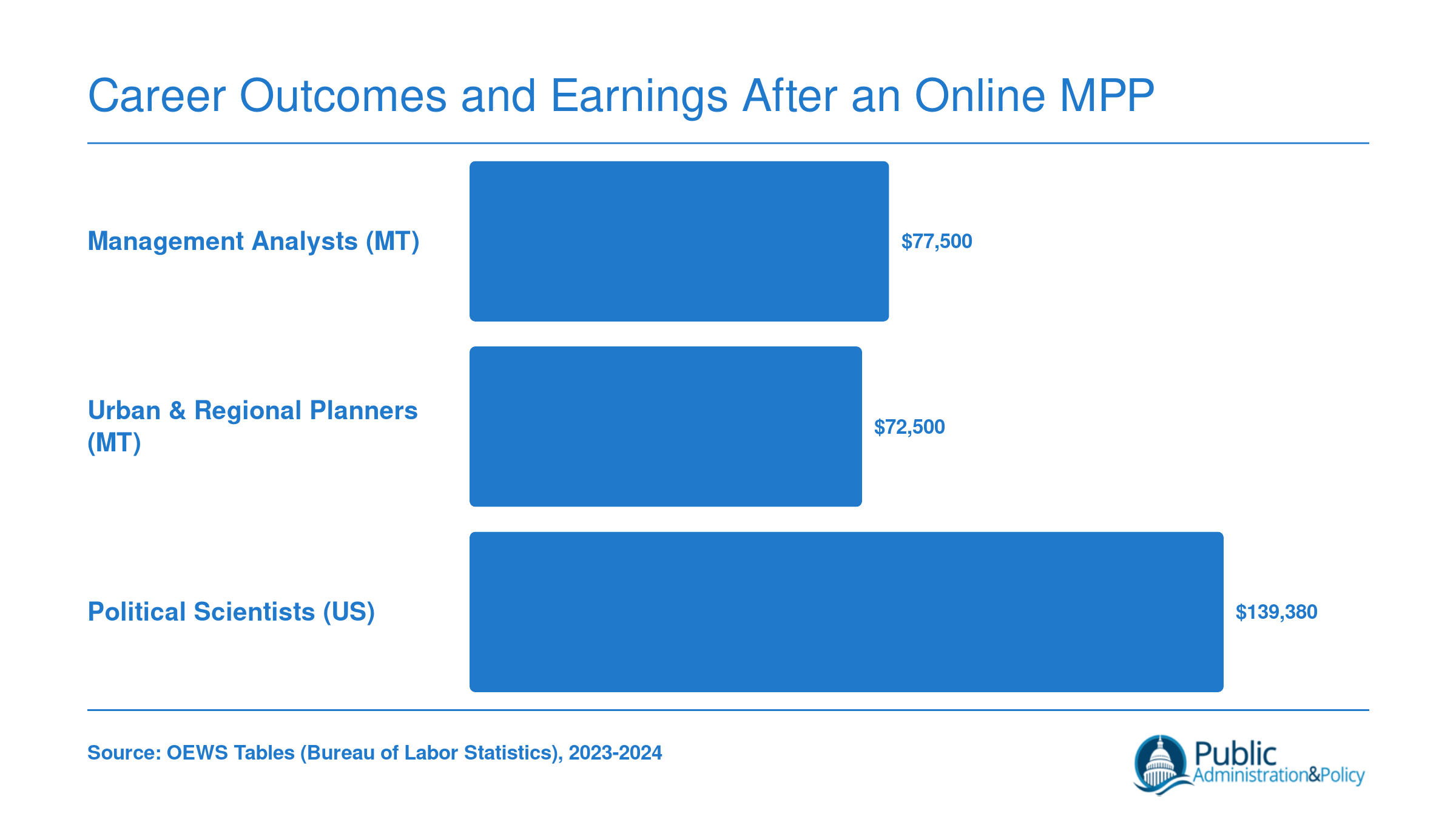
Program-level earnings data for MPP graduates (such as salary one, two, or four years after completion and the share of graduates employed rather than enrolled) are not yet published for the online public policy programs in our ranking. However, broader occupational wage data offers a useful benchmark for Montana students weighing return on investment. The roles most commonly filled by MPP holders in Montana, including management analysts and urban and regional planners, pay median salaries well above the state average. For graduates pursuing tribal governance, state legislature staff positions, or natural resources agency roles, an MPP can meaningfully accelerate earnings and open doors that a bachelor's degree alone cannot.
Online MPP Programs for Tribal Policy and Natural Resources Careers
Montana is home to seven federally recognized tribal nations and vast public lands, making tribal governance and natural resources policy two of the most consequential career paths in the state. An online MPP can position you for leadership in these areas, but choosing the right program and understanding the workforce landscape takes deliberate research.
Understanding Workforce Demand in Montana
Tribal governments in Montana employ thousands of people across health, education, housing, and natural resources departments, and many of these roles require the kind of policy expertise that an MPP provides. To get a current picture of demand, start with these resources:
BLS.gov: Filter the Bureau of Labor Statistics occupational data by Montana and search occupation codes tied to social and community service managers, conservation scientists, and urban and regional planners. State-level breakdowns reveal where openings are concentrated.
Montana Governor's Office: Check the Governor's website for recent executive orders, task force reports, or workforce development strategies related to tribal relations and natural resources. These documents often highlight hiring priorities and gaps.
Tribal Employment Rights Offices (TEROs): Each reservation in Montana operates a TERO that tracks workforce needs and may publish reports on policy and administrative hiring. Contact them directly for the most localized data.
Professional Associations Worth Monitoring
Two organizations stand out for anyone pursuing tribal or natural resources policy careers:
National Congress of American Indians (NCAI): NCAI publishes policy briefs, hosts an annual convention with career networking, and maintains job boards that frequently list tribal governance and federal policy positions.
American Society for Public Administration (ASPA): ASPA's sections on environmental policy and social equity offer webinars, mentorship, and workforce trend reports that help you benchmark where MPP graduates are landing.
Both organizations can also connect you with alumni working in tribal and environmental policy, which is invaluable for informational interviews before you commit to a program. For a broader look at the types of roles available to policy graduates, explore careers in public administration across federal, state, and tribal settings.
What to Look for in Program Pages
When evaluating online MPP programs, dig into their curriculum and alumni placement data. Programs at institutions like the University of Montana or Harvard Kennedy School publish case studies, capstone project archives, and alumni career pages that reveal whether graduates have moved into tribal policy, Bureau of Indian Affairs roles, or state-level natural resources agencies. Look for electives or concentrations in Indigenous governance, environmental policy, or rural community development. Understanding the distinction between public administration vs public policy can also help you decide whether an MPP or an MPA better fits your career goals. A program that offers a practicum placement with a tribal government or a federal land management agency will give you an edge that coursework alone cannot replicate.
Montana students should also confirm whether a program allows capstone projects focused on tribal sovereignty, water rights, or public land management, as these portfolio pieces carry real weight with employers across the state.
Accreditation and What NASPAA Means for Your MPP
Accreditation is one of the most important factors to evaluate before committing to an online MPP, yet it is also one of the most misunderstood. For Montana students shopping for programs across state lines, understanding how accreditation works at the program level can save you from costly missteps and strengthen your long-term career prospects.
What NASPAA Accreditation Covers
The Network of Schools of Public Policy, Affairs, and Administration (NASPAA) is the global standard-setting body for graduate education in public policy, public affairs, and public administration. NASPAA evaluates programs on criteria that matter directly to your education: curriculum quality, faculty qualifications, student learning outcomes, diversity commitments, and alignment with public-service values.1
A critical distinction to keep in mind is that NASPAA accredits at the program level, not the institution level. A university can hold full regional accreditation (the baseline credential that makes a school eligible for federal financial aid) without its MPP carrying NASPAA recognition. Regional accreditation tells you the university meets broad academic standards. NASPAA accreditation tells you the specific policy program meets the profession's own benchmarks.
Which Online MPP Programs Hold NASPAA Accreditation
As of the most recent NASPAA roster, three fully online MPP or MPP-equivalent programs carry active accreditation:2
American University: Master of Public Policy (MPP)
Northwestern University: Master of Public Policy and Administration (MPPA)
Oregon State University: Master of Public Policy (MPP)
NASPAA updates its roster of accredited programs annually, so it is worth verifying current status directly before you apply. Other online programs listed earlier in this article may be housed at regionally accredited institutions with strong reputations but do not hold separate NASPAA program-level accreditation.
Why This Matters for Montana Students
If you plan to work in government, whether at the federal, state, or tribal level, NASPAA accreditation carries real weight in hiring decisions. Federal agencies and many state personnel systems recognize NASPAA-accredited degrees as meeting specific qualification standards for policy analyst and program evaluation roles. In a competitive applicant pool, holding a degree from a NASPAA-accredited program can be the detail that distinguishes your resume. Students weighing a related best online master of public administration Montana degree should apply the same accreditation lens to MPA programs.
For Montana students specifically, where no in-state MPP exists, choosing a NASPAA-accredited online program is one of the clearest ways to ensure your investment translates into employer confidence. It signals that your coursework aligns with professional competencies recognized nationwide, from quantitative analysis to stakeholder engagement, regardless of where you earned the degree.
Admissions Requirements and Typical Student Profile
Because Montana has no in-state MPP program, you will be applying to online or hybrid programs at universities across the country. The good news: admissions standards are broadly consistent, and the process is straightforward once you know what to expect.
Common Application Requirements
Most online MPP programs ask for a similar set of materials:
Bachelor's degree: A completed four-year degree from an accredited institution is universally required. Your major does not need to be in political science or economics; programs welcome applicants from diverse academic backgrounds.
GPA: A minimum of 3.0 on a 4.0 scale is the standard threshold. Some programs, like Ohio State University's MA in Public Policy and Management, list 3.0 explicitly, while Duke's Sanford School reports an average admitted GPA closer to 3.5.
GRE/GMAT scores: The trend has shifted decisively toward test-optional admissions. Duke, Ohio State, the University of Tennessee-Knoxville, and the University of Pittsburgh all either waive the GRE entirely or make it optional. A few programs still request scores from applicants with non-U.S. degrees.
Statement of purpose: Every program requires one. This is where you articulate your policy interests and career goals.
Letters of recommendation: Expect to submit two or three. Professional references from supervisors or colleagues carry weight, especially for mid-career applicants.
Resume or CV: Programs want to see your professional trajectory, even if you are early in your career.
Work Experience Expectations
The experience threshold varies widely. Programs designed for early-career applicants, like Binghamton University's fully online MPP, welcome candidates with little or no post-college work history. On the other end, the University of Pittsburgh's MPPM targets mid-career professionals with at least five years of experience, and Ohio State requires a minimum of three years. Most programs fall somewhere in the zero-to-three-year range for entry, making them accessible whether you are fresh out of undergrad or several years into a government or nonprofit career.
Who Is the Typical Online MPP Student?
Online MPP cohorts tend to include working professionals balancing full-time jobs with graduate study. You will find state and local government employees, nonprofit program managers, legislative staff, and consultants seated alongside recent graduates. The asynchronous and evening-class formats offered by programs like Binghamton and UW-Bothell are designed precisely for this mix. If you are also weighing a best online master of public administration Montana degree, many of the same admissions criteria apply.
A Note on Institutional Selectivity
Admission rates at the university level can provide some context, though they reflect undergraduate admissions rather than MPP-specific decisions. Duke, for instance, has an overall admission rate around 6%, signaling a highly selective institution, while public universities like Oregon State (roughly 77%) or George Mason (roughly 87%) are more broadly accessible. Graduate admissions committees evaluate your application holistically, so a strong statement of purpose and relevant experience can offset a GPA that is slightly below the posted minimum.
Montana Applicants Have a Distinct Advantage
If you work in tribal governance, state land management, natural resource policy, or rural health administration, your application narrative already stands out. Montana's policy landscape, from tribal sovereignty questions to federal lands management, gives you real-world context that admissions committees value. Programs actively seek geographic and professional diversity in their cohorts, and firsthand experience navigating policy challenges unique to the Northern Great Plains and tribal nations is a compelling differentiator.
Frequently Asked Questions About Online MPP Programs for Montana Students
Montana students considering an online Master of Public Policy often have questions about program availability, costs, and career outcomes. Below are answers to the most common questions we receive, with specific details to help you make an informed decision.
Are there any online MPP programs based in Montana?
As of 2026, no Montana institution offers an online Master of Public Policy degree. The University of Montana and Montana State University provide related programs in public administration, but neither has launched a dedicated MPP. Montana students typically enroll in accredited online MPP programs offered by universities in other states, many of which charge the same tuition rate regardless of where you live.
What is the difference between an MPP and an MPA degree?
An MPP (Master of Public Policy) focuses on policy analysis, quantitative research methods, and program evaluation. It prepares graduates to design and assess public policies. An MPA (Master of Public Administration) emphasizes organizational management, budgeting, and leadership within government agencies. If your goal is to analyze policy options or work in a research or advisory role, the MPP is usually the stronger fit. If you want to manage programs and lead teams, the MPA may be more appropriate.
Which online MPP programs are NASPAA accredited?
Several online MPP programs hold NASPAA (Network of Schools of Public Policy, Affairs, and Administration) accreditation, including programs at the University of Michigan, University of Southern California, American University, and the University of Chicago. NASPAA accreditation signals that a program meets rigorous standards for curriculum, faculty qualifications, and student outcomes. Montana students should verify current accreditation status on the NASPAA website before applying.
Can Montana residents get in-state tuition for out-of-state online programs?
In many cases, yes. A growing number of universities offer flat tuition rates for all online students regardless of residency. Montana also participates in the Western Interstate Commission for Higher Education (WICHE) agreements, which can reduce tuition at participating institutions in western states. Additionally, some schools waive out-of-state surcharges specifically for fully online programs. Always confirm pricing directly with each university's admissions office.
How much does an online Master of Public Policy cost?
Total tuition for an online MPP typically ranges from approximately $20,000 to $80,000, depending on the institution. More affordable options at public universities often fall between $20,000 and $40,000 for the full degree. Elite private programs can exceed $70,000. Montana students should factor in financial aid, employer tuition assistance, and WICHE discounts when calculating their net cost.
What careers can you pursue with an MPP degree in Montana?
MPP graduates in Montana find roles in state and tribal government, natural resource management, healthcare policy, and nonprofit advocacy. Common job titles include policy analyst, legislative aide, program evaluator, and research director. Montana's unique policy landscape, spanning tribal sovereignty, public lands management, and rural health, creates demand for professionals trained in rigorous policy analysis and evidence-based decision making.
Do online MPP programs require the GRE?
Many online MPP programs have moved away from requiring the GRE, especially since the pandemic. Schools such as American University, the University of Southern California, and several other programs now offer GRE-optional or GRE-waiver policies. Some programs waive the requirement for applicants with significant professional experience or a strong undergraduate GPA. Check each program's current admissions requirements, as policies can change from year to year.
More Online MPP Programs Available to Montana Students
Beyond the top-ranked programs, dozens more accredited online MPP degrees enroll students from Montana. The schools below offer flexible formats, competitive tuition, and unique concentrations, from environmental policy to data visualization. Explore these options to find the best fit for your career goals in public service.
University of Northern Iowa
Offers a 36-credit online MPP with synchronous Zoom sessions on Tuesday evenings, following a cohort model for two-year completion. Tuition is $586 per graduate credit for 2025-26, with scholarship opportunities available.
Part-time online MPP designed for working professionals, emphasizing policy analysis, research, and data-driven evaluation. Includes virtual live lectures, project-based assignments, and two on-campus immersions.
Offers an online Master of Public Policy and Administration with concentrations in Public Management, Public Policy, or International Policy and Management. Interdisciplinary curriculum with accelerated options available.
Hybrid MPP through McGeorge School of Law, combining online coursework with in-person Saturday sessions in Sacramento. Offers concentrations in Environmental and Water Policy, Public Policy Advocacy, and more.
Blended Master of Public Administration and Policy, 36 credits combining online and on-campus courses. Includes core courses in policy analysis, public budgeting, and organizational theory, plus a capstone fieldwork component.
Hybrid MPP program with online and on-campus options, no entrance exam required. Offers Graduate Public Service Internships with paid government work and tuition waivers in Springfield or Chicago.
Hybrid MPP with flexible full-time or part-time study, completable in 18-24 months. Features case study research, year-round admissions, and customization through certificates or graduate minors.
Hybrid MPP allowing in-person or remote real-time attendance, 36 credits over two years. Focuses on policy design and evaluation, with an accelerated five-year option for undergraduates.
Hybrid Master of Public Administration with emphasis on leadership in government, non-profits, and public sector management. Curriculum blends policy analysis, organizational theory, budgeting, and ethical decision-making.
Hybrid MPP with a Washington, DC track, 48 units over 20 months. Offers five specializations, no GRE required, and over 95% of students receive scholarships covering average 70% of tuition.
University of Colorado Denver/Anschutz Medical Campus
Hybrid MPP with 36 credits, optional concentrations in Education Policy, Environmental Policy, and more. Features an internship requirement (240 hours) unless waived, and a capstone or thesis option.
Fully online Master of Public Policy and Administration, 36 credits, completable in two years. Concentrations in Urban Planning, Nonprofit Leadership, and Local Government, plus a thesis project.
Hybrid Master of Public Policy and Management with concentrations in Community Planning and Sustainable Development or Public Policy and Public/Nonprofit Management. Offers reduced out-of-state tuition and no entrance exam required.
Hybrid MPPA blending policy analysis with public management, 56 credits at $882 per credit. Features 8-week courses, cohort-based learning, and no GRE requirement; completable in 15 months.
Hybrid Master of Science in Public and Urban Policy focusing on social inclusion and equity. Includes Urban Policy Lab with real-world client projects, no GRE required, and concentrations in Data Visualization and Global Urban Futures.