Best Online MPP Programs for Wisconsin Students (2026)
Ranked online MPP degrees with tuition, career outcomes, and admissions details for Wisconsin residents
By Holly AbramsonReviewed by PAP Editoral TeamUpdated August 14, 202625+ min read
What you’ll learn in this article…
No Wisconsin university currently offers an online MPP, but dozens of nationally available programs accept Wisconsin residents.
NASPAA accredited options like Duke and Binghamton report median institutional graduate earnings above $78,000.
MPP degrees emphasize quantitative policy analysis, while MPA degrees focus on organizational management in public agencies.
Most online MPP programs use holistic admissions, so strong experience can offset a lower GPA or absent GRE scores.
Wisconsin's Bureau of Labor Statistics projections show steady growth for policy analysts, program evaluators, and legislative staff across state government, nonprofits, and advocacy organizations headquartered in Madison and Milwaukee. Yet no Wisconsin university currently offers a fully online Master of Public Policy degree. That gap sends residents to nationally ranked programs that readily accept out-of-state students, often at tuition rates comparable to what an in-state option would charge.
The practical challenge is sorting signal from noise: identifying which online MPP programs carry NASPAA accreditation, offer competitive net prices for Wisconsin residents, and produce measurable salary returns in a midwestern labor market where median public-sector wages sit below coastal benchmarks. States like online master of public policy Nebraska and online MPP programs Idaho face the same availability gap, yet their residents find strong options by shopping nationally. For Wisconsin professionals balancing full-time work with graduate study, program format and admissions flexibility matter as much as prestige.
Best Online MPP Programs for Wisconsin Students
No Wisconsin university currently offers an online Master of Public Policy, but that does not limit your options. The nationally available programs below were selected and ordered using a quality composite that weighs graduation rates, institutional strength, and post-graduation outcomes. Every program on this list accepts Wisconsin residents and can be completed primarily or entirely online, giving you access to some of the strongest policy schools in the country without relocating from Madison, Milwaukee, or anywhere else in the state.
Factors considered
Institutional graduation and retention rates
Graduate earnings after completion
Net price and debt levels
Online or hybrid delivery availability
Program depth and concentration options
Sources
NCES-IPEDS federal institutional data — nces.ed.gov
Best for: Mid-career government professionals seeking affordability
The University of Pittsburgh stands out as one of the most Wisconsin-friendly options on this list because all online students pay in-state Pennsylvania tuition regardless of where they live. Full-time government employees receive an additional 20% tuition discount, making this program especially cost-competitive for Wisconsin public servants. The 30-credit Master of Public Policy and Management targets mid-career professionals with at least five years of experience and can be completed in 20 months with no campus visits required.
View program
Master of Public Policy and Management — Online
30 credit hours across 4 required courses and 6 electives
Online students pay in-state tuition regardless of residency
20% tuition discount for full-time government employees
Designed for professionals with 5+ years of experience
Completable in 20 months at two courses per term
No campus visits required; fully online delivery available
SARA-authorized for enrollment and internships in Wisconsin
Best for: Working professionals needing asynchronous flexibility
Binghamton University offers one of the few fully online, asynchronous MPP programs in the country, making it an excellent fit for Wisconsin residents who need maximum scheduling flexibility. The curriculum emphasizes data analysis, policy modeling, and global perspectives, with applied projects conducted through a virtual policy laboratory. Online nonresident tuition is set below the standard on-campus out-of-state rate, and the program can be completed in as little as one year of full-time study.
View program
Master of Public Policy — Online
Fully online, asynchronous delivery with no campus visits
Can be completed in one year of full-time study
Out-of-state tuition: approximately $27,140 per year
Best for: Policy specialists wanting diverse concentration choices
The University of Tennessee, Knoxville delivers its MPP entirely online through the Howard H. Baker Jr. Center for Public Policy, with seven concentration tracks that span energy, health, national security, and more. Wisconsin students can complete the required internship and capstone master class from their home state, working with local organizations under remote faculty supervision. The 36-credit program does not require a thesis, and GRE scores are only necessary for applicants with non-U.S. degrees.
View program
Master of Public Policy — Online
36 credit hours; fully online delivery
Seven concentrations including Health, Energy, and National Security
Out-of-state tuition: approximately $34,760 per year
Duke University's Sanford School of Public Policy runs a prestigious 24-month MPP with concentrations including Development Policy and Energy and Environment Policy. While the program is primarily residential in Durham, NC, it uses a hybrid format that blends online and on-campus learning. With an institutional graduation rate near 97% and median earnings of $97,800 ten years after enrollment, Duke delivers elite outcomes, though Wisconsin residents should plan for periodic on-campus commitments and a net price around $29,612.
View 2 programs
Master of Public Policy — Hybrid
24-month hybrid program; 51 credit hours required
Concentrations in Development Policy, Energy and Environment, and more
Net price approximately $29,612; financial aid and fellowships available
Oregon State University's NASPAA-accredited MPP offers Wisconsin residents a meaningful cost advantage: courses taken through OSU's Ecampus carry a single tuition rate regardless of state of residence, helping you avoid full nonresident pricing. The program requires 54 quarter credit hours and features seven established concentrations, from Energy Policy to Rural Policy, plus a self-designed option. The 11-week online capstone policy lab pairs student teams with real clients, and much of the degree can be completed remotely.
View program
Master of Public Policy, energy policy — Hybrid
54 quarter credit hours; NASPAA-accredited
Ecampus courses carry one rate regardless of residency
Concentrations: Energy, Environmental, International, Rural, and more
11-week online capstone with real-world client projects
George Mason University's Schar School of Policy and Government leverages its proximity to Washington, D.C. to connect students with top policy employers such as government agencies, consulting firms, and international organizations. The MPP is available in both hybrid and fully online formats, with evening classes that work for professionals in any time zone. Merit scholarships and military tuition assistance further offset the out-of-state tuition of roughly $40,308.
View program
Master of Public Policy — Hybrid
Hybrid or fully online format with evening classes
Located near D.C.; access to federal policy networks
Out-of-state tuition: approximately $40,308 per year
Net price approximately $17,915
Merit scholarships and military tuition assistance available
80+ faculty members with practitioner experience
Graduates hired by agencies, NGOs, and international organizations
Rutgers University's 48-credit MPP blends in-person instruction with synchronous remote courses, offering 14 concentrations or the option to design a custom track. A standout feature is the ability to cross-register at Princeton's School of Public and International Affairs. Wisconsin students should note that the program is primarily campus-based in New Brunswick, NJ, so remote participation is limited to certain synchronous sessions rather than a fully online pathway.
View program
Master of Public Policy (MPP) — Hybrid
48 credits over two years; hybrid delivery
14 concentrations including Health, Budget and Finance, and Urban Policy
Cross-registration available at Princeton
300-hour internship and group policy research practicum
Out-of-state tuition: approximately $37,689 per year
No thesis required; no entrance exam for admission
Ohio State University's Glenn College offers a Master of Arts in Public Policy and Management designed specifically for in-career professionals with at least three years of experience. The 38-credit hybrid program features evening classes, and most students finish in five semesters. While the program is not fully online, its flexible scheduling and no-GRE admission policy make it accessible to motivated Wisconsin residents willing to manage a hybrid commitment.
View program
Master of Arts in Public Policy and Management — Hybrid
38 credit hours; hybrid delivery with evening classes
Designed for professionals with 3+ years of experience
Out-of-state tuition: approximately $42,740 per year
The University of Houston's Hobby School of Public Affairs delivers a NASPAA-accredited, 39-credit-hour MPP with a strong interdisciplinary core in economics, politics, ethics, and quantitative analysis. The program uses a hybrid format that blends online and on-campus learning in one of the most diverse metro areas in the country. At roughly $19,231 in out-of-state tuition, it is among the most affordable options on this list, though Wisconsin students should confirm the extent of online availability for their specific course plan.
View program
Master of Public Policy — Hybrid
39 credit hours; NASPAA-accredited
Out-of-state tuition: approximately $19,231 per year
Net price approximately $14,276
Hybrid format with internship and capstone project
Interdisciplinary core in economics, politics, and ethics
Institutional median earnings of $62,377 ten years out
Virtual information sessions and fee waivers available
The University of Washington, Bothell offers a Master of Arts in Policy Studies through an interdisciplinary, cohort-based program focused on evidence-based analysis and social change. Evening classes held after 5 p.m. two to three times a week make it workable for professionals, though Wisconsin residents should be aware the program is primarily designed for the Seattle metro area. Community partner projects and a strong local network define the experience.
View program
Master of Arts in Policy Studies — Hybrid
Hybrid program with evening classes after 5 p.m.
Cohort model with community partner projects
Out-of-state tuition: approximately $32,757 per year
Net price approximately $12,319
Interdisciplinary curriculum in social theory and data analysis
Designed for working professionals and non-traditional students
Why No Wisconsin Universities Offer an Online MPP, and Why That's OK
If you have been searching for a fully online Master of Public Policy program housed at a Wisconsin university, you have probably come up empty. That is not a gap in your research. It reflects a pattern common across smaller-population states: institutions in Wisconsin tend to concentrate their graduate public affairs offerings in campus-based MPA or related formats, and a dedicated online MPP simply is not part of their current portfolio. States like Nebraska, South Dakota, and Idaho face the same situation. The good news is that this limitation does not limit you at all.
Online MPP Programs Are Built for Students Like You
Universities that offer accredited online MPP degrees recruit nationally, and many of them price their programs accordingly. A growing number charge a flat per-credit online tuition rate that does not change based on where you live. In practice, this means a Wisconsin resident can enroll in an out-of-state online MPP and pay the same tuition as a student living down the street from campus. In some cases, that flat rate is actually lower than the in-state graduate tuition you would pay for a related on-campus degree in Wisconsin. Shopping beyond state lines is not a compromise; it can be a strategic financial move.
Accreditation Travels With the Degree
One concern prospective students raise is whether an online degree earned at an out-of-state school will carry the same weight with Wisconsin employers. When a program holds NASPAA accreditation, the answer is straightforward: yes. NASPAA does not differentiate between online and on-campus delivery when it accredits a program. State agencies, county governments, nonprofits, and policy organizations across Wisconsin recognize that credential on equal footing with a degree earned in a traditional classroom. The accreditation signals that the curriculum meets rigorous standards for policy analysis, quantitative methods, and public management, regardless of how the coursework was delivered.
Stay Rooted in Wisconsin While You Study
For professionals already working in state government in Madison, health policy in Milwaukee, or community development in Green Bay, leaving a job to relocate for graduate school is rarely realistic. Online MPP programs are designed with working professionals in mind, offering asynchronous coursework, evening synchronous sessions, or weekend residencies that fit around a full-time schedule. You can apply your coursework directly to the policy challenges you encounter at work, building a portfolio of real-world projects while you earn the degree. That kind of immediate, applied learning is one of the strongest arguments for the online format, and it is something a traditional campus program cannot always replicate for students who are already embedded in the field.
How We Ranked These Online MPP Programs
Choosing the right online Master of Public Policy program from out of state requires more than a quick Google search. Because Wisconsin does not currently have a homegrown online MPP, every program on our list was selected for its accessibility to Wisconsin residents and then evaluated through a composite quality lens. If you are also weighing a Master of Public Administration, our guide to online MPA programs for Wisconsin students covers that adjacent pathway. Here is how we built the rankings.
Online Delivery Is the Starting Filter
Only programs offered in a fully online or hybrid format made the cut. Campus-only programs, no matter how prestigious, were excluded. This ensures that every option on the list is genuinely available to working professionals and students across Wisconsin without requiring relocation.
What the Quality Composite Measures
After filtering for delivery format, we evaluated each program using a composite that weighs several institutional and program-level indicators:
Graduation rates: These reflect institution-wide completion rates, not MPP-specific figures. They offer a meaningful, if imperfect, proxy for how well a university supports students through to degree completion.
Net price: This is an institutional average across all students receiving aid. It is useful for apples-to-apples comparison, but your actual cost will vary based on residency agreements, employer tuition benefits, and financial aid packages.
Program-level earnings: Where available, we incorporated reported earnings for graduates of each specific program, giving you a sense of the economic return on your investment.
Debt outcomes: We factored in how much debt graduates typically carry, because a low sticker price means little if students routinely borrow far beyond it.
A Note on NASPAA Accreditation
NASPAA (the Network of Schools of Public Policy, Affairs, and Administration) is the gold-standard accreditor for public policy and public administration programs. Throughout our rankings, we flag which programs hold NASPAA accreditation so you can weigh that credential in your decision. However, NASPAA status is not built into the ranking formula as a weighted factor. Not every program in our dataset has sought or received this accreditation, and penalizing newer or non-accredited programs would unfairly skew the results. Instead, we treat it as an important contextual detail you should consider alongside the quantitative indicators.
Why This Approach Serves Wisconsin Students
This methodology is designed to surface programs that balance affordability, quality, and real-world outcomes for students who will be studying from Wisconsin. Rather than relying on reputation alone, the composite rewards programs that deliver measurable value, helping you invest your time and tuition dollars where they are most likely to pay off in a meaningful public policy career.
Questions to Ask Yourself
Do you want to build skills in quantitative policy analysis, or are you more drawn to organizational management and leadership?
An MPP emphasizes data analysis, economics, and program evaluation, while an MPA leans toward budgeting, human resources, and agency leadership. Choosing the wrong degree can leave you underprepared for the roles you actually want.
Can your schedule accommodate live, synchronous class sessions, or do you need fully asynchronous coursework?
Some online MPP programs require real-time participation at set times, which can conflict with full-time work or caregiving. Fully asynchronous options let you complete lectures and assignments on your own timeline each week.
Is NASPAA accreditation a firm requirement for the employers or agencies you plan to target in Wisconsin?
Several Wisconsin state agencies and nonprofits prefer or require graduates of NASPAA-accredited programs. If your career goals center on state government roles, narrowing your search to accredited programs can strengthen your candidacy.
Online MPP Vs. MPA: Which Degree Is Right for You?
Choosing between a Master of Public Policy (MPP) and a Master of Public Administration (MPA) comes down to how you want to engage with public problems. The MPP trains you to analyze and design policy using rigorous quantitative methods, while the MPA prepares you to manage organizations and implement programs. Both degrees open doors in government, nonprofits, and consulting, but the day-to-day work they prepare you for differs significantly. Some schools blur the line by housing both tracks under one umbrella or offering policy concentrations within an MPA, so always review the actual curriculum rather than relying on the degree title alone.
Dimension
Master of Public Policy (MPP)
Master of Public Administration (MPA)
Analytical Focus
Policy analysis, program evaluation, and evidence-based decision making
Organizational leadership, strategic management, and administrative processes
Typical Coursework
Econometrics, cost-benefit analysis, statistical research methods, microeconomics for policy
Public budgeting and finance, human resource management, organizational behavior, public law
Quantitative Rigor
High: heavy use of regression analysis, causal inference, and data modeling
Moderate: budgeting and performance measurement with less emphasis on advanced statistics
Common Career Tracks
Policy analyst, legislative researcher, program evaluator, data analyst in government or think tanks
City or county manager, agency director, nonprofit executive, budget officer
Typical Employers in Wisconsin
Legislative Fiscal Bureau, Department of Administration (policy divisions), research institutes, advocacy organizations
Municipal and county governments, Department of Health Services (operations), large nonprofits, school district administration
Online Degree Availability
Fewer fully online options nationally; no Wisconsin-based university currently offers a fully online MPP
Widely available online, including several programs within the Midwest and nationally that accept Wisconsin residents
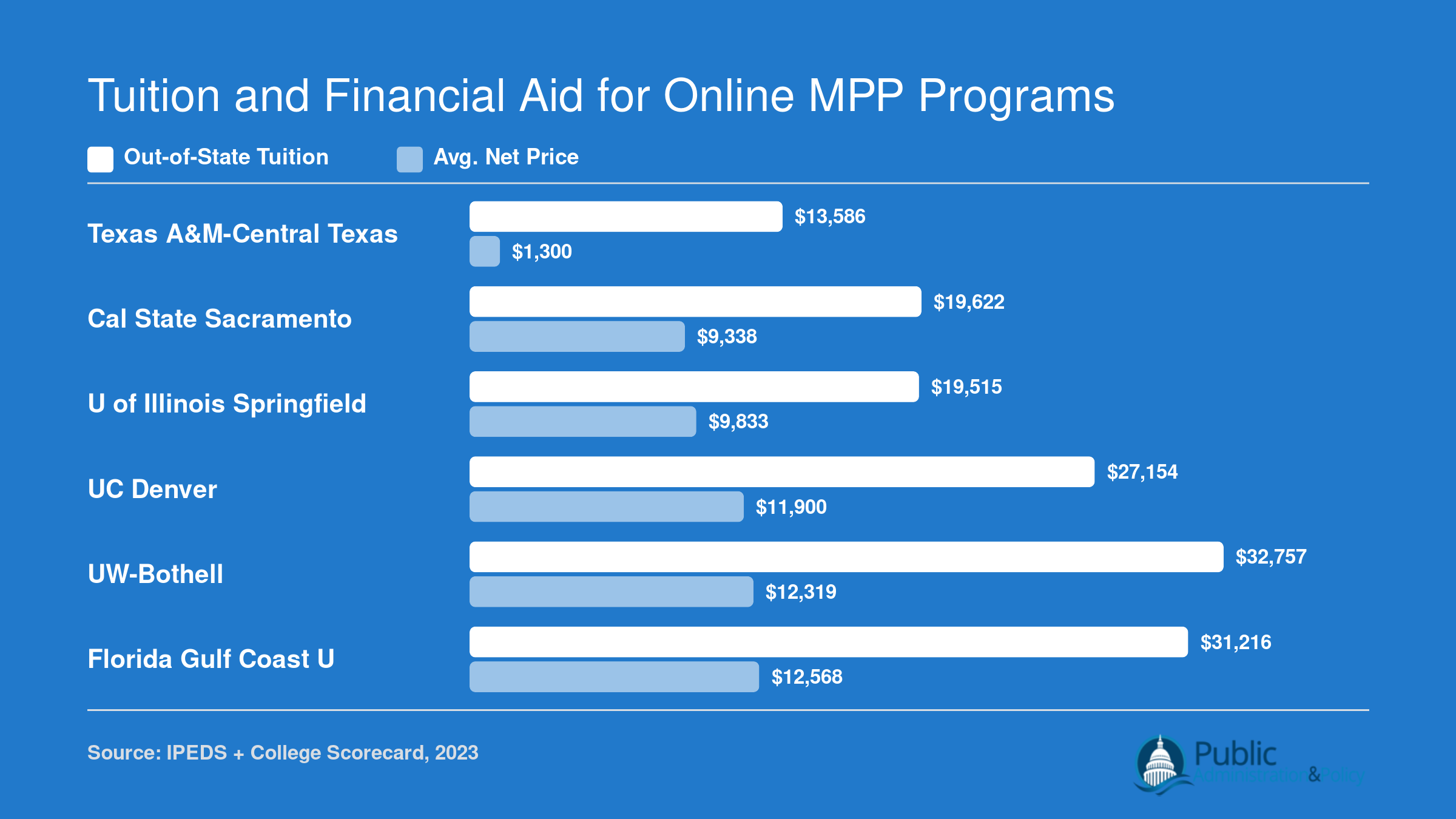
Because no Wisconsin university currently offers an online MPP, most Wisconsin students will pay out-of-state tuition rates at programs across the country. The chart below compares published out-of-state tuition alongside the institution-wide average net price for six of the most affordable online MPP programs in our rankings. Keep in mind that net price figures are university-wide averages reflecting all undergrad and graduate students; your actual cost will depend on your specific program, credit load, and financial aid package. To reduce costs, file the FAFSA to unlock federal loans and grants, ask your employer about tuition reimbursement, and look for programs that charge a flat tuition rate regardless of residency. Note that the Wisconsin Higher Education Grant applies only at in-state institutions, so it will not cover these out-of-state online programs.
NASPAA Accreditation: Which Online MPP Programs Have It and Why It Matters
NASPAA, the Network of Schools of Public Policy, Affairs, and Administration, serves as the specialized accrediting body for graduate programs in public administration, public policy, and public affairs. Think of it as the equivalent of AACSB accreditation for business schools. A NASPAA seal signals that a program meets rigorous standards for curriculum design, faculty qualifications, student learning outcomes, and mission alignment with public service values. For Wisconsin students weighing online MPP options from out-of-state universities, understanding which programs carry this credential can meaningfully shape career prospects.
How NASPAA Accreditation Works for Online Programs
NASPAA accredits at the program level, not the delivery mode.1 That means when a university holds NASPAA accreditation for its Master of Public Policy, the credential covers every format the school offers under that same degree, whether on campus, hybrid, or fully online. You do not need to hunt for a separate "online accreditation" designation.
That said, program delivery formats can change mid-cycle, and new online options sometimes launch before the next accreditation review.2 The most reliable way to confirm a program's current status is to consult NASPAA's roster of accredited programs or its searchable schools directory, both of which allow you to filter by degree type and online delivery.1 Cross-checking the program's own website is also a smart step, since third-party ranking sites are not authoritative sources for accreditation status.
Which Online MPP Programs Hold NASPAA Accreditation?
Because accreditation rosters update annually and online delivery options can shift between review cycles, we encourage readers to verify status directly through NASPAA's 2025-2026 roster of accredited programs.3 Among the universities commonly recognized for strong online MPP offerings, several hold NASPAA accreditation, including programs at schools like the University of Michigan, University of Southern California, American University, and the University of Massachusetts Amherst. Others, particularly newer or more interdisciplinary programs, may not yet appear on the roster. That does not automatically mean a program is lower quality; it may simply be too new for the multi-year accreditation timeline, or the institution may have chosen a different curricular framework that falls outside NASPAA's scope.
Why It Matters for Wisconsin Careers
Accreditation carries practical weight in the job market. Some federal agencies and certain state civil service systems, including positions within Wisconsin state government, may give preference to candidates who hold degrees from NASPAA-accredited programs. In competitive hiring pools for policy analyst, legislative staff, or program evaluation roles, that distinction can serve as a tiebreaker.
Before enrolling, consider these steps:
Check your target employer's requirements. If you plan to work in a specific agency or policy area, confirm whether the position description references NASPAA accreditation as preferred or required.
Verify directly with NASPAA. Use the schools search tool or the downloadable roster PDF, filtering for Master of Public Policy and online delivery options.1
Contact the program's admissions office. If a program's accreditation status is unclear online, a quick email can clarify whether the degree is accredited, in candidacy, or pursuing accreditation.
NASPAA accreditation is a valuable credential, but it is not the only marker of a strong program. If your career goals point to an employer or sector that does not specifically require it, weigh other factors like curriculum fit, faculty expertise, and alumni networks alongside accreditation status.
Admissions Requirements and How to Apply for an Online MPP
Applying to an online Master of Public Policy program is more straightforward than many Wisconsin students expect. Most schools use a holistic review process, which means your entire profile matters, not just a single test score or transcript line.1 Below is what you should prepare before you hit "submit."
Standard Application Materials
Nearly every online MPP program asks for the same core documents:
Official transcripts: A bachelor's degree from a regionally accredited institution is required. Most programs set a minimum GPA around 3.0 on a 4.0 scale, though a few, such as Eastern Illinois University's online MPP, accept applicants with a GPA as low as 2.75.3
Statement of purpose: This is your chance to connect your professional goals to the program's strengths. Admissions committees look for clear motivation, relevant experience, and an understanding of how policy analysis can advance your career.
Resume or CV: Highlight any public sector, nonprofit, or research experience. While no minimum work experience is formally required at most programs, real-world context strengthens your application.1
Letters of recommendation: Expect to submit two or three letters. Choose recommenders who can speak to your analytical abilities, leadership, or commitment to public service.
Writing sample: Some programs request one, but at many schools this is optional rather than mandatory.1
English proficiency scores: International applicants whose first language is not English will need to provide TOEFL, IELTS, or equivalent results.1
Application fees vary by institution, so check each school's portal for current amounts.
GRE Policies: A Shifting Landscape
The trend across online MPP programs in 2026 continues to move away from standardized test requirements. Many schools now waive the GRE entirely or offer a GRE-optional pathway, especially for applicants who bring professional experience or hold a graduate degree.1 A handful of programs still value strong GRE scores as part of their review (UMass Dartmouth, for instance, considers a high GRE score favorably), so verify each school's current policy before assuming you can skip it. Students researching online MPP programs Illinois will find similar GRE-optional trends at many of the same nationally available programs.
No Single "Right" Undergraduate Major
Admissions committees do not require a specific bachelor's degree discipline. Students enter online MPP programs from political science, economics, sociology, public health, STEM fields, and the humanities. Some programs recommend or prefer foundational coursework in statistics or economics, but these prerequisites can often be completed after admission or during your first semester.
Residency and On-Campus Requirements
Most top online MPP programs accessible to Wisconsin students are fully asynchronous, meaning you can complete every assignment, discussion, and exam from wherever you live. A small number of programs do include short immersion experiences, such as a weekend orientation or a capstone residency, so read the fine print carefully if your schedule or location makes travel difficult. If a fully remote experience is non-negotiable for you, prioritize programs that explicitly state no on-campus component is required.
Transfer Credits
If you have completed relevant graduate-level coursework elsewhere, many programs accept between six and twelve transfer credits. This can reduce both your time to degree and your total tuition bill. If you already hold a graduate degree, such as an online phd in public administration, some of that coursework may qualify. Contact each program's admissions office to confirm which courses are eligible before you apply.
Career Outcomes and Salaries for MPP Graduates in Wisconsin
Wisconsin offers a surprisingly robust job market for policy graduates, even though no in-state university currently offers an online MPP. The state capital in Madison anchors a dense cluster of government agencies, research organizations, and advocacy groups, while Milwaukee provides a second employment corridor rich in nonprofit and community development work. Earning your MPP online from a nationally recognized program positions you to compete effectively in both markets. For a broader look at careers in public policy, our career guide covers the full range of roles available to policy graduates.
Policy-Relevant Salaries in Wisconsin
Bureau of Labor Statistics wage data highlights strong earning potential across the occupations most commonly filled by MPP holders in Wisconsin:1
Political scientists (SOC 19-3094): The national median annual wage sits at approximately $139,380.2 Wisconsin employs a smaller number of professionals in this category, concentrated largely in Madison-area legislative support roles and university-affiliated research centers.
Management analysts (SOC 13-1111): These professionals, who frequently apply policy analysis skills in government and consulting settings, earn competitive wages in the state. Wisconsin employs thousands in this occupation across state agencies, health systems, and private firms.
Social and community service managers (SOC 11-9151): This occupation is especially relevant for MPP graduates drawn to direct program oversight in human services, housing, and public health. Wisconsin employers in this field span county government offices, United Way chapters, and community action agencies.
Wage data from BLS Occupational Employment and Wage Statistics tables provides state-level detail for these roles, and Wisconsin figures generally track within range of Midwest averages.1
Where MPP Graduates Work in Wisconsin
Madison's concentration of state government offices creates steady demand for policy analysts, budget specialists, and program evaluators. Key employers include:
Wisconsin Department of Health Services (DHS)
Wisconsin Department of Natural Resources (DNR)
Wisconsin Department of Administration (DOA)
Legislative Fiscal Bureau
Wisconsin Policy Forum, an independent research organization focused on state and local governance
Center on Wisconsin Strategy (COWS) at UW-Madison
Milwaukee and its surrounding counties add another layer of opportunity. The City of Milwaukee, Dane County government, Feeding Wisconsin, and national nonprofits with Wisconsin offices all recruit professionals trained in evidence-based policy analysis. Organizations working on housing, workforce development, and public administration careers in public health are especially active hirers.
What Graduates of Ranked Programs Actually Earn
Program-level earnings data from the federal College Scorecard is not yet available for the online MPP programs featured in our rankings. This means we cannot report specific one-year or four-year post-completion median salaries for graduates of programs such as those at Duke University, Drexel University, Pepperdine University, Binghamton University, or the University of Washington-Bothell. As the Department of Education publishes updated outcomes, publicadministrationpolicy.org will incorporate those figures.
In the meantime, the BLS occupation-level data above offers a reliable benchmark. MPP graduates who land management analyst or political scientist roles in Wisconsin can expect salaries that compare favorably with the cost of many online programs, particularly those at public universities with out-of-state tuition rates below $33,000.
Positioning Yourself in the Wisconsin Market
If you plan to work in Wisconsin after completing an online MPP, consider building connections during your program through virtual networking, internships with Wisconsin agencies, or capstone projects focused on state policy issues. Madison and Milwaukee employers value candidates who understand Wisconsin-specific challenges in areas like rural health care access, Great Lakes environmental policy, and workforce participation. An online MPP gives you the analytical toolkit; pairing it with local knowledge and relationships makes you a compelling hire.
Frequently Asked Questions About Online MPP Programs for Wisconsin Students
Wisconsin students frequently ask about online Master of Public Policy options, from program availability and accreditation to cost and career prospects. Below we answer the most common questions, drawing on details covered throughout this article.
Are there any online MPP programs based in Wisconsin?
As of 2026, no Wisconsin university offers a fully online Master of Public Policy degree. However, several nationally recognized programs from other states are open to Wisconsin residents and deliver coursework entirely online. Schools such as the University of Massachusetts Amherst, Northeastern University, the University of Colorado Denver, and the University of Northern Iowa all accept out-of-state students. See the section earlier in this article for a full explanation of why this gap exists and why it should not limit your options.
What is the difference between an MPP and an MPA degree?
An MPP focuses on policy analysis, quantitative research methods, and evidence-based decision making, preparing graduates to design and evaluate public policies. An MPA emphasizes organizational management, budgeting, and leadership within public agencies. If your goal is to analyze policy problems and advise decision makers, the MPP is typically the better fit. If you want to manage programs or lead agencies, consider an MPA. Our comparison section earlier in this article breaks down the key distinctions in detail.
Which online MPP programs are NASPAA accredited?
NASPAA (the Network of Schools of Public Policy, Affairs, and Administration) accredits select online MPP programs that meet rigorous standards for curriculum, faculty quality, and student outcomes. Not every online MPP carries this accreditation, so it is important to verify each program's status directly through NASPAA's database. Our accreditation section earlier in this article identifies which ranked programs hold NASPAA accreditation and explains why it matters for career competitiveness.
How much does an online Master of Public Policy cost?
Tuition for online MPP programs varies widely depending on the institution, residency status, and credit requirements. Programs in our ranking range from roughly 36 to 40 credits, and total costs can span from approximately $20,000 to over $60,000. Many schools offer financial aid, graduate assistantships, or employer tuition reimbursement options. Check our tuition and financial aid section for program-by-program cost comparisons and tips on reducing out-of-pocket expenses.
Do online MPP programs require on-campus residencies?
Most online MPP programs are designed for working professionals and do not require mandatory on-campus residencies. Some programs may offer optional in-person intensives, capstone presentations, or networking events, but these are generally not required for degree completion. Wisconsin students can typically earn their degree without traveling to the host campus. Always confirm residency requirements with your chosen program before enrolling.
What can you do with a Master of Public Policy degree in Wisconsin?
MPP graduates in Wisconsin pursue careers in state and local government, nonprofit organizations, healthcare systems, and research institutions. Common roles include policy analyst, legislative aide, program evaluator, and government affairs specialist. Wisconsin's state capital in Madison and its network of regional nonprofits create steady demand for policy-trained professionals. Our career outcomes section provides salary data and specific job paths relevant to the Wisconsin labor market.
How long does it take to complete an online MPP program?
Completion timelines depend on enrollment status and program structure. Full-time students can finish in as few as 18 months at Northeastern University, while part-time students at the University of Colorado Denver may take up to 30 months or longer, with a maximum window of 72 months. UMass Amherst and the University of Northern Iowa each estimate about 24 months. Most online MPP programs are built with flexible scheduling that allows working professionals to balance coursework with career obligations.
More Online MPP Programs Available to Wisconsin Students
Beyond the top-ranked programs, Wisconsin students have many other excellent online MPP options. The following directory lists additional programs from across the country that are fully available to you as a Wisconsin resident. Compare tuition, format, and curriculum to find the best fit for your career goals.
University of Northern Iowa
Offers a 36-credit online Master of Public Policy with synchronous Zoom sessions on Tuesday evenings. The cohort model enables full-time completion in two years, with tuition at $586 per graduate credit for 2025-26.
Part-time online Master of Public Policy designed for working professionals, emphasizing technical skills in policy analysis, research, and data-driven evaluation. Includes virtual live lectures and two on-campus immersions.
Online Master of Public Policy and Administration with concentrations in Public Management, Public Policy, and International Policy. Interdisciplinary curriculum blending theory with practical experience for public service leadership.
Hybrid Master of Public Policy through McGeorge School of Law, combining online coursework with in-person Saturday sessions. Offers concentrations in Environmental and Water Policy, Public Policy Advocacy, Non-Profit Management, and Local Government.
Blended Master of Public Administration and Policy (MPAP) with online and on-campus courses. Prepares students for policy analysis and municipal planning roles through core courses and a capstone fieldwork component.
Hybrid Master of Public Policy offering both online and on-campus options. Features Graduate Public Service Internships with paid government work and tuition waivers. No entrance exam required.
Hybrid Master of Public Policy with case study-driven curriculum. Flexible full-time or part-time study with completion in 18-24 months. Year-round admissions and no entrance exam required.
Hybrid Master of Public Policy allowing in-person or remote real-time attendance. 36-credit program with accelerated five-year option for undergraduates. Focus on policy design and evaluation.
Hybrid Master of Public Administration (MPA) designed for public service leadership. 36-credit curriculum blending policy analysis, organizational theory, budgeting, and ethical decision-making. Military-friendly.
Hybrid Master of Public Policy with online flexibility and in-person classes at Malibu or Washington DC track. 48-unit program with scholarships for over 95% of students. No GRE required.
University of Colorado Denver/Anschutz Medical Campus
Hybrid Master of Public Policy with online and on-campus options. 36-credit curriculum with concentrations in Education Policy, Environmental Policy, and more. No entrance exam required.
Fully online Master of Public Policy and Administration (MPPA) with concentrations in Urban Planning, Nonprofit Leadership, and Local Government. 36-credit program with thesis project and hands-on learning.
Hybrid Master of Public Policy and Management (MPPM) with concentrations in Community Planning and Sustainable Development or Public Policy and Public/Nonprofit Management. Reduced tuition for out-of-state students.
Hybrid Master of Public Policy & Administration (MPPA) blending policy analysis with public management. 56-credit program with flexible formats including online, in-person, and hybrid. No standardized tests required.
Hybrid Master of Science in Public and Urban Policy focusing on social inclusion and equity. Features Urban Policy Lab with client projects. Concentrations in Data Visualization and Global Urban Futures.