Best Online Master of Public Policy Programs in Mississippi for 2026

Compare costs, accreditation, and career outcomes for every Mississippi-based online MPP and MPPA option

By PublicAdministrationPolicyReviewed by PAP Editoral TeamUpdated May 16, 202610+ min read

Key Points

  • Mississippi State University's online MPPA is the state's primary NASPAA-accredited graduate policy program.
  • In-state tuition and flexible pacing let most working professionals finish in two to three years.
  • NASPAA accreditation strengthens competitiveness for federal GS-series analyst and program evaluation positions.
  • Graduates pursue leadership roles across Mississippi state agencies, nonprofits, and federal offices.

Mississippi ranks among the states with the most acute workforce gaps in rural health administration, K-12 policy leadership, and emergency management, yet only one university currently offers a fully online graduate degree specifically in public policy: Mississippi State University's NASPAA-accredited Master of Public Policy and Administration. That narrow field simplifies the search but raises the stakes. Choosing the right program structure, understanding true costs (in-state tuition starts at roughly $10,200 per year), and confirming that a 42-credit-hour curriculum aligns with your career trajectory all matter more when alternatives are scarce.

For working professionals rooted in the state, the practical tension is clear: demand for policy-trained talent in Jackson, the Delta, and coastal counties is rising, while local graduate options remain limited. Students weighing a broader administration focus can also explore online MPA programs in Mississippi, but employer expectations around NASPAA credentials and quantitative skills like program evaluation continue to tighten, particularly for state agency and federal roles.

Ranked: Best Online MPP and MPPA Programs in Mississippi

Mississippi offers a limited but focused landscape for online public policy graduate education. The ranking below reflects programs filtered specifically for online delivery and ordered by a composite of institutional quality indicators, including net price, graduation rate, and available earnings data. Because only one institution currently offers an online MPP or MPPA degree in the state, Mississippi State University stands alone as the top option for students seeking a fully online, NASPAA-accredited pathway into public policy and administration careers across the state and region.

Factors considered
  • Net price after financial aid
  • Institution-wide graduation rate
  • Graduate earnings where available
  • NASPAA accreditation status
  • Online delivery confirmation
Data sources
  • Internal program database
  • Independent program research
  • NCES-IPEDS federal institutional data — nces.ed.gov

Mississippi State University

#1

Mississippi State, MS · $18,000/yr

Best for: Working professionals seeking NASPAA-accredited online study

Mississippi State University's MPPA is the only NASPAA-accredited, fully online public policy graduate program based in Mississippi, making it the clear frontrunner for in-state and regional learners. The university enrolls students from all corners of Mississippi and many other states, with a mission explicitly tied to strengthening the professional public service workforce in the state and broader region. With an institution-wide graduation rate of approximately 66.7% and a student-to-faculty ratio of 16:1, MSU delivers a research-university experience at a price point that remains competitive, especially for in-state students. Note that the graduation rate cited is an institution-wide figure and not specific to the MPPA program.

  • 42-credit-hour program available fully online or on campus
  • 27 hours of core coursework in policy analysis and budgeting
  • 12 hours of elective concentration courses tailored to career goals
  • Synchronous evening classes, Monday through Thursday, 6 to 8:50 PM CST
  • 3-hour internship requirement, waivable with relevant work experience
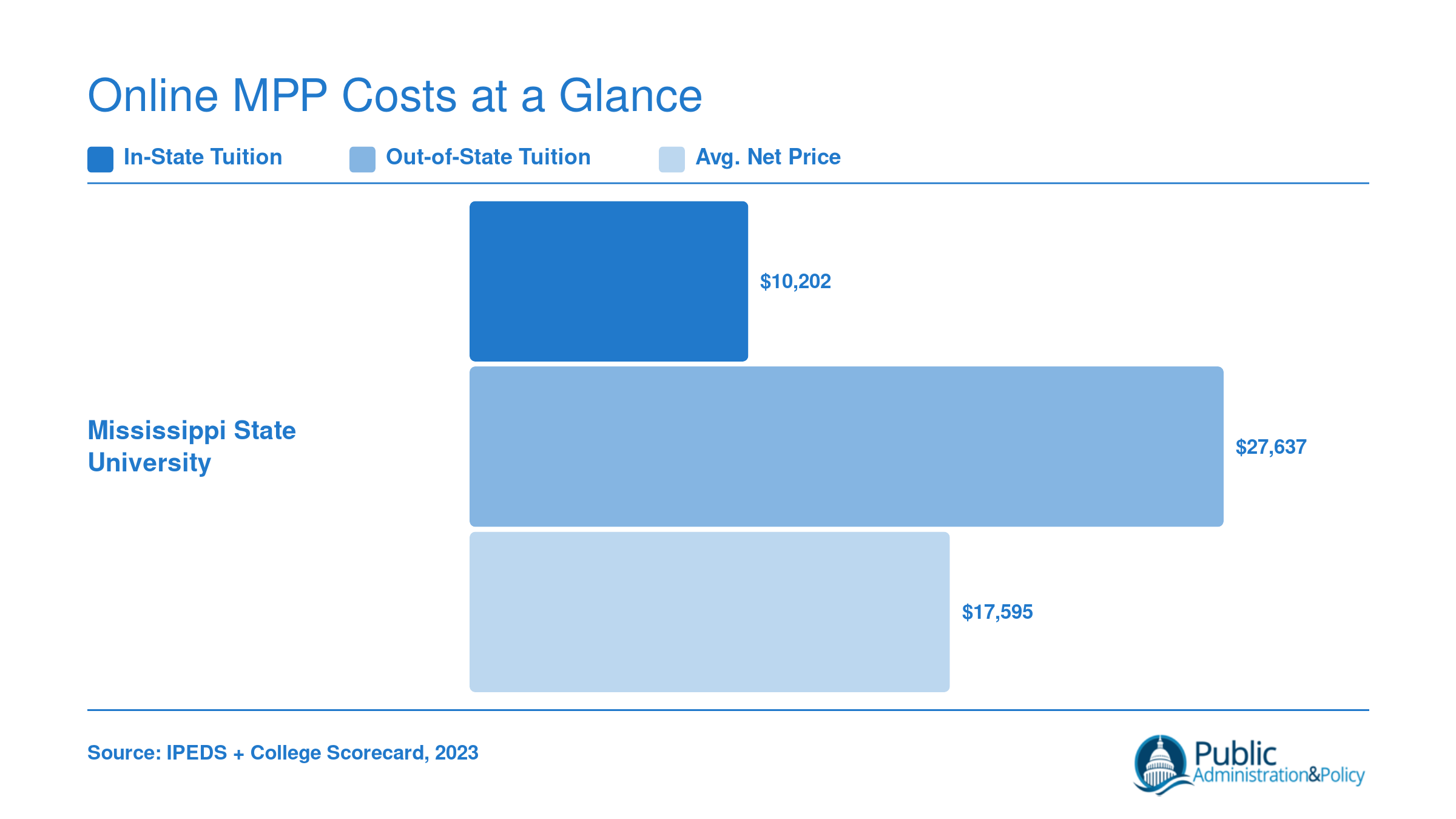
  • In-state tuition approximately $10,202; out-of-state approximately $27,637
  • NASPAA accredited with faculty who bring real government experience
  • Integrative capstone course ties together core and elective learning

MPP vs. MPA vs. MPPA: Which Mississippi Degree Fits Your Goals?

If you are exploring graduate programs in public policy and administration in Mississippi, three degree abbreviations will keep surfacing: MPP, MPA, and MPPA. Each prepares you for public service, but they differ in emphasis, skill sets, and the career doors they open.1 Understanding those differences is especially important in Mississippi, where the most prominent in-state online option, Mississippi State University's Master of Public Policy and Administration, deliberately blends elements of two of these models.

Master of Public Policy (MPP)

The MPP is the most analytically intensive of the three. Coursework centers on statistics, econometrics, cost-benefit analysis, program evaluation, and policy modeling.1 Graduates tend to work behind the scenes, producing the research and data that inform decisions rather than managing the organizations that carry them out.

In a Mississippi context, an MPP skillset maps well to roles such as state legislative analyst in Jackson, research staff at a regional think tank, or evaluation specialist for a federally funded program operating across the Delta. If you enjoy crunching numbers and translating findings into actionable recommendations, a policy analyst career path is the lane to explore.

Master of Public Administration (MPA)

The MPA tilts toward leadership and organizational management. Expect coursework in budgeting, human resources, strategic planning, and implementation.1 The degree is designed for professionals who want to run agencies, departments, or nonprofit organizations.

Mississippi career paths for MPA holders include city or county manager positions, nonprofit executive director roles, and agency directors at the state level. If your energy comes from building teams, balancing budgets, and steering organizations toward their missions, the MPA is a natural fit. For a deeper look at the field, our overview of public administration careers breaks down what to expect.

Master of Public Policy and Administration (MPPA)

The MPPA sits squarely between the other two. It pairs the analytical rigor of a policy degree with the management toolkit of an administration degree. Mississippi State's online MPPA program is the most visible in-state option and reflects this hybrid philosophy.2 The program emphasizes leading and managing in the public interest, participating in the policy process, evidence-informed decision making, and effective communication.

On the MPP-to-MPA spectrum, Mississippi State's MPPA lands near the center, giving graduates enough quantitative training to interpret data and evaluate programs while also preparing them to lead teams and manage budgets. Typical career outcomes include program or department leadership positions at the national, state, and local levels of government: roles where you both shape policy and oversee its implementation.2

How to Self-Select

A quick decision framework can help you narrow the field:

  • You want to analyze: If your ideal workday involves datasets, regression models, and writing policy briefs, lean toward a pure MPP.
  • You want to manage: If you see yourself running an agency, directing a nonprofit, or overseeing a city department, an MPA aligns with those goals.
  • You want both: If you picture yourself as an agency program manager who also contributes to policy design, or a policy advisor who leads a team, the MPPA path offers that dual preparation.

Keep in mind that other Mississippi institutions may offer related graduate degrees in political science or public administration, but Mississippi State's MPPA stands out as the most clearly branded online option that merges policy analysis with administrative skill-building. Before committing, review the specific curriculum of any program you are considering to confirm it emphasizes the side of public service, analytical or managerial, that matches your professional ambitions.

Questions to Ask Yourself

An MPP emphasizes policy analysis, research methods, and quantitative skills, while an MPA or MPPA leans toward organizational leadership and public management. Clarifying your day-to-day career vision helps you pick the degree that builds the right skill set.

Some Mississippi state agencies and nonprofits tie tuition assistance to particular degree titles or accreditation standards. Confirming reimbursement eligibility before you enroll can save thousands of dollars and prevent mid-program surprises.

Certain federal positions and competitive fellowships give preference to graduates of NASPAA-accredited programs. If those career paths are on your radar, accreditation status should weigh heavily in your program comparison.

Program Cost Comparison and Financial Aid Options

Understanding the true cost of an online MPP or MPPA in Mississippi means looking beyond the sticker price. Below, we break down tuition rates, estimate total program costs, and outline financial aid strategies that can significantly reduce your out-of-pocket expense.

Tuition Rates for Mississippi Graduate Policy Programs

Mississippi State University's online MPPA charges a flat rate of $606 per credit hour for the 2025-2026 academic year, which includes $581 in tuition and required fees plus a $25 instructional support fee per credit.1 All online students pay the same rate regardless of residency, so out-of-state learners are not penalized.1 The university's published undergraduate and institution-wide figures (annual in-state tuition of approximately $10,202 and out-of-state tuition of roughly $27,637) apply to on-campus undergraduates and should not be confused with the per-credit online graduate rate. The institution-wide average net price, reported at around $17,595, reflects a broad institutional average across all programs and student levels. It is not a guaranteed quote for any individual graduate student.

Belhaven University offers an online MPA that is sometimes considered alongside Mississippi's policy-focused degrees. Per-credit rates for Belhaven's graduate programs have historically hovered in the mid-$500 range, though prospective students should confirm current pricing directly with the university, as published rates can shift year to year. For a deeper comparison of online MPA programs in Mississippi, see our dedicated MPA guide. The University of Mississippi (Ole Miss) does not currently offer a fully online MPP or MPA, though it maintains several policy-adjacent graduate certificates and programs. Verify the latest offerings and tuition schedules through Ole Miss's graduate school.

Estimating Your Total Program Cost

Mississippi State's MPPA requires 42 credit hours. At $606 per credit, the estimated tuition total comes to approximately $25,452 before any institutional fees assessed per semester (technology fees, for example, may apply separately). How quickly you finish affects indirect costs like opportunity cost and fee assessments:

  • Full-time pace (about two years): Expect roughly $25,452 in tuition spread across four to five semesters, plus any per-semester fees.
  • Part-time pace (three to four years): The per-credit rate remains the same, but you will pay per-semester fees over more terms, potentially adding several hundred dollars to the overall total.

For a Belhaven MPA, total costs will depend on the program's required credit hours and current per-credit rate, so request an itemized cost sheet from the admissions office.

Financial Aid and Tuition Assistance

Several funding avenues can reduce the burden of graduate tuition in Mississippi.

The FAFSA is the essential starting point for any graduate student. Filing opens the door to federal Direct Unsubsidized Loans and, for those who qualify, Graduate PLUS Loans. While loans are not free money, they offer lower interest rates and more flexible repayment options than private alternatives.

Mississippi's State Employee Tuition Reimbursement program, administered through the Mississippi State Personnel Board, allows eligible state employees to receive reimbursement for coursework related to their job duties. Reimbursement is subject to annual caps and requires prior approval, so state workers considering an MPPA or MPA should coordinate with their agency's human resources office well before the semester begins to confirm that the degree qualifies.

Graduate assistantships at Mississippi State can offset tuition substantially, though availability for fully online students is more limited than for on-campus peers. Contact the Department of Political Science and Public Administration directly to ask about remote assistantship possibilities.

Many Mississippi public-sector employers, including county and municipal governments, offer their own tuition-assistance programs. Organizations such as the Mississippi Municipal League and the Mississippi Association of Supervisors periodically publicize professional development funding. Private-sector employers in healthcare, utilities, and defense contracting (all significant industries in the state) frequently provide tuition benefits as well.

Scholarships and Fellowships Worth Exploring

While dedicated MPP or MPPA scholarships in Mississippi are limited, a few options deserve attention:

  • Mississippi State Graduate School scholarships: Open to all admitted graduate students based on academic merit.
  • Pi Alpha Alpha honor society awards: Available to graduate students in NASPAA-accredited programs who demonstrate strong academic performance and public service commitment.
  • Professional association grants: Groups such as the American Society for Public Administration (ASPA) occasionally fund graduate study in public affairs.

When you combine a competitive per-credit rate, state employee reimbursement, federal aid, and even modest scholarship support, the total out-of-pocket cost for an online MPPA in Mississippi can land well below the $25,000 tuition estimate. The key is to layer multiple funding sources and confirm eligibility early in the application process.
How Long Does an Online MPP Take in Mississippi?

One of the most common questions prospective students ask is how quickly they can finish a graduate policy degree while balancing a career, family, or both. The answer depends on your credit load each semester, whether you qualify for any accelerated pathways, and whether a capstone or practicum is part of your plan.

Typical Full-Time and Part-Time Timelines

Mississippi State University's online MPPA requires 42 credit hours, which is slightly above the national range of 36 to 42 credits for most MPP and MPPA programs.1 At a full-time pace of roughly 10 to 12 credits per semester (three to four courses), students can expect to finish in about two years, or four academic semesters. Part-time students who take two courses per semester typically complete the degree in three to four years, depending on whether they enroll during summer terms.

Because the program delivers coursework through synchronous evening sessions, it is structured with working professionals in mind.2 Most online cohorts assume that students are employed full-time and will enroll in two to three courses each semester, a pace that keeps workload manageable without stretching the timeline unnecessarily. Students weighing the MPPA against a related mpa ms degree should note that program lengths are comparable, though curriculum emphasis differs.

Accelerated Pathways and Credit Savings

Mississippi State offers an accelerated pathway designed for qualifying undergraduates. Through this option, students can double-count up to nine credit hours toward both their bachelor's degree and the MPPA.1 That effectively reduces the graduate credit requirement from 42 to 33 hours, potentially shaving a full semester off the timeline. If you are still completing your undergraduate degree or recently graduated, this pathway is worth exploring during the admissions process.

Summer enrollment is another lever for shortening your time to graduation. Students who add one or two courses during the summer session each year can compress a part-time timeline considerably.

Capstone and Practicum Considerations

Graduate programs in public policy commonly require a capstone project, a practicum placement, or both. These components allow you to apply analytic skills to a real policy challenge, but they also require scheduling and, in some cases, coordination with a host agency. If your program includes a practicum, plan for it early. Students who leave the practicum to their final semester sometimes encounter delays when placement logistics take longer than expected.

For working professionals already embedded in a government agency or nonprofit, the practicum can often be completed within your current organization, which simplifies scheduling and may even accelerate the experience.

Planning Your Personal Timeline

Before enrolling, map out a realistic semester-by-semester plan. Consider the following factors:

  • Credit load per term: Two courses per semester is sustainable for most full-time workers; three courses speeds things up but demands significant evening and weekend study time.
  • Summer enrollment: Adding summer terms can cut six months or more from your total timeline.
  • Accelerated undergraduate pathway: If eligible, the nine-credit overlap meaningfully shortens the degree.
  • Practicum or capstone sequencing: Confirm prerequisites so you are not waiting an extra semester to begin your culminating project.

Most students in Mississippi's online MPPA programs graduate in two to three years. The flexibility of the online format means you can adjust your pace from semester to semester as your professional and personal responsibilities shift, a practical advantage that traditional on-campus cohorts rarely offer.

NASPAA Accreditation and What It Means for Your Career

When evaluating online MPP or MPPA programs in Mississippi, accreditation should be near the top of your checklist. The Network of Schools of Public Policy, Affairs, and Administration (NASPAA) serves as the global accreditor for graduate programs in public policy, public administration, and public affairs.1 Think of it as the equivalent of AACSB accreditation for business schools: it is the recognized gold standard that signals a program meets rigorous peer-reviewed quality benchmarks in curriculum design, faculty qualifications, and student outcomes.

Which Mississippi Programs Hold NASPAA Accreditation?

Among the Mississippi institutions offering relevant online graduate degrees, Mississippi State University's Master of Public Policy and Administration (MPPA) program holds NASPAA accreditation. This distinction places it in a select group of programs nationwide that have undergone comprehensive external review and met NASPAA's standards for excellence. Belhaven University, which offers an online MPA programs in Mississippi, does not currently hold NASPAA accreditation. That does not necessarily make the program a poor choice, but prospective students should weigh the difference carefully, particularly if they plan to pursue federal employment.

Why Accreditation Matters for Your Career

NASPAA accreditation carries practical weight in the job market, especially in government. The U.S. Office of Personnel Management (OPM) oversees classification standards for federal job series in public administration, and certain positions list a degree from a NASPAA-accredited program as a preferred or qualifying credential. Mississippi state agencies and regional organizations may similarly view NASPAA accreditation favorably when screening candidates.

As NASPAA itself notes, accreditation provides a "quality and reliability signal" that helps employers, students, and the public identify programs committed to preparing graduates for meaningful careers in public service.2 For students investing time and tuition in a graduate degree, that external validation can open doors that might otherwise require additional credentialing or experience.

Practical Considerations

Before enrolling, consider these accreditation-related factors:

  • Federal career goals: If you plan to apply for federal positions in policy analysis, program evaluation, or management, a NASPAA-accredited degree may give you a competitive edge or satisfy qualification requirements.
  • Credential portability: NASPAA accreditation is recognized nationally and internationally, which matters if your career takes you beyond Mississippi.
  • Program quality assurance: Accredited programs must participate in regular self-study and peer review, ensuring the curriculum stays current with evolving public sector demands.

If your career aspirations include federal or state government service, prioritizing a NASPAA-accredited program like Mississippi State's MPPA is a strategic decision that can pay dividends throughout your career.

Curriculum, Coursework, and Mississippi Policy Focus Areas

Graduate programs in public policy and public policy administration in Mississippi are designed to build a rigorous analytical toolkit while giving students the flexibility to engage with challenges unique to the state. Whether you enroll in a Master of Public Policy and Administration (MPPA) or a closely related MPP track, expect a curriculum that balances quantitative rigor with real-world application.

Core Coursework You Can Expect

Most programs share a common foundation that prepares graduates to evaluate, design, and implement public policy at every level of government. Typical core courses include:

  • Policy Analysis: Frameworks for assessing the costs, benefits, and trade-offs of proposed and existing policies.
  • Statistics and Quantitative Methods: Applied research design, regression analysis, and data interpretation for evidence-based decision-making.
  • Economics for Policy: Microeconomic and macroeconomic principles as they relate to market failures, public goods, and government intervention.
  • Public Budgeting and Finance: Revenue forecasting, expenditure analysis, and the politics of resource allocation in state and local government.
  • Ethics in Public Service: Professional standards, accountability structures, and the ethical dilemmas that arise in governance.

Together, these courses ensure that graduates can move between technical analysis and the political realities of policymaking.

Mississippi-Specific Electives and Concentrations

What sets a Mississippi-based program apart is the opportunity to align elective coursework with the state's most pressing policy needs. Mississippi State University's MPPA program, for example, allows students to tailor elective selections toward areas that reflect the state's distinctive landscape. Common focus areas include:

  • Rural Health Policy: Mississippi consistently faces some of the nation's most acute rural health care shortages, making this a critical area of study for students interested in health systems and access.
  • Education Equity: Persistent gaps in educational funding and outcomes across the state provide a rich context for policy research and program evaluation.
  • Disaster and Emergency Management: With recurring exposure to hurricanes, flooding, and other natural disasters, Mississippi offers a natural laboratory for studying resilience planning, FEMA coordination, and community recovery.
  • Economic Development in the Delta: The Mississippi Delta region presents complex, intergenerational economic challenges that call for innovative workforce, housing, and infrastructure policy.

Students in Mississippi State's MPPA can often select electives from related departments, including political science, sociology, and agricultural economics, to build a concentration that matches their career interests. Those drawn to Delta-focused economic challenges may also find value in exploring what a community development specialist does professionally.

Experiential Learning and Capstone Opportunities

Coursework alone does not fully prepare you for the demands of public service. Mississippi programs recognize this by integrating hands-on components into the curriculum. Mississippi State's MPPA includes a capstone experience that can take the form of a comprehensive research project, a policy memo, or applied work tied to a state or local agency. Some students have completed capstone projects in partnership with Mississippi government offices, nonprofits, or regional planning organizations.

Internship and practicum opportunities, while not always required for online students, are strongly encouraged. Working professionals already embedded in Mississippi agencies may be able to use their current roles to fulfill experiential requirements, turning day-to-day responsibilities into structured learning. For students not yet working in government, placements with state legislative offices, the Mississippi Department of Health, emergency management agencies, or Delta-focused nonprofits can provide direct exposure to the policy process.

This combination of analytical training, state-relevant specialization, and applied experience means graduates leave these programs ready to tackle the issues that matter most to Mississippi communities.

Career Outcomes for MPP Graduates in Mississippi

A graduate degree in public policy or public policy and administration opens doors to a range of leadership and analytical roles across Mississippi's public, nonprofit, and federal sectors. Understanding what you can earn and where you can work helps you weigh the return on your investment before committing to a program.

What Can You Expect to Earn?

Program-level earnings data for the Mississippi State University MPPA are not yet available through federal reporting, so we turn to Bureau of Labor Statistics Occupational Employment and Wage Statistics for the most reliable salary benchmarks in the state.

  • Political scientists and policy analysts (SOC 19-3094): The median annual wage in Mississippi hovers near $67,000, with earners at the 75th percentile reaching approximately $82,000. These roles are concentrated in the Jackson metropolitan area, where state government agencies cluster, though some positions exist at federal installations in southern Mississippi.
  • Top executives and public administration managers (SOC 11-1011): Mississippi's median wage for this group sits around $88,000, with the 75th percentile exceeding $120,000. Metro areas like Jackson and Gulfport-Biloxi offer the highest concentrations.
  • Social and community service managers (SOC 11-9151): The statewide median is roughly $60,000, climbing to about $73,000 at the 75th percentile. Rural regions and the Delta rely heavily on professionals in these roles to manage health, housing, and workforce programs.

Salaries in the Jackson MSA generally run 10 to 15 percent higher than in rural parts of the state, reflecting cost-of-living differences and the density of government positions near the Capitol.

Where MPP and MPPA Graduates Work in Mississippi

Mississippi's public sector is a primary employer, but opportunities extend well beyond state government. For a broader look at public administration jobs, the field spans federal, nonprofit, and private-sector employers. Key employers in Mississippi include:

  • State agencies: The Mississippi Department of Employment Security (MDES), Mississippi State Department of Health (MSDH), and Mississippi Department of Education (MDE) regularly hire analysts, evaluators, and program managers.
  • Federal installations: Stennis Space Center and Keesler Air Force Base both support civilian policy, logistics, and community liaison roles that align with MPP training.
  • Nonprofits and advocacy organizations: Groups focused on education equity, public health, and economic development across the Delta and Gulf Coast recruit graduates for grant management, community engagement, and research positions.
  • Regional planning commissions: Bodies such as the Central Mississippi Planning and Development District coordinate infrastructure, housing, and disaster resilience projects that demand policy expertise.

Common Job Titles for Graduates

The skill set you develop in an MPP or MPPA program, spanning quantitative analysis, program evaluation, budgeting, and policy writing, maps onto a variety of positions:

  • Legislative analyst
  • Program evaluator
  • Budget analyst
  • Grant manager
  • Community development specialist
  • Research and policy associate

If roles like public budget analyst or grant administrator interest you, dedicated career guides can help you understand the day-to-day responsibilities and advancement paths. Many of these titles appear at every level of government, from municipal offices in Hattiesburg or Meridian to federal agencies based along the Gulf Coast.

Building a Career Path in Mississippi

Mississippi faces persistent challenges in health outcomes, educational attainment, and economic mobility, which means demand for trained policy professionals remains strong. Graduates who combine their degree with field experience (such as the internship component in Mississippi State's 42-hour MPPA program) position themselves for mid-career advancement into director-level or chief-of-staff roles within five to seven years. If you already work in a public or nonprofit setting, completing the degree online allows you to apply coursework to real projects immediately, making you a stronger candidate for promotion without relocating.

Admissions Requirements and Tips for Working Professionals

Getting into an online MPP or MPPA program in Mississippi is more straightforward than many prospective students expect, especially for those who bring meaningful professional experience to the table. Still, understanding what admissions committees look for, and knowing how to present your strongest case, can make the difference between a smooth acceptance and a frustrating wait.

Typical Admissions Requirements

Most online MPP and MPPA programs in Mississippi share a common set of application components:

  • Minimum GPA: A cumulative undergraduate GPA of 3.0 on a 4.0 scale is the standard benchmark. Some programs will consider applicants with slightly lower GPAs if other parts of the application are strong, particularly work history.
  • GRE scores: This is where things have shifted considerably. Several Mississippi programs have moved to GRE-optional or GRE-waiver policies, especially for applicants with substantial professional experience (often three or more years). If you are wondering whether you need to take the GRE, check the specific program page carefully. In many cases, mid-career professionals can bypass the exam entirely.
  • Statement of purpose: Expect to write a personal essay outlining your career goals, your interest in public policy, and how the degree fits into your professional trajectory.
  • Letters of recommendation: Two to three letters are standard. At least one should come from a professional supervisor or colleague who can speak to your analytical abilities and leadership potential.
  • Resume or CV: Programs want to see your career arc, including government, nonprofit, military, or private-sector roles that connect to policy work.

Who Is in the Online Cohort?

If you picture a typical online MPPA or MPP classroom in Mississippi, you will find mid-career professionals averaging three to five years of work experience. Many come from state and local government agencies, nonprofit organizations, military service, or healthcare administration. This peer group is one of the program's greatest assets, because classmates bring real policy challenges into discussions and group projects. If you are also weighing a more administration-focused track, our guide to mpa ms options covers programs that overlap significantly with MPP curricula.

Strengthening a Borderline Application

If your undergraduate GPA falls below 3.0 or you are switching careers from an unrelated field, there are concrete steps you can take:

  • Secure strong professional references from supervisors who can attest to your analytical skills and leadership.
  • Craft a statement of purpose that frames your career narrative around policy relevance. Even work in operations, budgeting, or community outreach translates well.
  • Highlight any graduate-level coursework, professional certifications, or training programs that demonstrate your readiness for rigorous academic work.
  • Some programs allow conditional admission with the expectation that you maintain a specific GPA during your first semester.

Balancing Coursework with a Full-Time Job

Online programs in Mississippi are designed with working adults in mind, but intentional planning still matters. Consider these practical strategies:

  • Block dedicated study time on your calendar each week, treating it as non-negotiable.
  • Communicate with your supervisor early. Many government agencies and nonprofits in Mississippi offer tuition assistance or flexible scheduling for employees pursuing graduate degrees.
  • Take advantage of employer tuition reimbursement programs. The Mississippi State Employee Tuition Reimbursement Program and similar benefits through federal agencies or military branches can significantly offset costs.
  • Start with one or two courses per semester if you are unsure about the workload, then scale up once you have a rhythm.

The common thread among successful online MPP students is not a perfect transcript. It is the ability to connect professional experience to academic goals and to plan realistically for the demands of graduate study alongside a career.

Frequently Asked Questions About Online MPP Programs in Mississippi

Prospective students frequently have questions about program format, cost, and career value before committing to a graduate degree. Below are direct answers to the most common questions about online MPP and MPPA programs available in Mississippi.

An MPP (Master of Public Policy) emphasizes policy analysis, research methods, and quantitative evaluation, preparing graduates to design and assess public policies. An MPA (Master of Public Administration) focuses more on organizational management, budgeting, and leadership within government agencies. Mississippi State University offers an MPPA (Master of Public Policy and Administration) that blends both disciplines, giving students exposure to policy analysis and administrative practice in a single program.

Mississippi State University's Master of Public Policy and Administration (MPPA) program holds NASPAA accreditation, which is the gold standard for graduate programs in public affairs. NASPAA accreditation signals that the curriculum, faculty qualifications, and student outcomes meet rigorous national standards. If accreditation matters to your career goals, particularly for federal employment or competitive fellowships, prioritize NASPAA-accredited options when evaluating Mississippi programs.

Most online MPP or MPPA programs in Mississippi require around 40 credit hours and can be completed in approximately two years of full-time study. Part-time students who take one or two courses per semester should expect a timeline closer to three to four years. Accelerated options or summer enrollment may shorten the path, so check with your program for specific scheduling flexibility.

Total tuition for an online MPP or MPPA in Mississippi generally falls between roughly $15,000 and $30,000, depending on residency status and fee structures. Mississippi State University's MPPA is competitively priced relative to national averages for NASPAA-accredited programs. Be sure to factor in technology fees, textbooks, and any required on-campus residency components when calculating your full investment.

Yes. Mississippi's online MPP and MPPA programs are structured with working professionals in mind. Courses are typically delivered asynchronously, allowing you to complete lectures and assignments on your own schedule. Many students maintain full-time employment throughout the program by enrolling part-time. Some programs may include occasional synchronous sessions or brief residency requirements, so confirm the schedule expectations before enrolling.

An MPP or MPPA opens doors to roles such as policy analyst, program evaluator, legislative aide, budget analyst, and nonprofit director. In Mississippi, graduates find opportunities with state agencies, the Mississippi Legislature, federal offices, regional nonprofits, and healthcare organizations. The degree also supports advancement for professionals already working in government or community development who want to move into leadership or analytical positions.

GRE requirements vary by program. Mississippi State University's MPPA program has historically offered GRE waivers for applicants who meet certain criteria, such as holding a minimum undergraduate GPA or relevant professional experience. Policies can change from year to year, so contact the admissions office directly for the most current requirements. Programs that waive the GRE often place greater weight on professional references and a statement of purpose.

Recent Articles